Back to Integrations
integrationAirtable node
integrationGoogle Sheets node

Airtable and Google Sheets integration

Save yourself the work of writing custom integrations for Airtable and Google Sheets and use n8n instead. Build adaptable and scalable Data & Storage, and Productivity workflows that work with your technology stack. All within a building experience you will love.

How to connect Airtable and Google Sheets

  • Step 1: Create a new workflow
  • Step 2: Add and configure nodes
  • Step 3: Connect
  • Step 4: Customize and extend your integration
  • Step 5: Test and activate your workflow

Step 1: Create a new workflow and add the first step

In n8n, click the "Add workflow" button in the Workflows tab to create a new workflow. Add the starting point – a trigger on when your workflow should run: an app event, a schedule, a webhook call, another workflow, an AI chat, or a manual trigger. Sometimes, the HTTP Request node might already serve as your starting point.
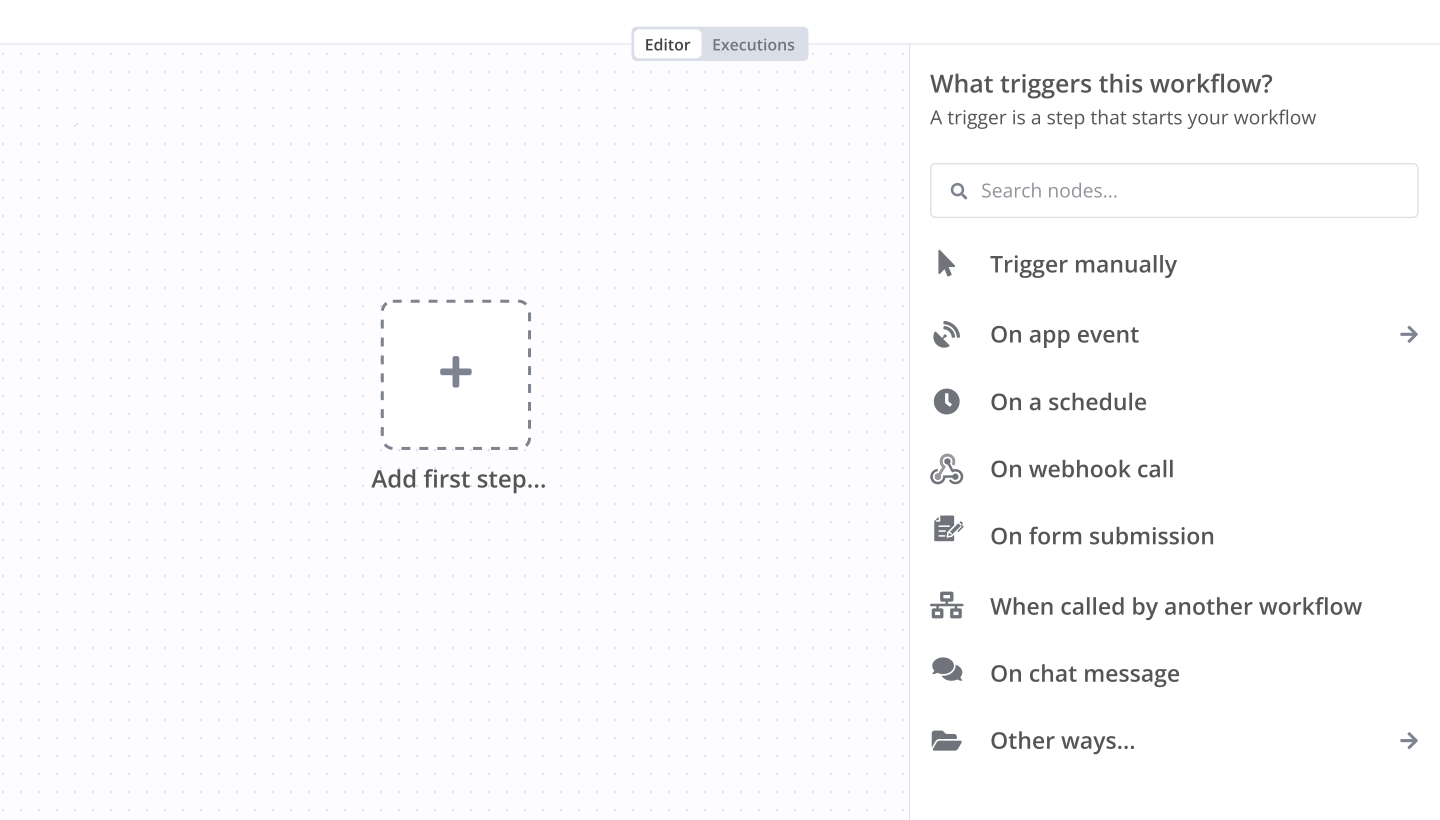
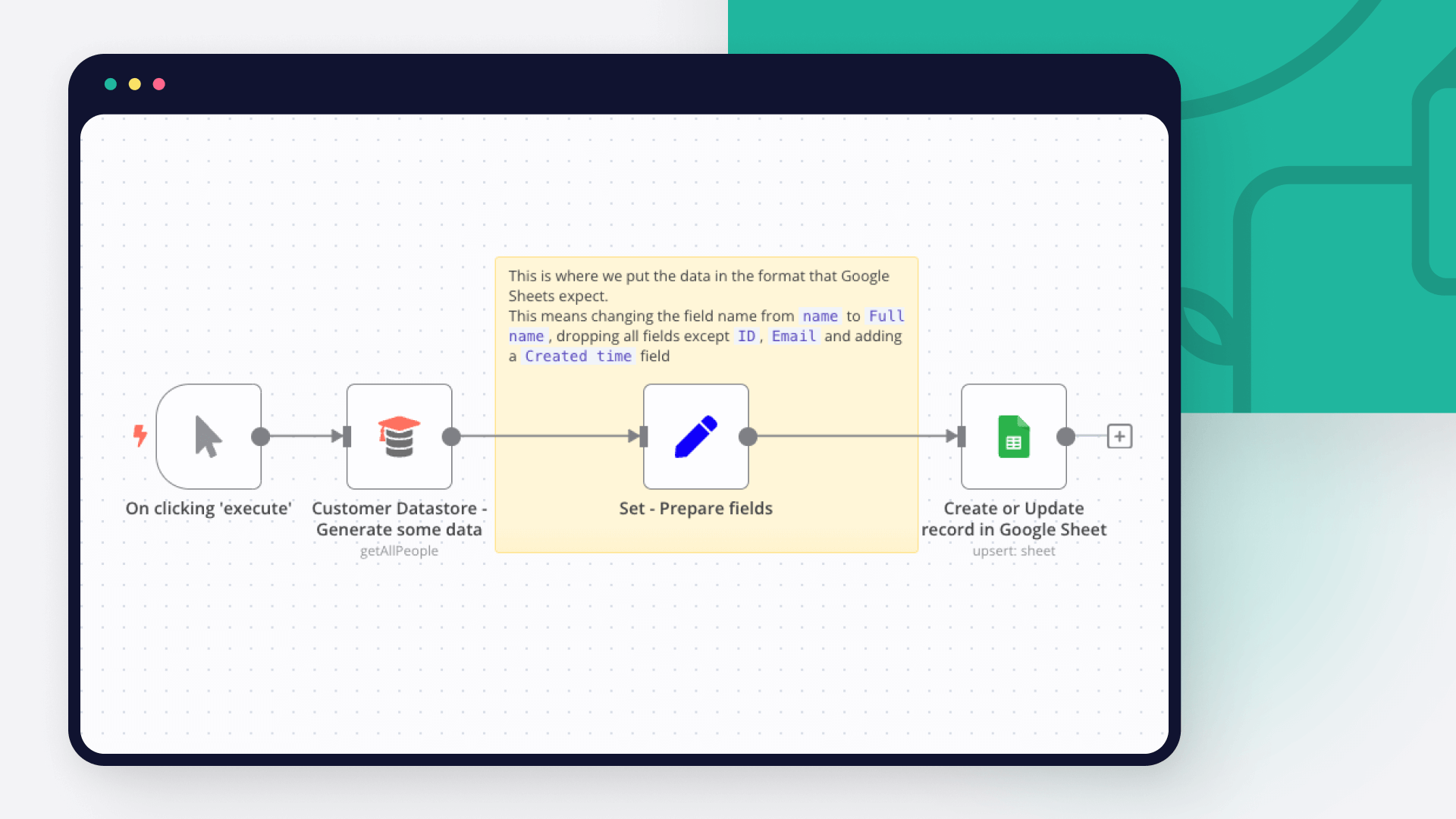
Airtable and Google Sheets integration: Create a new workflow and add the first step

Step 2: Add and configure Airtable and Google Sheets nodes

You can find Airtable and Google Sheets in the nodes panel. Drag them onto your workflow canvas, selecting their actions. Click each node, choose a credential, and authenticate to grant n8n access. Configure Airtable and Google Sheets nodes one by one: input data on the left, parameters in the middle, and output data on the right.

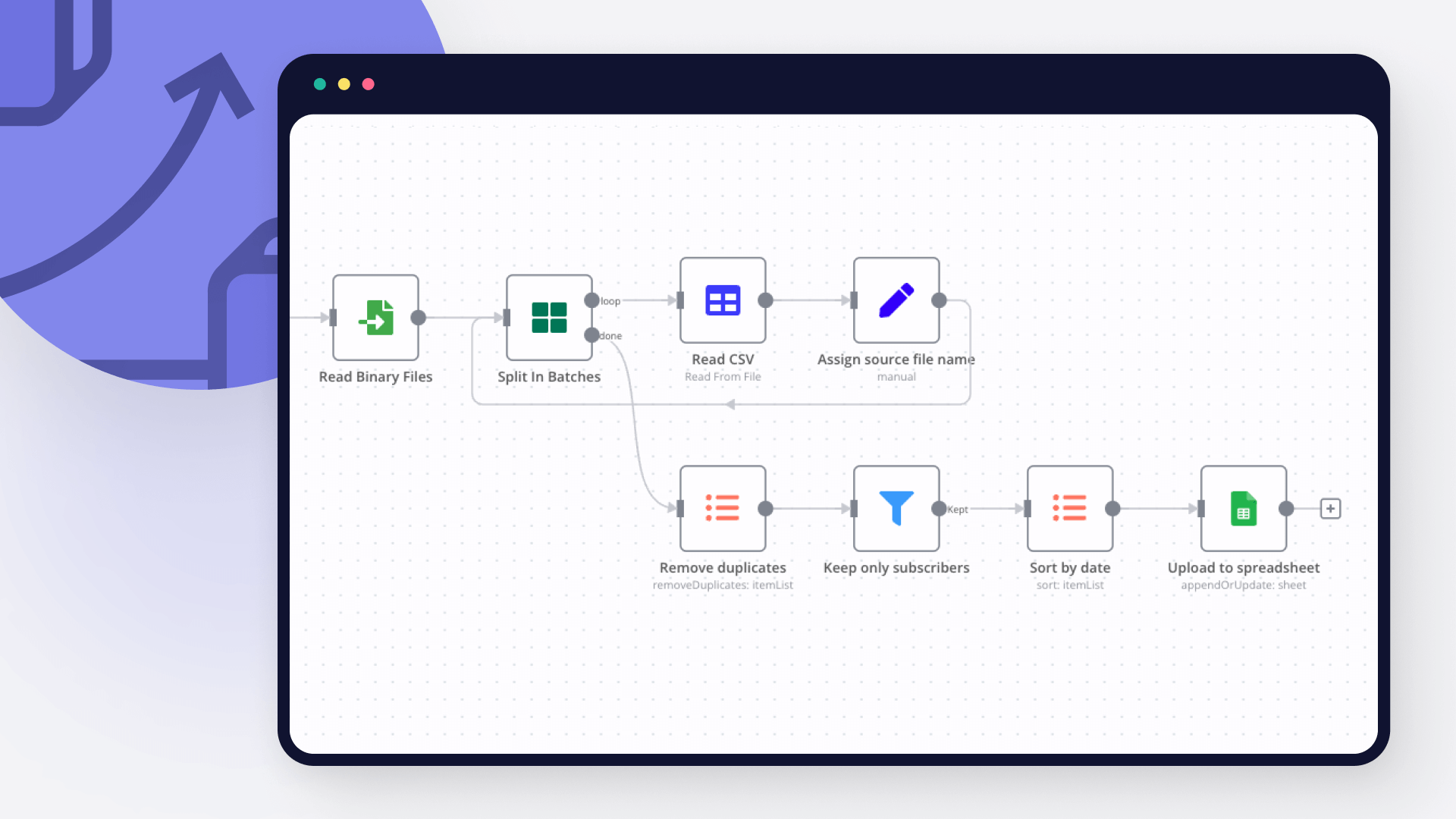
Airtable and Google Sheets integration: Add and configure Airtable and Google Sheets nodes

Step 3: Connect Airtable and Google Sheets

A connection establishes a link between Airtable and Google Sheets (or vice versa) to route data through the workflow. Data flows from the output of one node to the input of another. You can have single or multiple connections for each node.

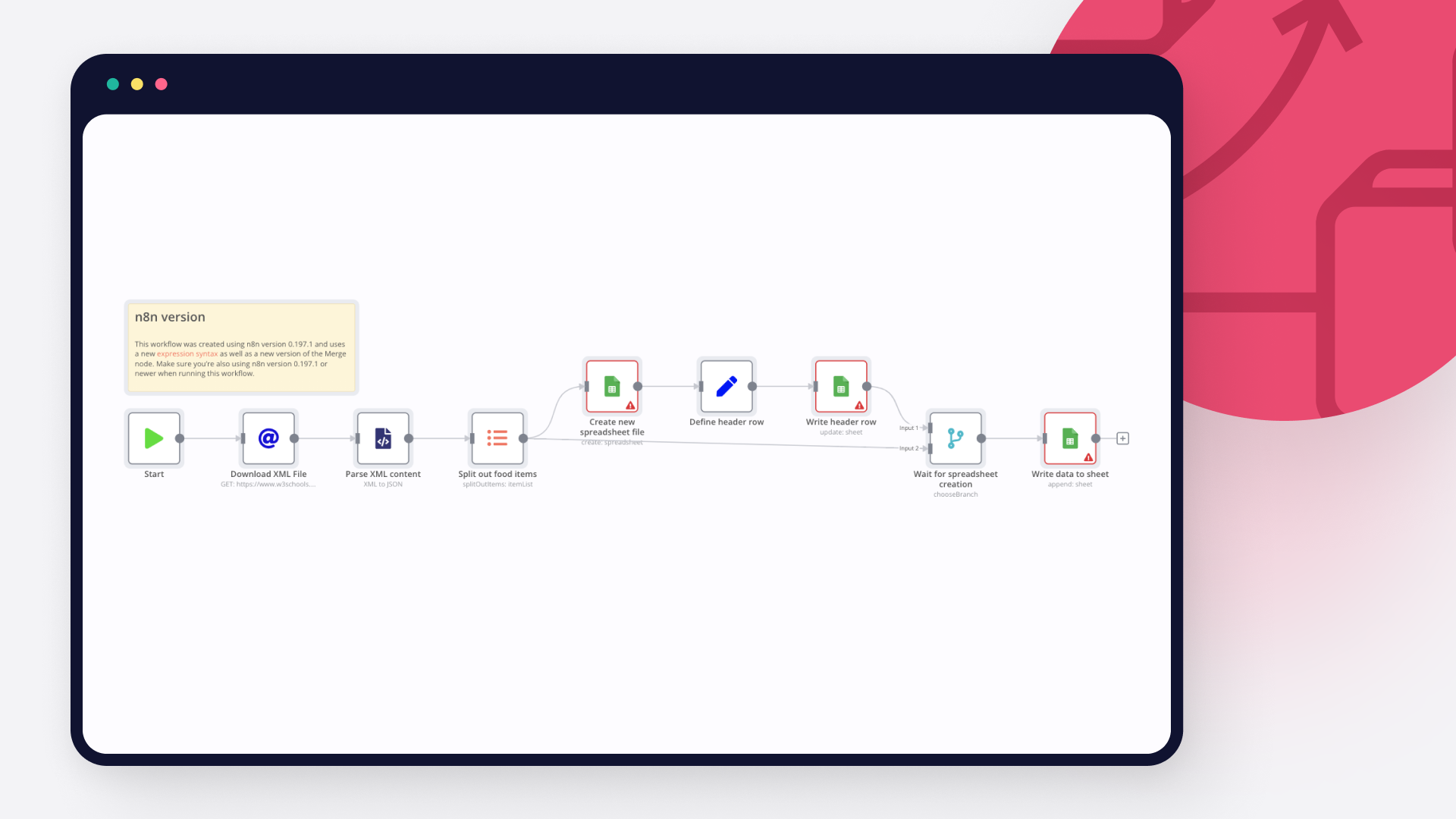
Airtable and Google Sheets integration: Connect Airtable and Google Sheets

Step 4: Customize and extend your Airtable and Google Sheets integration

Use n8n's core nodes such as If, Split Out, Merge, and others to transform and manipulate data. Write custom JavaScript or Python in the Code node and run it as a step in your workflow. Connect Airtable and Google Sheets with any of n8n’s 1000+ integrations, and incorporate advanced AI logic into your workflows.

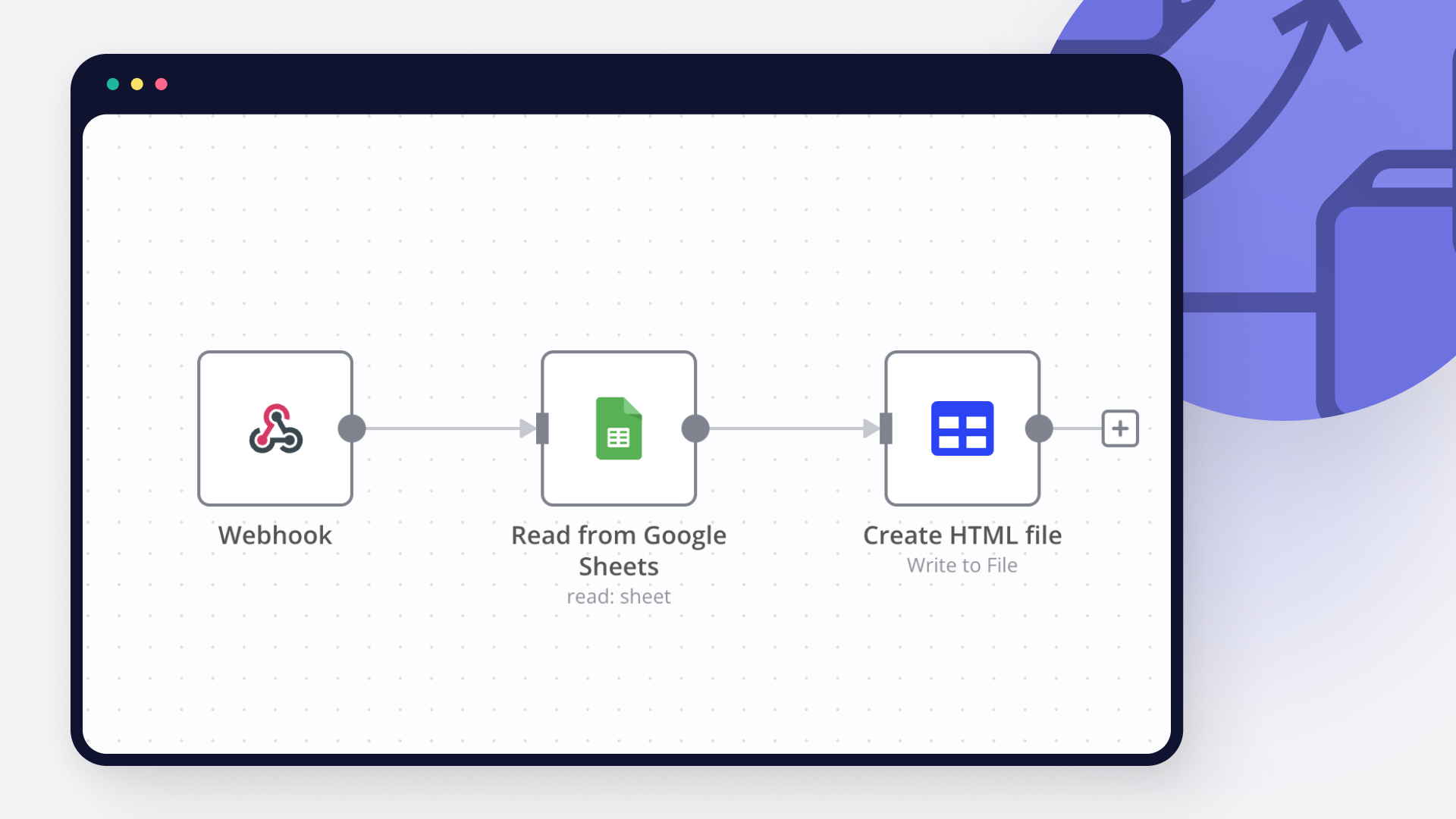
Airtable and Google Sheets integration: Customize and extend your Airtable and Google Sheets integration

Step 5: Test and activate your Airtable and Google Sheets workflow

Save and run the workflow to see if everything works as expected. Based on your configuration, data should flow from Airtable to Google Sheets or vice versa. Easily debug your workflow: you can check past executions to isolate and fix the mistake. Once you've tested everything, make sure to save your workflow and activate it.

Airtable and Google Sheets integration: Test and activate your Airtable and Google Sheets workflow

Voiceflow demo support chatbot

Submission Overview for Voiceflow Demo Workflow

View the YouTube video for this workflow here.

Who is this for?
This workflow is ideal for businesses and developers using Voiceflow to power AI voice chatbots. It benefits teams that want to enhance chatbot functionality through integrations with platforms like Zendesk, Google Calendar, and Airtable.

What problem is this workflow solving?
The workflow addresses the need for seamless integration of chatbot interactions with backend systems. It automates customer service tasks such as ticket creation, meeting scheduling, and data reporting, reducing manual effort and enhancing efficiency.

What does this workflow do?
Customer Lookup:** Checks the database for existing customers and returns relevant details or a "NOT_FOUND" status.
Zendesk Ticket Creation:** Automates the creation of support tickets for customer issues.
Meeting Scheduling:** Integrates with Google Calendar to provide availability and schedule meetings.
Transcript Reporting:** Aggregates interaction data and sends it to Airtable for analysis by the product team.

Setup
Configure your Voiceflow chatbot to connect to this workflow via a webhook.
Set up the required integrations:
Zendesk API: For ticket creation.
Google Calendar API: For scheduling.
Airtable API: For storing transcripts.
Customize the workflow's nodes to match your use case, such as database fields or API endpoints.
Deploy the workflow on your n8n instance and test the integrations.

How to customize this workflow to your needs
Adjust database queries to match your customer data schema.
Modify the Zendesk ticket payload to include additional fields or custom formats.
Update Google Calendar configurations for different scheduling requirements.
Add or remove Airtable fields based on the product team's analysis needs.

This template adheres to n8n’s submission guidelines, ensuring clarity, relevance, and broad applicability for users in customer service, product development, and automation.

Nodes used in this workflow

Popular Airtable and Google Sheets workflows

+5

Generate Videos with AI, ElevenLabs,PIAPI Shotstack/Creatomate & Post to Youtube

Auto-Generate Long Videos with AI, ElevenLabs,PIAPI,Shotstack/Creatomate & Post to Youtube Overview This n8n automation workflow automates the creation, scripting, production, and posting of YouTube videos. It leverages AI (OpenAI), image generation (PIAPI), video rendering (Shotstack), and platform integrations (Airtable, Google Sheets, YouTube) to streamline the process. Target Audience Content creators, video producers, and YouTubers** seeking to automate video content creation. Digital marketing teams** managing video campaigns for travel or history niches. Users familiar with n8n, Airtable, Google Sheets, YouTube, and API integrations**. Problem Solved Manually managing YouTube video production, from ideation to posting, is time-consuming and prone to errors. This workflow addresses: Content Sourcing**: Generates video ideas using AI based on "domain of choice". Content Formatting**: Automatically creates detailed scripts and scene structures. Visual Production**: Produces high-quality images and renders videos with minimal manual input. Multi-Platform Integration**: Publishes to YouTube with status tracking in Airtable and Google Sheets. Status Tracking**: Monitors progress (Generated, Scripted, Produced, Published) across platforms. Prerequisites Before setting up, ensure you have: An n8n instance (self-hosted or cloud) API credentials for: OpenAI (for idea generation) PIAPI.ai (for image and video generation) ElevenLabs (for audio generation) Shotstack (for video rendering) Creatomate (for video rendering) Airtable & Google Sheets and Drive (for storage and tracking) Gmail (for notifications) YouTube API (for posting to YouTube) How the Automation Works (Step by Step) Trigger (Schedule Trigger) Initiates the workflow daily Connects to "Generate Idea" Generate Idea Uses OpenAI to create a unique 4-minute video idea with a title, description, keywords, scene structure, and intrigue note Checks Airtable "Ideas" table via searchAirtable to avoid duplicates Connects to "Parse Ideas" Parse Ideas Extracts title, description, and notes from the OpenAI output using JavaScript Connects to "Add Ideas" Add Ideas Stores the initial idea in Google Sheets "Ideas" sheet with fields like "Idea", "Description", and "Progress" (set to "Generated") Connects to "Store in Airtable" Store in Airtable Saves the idea to Airtable "Ideas" table with mapped fields and typecast enabled Connects to "Generate Script" Generate Script Creates a 500-600 word script with 8-10 scenes using OpenAI, based on the latest "Generated" idea Uses Structured Output Parser to format output Connects to "Parse Script Output" Parse Script Output Formats the script into readable text and JSON, extracting scenes and closing question Connects to "Store Script" Store Script Saves the script to Google Sheets "Production" sheet with "Script", "Scenes", and "Status" (set to "Scripted") Connects to "Store Script in Airtable" Store Script in Airtable Saves the script to Airtable "Production" table with mapped fields and typecast enabled Connects to "Updated Idea to Scripted" Updated Idea to Scripted Updates the idea status to "Scripted" in Google Sheets "Ideas" sheet Connects to "Update Status Ideas Table" Update Status Ideas Table Updates the idea status to "Scripted" in Airtable "Ideas" table, matching by "Idea ID" Connects to "Extract Scenes" Extract Scenes Parses scene data from Airtable "Production" table for image generation Connects to "Text-to-Image" Text-to-Image Generates images for each scene using PIAPI Connects to "Wait for 4 Min" Wait for 4 Min Waits 3 minutes to allow image generation to complete Connects to "Get Images" Trigger (Schedule Trigger1) Initiates the posting process daily Connects to "Search for Latest Ready Video" Search for Latest Ready Video Searches Airtable "Production" table for the latest video with "Status" = "Ready" Connects to "If Ready?" If Ready? Checks if a video is ready (condition: Status contains Ready) If true, connects to "Download Video" and "Update Production Table" Download Video Downloads the video file using the VideoURL from Airtable Connects to "Post YouTube" Post YouTube Uploads the video to YouTube with title and description, using YouTube OAuth2 Update Production Table Updates the "Production" sheet in Google Sheets, setting "Status" to "Published" and matching by "Production ID" Additional Nodes and Processes OpenAI Chat Model**: Powers "Generate Idea" and "Generate Script" with GPT Structured Output Parser**: Ensures proper JSON output for scripts Get Images**: Retrieves generated images Extract Narration**: Prepares narration for voice generation Voice Generation**: Generates voiceovers Generate Music Prompt**: Creates music prompts using OpenAI Text-to-Music**: Generates music Build Shotstack Timeline**: Constructs video timeline ShotStack Render Video**: Renders the final video Poll Rendered Videos**: Checks video rendering status Final Video**: Updates Airtable "Production" with final video details Final Video Update**: Updates Google Sheets "Production" with video URL Music Urls**: Adds music URLs to the process Setup Requirements Before starting, ensure you have the following 1 n8n Instance A self-hosted or cloud-based n8n instance to run the workflow 2 API Credentials OpenAI: API key Airtable: Personal Access Token (e.g, "Airtable Personal Access Token Google Sheets: OAuth2 credentials PIAPI: HTTP Header Auth key YouTube: OAuth2 credentials 3 Airtable Configuration Base: "Youtube Videos" Tables: "Ideas" "Production" Share with the Airtable token 4 Google Sheets Configuration Document: "Youtube Videos" Sheets: "Ideas" "Production" Share with the Google Sheets credential email Shotstack Configuration (Assumed) API key and endpoint for video rendering (not specified in JSON) Setup Instructions Import the Workflow Import the provided JSON file into your n8n instance Configure Credentials Add OpenAI, Airtable, Google Sheets, PIAPI, and YouTube credentials in n8n’s credential manager Set Up Airtable Create or update the "Ideas" and "Production" tables with the specified fields Ensure proper permissions with the Airtable token Configure Google Sheets Create or update the "Ideas" and "Production" sheets with the specified columns Share the document with the Google Sheets credential email Schedule Triggers Set "Schedule Trigger" to trigger Test the Workflow Run manually to verify each node’s functionality Check Airtable, Google Sheets, and YouTube for updates Ensure PIAPI image generation completes (wait 4 minutes) Monitor and Adjust Monitor API rate limits (e.g, PIAPI, YouTube) Adjust wait times if image or video generation delays occur Verify connections for unlinked nodes Benefits Efficiency**: Automates the entire process from idea to posting Scalability**: Handles daily video production Quality**: Ensures cinematic scripts and visuals Tracking**: Provides detailed progress monitoring Notes Rate Limits**: Be aware of PIAPI (150,000 units per task) and YouTube API limits Timing**: Adjust wait nodes (e.g, "Wait for 4 Min") based on API response times Conclusion and Suggestions to Improve the Automation Conclusion This workflow streamlines YouTube video production, making it ideal for busy content creators, video producers, and marketing teams. Customize it by adding more platforms, adjusting wait delays for image/video generation, or enhancing notifications for status updates. Share your feedback in the n8n community to help others benefit from this automation. Suggestions to Improve Customization**: Adjust prompts, timings, and API parameters based on your needs Expand "Text-to-Music**" with multiple music styles or integrate a royalty-free music API for variety. Improve Video Rendering**: Optimize "Build Shotstack Timeline" and "ShotStack Render Video" with predefined templates to reduce rendering time. Add Analytics Tracking**: Include a node to fetch YouTube Analytics post-upload for performance monitoring. Error Handling**: Add error-catching nodes (e.g., "If" nodes) to retry failed image or video generations. Notification System**: Incorporate email or Slack notifications for key milestones (e.g., script completion, video upload).
+2

Upload Instagram Reels from Google Sheets with DeepSeek AI captions

Overview This n8n workflow template automates the entire process of publishing Instagram Reels from content stored in Google Sheets and Google Drive. It's designed for content creators, social media managers, and businesses who maintain a content calendar in spreadsheets and need automated publishing with AI-generated captions. Workflow Steps Trigger Phase Schedule Trigger**: Runs every 12 hours (configurable) Google Sheets Trigger**: Alternatively triggers when new rows are added Retrieves the next unposted video from the spreadsheet (where POSTED = FALSE) Content Preparation Downloads video from Google Drive using file ID from spreadsheet Processes video with FFmpeg to add custom text overlays: Title text overlay Numbering overlay Sales hook text Sends processed video using SSH Caption & Metadata Generation Extracts video filename and metadata Uses AI Agent (DeepSeek) to generate engaging Instagram captions: 2-4 engaging sentences 3-5 relevant hashtags Clear call-to-action Under 150 characters total Stores caption and metadata in Airtable for record-keeping Instagram Publishing Creates Facebook/Instagram media container with video URL and caption Waits and polls for video processing completion Publishes the Reel when ready Updates Google Sheet to mark content as posted (POSTED = TRUE) Cleanup Removes temporary video files from disk
+2

Inventory Reconciliation between Notion & Airtable with GPT-4o Slack Alerts

📘 Description This workflow performs automated inventory reconciliation between Notion (physical counts) and Airtable (system counts), ensuring both databases stay synchronized. It fetches records from both systems, merges them into a unified comparison payload, validates the structure, and calculates discrepancies. If a mismatch is detected, the workflow automatically updates Airtable with the corrected count and notifies the operations team on Slack. If everything matches, a simple “No action needed” Slack message is sent. Any malformed or incomplete payloads are logged into Google Sheets for audit tracking. ⚙️ What This Workflow Does (Step-by-Step) 🟢 Manual Trigger – Execute Workflow Starts the reconciliation process on demand. 📥 Fetch Records from Notion Retrieves physical stock data (cycle count) stored in Notion. 📦 Fetch Records from Airtable Loads inventory data from Airtable’s system-of-record table. 🔀 Merge Notion + Airtable Inputs Combines both datasets into a single payload for unified processing. 🔍 Validate Payload Structure (IF Node) Ensures that key fields (like id) exist. Valid → continue Invalid → logged to Google Sheets. 🧾 Log Invalid Versioning Requests to Google Sheets Stores broken or incomplete payload entries for later review. 🧮 Build Combined Notion + Airtable Payload (Code Node) Constructs the structured comparison object: { notion: {...}, airtable: [...] } 📊 Compare Notion Record With Airtable Record (Code Node) Performs core reconciliation logic: Matches items by name Compares physical vs. system count Calculates difference Determines if a correction is needed If mismatch → flagged for update. 🔎 Check If Record Requires Update (IF Node) Branches logic into: Mismatch → Update Airtable + Alert Match → No action summary 🛠️ Update Airtable Record With Corrected Count Writes the accurate physical count from Notion into Airtable. 🧠 Configure GPT-4o – Slack Summary Models Two models: For “no action needed” summaries For “Airtable updated” discrepancy alerts 🤖 Generate Slack Summary / Generate Slack Summary1 AI produces short, precise, operations-friendly Slack messages based on whether a discrepancy existed. 💬 Slack – Send Summary Notification / Send Update Notification Sends final Slack message to the operations user, confirming: Stock match status Updates made Item details Difference values 🧩 Prerequisites Notion API integration Airtable API credentials Azure OpenAI GPT-4o Slack API connection Google Sheets OAuth 💡 Key Benefits ✔ Eliminates manual reconciliation errors ✔ Keeps Airtable continuously aligned with real physical counts ✔ Provides instant Slack visibility to operations teams ✔ Logs all invalid or malformed cases ✔ Centralizes Notion + Airtable consistency checks 👥 Perfect For Operations teams managing multi-system inventory Warehouse cycle count workflows Audit-driven companies needing accurate stock data Businesses using Notion + Airtable as parallel systems

Automate Marketing Leads Import from Google Sheets to Airtable CRM

🎯General Principles This workflow automates the import of leads into the Company table of a CRM built with Airtable. Its originality lies in leveraging the new "Data Table" node (an internal table within n8n) to generate an execution report. 📚 Why Data Tables: This approach eliminates the need for reading/writing operations on a Google Sheet file or an external database. 🧩 It is structured on 3 main key steps: Reading leads for which email address validity has been verified. Creating or updating company information. Generating of execution report. This workflow enables precise tracking of marketing actions while facilitating the historical record of interactions with prospects and clients. Prerequisites Leads file: A prior validation check on email address accuracy is required. Airtable: Must contain at least a Company table with the following fields: Company: company name Business Leader: name of the executive Activity: business sector (notary, accountant, plumber, electrician, etc.) Address: main company address Zip Code: postal code City: city Phone Number: phone number Email: email address of a manager URL Site: company website URL Opt-in: company’s consent for commercial prospecting Campaign: reserved for future marketing campaigns Valid Email: indicator confirming email verification ⚙️ Step-by-Step Description 1️⃣ Initialization and Lead Selection Data Table Initialization: An internal n8n table is created to build the execution report. Lead Selection: The workflow selects leads from the Google Sheet file (Sheet1 tab) where the condition "Valid Email" is equal to OK. 2️⃣ Iterative Loop Company Existence Check: The Search Company node is configured with Always Output Data enabled. A JavaScript code node distinguishes three possibilities: Company does not exist: create a new record and increment the created records counter. Company exists once: update the record and increment the updated records counter. Company appears multiple times: log the issue in the Leads file under the Logs tab, requiring a data quality procedure. 3️⃣ Execution Report Generation An execution report is generated and emailed, example format: Leads Import Report: Number of records read: 2392 Number of records created: 2345 Number of records updated: 42 If the sum of records created and updated differs from the total records read, it indicates the presence of duplicates. A counter for duplicated companies could be added. ✅ Benefits of this template Exception Management and Logging: Identification and traceability of inconsistencies during import with dedicated logs for issues. Data Quality and Structuring: Built-in checks for duplicate detection, validation, and mapping to ensure accurate analysis and compliance. Automated Reporting: Systematic production and delivery of a detailed execution report covering records read, created, and updated. 📬 Contact Need help customizing this (e.g., expanding Data Tables, connecting multiple surveys, or automating follow-ups)? 📧 [email protected] 🔗 guy.salvatore 🌐 smarthome-smartelec.fr
+3

Track Singapore COE Prices with AI Forecasting & Smart Buy Recommendations via Telegram

Introduction Automates Singapore COE price tracking with AI forecasts and buy/wait recommendations. Weekly scraping collects LTA data, enriches with economic indicators, predicts 6-month trends, and alerts users via Telegram/email—helping car buyers and fleet managers make data-driven purchase decisions while avoiding manual tracking. How it Works Weekly trigger scrapes LTA COE → validates → stores in Google Sheets → calculates indicators → AI forecasts trends → multi-scenario analysis → generates buy/wait signals → sends actionable alerts. Setup Steps Add OpenAI/NVIDIA API credentials in n8n Authenticate Google Sheets and create spreadsheet Configure Telegram bot or Gmail SMTP Set weekly trigger (Thursday 9AM SGT post-bidding) Adjust alert thresholds in conditional nodes Workflow Schedule Trigger → Scrape COE → Validate → Store Sheets → Fetch Historical → Calculate Indicators → AI Prediction → Merge Economics → Multi-Scenario Analysis → Compare Conditions → Generate Dashboard → Send Alerts Workflow Steps Scraping: Fetch LTA COE results with retry logic Validation: Check completeness, flag anomalies Storage: Append timestamped records to Sheets Enrichment: Calculate moving averages, volatility, seasonality AI Analysis: Forecast next 6 months with confidence intervals Decision Engine: Output buy/wait/monitor recommendation Reporting: Create dashboard and send alerts via Telegram/email Prerequisites OpenAI/NVIDIA API key, Google Sheets access, Telegram bot token or Gmail, basic COE category understanding Use Cases First-time buyers timing purchases, fleet operators coordinating bulk acquisitions Customization Add SMS alerts via Twilio, integrate loan calculators for total cost analysis Benefits Saves 5+ hours monthly, captures 10–18% price dips, provides predictive insights (potential $10K–$25K savings)

Multi-Agent AI Content Creator for SEO Blogs & Newsletters with OpenRouter, DALL-E, Gemini

Who is this for This workflow is designed for content creators, digital marketers, bloggers, and businesses who need to produce high-quality, SEO-optimized blog posts and newsletters at scale. Perfect for marketing teams, content agencies, solopreneurs, and anyone looking to automate their content creation process while maintaining professional quality. What it does This multi-agent AI system generates complete, research-backed blog posts and newsletters automatically. Four specialized AI agents work in sequence: the Research Agent gathers facts and sources, the Outline Agent structures the content, the Writer Agent creates engaging Medium-style prose, and the Editor Agent polishes and optimizes for search engines. The workflow automatically routes content to either blog format (with DALL-E generated featured images) or newsletter format based on your input, then saves everything to Airtable or Google Sheets for easy management. Requirements OpenRouter API key (for Grok AI model) Google Gemini API key OpenAI API key (for DALL-E image generation) Airtable account Google Sheets account (for newsletters) Telegram bot token (optional, for notifications) How to set up Import the workflow into your n8n instance Add your API credentials to each language model node (OpenRouter, Google Gemini, OpenAI) Configure your Airtable base ID and table ID in the "Save Blog to Airtable" node Set your Google Sheets document ID in the "Save Newsletter to Google Sheets" node (Optional) Add your Telegram bot token and chat ID for notifications Test the workflow by submitting the form with a sample topic How to customize the workflow You can easily adapt this workflow to your specific needs. Replace the AI models with your preferred providers (Claude, GPT-4, Llama, etc.) by swapping the language model nodes. Modify the agent prompts to change writing style, tone, or target audience. Add additional agents for fact-checking, plagiarism detection, or brand voice alignment. Connect the output directly to publishing platforms like WordPress, Medium, Webflow, or email marketing services like Mailchimp. Adjust the image generation parameters to match your brand aesthetic, or skip image generation entirely if not needed.

Build your own Airtable and Google Sheets integration

Create custom Airtable and Google Sheets workflows by choosing triggers and actions. Nodes come with global operations and settings, as well as app-specific parameters that can be configured. You can also use the HTTP Request node to query data from any app or service with a REST API.


Airtable supported actions

Get Many
List all the bases
Get Schema
Get the schema of the tables in a base
Create
Create a new record in a table
Create or Update
Create a new record, or update the current one if it already exists (upsert)
Delete
Delete a record from a table
Get
Retrieve a record from a table
Search
Search for specific records or list all
Update
Update a record in a table

Google Sheets supported actions

Create
Create a spreadsheet
Delete
Delete a spreadsheet
Append or Update Row
Append a new row or update an existing one (upsert)
Append Row
Create a new row in a sheet
Clear
Delete all the contents or a part of a sheet
Create
Create a new sheet
Delete
Permanently delete a sheet
Delete Rows or Columns
Delete columns or rows from a sheet
Get Row(s)
Retrieve one or more rows from a sheet
Update Row
Update an existing row in a sheet

FAQs

  • Can Airtable connect with Google Sheets?

  • Can I use Airtable’s API with n8n?

  • Can I use Google Sheets’s API with n8n?

  • Is n8n secure for integrating Airtable and Google Sheets?

  • How to get started with Airtable and Google Sheets integration in n8n.io?

Need help setting up your Airtable and Google Sheets integration?

Discover our latest community's recommendations and join the discussions about Airtable and Google Sheets integration.
Sergey Komardenkov
sérgio eduardo floresta filho
Julian
therealJMT
Michael Wells

Looking to integrate Airtable and Google Sheets in your company?

Over 3000 companies switch to n8n every single week

Why use n8n to integrate Airtable with Google Sheets

Build complex workflows, really fast

Build complex workflows, really fast

Handle branching, merging and iteration easily.
Pause your workflow to wait for external events.

Code when you need it, UI when you don't

Simple debugging

Your data is displayed alongside your settings, making edge cases easy to track down.

Use templates to get started fast

Use 1000+ workflow templates available from our core team and our community.

Reuse your work

Copy and paste, easily import and export workflows.

Implement complex processes faster with n8n

red iconyellow iconred iconyellow icon