Back to Integrations
integrationAWS DynamoDB node
integrationTelegram node

AWS DynamoDB and Telegram integration

Save yourself the work of writing custom integrations for AWS DynamoDB and Telegram and use n8n instead. Build adaptable and scalable Data & Storage, Development, Communication, and HITL workflows that work with your technology stack. All within a building experience you will love.

How to connect AWS DynamoDB and Telegram

  • Step 1: Create a new workflow
  • Step 2: Add and configure nodes
  • Step 3: Connect
  • Step 4: Customize and extend your integration
  • Step 5: Test and activate your workflow

Step 1: Create a new workflow and add the first step

In n8n, click the "Add workflow" button in the Workflows tab to create a new workflow. Add the starting point – a trigger on when your workflow should run: an app event, a schedule, a webhook call, another workflow, an AI chat, or a manual trigger. Sometimes, the HTTP Request node might already serve as your starting point.
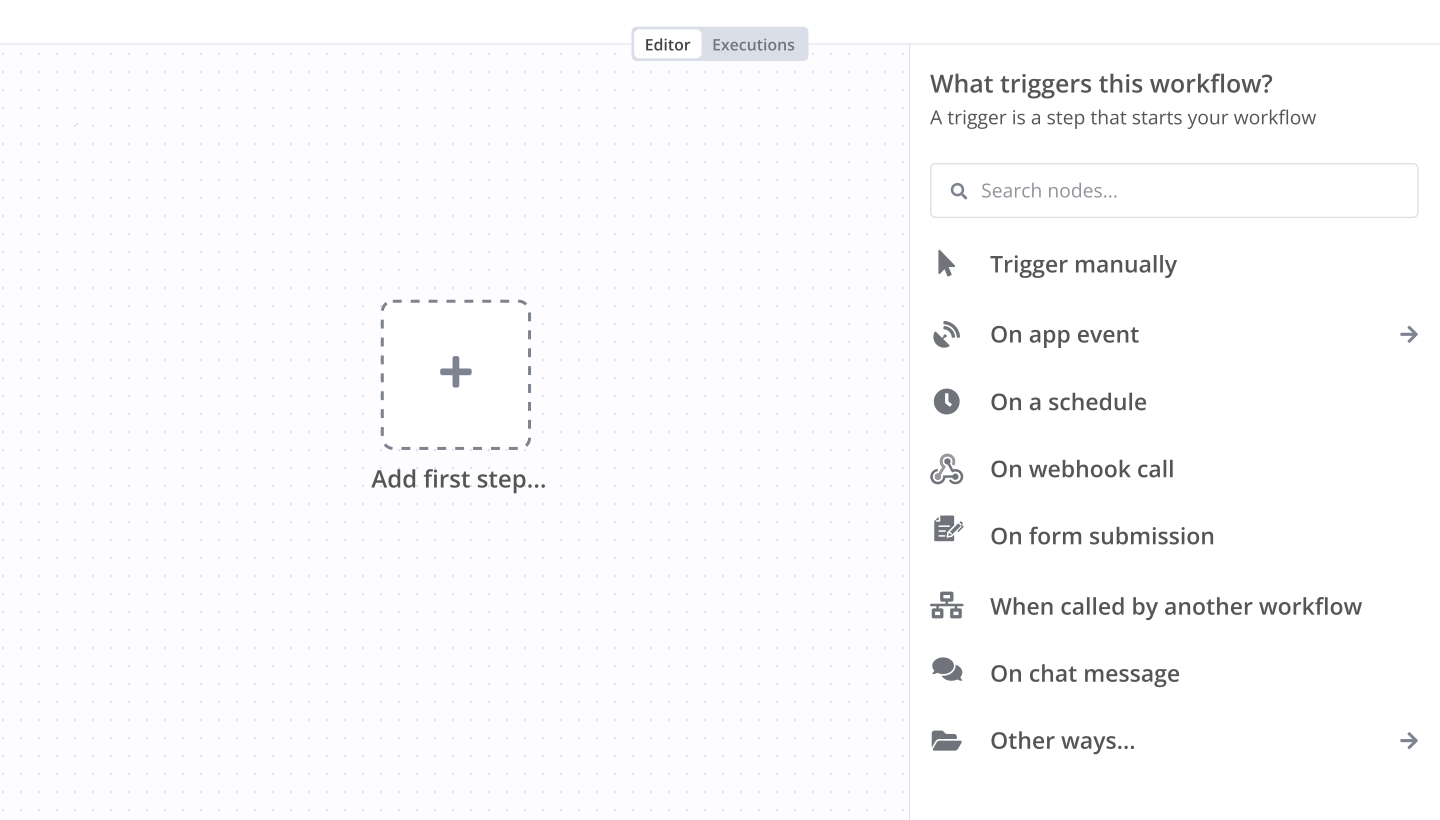
AWS DynamoDB and Telegram integration: Create a new workflow and add the first step

Step 2: Add and configure AWS DynamoDB and Telegram nodes

You can find AWS DynamoDB and Telegram in the nodes panel. Drag them onto your workflow canvas, selecting their actions. Click each node, choose a credential, and authenticate to grant n8n access. Configure AWS DynamoDB and Telegram nodes one by one: input data on the left, parameters in the middle, and output data on the right.

AWS DynamoDB and Telegram integration: Add and configure AWS DynamoDB and Telegram nodes

Step 3: Connect AWS DynamoDB and Telegram

A connection establishes a link between AWS DynamoDB and Telegram (or vice versa) to route data through the workflow. Data flows from the output of one node to the input of another. You can have single or multiple connections for each node.

AWS DynamoDB and Telegram integration: Connect AWS DynamoDB and Telegram

Step 4: Customize and extend your AWS DynamoDB and Telegram integration

Use n8n's core nodes such as If, Split Out, Merge, and others to transform and manipulate data. Write custom JavaScript or Python in the Code node and run it as a step in your workflow. Connect AWS DynamoDB and Telegram with any of n8n’s 1000+ integrations, and incorporate advanced AI logic into your workflows.

AWS DynamoDB and Telegram integration: Customize and extend your AWS DynamoDB and Telegram integration

Step 5: Test and activate your AWS DynamoDB and Telegram workflow

Save and run the workflow to see if everything works as expected. Based on your configuration, data should flow from AWS DynamoDB to Telegram or vice versa. Easily debug your workflow: you can check past executions to isolate and fix the mistake. Once you've tested everything, make sure to save your workflow and activate it.

AWS DynamoDB and Telegram integration: Test and activate your AWS DynamoDB and Telegram workflow

Generate SEO-optimized blog content with Google Gemini, RSS feeds and Telegram

Workflow Objective

This n8n workflow automates the entire content creation process by monitoring specified RSS feeds for new articles. It then leverages Google Gemini AI to generate comprehensive, SEO-optimized blog posts inspired by these articles, creates unique cover images, and distributes the final content as a JSON file to stakeholders via Telegram. The primary goal is to automate the end-to-end content pipeline, saving significant time and ensuring a consistent output of high-quality content.

Step-by-Step Breakdown

Monitor News Sources (RSS Triggers):
The workflow is triggered periodically (e.g., hourly, weekly) by multiple RSS Feed nodes that monitor sources like "Search Engine Journal" and "Tech Crunch" for new publications.

Prevent Duplicate Content (Deduplication):
For each new article fetched from the RSS feeds, the workflow checks an AWS DynamoDB database to see if the article's URL has been processed before.
If the link already exists in the database, the process for that item is halted, and a debug notification is sent to Telegram via the "Telegram Debugger" node. This prevents the generation of duplicate content.

AI-Powered Content Generation (Gemini Content Generation):
If the article is new, its link is passed to a Google Gemini node.
Using a highly detailed and structured prompt, Gemini generates a complete blog post in a specific JSON format. This output includes a title, meta description, SEO-friendly slug, a descriptive prompt for generating a cover image, and the full markdown body of the article (including an introduction, subheadings, conclusion, FAQ section, etc.).

Data Cleaning and Parsing (JSON Parser):
The raw text response from the AI is processed by a "Code" node. This custom script cleans the output—removing markdown code blocks, fixing potential syntax errors—and reliably parses it into a valid JSON object, ensuring the data is clean for subsequent steps.

Image Generation and Cloud Storage:
The image_generation_prompt from the parsed JSON is sent to another Google Gemini node configured for image generation, creating a 1200x630 cover image for the blog post.
The newly created image is renamed using the slug.
Finally, the image is uploaded to a cloud storage service like Cloudflare R2. If the upload fails, an error message is sent to Telegram.

Final Data Assembly and Distribution:
The generated text content is merged with the URL of the uploaded image to create the final, complete blog post data object.
This entire data structure is converted into a JSON file, named using the format [slug].json.
In the final step, this JSON file is sent as a document to designated recipients User via the Telegram nodes.

Technologies and Services Used

Trigger:** RSS Feed Reader
Artificial Intelligence:** Google Gemini (for both text and image generation)
Database:** AWS DynamoDB (for content deduplication)
Cloud Storage:** Cloudflare R2 (S3-compatible)
Notification & Distribution:** Telegram
Data Processing:** n8n's native nodes (Merge, If, Set, Code)

Nodes used in this workflow

Popular AWS DynamoDB and Telegram workflows

Generate SEO-Optimized Blog Content with Google Gemini, RSS Feeds and Telegram

Workflow Objective This n8n workflow automates the entire content creation process by monitoring specified RSS feeds for new articles. It then leverages Google Gemini AI to generate comprehensive, SEO-optimized blog posts inspired by these articles, creates unique cover images, and distributes the final content as a JSON file to stakeholders via Telegram. The primary goal is to automate the end-to-end content pipeline, saving significant time and ensuring a consistent output of high-quality content. Step-by-Step Breakdown Monitor News Sources (RSS Triggers): The workflow is triggered periodically (e.g., hourly, weekly) by multiple RSS Feed nodes that monitor sources like "Search Engine Journal" and "Tech Crunch" for new publications. Prevent Duplicate Content (Deduplication): For each new article fetched from the RSS feeds, the workflow checks an AWS DynamoDB database to see if the article's URL has been processed before. If the link already exists in the database, the process for that item is halted, and a debug notification is sent to Telegram via the "Telegram Debugger" node. This prevents the generation of duplicate content. AI-Powered Content Generation (Gemini Content Generation): If the article is new, its link is passed to a Google Gemini node. Using a highly detailed and structured prompt, Gemini generates a complete blog post in a specific JSON format. This output includes a title, meta description, SEO-friendly slug, a descriptive prompt for generating a cover image, and the full markdown body of the article (including an introduction, subheadings, conclusion, FAQ section, etc.). Data Cleaning and Parsing (JSON Parser): The raw text response from the AI is processed by a "Code" node. This custom script cleans the output—removing markdown code blocks, fixing potential syntax errors—and reliably parses it into a valid JSON object, ensuring the data is clean for subsequent steps. Image Generation and Cloud Storage: The image_generation_prompt from the parsed JSON is sent to another Google Gemini node configured for image generation, creating a 1200x630 cover image for the blog post. The newly created image is renamed using the slug. Finally, the image is uploaded to a cloud storage service like Cloudflare R2. If the upload fails, an error message is sent to Telegram. Final Data Assembly and Distribution: The generated text content is merged with the URL of the uploaded image to create the final, complete blog post data object. This entire data structure is converted into a JSON file, named using the format [slug].json. In the final step, this JSON file is sent as a document to designated recipients User via the Telegram nodes. Technologies and Services Used Trigger:** RSS Feed Reader Artificial Intelligence:** Google Gemini (for both text and image generation) Database:** AWS DynamoDB (for content deduplication) Cloud Storage:** Cloudflare R2 (S3-compatible) Notification & Distribution:** Telegram Data Processing:** n8n's native nodes (Merge, If, Set, Code)

Build your own AWS DynamoDB and Telegram integration

Create custom AWS DynamoDB and Telegram workflows by choosing triggers and actions. Nodes come with global operations and settings, as well as app-specific parameters that can be configured. You can also use the HTTP Request node to query data from any app or service with a REST API.


AWS DynamoDB supported actions

Create or Update
Create a new record, or update the current one if it already exists (upsert)
Delete
Delete an item
Get
Get an item
Get Many
Get many items

Telegram supported actions

Get
Get up to date information about a chat
Get Administrators
Get the Administrators of a chat
Get Member
Get the member of a chat
Leave
Leave a group, supergroup or channel
Set Description
Set the description of a chat
Set Title
Set the title of a chat
Answer Query
Send answer to callback query sent from inline keyboard
Answer Inline Query
Send answer to callback query sent from inline bot
Get
Get a file
Delete Chat Message
Delete a chat message
Edit Message Text
Edit a text message
Pin Chat Message
Pin a chat message
Send Animation
Send an animated file
Send Audio
Send a audio file
Send Chat Action
Send a chat action
Send Document
Send a document
Send Location
Send a location
Send Media Group
Send group of photos or videos to album
Send Message
Send a text message
Send and Wait for Response
Send a message and wait for response
Send Photo
Send a photo
Send Sticker
Send a sticker
Send Video
Send a video
Unpin Chat Message
Unpin a chat message

FAQs

  • Can AWS DynamoDB connect with Telegram?

  • Can I use AWS DynamoDB’s API with n8n?

  • Can I use Telegram’s API with n8n?

  • Is n8n secure for integrating AWS DynamoDB and Telegram?

  • How to get started with AWS DynamoDB and Telegram integration in n8n.io?

Need help setting up your AWS DynamoDB and Telegram integration?

Discover our latest community's recommendations and join the discussions about AWS DynamoDB and Telegram integration.
Trigi Digital

Looking to integrate AWS DynamoDB and Telegram in your company?

Over 3000 companies switch to n8n every single week

Why use n8n to integrate AWS DynamoDB with Telegram

Build complex workflows, really fast

Build complex workflows, really fast

Handle branching, merging and iteration easily.
Pause your workflow to wait for external events.

Code when you need it, UI when you don't

Simple debugging

Your data is displayed alongside your settings, making edge cases easy to track down.

Use templates to get started fast

Use 1000+ workflow templates available from our core team and our community.

Reuse your work

Copy and paste, easily import and export workflows.

Implement complex processes faster with n8n

red iconyellow iconred iconyellow icon