Back to Integrations
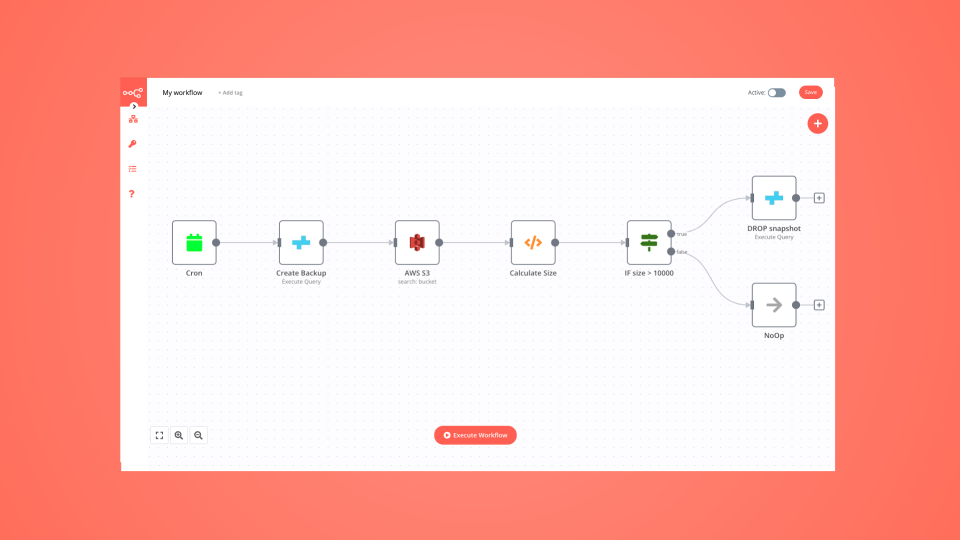
integrationAWS S3 node
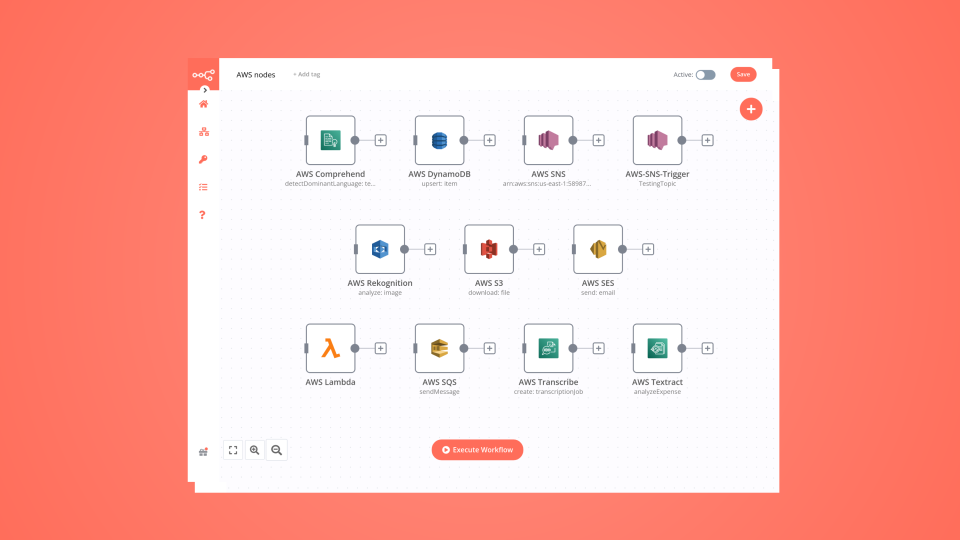
integrationGoogle Drive node

AWS S3 and Google Drive integration

Save yourself the work of writing custom integrations for AWS S3 and Google Drive and use n8n instead. Build adaptable and scalable Development, and Data & Storage workflows that work with your technology stack. All within a building experience you will love.

How to connect AWS S3 and Google Drive

  • Step 1: Create a new workflow
  • Step 2: Add and configure nodes
  • Step 3: Connect
  • Step 4: Customize and extend your integration
  • Step 5: Test and activate your workflow

Step 1: Create a new workflow and add the first step

In n8n, click the "Add workflow" button in the Workflows tab to create a new workflow. Add the starting point – a trigger on when your workflow should run: an app event, a schedule, a webhook call, another workflow, an AI chat, or a manual trigger. Sometimes, the HTTP Request node might already serve as your starting point.
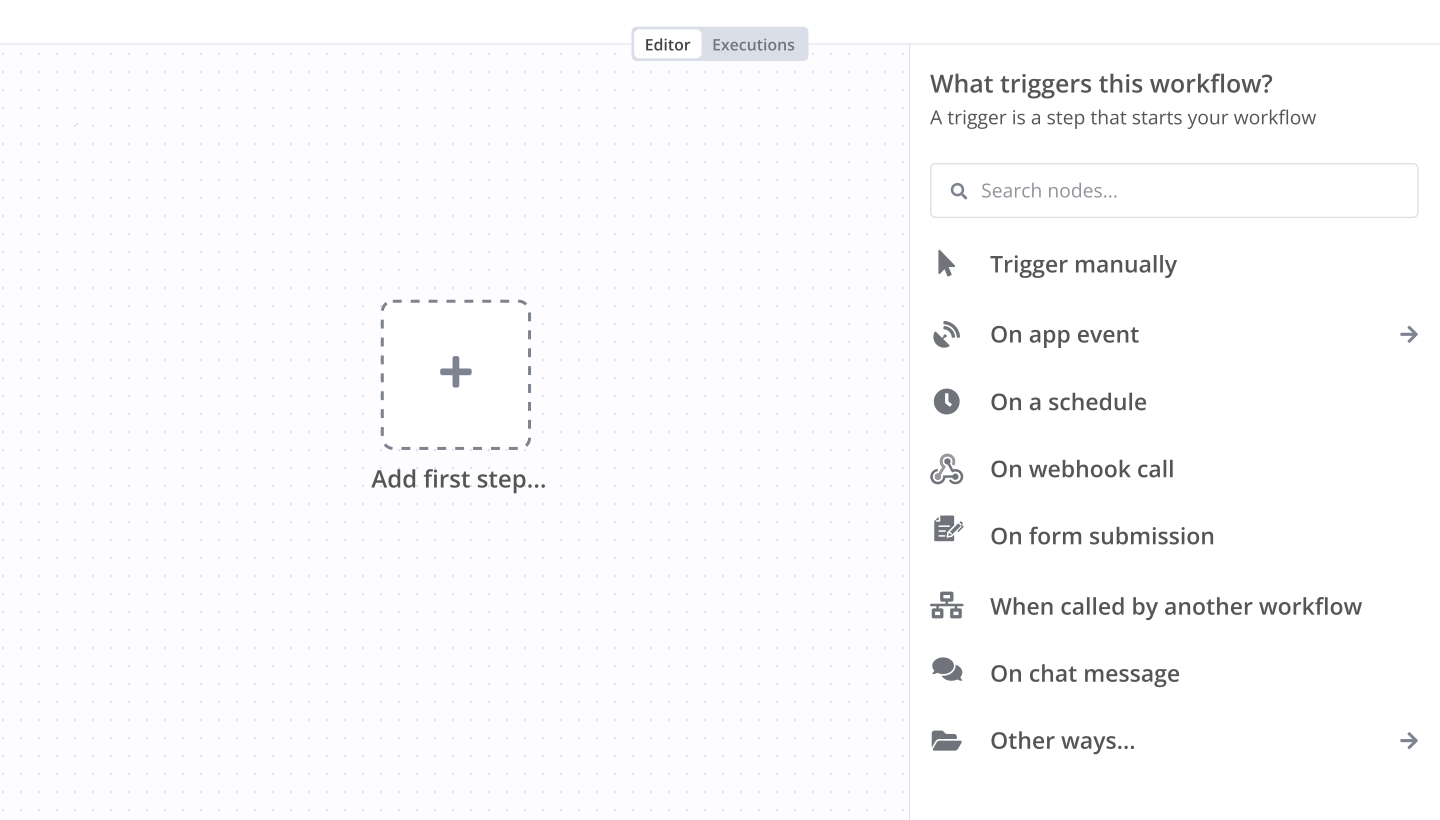
AWS S3 and Google Drive integration: Create a new workflow and add the first step

Step 2: Add and configure AWS S3 and Google Drive nodes

You can find AWS S3 and Google Drive in the nodes panel. Drag them onto your workflow canvas, selecting their actions. Click each node, choose a credential, and authenticate to grant n8n access. Configure AWS S3 and Google Drive nodes one by one: input data on the left, parameters in the middle, and output data on the right.

AWS S3 and Google Drive integration: Add and configure AWS S3 and Google Drive nodes

Step 3: Connect AWS S3 and Google Drive

A connection establishes a link between AWS S3 and Google Drive (or vice versa) to route data through the workflow. Data flows from the output of one node to the input of another. You can have single or multiple connections for each node.

AWS S3 and Google Drive integration: Connect AWS S3 and Google Drive

Step 4: Customize and extend your AWS S3 and Google Drive integration

Use n8n's core nodes such as If, Split Out, Merge, and others to transform and manipulate data. Write custom JavaScript or Python in the Code node and run it as a step in your workflow. Connect AWS S3 and Google Drive with any of n8n’s 1000+ integrations, and incorporate advanced AI logic into your workflows.

AWS S3 and Google Drive integration: Customize and extend your AWS S3 and Google Drive integration

Step 5: Test and activate your AWS S3 and Google Drive workflow

Save and run the workflow to see if everything works as expected. Based on your configuration, data should flow from AWS S3 to Google Drive or vice versa. Easily debug your workflow: you can check past executions to isolate and fix the mistake. Once you've tested everything, make sure to save your workflow and activate it.

AWS S3 and Google Drive integration: Test and activate your AWS S3 and Google Drive workflow

Transcribe audio files from Cloud Storage

This workflow transcribes audio files stored in AWS S3 and stores the information in Google Sheets.

Google Drive Trigger node** triggers the workflow when a new file is uploaded in Google Drive.
AWS S3 1 node** uploads the new file to an S3 bucket.
AWS S3 2 node** gets the file from the S3 bucket.
AWS Transcribe 1 node** creates a transciption job for the respective audio file.
Wait node** waits for the transcription job from the previous node to be complete before proceeding with the workflow (necessary in case the service is busy or the file to be transcribed is large, delaying the workflow).
AWS Transcribe 2 node** gets the information of the transcription job.
Set node** sets the necessary values to be included in the data set.
Google Sheets node** adds the transcription information to a sheet that serves as data set.

Nodes used in this workflow

Popular AWS S3 and Google Drive workflows

Optimize Technical Manuals for RAG & Agents with Blockify IdeaBlocks

Blockify® Technical Manual Data Optimization Workflow Blockify Optimizes Data for Technical Manual RAG and Agents - Giving Structure to Unstructured Data for ~78X Accuracy, when pairing Blockify Ingest and Blockify Distill Learn more at https://iternal.ai/blockify Get Free Demo API Access here: https://console.blockify.ai/signup Read the Technical Whitepaper here: https://iternal.ai/blockify-results See example Accuracy Comparison here: https://iternal.ai/case-studies/medical-accuracy/ Blockify is a data optimization tool that takes messy, unstructured text, like hundreds of sales‑meeting transcripts or long proposals, and intelligently optimizes the data into small, easy‑to‑understand "IdeaBlocks." Each IdeaBlock is just a couple of sentences in length that capture one clear idea, plus a built‑in contextualized question and answer. With this approach, Blockify improves accuracy of LLMs (Large Language Models) by an average aggregate 78X, while shrinking the original mountain of text to about 2.5% of its size while keeping (and even improving) the important information. When Blockify's IdeaBlocks are compared with the usual method of breaking text into equal‑sized chunks, the results are dramatic. Answers pulled from the distilled IdeaBlocks are roughly 40X more accurate, and user searches return the right information about 52% more accurate. In short, Blockify lets you store less data, spend less on computing, and still get better answers- turning huge documents into a concise, high‑quality knowledge base that anyone can search quickly. Blockify works by processing chunks of text to create structured data from an unstructured data source. Blockify® replaces the traditional "dump‑and‑chunk" approach with an end‑to‑end pipeline that cleans and organizes content before it ever hits a vector store. Admins first define who should see what, then the system ingests any file type—Word, PDF, slides, images—inside public cloud, private cloud, or on‑prem. A ​context‑aware splitter finds natural breaks, and a series of specially developed Blockify LLM model turns each segment into a draft IdeaBlock. GenAI systems fed with this curated data return sharper answers, hallucinate far less, and comply with security policies out of the box. The result: higher trust, lower operating cost, and a clear path to enterprise‑scale RAG without the cleanup headaches that stall most AI rollouts.
+3

Create AI-Generated Books with GPT-4.1-mini, DALL-E, Google Drive and AWS S3

Multi-Agent Book Creation Workflow with AI Tool Node and GPT-4, DALL-E Who’s it for This workflow is designed for: Content creators** who want to generate books or structured documents automatically. Educators and trainers** who need quick course materials, eBooks, or study guides. Automation enthusiasts* exploring multi-agent systems using the newly released AI Tool Node* in n8n. Developers* looking for a reference template to understand orchestration of multiple AI agents* with structured output. How it works / What it does This template demonstrates a multi-agent orchestration system powered by AI Tool Nodes: Trigger: Workflow starts when a chat message is received. Book Brief Agent: Generates the initial book concept (title, subtitle, and outline). Book Writer Agent: Expands the outline into full content by collaborating with two sub-agents: Designer Agent → Provides layout/design suggestions. Content Writer Agent → Drafts and refines chapters. Generate Cover Image: AI generates a custom book cover image. Upload to AWS S3: Stores the cover image securely. Configure Metadata: Adds metadata for title, author, and description. Build Book HTML: Converts markdown-based content into HTML format. Upload to Google Drive: Saves the HTML content for processing. Convert to PDF: Transforms the book into a professional PDF. Archive to Google Drive: Final version is archived for safe storage. This workflow showcases multi-agent coordination, structured parsing, and seamless integration with cloud storage services. How to set up Import the workflow into n8n. Configure the following connections: OpenAI (for Book Brief, Book Writer, Designer, and Content Writer Agents). AWS S3 (for image storage). Google Drive (for document storage & archiving). Add your API keys and credentials in n8n credentials manager. Test the workflow by sending a sample chat message (e.g., “Write a book about AI in education”). Verify outputs in Google Drive (HTML + PDF) and AWS S3 (cover image). Requirements n8n* (latest version with AI Tool Node* support). OpenAI API key** (to power multi-agent models). AWS account** (with S3 bucket for storing images). Google Drive integration** (for document storage and archiving). Basic familiarity with workflow setup in n8n. How to customize the workflow Switch Models**: Replace gpt-4.1-mini with other models (faster, cheaper, or more powerful). Add More Agents: Introduce agents for **editing, fact-checking, or translation. Change Output Format: Export to **EPUB, DOCX, or Markdown instead of PDF. Branding Options: Modify the **cover generation prompt to include company logos or specific style. Extend Storage: Add **Dropbox, OneDrive, or Notion integration for additional archiving. Trigger Alternatives: Replace chat trigger with **form submission, webhook, or schedule-based runs. ✅ This workflow acts as a free, plug-and-play template to showcase how multi-agents + AI Tool Node can work together to automate complex content creation pipelines.

Sync data between Google Drive and AWS S3

This workflow synchronizes files one-way from Google Drive to AWS S3. Google Drive Trigger node** triggers the workflow when a new file is added to the drive. AWS S3 node** gets all files stored in an S3 bucket. Merge node** merges the files from Google Drive and AWS S3 by key (file name) and keeps only the new file. AWS S3 node** uploads the new file in the S3 bucket.

Transcribe audio files from Cloud Storage

This workflow transcribes audio files stored in AWS S3 and stores the information in Google Sheets. Google Drive Trigger node** triggers the workflow when a new file is uploaded in Google Drive. AWS S3 1 node** uploads the new file to an S3 bucket. AWS S3 2 node** gets the file from the S3 bucket. AWS Transcribe 1 node** creates a transciption job for the respective audio file. Wait node** waits for the transcription job from the previous node to be complete before proceeding with the workflow (necessary in case the service is busy or the file to be transcribed is large, delaying the workflow). AWS Transcribe 2 node** gets the information of the transcription job. Set node** sets the necessary values to be included in the data set. Google Sheets node** adds the transcription information to a sheet that serves as data set.

Build your own AWS S3 and Google Drive integration

Create custom AWS S3 and Google Drive workflows by choosing triggers and actions. Nodes come with global operations and settings, as well as app-specific parameters that can be configured. You can also use the HTTP Request node to query data from any app or service with a REST API.

AWS S3 supported actions

Create
Create a bucket
Delete
Delete a bucket
Get Many
Get many buckets
Search
Search within a bucket
Copy
Copy a file
Delete
Delete a file
Download
Download a file
Get Many
Get many files
Upload
Upload a file
Create
Create a folder
Delete
Delete a folder
Get Many
Get many folders

Google Drive supported actions

Copy
Create a copy of an existing file
Create From Text
Create a file from a provided text
Delete
Permanently delete a file
Download
Download a file
Move
Move a file to another folder
Share
Add sharing permissions to a file
Update
Update a file
Upload
Upload an existing file to Google Drive
Search
Search or list files and folders
Create
Create a folder
Delete
Permanently delete a folder
Share
Add sharing permissions to a folder
Create
Create a shared drive
Delete
Permanently delete a shared drive
Get
Get a shared drive
Get Many
Get the list of shared drives
Update
Update a shared drive

FAQs

  • Can AWS S3 connect with Google Drive?

  • Can I use AWS S3’s API with n8n?

  • Can I use Google Drive’s API with n8n?

  • Is n8n secure for integrating AWS S3 and Google Drive?

  • How to get started with AWS S3 and Google Drive integration in n8n.io?

Need help setting up your AWS S3 and Google Drive integration?

Discover our latest community's recommendations and join the discussions about AWS S3 and Google Drive integration.
hubschrauber
Jon
David O'Neil

Looking to integrate AWS S3 and Google Drive in your company?

Over 3000 companies switch to n8n every single week

Why use n8n to integrate AWS S3 with Google Drive

Build complex workflows, really fast

Build complex workflows, really fast

Handle branching, merging and iteration easily.
Pause your workflow to wait for external events.

Code when you need it, UI when you don't

Simple debugging

Your data is displayed alongside your settings, making edge cases easy to track down.

Use templates to get started fast

Use 1000+ workflow templates available from our core team and our community.

Reuse your work

Copy and paste, easily import and export workflows.

Implement complex processes faster with n8n

red iconyellow iconred iconyellow icon