Back to Integrations
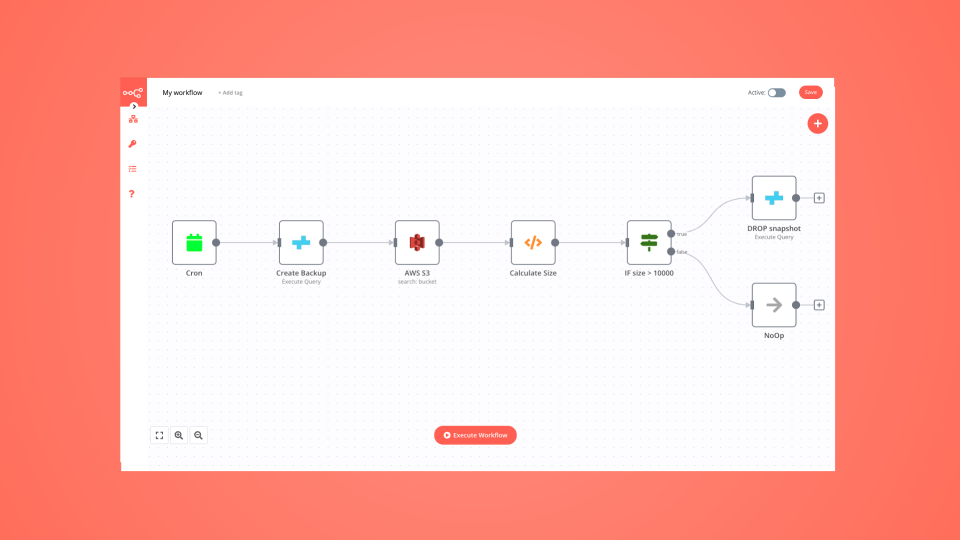
integrationAWS S3 node
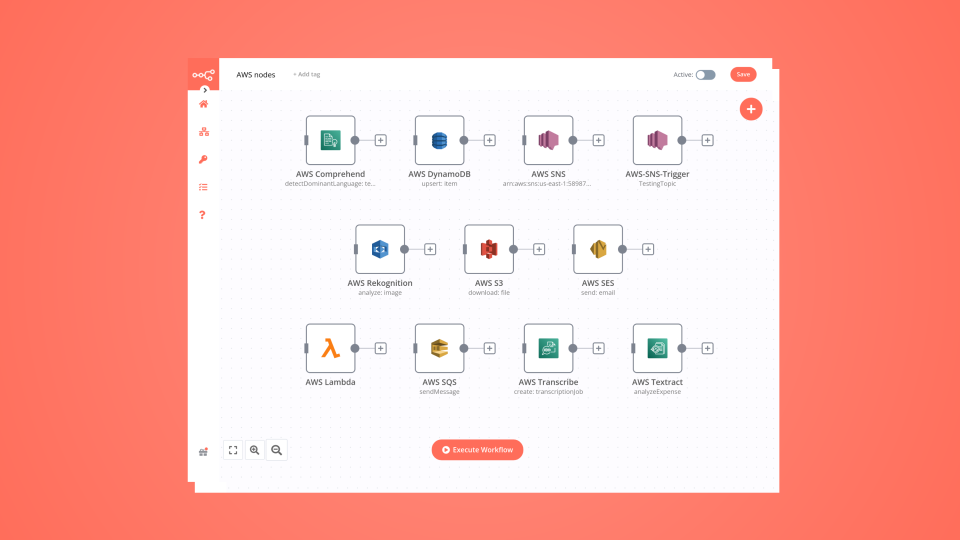
integrationHTTP Request node

AWS S3 and HTTP Request integration

Save yourself the work of writing custom integrations for AWS S3 and HTTP Request and use n8n instead. Build adaptable and scalable Development, Data & Storage, and Core Nodes workflows that work with your technology stack. All within a building experience you will love.

How to connect AWS S3 and HTTP Request

  • Step 1: Create a new workflow
  • Step 2: Add and configure nodes
  • Step 3: Connect
  • Step 4: Customize and extend your integration
  • Step 5: Test and activate your workflow

Step 1: Create a new workflow and add the first step

In n8n, click the "Add workflow" button in the Workflows tab to create a new workflow. Add the starting point – a trigger on when your workflow should run: an app event, a schedule, a webhook call, another workflow, an AI chat, or a manual trigger. Sometimes, the HTTP Request node might already serve as your starting point.
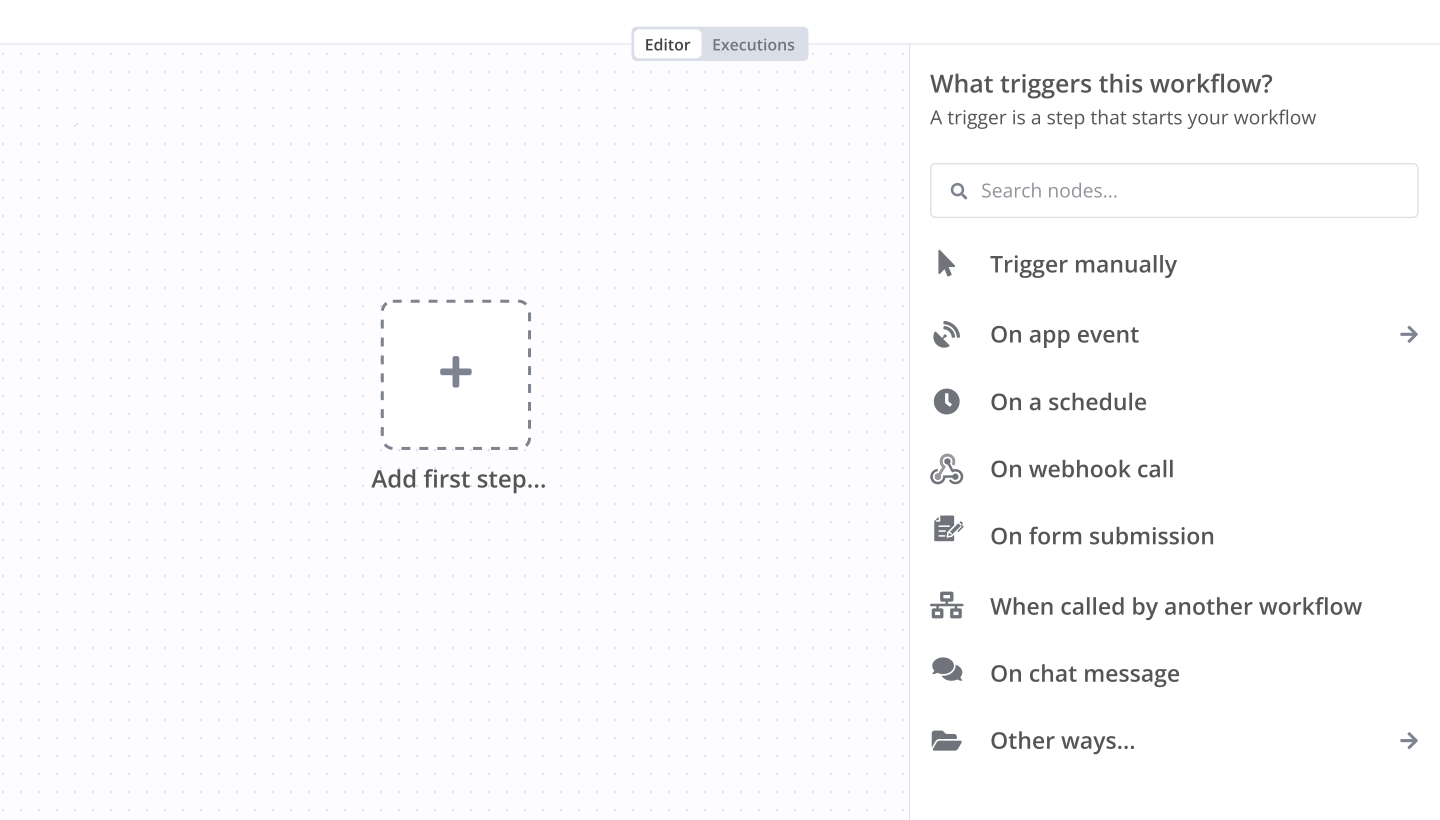
AWS S3 and HTTP Request integration: Create a new workflow and add the first step

Step 2: Add and configure AWS S3 and HTTP Request nodes

You can find AWS S3 and HTTP Request in the nodes panel. Drag them onto your workflow canvas, selecting their actions. Click each node, choose a credential, and authenticate to grant n8n access. Configure AWS S3 and HTTP Request nodes one by one: input data on the left, parameters in the middle, and output data on the right.

AWS S3 and HTTP Request integration: Add and configure AWS S3 and HTTP Request nodes

Step 3: Connect AWS S3 and HTTP Request

A connection establishes a link between AWS S3 and HTTP Request (or vice versa) to route data through the workflow. Data flows from the output of one node to the input of another. You can have single or multiple connections for each node.

AWS S3 and HTTP Request integration: Connect AWS S3 and HTTP Request

Step 4: Customize and extend your AWS S3 and HTTP Request integration

Use n8n's core nodes such as If, Split Out, Merge, and others to transform and manipulate data. Write custom JavaScript or Python in the Code node and run it as a step in your workflow. Connect AWS S3 and HTTP Request with any of n8n’s 1000+ integrations, and incorporate advanced AI logic into your workflows.

AWS S3 and HTTP Request integration: Customize and extend your AWS S3 and HTTP Request integration

Step 5: Test and activate your AWS S3 and HTTP Request workflow

Save and run the workflow to see if everything works as expected. Based on your configuration, data should flow from AWS S3 to HTTP Request or vice versa. Easily debug your workflow: you can check past executions to isolate and fix the mistake. Once you've tested everything, make sure to save your workflow and activate it.

AWS S3 and HTTP Request integration: Test and activate your AWS S3 and HTTP Request workflow

One-way sync Stripe invoice PDFs to a S3 bucket

This automation syncs your Invoice PDFs from Stripe to a (AWS) S3 Bucket each month, in a folder of your choice, with the following subPath:

yourFolder/invoiceYear/invoiceMonth/fileName

Fill in your Credentials and Settings in the Nodes marked with "*".

You can adjust this Workflow to your needs. You can also override the yearand month in the ENV* Node for manual syncs. It will sync every Invoice PDF which created-date is greater then the provided year and month. It will automatically set the day to the first day of the desired month.

Enjoy the Workflow! ❤️
https://let-the-work-flow.com
Workflow Automation & Development

Nodes used in this workflow

Popular AWS S3 and HTTP Request workflows

Generate Marketing Ad Banners with LINE, Gemini, and Nano Banana Pro

About This Template This workflow creates high-quality, text-rich advertising banners from simple LINE messages. It combines Google Gemini (for marketing-focused prompt engineering) and Nano Banana Pro (accessed via Kie.ai API) to generate images with superior text rendering capabilities. It also handles the asynchronous API polling required for high-quality image generation. How It Works Input: Users send a banner concept via LINE (e.g., "Coffee brand, morning vibe"). Prompt Engineering: Gemini optimizes the request into a detailed prompt, specifying lighting, composition, and Japanese catch-copy placement. Async Generation: The workflow submits a job to Nano Banana Pro (Kie API) and intelligently waits/polls until the image is ready. Hosting: The final image is downloaded and uploaded to a public AWS S3 bucket. Delivery: The image is pushed back to the user on LINE. Who It’s For Marketing teams creating A/B test assets. Japanese market advertisers needing accurate text rendering. Developers looking for an example of Async API Polling patterns in n8n. Requirements n8n** (Cloud or Self-hosted). Kie.ai API Key** (for Nano Banana Pro model). Google Gemini API Key**. AWS S3 Bucket** (Public access enabled). LINE Official Account** (Messaging API). Setup Steps Credentials: Configure the "Header Auth" credential for the Kie.ai nodes (Header: Authorization, Value: Bearer YOUR_API_KEY). AWS: Ensure your S3 bucket allows public read access so LINE can display the image. Webhook: Add the production webhook URL to your LINE Developers console.

Instant Infographic Generator (LINE + Nano Banana Pro)

About This Template This workflow turns complex data or topics sent via LINE into beautiful, easy-to-understand Infographics. It combines Gemini (to analyze data and structure the visual layout) and Nano Banana Pro (accessed via Kie.ai API) to generate high-quality, data-rich graphics (Charts, timelines, processes). How It Works Input: User sends a topic or data points via LINE (e.g., "Japan's Energy Mix: 20% Solar, 10% Wind..."). Data Visualization Logic: Gemini acts as an Information Designer, deciding the best chart type (Pie, Bar, Flow) and layout for the data. Render: Nano Banana generates a professional 3:4 Vertical Infographic. Smart Polling: The workflow uses a loop to check the API status every 5 seconds, ensuring it waits exactly as long as needed. Delivery: Uploads to S3 and sends the visual report back to LINE. Who It’s For Social Media Managers needing quick visual content. Educators and presenters summarizing data. Consultants creating quick visual reports on the go. Requirements n8n** (Cloud or Self-hosted). Kie.ai API Key** (Nano Banana Pro). Google Gemini API Key**. AWS S3 Bucket** (Public access). LINE Official Account**. Setup Steps Credentials: Configure Header Auth for Kie.ai and your other service credentials. Webhook: Add the production URL to LINE Developers console.

Create Deepfake Videos by Swapping Faces with Fal.ai Wan 2.2 and AWS S3

Animate Any Face into a Video with Fal.ai Create stunning deepfake-style videos automatically by swapping a face from an image onto a source video. This workflow provides a powerful, automated pipeline to perform video face-swapping using the Fal.ai API. It's designed to handle the entire asynchronous process: accepting a source video and a target face image, uploading them to cloud storage, initiating the AI job, polling for completion, and retrieving the final, rendered video. | Services Used | Features | | :--- | :--- | | 🤖 Fal.ai | Leverages the powerful Wan 2.2 model for high-quality face animation. | | ☁️ AWS S3 | Uses enterprise-grade cloud storage for reliable public file hosting. | | 🔄 Polling Loop | Intelligently waits for the asynchronous AI job to complete before proceeding. | | 📥 n8n Form Trigger | Provides a simple UI to upload your source image and video. | How It Works ⚙️ 📥 Get User Input: The workflow starts when you upload a source video and a face image via the n8n Form Trigger. ☁️ Upload to Cloud: Both files are automatically uploaded to a specified AWS S3 bucket to generate the publicly accessible URLs required by the AI model. 🚀 Start AI Job: The public URLs for the video and image are sent in an HTTP Request to the Fal.ai API, which starts the asynchronous face animation process and returns a request_id. ⏳ Wait & Check: The workflow enters a polling loop. It Waits for one minute, then makes another HTTP Request to the Fal.ai status endpoint using the request_id. ✅ Check for Completion: An IF node checks if the job status is COMPLETED. If not, the workflow loops back to the Wait node. 🎬 Retrieve Final Video: Once the job is complete, the workflow makes a final HTTP Request to fetch the finished animated video. 🛠️ How to Set Up 🔑 Set Up Fal.ai Credentials: Get your API Key from Fal.ai. In n8n, go to Credentials, add a new Header Auth credential, and save your key. Connect this credential to all three HTTP Request nodes in the workflow. ☁️ Configure AWS S3: Add your AWS credentials in n8n. In the two AWS S3 nodes (Upload Video1 and Upload Image1), update the Bucket Name parameter to your own S3 bucket. Ensure your bucket permissions allow for public reads. ▶️ Activate and Run: Activate the workflow. Open the Form Trigger URL from the n8n editor, upload your files, and submit. The final video will be available in the execution log of the Get Final Video node. Requirements An active Fal.ai account and API key. An AWS account with an S3 bucket configured for public access. Alternative Storage:* For a personal setup, you can replace the AWS S3 nodes with Cloudinary* nodes. Just ensure the output is a public URL. 💬 Need Help or Want to Learn More? Join my Skool community for n8n + AI automation tutorials, live Q&A sessions, and exclusive workflows: 👉 https://www.skool.com/n8n-ai-automation-champions Template Author: Sandeep Patharkar Category: Content Generation / Content Marketing Difficulty: Intermediate Estimated Setup Time: ⏱️ 20 minutes

Salesforce to S3 File Migration & Cleanup

Salesforce to S3 File Migration & Cleanup Automate archiving old Salesforce files to Amazon S3, log them back in Salesforce, and free up org storage — all from a scheduled n8n workflow. 🔧 How It Works (High-Level) Schedule Trigger kicks off (e.g., daily). Query Salesforce for ContentDocument records older than 365 days. Loop Each File → download binary via REST. Upload to S3 with the original filename. Lookup Links (ContentDocumentLink) to keep the parent record reference. Filter Out Users (ignore LinkedEntityId starting with 005). Create S3_File__c record in Salesforce for traceability. Delete Original File from Salesforce to reclaim storage. Notify via Slack when the batch is done. 🚀 Set Up Steps (Time: ~45–90 mins) Import n8n Workflow JSON and wire up credentials (Salesforce OAuth2, AWS S3, Slack). Install Salesforce Unmanaged Package (Custom Object S3_File__c, Apex controller, LWC, settings). Fill S3Settings__c (bucket, region, keys, expiry) or swap to Named Credentials. Test with a Sandbox Batch (e.g., small date range) and verify upload/delete. Schedule & Monitor (tweak interval, Slack channel). 💖 Why you’ll love it 💸 Slash storage costs — offload gigabytes to S3 🔍 Full traceability — every file still tracked in Salesforce 🧰 Plug & play — import JSON, install package, plug in creds 🧱 Modular & extensible — swap S3, add approvals, build an uploader UI ⏱ Set it & forget it — scheduled automation + Slack alerts 📦 What’s Included n8n JSON Flow** – ready to import. Salesforce Unmanaged Package** – Apex (S3FilesController.cls), LWC (s3FilesViewer), S3_File__c, S3Settings__c. S3 + Salesforce Setup Guide** – quick reference for configuring keys, permissions, and the LWC. All components are editable — extend, replace, or integrate with your own processes. 🧱 Requirements n8n instance (self-hosted or Cloud) with HTTP Request, AWS S3, Slack, and Salesforce nodes. Salesforce org with API access & permission to install unmanaged packages. You have to have Query All Files permission. Setup-> Permission Sets / Profile -> App Permission -> Content -> Query All Files. Allows View All Data users to SOQL query all files in the org. AWS S3 bucket + IAM user/role with GetObject/PutObject (and optional ListBucket).

Process WhatsApp PDFs with AWS Textract OCR via S3

This n8n template demonstrates how to automatically extract text content from PDF documents received via WhatsApp messages using OCR. It is designed for use cases where users submit documents through WhatsApp and the document content needs to be digitized for further processing — such as document analysis, AI-powered workflows, compliance checks, or data ingestion. Good to know This workflow processes PDF documents only. OCR is handled using AWS Textract, which supports both scanned and digital PDFs. AWS Textract pricing depends on the number of pages processed. Refer to AWS Textract Pricing for up-to-date costs. An AWS S3 bucket is required as an intermediate storage layer for the PDF files. Processing time may vary depending on PDF size and number of pages. How it works The workflow is triggered when an incoming WhatsApp message containing a PDF document is received. The PDF file is downloaded from WhatsApp’s media endpoint using an HTTP Request node. The downloaded PDF is uploaded to an AWS S3 bucket to make it accessible for OCR processing. AWS Textract is invoked to analyze the PDF stored in S3 and extract all readable text content. The Textract response is parsed and consolidated into a clean, ordered text output representing the PDF’s content. How to use The workflow can be triggered using a webhook connected to WhatsApp Cloud API or any compatible WhatsApp integration. Ensure your AWS credentials have permission to upload to S3 and invoke Textract. Once active, simply send a PDF document via WhatsApp to start the extraction process automatically. Requirements WhatsApp integration (e.g. WhatsApp Cloud API or provider webhook) AWS account with: S3 bucket access Textract permissions n8n instance with HTTP Request and AWS nodes configured Customising this workflow Store extracted text in a database or document store. Pass the extracted content to an AI model for summarization, classification, or validation. Split output by pages or sections. Add file type validation or size limits. Extend the workflow to support additional document formats.

Extract structured data from Gmail attachments to Google Sheets, GPT vision

Automatically extract structured information from emails using AI-powered document analysis. This workflow processes emails from specified domains, classifies them by type, and extracts structured data from various attachment formats. Who is this for Operations teams, coordinators, and business professionals who receive proposals or reports from multiple sources via email and need to consolidate the information into a structured database. What this workflow does Monitors Gmail every 30 minutes for emails from specified domains Classifies emails into three categories based on customizable keywords Processes attachments intelligently based on file type and email classification Extracts structured data: dates, times, names, amounts, and other fields Saves to Google Sheets with full metadata and classification Labels processed emails in Gmail for tracking Setup requirements Gmail OAuth2 credentials OpenAI API key (GPT-4 Vision) Google Sheets OAuth2 credentials AWS S3 bucket for temporary image storage ConvertAPI account for PPTX/PDF conversion How to customize Edit the domain list and classification keywords in the code nodes to adapt for your specific use case.

Build your own AWS S3 and HTTP Request integration

Create custom AWS S3 and HTTP Request workflows by choosing triggers and actions. Nodes come with global operations and settings, as well as app-specific parameters that can be configured. You can also use the HTTP Request node to query data from any app or service with a REST API.

AWS S3 supported actions

Create
Create a bucket
Delete
Delete a bucket
Get Many
Get many buckets
Search
Search within a bucket
Copy
Copy a file
Delete
Delete a file
Download
Download a file
Get Many
Get many files
Upload
Upload a file
Create
Create a folder
Delete
Delete a folder
Get Many
Get many folders
Use case

Save engineering resources

Reduce time spent on customer integrations, engineer faster POCs, keep your customer-specific functionality separate from product all without having to code.

Learn more

FAQs

  • Can AWS S3 connect with HTTP Request?

  • Can I use AWS S3’s API with n8n?

  • Can I use HTTP Request’s API with n8n?

  • Is n8n secure for integrating AWS S3 and HTTP Request?

  • How to get started with AWS S3 and HTTP Request integration in n8n.io?

Need help setting up your AWS S3 and HTTP Request integration?

Discover our latest community's recommendations and join the discussions about AWS S3 and HTTP Request integration.
Moiz Contractor
theo
Jon
Dan Burykin
Tony

Looking to integrate AWS S3 and HTTP Request in your company?

Over 3000 companies switch to n8n every single week

Why use n8n to integrate AWS S3 with HTTP Request

Build complex workflows, really fast

Build complex workflows, really fast

Handle branching, merging and iteration easily.
Pause your workflow to wait for external events.

Code when you need it, UI when you don't

Simple debugging

Your data is displayed alongside your settings, making edge cases easy to track down.

Use templates to get started fast

Use 1000+ workflow templates available from our core team and our community.

Reuse your work

Copy and paste, easily import and export workflows.

Implement complex processes faster with n8n

red iconyellow iconred iconyellow icon