Back to Integrations
integrationBaserow node
integrationSendGrid node

Baserow and SendGrid integration

Save yourself the work of writing custom integrations for Baserow and SendGrid and use n8n instead. Build adaptable and scalable Data & Storage, Marketing, and Communication workflows that work with your technology stack. All within a building experience you will love.

How to connect Baserow and SendGrid

  • Step 1: Create a new workflow
  • Step 2: Add and configure nodes
  • Step 3: Connect
  • Step 4: Customize and extend your integration
  • Step 5: Test and activate your workflow

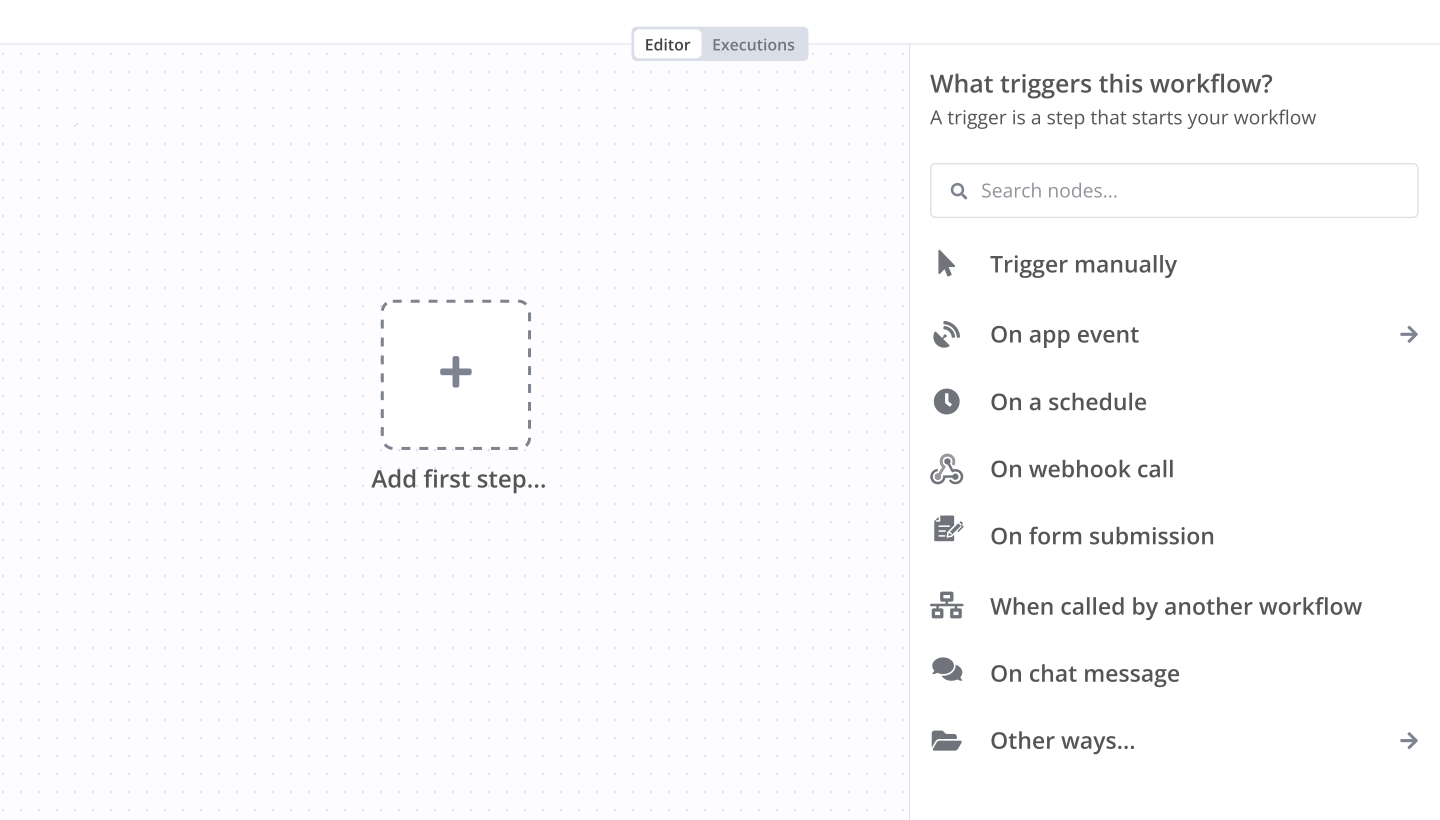
Step 1: Create a new workflow and add the first step

In n8n, click the "Add workflow" button in the Workflows tab to create a new workflow. Add the starting point – a trigger on when your workflow should run: an app event, a schedule, a webhook call, another workflow, an AI chat, or a manual trigger. Sometimes, the HTTP Request node might already serve as your starting point.

Baserow and SendGrid integration: Create a new workflow and add the first step

Step 2: Add and configure Baserow and SendGrid nodes

You can find Baserow and SendGrid in the nodes panel. Drag them onto your workflow canvas, selecting their actions. Click each node, choose a credential, and authenticate to grant n8n access. Configure Baserow and SendGrid nodes one by one: input data on the left, parameters in the middle, and output data on the right.

Baserow and SendGrid integration: Add and configure Baserow and SendGrid nodes

Step 3: Connect Baserow and SendGrid

A connection establishes a link between Baserow and SendGrid (or vice versa) to route data through the workflow. Data flows from the output of one node to the input of another. You can have single or multiple connections for each node.

Baserow and SendGrid integration: Connect Baserow and SendGrid

Step 4: Customize and extend your Baserow and SendGrid integration

Use n8n's core nodes such as If, Split Out, Merge, and others to transform and manipulate data. Write custom JavaScript or Python in the Code node and run it as a step in your workflow. Connect Baserow and SendGrid with any of n8n’s 1000+ integrations, and incorporate advanced AI logic into your workflows.

Baserow and SendGrid integration: Customize and extend your Baserow and SendGrid integration

Step 5: Test and activate your Baserow and SendGrid workflow

Save and run the workflow to see if everything works as expected. Based on your configuration, data should flow from Baserow to SendGrid or vice versa. Easily debug your workflow: you can check past executions to isolate and fix the mistake. Once you've tested everything, make sure to save your workflow and activate it.

Baserow and SendGrid integration: Test and activate your Baserow and SendGrid workflow

Track investments using Baserow and n8n

This workflow uses a number of technologies to track the value of ETFs, stocks and other exchange-traded products:

Baserow: To keep track of our investments
n8n’s Cron node: To trigger the workflow compiling our daily morning briefing
Webscraping: The HTTP Request & HTML Extract nodes to fetch up-to-date prices from the relevant stock exchange and structure this infromation
Javascript: We’ll use the Function node to build a custom HTML body with all the relevant information
Sendgrid: The Email Service Provider in this workflow to send out our email

Thanks to n8n, the steps in this workflow can easily be changed. Not a Sendgrid user? Simply remove the Sendgrid node and add a Gmail node instead. The stock exchange has a REST API? Just throw away the HTML Extract node.

Here’s how it works:

Data Source

In this scenario, our data source is Baserow. In our table, we’ll track all information needed to identify each investment product:

We have two text type columns (Name and ISIN) as well as two number type columns (Count and Purchase Price).

Workflow

Nodes

  1. Cron

The Cron node will trigger our workflow to run each work day in the morning hours.

  1. Baserow

The Baserow node will fetch our investments from the database table shown above.

  1. HTTP Request

Using the HTTP Request node we can fetch live data from the stock exchange of our choice based on the ISIN. This example uses Tradegate, which is used by many German fintechs. The basic approach should also work for other exchanges, as long as they provide the required data to the public.

  1. HTML Extract

Since our HTTP Request node fetches full websites, we’re using the HTML Extract node to extract the information we’re looking for from each website. If an exchange other than Tradegate is used, the selectors used in this node will most likely need to be updated.

      1. Set

The Set nodes helps with setting the exact columns we’ll use in our table. In this case we’re first formatting the results from our exchange, then calculate the changes based on the purchase price.

  1. Function

Here were using a bit of Javascript magic to build an HTML email. This is where any changes to the email content would have to be made.

  1. Sendgrid

Finally we send out the email built in the previous step. This is where you can configure sender and recipients.

Result

The basic email generated by this workflow will look like so:

Nodes used in this workflow

Popular Baserow and SendGrid workflows

Handle approval requests with SendGrid email and Baserow records

Approval Workflow Handler – SendGrid & Baserow This workflow automates the end-to-end approval process for any request type (e.g., purchase orders, content sign-off, access permissions). It routes the request to designated approvers, records every decision in a Baserow table, and notifies requesters and stakeholders via SendGrid at each stage. Pre-conditions/Requirements Prerequisites n8n instance (self-hosted, desktop, or n8n cloud) SendGrid account with an API Key Baserow workspace & table set up to store approval records Basic understanding of n8n node configuration Required Credentials SendGrid API Key** – For sending transactional emails Baserow Personal API Token** – For creating, updating, and querying table rows Specific Setup Requirements | Baserow Column | Type | Purpose | Example Value | | -------------- | -------- | ------------------------------------ | ------------- | | request_id | text | Unique identifier for each request | 2542 | | title | text | Short description of the request | “PO > $5K” | | status | single select | Tracks state (Pending, Approved, Rejected) | “Pending” | | requester | text | Email of person creating the request | [email protected] | | approver | text | Email of assigned approver | [email protected] | | updated_at | date | Last status change timestamp | | How it works This workflow automates the end-to-end approval process for any request type (e.g., purchase orders, content sign-off, access permissions). It routes the request to designated approvers, records every decision in a Baserow table, and notifies requesters and stakeholders via SendGrid at each stage. Key Steps: Trigger**: A Manual Trigger (or any upstream workflow) injects the initial request data. Create Record (Baserow)**: Store the new request as a “Pending” row. Notify Approver (SendGrid)**: Email the approver with approval/denial links. Wait for Action**: Hold execution until the approver clicks a link that calls the workflow’s Webhook URL. Decision Branch (If node)**: Determine whether the request is Approved or Rejected. Update Record (Baserow)**: Write the new status and timestamp back to the row. Notify Requester (SendGrid)**: Send the final decision to the original requester. Error Handling**: Error Trigger captures any unhandled failures and notifies ops. Set up steps Setup Time: 15-25 minutes Clone or import the template into your n8n instance. Add credentials a. Go to Credentials → New → SendGrid and paste your API key. b. Go to Credentials → New → Baserow and paste your Personal API Token. Configure environment variables (optional but recommended) APPROVER_EMAILS – Comma-separated list of default approvers. STAKEHOLDER_EMAILS – Comma-separated list of CC recipients. Edit the Baserow node Select your workspace and the “Approvals” table that matches the column schema above. Customize email templates in both SendGrid nodes (subject, HTML content, variables). Update Wait node’s webhook URL if running self-hosted behind a reverse proxy. Run a test execution using the Manual Trigger; confirm emails are delivered and the Baserow table updates correctly. Switch the trigger (optional) from Manual to Webhook or Schedule for production use. Enable workflow to begin processing live approval requests. Node Descriptions Core Workflow Nodes: Manual Trigger** – Starts the workflow during testing or via UI. Set (Initialize Request)** – Normalizes incoming data and generates a unique request_id. Baserow (Create Row)** – Inserts a new “Pending” record. SendGrid (Notify Approver)** – Sends approval request email with dynamic links. Wait** – Pauses execution until the approver responds. If (Decision)** – Routes the flow based on approved vs rejected. Baserow (Update Row)** – Writes final status and timestamp. SendGrid (Notify Requester)** – Communicates final decision. Merge** – Consolidates parallel branches before ending. Error Trigger** – Captures errors, logs them, and optionally notifies ops via email. Sticky Notes** – Contain inline documentation for maintainers. Data Flow: Manual Trigger → Set → Baserow (Create Row) → SendGrid (Notify Approver) → Wait Wait → If → (Approved ⬅︎ or ➡︎ Rejected) → Baserow (Update Row) → SendGrid (Notify Requester) → Merge Customization Examples Auto-assign approver based on request amount // Code node: Dynamic approver selection const amount = items[0].json.amount; items[0].json.approver = amount > 10000 ? '[email protected]' : '[email protected]'; return items; Slack notification instead of email // Replace SendGrid node with Slack node { "channel": "#approvals", "text": Request ${$json["request_id"]} was approved by ${$json["approver"]} } Data Output Format The workflow outputs structured JSON data: { "request_id": "2542", "title": "PO > $5K", "status": "Approved", "requester": "[email protected]", "approver": "[email protected]", "updated_at": "2024-04-27T15:41:22.347Z" } Troubleshooting Common Issues Emails not sending – Verify SendGrid API key and account sender verification; check node credentials. Baserow “permission denied” – Ensure the Personal API Token has access to the workspace and table. Wait node never resumes – Confirm the public webhook URL is reachable and correctly embedded in email links. Performance Tips Batch approvals in a single workflow run when possible to reduce API overhead. Set up Baserow table indexing on request_id for faster lookups. Pro Tips: Use the Error Trigger to post incidents to a dedicated Slack or Microsoft Teams channel. Store reusable email templates in a separate “Settings” sheet or in n8n’s global static data. Add analytics by sending events to PostHog or Amplitude after each approval. This is a community-contributed workflow template. It is provided “as-is” without warranty; review and test thoroughly before using in production.

Track investments using Baserow and n8n

This workflow uses a number of technologies to track the value of ETFs, stocks and other exchange-traded products: Baserow: To keep track of our investments n8n’s Cron node: To trigger the workflow compiling our daily morning briefing Webscraping: The HTTP Request & HTML Extract nodes to fetch up-to-date prices from the relevant stock exchange and structure this infromation Javascript: We’ll use the Function node to build a custom HTML body with all the relevant information Sendgrid: The Email Service Provider in this workflow to send out our email Thanks to n8n, the steps in this workflow can easily be changed. Not a Sendgrid user? Simply remove the Sendgrid node and add a Gmail node instead. The stock exchange has a REST API? Just throw away the HTML Extract node. Here’s how it works: Data Source In this scenario, our data source is Baserow. In our table, we’ll track all information needed to identify each investment product: We have two text type columns (Name and ISIN) as well as two number type columns (Count and Purchase Price). Workflow Nodes Cron The Cron node will trigger our workflow to run each work day in the morning hours. Baserow The Baserow node will fetch our investments from the database table shown above. HTTP Request Using the HTTP Request node we can fetch live data from the stock exchange of our choice based on the ISIN. This example uses Tradegate, which is used by many German fintechs. The basic approach should also work for other exchanges, as long as they provide the required data to the public. HTML Extract Since our HTTP Request node fetches full websites, we’re using the HTML Extract node to extract the information we’re looking for from each website. If an exchange other than Tradegate is used, the selectors used in this node will most likely need to be updated. + 6. Set The Set nodes helps with setting the exact columns we’ll use in our table. In this case we’re first formatting the results from our exchange, then calculate the changes based on the purchase price. Function Here were using a bit of Javascript magic to build an HTML email. This is where any changes to the email content would have to be made. Sendgrid Finally we send out the email built in the previous step. This is where you can configure sender and recipients. Result The basic email generated by this workflow will look like so:

Build your own Baserow and SendGrid integration

Create custom Baserow and SendGrid workflows by choosing triggers and actions. Nodes come with global operations and settings, as well as app-specific parameters that can be configured. You can also use the HTTP Request node to query data from any app or service with a REST API.

Baserow supported actions

Batch Create
Create up to 200 rows in one request
Batch Delete
Delete up to 200 rows in one request
Batch Update
Update up to 200 rows in one request
Create
Create a row
Delete
Delete a row
Get
Retrieve a row
Get Many
Retrieve many rows
Update
Update a row

SendGrid supported actions

Create or Update
Create a new contact, or update the current one if it already exists (upsert)
Delete
Delete a contact
Get
Get a contact by ID
Get Many
Get many contacts
Create
Create a list
Delete
Delete a list
Get
Get a list
Get Many
Get many lists
Update
Update a list
Send
Send an email

FAQs

  • Can Baserow connect with SendGrid?

  • Can I use Baserow’s API with n8n?

  • Can I use SendGrid’s API with n8n?

  • Is n8n secure for integrating Baserow and SendGrid?

  • How to get started with Baserow and SendGrid integration in n8n.io?

Need help setting up your Baserow and SendGrid integration?

Discover our latest community's recommendations and join the discussions about Baserow and SendGrid integration.
Isreal

Looking to integrate Baserow and SendGrid in your company?

Over 3000 companies switch to n8n every single week

Why use n8n to integrate Baserow with SendGrid

Build complex workflows, really fast

Build complex workflows, really fast

Handle branching, merging and iteration easily.
Pause your workflow to wait for external events.

Code when you need it, UI when you don't

Simple debugging

Your data is displayed alongside your settings, making edge cases easy to track down.

Use templates to get started fast

Use 1000+ workflow templates available from our core team and our community.

Reuse your work

Copy and paste, easily import and export workflows.

Implement complex processes faster with n8n

red iconyellow iconred iconyellow icon