Back to Integrations
integrationBox node
integrationHTTP Request node

Box and HTTP Request integration

Save yourself the work of writing custom integrations for Box and HTTP Request and use n8n instead. Build adaptable and scalable Data & Storage, Development, and Core Nodes workflows that work with your technology stack. All within a building experience you will love.

How to connect Box and HTTP Request

  • Step 1: Create a new workflow
  • Step 2: Add and configure nodes
  • Step 3: Connect
  • Step 4: Customize and extend your integration
  • Step 5: Test and activate your workflow

Step 1: Create a new workflow and add the first step

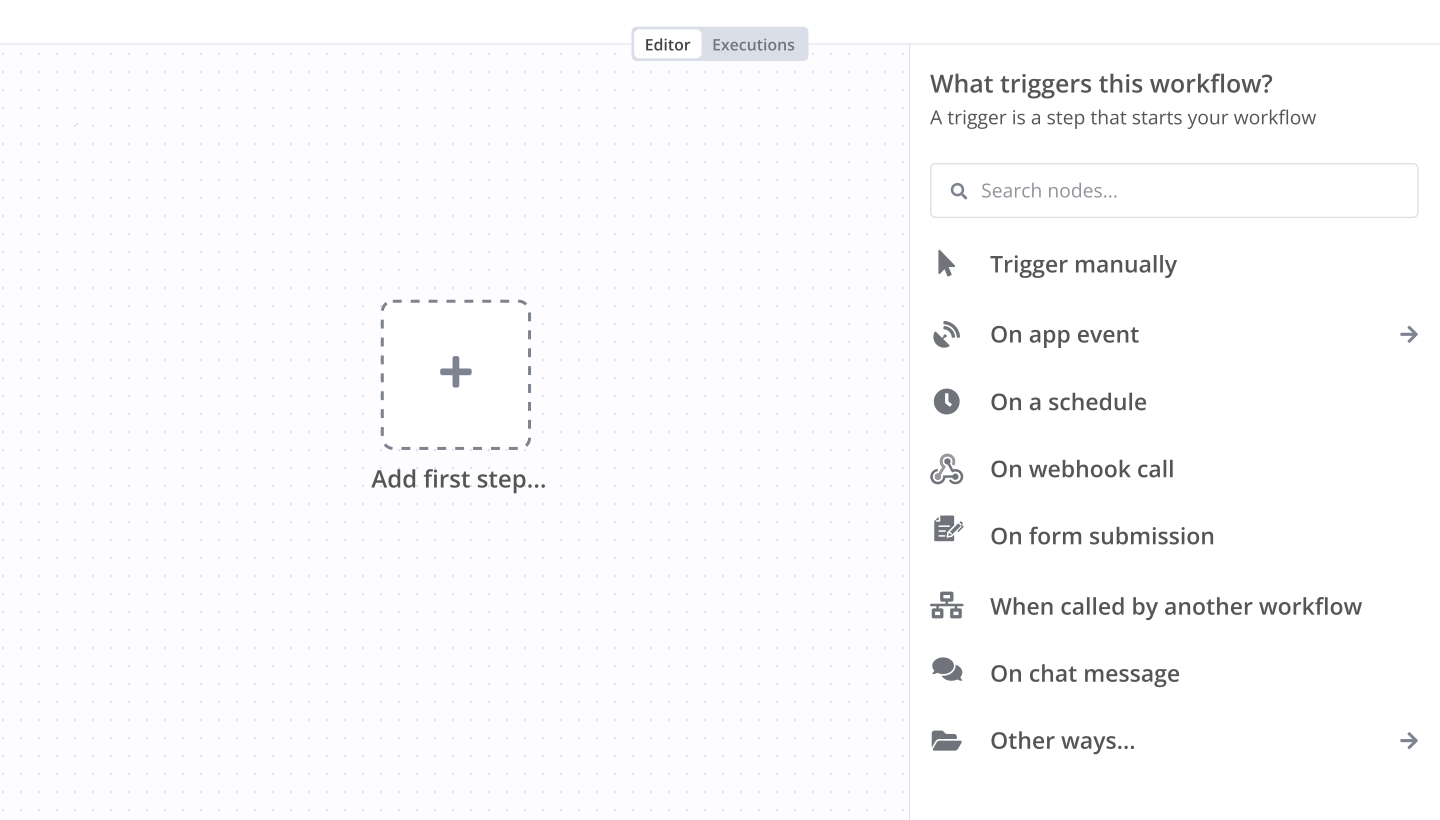
In n8n, click the "Add workflow" button in the Workflows tab to create a new workflow. Add the starting point – a trigger on when your workflow should run: an app event, a schedule, a webhook call, another workflow, an AI chat, or a manual trigger. Sometimes, the HTTP Request node might already serve as your starting point.

Box and HTTP Request integration: Create a new workflow and add the first step

Step 2: Add and configure Box and HTTP Request nodes

You can find Box and HTTP Request in the nodes panel. Drag them onto your workflow canvas, selecting their actions. Click each node, choose a credential, and authenticate to grant n8n access. Configure Box and HTTP Request nodes one by one: input data on the left, parameters in the middle, and output data on the right.

Box and HTTP Request integration: Add and configure Box and HTTP Request nodes

Step 3: Connect Box and HTTP Request

A connection establishes a link between Box and HTTP Request (or vice versa) to route data through the workflow. Data flows from the output of one node to the input of another. You can have single or multiple connections for each node.

Box and HTTP Request integration: Connect Box and HTTP Request

Step 4: Customize and extend your Box and HTTP Request integration

Use n8n's core nodes such as If, Split Out, Merge, and others to transform and manipulate data. Write custom JavaScript or Python in the Code node and run it as a step in your workflow. Connect Box and HTTP Request with any of n8n’s 1000+ integrations, and incorporate advanced AI logic into your workflows.

Box and HTTP Request integration: Customize and extend your Box and HTTP Request integration

Step 5: Test and activate your Box and HTTP Request workflow

Save and run the workflow to see if everything works as expected. Based on your configuration, data should flow from Box to HTTP Request or vice versa. Easily debug your workflow: you can check past executions to isolate and fix the mistake. Once you've tested everything, make sure to save your workflow and activate it.

Box and HTTP Request integration: Test and activate your Box and HTTP Request workflow

Automated video translation & distribution with DubLab to multiple platforms

Automated n8n workflow: Receives videos via form, dubs/translates them to the selected languages, and—upon completion—uploads them to multiple social media channels and cloud drives, including Box, Dropbox, and YouTube, Telegram, Postiz (Facebook, Instagram, Tiktok, Reddit etc.)

Workflows
Via n8n form select files to dub for desired languages.
Listen webhook and whenever dubbing finishes upload to desired platforms

Used Stacks
DubLab App (ApiKey, Webhook Setup Required)
Optional (Upload)
Telegram (Token Required)
Box (Oauth2 Required)
Dropbox (Oauth2 Required)
Youtube (Oauth2 Required)
Postiz (ApiKey Required)

Nodes used in this workflow

Popular Box and HTTP Request workflows

Automated Video Translation & Distribution with DubLab to Multiple Platforms

Automated n8n workflow: Receives videos via form, dubs/translates them to the selected languages, and—upon completion—uploads them to multiple social media channels and cloud drives, including Box, Dropbox, and YouTube, Telegram, Postiz (Facebook, Instagram, Tiktok, Reddit etc.) Workflows Via n8n form select files to dub for desired languages. Listen webhook and whenever dubbing finishes upload to desired platforms Used Stacks DubLab App (ApiKey, Webhook Setup Required) Optional (Upload) Telegram (Token Required) Box (Oauth2 Required) Dropbox (Oauth2 Required) Youtube (Oauth2 Required) Postiz (ApiKey Required)

Back up databases and files to Box with Mailgun email notifications

Scheduled Backup Automation – Mailgun & Box This workflow automatically schedules, packages, and uploads backups of your databases, files, or configuration exports to Box cloud storage, then sends a completion email via Mailgun. It is ideal for small-to-medium businesses or solo developers who want hands-off, verifiable backups without writing custom scripts. Pre-conditions/Requirements Prerequisites n8n instance (self-hosted or n8n.cloud) Box account with a folder dedicated to backups Mailgun account & verified domain Access to the target database/server you intend to back up Basic knowledge of environment variables to store secrets Required Credentials Box OAuth2** – For uploading the backup file(s) Mailgun API Key** – For sending backup status notifications (Optional) Database Credentials** – Only if the backup includes a DB dump triggered from inside n8n Specific Setup Requirements | Variable | Example | Purpose | |-------------------------|------------------------------------------|---------------------------------------| | BOX_FOLDER_ID | 1234567890 | ID of the Box folder that stores backups | | MAILGUN_DOMAIN | mg.example.com | Mailgun domain used for sending email | | MAILGUN_FROM | Backups <[email protected]> | “From” address in status emails | | NOTIFY_EMAIL | [email protected] | Recipient of backup status emails | How it works This workflow automatically schedules, packages, and uploads backups of your databases, files, or configuration exports to Box cloud storage, then sends a completion email via Mailgun. It is ideal for small-to-medium businesses or solo developers who want hands-off, verifiable backups without writing custom scripts. Key Steps: Webhook (Scheduler Trigger)**: Triggers the workflow on a CRON schedule or external call. Code (DB/File Dump)**: Executes bash or Node.js commands to create a tar/zip or SQL dump. Move Binary Data**: Converts the created file into n8n binary format. Set**: Attaches metadata (timestamp, file name). Split In Batches* *(optional): Splits multiple backup files for sequential uploads. Box Node**: Uploads each backup file into the specified Box folder. HTTP Request (Verify Upload)**: Calls Box API to confirm upload success. If**: Branches on success vs failure. Mailgun Node**: Sends confirmation or error report email. Sticky Notes**: Provide inline documentation inside the workflow canvas. Set up steps Setup Time: 15-20 minutes Clone or import the workflow JSON into your n8n instance. Create credentials: Box OAuth2: paste Client ID, Client Secret, perform OAuth handshake. Mailgun API: add Private API key and domain. Update environment variables (BOX_FOLDER_ID, MAILGUN_DOMAIN, etc.) or edit the relevant Set node. Modify the Code node to run your specific backup command, e.g.: pg_dump -U $DB_USER -h $DB_HOST $DB_NAME > /tmp/db_backup.sql tar -czf /tmp/full_backup_{{new Date().toISOString()}}.tar.gz /etc/nginx /var/www /tmp/db_backup.sql Set the CRON schedule inside the Webhook node (or replace with a Cron node) to your desired frequency (daily, weekly, etc.). Execute once manually to verify the Box upload and email notification. Enable the workflow. Node Descriptions Core Workflow Nodes: Webhook / Cron** – Acts as the time-based trigger for backups. Code** – Creates the actual backup archive (tar, zip, SQL dump). Move Binary Data** – Moves the generated file into binary property. Set** – Adds filename and timestamp metadata for Box. Split In Batches** – Handles multiple files when necessary. Box** – Uploads the backup file to Box. HTTP Request** – Optional re-check to ensure the file exists in Box. If** – Routes the flow based on success or error. Mailgun** – Sends success/failure notifications. Sticky Note** – Explains credential handling and customization points. Data Flow: Webhook/Cron → Code → Move Binary Data → Set → Split In Batches → Box → HTTP Request → If → Mailgun Customization Examples Add Retention Policy (Auto-delete old backups) // In a Code node before upload const retentionDays = 30; const cutoff = Date.now() - retentionDays * 246060*1000; items = items.filter(item => { return item.json.modifiedAt > cutoff; // keep only recent files }); return items; Parallel Upload to S3 // Duplicate the Box node, replace with AWS S3 node // Use Merge node to combine results before the HTTP Request verification Data Output Format The workflow outputs structured JSON data: { "fileName": "full_backup_2023-10-31T00-00-00Z.tar.gz", "boxFileId": "9876543210", "uploadStatus": "success", "timestamp": "2023-10-31T00:05:12Z", "emailNotification": "sent" } Troubleshooting Common Issues “Invalid Box Folder ID” – Verify BOX_FOLDER_ID and ensure the OAuth user has write permissions. Mailgun 401 Unauthorized – Check that you used the Private API key and the domain is verified. Backup file too large – Enable chunked upload in Box node or increase client_max_body_size on reverse proxy. Performance Tips Compress backups with gzip or zstd to reduce upload time. Run the database dump on the same host as n8n to avoid network overhead. Pro Tips: Store secrets as environment variables and reference them in Code nodes (process.env.MY_SECRET). Chain backups with version numbers (YYYYMMDD_HHmm) for easy sorting. Use n8n’s built-in execution logging to audit backup history. This is a community workflow template provided “as-is” without warranty. Adapt and test in a safe environment before using in production.

Score and route leads with Telegram alerts and Box storage

Lead Scoring Pipeline with Telegram and Box This workflow ingests incoming lead data from a form submission webhook, enriches each lead with external data sources, applies a custom scoring algorithm, and automatically stores the enriched record in Box while notifying your sales team in Telegram. It is designed to give you a real-time, end-to-end lead-qualification pipeline without writing any glue code. Pre-conditions/Requirements Prerequisites n8n instance (self-hosted or n8n.cloud) ScrapeGraphAI community node installed (not directly used in this template but required by marketplace listing rules) Telegram Bot created via BotFather Box account (Developer App or User OAuth2) Publicly accessible URL (for the Webhook trigger) Optional: Enrichment API account (e.g., Clearbit, PDL) for richer scoring data Required Credentials | Credential | Scope | Purpose | |------------|-------|---------| | Telegram Bot Token | Bot | Send scored-lead alerts | | Box OAuth2 Credentials | App Level | Upload enriched lead JSON/CSV | | (Optional) Enrichment API Key | REST | Append firmographic & technographic data | Environment Variables (Recommended) | Variable | Example | Description | |---------|----------|-------------| | LEAD_SCORE_THRESHOLD | 75 | Minimum score that triggers a Telegram alert | | BOX_FOLDER_ID | 123456789 | Destination folder for lead files | How it works This workflow listens for new form submissions, enriches each contact with external data, calculates a lead score based on configurable criteria, and routes the lead through one of two branches: high-value leads trigger an instant Telegram alert and are archived to Box, while low-value leads are archived only. Errors are captured by an Error Trigger for post-mortem analysis. Key Steps: Webhook Trigger**: Receives raw form data (name, email, company, etc.). Set node – Normalization**: Renames fields and initializes default values. HTTP Request – Enrichment**: Calls an external enrichment API to augment data. Merge node**: Combines original and enriched data into a single object. Code node – Scoring**: Runs JavaScript to calculate a numeric lead score. If node – Qualification Gate**: Checks if score ≥ LEAD_SCORE_THRESHOLD. Telegram node**: Sends alert message to your sales channel for high-scoring leads. Box node**: Uploads the enriched JSON (or CSV) file into a specified folder. Error Trigger**: Captures any unhandled errors and notifies ops (optional). Sticky Notes**: Explain scoring logic and credential placement (documentation aids). Set up steps Setup Time: 15-25 minutes Create Telegram Bot & Get Token Talk to BotFather → /newbot → copy the provided token. Create a Box Developer App Enable OAuth2 → add https://api.n8n.cloud/oauth2-credential/callback (or your own) as redirect URI. Install Required Community Nodes From n8n editor → “Install” → search “ScrapeGraphAI” → install. Import the Workflow JSON Click “Import” → paste the workflow file → save. Configure the Webhook URL in Your Form Tool Copy the production URL generated by the Webhook node → add it as form action. Set Environment Variables In n8n (Settings → Environment) add LEAD_SCORE_THRESHOLD and BOX_FOLDER_ID. Fill in All Credentials Telegram: paste bot token. Box: complete OAuth2 flow. Enrichment API: paste key in the HTTP Request node headers. Activate Workflow Toggle “Activate”. Submit a test form to verify Telegram/Box outputs. Node Descriptions Core Workflow Nodes: Webhook** – Entry point; captures incoming JSON payload from the form. Set (Normalize Fields)** – Maps raw keys to standardized ones (firstName, email, etc.). HTTP Request (Enrichment)** – Queries external service for firmographic data. Merge (Combine Data)** – Merges the two JSON objects (form + enrichment). Code (Scoring)** – Calculates lead score using weighted attributes. If (Score Check)** – Branches flow based on the score threshold. Telegram** – Sends high-score alerts to a specified chat ID. Box** – Saves a JSON/CSV file of the enriched lead to cloud storage. Error Trigger** – Executes if any preceding node fails. Sticky Notes** – Inline documentation for quick reference. Data Flow: Webhook → Set → HTTP Request → Merge → Code → If If (true) → Telegram If (always) → Box Error (from any node) → Error Trigger Customization Examples Change Scoring Logic // Inside the Code node const { jobTitle, companySize, technologies } = items[0].json; let score = 0; if (jobTitle.match(/(CTO|CEO|Founder)/i)) score += 50; if (companySize > 500) score += 20; if (technologies.includes('AWS')) score += 10; // Bonus: subtract points if free email domain if (items[0].json.email.endsWith('@gmail.com')) score -= 30; return [{ json: { ...items[0].json, score } }]; Use a Different Storage Provider (e.g., Google Drive) // Replace Box node with Google Drive node { "node": "Google Drive", "operation": "upload", "fileName": "lead_{{$json.email}}.json", "folderId": "1A2B3C..." } Data Output Format The workflow outputs structured JSON data: { "firstName": "Ada", "lastName": "Lovelace", "email": "[email protected]", "company": "Analytical Engines Inc.", "companySize": 250, "jobTitle": "CTO", "technologies": ["AWS", "Docker", "Node.js"], "score": 82, "qualified": true, "timestamp": "2024-04-07T12:34:56.000Z" } Troubleshooting Common Issues Telegram messages not received – Ensure the bot is added to the group and chat_id/token are correct. Box upload fails with 403 – Check folder permissions; verify OAuth2 tokens have not expired. Webhook shows 404 – The workflow is not activated or the URL was copied in “Test” mode instead of “Production”. Performance Tips Batch multiple form submissions using the “SplitInBatches” node to reduce API-call overhead. Cache enrichment responses (Redis, n8n Memory) to avoid repeated lookups for the same domain. Pro Tips: Add an n8n “Wait” node between enrichment calls to respect rate limits. Use Static Data to store domain-level enrichment results for even faster runs. Tag Telegram alerts with emojis based on score (🔥 Hot Lead for >90). This is a community-contributed n8n workflow template provided “as-is.” Always test thoroughly in a non-production environment before deploying to live systems.

+4

Generate UGC product video ads from a reference image with OpenAI and Kie.ai

How it works Analyzes a reference product image using AI vision to extract brand elements, colors, and design Generates UGC-style prompts for image and video creation based on your specifications Calls external APIs to generate product images and videos at scale Polls for completion and retrieves the generated media files Uploads all videos to Box and Google Drive, then logs results to Google Sheets Set up steps Connect OpenAI credentials for image analysis Configure your image generation API credentials Configure your video generation API credentials Connect Google Drive and Box for file uploads Connect Google Sheets for tracking and logging Keep detailed descriptions of your UGC style preferences in the sticky notes inside your workflow

Build your own Box and HTTP Request integration

Create custom Box and HTTP Request workflows by choosing triggers and actions. Nodes come with global operations and settings, as well as app-specific parameters that can be configured. You can also use the HTTP Request node to query data from any app or service with a REST API.

Box supported actions

Copy
Copy a file
Delete
Delete a file
Download
Download a file
Get
Get a file
Search
Search files
Share
Share a file
Upload
Upload a file
Create
Create a folder
Delete
Delete a folder
Get
Get a folder
Search
Search files
Share
Share a folder
Update
Update folder
Use case

Save engineering resources

Reduce time spent on customer integrations, engineer faster POCs, keep your customer-specific functionality separate from product all without having to code.

Learn more

FAQs

  • Can Box connect with HTTP Request?

  • Can I use Box’s API with n8n?

  • Can I use HTTP Request’s API with n8n?

  • Is n8n secure for integrating Box and HTTP Request?

  • How to get started with Box and HTTP Request integration in n8n.io?

Need help setting up your Box and HTTP Request integration?

Discover our latest community's recommendations and join the discussions about Box and HTTP Request integration.
Moiz Contractor
theo
Jon
Dan Burykin
Tony

Looking to integrate Box and HTTP Request in your company?

Over 3000 companies switch to n8n every single week

Why use n8n to integrate Box with HTTP Request

Build complex workflows, really fast

Build complex workflows, really fast

Handle branching, merging and iteration easily.
Pause your workflow to wait for external events.

Code when you need it, UI when you don't

Simple debugging

Your data is displayed alongside your settings, making edge cases easy to track down.

Use templates to get started fast

Use 1000+ workflow templates available from our core team and our community.

Reuse your work

Copy and paste, easily import and export workflows.

Implement complex processes faster with n8n

red iconyellow iconred iconyellow icon