Back to Integrations
integrationDatabricks node
integrationGoogle Forms node
HTTP Request

Databricks and Google Forms integration

Save yourself the work of writing custom integrations for Databricks and Google Forms and use n8n instead. Build adaptable and scalable Data & Storage, and Productivity workflows that work with your technology stack. All within a building experience you will love.

How to connect Databricks and Google Forms

  • Step 1: Create a new workflow
  • Step 2: Add and configure nodes
  • Step 3: Connect
  • Step 4: Customize and extend your integration
  • Step 5: Test and activate your workflow

Step 1: Create a new workflow and add the first step

In n8n, click the "Add workflow" button in the Workflows tab to create a new workflow. Add the starting point – a trigger on when your workflow should run: an app event, a schedule, a webhook call, another workflow, an AI chat, or a manual trigger. Sometimes, the HTTP Request node might already serve as your starting point.
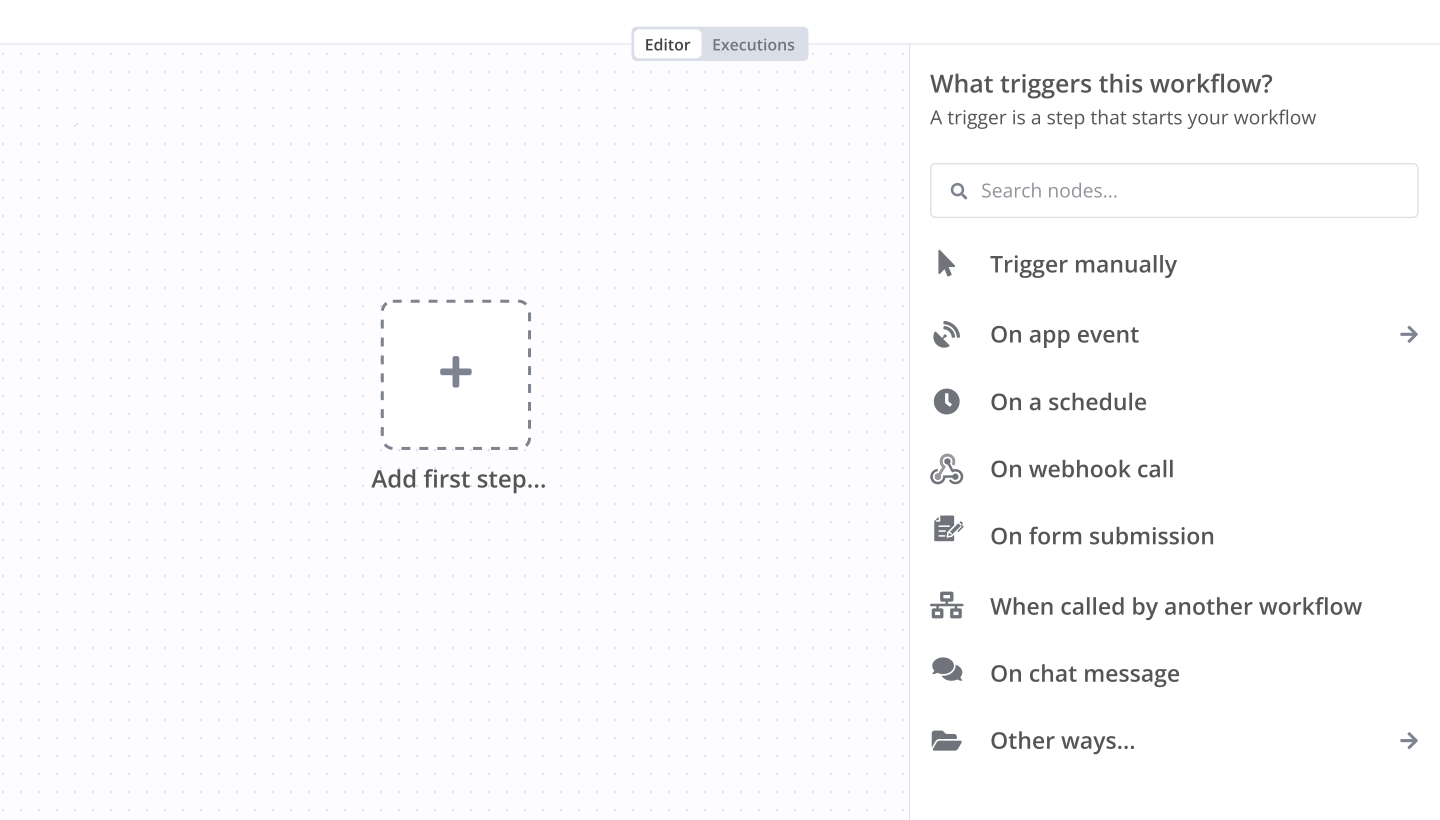
Databricks and Google Forms integration: Create a new workflow and add the first step

Step 2: Add and configure Databricks and Google Forms nodes (using the HTTP Request node)

You can find the Databricks node in the nodes panel and drag it onto your workflow canvas. To add the Google Forms app to the workflow select the HTTP Request node and use the generic authentication method to make custom API calls to Google Forms. Configure Google Forms and Databricks one by one: input data on the left, parameters in the middle, and output data on the right.

Databricks and Google Forms integration: Add and configure Databricks and Google Forms nodes

Step 3: Connect Databricks and Google Forms

A connection establishes a link between Databricks and Google Forms (or vice versa) to route data through the workflow. Data flows from the output of one node to the input of another. You can have single or multiple connections for each node.

Databricks and Google Forms integration: Connect Databricks and Google Forms

Step 4: Customize and extend your Databricks and Google Forms integration

Use n8n's core nodes such as If, Split Out, Merge, and others to transform and manipulate data. Write custom JavaScript or Python in the Code node and run it as a step in your workflow. Connect Databricks and Google Forms with any of n8n’s 1000+ integrations, and incorporate advanced AI logic into your workflows.

Databricks and Google Forms integration: Customize and extend your Databricks and Google Forms integration

Step 5: Test and activate your Databricks and Google Forms workflow

Save and run the workflow to see if everything works as expected. Based on your configuration, data should flow from Databricks to Google Forms or vice versa. Easily debug your workflow: you can check past executions to isolate and fix the mistake. Once you've tested everything, make sure to save your workflow and activate it.

Databricks and Google Forms integration: Test and activate your Databricks and Google Forms workflow

Build your own Databricks and Google Forms integration

Create custom Databricks and Google Forms workflows by choosing triggers and actions. Nodes come with global operations and settings, as well as app-specific parameters that can be configured. You can also use the HTTP Request node to query data from any app or service with a REST API.

Databricks supported actions

Execute Query
Execute a SQL query and wait for results
Create Directory
Create a directory in volume
Delete Directory
Delete a directory in volume
Delete File
Delete a file from a volume
Download File
Download file content from a volume
Get File Metadata
Get file metadata from a volume
List Directory
List directory contents in volume
Upload File
Upload a file (up to 5 GiB) to Databricks volumes
Create Conversation Message
Create a new conversation message
Execute Message SQL Query
Execute a SQL query from a message attachment
Get Conversation Message
Get a conversation message by ID
Get Genie Space
Get details of a Genie space
Get Query Results
Get results of a SQL query execution
Start Conversation
Start a new conversation
Query Endpoint
Query a serving endpoint. The input format is automatically detected from the endpoint schema.
Create Catalog
Create a new catalog
Create Function
Create a new function
Create Table
Register a new table
Create Volume
Create a new volume
Delete Catalog
Delete a catalog
Delete Function
Delete a function
Delete Table
Delete a table
Delete Volume
Delete a volume
Get Catalog
Get catalog information
Get Function
Get function information
Get Table
Get table information
Get Volume
Get volume information
List Catalogs
List all catalogs
List Functions
List functions in schema
List Tables
List tables in schema
List Volumes
List volumes in schema
Update Catalog
Update catalog information
Create Index
Create a new vector search index
Get Index
Get details of a vector search index
List Indexes
List all vector search indexes
Query Index
Query a vector search index with text or vectors

Supported API Endpoints for Google Forms

To set up Google Forms integration, add the HTTP Request node to your workflow canvas and authenticate it using a generic authentication method. The HTTP Request node makes custom API calls to Google Forms to query the data you need using the API endpoint URLs you provide.

Create form
Creates a new form.
POST
/forms/api/reference/rest/v1/forms/create
Get form
Retrieves the details of a specific form.
GET
/forms/api/reference/rest/v1/forms/get
Batch update form
Change the form with a batch of updates.
POST
/v1/forms/{formId}:batchUpdate
Create form
Create a new form using the title given in the provided form message in the request.
POST
/v1/forms
Get form
Get a form.
GET
/v1/forms/{formId}
Create form
Creates a new form.
POST
/forms/create
Get form
Retrieves a specific form by its ID.
GET
/forms/get
List forms
Retrieve a list of forms available to the user.
GET
/v1/forms
Batch update form
Change the form with a batch of updates.
POST
/v1/forms/batchUpdate
Create form
Create a new form using the title given in the provided form message in the request.
POST
/v1/forms/create
Get form
Get a form.
GET
/v1/forms/get

These API endpoints were generated using n8n

n8n AI workflow transforms web scraping into an intelligent, AI-powered knowledge extraction system that uses vector embeddings to semantically analyze, chunk, store, and retrieve the most relevant API documentation from web pages. Remember to check the Google Forms official documentation to get a full list of all API endpoints and verify the scraped ones!

Get responses
Retrieves responses for a specific form.
GET
/forms/api/reference/rest/v1/forms.responses/get
List responses
Lists responses for a specific form.
GET
/forms/api/reference/rest/v1/forms.responses/list
Get response
Get one response from the form.
GET
/v1/forms/{formId}/responses/{responseId}
List responses
List a form's responses.
GET
/v1/forms/{formId}/responses
Get responses
Retrieves responses for a specific form.
GET
/forms.responses/get
List responses
Lists all responses for a specific form.
GET
/forms.responses/list

These API endpoints were generated using n8n

n8n AI workflow transforms web scraping into an intelligent, AI-powered knowledge extraction system that uses vector embeddings to semantically analyze, chunk, store, and retrieve the most relevant API documentation from web pages. Remember to check the Google Forms official documentation to get a full list of all API endpoints and verify the scraped ones!

Create watch
Creates a watch on a specific form.
POST
/forms/api/reference/rest/v1/forms.watches/create
Delete watch
Deletes a watch on a specific form.
DELETE
/forms/api/reference/rest/v1/forms.watches/delete
List watches
Lists all watches for a specific form.
GET
/forms/api/reference/rest/v1/forms.watches/list
Renew watch
Renews a watch for a specific form.
POST
/forms/api/reference/rest/v1/forms.watches/renew
Create watch
Create a new watch.
POST
/v1/forms/{formId}/watches
Delete watch
Delete a watch.
DELETE
/v1/forms/{formId}/watches/{watchId}
Renew watch
Renew an existing watch for seven days.
POST
/v1/forms/{formId}/watches/{watchId}:renew
Create watch
Sets up a watch on a form to receive notifications.
POST
/forms.watches/create
Delete watch
Deletes the watch that was set up for a form.
DELETE
/forms.watches/delete
List watches
Lists all watches set up for a specific form.
GET
/forms.watches/list
Renew watch
Renews an existing watch for a form.
POST
/forms.watches/renew

These API endpoints were generated using n8n

n8n AI workflow transforms web scraping into an intelligent, AI-powered knowledge extraction system that uses vector embeddings to semantically analyze, chunk, store, and retrieve the most relevant API documentation from web pages. Remember to check the Google Forms official documentation to get a full list of all API endpoints and verify the scraped ones!

FAQs

  • Can Databricks connect with Google Forms?

  • Can I use Databricks’s API with n8n?

  • Can I use Google Forms’s API with n8n?

  • Is n8n secure for integrating Databricks and Google Forms?

  • How to get started with Databricks and Google Forms integration in n8n.io?

Looking to integrate Databricks and Google Forms in your company?

Over 3000 companies switch to n8n every single week

Why use n8n to integrate Databricks with Google Forms

Build complex workflows, really fast
Build complex workflows, really fast

Handle branching, merging and iteration easily.
Pause your workflow to wait for external events.

Code when you need it, UI when you don't

Simple debugging

Your data is displayed alongside your settings, making edge cases easy to track down.

Use templates to get started fast

Use 1000+ workflow templates available from our core team and our community.

Reuse your work

Copy and paste, easily import and export workflows.

Implement complex processes faster with n8n

red iconyellow iconred iconyellow icon