

Databricks and Microsoft OneDrive integration
Save yourself the work of writing custom integrations for Databricks and Microsoft OneDrive and use n8n instead. Build adaptable and scalable Data & Storage workflows that work with your technology stack. All within a building experience you will love.
How to connect Databricks and Microsoft OneDrive
- Step 1: Create a new workflow
- Step 2: Add and configure nodes
- Step 3: Connect
- Step 4: Customize and extend your integration
- Step 5: Test and activate your workflow
Step 1: Create a new workflow and add the first step
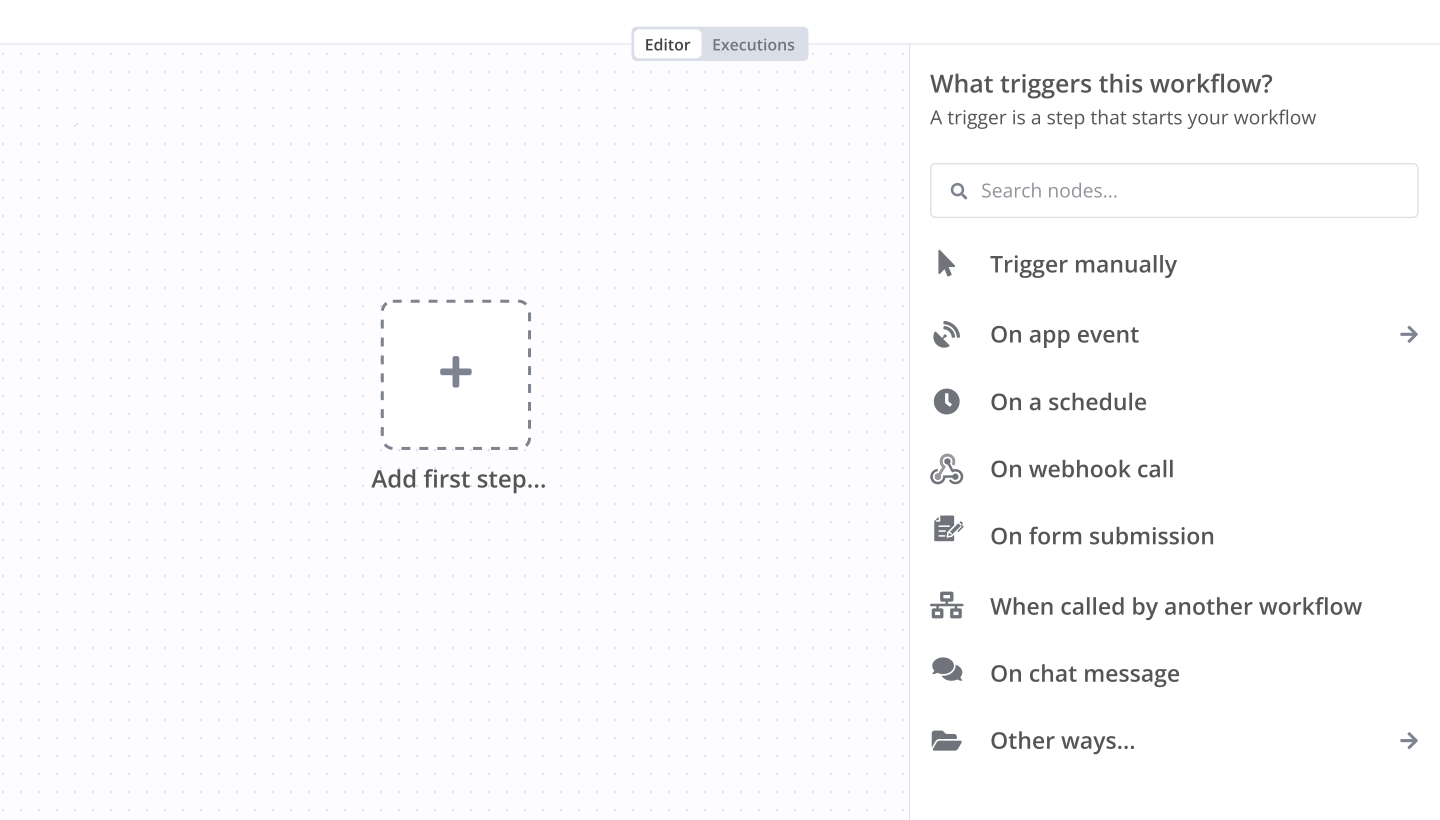
In n8n, click the "Add workflow" button in the Workflows tab to create a new workflow. Add the starting point – a trigger on when your workflow should run: an app event, a schedule, a webhook call, another workflow, an AI chat, or a manual trigger. Sometimes, the HTTP Request node might already serve as your starting point.
Step 2: Add and configure Databricks and Microsoft OneDrive nodes
You can find Databricks and Microsoft OneDrive in the nodes panel. Drag them onto your workflow canvas, selecting their actions. Click each node, choose a credential, and authenticate to grant n8n access. Configure Databricks and Microsoft OneDrive nodes one by one: input data on the left, parameters in the middle, and output data on the right.

Step 3: Connect Databricks and Microsoft OneDrive
A connection establishes a link between Databricks and Microsoft OneDrive (or vice versa) to route data through the workflow. Data flows from the output of one node to the input of another. You can have single or multiple connections for each node.

Step 4: Customize and extend your Databricks and Microsoft OneDrive integration
Use n8n's core nodes such as If, Split Out, Merge, and others to transform and manipulate data. Write custom JavaScript or Python in the Code node and run it as a step in your workflow. Connect Databricks and Microsoft OneDrive with any of n8n’s 1000+ integrations, and incorporate advanced AI logic into your workflows.

Step 5: Test and activate your Databricks and Microsoft OneDrive workflow
Save and run the workflow to see if everything works as expected. Based on your configuration, data should flow from Databricks to Microsoft OneDrive or vice versa. Easily debug your workflow: you can check past executions to isolate and fix the mistake. Once you've tested everything, make sure to save your workflow and activate it.

Build your own Databricks and Microsoft OneDrive integration
Create custom Databricks and Microsoft OneDrive workflows by choosing triggers and actions. Nodes come with global operations and settings, as well as app-specific parameters that can be configured. You can also use the HTTP Request node to query data from any app or service with a REST API.
Databricks and Microsoft OneDrive integration details



FAQs
Can Databricks connect with Microsoft OneDrive?
Can I use Databricks’s API with n8n?
Can I use Microsoft OneDrive’s API with n8n?
Is n8n secure for integrating Databricks and Microsoft OneDrive?
How to get started with Databricks and Microsoft OneDrive integration in n8n.io?
Looking to integrate Databricks and Microsoft OneDrive in your company?
Over 3000 companies switch to n8n every single week









Why use n8n to integrate Databricks with Microsoft OneDrive
Build complex workflows, really fast