Back to Integrations
integrationGitLab node
integrationTelegram node

GitLab and Telegram integration

Save yourself the work of writing custom integrations for GitLab and Telegram and use n8n instead. Build adaptable and scalable Development, Communication, and HITL workflows that work with your technology stack. All within a building experience you will love.

How to connect GitLab and Telegram

  • Step 1: Create a new workflow
  • Step 2: Add and configure nodes
  • Step 3: Connect
  • Step 4: Customize and extend your integration
  • Step 5: Test and activate your workflow

Step 1: Create a new workflow and add the first step

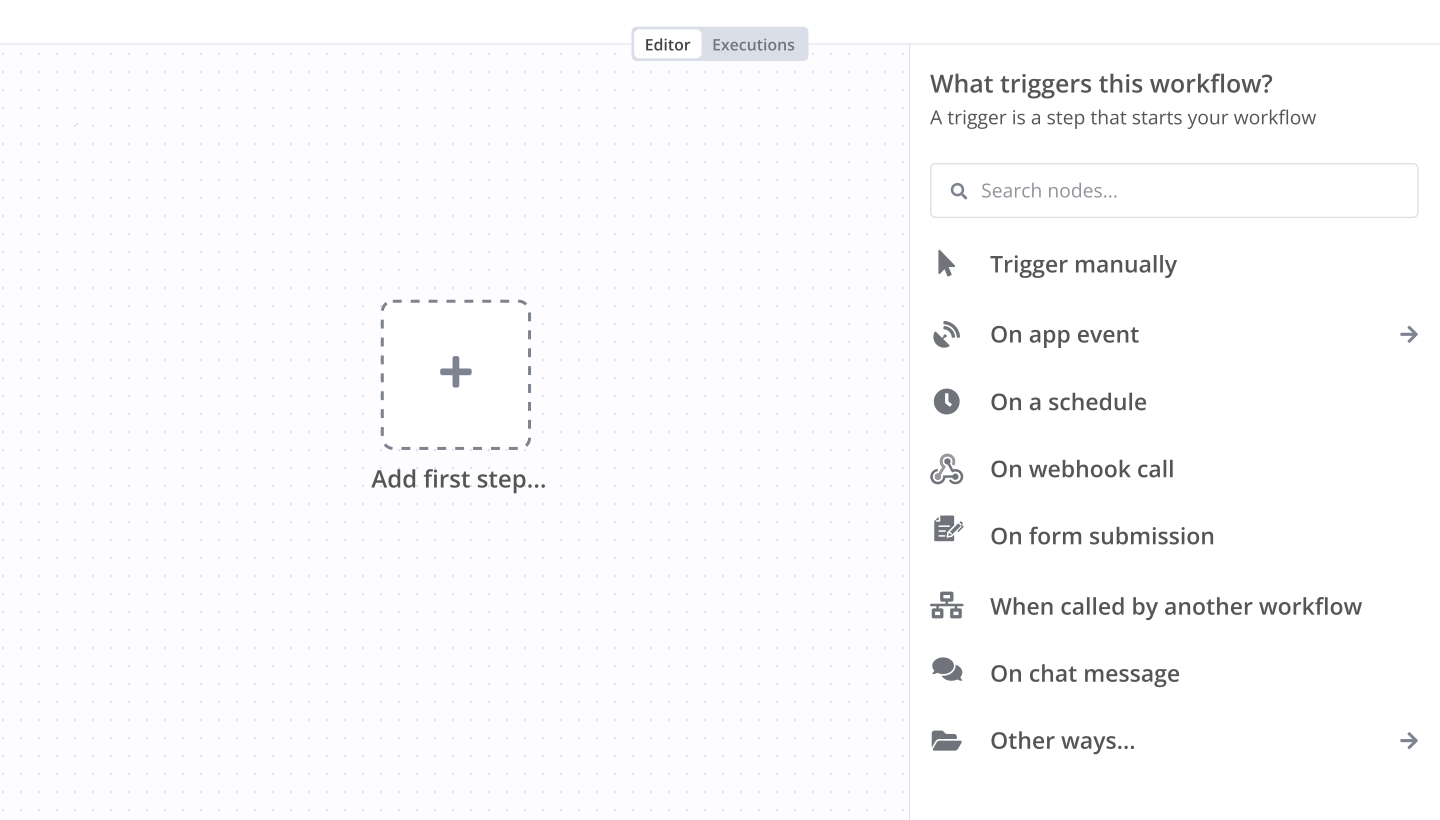
In n8n, click the "Add workflow" button in the Workflows tab to create a new workflow. Add the starting point – a trigger on when your workflow should run: an app event, a schedule, a webhook call, another workflow, an AI chat, or a manual trigger. Sometimes, the HTTP Request node might already serve as your starting point.

GitLab and Telegram integration: Create a new workflow and add the first step

Step 2: Add and configure GitLab and Telegram nodes

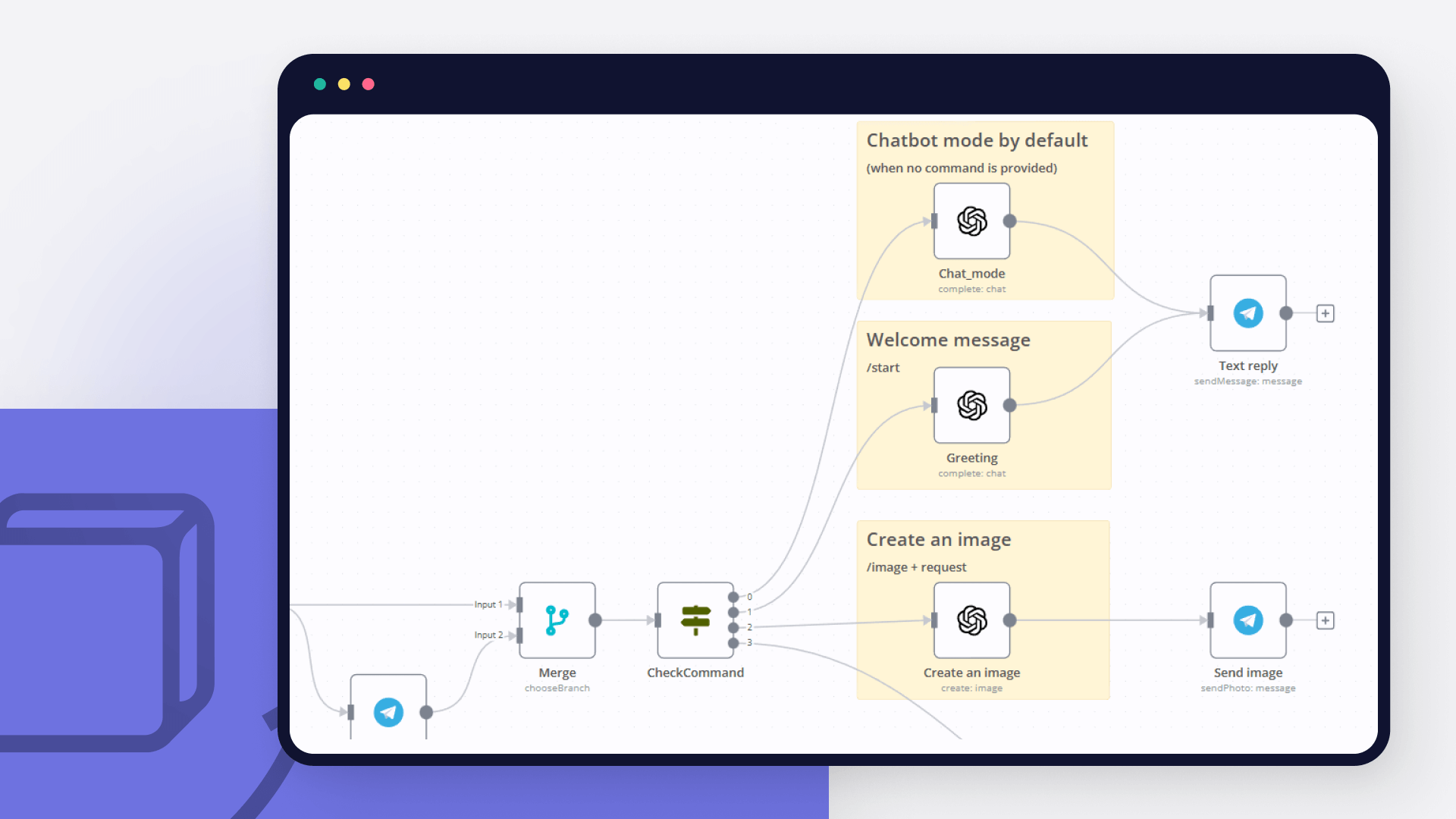
You can find GitLab and Telegram in the nodes panel. Drag them onto your workflow canvas, selecting their actions. Click each node, choose a credential, and authenticate to grant n8n access. Configure GitLab and Telegram nodes one by one: input data on the left, parameters in the middle, and output data on the right.

GitLab and Telegram integration: Add and configure GitLab and Telegram nodes

Step 3: Connect GitLab and Telegram

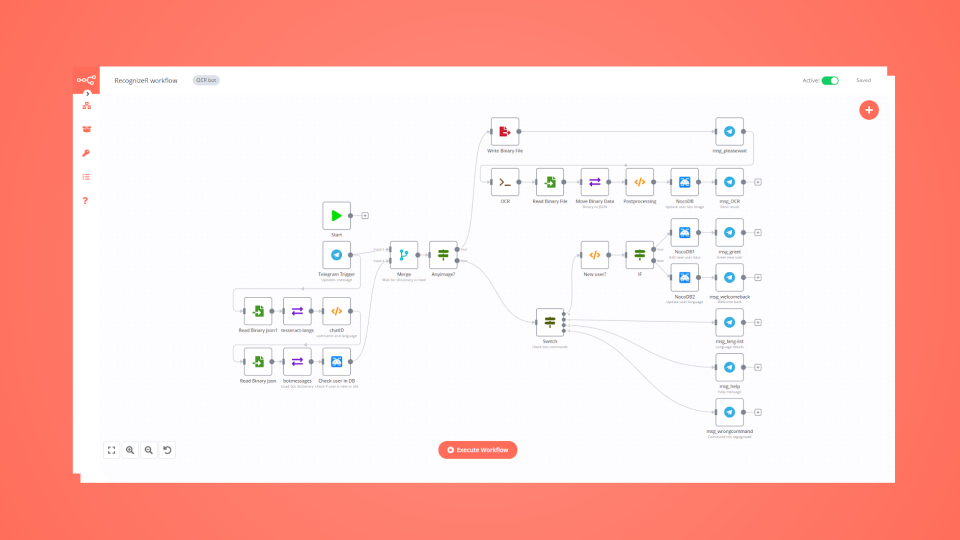
A connection establishes a link between GitLab and Telegram (or vice versa) to route data through the workflow. Data flows from the output of one node to the input of another. You can have single or multiple connections for each node.

GitLab and Telegram integration: Connect GitLab and Telegram

Step 4: Customize and extend your GitLab and Telegram integration

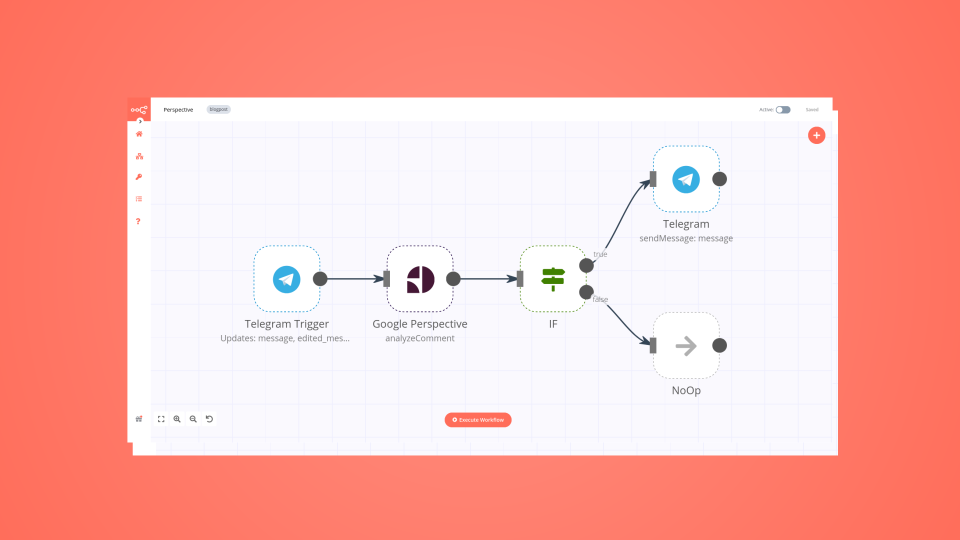
Use n8n's core nodes such as If, Split Out, Merge, and others to transform and manipulate data. Write custom JavaScript or Python in the Code node and run it as a step in your workflow. Connect GitLab and Telegram with any of n8n’s 1000+ integrations, and incorporate advanced AI logic into your workflows.

GitLab and Telegram integration: Customize and extend your GitLab and Telegram integration

Step 5: Test and activate your GitLab and Telegram workflow

Save and run the workflow to see if everything works as expected. Based on your configuration, data should flow from GitLab to Telegram or vice versa. Easily debug your workflow: you can check past executions to isolate and fix the mistake. Once you've tested everything, make sure to save your workflow and activate it.

GitLab and Telegram integration: Test and activate your GitLab and Telegram workflow

Automated Kubernetes testing with Robot Framework, ArgoCD & with KinD lifecycle

Overview

This n8n workflow provides automated CI/CD testing for Kubernetes applications using KinD (Kubernetes in Docker). It creates temporary infrastructure, runs tests, and cleans up everything automatically.

Three-Phase Lifecycle

INIT Phase - Infrastructure Setup
Installs dependencies (sshpass, Docker, KinD)
Creates KinD cluster
Installs Helm and Nginx Ingress
Installs HAProxy for port forwarding
Deploys ArgoCD
Applies ApplicationSet

TEST Phase - Automated Testing
Downloads Robot Framework test script from GitLab
Installs Robot Framework and Browser library
Executes automated browser tests
Packages test results
Sends results via Telegram

DESTROY Phase - Complete Cleanup
Removes HAProxy
Deletes KinD cluster
Uninstalls KinD
Uninstalls Docker
Sends completion notification

Execution Modes

Full Pipeline Mode (progress_only = false)
> Automatically progresses through all phases: INIT → TEST → DESTROY

Single Phase Mode (progress_only = true)
> Executes only the specified phase and stops

Prerequisites

Local Environment (n8n Host)
n8n instance version 1.0 or higher
Community node n8n-nodes-robotframework installed
Network access to target host and GitLab
Minimum 4 GB RAM, 20 GB disk space

Remote Target Host
Linux server (Ubuntu, Debian, CentOS, Fedora, or Alpine)
SSH access with sudo privileges
Minimum 8 GB RAM (16 GB recommended)
20 GB** free disk space
Open ports: 22, 80, 60080, 60443, 56443

External Services
GitLab** account with OAuth2 application
Repository with test files (test.robot, config.yaml, demo-applicationSet.yaml)
Telegram Bot** for notifications
Telegram Chat ID

Setup Instructions

Step 1: Install Community Node

In n8n web interface, navigate to Settings → Community Nodes
Install n8n-nodes-robotframework
Restart n8n if prompted

Step 2: Configure GitLab OAuth2

Create GitLab OAuth2 Application
Log in to GitLab
Navigate to User Settings → Applications
Create new application with redirect URI: https://your-n8n-instance.com/rest/oauth2-credential/callback
Grant scopes: read_api, read_repository, read_user
Copy Application ID and Secret

Configure in n8n
Create new GitLab OAuth2 API credential
Enter GitLab server URL, Client ID, and Secret
Connect and authorize

Step 3: Prepare GitLab Repository

Create repository structure:

your-repo/
├── test.robot
├── config.yaml
├── demo-applicationSet.yaml
└── .gitlab-ci.yml

Upload your:
Robot Framework test script
KinD cluster configuration
ArgoCD ApplicationSet manifest

Step 4: Configure Telegram Bot

Create Bot
Open Telegram, search for @BotFather
Send /newbot command
Save the API token

Get Chat ID
For personal chat:
Send message to your bot
Visit: https://api.telegram.org/bot<YOUR_TOKEN>/getUpdates
Copy the chat ID (positive number)

For group chat:
Add bot to group
Send message mentioning the bot
Visit getUpdates endpoint
Copy group chat ID (negative number)

Configure in n8n
Create Telegram API credential
Enter bot token
Save credential

Step 5: Prepare Target Host

Verify SSH access:
Test connection: ssh -p <port> <username>@<host_ip>
Verify sudo: sudo -v

The workflow will automatically install dependencies.

Step 6: Import and Configure Workflow

Import Workflow
Copy workflow JSON
In n8n, click Workflows → Import from File/URL
Import the JSON

Configure Parameters

Open Set Parameters node and update:

Parameter Description Example
target_host IP address of remote host 192.168.1.100
target_port SSH port 22
target_user SSH username ubuntu
target_password SSH password your_password
progress Starting phase INIT, TEST, or DESTROY
progress_only Execution mode true or false
KIND_CONFIG Path to config.yaml config.yaml
ROBOT_SCRIPT Path to test.robot test.robot
ARGOCD_APPSET Path to ApplicationSet demo-applicationSet.yaml

> Security: Use n8n credentials or environment variables instead of storing passwords in the workflow.

Configure GitLab Nodes

For each of the three GitLab nodes:
Set Owner (username or organization)
Set Repository name
Set File Path (uses parameter from Set Parameters)
Set Reference (branch: main or master)
Select Credentials (GitLab OAuth2)

Configure Telegram Nodes

Send ROBOT Script Export Pack node:
Set Chat ID
Select Credentials

Process Finish Report node:
Update chat ID in command

Step 7: Test and Execute

Test individual components first
Run full workflow
Monitor execution (30-60 minutes total)

How to Use

Execution Examples

Complete Testing Pipeline
progress = "INIT"
progress_only = "false"
Flow: INIT → TEST → DESTROY

Setup Infrastructure Only
progress = "INIT"
progress_only = "true"
Flow: INIT → Stop

Test Existing Infrastructure
progress = "TEST"
progress_only = "false"
Flow: TEST → DESTROY

Cleanup Only
progress = "DESTROY"
Flow: DESTROY → Complete

Trigger Methods

  1. Manual Execution
    Open workflow in n8n
    Set parameters
    Click Execute Workflow

  2. Scheduled Execution
    Open Schedule Trigger node
    Configure time (default: 1 AM daily)
    Ensure workflow is Active

  3. Webhook Trigger
    Configure webhook in GitLab repository
    Add webhook URL to GitLab CI

Monitoring Execution

In n8n Interface:
View progress in Executions tab
Watch node-by-node execution
Check output details

Via Telegram:
Receive test results after TEST phase
Receive completion notification after DESTROY phase

Execution Timeline:

Phase Duration
INIT 15-25 minutes
TEST 5-10 minutes
DESTROY 5-10 minutes

Understanding Test Results

After TEST phase, receive testing-export-pack.tar.gz via Telegram containing:

log.html - Detailed test execution log
report.html - Test summary report
output.xml - Machine-readable results
screenshots/ - Browser screenshots

To view:
Download .tar.gz from Telegram
Extract: tar -xzf testing-export-pack.tar.gz
Open report.html for summary
Open log.html for detailed steps

Success indicators:
All tests marked PASS
Screenshots show expected UI states
No error messages in logs

Failure indicators:
Tests marked FAIL
Error messages in logs
Unexpected UI states in screenshots

Configuration Files

test.robot

Robot Framework test script structure:
Uses Browser library
Connects to http://autotest.innersite
Logs in with autotest/autotest
Takes screenshots
Runs in headless Chromium

config.yaml

KinD cluster configuration:
1 control-plane node**
1 worker node**
Port mappings: 60080 (HTTP), 60443 (HTTPS), 56443 (API)
Kubernetes version: v1.30.2

demo-applicationSet.yaml

ArgoCD Application manifest:
Points to Git repository
Automatic sync enabled
Deploys to default namespace

gitlab-ci.yml

Triggers n8n workflow on commits:
Installs curl
Sends POST request to webhook

Troubleshooting

SSH Permission Denied

Symptoms:
Error: Permission denied (publickey,password)

Solutions:
Verify password is correct
Check SSH authentication method
Ensure user has sudo privileges
Use SSH keys instead of passwords

Docker Installation Fails

Symptoms:
Error: Package docker-ce is not available

Solutions:
Check OS version compatibility
Verify network connectivity
Manually add Docker repository

KinD Cluster Creation Timeout

Symptoms:
Error: Failed to create cluster: timed out

Solutions:
Check available resources (RAM/CPU/disk)
Verify Docker daemon status
Pre-pull images
Increase timeout

ArgoCD Not Accessible

Symptoms:
Error: Failed to connect to autotest.innersite

Solutions:
Check HAProxy status: systemctl status haproxy
Verify /etc/hosts entry
Check Ingress: kubectl get ingress -n argocd
Test port forwarding: curl http://127.0.0.1:60080

Robot Framework Tests Fail

Symptoms:
Error: Chrome failed to start

Solutions:
Verify Chromium installation
Check Browser library: rfbrowser show-trace
Ensure correct executablePath in test.robot
Install missing dependencies

Telegram Notification Not Received

Symptoms:
Workflow completes but no message

Solutions:
Verify Chat ID
Test Telegram API manually
Check bot status
Re-add bot to group

Workflow Hangs

Symptoms:
Node shows "Executing..." indefinitely

Solutions:
Check n8n logs
Test SSH connection manually
Verify target host status
Add timeouts to commands

Best Practices

Development Workflow

Test locally first
Run Robot Framework tests on local machine
Verify test script syntax

Version control
Keep all files in Git
Use branches for experiments
Tag stable versions

Incremental changes
Make small testable changes
Test each change separately

Backup data
Export workflow regularly
Save test results
Store credentials securely

Production Deployment

Separate environments
Dev: Frequent testing
Staging: Pre-production validation
Production: Stable scheduled runs

Monitoring
Set up execution alerts
Monitor host resources
Track success/failure rates

Disaster recovery
Document cleanup procedures
Keep backup host ready
Test restoration process

Security
Use SSH keys
Rotate credentials quarterly
Implement network segmentation

Maintenance Schedule

Frequency Tasks
Daily Review logs, check notifications
Weekly Review failures, check disk space
Monthly Update dependencies, test recovery
Quarterly Rotate credentials, security audit

Advanced Topics

Custom Configurations

Multi-node clusters:
Add more worker nodes for production-like environments
Configure resource limits
Add custom port mappings

Advanced testing:
Load testing with multiple iterations
Integration testing for full deployment pipeline
Chaos engineering with failure injection

Integration with Other Tools

Monitoring:
Prometheus for metrics collection
Grafana for visualization

Logging:
ELK stack for log aggregation
Custom dashboards

CI/CD Integration:
Jenkins pipelines
GitHub Actions
Custom webhooks

Resource Requirements

Minimum

Component CPU RAM Disk
n8n Host 2 4 GB 20 GB
Target Host 4 8 GB 20 GB

Recommended

Component CPU RAM Disk
n8n Host 4 8 GB 50 GB
Target Host 8 16 GB 50 GB

Useful Commands

KinD
List clusters: kind get clusters
Get kubeconfig: kind get kubeconfig --name automate-tst
Export logs: kind export logs --name automate-tst

Docker
List containers: docker ps -a --filter "name=automate-tst"
Enter control plane: docker exec -it automate-tst-control-plane bash
View logs: docker logs automate-tst-control-plane

Kubernetes
Get all resources: kubectl get all -A
Describe pod: kubectl describe pod -n argocd <pod-name>
View logs: kubectl logs -n argocd <pod-name> --follow
Port forward: kubectl port-forward -n argocd svc/argocd-server 8080:80

Robot Framework
Run tests: robot test.robot
Run specific test: robot -t "Test Name" test.robot
Generate report: robot --outputdir results test.robot

Additional Resources

Official Documentation
n8n**: https://docs.n8n.io
KinD**: https://kind.sigs.k8s.io
ArgoCD**: https://argo-cd.readthedocs.io
Robot Framework**: https://robotframework.org
Browser Library**: https://marketsquare.github.io/robotframework-browser

Community
n8n Community**: https://community.n8n.io
Kubernetes Slack**: https://kubernetes.slack.com
ArgoCD Slack**: https://argoproj.github.io/community/join-slack
Robot Framework Forum**: https://forum.robotframework.org

Related Projects
k3s**: Lightweight Kubernetes distribution
minikube**: Local Kubernetes alternative
Flux CD**: Alternative GitOps tool
Playwright**: Alternative browser automation

Nodes used in this workflow

Popular GitLab and Telegram workflows

Automated Kubernetes Testing with Robot Framework, ArgoCD & With KinD Lifecycle

Overview This n8n workflow provides automated CI/CD testing for Kubernetes applications using KinD (Kubernetes in Docker). It creates temporary infrastructure, runs tests, and cleans up everything automatically. Three-Phase Lifecycle INIT Phase - Infrastructure Setup Installs dependencies (sshpass, Docker, KinD) Creates KinD cluster Installs Helm and Nginx Ingress Installs HAProxy for port forwarding Deploys ArgoCD Applies ApplicationSet TEST Phase - Automated Testing Downloads Robot Framework test script from GitLab Installs Robot Framework and Browser library Executes automated browser tests Packages test results Sends results via Telegram DESTROY Phase - Complete Cleanup Removes HAProxy Deletes KinD cluster Uninstalls KinD Uninstalls Docker Sends completion notification Execution Modes Full Pipeline Mode (progress_only = false) > Automatically progresses through all phases: INIT → TEST → DESTROY Single Phase Mode (progress_only = true) > Executes only the specified phase and stops Prerequisites Local Environment (n8n Host) n8n instance version 1.0 or higher Community node n8n-nodes-robotframework installed Network access to target host and GitLab Minimum 4 GB RAM, 20 GB disk space Remote Target Host Linux server (Ubuntu, Debian, CentOS, Fedora, or Alpine) SSH access with sudo privileges Minimum 8 GB RAM (16 GB recommended) 20 GB** free disk space Open ports: 22, 80, 60080, 60443, 56443 External Services GitLab** account with OAuth2 application Repository with test files (test.robot, config.yaml, demo-applicationSet.yaml) Telegram Bot** for notifications Telegram Chat ID Setup Instructions Step 1: Install Community Node In n8n web interface, navigate to Settings → Community Nodes Install n8n-nodes-robotframework Restart n8n if prompted Step 2: Configure GitLab OAuth2 Create GitLab OAuth2 Application Log in to GitLab Navigate to User Settings → Applications Create new application with redirect URI: https://your-n8n-instance.com/rest/oauth2-credential/callback Grant scopes: read_api, read_repository, read_user Copy Application ID and Secret Configure in n8n Create new GitLab OAuth2 API credential Enter GitLab server URL, Client ID, and Secret Connect and authorize Step 3: Prepare GitLab Repository Create repository structure: your-repo/ ├── test.robot ├── config.yaml ├── demo-applicationSet.yaml └── .gitlab-ci.yml Upload your: Robot Framework test script KinD cluster configuration ArgoCD ApplicationSet manifest Step 4: Configure Telegram Bot Create Bot Open Telegram, search for @BotFather Send /newbot command Save the API token Get Chat ID For personal chat: Send message to your bot Visit: https://api.telegram.org/bot<YOUR_TOKEN>/getUpdates Copy the chat ID (positive number) For group chat: Add bot to group Send message mentioning the bot Visit getUpdates endpoint Copy group chat ID (negative number) Configure in n8n Create Telegram API credential Enter bot token Save credential Step 5: Prepare Target Host Verify SSH access: Test connection: ssh -p <port> <username>@<host_ip> Verify sudo: sudo -v The workflow will automatically install dependencies. Step 6: Import and Configure Workflow Import Workflow Copy workflow JSON In n8n, click Workflows → Import from File/URL Import the JSON Configure Parameters Open Set Parameters node and update: | Parameter | Description | Example | |-----------|-------------|---------| | target_host | IP address of remote host | 192.168.1.100 | | target_port | SSH port | 22 | | target_user | SSH username | ubuntu | | target_password | SSH password | your_password | | progress | Starting phase | INIT, TEST, or DESTROY | | progress_only | Execution mode | true or false | | KIND_CONFIG | Path to config.yaml | config.yaml | | ROBOT_SCRIPT | Path to test.robot | test.robot | | ARGOCD_APPSET | Path to ApplicationSet | demo-applicationSet.yaml | > Security: Use n8n credentials or environment variables instead of storing passwords in the workflow. Configure GitLab Nodes For each of the three GitLab nodes: Set Owner (username or organization) Set Repository name Set File Path (uses parameter from Set Parameters) Set Reference (branch: main or master) Select Credentials (GitLab OAuth2) Configure Telegram Nodes Send ROBOT Script Export Pack node: Set Chat ID Select Credentials Process Finish Report node: Update chat ID in command Step 7: Test and Execute Test individual components first Run full workflow Monitor execution (30-60 minutes total) How to Use Execution Examples Complete Testing Pipeline progress = "INIT" progress_only = "false" Flow: INIT → TEST → DESTROY Setup Infrastructure Only progress = "INIT" progress_only = "true" Flow: INIT → Stop Test Existing Infrastructure progress = "TEST" progress_only = "false" Flow: TEST → DESTROY Cleanup Only progress = "DESTROY" Flow: DESTROY → Complete Trigger Methods Manual Execution Open workflow in n8n Set parameters Click Execute Workflow Scheduled Execution Open Schedule Trigger node Configure time (default: 1 AM daily) Ensure workflow is Active Webhook Trigger Configure webhook in GitLab repository Add webhook URL to GitLab CI Monitoring Execution In n8n Interface: View progress in Executions tab Watch node-by-node execution Check output details Via Telegram: Receive test results after TEST phase Receive completion notification after DESTROY phase Execution Timeline: | Phase | Duration | |-------|----------| | INIT | 15-25 minutes | | TEST | 5-10 minutes | | DESTROY | 5-10 minutes | Understanding Test Results After TEST phase, receive testing-export-pack.tar.gz via Telegram containing: log.html - Detailed test execution log report.html - Test summary report output.xml - Machine-readable results screenshots/ - Browser screenshots To view: Download .tar.gz from Telegram Extract: tar -xzf testing-export-pack.tar.gz Open report.html for summary Open log.html for detailed steps Success indicators: All tests marked PASS Screenshots show expected UI states No error messages in logs Failure indicators: Tests marked FAIL Error messages in logs Unexpected UI states in screenshots Configuration Files test.robot Robot Framework test script structure: Uses Browser library Connects to http://autotest.innersite Logs in with autotest/autotest Takes screenshots Runs in headless Chromium config.yaml KinD cluster configuration: 1 control-plane node** 1 worker node** Port mappings: 60080 (HTTP), 60443 (HTTPS), 56443 (API) Kubernetes version: v1.30.2 demo-applicationSet.yaml ArgoCD Application manifest: Points to Git repository Automatic sync enabled Deploys to default namespace gitlab-ci.yml Triggers n8n workflow on commits: Installs curl Sends POST request to webhook Troubleshooting SSH Permission Denied Symptoms: Error: Permission denied (publickey,password) Solutions: Verify password is correct Check SSH authentication method Ensure user has sudo privileges Use SSH keys instead of passwords Docker Installation Fails Symptoms: Error: Package docker-ce is not available Solutions: Check OS version compatibility Verify network connectivity Manually add Docker repository KinD Cluster Creation Timeout Symptoms: Error: Failed to create cluster: timed out Solutions: Check available resources (RAM/CPU/disk) Verify Docker daemon status Pre-pull images Increase timeout ArgoCD Not Accessible Symptoms: Error: Failed to connect to autotest.innersite Solutions: Check HAProxy status: systemctl status haproxy Verify /etc/hosts entry Check Ingress: kubectl get ingress -n argocd Test port forwarding: curl http://127.0.0.1:60080 Robot Framework Tests Fail Symptoms: Error: Chrome failed to start Solutions: Verify Chromium installation Check Browser library: rfbrowser show-trace Ensure correct executablePath in test.robot Install missing dependencies Telegram Notification Not Received Symptoms: Workflow completes but no message Solutions: Verify Chat ID Test Telegram API manually Check bot status Re-add bot to group Workflow Hangs Symptoms: Node shows "Executing..." indefinitely Solutions: Check n8n logs Test SSH connection manually Verify target host status Add timeouts to commands Best Practices Development Workflow Test locally first Run Robot Framework tests on local machine Verify test script syntax Version control Keep all files in Git Use branches for experiments Tag stable versions Incremental changes Make small testable changes Test each change separately Backup data Export workflow regularly Save test results Store credentials securely Production Deployment Separate environments Dev: Frequent testing Staging: Pre-production validation Production: Stable scheduled runs Monitoring Set up execution alerts Monitor host resources Track success/failure rates Disaster recovery Document cleanup procedures Keep backup host ready Test restoration process Security Use SSH keys Rotate credentials quarterly Implement network segmentation Maintenance Schedule | Frequency | Tasks | |-----------|-------| | Daily | Review logs, check notifications | | Weekly | Review failures, check disk space | | Monthly | Update dependencies, test recovery | | Quarterly | Rotate credentials, security audit | Advanced Topics Custom Configurations Multi-node clusters: Add more worker nodes for production-like environments Configure resource limits Add custom port mappings Advanced testing: Load testing with multiple iterations Integration testing for full deployment pipeline Chaos engineering with failure injection Integration with Other Tools Monitoring: Prometheus for metrics collection Grafana for visualization Logging: ELK stack for log aggregation Custom dashboards CI/CD Integration: Jenkins pipelines GitHub Actions Custom webhooks Resource Requirements Minimum | Component | CPU | RAM | Disk | |-----------|-----|-----|------| | n8n Host | 2 | 4 GB | 20 GB | | Target Host | 4 | 8 GB | 20 GB | Recommended | Component | CPU | RAM | Disk | |-----------|-----|-----|------| | n8n Host | 4 | 8 GB | 50 GB | | Target Host | 8 | 16 GB | 50 GB | Useful Commands KinD List clusters: kind get clusters Get kubeconfig: kind get kubeconfig --name automate-tst Export logs: kind export logs --name automate-tst Docker List containers: docker ps -a --filter "name=automate-tst" Enter control plane: docker exec -it automate-tst-control-plane bash View logs: docker logs automate-tst-control-plane Kubernetes Get all resources: kubectl get all -A Describe pod: kubectl describe pod -n argocd <pod-name> View logs: kubectl logs -n argocd <pod-name> --follow Port forward: kubectl port-forward -n argocd svc/argocd-server 8080:80 Robot Framework Run tests: robot test.robot Run specific test: robot -t "Test Name" test.robot Generate report: robot --outputdir results test.robot Additional Resources Official Documentation n8n**: https://docs.n8n.io KinD**: https://kind.sigs.k8s.io ArgoCD**: https://argo-cd.readthedocs.io Robot Framework**: https://robotframework.org Browser Library**: https://marketsquare.github.io/robotframework-browser Community n8n Community**: https://community.n8n.io Kubernetes Slack**: https://kubernetes.slack.com ArgoCD Slack**: https://argoproj.github.io/community/join-slack Robot Framework Forum**: https://forum.robotframework.org Related Projects k3s**: Lightweight Kubernetes distribution minikube**: Local Kubernetes alternative Flux CD**: Alternative GitOps tool Playwright**: Alternative browser automation

Build your own GitLab and Telegram integration

Create custom GitLab and Telegram workflows by choosing triggers and actions. Nodes come with global operations and settings, as well as app-specific parameters that can be configured. You can also use the HTTP Request node to query data from any app or service with a REST API.

GitLab supported actions

Create
Create a new file in repository
Delete
Delete a file in repository
Edit
Edit a file in repository
Get
Get the data of a single file
List
List contents of a folder
Create
Create a new issue
Create Comment
Create a new comment on an issue
Edit
Edit an issue
Get
Get the data of a single issue
Lock
Lock an issue
Create
Create a new release
Delete
Delete a release
Get
Get a release
Get Many
Get many releases
Update
Update a release
Get
Get the data of a single repository
Get Issues
Returns issues of a repository
Get Repositories
Returns the repositories of a user

Telegram supported actions

Get
Get up to date information about a chat

Get Administrators
Get the Administrators of a chat
Get Member
Get the member of a chat
Leave
Leave a group, supergroup or channel
Set Description
Set the description of a chat
Set Title
Set the title of a chat
Answer Query
Send answer to callback query sent from inline keyboard
Answer Inline Query
Send answer to callback query sent from inline bot
Get
Get a file
Delete Chat Message
Delete a chat message
Edit Message Text
Edit a text message
Pin Chat Message
Pin a chat message
Send Animation

Send an animated file
Send Audio
Send a audio file
Send Chat Action
Send a chat action

Send Document
Send a document
Send Location
Send a location

Send Media Group
Send group of photos or videos to album
Send Message
Send a text message
Send and Wait for Response
Send a message and wait for response
Send Photo
Send a photo
Send Sticker
Send a sticker
Send Video
Send a video
Unpin Chat Message
Unpin a chat message

FAQs

  • Can GitLab connect with Telegram?

  • Can I use GitLab’s API with n8n?

  • Can I use Telegram’s API with n8n?

  • Is n8n secure for integrating GitLab and Telegram?

  • How to get started with GitLab and Telegram integration in n8n.io?

Need help setting up your GitLab and Telegram integration?

Discover our latest community's recommendations and join the discussions about GitLab and Telegram integration.
Trigi Digital
Karim El Soufi

Looking to integrate GitLab and Telegram in your company?

Over 3000 companies switch to n8n every single week

Why use n8n to integrate GitLab with Telegram

Build complex workflows, really fast

Build complex workflows, really fast

Handle branching, merging and iteration easily.
Pause your workflow to wait for external events.

Code when you need it, UI when you don't

Simple debugging

Your data is displayed alongside your settings, making edge cases easy to track down.

Use templates to get started fast

Use 1000+ workflow templates available from our core team and our community.

Reuse your work

Copy and paste, easily import and export workflows.

Implement complex processes faster with n8n

red iconyellow iconred iconyellow icon