Back to Integrations
integrationGmail node
integrationHubSpot node

Gmail and HubSpot integration

Save yourself the work of writing custom integrations for Gmail and HubSpot and use n8n instead. Build adaptable and scalable Communication, HITL, and Sales workflows that work with your technology stack. All within a building experience you will love.

How to connect Gmail and HubSpot

  • Step 1: Create a new workflow
  • Step 2: Add and configure nodes
  • Step 3: Connect
  • Step 4: Customize and extend your integration
  • Step 5: Test and activate your workflow

Step 1: Create a new workflow and add the first step

In n8n, click the "Add workflow" button in the Workflows tab to create a new workflow. Add the starting point – a trigger on when your workflow should run: an app event, a schedule, a webhook call, another workflow, an AI chat, or a manual trigger. Sometimes, the HTTP Request node might already serve as your starting point.
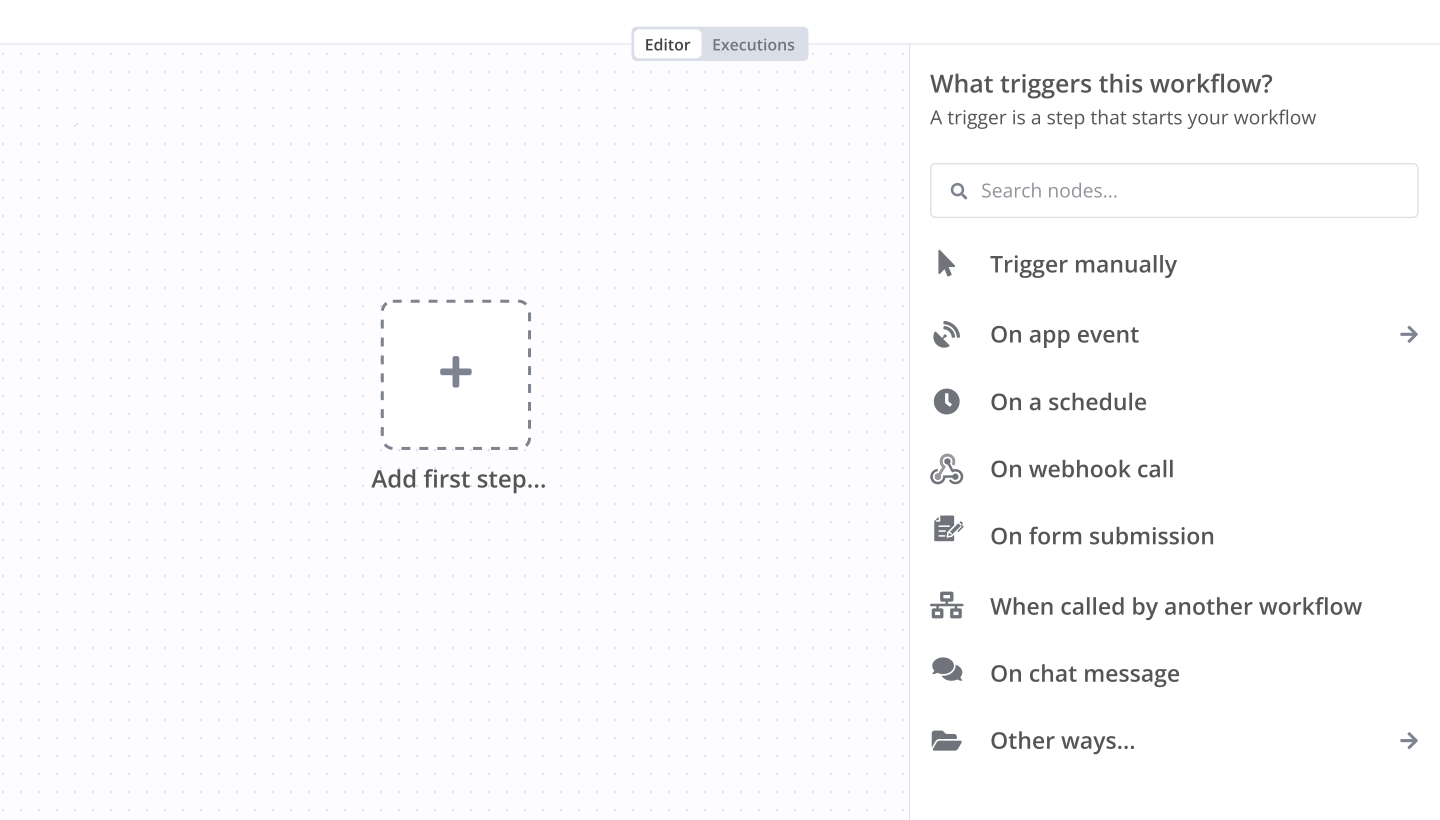
Gmail and HubSpot integration: Create a new workflow and add the first step

Step 2: Add and configure Gmail and HubSpot nodes

You can find Gmail and HubSpot in the nodes panel. Drag them onto your workflow canvas, selecting their actions. Click each node, choose a credential, and authenticate to grant n8n access. Configure Gmail and HubSpot nodes one by one: input data on the left, parameters in the middle, and output data on the right.

Gmail and HubSpot integration: Add and configure Gmail and HubSpot nodes

Step 3: Connect Gmail and HubSpot

A connection establishes a link between Gmail and HubSpot (or vice versa) to route data through the workflow. Data flows from the output of one node to the input of another. You can have single or multiple connections for each node.

Gmail and HubSpot integration: Connect Gmail and HubSpot

Step 4: Customize and extend your Gmail and HubSpot integration

Use n8n's core nodes such as If, Split Out, Merge, and others to transform and manipulate data. Write custom JavaScript or Python in the Code node and run it as a step in your workflow. Connect Gmail and HubSpot with any of n8n’s 1000+ integrations, and incorporate advanced AI logic into your workflows.

Gmail and HubSpot integration: Customize and extend your Gmail and HubSpot integration

Step 5: Test and activate your Gmail and HubSpot workflow

Save and run the workflow to see if everything works as expected. Based on your configuration, data should flow from Gmail to HubSpot or vice versa. Easily debug your workflow: you can check past executions to isolate and fix the mistake. Once you've tested everything, make sure to save your workflow and activate it.

Gmail and HubSpot integration: Test and activate your Gmail and HubSpot workflow

Automate new customer onboarding with HubSpot, Google Calendar, and AI-powered Gmail

This n8n workflow streamlines the onboarding process for new customers by automating personalized email communication, calendar scheduling, and contact assignment in HubSpot. It is perfect for businesses looking to ensure a smooth and personalized onboarding experience for new clients.

🧑‍💼 Who is this for?

Customer success teams who need to onboard new clients efficiently.
Sales teams who want to ensure smooth transitions from prospect to customer.
Small businesses that want to automate customer onboarding without complex systems.

🧩 What problem is this workflow solving?

This workflow reduces the manual effort involved in onboarding new customers by:

Automatically sending personalized welcome emails.
Scheduling a welcome meeting using a calendar tool.
Assigning the customer to a Customer Success Manager (CSM) in HubSpot.

⚙️ What this workflow does

Trigger via Webhook or HubSpot:
The workflow can be triggered either by a webhook (direct API call) or a HubSpot trigger (e.g., when a new contact is created).

HubSpot Connection:
Retrieves the list of HubSpot owners (users with contact access).
Identifies the owner of the new contact.

Calendar Management:
Utilizes a Calendar Agent to schedule a welcome meeting with the new customer.
The Calendar Agent can create, update, or delete events as needed.

Personalized Email Creation:
Uses an AI-powered Email Writer (OpenAI) to generate a personalized welcome email.
Transforms the email text into HTML for a polished format.

Email Sending via Gmail:
Sends the personalized email to the customer using Gmail.
Sets the new contact’s owner in HubSpot for further communication tracking.

🛠️ Setup

Webhook Setup in n8n:
Create a new workflow and add a Webhook node.
Set the Webhook URL path (e.g., /webhook-customer-onboarding).
Make sure the workflow is active.

Webhook Setup in HubSpot:
Go to HubSpot Developer Account.
Navigate to Settings > Integrations > Webhooks.
Create a new webhook and set the URL as the n8n Webhook URL.
Choose POST as the request method.
Test the webhook to ensure it triggers the workflow in n8n.

Calendar Agent Configuration:
The Calendar Agent can be configured to create, update, or delete events.
Connect it to your calendar tool (Google Calendar, Outlook, etc.).
Customize the calendar event details (title, description, time).

Email Writer Setup:
Customize the AI prompt in the Email Writer node to match your brand’s voice.
Adjust the email text format for your specific needs.

Gmail Integration:
Connect your Gmail account in n8n.
Set the recipient email to the new customer’s email address.

✏️ How to customize this workflow to your needs

Modify the AI-Powered Email**:
Adjust the email prompt for the AI model to create a different welcome message.
Change the email format or add custom variables (e.g., customer name, service details).

Customize Calendar Settings**:
Set default time slots for welcome meetings.
Specify which calendar to use for scheduling.

Add Additional Steps**:
Extend the workflow to automatically assign the customer to a specific HubSpot list.
Add a follow-up email or survey after the welcome meeting.

This workflow is perfect for businesses seeking an efficient and personalized onboarding process, ensuring new customers feel welcomed and supported from day one.

Nodes used in this workflow

Popular Gmail and HubSpot workflows

Build Targeted Prospect Lists: Find & Enrich Leads with Surfe to HubSpot

🚀 Build Hyper-Targeted Prospecting Lists with Surfe & HubSpot This template automatically discovers companies that match your Ideal Customer Profile (ICP), finds the right people inside those companies and enriches them — ready to drop straight into HubSpot. Launch the workflow, sit back, and get a clean list of validated prospects in minutes. ❓ What Problem Does This Solve? Sourcing prospects that truly fit your ICP is slow and repetitive. You jump between databases, copy domains, hunt down decision-makers, and then still have to enrich emails and phone numbers one by one. This workflow replaces all that manual effort: It queries Surfe’s database for companies that match your exact industry, size, revenue and geography filters. It pulls the best-fit people inside each company and enriches them in bulk. It keeps only records with both a direct email and mobile phone, then syncs them to HubSpot automatically. No spreadsheets, no copy-paste — just a fresh, qualified prospect list ready for outreach. 🧰 Prerequisites You’ll need: A self-hosted or cloud instance of n8n A Surfe API Key A HubSpot Private App Token with contact read/write scopes A Gmail account (OAuth2) for the completion notification The workflow JSON file linked above N8N_FLOW_2__Building_Prospecting_Lists.json 📌 Search ICP Companies Configuration — Fine-Tune Your Targeting 3.1 Editing the JSON Every targeting rule lives inside the “🔍 Search ICP Companies” HTTP node. Open the node Search ICP Companies → Parameters tab → JSON Body to edit the filters. | Filter | JSON path | What it does | Example | | --- | --- | --- | --- | | industries | filters.industries | Narrow to specific verticals (case-sensitive strings) | ["Software","Apps","SaaS"] | | employeeCount.from / to | filters.employeeCount | from / to | 1 / 35 | | countries | filters.countries | 2-letter ISO codes | ["FR","DE"] | | revenues | filters.revenues | Annual revenue brackets | ["1-10M"] | | limit | limit | Companies per run | 20 | 3.2 Where to find allowed values Surfe exposes an “🗂 Get Filters” endpoint that returns every accepted value for: industries employeeCounts revenues countries (always ISO-2 codes) You can hit it with a simple GET /v1/people/search/filters request or browse the interactive docs here: https://developers.surfe.com/public-008-people-filters developers.surfe.com For company-level searches, the same enumerations apply. ⚙️ Setup Instructions 4.1 🔐 Create Your Credentials in n8n 4.1.1 🚀 Surfe API In your Surfe dashboard → Use Surfe Api → copy your API key Go to n8n → Credentials → Create Credential Choose Credential Type: Bearer Auth Name it something like SURFE API Key Paste your API key into the Bearer Token Save 4.1.2 📧 Gmail OAuth2 API Go to n8n → Credentials Create new credentials: Type: Gmail OAuth2 API A pop-up window will appear where you can log in with your Google account that is linked to Gmail Make sure you grant email send permissions when prompted 4.1.3 🎯 HubSpot 🔓 Private App Token Go to HubSpot → Settings → Integrations → Private Apps Create an app with scopes: crm.objects.contacts.read crm.objects.contacts.write crm.schemas.contacts.read Save the App token Go to n8n → Credentials → Create Credential → HubSpot App Token Paste your App Token ✅ You are now all set for the credentials 4.2 📥 Import and Configure the N8N Workflow Import the provided JSON workflow into N8N Create a New Blank Workflow click the … on the top left Import from File 4.2.1 🔗 Link Nodes to Your Credentials In the workflow, link your newly created credentials to each node of this list : Surfe HTTP nodes: Authentication → Generic Credential Type Generic Auth Type → Bearer Auth Bearer Auth → Select the credentials you created before Gmail Node Credentials to connect with → Gmail account Hubspot Node →Credentials to connect with → Gmail account Surfe HTTP nodes Surfe HTTP nodes HubSpot node → Credentials to connect with → select your HubSpot credentials in the list 🔄 How This N8N Workflow Works Manual Trigger – Click Execute Workflow (or schedule it) to start. Search ICP Companies – Surfe returns company domains that match your filter set. Prepare JSON Payload with Company Domains – Formats the domain list for the next call. Search People in Companies – Finds people inside each company. Prepare JSON Payload Enrichment Request – Builds the bulk-enrichment request. Surfe Bulk Enrichments API – Launches one enrichment job for the whole batch. Wait + Polling loop – Checks job status every 3 seconds until it’s COMPLETED. Extract List of People – Pulls the enriched contacts from Surfe’s response. Filter: phone AND email – Keeps only fully reachable prospects (email and mobile). HubSpot: Create or Update – Inserts/updates each contact in HubSpot. Gmail – Sends you a “Your ICP prospecting enrichment is done” email. 🧩 Use Cases Weekly prospect list refresh** – Generate 50 perfectly-matched prospects every Monday morning. Territory expansion** – Spin up a list of SMB software CEOs in a new country in minutes. ABM prep** – Build multi-stakeholder buying-group lists for target accounts. Campaign-specific lists** – Quickly assemble contacts for a limited-time product launch. 🛠 Customization Ideas prepare 🎯 Refine filters for people – Add seniorities or other filters in the node JSON PAYLOAD WITH Company Domains use the surfe search people api doc https://developers.surfe.com/public-009-search-people-v2 ♻️ Deduplicate – Check HubSpot first to skip existing contacts. 🟢 Slack alert – Replace Gmail with a Slack notification. 📊 Reporting – Append enriched contacts to a Google Sheet for analytics. ✅ Summary Fire off the workflow, and n8n will find ICP-fit companies, pull key people, enrich direct contact data and drop everything into HubSpot — all on autopilot. Prospecting lists, done for you.
+5

Automate B2B SaaS Renewal Risk Management with CRM, Support & Usage Data

Description This workflow is designed for B2B/SaaS teams who want to secure renewals before it’s too late. It runs every day, identifies all accounts whose licenses are up for renewal in J–30, enriches them with CRM, product usage and support data, computes an internal churn risk level, and then triggers the appropriate playbook: HIGH risk** → full escalation (tasks, alerts, emails) MEDIUM risk** → proactive follow-up by Customer Success LOW risk** → light renewal touchpoint / monitoring Everything is logged into a database table so that you can build dashboards, run analysis, or plug additional automations on top. How it works Daily detection (J–30 renewals) A scheduled trigger runs every morning and queries your database (Postgres / Supabase) to fetch all active subscriptions expiring in 30 days. Each row includes the account identifier, name, renewal date and basic commercial data. Data enrichment across tools For each account, the workflow calls several business systems to collect context: HubSpot → engagement history Salesforce → account profile and segment Pipedrive → deal activities and associated products Analytics API → product feature usage and activity trends Zendesk → recent support tickets and potential friction signals All of this is merged into a single, unified item. Churn scoring & routing An internal scoring step evaluates the risk for each account based on multiple signals (engagement, usage, support, timing). The workflow then categorizes each account into one of three risk levels: HIGH – strong churn signals → needs immediate attention MEDIUM – some warning signs → needs proactive follow-up LOW – looks healthy → light renewal reminder A Switch node routes each account to the relevant playbook. Automated playbooks 🔴 HIGH risk Create a Trello card on a dedicated “High-Risk Renewals” board/list Create a Jira ticket for the CS / AM team Send a Slack alert in a designated channel Send a detailed email to the CSM and/or account manager 🟠 MEDIUM risk Create a Trello card in a “Renewals – Follow-up” list Send a contextual email to the CSM to recommend a proactive check-in 🟢 LOW risk Send a soft renewal email / internal note to keep the account on the radar Logging & daily reporting For every processed account, the workflow prepares a structured log record (account, renewal date, risk level, basic context). A Postgres node is used to insert the data into a churn_logs table. At the end of each run, all processed accounts are aggregated and a daily summary email is sent (for example to the Customer Success leadership team), listing the renewals and their risk levels. Requirements Database A table named churn_logs (or equivalent) to store workflow decisions and history. Example fields: account_id, account_name, end_date, riskScore, riskLevel, playbook, trello_link, jira_link, timestamp. External APIs HubSpot (engagement data) Salesforce (account profile) Pipedrive (deals & products) Zendesk (support tickets) Optional: product analytics API for usage metrics Communication & task tools Gmail (emails to CSM / AM / summary recipients) Slack (alert channel for high-risk cases) Trello (task creation for CS follow-up) Jira (escalation tickets for high-risk renewals) Configuration variables Thresholds are configured in the Init config & thresholds node: days_before_renewal churn_threshold_high churn_threshold_medium These parameters let you adapt the detection window and risk sensitivity to your own business rules. Typical use cases Customer Success teams who want a daily churn watchlist without exporting spreadsheets. RevOps teams looking to standardize renewal playbooks across tools. SaaS companies who need to prioritize renewals based on real risk signals rather than gut feeling. Product-led organizations that want to combine usage data + CRM + support into one automated process. Tutorial video Watch the Youtube Tutorial video About me : I’m Yassin a Project & Product Manager Scaling tech products with data-driven project management. 📬 Feel free to connect with me on Linkedin
+3

AI-powered Client Onboarding with Jotform, Asana, Slack, and HubSpot

Streamline client onboarding and project setup from hours to minutes with AI-driven automation. This intelligent workflow eliminates manual coordination, builds proposals, creates projects in Asana, welcomes clients on Slack, and logs everything — ensuring 90% faster onboarding and zero dropped steps. What This Workflow Does Transforms your client onboarding from scattered tools and emails into one seamless automation: 📝 Capture Client Details – Jotform intake form collects client, company, and project information. 🧠 AI-Powered Analysis – LangChain AI Agent analyzes the project scope, estimates effort, and recommends team composition. 📄 Generate Proposal – Automatically builds a professional HTML proposal summarizing goals, timeline, and estimated hours. 🗂️ Create Asana Project – Generates a new project with all key details, milestones, and assigned team members. 💬 Slack Collaboration – Creates a dedicated Slack channel, sends welcome messages, and introduces the project team. 📧 Welcome Email – Sends a personalized onboarding email to the client with project summary and next steps. 💼 CRM Sync – Creates or updates a HubSpot contact with complete project and client information. 📊 Audit Logging – Logs all onboarding activity to Google Sheets for centralized record-keeping. Key Features 🤖 AI Proposal Generation – Uses LangChain AI to generate smart project summaries and resource plans. ⚙️ End-to-End Automation – From form submission to project creation, communication, and CRM logging. 💬 Smart Slack Setup – Automatic channel creation and messaging for internal coordination. 📧 Personalized Client Emails – Beautifully formatted, professional onboarding emails. 🗂️ Asana Integration – Project creation with dynamic task templates and priorities. 📊 Google Sheets Logging – Instant audit trail for every client submission and generated proposal. 💼 CRM Integration – Automatically syncs client data with HubSpot for sales and account tracking. Perfect For 🚀 Agencies & Service Providers – Automate client onboarding, proposal creation, and task setup. 🏢 Consultancies – Quickly turn client requests into structured projects with assigned resources. 💻 Freelancers & Creators – Impress clients with AI-built proposals and instant communication. 📈 Growing Teams – Scale onboarding without extra admin or coordination time. 🧠 Operations Teams – Ensure consistency and transparency across all onboarding activities. What You’ll Need Required Integrations 🧾 Jotform – Client intake form (project details, budget, company info). Create your form for free on Jotform using this link 🤖 AI Agent – For analyzing project scope and building proposals. 🗂️ Asana – Project creation and task assignment. 💬 Slack – For automated client channel creation and internal communication. 📧 Gmail – For onboarding and proposal emails. 💼 HubSpot – CRM contact creation and project linkage. 📊 Google Sheets – For logging all onboarding and AI results. Optional Enhancements 📄 PDF Generation (PDF Munk) – Convert AI-generated proposals into downloadable PDFs. 💬 Slack Interactive Approvals – Add buttons for internal review before client communication. 📈 Performance Dashboard – Connect Google Sheets data to Looker Studio for tracking onboarding times. 🌍 Multilingual Support – Add translation nodes for international clients. 🔐 File Attachments – Send proposal PDFs or onboarding kits automatically via Gmail. Quick Start 1️⃣ Import Template – Copy and import the JSON file into your n8n workspace. 2️⃣ Set Up Jotform – Create a form with fields for client name, company, project name, budget, and requirements. 3️⃣ Add Credentials – Connect Jotform, AI Agent, Asana, Slack, Gmail, HubSpot, and Google Sheets. 4️⃣ Configure Sheet ID – Replace YOUR_SHEET_ID in the Google Sheets node. 5️⃣ Customize Proposal HTML – Edit AI prompt and branding to reflect your company’s style. 6️⃣ Test Workflow – Submit a test form and verify Slack, Asana, Gmail, and Sheets outputs. 7️⃣ Deploy – Activate workflow and share the Jotform link with your sales or operations team. Customization Options 1️⃣ Proposal Branding – Customize proposal HTML with logos, brand colors, and formatting. 2️⃣ AI Prompt Tuning – Refine the LangChain AI prompt to match your tone or project style. 3️⃣ Task Templates – Adjust task names, assignees, and due dates in the Asana creation node. 4️⃣ Slack Messaging – Update welcome message formatting and team introduction details. 5️⃣ CRM Fields – Map additional HubSpot properties for better data tracking. 6️⃣ Sheet Logging – Add more columns for tracking team recommendations or proposal scores. Expected Results ⚡ 90% Faster Onboarding – Reduce manual setup from hours to minutes. 🤖 AI Precision – Intelligent proposals and team allocations that impress clients instantly. 📈 Zero Missed Steps – Every project automatically created, communicated, and logged. 💬 Seamless Collaboration – Slack, Gmail, and Asana in perfect sync. 🗂️ Complete Transparency – Every onboarding step logged for accountability and improvement. 🏆 Use Cases 🧑‍💼 Marketing & Creative Agencies – Automate creative project scoping and proposal creation. 💻 Software Development Teams – Rapidly assess client tech requirements and allocate developers. 🧾 Consulting Firms – Build data-backed, AI-enhanced proposals for client engagements. 🏢 Corporate PMOs – Standardize project setup and approvals across multiple departments. Pro Tips 💡 Refine AI Prompt – Include examples of past projects to improve proposal quality. 💬 Add Slack Approvals – Insert “manager approval” logic before sending proposals. 📄 Attach PDFs – Use PDF Munk for branded, downloadable proposals. 📊 Track Conversion – Link HubSpot deal stage changes based on Asana progress. 📅 Monitor Efficiency – Use Sheet timestamps to calculate average onboarding time. Learning Resources This workflow demonstrates: AI integration using Agents Multi-app orchestration and data syncing Advanced HTML and email template customization Real-world Asana and Slack API usage CRM syncing and Google Sheets logging Modular, scalable n8n workflow design Workflow Structure Visualization 📝 Jotform Submission ↓ 🧠 AI Project Analysis (Agent) ↓ 📄 Proposal Generation (HTML) ↓ 🗂️ Asana Project Creation ↓ 💬 Slack Channel Setup & Message ↓ 📧 Gmail Welcome Email ↓ 💼 HubSpot Contact Creation ↓ 📊 Google Sheets Log Ready to Revolutionize Client Onboarding? Import this template today and let AI handle the heavy lifting. Your team saves hours, your clients get instant engagement — and your entire process runs flawlessly. ✨
+3

Bilingual Newsletters with GPT-4o, AI Images & Videos for HubSpot & SP

Who’s it for Marketing, growth, and automation teams that need to ship polished bilingual newsletters—complete with images, optional video, and multi-channel distribution—without writing a line of code. How it works / What it does A Webhook receives a plain-language request (e.g. “Create a newsletter about XYZ and store it in SharePoint”). The Webhook can be changed to another trigger, fr example Manual Trigger. An AI Agent (OpenAI GPT-4o) drafts German & English newsletter copy following a strict JSON schema. SharePoint fetches an HTML template; a Code node injects AI copy into the placeholders. Optional creative assets: Pollinations AI → image (resolution check & frame overlay) FAL AI → short video + Lyria2 audio → merged via FFmpeg API A Gmail Approval step sends the draft to an approver; the flow continues only on “Approve”. Depending on user intent the workflow: Emails the newsletter to HubSpot contacts, and/or Saves HTML (+ JPG/Video URL) to a SharePoint library. How to set up Import the template Open the yellow sticky note and follow the checklist Create credentials for OpenAI, HubSpot (App Token), Microsoft 365, Gmail, and FAL AI. Enter them in n8n Credential Manager (never in the HTTP node). Edit the Configuration Settings Set node with your ENV_* variables. Activate the workflow, copy the production Webhook URL, and trigger it with JSON body { "text": "…" } or with a desired trigger. Requirements OpenAI account Microsoft 365 tenant (SharePoint & Outlook) HubSpot App Token FAL AI API Key (video & audio generation) How to customize Want a different language? Tweak the AI prompt inside AI Agent. Want a different storage provider? Change the SharePoint nodes to Google Drive or Dropbox. Skip video generation: set include_video to false in the incoming prompt. Change the distribution logic by adjusting the WF Result Switch node. Add more channels (e.g. Slack) by inserting additional branches after the Switch and modifying the intent determination at the beginning of the workflow.
+3

Score and nurture HubSpot leads with Clearbit and Gemini AI

Who is this for SMB sales teams and SaaS companies who want to automatically prioritize and nurture new leads without manual qualification. Perfect for businesses getting 50+ leads per month who need to identify high-value prospects quickly. How it works When a new contact is created in HubSpot, the workflow automatically enriches their data using Clearbit's company database. A scoring algorithm evaluates company size, industry fit, and job title relevance, then Gemini AI analyzes the enriched data to provide additional insights and generate personalized outreach content. Hot leads (score 80+) receive immediate personalized emails and trigger Slack notifications to the sales team. Warm leads (50-79) are added to nurturing sequences. Cold leads are simply scored for future reference. All scoring data and reasoning are logged to Google Sheets for analysis and optimization. How to set up Configure credentials for HubSpot, Clearbit API, Gemini AI, Gmail, Slack, and Google Sheets. Create a Google Sheet for scoring history with the column headers shown in the workflow. Update the Slack channel name in the notification node and customize the Gmail sender settings. Requirements HubSpot with contact creation access Clearbit Enrichment API account Google Gemini AI API key Gmail account for sending emails Slack workspace for notifications Google Sheets for tracking How to customize Adjust scoring criteria in the Set node including target industries, company size weights, and role priorities. Modify hot/warm score thresholds (default 80/50). Customize email templates and Slack message format within the Gemini AI prompt. Add additional scoring factors in the Code node calculation.

Re-engage HubSpot leads using Azure OpenAI GPT-4o, Gmail and Slack

📘 Description This workflow automates daily re-engagement for HubSpot leads that were previously paused due to timing. It runs every 24 hours, fetches recent leads with activity data, and filters only those marked as “bad timing,” ensuring active opportunities are not disturbed. Qualified leads are processed in batches, and an AI agent generates a short, polite follow-up email designed to reopen the conversation without sounding salesy. Instead of sending automatically, the workflow creates a Gmail draft for human review and notifies the assigned owner in Slack. If AI generation fails, the workflow sends a Slack alert with the lead details so manual follow-up can still happen. This ensures consistent reactivation of cold leads without silent failures or missed opportunities. ⚙️ What This Workflow Does (Step-by-Step) ⏰ Daily Trigger (Every 24h) Runs the workflow once per day. 📥 HubSpot: Fetch Recent Leads + Activity Fields Pulls up to 20 leads with key activity and lifecycle properties needed for follow-up timing. 🚦 Filter: Lead Status = BAD_TIMING Keeps only leads that were previously paused due to timing (targets cold opportunities only). 🔄 Batch Leads (Split In Batches) Processes leads one-by-one / in batches to prevent rate-limit issues and keep execution stable. ✍️ AI: Generate Re-Engagement Follow-Up Email Body Creates a short, friendly follow-up message based on lead context (no CRM labels, no salesy tone). 🧩 Parse AI JSON Normalizes AI output into usable fields (subject/body/toEmail/owner details). 📩 Gmail: Create Follow-Up Draft Email Creates a Gmail draft (human-in-the-loop; no auto-send). 🔔 Slack: Notify Owner to Re-Engage Lead Notifies the assigned owner that a draft is ready and the lead is worth revisiting. ⚠️ Build AI Error Payload Builds a clean error context (lead name/email + AI error message). 🚨 Slack: Alert AI Draft Failure Alerts the owner when AI fails so the lead can be followed up manually. 🧩 Prerequisites • n8n instance • HubSpot App Token (read access to leads + properties) • Azure OpenAI credentials (GPT-4o) for email generation • Gmail OAuth2 (draft creation permissions) • Slack API token (DM user messaging permissions) 💡 Key Benefits ✔ Daily automated re-engagement for paused leads ✔ Prevents random outreach to active leads ✔ Human-in-the-loop safety via Gmail drafts (no auto-send) ✔ Owner notifications ensure follow-up execution ✔ Batch processing avoids rate-limit instability ✔ Strong failure handling prevents silent lead drops 👥 Perfect For SDR teams managing large HubSpot pipelines Founders doing lightweight outbound follow-ups Sales ops teams wanting structured reactivation loops Agencies re-engaging cold inbound / outbound leads

Build your own Gmail and HubSpot integration

Create custom Gmail and HubSpot workflows by choosing triggers and actions. Nodes come with global operations and settings, as well as app-specific parameters that can be configured. You can also use the HTTP Request node to query data from any app or service with a REST API.

Gmail supported actions

Add Label
Delete
Get
Get Many
Mark as Read
Mark as Unread
Remove Label
Reply
Send
Send and Wait for Response
Create
Delete
Get
Get Many
Create
Delete
Get
Get Many
Add Label
Delete
Get
Get Many
Remove Label
Reply
Trash
Untrash

HubSpot supported actions

Create
Create a company
Delete
Delete a company
Get
Get a company
Get Many
Get many companies
Get Recently Created/Updated
Get recently created/updated companies
Search
Search companies by their website domain
Update
Update a company
Create or Update
Create a new contact, or update the current one if it already exists (upsert)
Delete
Delete a contact
Get
Get a contact
Get Many
Get many contacts
Get Recently Created/Updated
Get recently created/updated contacts
Search
Search contacts
Add
Add contact to a list
Remove
Remove a contact from a list
Create
Create a deal
Delete
Delete a deal
Get
Get a deal
Get Many
Get many deals
Get Recently Created/Updated
Get recently created/updated deals
Search
Search deals
Update
Update a deal
Create
Create an engagement
Delete
Delete an engagement
Get
Get an engagement
Get Many
Get many engagements
Create
Create a ticket
Delete
Delete a ticket
Get
Get a ticket
Get Many
Get many tickets
Update
Update a ticket

FAQs

  • Can Gmail connect with HubSpot?

  • Can I use Gmail’s API with n8n?

  • Can I use HubSpot’s API with n8n?

  • Is n8n secure for integrating Gmail and HubSpot?

  • How to get started with Gmail and HubSpot integration in n8n.io?

Need help setting up your Gmail and HubSpot integration?

Discover our latest community's recommendations and join the discussions about Gmail and HubSpot integration.
jake chard
Jan Koch
Paul Kennard

Looking to integrate Gmail and HubSpot in your company?

Over 3000 companies switch to n8n every single week

Why use n8n to integrate Gmail with HubSpot

Build complex workflows, really fast

Build complex workflows, really fast

Handle branching, merging and iteration easily.
Pause your workflow to wait for external events.

Code when you need it, UI when you don't

Simple debugging

Your data is displayed alongside your settings, making edge cases easy to track down.

Use templates to get started fast

Use 1000+ workflow templates available from our core team and our community.

Reuse your work

Copy and paste, easily import and export workflows.

Implement complex processes faster with n8n

red iconyellow iconred iconyellow icon