Back to Integrations
integrationGmail node
integrationMonday.com node

Gmail and Monday.com integration

Save yourself the work of writing custom integrations for Gmail and Monday.com and use n8n instead. Build adaptable and scalable Communication, HITL, and Productivity workflows that work with your technology stack. All within a building experience you will love.

How to connect Gmail and Monday.com

  • Step 1: Create a new workflow
  • Step 2: Add and configure nodes
  • Step 3: Connect
  • Step 4: Customize and extend your integration
  • Step 5: Test and activate your workflow

Step 1: Create a new workflow and add the first step

In n8n, click the "Add workflow" button in the Workflows tab to create a new workflow. Add the starting point – a trigger on when your workflow should run: an app event, a schedule, a webhook call, another workflow, an AI chat, or a manual trigger. Sometimes, the HTTP Request node might already serve as your starting point.
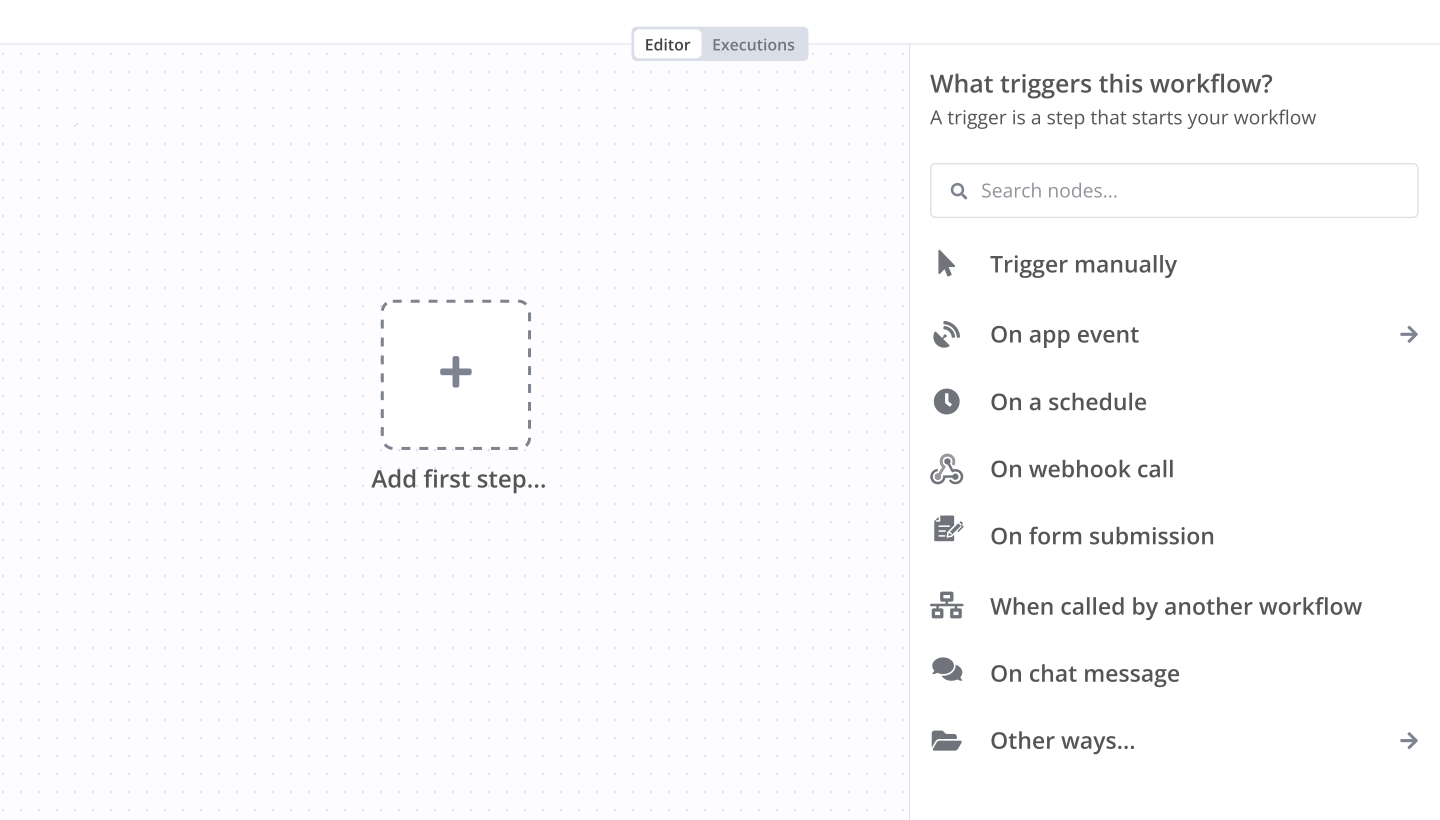
Gmail and Monday.com integration: Create a new workflow and add the first step

Step 2: Add and configure Gmail and Monday.com nodes

You can find Gmail and Monday.com in the nodes panel. Drag them onto your workflow canvas, selecting their actions. Click each node, choose a credential, and authenticate to grant n8n access. Configure Gmail and Monday.com nodes one by one: input data on the left, parameters in the middle, and output data on the right.

Gmail and Monday.com integration: Add and configure Gmail and Monday.com nodes

Step 3: Connect Gmail and Monday.com

A connection establishes a link between Gmail and Monday.com (or vice versa) to route data through the workflow. Data flows from the output of one node to the input of another. You can have single or multiple connections for each node.

Gmail and Monday.com integration: Connect Gmail and Monday.com

Step 4: Customize and extend your Gmail and Monday.com integration

Use n8n's core nodes such as If, Split Out, Merge, and others to transform and manipulate data. Write custom JavaScript or Python in the Code node and run it as a step in your workflow. Connect Gmail and Monday.com with any of n8n’s 1000+ integrations, and incorporate advanced AI logic into your workflows.

Gmail and Monday.com integration: Customize and extend your Gmail and Monday.com integration

Step 5: Test and activate your Gmail and Monday.com workflow

Save and run the workflow to see if everything works as expected. Based on your configuration, data should flow from Gmail to Monday.com or vice versa. Easily debug your workflow: you can check past executions to isolate and fix the mistake. Once you've tested everything, make sure to save your workflow and activate it.

Gmail and Monday.com integration: Test and activate your Gmail and Monday.com workflow

Monitor daily HR risks and standup summaries with Monday.com and GPT-4o-mini

📊 Description
This workflow automates the daily HR standup by continuously monitoring active hiring and HR tasks, identifying risks and blockers, and generating an intelligent, action-oriented summary using AI.
Every morning, HR and leadership teams receive a clear overview of priorities, overdue items, and potential risks — without any manual preparation. By combining structured task data with AI-driven analysis, the workflow ensures teams start the day aligned, informed, and ready to act.
The automation is designed for real-world HR operations, scaling seamlessly as task volume grows while maintaining concise and consistent reporting.

🔁 What this automation does
Automatically triggers every morning using a scheduled Cron trigger.
Retrieves all HR and hiring-related tasks from a Monday.com board.
Filters out completed items to focus only on active and relevant work.
Aggregates all remaining tasks into a single structured dataset.
Analyzes task status, ownership, and due dates to identify blockers and risks.
Uses AI (GPT-4o-mini) to generate a concise, structured daily standup report.
Delivers the final standup update to HR via email for immediate visibility.

🧠 Key design decisions
Uses a scheduled trigger to ensure consistent, hands-free execution
Applies task filtering via a Code node to overcome API limitations
Aggregates all tasks to produce a single, consolidated standup report
Leverages AI for insight generation, not raw data repetition
Excludes completed tasks to reduce noise and improve signal quality
Prioritizes concise, actionable output suitable for leadership review

⭐ Key benefits
Eliminates manual standup preparation
Ensures overdue tasks and blockers are surfaced early
Improves visibility and accountability across HR operations
Saves daily operational time for HR and managers
Produces consistent, professional summaries every day
Scales efficiently as teams and task volume increase
🛠️ Tools & services used
n8n – Workflow orchestration and automation
Monday.com – HR and hiring task management
OpenAI (GPT-4o-mini) – Intelligent analysis and summarization
Gmail – Delivery of daily standup reports
Cron – Scheduled execution

🔐 Requirements
Monday.com OAuth credentials
OpenAI API key
Gmail OAuth credentials
n8n (cloud or self-hosted)
HR board with status and due date columns

🎯 Target audience
HR and Talent Acquisition teams
Hiring managers
Operations and RevOps teams
Startups and scaling organizations
Automation teams building internal HR tooling

Nodes used in this workflow

Popular Gmail and Monday.com workflows

Monitor daily HR risks and standup summaries with Monday.com and GPT-4o-mini

📊 Description This workflow automates the daily HR standup by continuously monitoring active hiring and HR tasks, identifying risks and blockers, and generating an intelligent, action-oriented summary using AI. Every morning, HR and leadership teams receive a clear overview of priorities, overdue items, and potential risks — without any manual preparation. By combining structured task data with AI-driven analysis, the workflow ensures teams start the day aligned, informed, and ready to act. The automation is designed for real-world HR operations, scaling seamlessly as task volume grows while maintaining concise and consistent reporting. 🔁 What this automation does Automatically triggers every morning using a scheduled Cron trigger. Retrieves all HR and hiring-related tasks from a Monday.com board. Filters out completed items to focus only on active and relevant work. Aggregates all remaining tasks into a single structured dataset. Analyzes task status, ownership, and due dates to identify blockers and risks. Uses AI (GPT-4o-mini) to generate a concise, structured daily standup report. Delivers the final standup update to HR via email for immediate visibility. 🧠 Key design decisions Uses a scheduled trigger to ensure consistent, hands-free execution Applies task filtering via a Code node to overcome API limitations Aggregates all tasks to produce a single, consolidated standup report Leverages AI for insight generation, not raw data repetition Excludes completed tasks to reduce noise and improve signal quality Prioritizes concise, actionable output suitable for leadership review ⭐ Key benefits Eliminates manual standup preparation Ensures overdue tasks and blockers are surfaced early Improves visibility and accountability across HR operations Saves daily operational time for HR and managers Produces consistent, professional summaries every day Scales efficiently as teams and task volume increase 🛠️ Tools & services used n8n – Workflow orchestration and automation Monday.com – HR and hiring task management OpenAI (GPT-4o-mini) – Intelligent analysis and summarization Gmail – Delivery of daily standup reports Cron – Scheduled execution 🔐 Requirements Monday.com OAuth credentials OpenAI API key Gmail OAuth credentials n8n (cloud or self-hosted) HR board with status and due date columns 🎯 Target audience HR and Talent Acquisition teams Hiring managers Operations and RevOps teams Startups and scaling organizations Automation teams building internal HR tooling

Onboard new employees with Monday.com, Asana, Zoom, and Gmail

📝 Description Automate your new employee onboarding process by instantly creating structured onboarding tasks, scheduling an intro meeting, updating HR records, and notifying stakeholders — all triggered by a single status change in Monday.com. 🚀 This automation ensures every new joiner receives a consistent onboarding experience, while HR teams gain full visibility and control without manual coordination. 🎯 ⚠️ Disclaimer This template uses community-supported nodes (Zoom & AI-related nodes, if extended). While stable, these nodes are not officially maintained by n8n and should be reviewed before use in production environments. 🔁 What This Automation Does 1️⃣ Triggers automatically when an employee’s status changes to “Joined” in Monday.com. 2️⃣ Creates a structured onboarding checklist task in Asana. 📋 3️⃣ Schedules a Zoom intro / welcome meeting automatically. 🎥 4️⃣ Updates the employee record in Monday.com with the Zoom join link. 🔗 5️⃣ Sends a welcome or notification email via Gmail. 📧 🧠 Key Design Decisions ✅ Monday.com is the source of truth for employee data ✅ Asana is used only for task tracking, not employee records ✅ Zoom links are stored centrally in Monday.com ✅ Uses participant-safe join_url (never host URLs) ✅ Avoids data duplication across tools ✅ Workflow runs once per employee lifecycle event ⭐ Key Benefits ✅ Zero manual onboarding coordination ✅ Consistent onboarding for every employee ✅ Clear ownership and task tracking ✅ Centralized HR records ✅ Faster first-day readiness ✅ Easily scalable for growing teams 🛠️ Tools & Services Used n8n – Workflow orchestration Monday.com – Employee & HR lifecycle management Asana – Onboarding task tracking Zoom – Intro / welcome meeting scheduling Gmail – Welcome and notification emails 🔐 Requirements Monday.com OAuth credentials Asana OAuth credentials Zoom OAuth credentials Gmail OAuth credentials n8n (self-hosted or cloud) HR board with: Status column (Joined) Email column Zoom Link column for Zoom meeting 🎯 Target Audience HR & People Operations teams Talent Acquisition teams Startup & scale-up organizations Operations & internal automation teams

Complete Client Onboarding: Form to Monday.com, Google Drive & Email

Overview Streamline your entire client onboarding process with a single workflow. When a new client submits the intake form, this automation creates a Monday.com item, generates a complete Google Drive folder structure from your template, updates the Monday item with the folder link, and sends a personalized welcome email—all automatically. What This Workflow Does Displays a professional intake form (client name, email, project type) Creates a new item in your Monday.com board with all details Generates a Google Drive folder for the client Duplicates your template folder structure using Apps Script Updates the Monday.com item with the Google Drive folder link Sends a welcome email to the client with folder access Key Features End-to-end automation** — From form submission to welcome email CRM integration** — All client data captured in Monday.com Organized file storage** — Consistent folder structure for every client Professional onboarding** — Clients receive immediate welcome email with resources Fully customizable** — Add more form fields, notifications, or integrations Prerequisites Monday.com account with API credentials Google Drive account with OAuth2 credentials Gmail account with OAuth2 credentials Google Apps Script deployment (code below) Template folder in Google Drive with {{NAME}} placeholders Setup Step 1: Get your Monday.com IDs Open your Monday.com board Board ID: Check the URL → monday.com/boards/BOARD_ID Group ID: Use Monday API Explorer or browser dev tools Column IDs: Found in column settings or via API Step 2: Create your Drive template folder 📁 {{NAME}} - Client Files ├── 📁 01. Contracts & Agreements ├── 📁 02. {{NAME}} - Assets ├── 📁 03. Deliverables ├── 📁 04. Communications └── 📄 {{NAME}} - Project Brief.gdoc Step 3: Deploy Apps Script Go to script.google.com Create new project → Paste code below Deploy → New deployment → Web app Execute as: Me | Access: Anyone Copy the deployment URL Step 4: Configure the workflow Replace these placeholders: YOUR_BOARD_ID — Monday.com board ID YOUR_GROUP_ID — Monday.com group ID DESTINATION_PARENT_FOLDER_ID — Drive folder for new client folders YOUR_APPS_SCRIPT_URL — Apps Script deployment URL YOUR_TEMPLATE_FOLDER_ID — Template folder to duplicate Step 5: Connect credentials Monday.com API credentials Google Drive OAuth2 Gmail OAuth2 Apps Script Code function doPost(e) { try { var params = e.parameter; var templateFolderId = params.templateFolderId; var name = params.name; var destinationFolderId = params.destinationFolderId; if (!templateFolderId || !name) { return jsonResponse({ success: false, error: 'Missing required parameters: templateFolderId and name are required' }); } var templateFolder = DriveApp.getFolderById(templateFolderId); if (destinationFolderId) { var destinationFolder = DriveApp.getFolderById(destinationFolderId); copyContentsRecursively(templateFolder, destinationFolder, name); return jsonResponse({ success: true, id: destinationFolder.getId(), url: destinationFolder.getUrl(), name: destinationFolder.getName(), mode: 'copied_to_existing', timestamp: new Date().toISOString() }); } else { var parentFolder = templateFolder.getParents().next(); var newFolderName = replacePlaceholders(templateFolder.getName(), name); var newFolder = parentFolder.createFolder(newFolderName); copyContentsRecursively(templateFolder, newFolder, name); return jsonResponse({ success: true, id: newFolder.getId(), url: newFolder.getUrl(), name: newFolder.getName(), mode: 'created_new', timestamp: new Date().toISOString() }); } } catch (error) { return jsonResponse({ success: false, error: error.toString() }); } } function replacePlaceholders(text, name) { var result = text; result = result.replace(/\{\{NAME\}\}/g, name); result = result.replace(/\{\{name\}\}/g, name.toLowerCase()); result = result.replace(/\{\{Name\}\}/g, name); return result; } function copyContentsRecursively(sourceFolder, destinationFolder, name) { var files = sourceFolder.getFiles(); while (files.hasNext()) { try { var file = files.next(); var newFileName = replacePlaceholders(file.getName(), name); file.makeCopy(newFileName, destinationFolder); Utilities.sleep(150); } catch (error) { Logger.log('Error copying file: ' + error.toString()); } } var subfolders = sourceFolder.getFolders(); while (subfolders.hasNext()) { try { var subfolder = subfolders.next(); var newSubfolderName = replacePlaceholders(subfolder.getName(), name); var newSubfolder = destinationFolder.createFolder(newSubfolderName); Utilities.sleep(200); copyContentsRecursively(subfolder, newSubfolder, name); } catch (error) { Logger.log('Error copying subfolder: ' + error.toString()); } } } function jsonResponse(data) { return ContentService .createTextOutput(JSON.stringify(data)) .setMimeType(ContentService.MimeType.JSON); } Use Cases Agencies** — Automate client onboarding with CRM tracking Freelancers** — Professional intake process for new projects Consulting firms** — Standardized client setup workflow Creative studios** — Organize assets and deliverables from day one Service businesses** — Streamline customer setup and communication Customization Ideas Add more form fields: phone, company size, budget, deadline Add Slack notification to alert your team Create tasks in Monday.com sub-items Add to Google Calendar for kickoff meeting Integrate with invoicing (Stripe, QuickBooks) Notes Apps Script may take 30-60 seconds for large folder structures Monday.com column IDs must match your board's actual columns The welcome email can be customized with your branding Test with a single client before full deployment

Automate Change Request Approvals with Monday.com, Jira, Slack & Google Sheets

Description Streamline IT and operations change management by automating approval routing, Jira issue creation, audit logging, and real-time Slack alerts. This workflow ensures faster reviews, traceable approvals, and transparent communication across systems. 🚀 What This Template Does Step 1: Triggers automatically every weekday at 3:00 AM to fetch new or updated change requests from Monday.com. ⏰ Step 2: Extracts key fields (request name, component, risk level, approvers, and description) for structured processing. 🧩 Step 3: Routes each request based on its current status — Pending, Approved, or Rejected. 🔀 Step 4: Sends Slack alerts for pending approvals with detailed context for quick action. 💬 Step 5: Creates Jira tickets for approved requests, ensuring smooth implementation tracking. 🎫 Step 6: Logs all approved requests to Google Sheets for compliance and audit purposes. 📊 Step 7: Sends confirmation emails to requesters with Jira ticket details via Gmail. 📧 Step 8: Automatically creates resubmission items in Monday.com for rejected requests. 🔁 Key Benefits ✅ Eliminates manual approval routing between tools ✅ Centralizes audit trails and implementation data ✅ Accelerates change management turnaround ✅ Provides real-time alerts to approvers and teams ✅ Ensures compliance with automated record-keeping Features Automated daily trigger (Mon–Fri, 3 AM) Monday.com integration for request intake Conditional branching by status (Pending, Approved, Rejected) Jira issue creation for approved requests Slack notifications for pending and approved updates Google Sheets logging for audit tracking Gmail email confirmations for requesters Automatic resubmission handling for rejected requests Requirements Monday.com API credentials with board access Jira API credentials with project permissions Google Sheets OAuth2 credentials Slack Bot token with chat:write permissions Gmail OAuth2 credentials for email automation Target Audience IT & DevOps teams managing structured change approvals Project management teams tracking implementation requests Organizations seeking automated risk-based change routing Managers needing centralized logs and instant Slack alerts Step-by-Step Setup Instructions Connect your Monday.com account and replace YOUR_BOARD_ID and groupId. Configure Jira credentials and set the target project for new tickets. Link your Google Sheets document and replace YOUR_SHEET_ID and YOUR_SHEET_GID. Add Slack credentials and update YOUR_CHANNEL_ID for notifications. Set up Gmail OAuth2 for sending confirmation emails. Adjust the cron expression (0 3 * * 1-5) if needed to match your timezone. Run the workflow manually once to test end-to-end connectivity. Enable for scheduled automation and enjoy a fully managed approval process.
+5

Analyze Customer Feedback with Azure GPT-4, Jira Tasks & Outlook Reports from Monday.com

Description Automate customer feedback analysis and action planning by integrating Monday.com, Azure OpenAI, Jira, Google Sheets, and Outlook. This workflow classifies customer feedback with AI, calculates business impact, creates Jira tasks for high-priority issues, and sends weekly performance summaries — turning raw feedback into actionable insights. 💬📈🤖 What This Template Does Step 1: Triggers automatically every Monday at 9:00 AM to fetch new customer feedback from Monday.com. ⏰ Step 2: Normalizes and structures data into consistent fields (title, account, ARR, NPS, etc.). 🧩 Step 3: Uses Azure OpenAI GPT-4 to classify sentiment and identify feedback themes (e.g., “UI Design,” “App Crash”). 🧠 Step 4: Calculates a business impact score based on ARR, NPS delta, and sentiment weightings. ⚙️ Step 5: Creates Jira tasks for high-impact feedback items for product or engineering follow-up. 🎫 Step 6: Logs all feedback and impact scores into Google Sheets for analytics dashboards. 📊 Step 7: Generates a professional HTML report summarizing metrics, wins, and risks, then emails it via Outlook. 📧 Step 8: Sends automated error-alert emails if any node fails during execution. 🚨 Key Benefits ✅ Converts qualitative feedback into measurable business intelligence ✅ Identifies critical customer issues automatically using AI ✅ Reduces manual effort in triaging and prioritizing feedback ✅ Creates real-time visibility for product and CX teams ✅ Provides weekly executive summaries and performance insights Features Weekly scheduled trigger (every Monday 9 AM) Monday.com data fetching and field normalization Azure OpenAI GPT-4-based sentiment and theme detection Impact scoring combining ARR + NPS + sentiment weighting Jira issue creation with context-rich descriptions Google Sheets logging for dashboards and historical records Outlook HTML email reports for leadership visibility Automated Gmail error-notification system Requirements Monday.com API credentials with board access Azure OpenAI GPT-4 API credentials Jira Software Cloud API credentials Google Sheets OAuth2 credentials with edit permissions Microsoft Outlook OAuth2 credentials for email delivery Gmail OAuth2 credentials for error alerting Target Audience Product and CX teams analyzing customer sentiment SaaS businesses tracking post-implementation feedback Customer-success and support operations teams Product managers prioritizing improvements based on impact Leadership teams monitoring customer health and satisfaction Step-by-Step Setup Instructions 1️⃣ Connect Monday.com API and update your boardId and groupId. 2️⃣ Configure Azure OpenAI GPT-4 credentials for the AI classifier. 3️⃣ Set Jira project ID and issue type for ticket creation. 4️⃣ Link Google Sheets and replace YOUR_SHEET_ID. 5️⃣ Connect Outlook OAuth2 and add recipient email for reports. 6️⃣ Configure Gmail OAuth2 for error alerts. 7️⃣ Adjust the cron expression (0 9 * * 1) to fit your timezone. 8️⃣ Test the workflow end-to-end with sample data. 9️⃣ Enable automation for seamless weekly feedback intelligence. ✅

Automate Change Request Workflow: Monday.com to Jira with Slack & Sheets

📊 Description Streamline IT and operations change management by automating approval routing, Jira issue creation, audit logging, and real-time Slack alerts. This workflow ensures faster reviews, traceable approvals, and transparent communication across systems. 🚀💼 What This Template Does Step 1: Triggers automatically every weekday at 3:00 AM to fetch new or updated change requests from Monday.com. ⏰ Step 2: Extracts key fields (request name, component, risk level, approvers, and description) for structured processing. 🧩 Step 3: Routes each request based on its current status — Pending, Approved, or Rejected. 🔀 Step 4: Sends Slack alerts for pending approvals with detailed context for quick action. 💬 Step 5: Creates Jira tickets for approved requests, ensuring smooth implementation tracking. 🎫 Step 6: Logs all approved requests to Google Sheets for compliance and audit purposes. 📊 Step 7: Sends confirmation emails to requesters with Jira ticket details via Gmail. 📧 Step 8: Automatically creates resubmission items in Monday.com for rejected requests. 🔁 Key Benefits ✅ Eliminates manual approval routing between tools ✅ Centralizes audit trails and implementation data ✅ Accelerates change management turnaround ✅ Provides real-time alerts to approvers and teams ✅ Ensures compliance with automated record-keeping Features Automated daily trigger (Mon–Fri, 3 AM) Monday.com integration for request intake Conditional branching by status (Pending, Approved, Rejected) Jira issue creation for approved requests Slack notifications for pending and approved updates Google Sheets logging for audit tracking Gmail email confirmations for requesters Automatic resubmission handling for rejected requests Requirements Monday.com API credentials with board access Jira API credentials with project permissions Google Sheets OAuth2 credentials Slack Bot token with chat:write permissions Gmail OAuth2 credentials for email automation Target Audience IT & DevOps teams managing structured change approvals Project management teams tracking implementation requests Organizations seeking automated risk-based change routing Managers needing centralized logs and instant Slack alerts Step-by-Step Setup Instructions Connect your Monday.com account and replace YOUR_BOARD_ID and groupId. Configure Jira credentials and set the target project for new tickets. Link your Google Sheets document and replace YOUR_SHEET_ID and YOUR_SHEET_GID. Add Slack credentials and update YOUR_CHANNEL_ID for notifications. Set up Gmail OAuth2 for sending confirmation emails. Adjust the cron expression (0 3 * * 1-5) if needed to match your timezone. Run the workflow manually once to test end-to-end connectivity. Enable for scheduled automation and enjoy a fully managed approval process. ✅

Build your own Gmail and Monday.com integration

Create custom Gmail and Monday.com workflows by choosing triggers and actions. Nodes come with global operations and settings, as well as app-specific parameters that can be configured. You can also use the HTTP Request node to query data from any app or service with a REST API.

Gmail supported actions

Add Label
Delete
Get
Get Many
Mark as Read
Mark as Unread
Remove Label
Reply
Send
Send and Wait for Response
Create
Delete
Get
Get Many
Create
Delete
Get
Get Many
Add Label
Delete
Get
Get Many
Remove Label
Reply
Trash
Untrash

Monday.com supported actions

Archive
Archive a board
Create
Create a new board
Get
Get a board
Get Many
Get many boards
Create
Create a new column
Get Many
Get many columns
Delete
Delete a group in a board
Create
Create a group in a board
Get Many
Get list of groups in a board
Add Update
Add an update to an item
Change Column Value
Change a column value for a board item
Change Multiple Column Values
Change multiple column values for a board item
Create
Create an item in a board's group
Delete
Delete an item
Get
Get an item
Get By Column Value
Get items by column value
Get Many
Get many items
Move
Move item to group

FAQs

  • Can Gmail connect with Monday.com?

  • Can I use Gmail’s API with n8n?

  • Can I use Monday.com’s API with n8n?

  • Is n8n secure for integrating Gmail and Monday.com?

  • How to get started with Gmail and Monday.com integration in n8n.io?

Need help setting up your Gmail and Monday.com integration?

Discover our latest community's recommendations and join the discussions about Gmail and Monday.com integration.
jake chard
Jan Koch
Paul Kennard

Looking to integrate Gmail and Monday.com in your company?

Over 3000 companies switch to n8n every single week

Why use n8n to integrate Gmail with Monday.com

Build complex workflows, really fast

Build complex workflows, really fast

Handle branching, merging and iteration easily.
Pause your workflow to wait for external events.

Code when you need it, UI when you don't

Simple debugging

Your data is displayed alongside your settings, making edge cases easy to track down.

Use templates to get started fast

Use 1000+ workflow templates available from our core team and our community.

Reuse your work

Copy and paste, easily import and export workflows.

Implement complex processes faster with n8n

red iconyellow iconred iconyellow icon