Back to Integrations
integrationGmail node
integrationWooCommerce node

Gmail and WooCommerce integration

Save yourself the work of writing custom integrations for Gmail and WooCommerce and use n8n instead. Build adaptable and scalable Communication, HITL, and Sales workflows that work with your technology stack. All within a building experience you will love.

How to connect Gmail and WooCommerce

  • Step 1: Create a new workflow
  • Step 2: Add and configure nodes
  • Step 3: Connect
  • Step 4: Customize and extend your integration
  • Step 5: Test and activate your workflow

Step 1: Create a new workflow and add the first step

In n8n, click the "Add workflow" button in the Workflows tab to create a new workflow. Add the starting point – a trigger on when your workflow should run: an app event, a schedule, a webhook call, another workflow, an AI chat, or a manual trigger. Sometimes, the HTTP Request node might already serve as your starting point.
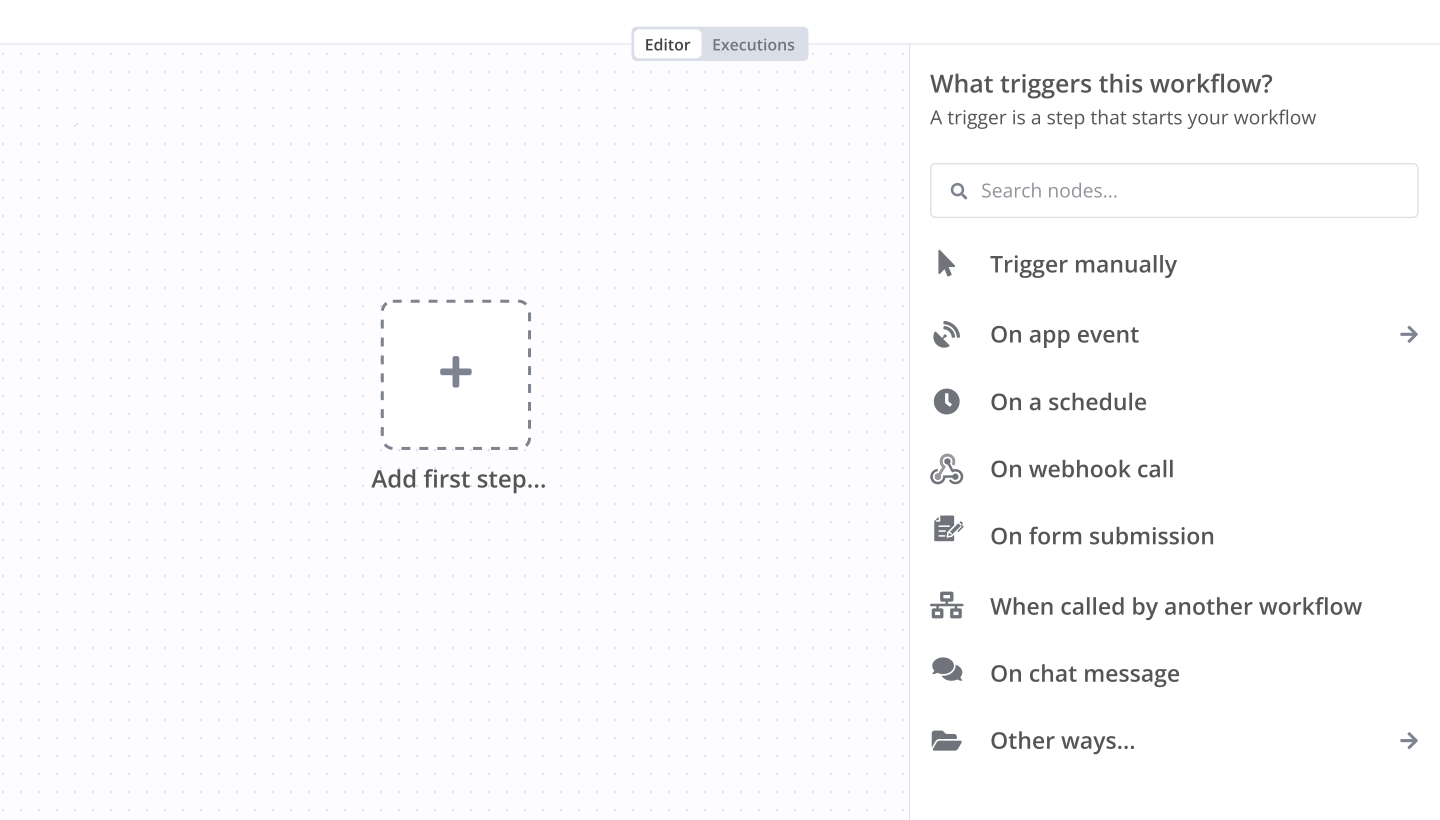
Gmail and WooCommerce integration: Create a new workflow and add the first step

Step 2: Add and configure Gmail and WooCommerce nodes

You can find Gmail and WooCommerce in the nodes panel. Drag them onto your workflow canvas, selecting their actions. Click each node, choose a credential, and authenticate to grant n8n access. Configure Gmail and WooCommerce nodes one by one: input data on the left, parameters in the middle, and output data on the right.

Gmail and WooCommerce integration: Add and configure Gmail and WooCommerce nodes

Step 3: Connect Gmail and WooCommerce

A connection establishes a link between Gmail and WooCommerce (or vice versa) to route data through the workflow. Data flows from the output of one node to the input of another. You can have single or multiple connections for each node.

Gmail and WooCommerce integration: Connect Gmail and WooCommerce

Step 4: Customize and extend your Gmail and WooCommerce integration

Use n8n's core nodes such as If, Split Out, Merge, and others to transform and manipulate data. Write custom JavaScript or Python in the Code node and run it as a step in your workflow. Connect Gmail and WooCommerce with any of n8n’s 1000+ integrations, and incorporate advanced AI logic into your workflows.

Gmail and WooCommerce integration: Customize and extend your Gmail and WooCommerce integration

Step 5: Test and activate your Gmail and WooCommerce workflow

Save and run the workflow to see if everything works as expected. Based on your configuration, data should flow from Gmail to WooCommerce or vice versa. Easily debug your workflow: you can check past executions to isolate and fix the mistake. Once you've tested everything, make sure to save your workflow and activate it.

Gmail and WooCommerce integration: Test and activate your Gmail and WooCommerce workflow

Send new WooCommerce product notifications to Slack, Gmail and Google Sheets

Retail – New Product Drop Notifications

This workflow automatically detects when a new product is created in WooCommerce and instantly notifies internal teams through Slack and email. At the same time, it logs all product details into Google Sheets for tracking and reporting. A centralized data formatting step ensures consistent and reusable product data across all nodes.

Quick Implementation Steps

Import the workflow JSON into n8n.
Connect WooCommerce, Slack, Gmail and Google Sheets credentials.
Review the Format Product Details node for field mappings.
Select the Slack channel and Google Sheet.
Activate the workflow.

What It Does

This workflow listens for new product creation events from WooCommerce. When a product is created, the workflow extracts key product attributes such as name, price, status, permalink and images and prepares them in a single centralized configuration node.

Using this standardized data, the workflow sends a real-time Slack notification to inform internal teams, sends a formatted HTML email announcing the product launch and appends the same product information into a Google Sheet for historical reference and reporting.

By centralizing data preparation and reusing it across all downstream nodes, the workflow remains easy to maintain, highly readable and simple to extend for future requirements.

Who’s It For

This workflow is ideal for:
E-commerce teams using WooCommerce
Marketing teams managing product launches
Operations teams maintaining product logs
Sales teams needing instant product visibility
Business owners tracking new product releases

Prerequisites

To use this workflow, you need:
An active n8n instance (self-hosted or cloud)
WooCommerce REST API credentials
Slack workspace with API access
Gmail account with OAuth2 access
Google Sheets API access
A Google Sheet with predefined columns

How to Use & Setup

Import the workflow JSON into n8n.
Configure WooCommerce – New Product Created with your WooCommerce credentials.
Review the Format Product Details node to verify product field mappings.
Configure Notify Team on Slack and select the target Slack channel.
Configure Send Product Launch Email and update the recipient email if required.
Configure Log Product in Google Sheets and select the target spreadsheet and sheet.
Save and activate the workflow.

Once activated, the workflow runs automatically whenever a new product is created in WooCommerce.

How To Customize Nodes

Format Product Details**
Add or remove product attributes such as SKU, categories or tags.
Modify how images are processed or stored.
Slack Notification**
Customize message format, emojis or mentions.
Email Notification**
Adjust branding, layout or additional product details.
Google Sheets Logging**
Add more columns like product ID, category or creator.

Add-ons (Optional Enhancements)

This workflow can be extended to:
Prevent duplicate product entries in Google Sheets
Route Slack notifications to different channels by category
Send emails to multiple stakeholder groups
Add approval or review steps before notifications
Integrate with CRM or ERP systems
Generate daily or weekly product launch summaries

Use Case Examples

Marketing teams receiving instant alerts for new product launches.
Operations teams maintaining a centralized product creation log.
Sales teams staying updated on new offerings.
Business owners tracking product launch activity over time.
Teams ensuring consistent communication across Slack, email and reports.

There can be many additional use cases depending on business needs.

Troubleshooting Guide

Issue Possible Cause Solution
Slack message not sent Invalid Slack credentials Reconnect Slack API credentials
Email not delivered Gmail OAuth expired Reauthorize Gmail account
Google Sheet not updated Sheet permissions missing Verify Google Sheets access
Images missing Product has no images Check WooCommerce product data
Workflow not executing Workflow inactive Activate the workflow

Need Help?

If you need help setting up, customizing or extending this workflow or want to build similar automations tailored to your business, our n8n developers at WeblineIndia can assist with advanced workflow design and automation solutions.

Nodes used in this workflow

Popular Gmail and WooCommerce workflows

Match WooCommerce orders to new Zendesk tickets and send confirmation emails

Zendesk New Ticket → WooCommerce Order Matching, Tagging & Email Automation Automatically enrich Zendesk tickets with WooCommerce order details and reduce manual lookups. This workflow listens for new Zendesk tickets, fetches the ticket requester’s details, retrieves recent WooCommerce orders, matches them by customer email and updates the ticket with order information and relevant tags. If a matching order is marked as completed, it also sends a confirmation email to the customer. Quick Implementation Steps Connect Zendesk, WooCommerce and Gmail credentials in n8n. Import the workflow JSON and review node credentials. Adjust the WooCommerce order fetch limit if needed. Activate the workflow. That’s it — new tickets will now automatically include order context. What It Does This workflow bridges the gap between customer support and order management by linking Zendesk tickets with WooCommerce orders. When a new ticket is created, the workflow retrieves the requester’s profile to identify their email address, which is then used to find related orders in WooCommerce. Because direct email-based filtering is not available in the WooCommerce node, the workflow fetches the latest five orders and performs email matching internally within n8n. This ensures accurate matching while working around platform limitations. Once a matching order is found, the workflow extracts essential details such as order number, status, currency and purchased items. It updates the Zendesk ticket with a private internal note and applies clear order-status-based tags. If the order is marked as completed, the workflow also sends a confirmation email to the customer. Who’s It For Customer support teams using Zendesk and WooCommerce E-commerce businesses handling frequent order-related inquiries Support managers aiming to reduce manual order lookups Teams that want faster, more consistent ticket responses Requirements to Use This Workflow An active Zendesk account with API access A WooCommerce store with REST API credentials A Gmail account (OAuth2) for sending customer emails An active n8n instance Permission to update tickets and users in Zendesk How It Works & How To Set Up Workflow Logic Overview Trigger on New Ticket The workflow starts when a new Zendesk ticket is created with status new. Fetch Ticket Requester Details The requester’s user profile is retrieved to obtain their email address. Fetch Recent WooCommerce Orders The workflow retrieves the latest five orders from WooCommerce. Match Customer Email Each order’s billing email is compared with the Zendesk requester’s email. Only matching orders continue through the workflow. Generate Zendesk Tags Order status is evaluated and mapped to meaningful Zendesk tags. Prepare Ticket Update Payload Order details and tags are formatted for the Zendesk update. Update Zendesk Ticket A private internal note is added to the ticket, along with order-related tags. Check for Completed Orders If the order status is completed, the workflow proceeds to send an email. Send Confirmation Email The customer receives a confirmation email with their order details. Setup Instructions Update credentials in all Zendesk, WooCommerce and Gmail nodes. Review the WooCommerce order fetch limit (default: 5). Verify the email comparison logic in the IF node. Activate the workflow once testing is complete. How To Customize Nodes WooCommerce – Fetch Recent Orders** Increase or decrease the limit value to control how many recent orders are checked. Match Customer Email (IF Node)** Modify comparison logic (for example, make it case-insensitive). Generate Zendesk Tags (Code Node)** Add or change tags based on custom order statuses. Zendesk – Update Ticket** Customize the internal note format or add additional fields. Send Order Confirmation Email** Edit the email content or disable this node if emails are not required. Add-ons (Additional Features) SLA-based ticket prioritization Shipment tracking number enrichment Refund and cancellation detection Slack or Microsoft Teams notifications Extended reporting using Zendesk tags Use Case Examples Automatically attaching order details to “Where is my order?” tickets Speeding up refund or replacement requests Reducing agent time spent switching between Zendesk and WooCommerce Applying consistent order-status tags for analytics Sending proactive confirmation emails for completed orders There are many more possible use cases depending on how this workflow is extended or customized. Troubleshooting Guide | Issue | Possible Cause | Solution | |------|---------------|----------| | No order found | Customer used a different email | Ask the customer to confirm the checkout email | | Wrong order matched | Order not in recent fetch range | Increase the WooCommerce order fetch limit | | No email sent | Order status is not completed | Confirm order status or customize the IF condition | | Ticket not updated | Zendesk permission issue | Verify API credentials and scopes | | Tags missing | Code node not triggered | Check order status logic in the Code node | Need Help? If you need help setting up this workflow, customizing nodes or building additional automation, WeblineIndia is here to support you. Our team specializes in n8n workflow automation, Zendesk integrations and WooCommerce process optimization. Whether you want to extend this workflow or build a similar solution tailored to your business, feel free to reach out to WeblineIndia for expert assistance.

Detect WooCommerce order delays with Gmail and Slack alerts in real time

Real-Time WooCommerce Order Delay Detection with Email & Slack Alerts This n8n workflow listens to real-time WooCommerce order events and automatically detects delivery delays based on the estimated delivery date. When a delay is identified, it proactively notifies the customer via email and alerts internal teams through Slack, ensuring transparency and faster response to fulfillment issues. Quick Start – Get This Running Fast Import the workflow JSON into n8n. Connect WooCommerce credentials. Configure Gmail and Slack credentials. Activate the workflow. Start receiving automatic delay alerts in real time. What It Does This workflow proactively monitors WooCommerce orders for delivery delays. It is triggered whenever a new order is created or updated. The workflow validates order status, checks the estimated delivery date, calculates delay duration and sends notifications if a delay is detected. Who’s It For WooCommerce Store Owners E-commerce Operations Teams Customer Support Teams Fulfillment & Logistics Teams Requirements WooCommerce store with REST API access Gmail account (OAuth enabled) Slack workspace n8n instance (Cloud or Self-hosted) Workflow Steps WooCommerce Trigger Normalize Order Data Validate Order Status Fetch Estimated Delivery Date Calculate Delay Send Email Notification Send Slack Alert Customization Modify delay threshold Customize email and Slack message formats Add escalation logic Optional Enhancements SMS / WhatsApp alerts Support ticket creation Analytics dashboards Troubleshooting | Issue | Solution | |------|----------| | No alerts | Verify credentials | | Wrong delay | Check date format | | Workflow stops | Ensure ETA exists | Support For advanced automation or customization support, contact WeblineIndia.

Sync retail product prices between Shopify and WooCommerce with alerts

Retail Price Sync Automation for Shopify & WooCommerce This workflow automates the synchronization of product prices across Shopify and WooCommerce platforms to ensure retail consistency. It triggers when a price change is detected in either system, applies platform-specific pricing rules (such as psychological rounding) and updates the secondary platform. The workflow also includes a threshold-based alerting system via Gmail for major price drops and logs every change to a Google Sheets master file for auditing. Quick Implementation Steps Set the priceChangeThreshold in the Shopify Configuration and WooCommerce Configuration nodes. Connect your Shopify Access Token credentials to the Shopify trigger and update nodes. Connect your WooCommerce API credentials to the WooCommerce trigger and update nodes. Link your Google Sheets OAuth2 and Gmail OAuth2 credentials for logging and notifications. Specify the documentId for your pricing log in the Log Price Changes node. What It Does This workflow acts as a bridge between two major e-commerce platforms, ensuring that a price update in one is intelligently reflected in the other. It goes beyond simple mirroring by: Threshold Monitoring: Detecting if a price change exceeds a set limit (e.g., $150 or $500) to trigger immediate management alerts. Platform-Specific Logic: Automatically formatting prices for different environments—for example, rounding WooCommerce prices to the nearest .99 for psychological pricing while using standard rounding for Shopify. Audit Trail Creation: Maintaining a centralized record of all price migrations in Google Sheets, including SKUs, old vs. new prices and timestamps. Team Communication: Sending automated email notifications to ensure the team is aware of successful syncs or critical price volatility. Who’s It For Multi-Channel Retailers who need to keep pricing in sync across Shopify and WooCommerce storefronts. Inventory Managers looking to automate price adjustments without manual data entry. Finance & Operations Teams requiring an automated audit log of all pricing modifications. Technical Workflow Breakdown Entry Points (Triggers) Shopify Price Update: Triggers on the orders/updated topic (or product updates) to capture new price data from Shopify. WooCommerce Price Update: Triggers on product.updated to capture changes originating from the WooCommerce store. Processing & Logic Configuration Nodes: Define the source system and set the specific threshold for what constitutes a "major" price change. Apply Platform-Specific Rules: A custom code block that calculates psychological pricing (e.g., forcing a .99 ending) and ensures prices never drop below a minimum safety floor (e.g., $1.00). Check Price Change Threshold: An internal filter that routes the workflow based on the magnitude of the price shift. Output & Integrations Update Nodes: Pushes the formatted price data to the target platform (Shopify or WooCommerce). Log Price Changes: Appends a new row to a Google Sheet with detailed metadata. Notifications: Uses Gmail to send high-priority alerts for major drops and routine confirmations for successful syncs. Customization Adjust Pricing Strategy Modify the Apply Platform-Specific Rules (Code Node) to change rounding logic, add currency conversion factors or implement different psychological pricing tiers. Change Alert Thresholds Update the priceChangeThreshold value in the Shopify Configuration or WooCommerce Configuration nodes to make alerts more or less sensitive. Expand Logging The Log Price Changes node is set to autoMapInputData. You can add custom columns to your Google Sheet and the workflow will automatically attempt to fill them if the data exists in the workflow. Troubleshooting Guide | Issue | Possible Cause | Solution | | :--------------------------------------- | :----------------------------------- | :----------------------------------------------------------------------------------------------------------------- | | Sync Not Triggering | Webhook not registered correctly. | Check the webhookId in the Shopify/WooCommerce trigger nodes and ensure the apps have permission to send events. | | Google Sheets Error | Sheet ID or Column names mismatched. | Verify the documentId and ensure the id column exists in your Sheet for matching. | | Prices Not Rounding Correct/Expected | Code node logic error. | Review the JavaScript in Apply Platform-Specific Rules to ensure the Math functions match your strategy. | | Emails Not Sending | Gmail OAuth2 expired. | Re-authenticate your Gmail credentials in the n8n settings. | Need Help? If you need assistance adjusting the psychological pricing code, adding more platforms (like Amazon or eBay) or setting up advanced Slack notifications, please reach out to our n8n automation experts at WeblineIndia. We can help scale this workflow to manage thousands of SKUs with high precision.

Track WooCommerce inventory and send reorder alerts via Gmail and Slack

WooCommerce Inventory Reorder Automation with n8n, Gmail & Slack Alerts Automatically track product sales and inventory levels in WooCommerce and trigger reorder notifications when stock runs low or sales spike. This n8n workflow runs daily, analyzes all WooCommerce orders to calculate SKU-wise sales, compares them with current product stock, calculates an optimal reorder quantity and sends automated alerts via Email (Gmail) and Slack when a product meets reorder conditions. Quick Implementation Steps (Get Started Fast) Import the workflow JSON into your n8n instance. Connect WooCommerce, Gmail and Slack credentials. Set the Schedule Trigger to run daily. Update email recipients and Slack channel. Activate the workflow. What It Does This workflow automates inventory monitoring and reorder decision-making for WooCommerce stores. On a daily schedule, it fetches all orders from WooCommerce and calculates how many units of each SKU were sold. This gives you a clear picture of recent sales velocity without manual reporting. The workflow then retrieves live product inventory data from WooCommerce, including current stock levels and low-stock thresholds. Sales data and product data are merged using SKU matching and evaluated using logical conditions to determine whether a product should be reordered. When a product meets the reorder criteria, the workflow calculates an optimal reorder quantity using average daily sales, supplier lead time and safety stock logic. It then automatically notifies the purchasing team via email and Slack, ensuring no critical stock replenishment is missed. Who’s It For This workflow is ideal for: WooCommerce store owners Inventory and supply chain managers E-commerce operations teams Businesses looking to reduce stockouts Teams that want proactive, automated purchase alerts Requirements to Use This Workflow To use this workflow, you will need: An active n8n instance A WooCommerce store with: Products using SKUs Stock management enabled WooCommerce API credentials with access to: Orders Products A Gmail account connected to n8n (OAuth2) A Slack workspace with bot permissions Basic understanding of n8n nodes and credentials How It Works & How To Set Up Step-by-Step Workflow Logic Schedule Trigger (Daily) The workflow runs automatically once per day. Fetch All WooCommerce Orders Retrieves all available orders from WooCommerce. No status or date filtering is applied. Calculate Sales per SKU A JavaScript Code node loops through order line items. Quantities sold are aggregated per SKU. Fetch All WooCommerce Products Retrieves product inventory data including: Stock quantity Low stock threshold Product name Merge Sales & Product Data Sales data and product inventory data are merged using SKU matching. Reorder Eligibility Filter A product qualifies if either condition is met: Current stock ≤ low-stock threshold OR recent sales quantity ≥ 1.5× low-stock threshold Reorder Quantity Calculation Uses: Average daily sales Fixed lead time (7 days) Safety stock (5 units) Calculates recommended reorder quantity. Email Notification Sends a formatted HTML email with reorder details. Slack Notification Sends a real-time alert to a specified Slack channel. How To Customize Nodes You can easily adapt this workflow to your business needs: Schedule Trigger** Change execution frequency (daily, weekly, etc.). Sales Calculation Code** Modify logic to: Ignore certain SKUs Add time-based filtering Apply weighted averages Filter Conditions** Adjust reorder rules: Change sales multiplier Use AND logic instead of OR Reorder Formula** Update lead time or safety stock values. Integrate supplier-specific rules. Email & Slack Nodes** Replace recipients and channels. Customize message formatting or branding. Add-ons (Extend the Workflow) You can enhance this workflow with: Automatic purchase order creation in ERP systems Google Sheets logging for reorder history Vendor-specific reorder logic Forecast-based inventory planning Approval workflows before notifications Webhook integration with procurement tools Use Case Examples Primary use cases include: Preventing stockouts in fast-moving WooCommerce stores Automating daily inventory monitoring Supporting purchasing teams with data-driven reorder alerts Replacing manual stock checks and spreadsheets Improving response time to sudden sales spikes There are many more variations of this workflow that can be adapted to different industries and store sizes. Troubleshooting Guide | Issue | Possible Cause | Solution | |-----|---------------|----------| | No emails sent | Gmail credentials not connected | Reconnect Gmail OAuth2 | | No Slack alerts | Wrong channel ID or permissions | Update channel and Slack app scopes | | Reorder triggered too often | Filter logic too sensitive | Adjust threshold values | | Missing sales data | Products without SKUs | Ensure all products have SKUs | | Workflow fails | WooCommerce API limits | Reduce frequency or paginate data | Need Help? Need assistance setting up this workflow or customizing it for your business? Our n8n workflow development team at WeblineIndia specializes in building advanced n8n automations, WooCommerce integrations and end-to-end business process workflows. Whether you need enhancements, add-ons or a completely custom automation solution, our experts are here to help you streamline operations and scale efficiently. Contact WeblineIndia to get started with smarter automation today.

Send new WooCommerce product notifications to Slack, Gmail and Google Sheets

Retail – New Product Drop Notifications This workflow automatically detects when a new product is created in WooCommerce and instantly notifies internal teams through Slack and email. At the same time, it logs all product details into Google Sheets for tracking and reporting. A centralized data formatting step ensures consistent and reusable product data across all nodes. Quick Implementation Steps Import the workflow JSON into n8n. Connect WooCommerce, Slack, Gmail and Google Sheets credentials. Review the Format Product Details node for field mappings. Select the Slack channel and Google Sheet. Activate the workflow. What It Does This workflow listens for new product creation events from WooCommerce. When a product is created, the workflow extracts key product attributes such as name, price, status, permalink and images and prepares them in a single centralized configuration node. Using this standardized data, the workflow sends a real-time Slack notification to inform internal teams, sends a formatted HTML email announcing the product launch and appends the same product information into a Google Sheet for historical reference and reporting. By centralizing data preparation and reusing it across all downstream nodes, the workflow remains easy to maintain, highly readable and simple to extend for future requirements. Who’s It For This workflow is ideal for: E-commerce teams using WooCommerce Marketing teams managing product launches Operations teams maintaining product logs Sales teams needing instant product visibility Business owners tracking new product releases Prerequisites To use this workflow, you need: An active n8n instance (self-hosted or cloud) WooCommerce REST API credentials Slack workspace with API access Gmail account with OAuth2 access Google Sheets API access A Google Sheet with predefined columns How to Use & Setup Import the workflow JSON into n8n. Configure WooCommerce – New Product Created with your WooCommerce credentials. Review the Format Product Details node to verify product field mappings. Configure Notify Team on Slack and select the target Slack channel. Configure Send Product Launch Email and update the recipient email if required. Configure Log Product in Google Sheets and select the target spreadsheet and sheet. Save and activate the workflow. Once activated, the workflow runs automatically whenever a new product is created in WooCommerce. How To Customize Nodes Format Product Details** Add or remove product attributes such as SKU, categories or tags. Modify how images are processed or stored. Slack Notification** Customize message format, emojis or mentions. Email Notification** Adjust branding, layout or additional product details. Google Sheets Logging** Add more columns like product ID, category or creator. Add-ons (Optional Enhancements) This workflow can be extended to: Prevent duplicate product entries in Google Sheets Route Slack notifications to different channels by category Send emails to multiple stakeholder groups Add approval or review steps before notifications Integrate with CRM or ERP systems Generate daily or weekly product launch summaries Use Case Examples Marketing teams receiving instant alerts for new product launches. Operations teams maintaining a centralized product creation log. Sales teams staying updated on new offerings. Business owners tracking product launch activity over time. Teams ensuring consistent communication across Slack, email and reports. There can be many additional use cases depending on business needs. Troubleshooting Guide | Issue | Possible Cause | Solution | |------|---------------|----------| | Slack message not sent | Invalid Slack credentials | Reconnect Slack API credentials | | Email not delivered | Gmail OAuth expired | Reauthorize Gmail account | | Google Sheet not updated | Sheet permissions missing | Verify Google Sheets access | | Images missing | Product has no images | Check WooCommerce product data | | Workflow not executing | Workflow inactive | Activate the workflow | Need Help? If you need help setting up, customizing or extending this workflow or want to build similar automations tailored to your business, our n8n developers at WeblineIndia can assist with advanced workflow design and automation solutions.
+3

WooCommerce 🛒 Product Review Sentiment Analysis and AI Report 🤖 for Improvement

This workflow automates the end-to-end analysis of WooCommerce product reviews, transforming raw customer feedback into actionable product and customer-care insights, and delivering them in a structured, visual, and shareable format. This workflow analyzes product review sentiment from WooCommerce using AI. It starts by retrieving reviews for a specified product via the WooCommerce. Each review then undergoes sentiment analysis using LangChain's Sentiment Analysis. The workflow aggregates sentiment data, creates a pie chart visualization via QuickChart, and compiles a comprehensive report using an AI Agent. The report includes executive summaries, quantitative data, qualitative analysis, product diagnostics, and operational recommendations. Finally, the AI-generated report is converted to HTML and emailed to a designated recipient for review by customer and product teams. Key Advantages ✅ Full Automation of Review Analysis Eliminates manual work by automating data collection, sentiment analysis, reporting, visualization, and delivery in a single workflow. ✅ Scalable and Reliable Batch processing ensures the workflow can handle dozens or hundreds of reviews without performance issues. ✅ Action-Oriented Insights (Not Just Sentiment) Instead of stopping at sentiment scores, the workflow produces: Root-cause hypotheses Concrete improvement actions Prioritized recommendations (P0 / P1 / P2) Measurable KPIs ✅ Combines Quantitative and Qualitative Analysis Merges hard metrics (averages, distributions, outliers) with qualitative insights (themes, risks, opportunities), giving a 360° view of customer feedback. ✅ Visual + Narrative Output Stakeholders receive both: Visual sentiment charts** for quick understanding Structured written reports** for strategic decision-making ✅ Ready for Product & Customer Care Teams The output format is tailored for non-technical teams: Clear language Masked personal data (GDPR-friendly) Immediate usability in meetings, emails, or documentation ✅ Easily Extensible The workflow can be extended to: Run on a schedule Analyze multiple products Store results in a database or CRM Trigger alerts for negative sentiment spikes Ideal Use Cases Continuous monitoring of product sentiment Supporting product roadmap decisions Identifying customer pain points early Improving customer support response strategies Reporting customer voice to stakeholders automatically How it works Manual Trigger & Configuration The workflow starts manually and sets the target WooCommerce product ID and store URL. Data Retrieval from WooCommerce Fetches all reviews for the selected product via the WooCommerce REST API. Retrieves product details (name, description, categories) to enrich the analysis context. Batch Processing of Reviews Reviews are processed in batches to ensure scalability and reliability, even with a large number of reviews. AI-Powered Sentiment Analysis Each review is analyzed using an OpenAI-based sentiment analysis model. For every review, the workflow extracts: Sentiment category (Positive / Negative / Neutral) Strength (intensity) Confidence (reliability of the classification) Data Normalization & Aggregation Review text is cleaned and structured. Sentiment data is aggregated to compute overall distributions and metrics. Visual Sentiment Distribution A pie chart is dynamically generated via QuickChart to visually represent sentiment distribution. Advanced AI Insight Generation A specialized AI agent (“Product Insights Analyst”) transforms the raw and aggregated data into a professional, structured report, including: Executive summary Quantitative statistics Qualitative themes Product diagnosis Operational recommendations Product backlog ideas Next steps HTML Conversion & Delivery The report is converted into clean HTML. The final output is automatically sent via email to stakeholders (e.g. product or customer care teams). Set up steps Configure credentials: Set up WooCommerce API credentials in the HTTP Request node. Add OpenAI API credentials for both sentiment analysis and reporting. Configure Gmail OAuth2 credentials for sending the final email report. Set parameters: In the "Product ID" node, replace PRODUCT_ID and YOUR_WEBSITE with actual product ID and WooCommerce site URL. Update the recipient email address in the "Send a message" node. Optional adjustments: Modify the pie chart design in the "QuichChart" node if needed. Adjust the report structure or language in the "Product Insights Analyst" system prompt. Run the workflow: Click "Execute workflow" on the manual trigger to start the process. Monitor execution in n8n to ensure all nodes process correctly. Once configured, the workflow will automatically analyze product reviews, generate insights, and deliver a formatted report via email. 👉 Subscribe to my new YouTube channel. Here I’ll share videos and Shorts with practical tutorials and FREE templates for n8n. Need help customizing? Contact me for consulting and support or add me on Linkedin.

Build your own Gmail and WooCommerce integration

Create custom Gmail and WooCommerce workflows by choosing triggers and actions. Nodes come with global operations and settings, as well as app-specific parameters that can be configured. You can also use the HTTP Request node to query data from any app or service with a REST API.

Gmail supported actions

Add Label
Delete
Get
Get Many
Mark as Read
Mark as Unread
Remove Label
Reply
Send
Send and Wait for Response
Create
Delete
Get
Get Many
Create
Delete
Get
Get Many
Add Label
Delete
Get
Get Many
Remove Label
Reply
Trash
Untrash

WooCommerce supported actions

Create
Create a customer
Delete
Delete a customer
Get
Retrieve a customer
Get Many
Retrieve many customers
Update
Update a customer
Create
Create a order
Delete
Delete a order
Get
Get a order
Get Many
Get many orders
Update
Update a order
Create
Create a product
Delete
Delete a product
Get
Get a product
Get Many
Get many products
Update
Update a product

FAQs

  • Can Gmail connect with WooCommerce?

  • Can I use Gmail’s API with n8n?

  • Can I use WooCommerce’s API with n8n?

  • Is n8n secure for integrating Gmail and WooCommerce?

  • How to get started with Gmail and WooCommerce integration in n8n.io?

Need help setting up your Gmail and WooCommerce integration?

Discover our latest community's recommendations and join the discussions about Gmail and WooCommerce integration.
jake chard
Jan Koch
Paul Kennard

Looking to integrate Gmail and WooCommerce in your company?

Over 3000 companies switch to n8n every single week

Why use n8n to integrate Gmail with WooCommerce

Build complex workflows, really fast
Build complex workflows, really fast

Handle branching, merging and iteration easily.
Pause your workflow to wait for external events.

Code when you need it, UI when you don't

Simple debugging

Your data is displayed alongside your settings, making edge cases easy to track down.

Use templates to get started fast

Use 1000+ workflow templates available from our core team and our community.

Reuse your work

Copy and paste, easily import and export workflows.

Implement complex processes faster with n8n

red iconyellow iconred iconyellow icon