Back to Integrations
integrationGoogle Calendar node
integrationGoogle Drive node

Google Calendar and Google Drive integration

Save yourself the work of writing custom integrations for Google Calendar and Google Drive and use n8n instead. Build adaptable and scalable Productivity, and Data & Storage workflows that work with your technology stack. All within a building experience you will love.

How to connect Google Calendar and Google Drive

  • Step 1: Create a new workflow
  • Step 2: Add and configure nodes
  • Step 3: Connect
  • Step 4: Customize and extend your integration
  • Step 5: Test and activate your workflow

Step 1: Create a new workflow and add the first step

In n8n, click the "Add workflow" button in the Workflows tab to create a new workflow. Add the starting point – a trigger on when your workflow should run: an app event, a schedule, a webhook call, another workflow, an AI chat, or a manual trigger. Sometimes, the HTTP Request node might already serve as your starting point.
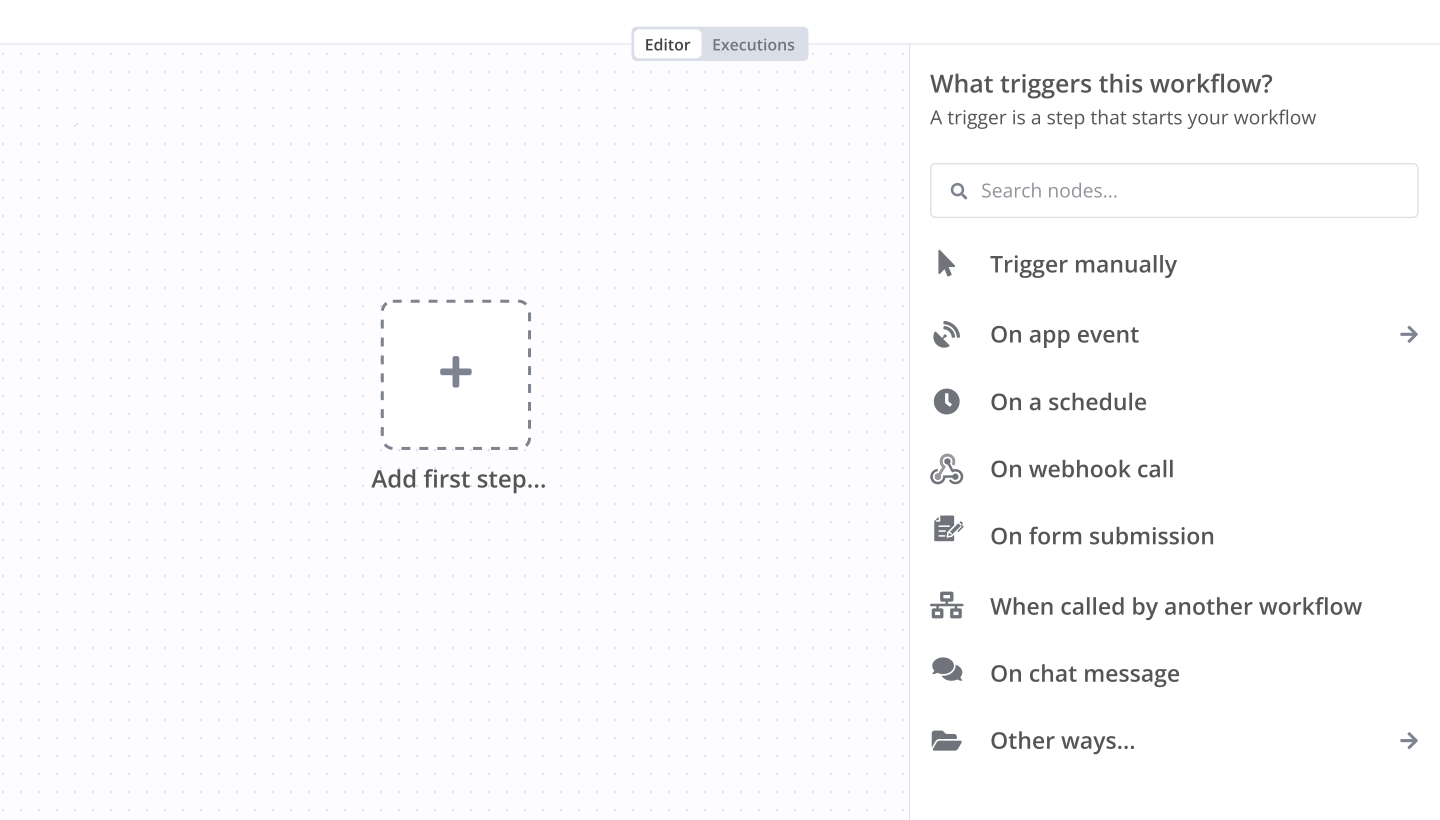
Google Calendar and Google Drive integration: Create a new workflow and add the first step

Step 2: Add and configure Google Calendar and Google Drive nodes

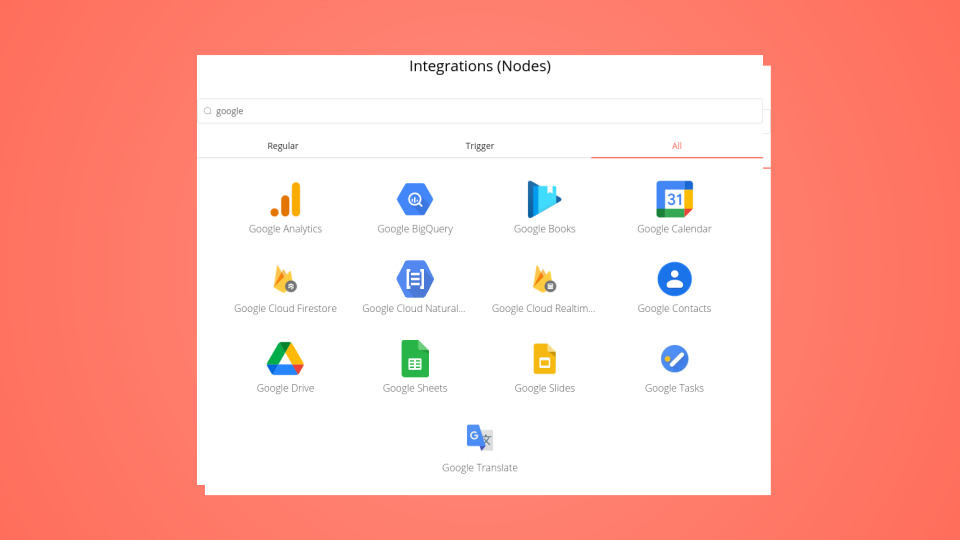
You can find Google Calendar and Google Drive in the nodes panel. Drag them onto your workflow canvas, selecting their actions. Click each node, choose a credential, and authenticate to grant n8n access. Configure Google Calendar and Google Drive nodes one by one: input data on the left, parameters in the middle, and output data on the right.

Google Calendar and Google Drive integration: Add and configure Google Calendar and Google Drive nodes

Step 3: Connect Google Calendar and Google Drive

A connection establishes a link between Google Calendar and Google Drive (or vice versa) to route data through the workflow. Data flows from the output of one node to the input of another. You can have single or multiple connections for each node.

Google Calendar and Google Drive integration: Connect Google Calendar and Google Drive

Step 4: Customize and extend your Google Calendar and Google Drive integration

Use n8n's core nodes such as If, Split Out, Merge, and others to transform and manipulate data. Write custom JavaScript or Python in the Code node and run it as a step in your workflow. Connect Google Calendar and Google Drive with any of n8n’s 1000+ integrations, and incorporate advanced AI logic into your workflows.

Google Calendar and Google Drive integration: Customize and extend your Google Calendar and Google Drive integration

Step 5: Test and activate your Google Calendar and Google Drive workflow

Save and run the workflow to see if everything works as expected. Based on your configuration, data should flow from Google Calendar to Google Drive or vice versa. Easily debug your workflow: you can check past executions to isolate and fix the mistake. Once you've tested everything, make sure to save your workflow and activate it.

Google Calendar and Google Drive integration: Test and activate your Google Calendar and Google Drive workflow

Actioning your meeting next steps using transcripts and AI

This n8n workflow demonstrates how you can summarise and automate post-meeting actions from video transcripts fed into an AI Agent.

Save time between meetings by allowing AI handle the chores of organising follow-up meetings and invites.

How it works
This workflow scans for the calendar for client or team meetings which were held online. * Attempts will be made to fetch any recorded transcripts which are then sent to the AI agent.
The AI agent summarises and identifies if any follow-on meetings are required.
If found, the Agent will use its Calendar Tool to to create the event for the time, date and place for the next meeting as well as add known attendees.

Requirements
Google Calendar and the ability to fetch Meeting Transcripts (There is a special OAuth permission for this action!)
OpenAI account for access to the LLM.

Customising the workflow

This example only books follow-on meetings but could be extended to generate reports or send emails.

Nodes used in this workflow

Popular Google Calendar and Google Drive workflows

+7

Build a Chatbot, Voice and Phone Agent with Voiceflow, Google Calendar and RAG

Voiceflow is a no-code platform that allows you to design, prototype, and deploy conversational assistants across multiple channels—such as chat, voice, and phone—with advanced logic and natural language understanding. It supports integration with APIs, webhooks, and even tools like Twilio for phone agents. It's perfect for building customer support agents, voice bots, or intelligent assistants. This workflow connects n8n and Voiceflow with tools like Google Calendar, Qdrant (vector database), OpenAI, and an order tracking API to power a smart, multi-channel conversational agent. There are 3 main webhook endpoints in n8n that Voiceflow interacts with: n8n_order – receives user input related to order tracking, queries an API, and responds with tracking status. n8n_appointment – processes appointment booking, reformats date input using OpenAI, and creates a Google Calendar event. n8n_rag – handles general product/service questions using a RAG (Retrieval-Augmented Generation) system backed by: Google Drive document ingestion, Qdrant vector store for search, and OpenAI models for context-based answers. Each webhook is connected to a corresponding "Capture" block inside Voiceflow, which sends data to n8n and waits for the response. How It Works This n8n workflow integrates Voiceflow for chatbot/voice interactions, Google Calendar for appointment scheduling, and RAG (Retrieval-Augmented Generation) for knowledge-based responses. Here’s the flow: Trigger**: Three webhooks (n8n_order, n8n_appointment, n8n_rag) receive inputs from Voiceflow (chat, voice, or phone calls). Each webhook routes requests to specific functions: Order Tracking: Fetches order status via an external API. Appointment Scheduling: Uses OpenAI to parse dates, creates Google Calendar events, and confirms via WhatsApp. RAG System: Queries a Qdrant vector store (populated with Google Drive documents) to answer customer questions using GPT-4. AI Processing**: OpenAI Chains: Convert natural language dates to Google Calendar formats and generate responses. RAG Pipeline: Embeds documents (via OpenAI), stores them in Qdrant, and retrieves context-aware answers. Voiceflow Integration: Routes responses back to Voiceflow for multi-channel delivery (chat, voice, or phone). Outputs**: Confirmation messages (e.g., "Event created successfully"). Dynamic responses for orders, appointments, or product support. Setup Steps Prerequisites: APIs**: Google Calendar & Drive OAuth credentials. Qdrant vector database (hosted or cloud). OpenAI API key (for GPT-4 and embeddings). Configuration: Qdrant Setup: Run the "Create collection" and "Refresh collection" nodes to initialize the vector store. Populate it with documents using the Google Drive → Qdrant pipeline (embeddings generated via OpenAI). Voiceflow Webhooks: Link Voiceflow’s "Captures" to n8n’s webhook URLs (n8n_order, n8n_appointment, n8n_rag). Google Calendar: Authenticate the Google Calendar node and set event templates (e.g., summary, description). RAG System: Configure the Qdrant vector store and OpenAI embeddings nodes. Adjust the Retrieve Agent’s system prompt for domain-specific queries (e.g., electronics store support). Optional: Add Twilio for phone-agent capabilities. Customize OpenAI prompts for tone/accuracy. PS. You can import a Twilio number to assign it to your agent for becoming a Phone Agent Need help customizing? Contact me for consulting and support or add me on Linkedin
+43

Explore n8n Nodes in a Visual Reference Library

WATCH THE n8n STARTER GUIDE 👇 This template is featured in the n8n Starter Guide series. The template is free, but comes with two additional PDFs and a Quick Start video if you grab the full download pack on gumroad. How it works This template is a visual map of many useful n8n nodes. It groups nodes like Triggers, AI tools, and App connectors onto the canvas. Explore the sections to learn about different nodes and easily copy them for your own workflows. It acts as a handy visual reference guide. Set up steps • Setup takes about 5 minutes. • Import the template into your n8n instance. • Explore the node categories visually on the canvas. • A Quick Start video is included in the download pack, along with a prompts PDF and PDF with links to other awesome n8n templates here on the n8n template gallery.
+8

Build an AI Powered Phone Agent 📞🤖 with Retell, Google Calendar and RAG

This Workflow simulates an AI-powered phone agent with RetellAI with two main functions: 📅 Appointment Booking – It can schedule appointments directly into Google Calendar. 🧠 RAG-based Information Retrieval – It provides answers using a Retrieval-Augmented Generation (RAG) system. For example, it can respond to questions such as store opening hours, return policies, or product details. The guide also explains how to purchase a dedicated phone number (with a +1 prefix) and link it to the AI agent. This setup is cost-effective, as it uses a FREE $10 credit to operate without additional charges in the beginning. ✨ Advantages 🕐 24/7 Availability** – The AI agent can answer calls and assist customers at any time. 🤖 Automation** – It reduces the workload on human staff by handling repetitive tasks like appointment scheduling and FAQ responses. 🔌 Easy Integration** – Built with n8n, it’s flexible and customizable for various platforms and tools. 💸 Low-cost Setup** – Using the free credit, businesses can get started without an upfront investment. 📦 Use Cases 🛍 E-commerce** – Answer common product questions or order inquiries. 🏬 Retail Stores** – Provide store hours, address info, and return policies. 🍽 Restaurants** – Take reservations or share menu information. 💼 Service Providers** – Book appointments or consultations. 📞 Any Local Business** – Offer phone support without needing a live operator. How It Works This Workflow simulates an AI-powered phone agent with two primary functions: Appointment Booking The workflow captures call events (e.g., call_ended or call_analyzed) and extracts key details (transcript, caller info, duration, etc.). Using OpenAI, it summarizes the conversation and parses structured data (e.g., names, contact info, dates). For scheduling, it converts user-provided dates into Google Calendar-compatible formats and creates events automatically. RAG-Based Information Retrieval When a query is received (e.g., store hours, product details), the workflow retrieves relevant information from a Qdrant vector store. An AI agent processes the query using the retrieved data and responds via a webhook, ensuring accurate, context-aware answers. Set Up Steps Prepare Qdrant Vector Store Create/refresh a Qdrant collection (via HTTP requests). Upload and vectorize documents (e.g., from Google Drive) using OpenAI embeddings. Configure RetellAI Agent Sign up for RetellAI, create an agent, and set the webhook URLs (n8n_call for call events, n8n_rag_function for RAG queries). Purchase a Twilio phone number and link it to the agent. n8n Workflow Setup Connect OpenAI, Qdrant, Google Calendar, and Telegram nodes with credentials. Customize prompts for summarization, date parsing, and RAG responses. Test the workflow to ensure data flows from call events → processing → actions (e.g., calendar bookings, Telegram alerts). Deploy Trigger the workflow via RetellAI webhooks during calls. Monitor outputs (e.g., call summaries in Telegram, calendar events). Note: Replace placeholders (e.g., QDRANTURL, COLLECTION, CHAT_ID) with actual values. 👉 Subscribe to my new YouTube channel. Here I’ll share videos and Shorts with practical tutorials and FREE templates for n8n. Need help customizing? Contact me for consulting and support or add me on Linkedin.
+13

Build a Multi-functional Telegram Bot with Gemini, RAG PDF Search & Google Suite

The Ultimate Beginner's Guide to an AI-Powered Telegram Assistant (PDF, Brave search & Google Suite) This comprehensive workflow bundle is designed as a powerful starter kit, enabling you to build a multi-functional AI assistant on Telegram. It seamlessly integrates AI-powered voice interactions, an intelligent PDF document search using a Retrieval-Augmented Generation (RAG) system, and automates various Google Suite tasks like calendar management and document generation. Perfect for beginners looking to explore advanced AI and automation capabilities. Disclaimer This template is designed for self-hosted n8n instances. 🚀 Key Features Telegram Bot Interface:** Interact with your AI assistant using both text and voice commands through Telegram. AI Voice Bot:** Transcribes user voice messages using OpenAI Whisper. Processes requests with an AI agent powered by Google Gemini. Responds with AI-synthesized voice using Replicate API. PDF RAG System:** Index PDF documents from Google Drive via Telegram commands. Utilizes Mistral AI for Optical Character Recognition (OCR) on PDFs. Stores document content and embeddings in a Qdrant vector database. Answers questions about your documents using Google Gemini, based on retrieved context. Google Suite Automation:** Manage Google Calendar: Create events, find upcoming holidays, and list birthdays. Google Drive: Search for PDF files and manage document templates. Google Docs: Automatically generate invoices from templates. Intelligent Web Search:** Employs Brave Search for fetching real-time information from the web. Versatile AI Agent:** Leverages Google Gemini with a suite of tools including a calculator, date & time utilities, and custom integrations (e.g., example Airbnb tools). Command-Driven Functionality:** Easily trigger specific actions using Telegram commands like /help, /pdf, /rag, /invoice, /chat, /brave, and /birthday. ⚙️ How It Works The workflow is initiated by messages or commands sent to your Telegram bot. A central Switch node directs the flow based on the input received. Telegram Interaction & Command Routing A Telegram Trigger node listens for new messages (text or voice). A "typing..." indicator is sent to Telegram for better user experience. The Switch node parses the message content and routes it to the appropriate sub-workflow based on predefined commands (e.g., /pdf, /rag, /voice) or general chat. AI Voice Bot Functionality For voice messages (or if the voice path is triggered): The voice file is downloaded from Telegram. OpenAI Whisper transcribes the audio into text. The transcribed text is fed to an AI Agent (powered by Google Gemini and equipped with various tools and memory). The AI Agent's text response is then sent to the Replicate API to generate a natural-sounding voice. The generated audio response is sent back to the user on Telegram. PDF RAG System with Mistral OCR & Qdrant Indexing PDFs (via /qdrant <Google_Drive_File_ID> command):** The specified PDF is downloaded from Google Drive. The PDF is uploaded to Mistral AI for OCR processing. The extracted text (in markdown format) is retrieved. The text is split into manageable chunks. OpenAI Embeddings are generated for each chunk. These chunks and their embeddings are stored in a Qdrant vector collection. A confirmation message is sent to Telegram. Querying PDFs (via /rag <your_question> command):** The user's question is processed by a RetrievalQA Chain. This chain uses Google Gemini as the Language Model and retrieves relevant document chunks from Qdrant based on semantic similarity (embeddings). Google Gemini then generates a concise answer based on the user's question and the retrieved contextual information from the documents. The answer is sent back to the user on Telegram. Searching PDFs in Drive (via /pdf <search_term> command):** Searches your Google Drive for PDF files matching the provided search term. Sends a list of found PDF files (name and ID) to the user on Telegram, allowing them to easily identify files for indexing with /qdrant. AI Chat & Task Automation (General Chat & /chat command) Handles general text messages or transcribed voice inputs that are not specific commands. An AI Agent (Google Gemini) processes these inputs. The agent is equipped with tools such as: Google Calendar Tools: To create events, find the next public holiday, or list upcoming birthdays. Brave Search Tool: To search the internet for information. Calculator Tool: For mathematical computations. Date & Time Utility: For handling and formatting dates. Example Airbnb Tools: Demonstrates extensibility for custom tool integrations. The agent utilizes a "Think Node" process for reasoning and Window Buffer Memory to maintain conversational context. Responses are formulated and sent back to the user on Telegram. Google Automations Invoice Generation (via /invoice command):** Copies a predefined Google Docs invoice template from your Google Drive. Populates the new document with details (client name, items, etc. – currently uses placeholder data from an 'Edit Fields' node, which can be customized to parse input from the command). Converts the populated Google Doc into a PDF file. Sends the generated PDF invoice to the user via Telegram. Calendar Management (via AI Agent or specific commands like /birthday):** The /birthday command fetches upcoming birthdays from a specified Google Calendar. The AI Agent can also interact with Google Calendar to create events or retrieve information based on natural language requests. Web Search (via /brave <query> command or AI Agent) Performs a web search using the Brave Search API. Returns a list of search results, including titles and URLs, to the user on Telegram. Help Command (/help) Provides the user with a formatted list of all available Telegram commands and their basic usage instructions. 🛠️ Setup Steps & Credentials To get this workflow bundle up and running, you'll need to configure several credentials: Telegram: Create a new bot via @BotFather on Telegram to obtain a Bot Token. Add this token to the Telegram Trigger node and all Telegram (sender) nodes in the workflow. OpenAI: Obtain an API Key from platform.openai.com. Create an OpenAI credential. Use this credential in the Convert audio to text (OpenAI node for Whisper transcription) and all Embeddings OpenAI nodes (for RAG system). Replicate API (Text-to-Speech): Sign up at replicate.com and get your API token. Create an HTTP Bearer Auth credential using this token. Assign this credential to the Call Replicate API (HTTP Request) node. Google Gemini (PaLM API): Get an API key from Google AI Studio or Google Cloud Console. Create a Google Gemini(PaLM) Api credential. Assign it to all Google Gemini Chat Model nodes. Qdrant (Vector Database): Set up a Qdrant instance (either cloud-hosted or self-managed). Note your Qdrant instance URL and API Key (if security is enabled). Create a QdrantApi credential with these details. Assign it to the Qdrant Vector Store nodes. For the Refresh collection node (an HTTP Request node used to clear the collection for /pdf command demo), create an HTTP Header Auth credential with your Qdrant API key if required by your instance. Mistral AI (PDF OCR): Obtain an API key from console.mistral.ai. Create a Mistral Cloud API credential. Assign this to the Mistral Upload, Mistral Signed URL, and Mistral DOC OCR (HTTP Request) nodes. Google Drive & Google Docs: Ensure the Google Drive API and Google Docs API are enabled in your Google Cloud Console project. Set up OAuth 2.0 credentials (Client ID and Client Secret). Create Google Drive OAuth2 Api and Google Docs OAuth2 Api credentials. Assign these to the respective Google Drive and Google Docs nodes throughout the workflow. Important: Configure relevant Folder IDs (for PDF search, invoice template source, invoice output) and the invoice template Document ID in the Google Drive and Google Docs nodes. Google Calendar: Enable the Google Calendar API in your Google Cloud Console project. Set up OAuth 2.0 credentials. Create a Google Calendar OAuth2 Api credential. Assign it to the Google CalendarTool and Google Calendar nodes. Specify the correct calendar names or IDs in the nodes (e.g., for birthdays, holidays, new event creation). Brave Search: Get a Brave Search API key from their developer portal. Create a Brave Search API credential. Assign it to the Brave Search nodes and tools. (Optional) Airbnb MCP Client: The workflow includes example nodes for Airbnb MCP tools. If you intend to use or expand these, set up the corresponding MCP Client API credentials. 💡 Customization & Learning This "Beginner Bundle" is not just a ready-to-use solution but also a fantastic learning resource: Explore AI Agent Prompts:** Dive into the AI Agent nodes to see how prompts are structured to guide the LLM's behavior, including the "Think Node" process and character guidance for robust messaging. Modify Toolsets:** Easily add or remove tools for the AI agent to expand its capabilities. Invoice Customization:** Adapt the Edit Fields node and the Google Docs template to match your invoicing needs. You can extend it to parse invoice details directly from the Telegram command. RAG Parameters:** Experiment with chunk sizes, overlap, and different embedding models in the RAG pipeline. Extend Commands:** Add new commands and corresponding functionalities by expanding the main Switch node and building out new automation paths. By setting up and dissecting this workflow, beginners can gain a practical understanding of building complex, AI-driven applications, integrating various services, and managing different data flows.

Sync Events from Excel to Google Calendar with GPT-4o-Mini Smart Summaries

Introduction Automatically imports Excel schedules from Google Drive, validates data with AI, syncs to Google Calendar, and emails smart summaries. Ideal for educators, managers, and administrators handling recurring academic or project schedules. How It Works Trigger → Download Excel → Filter events → Dual AI analysis (OpenAI + Parser) → Merge insights → Enrich data → Create/Update Google Calendar events → Generate and email AI summary. Workflow Template Trigger → Download Excel → Filter Events → AI Analysis → Merge Insights → Enrich Data → Create/Update Calendar → AI Summary → Email Report Workflow Steps Trigger: Runs on schedule to detect new files. Read Excel: Converts spreadsheet data to JSON. Filter Events: Removes invalid entries. AI Context Analysis: Understands event links and conflicts. Structured Parser: Formats AI output for consistency. Merge Insights: Combines multi-AI results. Enrich Data: Prepares Google Calendar-ready events. Calendar Actions: Creates or updates events. AI Summary: Generates executive overview. Email Delivery: Sends formatted summary report. Setup Google Drive: Connect OAuth2 → get file ID. Calendar: Enable API → authorize in n8n. OpenAI: Add API key → select GPT model. Email (Gmail/SMTP): Configure sender and recipients. Trigger: Set timezone and frequency. Excel Format: Include Name, Date, Time, Location, Staff, etc.
+7

AI-Powered RAG Q&A Chatbot with OpenAI, Google Sheets, Glide & Supabase

Automate AI-Powered RAG System with Contextual Q&A, Google Sheets Integration, and Glide Frontend—Powered by n8n, OpenAI, Supabase, and Google Apps Script. Tools & Services Used Glide (Frontend for user interactions) Google Sheets (Stores questions and answers) Google Apps Script (Forms + media upload handling) OpenAI (Embeddings + GPT-4 to rank and generate answers) Supabase (Optional for image hosting) n8n (Automation logic and backend glue) Workflow Overview This automation performs the following steps: Trigger: Webhook receives a user question from a Glide frontend. Fetch Data: Retrieves Q&A entries (and optionally, image URLs) from a connected Google Sheet. Rank Relevance: OpenAI Embeddings rank the relevance of stored questions to the new input. Top matches are passed to a GPT-4 prompt for answer generation. Generate Answer: GPT-4 creates a contextual answer using the best match. Optional: Includes media URL if attached to the matched answer. Response: Sends the formatted answer back to Glide frontend (text + optional image). Prerequisites Active accounts and API keys for: OpenAI (API key with GPT-4 and embedding access) Google Sheets (linked via Service Account or OAuth2 credentials) Glide App (with a form to submit questions) Supabase (optional, if hosting user-uploaded media) n8n Self-hosted (for community nodes and webhook access) How to Use This Template Step 1: Import the Template Upload the provided JSON into your self-hosted n8n instance. Requires installation of the Community Node: @n8n/n8n-nodes-openai-embeddings Step 2: Configure Credentials Webhook Trigger: Replace the Glide webhook URL with your actual endpoint from your app. Google Sheets Node: Set the spreadsheet ID and worksheet name to fetch your Q&A dataset. OpenAI Nodes: Insert your OpenAI API key. Confirm that both text-embedding-ada-002 (or similar) and gpt-4 are available. Supabase or Apps Script (Optional): Ensure image links are correctly formed in the Sheet. Step 3: Customize Prompts and Thresholds Update the OpenAI ranking prompt or similarity threshold in the Function or Code node. Tailor GPT-4 prompts to return concise or detailed answers based on your use case. Initial Test Run Simulate a Question: Trigger the Glide form with a sample question. Check n8n logs for: Matching score/ranking success Correct retrieval from Sheets GPT-4 answer generation Image URL handling (if enabled) Production Prep Add error-handling nodes for cases when Sheets are empty or GPT-4 fails. Set up logging via Google Sheets, Supabase, or external database. Rate-limit or debounce requests from Glide if needed. Use Cases Customer Support Portals: Offer instant Q&A with your business data. Internal Knowledgebase: Employees can query training manuals and SOPs. AI Concierge: Combine structured answers with friendly tone for guest interactions. Disclaimer Validate Glide form inputs before full deployment. Ensure your OpenAI and Google Sheets usage stays within quota limits.

Build your own Google Calendar and Google Drive integration

Create custom Google Calendar and Google Drive workflows by choosing triggers and actions. Nodes come with global operations and settings, as well as app-specific parameters that can be configured. You can also use the HTTP Request node to query data from any app or service with a REST API.

Google Calendar supported actions

Availability
If a time-slot is available in a calendar
Create
Add a event to calendar
Delete
Delete an event
Get
Retrieve an event
Get Many
Retrieve many events from a calendar
Update
Update an event

Google Drive supported actions

Copy
Create a copy of an existing file
Create From Text
Create a file from a provided text
Delete
Permanently delete a file
Download
Download a file
Move
Move a file to another folder
Share
Add sharing permissions to a file
Update
Update a file
Upload
Upload an existing file to Google Drive
Search
Search or list files and folders
Create
Create a folder
Delete
Permanently delete a folder
Share
Add sharing permissions to a folder
Create
Create a shared drive
Delete
Permanently delete a shared drive
Get
Get a shared drive
Get Many
Get the list of shared drives
Update
Update a shared drive

Google Calendar and Google Drive integration details

integrationGoogle Calendar node
Google Calendar

Google Calendar is a time-management and calendar service created by Google Workspace. It helps you schedule and organize events and meetings, send notifications, and synchronize with your team. It is widely used by both individuals and organizations.

FAQs

  • Can Google Calendar connect with Google Drive?

  • Can I use Google Calendar’s API with n8n?

  • Can I use Google Drive’s API with n8n?

  • Is n8n secure for integrating Google Calendar and Google Drive?

  • How to get started with Google Calendar and Google Drive integration in n8n.io?

Need help setting up your Google Calendar and Google Drive integration?

Discover our latest community's recommendations and join the discussions about Google Calendar and Google Drive integration.
jake chard
hubschrauber
Jon
David O'Neil

Looking to integrate Google Calendar and Google Drive in your company?

Over 3000 companies switch to n8n every single week

Why use n8n to integrate Google Calendar with Google Drive

Build complex workflows, really fast
Build complex workflows, really fast

Handle branching, merging and iteration easily.
Pause your workflow to wait for external events.

Code when you need it, UI when you don't

Simple debugging

Your data is displayed alongside your settings, making edge cases easy to track down.

Use templates to get started fast

Use 1000+ workflow templates available from our core team and our community.

Reuse your work

Copy and paste, easily import and export workflows.

Implement complex processes faster with n8n

red iconyellow iconred iconyellow icon