Back to Integrations
integrationGoogle Calendar node
integrationHubSpot node

Google Calendar and HubSpot integration

Save yourself the work of writing custom integrations for Google Calendar and HubSpot and use n8n instead. Build adaptable and scalable Productivity, and Sales workflows that work with your technology stack. All within a building experience you will love.

How to connect Google Calendar and HubSpot

  • Step 1: Create a new workflow
  • Step 2: Add and configure nodes
  • Step 3: Connect
  • Step 4: Customize and extend your integration
  • Step 5: Test and activate your workflow

Step 1: Create a new workflow and add the first step

In n8n, click the "Add workflow" button in the Workflows tab to create a new workflow. Add the starting point – a trigger on when your workflow should run: an app event, a schedule, a webhook call, another workflow, an AI chat, or a manual trigger. Sometimes, the HTTP Request node might already serve as your starting point.
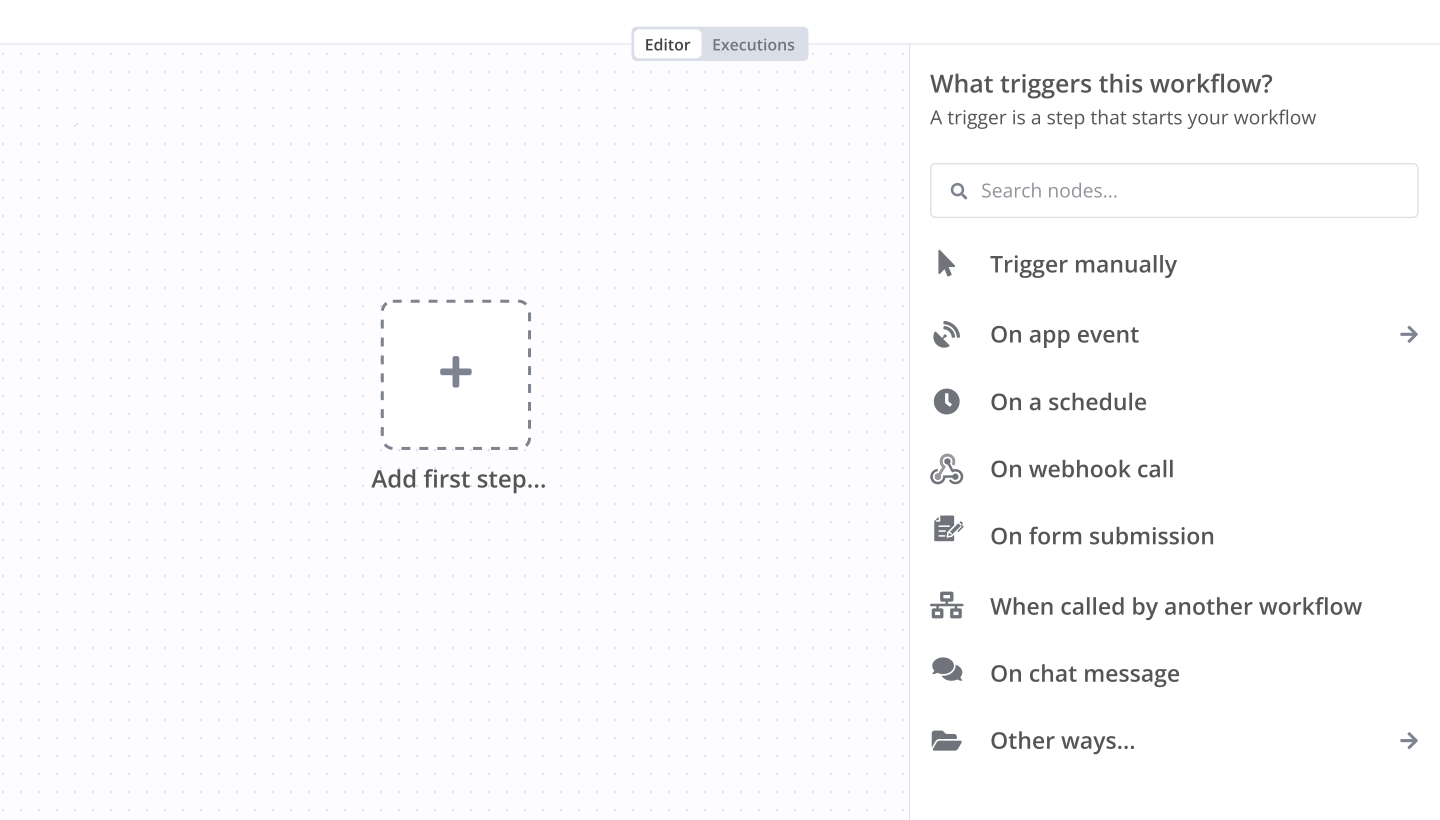
Google Calendar and HubSpot integration: Create a new workflow and add the first step

Step 2: Add and configure Google Calendar and HubSpot nodes

You can find Google Calendar and HubSpot in the nodes panel. Drag them onto your workflow canvas, selecting their actions. Click each node, choose a credential, and authenticate to grant n8n access. Configure Google Calendar and HubSpot nodes one by one: input data on the left, parameters in the middle, and output data on the right.

Google Calendar and HubSpot integration: Add and configure Google Calendar and HubSpot nodes

Step 3: Connect Google Calendar and HubSpot

A connection establishes a link between Google Calendar and HubSpot (or vice versa) to route data through the workflow. Data flows from the output of one node to the input of another. You can have single or multiple connections for each node.

Google Calendar and HubSpot integration: Connect Google Calendar and HubSpot

Step 4: Customize and extend your Google Calendar and HubSpot integration

Use n8n's core nodes such as If, Split Out, Merge, and others to transform and manipulate data. Write custom JavaScript or Python in the Code node and run it as a step in your workflow. Connect Google Calendar and HubSpot with any of n8n’s 1000+ integrations, and incorporate advanced AI logic into your workflows.

Google Calendar and HubSpot integration: Customize and extend your Google Calendar and HubSpot integration

Step 5: Test and activate your Google Calendar and HubSpot workflow

Save and run the workflow to see if everything works as expected. Based on your configuration, data should flow from Google Calendar to HubSpot or vice versa. Easily debug your workflow: you can check past executions to isolate and fix the mistake. Once you've tested everything, make sure to save your workflow and activate it.

Google Calendar and HubSpot integration: Test and activate your Google Calendar and HubSpot workflow

Automated client onboarding system with Notion, email & CRM integration

Graceful Client Onboarding Concierge — Pro

A warm, reliable onboarding system for small businesses and studios. Captures a form submission via webhook, creates a Client record in Notion, sends a concierge-style welcome email (with scheduler + optional contract link), optionally pings the owner on Telegram, mirrors the lead to Airtable/HubSpot, places a temporary Google Calendar hold, and includes a double opt-in confirmation link.

Made for: coaches, designers, boutique agencies, e-commerce and service providers who want consistent follow-up without manual busywork.

What it does (flow)

Trigger:** Form ➜ POST /client-intake (or Manual Trigger for instant demo)
Normalize & Score:** Map fields, auto-generate optInToken, compute score and tier
Create in Notion:** Clients page (Name, Email, Package, Notes, Status, Score, Tier, OptInToken, Consent=false)
Welcome Email:** industry-tuned copy + scheduler link (+ contract link for Growth/Pro/Custom packages)
Owner Notify (optional):** Telegram ping with tier + score
CRM Mirrors (optional):** Create Airtable row and/or HubSpot contact
Calendar Hold (optional):** 30-min “Intro Hold” event (e.g., now + 48h)
Double Opt-In:** /optin-confirm?token=...&email=... sets Consent=true & Status=Confirmed in Notion
Error Handling:** On failure, send an email to the owner

flowchart TD
A[Form → Webhook /client-intake] --> B[Map Intake + Score Lead]
B --> C[Notion: Create Client]
B --> D[Build Welcome Email]
D --> E[Email: Send Welcome]
D --> F{Optional actions}
F -->|Telegram| G[Telegram: Notify Owner]
F -->|Airtable| H[Airtable: Create Row]
F -->|HubSpot| I[HubSpot: Create Contact]
F -->|Calendar Hold| J[Google Calendar: Create Hold]
K[GET /optin-confirm] --> L[Find Notion by OptInToken] --> M[Update: Consent=true, Status=Confirmed]
ER[Error Trigger] --> EH[Email Owner]

Prerequisites

Notion* database Clients* with properties:
Name (title), Email (email), Package (select), Notes (rich text), Status (select), Score (number), Tier (select), OptInToken (text), Consent (checkbox)
(CSV header provided in the Sticky note on canvas.)
Email** (SMTP or Gmail OAuth)
Optional:** Telegram Bot + Chat ID, Airtable (Base ID + Table), HubSpot (Contacts), Google Calendar (Calendar ID)

Configuration (Set these in Set: User Config)

NOTION_DB_ID = your Notion Clients DB ID
FROM_EMAIL = sender address for welcome email
OWNER_EMAIL = where error notifications go
SCHEDULER_URL = booking link (Calendly, Once, etc.)
BASE_URL = your public n8n domain (for opt-in link)
CONTRACT_BASE_URL = (optional) proposal/contract URL base

ENABLE_TELEGRAM = true|false
TELEGRAM_CHAT_ID = (if enabled)

ENABLE_AIRTABLE = true|false
AIRTABLE_BASE_ID = (if enabled)
AIRTABLE_TABLE = (if enabled)

ENABLE_HUBSPOT = true|false

ENABLE_CAL_HOLD = true|false
CALENDAR_ID = "primary" or calendar ID
HOLD_HOURS_FROM_NOW = number of hours (default 48)

INDUSTRY = coaching | design_studio | ecommerce | services

Credentials: Attach in node credentials panels (no secrets in JSON).

How to use

Import the workflow JSON.
Open Set: User Config and fill required values (see above).
Attach credentials: Notion + Email; optional Telegram/Airtable/HubSpot/Google Calendar.
Run Manual Trigger to simulate an intake and verify:

Notion page created
Welcome email received
Optional Telegram/CRM/Calendar actions
Switch your form to the Production Webhook URL shown in the Client Intake Webhook node.

Sample JSON (for testing the live webhook):

{"name":"Ava Laurent","email":"[email protected]","package":"Growth","message":"Excited to begin!"}

Double opt-in: The welcome email includes a link like
https://YOUR-N8N-DOMAIN/webhook/optin-confirm?token=...&email=...
Clicking it sets Consent=true and Status=Confirmed on the Notion record.

Industry-tuned welcome copy

Set INDUSTRY to control phrasing automatically:

coaching – gentle goals/blocks framing
design_studio – asset handoff + milestone language
ecommerce – store link + quick-win focus
services – general service language

Submission compliance

✅ Manual Trigger path for instant demo
✅ Markdown sticky notes with clear H2 sections (README, Prereqs + CSV, Setup, Testing, Compliance, Changelog)
✅ No hardcoded API keys (credentials only)
✅ Timezone-safe ISO times for calendar hold
✅ Clear placeholders and copy-paste CSV headers included

Troubleshooting (quick)

No email:** attach Email creds; ensure FROM_EMAIL is allowed by your provider.
No Notion page:** verify NOTION_DB_ID and property names; check Notion permissions.
Webhook issues:* ensure your form sends JSON*; adapt mapping for form-encoded payloads.
Opt-in link fails:** BASE_URL must be your public n8n domain; workflow must be active.
Calendar hold not created:** set ENABLE_CAL_HOLD=true, attach Google Calendar creds, confirm CALENDAR_ID.

Tags: onboarding, notion, email, crm, telegram, airtable, hubspot, calendar, double-opt-in, small business, concierge, women-led brands

Version: v3 (see Changelog sticky on canvas)

Nodes used in this workflow

Popular Google Calendar and HubSpot workflows

Automated Client Onboarding System with Notion, Email & CRM Integration

Graceful Client Onboarding Concierge — Pro A warm, reliable onboarding system for small businesses and studios. Captures a form submission via webhook, creates a Client record in Notion, sends a concierge-style welcome email (with scheduler + optional contract link), optionally pings the owner on Telegram, mirrors the lead to Airtable/HubSpot, places a temporary Google Calendar hold, and includes a double opt-in confirmation link. Made for: coaches, designers, boutique agencies, e-commerce and service providers who want consistent follow-up without manual busywork. What it does (flow) Trigger:** Form ➜ POST /client-intake (or Manual Trigger for instant demo) Normalize & Score:** Map fields, auto-generate optInToken, compute score and tier Create in Notion:** Clients page (Name, Email, Package, Notes, Status, Score, Tier, OptInToken, Consent=false) Welcome Email:** industry-tuned copy + scheduler link (+ contract link for Growth/Pro/Custom packages) Owner Notify (optional):** Telegram ping with tier + score CRM Mirrors (optional):** Create Airtable row and/or HubSpot contact Calendar Hold (optional):** 30-min “Intro Hold” event (e.g., now + 48h) Double Opt-In:** /optin-confirm?token=...&email=... sets Consent=true & Status=Confirmed in Notion Error Handling:** On failure, send an email to the owner flowchart TD A[Form → Webhook /client-intake] --> B[Map Intake + Score Lead] B --> C[Notion: Create Client] B --> D[Build Welcome Email] D --> E[Email: Send Welcome] D --> F{Optional actions} F -->|Telegram| G[Telegram: Notify Owner] F -->|Airtable| H[Airtable: Create Row] F -->|HubSpot| I[HubSpot: Create Contact] F -->|Calendar Hold| J[Google Calendar: Create Hold] K[GET /optin-confirm] --> L[Find Notion by OptInToken] --> M[Update: Consent=true, Status=Confirmed] ER[Error Trigger] --> EH[Email Owner] Prerequisites Notion* database Clients* with properties: Name (title), Email (email), Package (select), Notes (rich text), Status (select), Score (number), Tier (select), OptInToken (text), Consent (checkbox) (CSV header provided in the Sticky note on canvas.) Email** (SMTP or Gmail OAuth) Optional:** Telegram Bot + Chat ID, Airtable (Base ID + Table), HubSpot (Contacts), Google Calendar (Calendar ID) Configuration (Set these in Set: User Config) NOTION_DB_ID = your Notion Clients DB ID FROM_EMAIL = sender address for welcome email OWNER_EMAIL = where error notifications go SCHEDULER_URL = booking link (Calendly, Once, etc.) BASE_URL = your public n8n domain (for opt-in link) CONTRACT_BASE_URL = (optional) proposal/contract URL base ENABLE_TELEGRAM = true|false TELEGRAM_CHAT_ID = (if enabled) ENABLE_AIRTABLE = true|false AIRTABLE_BASE_ID = (if enabled) AIRTABLE_TABLE = (if enabled) ENABLE_HUBSPOT = true|false ENABLE_CAL_HOLD = true|false CALENDAR_ID = "primary" or calendar ID HOLD_HOURS_FROM_NOW = number of hours (default 48) INDUSTRY = coaching | design_studio | ecommerce | services Credentials: Attach in node credentials panels (no secrets in JSON). How to use Import the workflow JSON. Open Set: User Config and fill required values (see above). Attach credentials: Notion + Email; optional Telegram/Airtable/HubSpot/Google Calendar. Run Manual Trigger to simulate an intake and verify: Notion page created Welcome email received Optional Telegram/CRM/Calendar actions Switch your form to the Production Webhook URL shown in the Client Intake Webhook node. Sample JSON (for testing the live webhook): {"name":"Ava Laurent","email":"[email protected]","package":"Growth","message":"Excited to begin!"} Double opt-in: The welcome email includes a link like https://YOUR-N8N-DOMAIN/webhook/optin-confirm?token=...&email=... Clicking it sets Consent=true and Status=Confirmed on the Notion record. Industry-tuned welcome copy Set INDUSTRY to control phrasing automatically: coaching – gentle goals/blocks framing design_studio – asset handoff + milestone language ecommerce – store link + quick-win focus services – general service language Submission compliance ✅ Manual Trigger path for instant demo ✅ Markdown sticky notes with clear H2 sections (README, Prereqs + CSV, Setup, Testing, Compliance, Changelog) ✅ No hardcoded API keys (credentials only) ✅ Timezone-safe ISO times for calendar hold ✅ Clear placeholders and copy-paste CSV headers included Troubleshooting (quick) No email:** attach Email creds; ensure FROM_EMAIL is allowed by your provider. No Notion page:** verify NOTION_DB_ID and property names; check Notion permissions. Webhook issues:* ensure your form sends JSON*; adapt mapping for form-encoded payloads. Opt-in link fails:** BASE_URL must be your public n8n domain; workflow must be active. Calendar hold not created:** set ENABLE_CAL_HOLD=true, attach Google Calendar creds, confirm CALENDAR_ID. Tags: onboarding, notion, email, crm, telegram, airtable, hubspot, calendar, double-opt-in, small business, concierge, women-led brands Version: v3 (see Changelog sticky on canvas)

Secure and classify legal documents with OpenAI, Airtable and HTML to PDF

Enterprise Legal Vault: AI Classification & Multi-Jurisdictional Security 🎯 Description This enterprise-grade legal document management system provides end-to-end automation for securing, classifying, and managing the lifecycle of sensitive documents. It is designed to handle high-stakes data across multiple jurisdictions (GDPR, CCPA, HIPAA) with AI-powered intelligence. ✨ What This Workflow Does Intelligent Intake & Deduplication - Monitors Google Drive, Email, and Webhooks. It uses SHA-256 fingerprinting to ensure every document is unique and to prevent redundant processing. AI-Powered Analysis Engine - Utilizes OpenAI/Claude to classify documents (NDA, MSA, Employment Agreements), detect jurisdiction, and assign a composite Risk Score (1-100). Dynamic Security Enforcement - Translates business rules from Airtable into technical enforcement using the HTML to PDF (Lock) node: Ultra-High Risk (90+): AES-256 encryption with disabled Print, Copy, and Modify permissions. High Risk (50-89): AES-128 encryption with dynamic recipient-specific watermarking. Public Filings: Timestamped watermarking with no encryption. Lifecycle & Retention Automation - Automatically calculates retention expiry dates based on legal requirements. It sets Google Calendar renewal reminders at 90, 60, and 30-day intervals. Intelligent Distribution Matrix - Verified: Attached to HubSpot Deals and synced to Dropbox client folders. Review: Flagged items are sent to a manual review queue with a Slack preview. Failed: Isolated in a Quarantine folder with incident logging in Airtable. 💡 Key Features Jurisdictional Logic:** Automatically adapts security and retention rules based on regional laws fetched from Airtable. Forensic Watermarking:** Embeds tracking data (User ID, Timestamp) to deter and identify data leaks. Fail-Safe Quarantine:** Prevents unverified or risky documents from ever entering the primary company storage. 📦 Requirements HTML to PDF Node* - Essential for tiered Lock* operations. Airtable** - Acts as the central "Business Rules Engine." Google Drive & HubSpot** - For storage and CRM synchronization. OpenAI/Claude API** - For document classification and risk assessment. 🚀 Benefits ✅ Zero Manual Security Setup - Documents are locked according to corporate policy the moment they are uploaded. ✅ Regulatory Compliance - Meets strict GDPR "Right to be Forgotten" and data localization standards automatically. ✅ Proactive Risk Management - High-liability clauses and auto-renewals are flagged instantly to the legal team. Tags: #legal #compliance #pdf-lock #encryption #gdpr #sec-ops #hubspot #airtable Category: Legal & Compliance Difficulty: Advanced
+3

Automated Marketing Campaign Email System with GPT-4 and HubSpot Customer Tracking

Overview This workflow automates customer outreach for marketing campaigns, including customer prioritization, AI-generated emails, automated sending, reply tracking, and meeting scheduling. How It Works Data Synchronization Customer and campaign data are periodically synchronized from Google Sheets and internal data tables. New customers and campaigns are inserted into the system if they do not already exist. Customer Evaluation and Prioritization Customers are evaluated based on revenue, industry, capital, and location. Each customer is classified into High / Medium / Low priority using AI. Only high-priority customers are selected for campaign outreach. Campaign Detection The workflow checks for new, unsent marketing campaigns. Campaigns marked as already sent are excluded. Personalized Email Generation For each eligible customer, past email history is retrieved. An AI agent generates a personalized campaign email: Uses historical interaction data when available. Uses customer interests and keywords for new customers. Produces a professional, friendly email proposing a meeting. Automated Email Sending Emails are sent automatically via Gmail. Sent emails are logged into the message history database. Campaign status is updated to “sent” after completion. Reply Handling Incoming customer replies are detected via Gmail triggers. Replies are matched with previous messages and stored in the database. AI generates an appropriate follow-up reply when required. Reply Classification and Scheduling Customer replies are classified as Positive / Pending / Negative. If a reply includes scheduling information, meeting details are extracted. Calendar events are automatically created in Google Calendar. Setup Steps Prepare Data Sources Set up Google Sheets for: Customer master data Format includes the following columns: #/メール/ 氏名/ 会社名/ 所在地/ 売上(万円)/ 資本金(万円)/ 業界/関心/ Hubspot同期 Campaign data Format includes the following columns: No / campaign_name / description / sent Prepare internal data tables for: Campaign records Email message histories Create Data table Campaign table: campaign_name: String description: String is_sent: boolean Mail Histories table: customer_email: String email_subject: String message: String reply: String reply_category: String Configure Credentials Google Sheets API Gmail OAuth Google Calendar API HubSpot App Token (for customer synchronization) OpenAI API (for AI agents)
+2

Automate Lead Qualification & Follow-up with Gemini, HubSpot, Zoom & Mailchimp

Lead Qualification & Follow‑up (Gemini) Automate lead intake, AI qualification, and next‑step outreach. Qualified leads get a scheduled meeting, Zoom details, an email confirmation, CRM update, and Mailchimp enrollment. Not‑qualified leads receive a follow‑up sequence, CRM update, and a 30‑day reminder. What this workflow does AI qualifies leads as QUALIFIED or NOT QUALIFIED using Google Gemini. Supports two triggers: Webhook (wordpress-form) or n8n Form Trigger. QUALIFIED branch: AI phone call via VAPI Schedules Google Calendar event Creates Zoom meeting Sends confirmation email via Gmail Adds to Mailchimp audience Updates contact in HubSpot NOT QUALIFIED branch: AI phone call via VAPI Adds to Mailchimp audience Sends follow‑up email via Gmail Updates contact in HubSpot Creates 30‑day follow‑up calendar event Apps and credentials required Google Gemini (PaLM/Gemini API) Gmail HubSpot Zoom Google Calendar VAPI (for AI phone calls) Mailchimp Environment variables MAILCHIMP_LIST_ID_QUALIFIED=your_mailchimp_list_id_for_qualified MAILCHIMP_LIST_ID_FOLLOWUP=your_mailchimp_list_id_for_followup Triggers supported Webhook: path wordpress-form (POST) Form Trigger: built‑in n8n form Use only one in production. Keep the other disabled. Expected input (fields) name: string email: string message: string If using Webhook, send a JSON body with the fields above. Setup Connect credentials: Google Gemini (model: models/gemini-2.5-flash) Gmail HubSpot (OAuth) Zoom Google Calendar (select the target calendar) VAPI (HTTP header auth: Bearer token) Set env vars: MAILCHIMP_LIST_ID_QUALIFIED MAILCHIMP_LIST_ID_FOLLOWUP Choose your trigger: Webhook: enable and use the provided URL for wordpress-form Form Trigger: enable and publish the form Review timing: adjust Wait nodes for your timezone and SLA. Personalize messaging: edit Gmail subjects/bodies and Zoom topic. CRM and lists: confirm HubSpot properties and Mailchimp list IDs. How it works (at a glance) Intake → AI classifies (QUALIFIED / NOT QUALIFIED) QUALIFIED: VAPI call → Schedule Calendar → Create Zoom → Add to Mailchimp (qualified) → Gmail confirmation → HubSpot update NOT QUALIFIED: VAPI call → Add to Mailchimp (follow‑up) → Gmail follow‑up → HubSpot update → 30‑day calendar event Test the workflow (before going live) Submit a test via your chosen trigger with name, email, message. Confirm AI decision at the “Lead Decision” node. If QUALIFIED: VAPI call executed Calendar event created Zoom meeting created (join URL available) Mailchimp enrollment (qualified list) Gmail confirmation sent HubSpot contact created/updated If NOT QUALIFIED: VAPI call executed Mailchimp enrollment (follow‑up list) Gmail follow‑up sent HubSpot updated 30‑day calendar reminder created Open any failing HTTP nodes and review response codes/messages. Go‑live checklist All credentials connected (no warnings) MAILCHIMP_LIST_ID_QUALIFIED and MAILCHIMP_LIST_ID_FOLLOWUP set Timezone and delays validated Email copy approved Only one trigger enabled Final end‑to‑end test passed Toggle workflow Active Customization ideas Add a Slack or Microsoft Teams notification on QUALIFIED Enrich leads (Clearbit, ZoomInfo, etc.) before AI decision Swap Mailchimp for your ESP (Klaviyo, SendGrid Marketing) Add a second‑chance branch for ambiguous AI classifications Localize email copy by country or language Troubleshooting Webhook receives no data: ensure external form POSTs JSON to the n8n URL and network rules allow it. AI decision empty/garbled: verify Gemini credentials/model ID and input fields. Mailchimp errors: verify List IDs and that email is valid. Gmail send fails: check OAuth scopes and daily limits. Zoom/Calendar issues: re‑connect OAuth; verify calendar access. HubSpot errors: confirm OAuth scopes and property mappings. Security and scopes Gmail: send email Google Calendar: create events Zoom: create meetings HubSpot: read/write contacts Mailchimp: list membership VAPI: authenticated HTTP requests Gemini: model inference Use least‑privilege for each integration. Limits and notes Gmail and Mailchimp rate limits may apply during spikes. Zoom and Google Calendar API quotas apply for frequent scheduling. VAPI call timeouts are 30s by default; adjust as needed. Changelog 2025‑09‑15: Initial public template with dual triggers, Gemini qualification, VAPI calls, scheduling, Mailchimp, Gmail, and HubSpot updates.

Build your own Google Calendar and HubSpot integration

Create custom Google Calendar and HubSpot workflows by choosing triggers and actions. Nodes come with global operations and settings, as well as app-specific parameters that can be configured. You can also use the HTTP Request node to query data from any app or service with a REST API.

Google Calendar supported actions

Availability
If a time-slot is available in a calendar
Create
Add a event to calendar
Delete
Delete an event
Get
Retrieve an event
Get Many
Retrieve many events from a calendar
Update
Update an event

HubSpot supported actions

Create
Create a company
Delete
Delete a company
Get
Get a company
Get Many
Get many companies
Get Recently Created/Updated
Get recently created/updated companies
Search
Search companies by their website domain
Update
Update a company
Create or Update
Create a new contact, or update the current one if it already exists (upsert)
Delete
Delete a contact
Get
Get a contact
Get Many
Get many contacts
Get Recently Created/Updated
Get recently created/updated contacts
Search
Search contacts
Add
Add contact to a list
Remove
Remove a contact from a list
Create
Create a deal
Delete
Delete a deal
Get
Get a deal
Get Many
Get many deals
Get Recently Created/Updated
Get recently created/updated deals
Search
Search deals
Update
Update a deal
Create
Create an engagement
Delete
Delete an engagement
Get
Get an engagement
Get Many
Get many engagements
Create
Create a ticket
Delete
Delete a ticket
Get
Get a ticket
Get Many
Get many tickets
Update
Update a ticket

Google Calendar and HubSpot integration details

integrationGoogle Calendar node
Google Calendar

Google Calendar is a time-management and calendar service created by Google Workspace. It helps you schedule and organize events and meetings, send notifications, and synchronize with your team. It is widely used by both individuals and organizations.

Use case

Supercharge your CRM

Need a more powerful integration with your CRM? n8n lets you go beyond standard integrations offered by popular CRMs!

Learn more

FAQs

  • Can Google Calendar connect with HubSpot?

  • Can I use Google Calendar’s API with n8n?

  • Can I use HubSpot’s API with n8n?

  • Is n8n secure for integrating Google Calendar and HubSpot?

  • How to get started with Google Calendar and HubSpot integration in n8n.io?

Need help setting up your Google Calendar and HubSpot integration?

Discover our latest community's recommendations and join the discussions about Google Calendar and HubSpot integration.
jake chard

Looking to integrate Google Calendar and HubSpot in your company?

Over 3000 companies switch to n8n every single week

Why use n8n to integrate Google Calendar with HubSpot

Build complex workflows, really fast

Build complex workflows, really fast

Handle branching, merging and iteration easily.
Pause your workflow to wait for external events.

Code when you need it, UI when you don't

Simple debugging

Your data is displayed alongside your settings, making edge cases easy to track down.

Use templates to get started fast

Use 1000+ workflow templates available from our core team and our community.

Reuse your work

Copy and paste, easily import and export workflows.

Implement complex processes faster with n8n

red iconyellow iconred iconyellow icon