Back to Integrations
integrationGoogle Calendar node
integrationNASA node

Google Calendar and NASA integration

Save yourself the work of writing custom integrations for Google Calendar and NASA and use n8n instead. Build adaptable and scalable Productivity, and Miscellaneous workflows that work with your technology stack. All within a building experience you will love.

How to connect Google Calendar and NASA

  • Step 1: Create a new workflow
  • Step 2: Add and configure nodes
  • Step 3: Connect
  • Step 4: Customize and extend your integration
  • Step 5: Test and activate your workflow

Step 1: Create a new workflow and add the first step

In n8n, click the "Add workflow" button in the Workflows tab to create a new workflow. Add the starting point – a trigger on when your workflow should run: an app event, a schedule, a webhook call, another workflow, an AI chat, or a manual trigger. Sometimes, the HTTP Request node might already serve as your starting point.
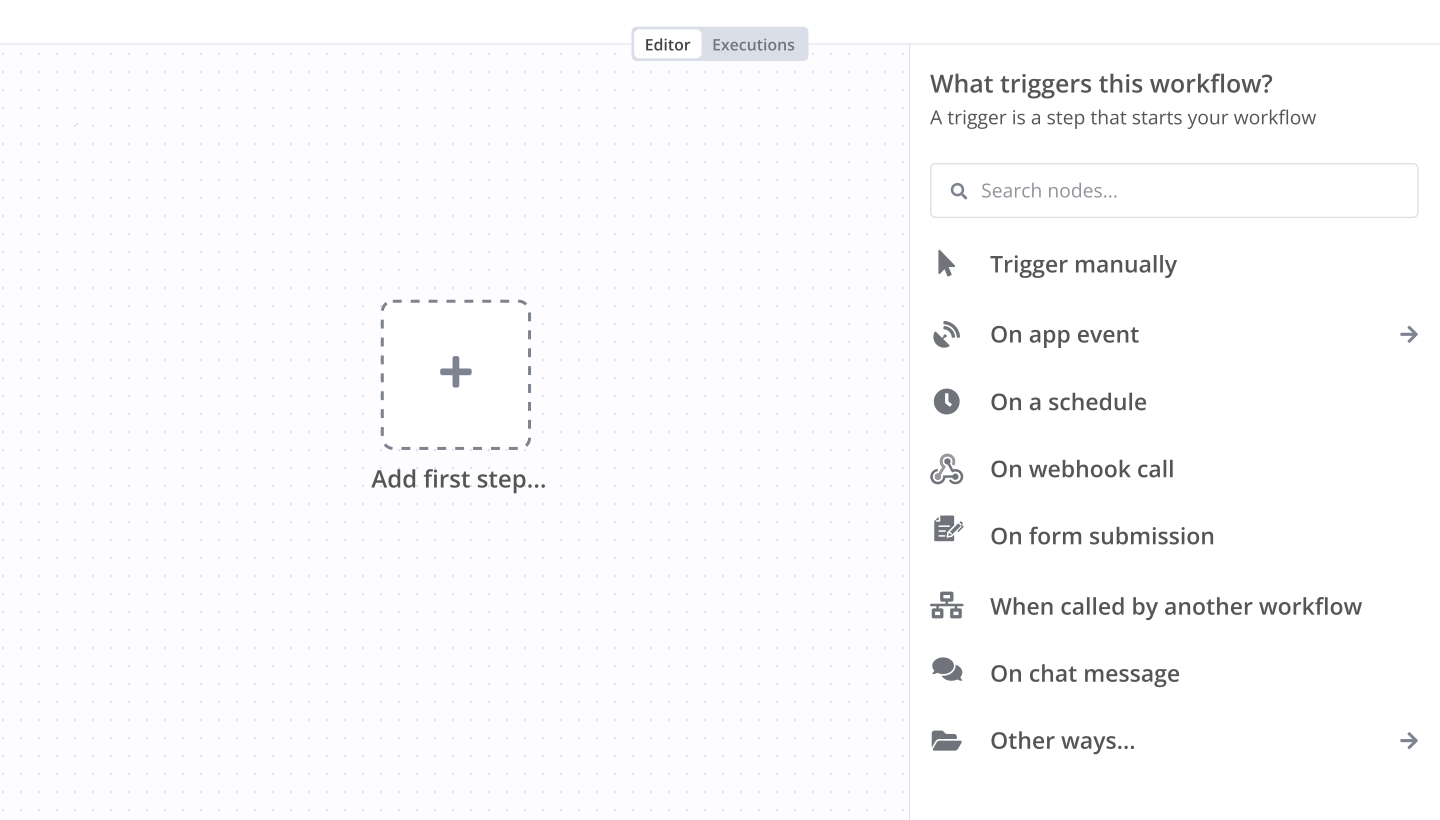
Google Calendar and NASA integration: Create a new workflow and add the first step

Step 2: Add and configure Google Calendar and NASA nodes

You can find Google Calendar and NASA in the nodes panel. Drag them onto your workflow canvas, selecting their actions. Click each node, choose a credential, and authenticate to grant n8n access. Configure Google Calendar and NASA nodes one by one: input data on the left, parameters in the middle, and output data on the right.

Google Calendar and NASA integration: Add and configure Google Calendar and NASA nodes

Step 3: Connect Google Calendar and NASA

A connection establishes a link between Google Calendar and NASA (or vice versa) to route data through the workflow. Data flows from the output of one node to the input of another. You can have single or multiple connections for each node.

Google Calendar and NASA integration: Connect Google Calendar and NASA

Step 4: Customize and extend your Google Calendar and NASA integration

Use n8n's core nodes such as If, Split Out, Merge, and others to transform and manipulate data. Write custom JavaScript or Python in the Code node and run it as a step in your workflow. Connect Google Calendar and NASA with any of n8n’s 1000+ integrations, and incorporate advanced AI logic into your workflows.

Google Calendar and NASA integration: Customize and extend your Google Calendar and NASA integration

Step 5: Test and activate your Google Calendar and NASA workflow

Save and run the workflow to see if everything works as expected. Based on your configuration, data should flow from Google Calendar to NASA or vice versa. Easily debug your workflow: you can check past executions to isolate and fix the mistake. Once you've tested everything, make sure to save your workflow and activate it.

Google Calendar and NASA integration: Test and activate your Google Calendar and NASA workflow

Automated asteroid alerts with NASA API, Slack & Google Calendar

This n8n template creates an automated alert system that checks NASA's data for near-Earth asteroids twice a day. When it finds asteroids meeting specific criteria, it sends a summary alert to Slack and creates individual events in Google Calendar for each object.

Use cases

Automated Monitoring**: Keep track of potentially hazardous asteroids without manually checking websites.
Team or Community Alerts**: Automatically inform a team, a group of friends, or a community about significant celestial events via Slack.
Personalized Space Calendar**: Populate your Google Calendar with upcoming asteroid close approaches, creating a personal "what's up in space" agenda.
Educational Tool**: Use this as a foundation to learn about API data fetching, data processing, and multi-channel notifications in n8n.

Good to know

This workflow runs on a schedule (every 12 hours by default) and does not require a manual trigger.
NASA API Key is highly recommended**. The default DEMO_KEY has strict rate limits. Get a free key from api.nasa.gov.
The filtering logic for what constitutes an "alert-worthy" asteroid (distance and size) is fully customizable within the "Filter and Process Asteroids" Code node.

How it works

A Schedule Trigger starts the workflow every 12 hours.
The "Calculate Date Range" Code node generates the start and end dates for the API query (today to 14 days from now).
The NASA node uses these dates to query the Near Earth Object Web Service (NeoWs) API, retrieving a list of all asteroids that will pass by Earth in that period.
The "Filter and Process Asteroids" Code node iterates through the list. It filters out objects that are too small or too far away, based on thresholds defined in the code. It then formats and sorts the remaining "interesting" asteroids by their closest approach distance.
An If node checks if any asteroids were found after filtering.
If true (asteroids were found), the flow continues to the alert steps.
If false, the workflow ends quietly via a NoOp node.
The "Format Alert Messages" Code node compiles a single, well-formatted summary message for Slack and prepares the data for other notifications.
The workflow then splits into two parallel branches:
Slack Alert: The Slack node sends the summary message to a specified channel.
Calendar Events: The Split Out node separates the data so that each asteroid is processed individually. For each asteroid, the Google Calendar node creates an all-day event on its close-approach date.

How to use

Configure the NASA Node:
Open the "Get an asteroid neo feed" (NASA) node.
Create new credentials and replace the default DEMO_KEY with your own NASA API key.

Customize Filtering (Optional):
Open the "Filter and Process Asteroids" Code node.
Adjust the MAX_DISTANCE_KM and MIN_DIAMETER_METERS variables to make the alerts more or less sensitive.
// Example: For closer, larger objects
const MAX_DISTANCE_KM = 7500000; // 7.5 million km (approx. 19.5 lunar distances)
const MIN_DIAMETER_METERS = 100; // 100 meters

Configure Slack Alerts:
Open the "Send Slack Alert" node.
Add your Slack OAuth2 credentials.
Select the channel where you want to receive alerts (e.g., #asteroid-watch).

Configure Google Calendar Events:
Open the "Create an event" (Google Calendar) node.
Add your Google Calendar OAuth2 credentials.
Select the calendar where events should be created.

Activate the workflow.

Requirements

A free NASA API Key.
Slack credentials** (OAuth2) and a workspace to post alerts.
Google Calendar credentials** (OAuth2) to create events.

Customising this workflow

Add More Notification Channels**: Add nodes for Discord, Telegram, or email to send alerts to other platforms.
Create a Dashboard**: Instead of just sending alerts, use the processed data to populate a database (like Baserow or Postgres) to power a simple dashboard.
Different Data Source**: Modify the HTTP Request node to pull data from other space-related APIs, like a feed of upcoming rocket launches.

Nodes used in this workflow

Popular Google Calendar and NASA workflows

Automated Asteroid Alerts with NASA API, Slack & Google Calendar

This n8n template creates an automated alert system that checks NASA's data for near-Earth asteroids twice a day. When it finds asteroids meeting specific criteria, it sends a summary alert to Slack and creates individual events in Google Calendar for each object. Use cases Automated Monitoring**: Keep track of potentially hazardous asteroids without manually checking websites. Team or Community Alerts**: Automatically inform a team, a group of friends, or a community about significant celestial events via Slack. Personalized Space Calendar**: Populate your Google Calendar with upcoming asteroid close approaches, creating a personal "what's up in space" agenda. Educational Tool**: Use this as a foundation to learn about API data fetching, data processing, and multi-channel notifications in n8n. Good to know This workflow runs on a schedule (every 12 hours by default) and does not require a manual trigger. NASA API Key is highly recommended**. The default DEMO_KEY has strict rate limits. Get a free key from api.nasa.gov. The filtering logic for what constitutes an "alert-worthy" asteroid (distance and size) is fully customizable within the "Filter and Process Asteroids" Code node. How it works A Schedule Trigger starts the workflow every 12 hours. The "Calculate Date Range" Code node generates the start and end dates for the API query (today to 14 days from now). The NASA node uses these dates to query the Near Earth Object Web Service (NeoWs) API, retrieving a list of all asteroids that will pass by Earth in that period. The "Filter and Process Asteroids" Code node iterates through the list. It filters out objects that are too small or too far away, based on thresholds defined in the code. It then formats and sorts the remaining "interesting" asteroids by their closest approach distance. An If node checks if any asteroids were found after filtering. If true (asteroids were found), the flow continues to the alert steps. If false, the workflow ends quietly via a NoOp node. The "Format Alert Messages" Code node compiles a single, well-formatted summary message for Slack and prepares the data for other notifications. The workflow then splits into two parallel branches: Slack Alert: The Slack node sends the summary message to a specified channel. Calendar Events: The Split Out node separates the data so that each asteroid is processed individually. For each asteroid, the Google Calendar node creates an all-day event on its close-approach date. How to use Configure the NASA Node: Open the "Get an asteroid neo feed" (NASA) node. Create new credentials and replace the default DEMO_KEY with your own NASA API key. Customize Filtering (Optional): Open the "Filter and Process Asteroids" Code node. Adjust the MAX_DISTANCE_KM and MIN_DIAMETER_METERS variables to make the alerts more or less sensitive. // Example: For closer, larger objects const MAX_DISTANCE_KM = 7500000; // 7.5 million km (approx. 19.5 lunar distances) const MIN_DIAMETER_METERS = 100; // 100 meters Configure Slack Alerts: Open the "Send Slack Alert" node. Add your Slack OAuth2 credentials. Select the channel where you want to receive alerts (e.g., #asteroid-watch). Configure Google Calendar Events: Open the "Create an event" (Google Calendar) node. Add your Google Calendar OAuth2 credentials. Select the calendar where events should be created. Activate the workflow. Requirements A free NASA API Key. Slack credentials** (OAuth2) and a workspace to post alerts. Google Calendar credentials** (OAuth2) to create events. Customising this workflow Add More Notification Channels**: Add nodes for Discord, Telegram, or email to send alerts to other platforms. Create a Dashboard**: Instead of just sending alerts, use the processed data to populate a database (like Baserow or Postgres) to power a simple dashboard. Different Data Source**: Modify the HTTP Request node to pull data from other space-related APIs, like a feed of upcoming rocket launches.

Build your own Google Calendar and NASA integration

Create custom Google Calendar and NASA workflows by choosing triggers and actions. Nodes come with global operations and settings, as well as app-specific parameters that can be configured. You can also use the HTTP Request node to query data from any app or service with a REST API.

Google Calendar supported actions

Availability
If a time-slot is available in a calendar
Create
Add a event to calendar
Delete
Delete an event
Get
Retrieve an event
Get Many
Retrieve many events from a calendar
Update
Update an event

NASA supported actions

Get Many
Browse the overall asteroid dataset
Get
Retrieve a list of asteroids based on their closest approach date to Earth
Get
Look up an asteroid based on its NASA SPK-ID
Get
Get the Astronomy Picture of the Day
Get
Retrieve DONKI coronal mass ejection data
Get
Retrieve DONKI high speed stream data
Get
Retrieve DONKI interplanetary shock data
Get
Retrieve data on DONKI magnetopause crossings
Get
Retrieve DONKI notifications data
Get
Retrieve DONKI radiation belt enhancement data
Get
Retrieve DONKI solar energetic particle data
Get
Retrieve DONKI solar flare data
Get
Retrieve DONKI WSA+EnlilSimulation data
Get
Retrieve Earth assets
Get
Retrieve Earth imagery

Google Calendar and NASA integration details

integrationGoogle Calendar node
Google Calendar

Google Calendar is a time-management and calendar service created by Google Workspace. It helps you schedule and organize events and meetings, send notifications, and synchronize with your team. It is widely used by both individuals and organizations.

FAQs

  • Can Google Calendar connect with NASA?

  • Can I use Google Calendar’s API with n8n?

  • Can I use NASA’s API with n8n?

  • Is n8n secure for integrating Google Calendar and NASA?

  • How to get started with Google Calendar and NASA integration in n8n.io?

Need help setting up your Google Calendar and NASA integration?

Discover our latest community's recommendations and join the discussions about Google Calendar and NASA integration.
jake chard

Looking to integrate Google Calendar and NASA in your company?

Over 3000 companies switch to n8n every single week

Why use n8n to integrate Google Calendar with NASA

Build complex workflows, really fast
Build complex workflows, really fast

Handle branching, merging and iteration easily.
Pause your workflow to wait for external events.

Code when you need it, UI when you don't

Simple debugging

Your data is displayed alongside your settings, making edge cases easy to track down.

Use templates to get started fast

Use 1000+ workflow templates available from our core team and our community.

Reuse your work

Copy and paste, easily import and export workflows.

Implement complex processes faster with n8n

red iconyellow iconred iconyellow icon