Back to Integrations
integrationGoogle Calendar node
integrationSendGrid node

Google Calendar and SendGrid integration

Save yourself the work of writing custom integrations for Google Calendar and SendGrid and use n8n instead. Build adaptable and scalable Productivity, Marketing, and Communication workflows that work with your technology stack. All within a building experience you will love.

How to connect Google Calendar and SendGrid

  • Step 1: Create a new workflow
  • Step 2: Add and configure nodes
  • Step 3: Connect
  • Step 4: Customize and extend your integration
  • Step 5: Test and activate your workflow

Step 1: Create a new workflow and add the first step

In n8n, click the "Add workflow" button in the Workflows tab to create a new workflow. Add the starting point – a trigger on when your workflow should run: an app event, a schedule, a webhook call, another workflow, an AI chat, or a manual trigger. Sometimes, the HTTP Request node might already serve as your starting point.
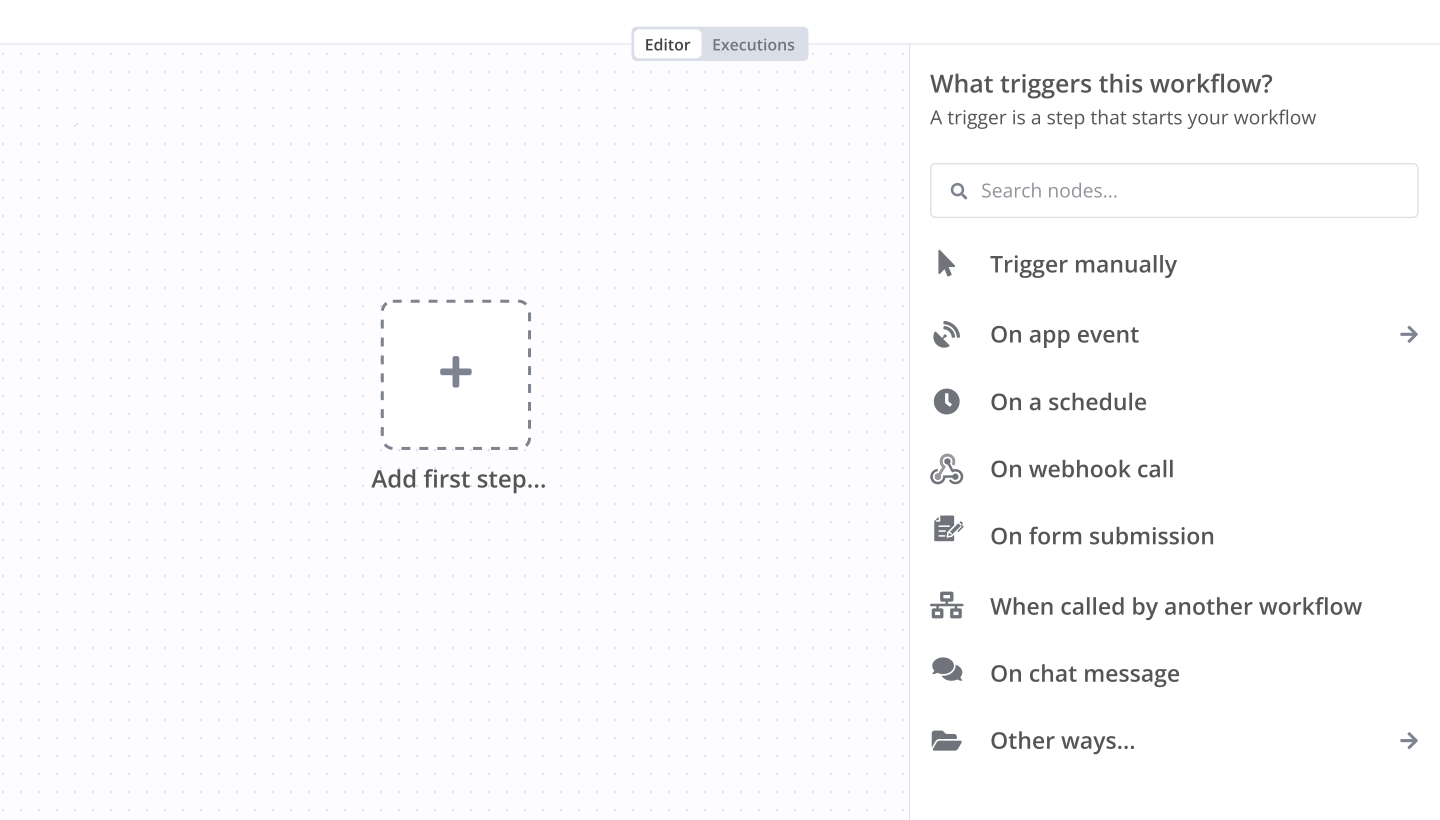
Google Calendar and SendGrid integration: Create a new workflow and add the first step

Step 2: Add and configure Google Calendar and SendGrid nodes

You can find Google Calendar and SendGrid in the nodes panel. Drag them onto your workflow canvas, selecting their actions. Click each node, choose a credential, and authenticate to grant n8n access. Configure Google Calendar and SendGrid nodes one by one: input data on the left, parameters in the middle, and output data on the right.

Google Calendar and SendGrid integration: Add and configure Google Calendar and SendGrid nodes

Step 3: Connect Google Calendar and SendGrid

A connection establishes a link between Google Calendar and SendGrid (or vice versa) to route data through the workflow. Data flows from the output of one node to the input of another. You can have single or multiple connections for each node.

Google Calendar and SendGrid integration: Connect Google Calendar and SendGrid

Step 4: Customize and extend your Google Calendar and SendGrid integration

Use n8n's core nodes such as If, Split Out, Merge, and others to transform and manipulate data. Write custom JavaScript or Python in the Code node and run it as a step in your workflow. Connect Google Calendar and SendGrid with any of n8n’s 1000+ integrations, and incorporate advanced AI logic into your workflows.

Google Calendar and SendGrid integration: Customize and extend your Google Calendar and SendGrid integration

Step 5: Test and activate your Google Calendar and SendGrid workflow

Save and run the workflow to see if everything works as expected. Based on your configuration, data should flow from Google Calendar to SendGrid or vice versa. Easily debug your workflow: you can check past executions to isolate and fix the mistake. Once you've tested everything, make sure to save your workflow and activate it.

Google Calendar and SendGrid integration: Test and activate your Google Calendar and SendGrid workflow

Qualify and call back inbound leads with OpenAI, Bland AI, Airtable and SendGrid

Qualify and Call Back Inbound Leads with OpenAI, Bland AI, Airtable & SendGrid

This n8n template demonstrates how to capture inbound leads from a form, qualify them with OpenAI, and route the hottest ones to a Bland AI voice agent that calls them back, books a meeting on Google Calendar, and confirms by email, all without a human touching the lead.

Use cases are many: instant follow-up on paid-ad leads, voice qualification for high-ticket consulting inquiries, or replacing the "first response" SDR seat entirely!

Good to know

Each Bland AI call is billed per minute. The default max_duration in this template is 5 minutes; see Bland AI pricing for the current rate.
OpenAI calls for qualification cost fractions of a cent per lead, but volume adds up; set a budget alert on your OpenAI account if you're running paid traffic. You can also use Claude.
Outbound calling is regulated. Make sure you have consent on your form and check the rules for your country (TCPA in the US, PECR in the UK, etc.) before going live.

How it works

We capture the lead via a webhook; your form, quiz, or landing page posts the payload (name, email, phone, company, plus any qualification fields you collect).
A code node normalises the payload, an IF node rejects anything missing required fields, and the lead is written to Airtable so you have a single source of truth.
OpenAI is then used to qualify the lead. We give it the cleaned payload and ask it to return one of three next actions: nurture_email, priority_email, or ai_call.
Low-intent leads get a SendGrid nurture email. Medium-intent leads get a priority email. High-intent leads continue down to the voice path.
For the voice path, we pull free slots from Google Calendar, format them into a natural-speech sentence ("I have Tuesday at 2 or Thursday at 10…"), and POST to Bland AI with the script, the lead's number, and a callback URL.
Bland AI calls the lead, runs the script, and posts the outcome back to the second webhook in this same workflow.
If a slot was booked, we create the Google Calendar event, update the Airtable record, and send a SendGrid confirmation. If the call failed (no answer, declined, error), we update Airtable and send a priority follow-up email so a human can step in.

How to use

The webhook trigger is set up for a typical form payload, but feel free to swap it for a Typeform/Tally trigger, a Calendly cancellation, or any inbound source.
Tune the prompt inside the AI Lead Qualification node to match your ICP; the routing logic only cares that the model returns one of the three action strings.
Edit the voice script inside the Trigger AI Phone Call body to match your company name, agent name, and offer before going live.
The Bland AI webhook field inside the request body must point to the production URL of the Call Outcome Webhook node in this same workflow so Bland can post back.

Requirements

OpenAI account for lead qualification
Bland AI account for the outbound voice agent
Airtable base with a Leads table
SendGrid account for emails
Google Calendar for availability and event creation

Customising this workflow

AI voice follow-up works for plenty of inbound flows beyond sales calls. Try it for booking demos, recovering abandoned checkout carts with a quick "is everything okay?" call, or as a re-engagement layer on stale leads in your CRM.

Nodes used in this workflow

Popular Google Calendar and SendGrid workflows

Qualify and call back inbound leads with OpenAI, Bland AI, Airtable and SendGrid

Qualify and Call Back Inbound Leads with OpenAI, Bland AI, Airtable & SendGrid This n8n template demonstrates how to capture inbound leads from a form, qualify them with OpenAI, and route the hottest ones to a Bland AI voice agent that calls them back, books a meeting on Google Calendar, and confirms by email, all without a human touching the lead. Use cases are many: instant follow-up on paid-ad leads, voice qualification for high-ticket consulting inquiries, or replacing the "first response" SDR seat entirely! Good to know Each Bland AI call is billed per minute. The default max_duration in this template is 5 minutes; see Bland AI pricing for the current rate. OpenAI calls for qualification cost fractions of a cent per lead, but volume adds up; set a budget alert on your OpenAI account if you're running paid traffic. You can also use Claude. Outbound calling is regulated. Make sure you have consent on your form and check the rules for your country (TCPA in the US, PECR in the UK, etc.) before going live. How it works We capture the lead via a webhook; your form, quiz, or landing page posts the payload (name, email, phone, company, plus any qualification fields you collect). A code node normalises the payload, an IF node rejects anything missing required fields, and the lead is written to Airtable so you have a single source of truth. OpenAI is then used to qualify the lead. We give it the cleaned payload and ask it to return one of three next actions: nurture_email, priority_email, or ai_call. Low-intent leads get a SendGrid nurture email. Medium-intent leads get a priority email. High-intent leads continue down to the voice path. For the voice path, we pull free slots from Google Calendar, format them into a natural-speech sentence ("I have Tuesday at 2 or Thursday at 10…"), and POST to Bland AI with the script, the lead's number, and a callback URL. Bland AI calls the lead, runs the script, and posts the outcome back to the second webhook in this same workflow. If a slot was booked, we create the Google Calendar event, update the Airtable record, and send a SendGrid confirmation. If the call failed (no answer, declined, error), we update Airtable and send a priority follow-up email so a human can step in. How to use The webhook trigger is set up for a typical form payload, but feel free to swap it for a Typeform/Tally trigger, a Calendly cancellation, or any inbound source. Tune the prompt inside the AI Lead Qualification node to match your ICP; the routing logic only cares that the model returns one of the three action strings. Edit the voice script inside the Trigger AI Phone Call body to match your company name, agent name, and offer before going live. The Bland AI webhook field inside the request body must point to the production URL of the Call Outcome Webhook node in this same workflow so Bland can post back. Requirements OpenAI account for lead qualification Bland AI account for the outbound voice agent Airtable base with a Leads table SendGrid account for emails Google Calendar for availability and event creation Customising this workflow AI voice follow-up works for plenty of inbound flows beyond sales calls. Try it for booking demos, recovering abandoned checkout carts with a quick "is everything okay?" call, or as a re-engagement layer on stale leads in your CRM.

Google Calendar Automated Notifications with Email, SMS & Analytics Dashboard

Automatically turn your Google Calendar into a fully-automated notification system with email alerts, SMS reminders, and a live performance dashboard - all powered by n8n. This automation helps you never miss an event, while giving you clear visibility into what notifications were sent, when, and how reliably they ran. What This Automation Does This solution is built as 4 connected workflows that run on a schedule and work together: Daily Email Summary (Morning) Every morning, the workflow: Reads today’s events from Google Calendar Formats them into a clean email Sends a daily schedule summary via Mailchimp or SendGrid Daily SMS Summary Shortly after, it: Sends a concise SMS overview of today’s meetings using Twilio 15-Minute Event Reminders Before each event: Sends an individual SMS reminder Skips all-day events automatically Weekly Schedule Preview Every Sunday: Sends a week-ahead summary so you can plan in advance Live Reporting & Dashboard All workflow activity is logged automatically into Google Sheets, which powers a real-time analytics dashboard showing: Number of notifications sent Success vs failure rates Daily and weekly execution stats Visual charts powered by Chart.js No manual tracking needed, everything updates automatically. How the Workflow Is Structured The automation is grouped into 3 clear sections: Section 1: Calendar Data Collection Pulls events from Google Calendar Filters relevant meetings Prepares clean event data Section 2: Notifications & Messaging Formats emails and SMS messages Sends reminders and summaries Handles scheduling logic Section 3: Logging & Reporting Saves every execution to Google Sheets Updates daily stats automatically Feeds the live dashboard SUPPORT & FEEDBACK Questions or issues? Connect with me on LinkedIn Want to see it in action? Try the live report demo: Click here

Build your own Google Calendar and SendGrid integration

Create custom Google Calendar and SendGrid workflows by choosing triggers and actions. Nodes come with global operations and settings, as well as app-specific parameters that can be configured. You can also use the HTTP Request node to query data from any app or service with a REST API.

Google Calendar supported actions

Availability
If a time-slot is available in a calendar
Create
Add a event to calendar
Delete
Delete an event
Get
Retrieve an event
Get Many
Retrieve many events from a calendar
Update
Update an event

SendGrid supported actions

Create or Update
Create a new contact, or update the current one if it already exists (upsert)
Delete
Delete a contact
Get
Get a contact by ID
Get Many
Get many contacts
Create
Create a list
Delete
Delete a list
Get
Get a list
Get Many
Get many lists
Update
Update a list
Send
Send an email

Google Calendar and SendGrid integration details

integrationGoogle Calendar node
Google Calendar

Google Calendar is a time-management and calendar service created by Google Workspace. It helps you schedule and organize events and meetings, send notifications, and synchronize with your team. It is widely used by both individuals and organizations.

Use case

Automate lead management

Using too many marketing tools? n8n lets you orchestrate all your apps into one cohesive, automated workflow.

Learn more

FAQs

  • Can Google Calendar connect with SendGrid?

  • Can I use Google Calendar’s API with n8n?

  • Can I use SendGrid’s API with n8n?

  • Is n8n secure for integrating Google Calendar and SendGrid?

  • How to get started with Google Calendar and SendGrid integration in n8n.io?

Need help setting up your Google Calendar and SendGrid integration?

Discover our latest community's recommendations and join the discussions about Google Calendar and SendGrid integration.
jake chard

Looking to integrate Google Calendar and SendGrid in your company?

Over 3000 companies switch to n8n every single week

Why use n8n to integrate Google Calendar with SendGrid

Build complex workflows, really fast
Build complex workflows, really fast

Handle branching, merging and iteration easily.
Pause your workflow to wait for external events.

Code when you need it, UI when you don't

Simple debugging

Your data is displayed alongside your settings, making edge cases easy to track down.

Use templates to get started fast

Use 1000+ workflow templates available from our core team and our community.

Reuse your work

Copy and paste, easily import and export workflows.

Implement complex processes faster with n8n

red iconyellow iconred iconyellow icon