Back to Integrations
integrationGoogle Calendar node
integrationTwilio node

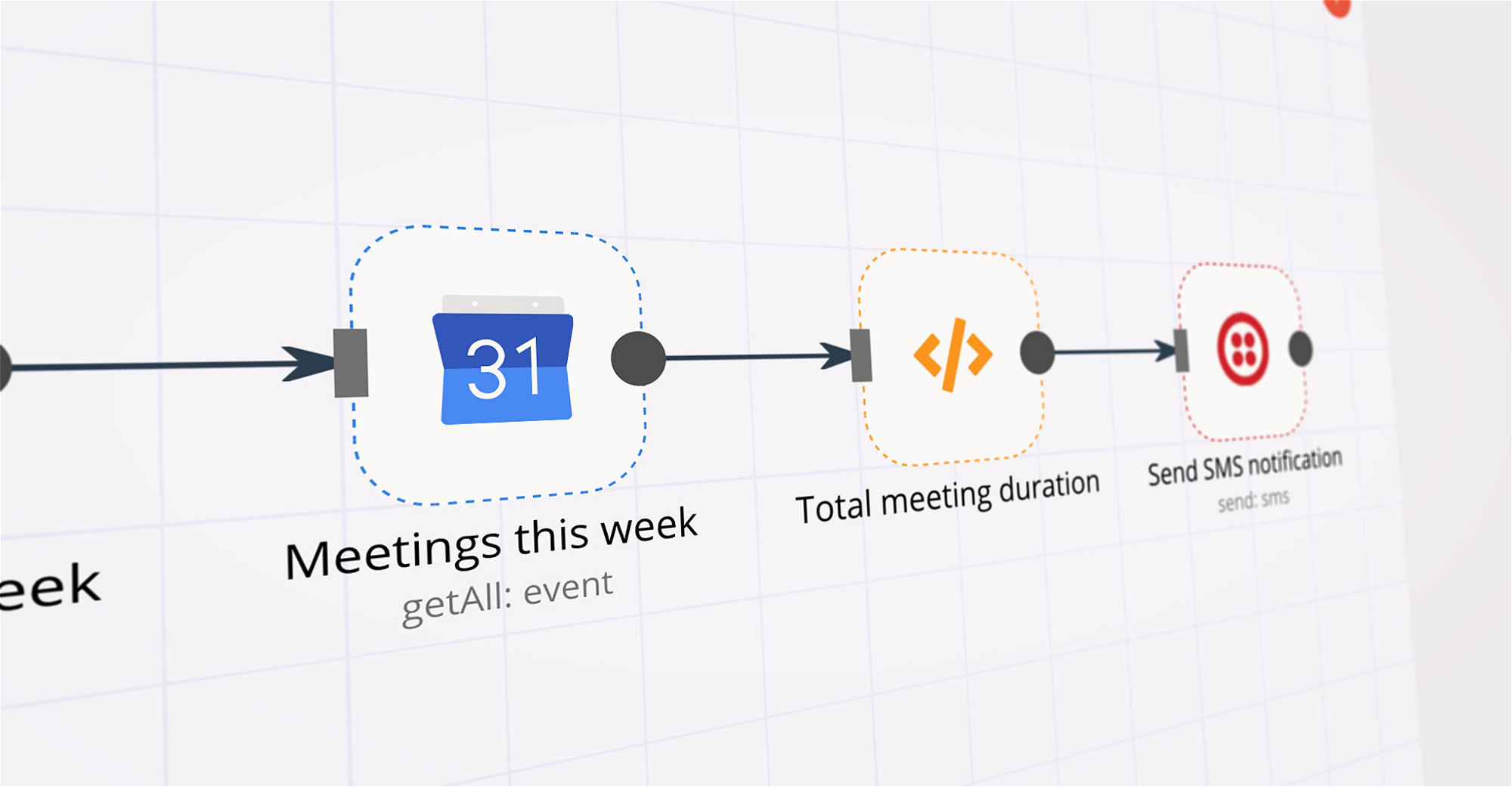
Google Calendar and Twilio integration

Save yourself the work of writing custom integrations for Google Calendar and Twilio and use n8n instead. Build adaptable and scalable Productivity, Communication, and Development workflows that work with your technology stack. All within a building experience you will love.

How to connect Google Calendar and Twilio

  • Step 1: Create a new workflow
  • Step 2: Add and configure nodes
  • Step 3: Connect
  • Step 4: Customize and extend your integration
  • Step 5: Test and activate your workflow

Step 1: Create a new workflow and add the first step

In n8n, click the "Add workflow" button in the Workflows tab to create a new workflow. Add the starting point – a trigger on when your workflow should run: an app event, a schedule, a webhook call, another workflow, an AI chat, or a manual trigger. Sometimes, the HTTP Request node might already serve as your starting point.
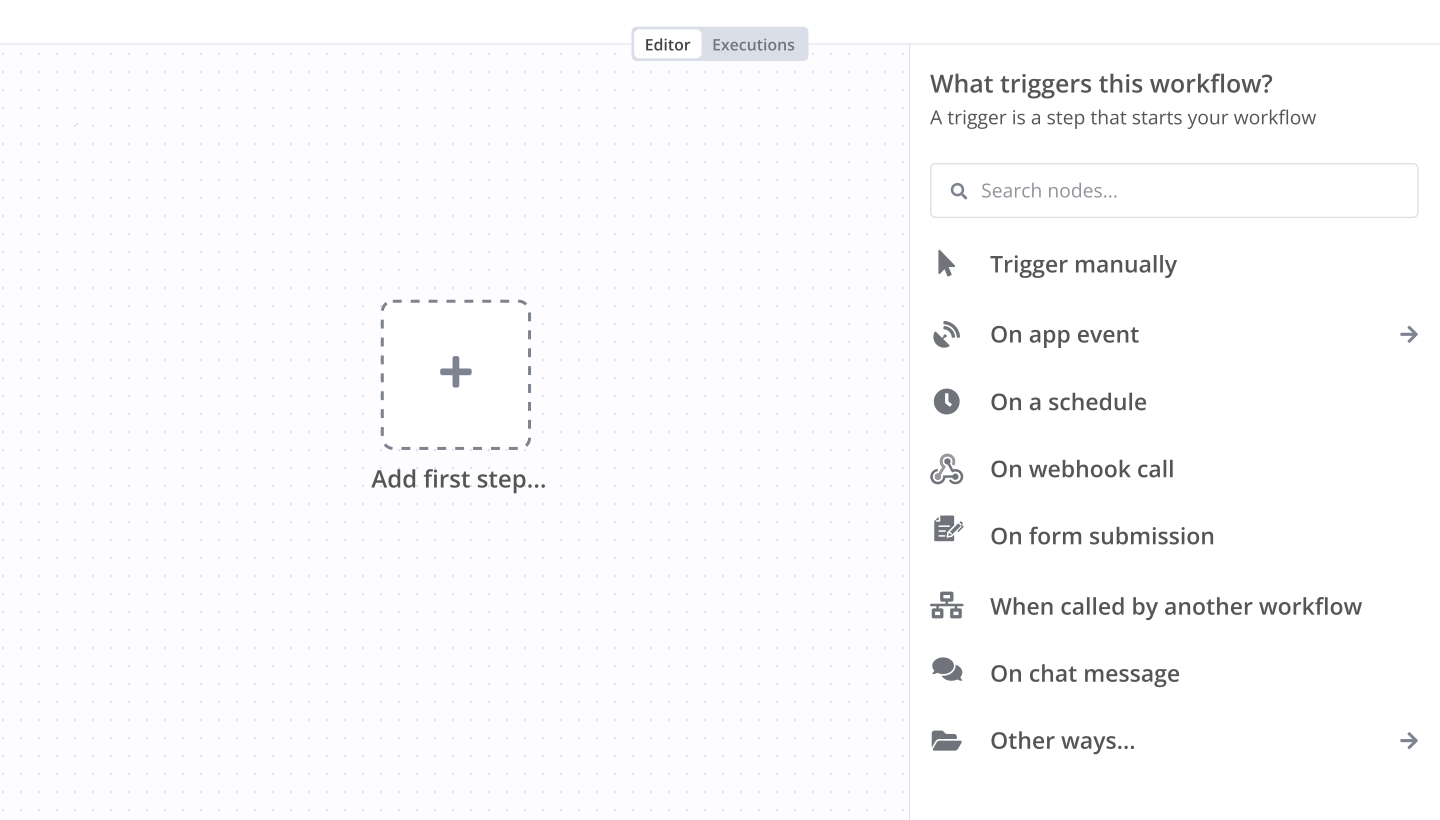
Google Calendar and Twilio integration: Create a new workflow and add the first step

Step 2: Add and configure Google Calendar and Twilio nodes

You can find Google Calendar and Twilio in the nodes panel. Drag them onto your workflow canvas, selecting their actions. Click each node, choose a credential, and authenticate to grant n8n access. Configure Google Calendar and Twilio nodes one by one: input data on the left, parameters in the middle, and output data on the right.

Google Calendar and Twilio integration: Add and configure Google Calendar and Twilio nodes

Step 3: Connect Google Calendar and Twilio

A connection establishes a link between Google Calendar and Twilio (or vice versa) to route data through the workflow. Data flows from the output of one node to the input of another. You can have single or multiple connections for each node.

Google Calendar and Twilio integration: Connect Google Calendar and Twilio

Step 4: Customize and extend your Google Calendar and Twilio integration

Use n8n's core nodes such as If, Split Out, Merge, and others to transform and manipulate data. Write custom JavaScript or Python in the Code node and run it as a step in your workflow. Connect Google Calendar and Twilio with any of n8n’s 1000+ integrations, and incorporate advanced AI logic into your workflows.

Google Calendar and Twilio integration: Customize and extend your Google Calendar and Twilio integration

Step 5: Test and activate your Google Calendar and Twilio workflow

Save and run the workflow to see if everything works as expected. Based on your configuration, data should flow from Google Calendar to Twilio or vice versa. Easily debug your workflow: you can check past executions to isolate and fix the mistake. Once you've tested everything, make sure to save your workflow and activate it.

Google Calendar and Twilio integration: Test and activate your Google Calendar and Twilio workflow

Multi-channel AI appointment confirmation with GPT-4, ElevenLabs & Twilio

📆 Workflow: AI Appointment Booking Assistant

⚡ About the Creators
This workflow was created by Varritech Technologies, a cutting-edge software agency that helps founders and operators go from idea to production 5× faster using AI. Based in New York City, we specialize in automating client-facing workflows like appointment setting, lead engagement, and support follow-ups.
Need help adapting this flow for your business? Reach out at varritech.com.

🧠 What This Workflow Does
This flow connects to varritech.com/booking and uses AI agents to intelligently manage the first stage of appointment scheduling — collecting user intent, formatting the data, confirming via calendar + email + SMS, and boosting follow-through with personalized voice messages.

🏗️ Architecture Overview
The workflow is designed to maximize conversion and show-up rate by combining structured automation with human-style messaging:

🔗 Webhook Trigger — Receives booking form submissions
🧠 AI Agents — Format phone numbers & craft natural confirmation messages
📅 Google Calendar — Schedules the meeting with auto-generated Meet link
📧 Emails — Send branded confirmation to client + internal team
🎙️ ElevenLabs TTS — Turns a personalized message into audio
☁️ Cloudinary Upload — Hosts the voice clip for SMS sharing
📲 Twilio SMS — Sends a text with the appointment time + audio

📦 Node-by-Node Breakdown
flowchart LR
A[Webhook: Booking Submission] --> B[Function: Extract + Format Data]
B --> C[Langchain Agent: Format Phone]
C --> D[Postgres: Store Appointment]
B --> E[Google Calendar: Create Event]
B --> F[Gmail: Notify Internal Team]
B --> G[Gmail: Confirm to Client]
B --> H[Langchain Agent: Voice Message Script]
H --> I[Function: Escape for JSON]
I --> J[HTTP: ElevenLabs TTS]
J --> K[Function: Rename to MP3]
K --> L[HTTP: Cloudinary Upload]
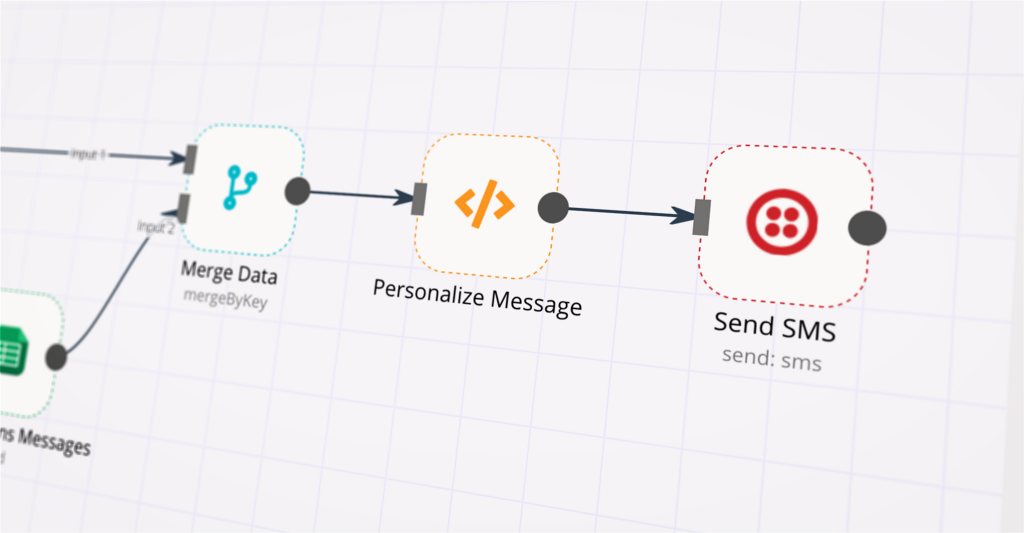
L --> M[Merge Data for Twilio]
M --> N[Twilio: Send Confirmation Text]

🔍 Design Rationale & Best Practices

AI Personalization Boosts Follow-Through
Personalized messages and human-sounding voice notes significantly increase user engagement and trust.

Multi-Channel Confirmation
Email + calendar + SMS ensures the user receives the booking details via their preferred method.

AI Agents for Edge Cases
Agents are used for formatting and natural-language generation to make the system flexible and future-proof.

Minimal Manual Input Required
Clients simply fill out a form — the rest is handled with high-quality automation.

Fully Extensible
Swap in different voice APIs, CRMs, or calendar providers with minimal changes to the core logic.

Nodes used in this workflow

Popular Google Calendar and Twilio workflows

+6

Predictive Health Monitoring & Alert System with GPT-4o-mini

How It Works The system collects real-time wearable health data, normalizes it, and uses AI to analyze trends and risk scores. It detects anomalies by comparing with historical patterns and automatically triggers alerts and follow-up actions when thresholds are exceeded. Setup Steps Configure Webhook Endpoint - Set up webhook to receive data from wearable devices Connect Database - Initialize storage for health metrics and historical data Set Normalization Rules - Define data standardization parameters for different devices Configure AI Model - Set up health score calculation and risk prediction algorithms Define Thresholds - Establish alert triggers for critical health metrics Connect Notification Channels - Configure email and Slack integrations Set Up Reporting - Create automated report templates and schedules Test Workflow - Run end-to-end tests with sample health data Workflow Template Webhook → Store Database → Normalize Data → Calculate Health Score → Analyze Metrics → Compare Previous → Check Threshold → Generate Reports/Alerts → Email/Slack → Schedule Follow-up Workflow Steps Ingest real-time wearable data via webhook, store and standardize it, and use GPT-4 for trend analysis and risk scoring. Monitor metrics against thresholds, trigger SMS, email, or Slack alerts, generate reports, and schedule follow-ups. Setup Instructions Configure webhook, database, GPT-4 API, notifications, calendar integration, and customize alert thresholds. Prerequisites Wearable API, patient database, GPT-4 key, email SMTP, optional Slack/Twilio, calendar integration. Use Cases Monitor glucose for diabetics, track elderly vitals/fall risk, assess corporate wellness, and post-surgery recovery alerts. Customization Adjust risk algorithms, add metrics, integrate telemedicine. Benefits Early intervention reduces readmissions and automates 80% of monitoring tasks.

Get Daily Calendar Summaries via SMS with Google Calendar, Twilio and Claude AI

This free n8n automation helps anyone—from busy parents to entrepreneurs—get a daily SMS summary of their calendar events. It’s a personal assistant that gives you a heads up of what your day will look like. Great for: starting your day cognizant of the day's events, or for the neurodivergent. Example use case: Parent receives a text summarizing the Family Calendar events at 5AM. Its a reminder of a child's doctor appointment at 1PM and soccer practice at 430PM. The AI then ends the message on an uplifting note. Good to Know Requires user to buy a Twilio phone number to send SMS from. Each message, at the time of writing, is $0.083 CAD. Requires basic knowledge of Google Cloud Console for the activation of Google Calendar API How it Works Every morning at 7AM, your workflow checks Google Calendar for the day’s events. It formats your schedule into a friendly, easy-to-read summary using your favorite AI model (any LLM works—Anthropic, OpenAI, Gemini, etc). That summary is texted directly to your phone via Twilio as a personal daily reminder. How to Use Copy this n8n workflow into your own instance. Hook up your Google Calendar and Twilio accounts. You can choose the specific calendar in the Calendar node. Choose or swap in any AI model you prefer to personalize your summaries. I find Claude sounds the most natural. Enjoy your daily, cheerful calendar digest by SMS at 7AM! Requirements A Google Cloud account (to activate the Calendar API and get credentials—see Google documentation). Twilio account (for sending SMS—get started with Twilio’s easy setup). Any LLM API account (optional, but recommended for polite/friendly summaries). Customize this flow Change SMS times to fit your morning routine. Adjust message formatting for your style or brand. Swap LLM services, tweak prompts, or combine multiple calendars—whatever works for you. Reach out anytime at ralleyreminders.com if you have questions or want to share ideas!

Automate Patient Journey with GPT-4, Twilio & Slack Notifications

How It Works ⚙️ This workflow is a comprehensive, AI-powered system that acts as a virtual patient assistant for clinics. It automates the entire patient journey from appointment confirmation to post-procedure follow-up. Appointment Trigger: The workflow starts when a new event is created in your Google Calendar for a patient appointment. AI-Powered Education: The new appointment is sent to an OpenAI (GPT-4) node, which acts as a virtual clinic assistant. It instantly generates a personalized pre-procedure guide based on the appointment's details. Automated Communication: The workflow then uses Twilio to send this AI-generated guide directly to the patient via SMS or WhatsApp, ensuring they are well-prepared for their appointment. Post-Procedure Follow-up: After the appointment ends, a Wait node pauses the workflow for a set period. It then sends a personalized follow-up message—also generated by OpenAI—to the patient, encouraging them to provide feedback. Staff Notification: A Slack notification is sent to the team once a follow-up message has been dispatched, keeping everyone informed and ready to act on incoming feedback. How to Set Up 🛠️ Import the Workflow: Copy the provided workflow JSON and import it into your n8n instance. Configure Credentials: Google Calendar: Add your OAuth2 credential. OpenAI: Add your API Key. Twilio: Add your API credentials. Slack: Add your Bot Token credential. Customize Workflow Nodes: Node 1 (Google Calendar Trigger): Select your clinic's booking calendar. Node 2 & 5 (OpenAI): You can customize the prompts to better match your clinic's tone and specific procedures. Node 3 & 6 (Twilio): Replace YOUR_TWILIO_NUMBER with your Twilio number and ensure you can extract the patient's phone number from your calendar events (e.g., from the event description). Node 7 (Slack): Replace YOUR_SLACK_CHANNEL_ID with the ID of your team's feedback or operations channel. Save & Activate: Once all settings and credentials are configured, save the workflow and click the "Inactive" toggle in the top-right corner to make it live.

Automated Client Journey Appointment Reminders & Follow-ups with Twilio

How It Works ⚙️ This workflow is a comprehensive, AI-powered system that acts as a virtual client relationship manager for any appointment-based business. It handles the entire client journey—from appointment booking to follow-up and re-engagement—all on autopilot. Appointment Trigger: The workflow starts when a new event is created in your Google Calendar. Client Data Management: It queries your client CRM database (Airtable or Google Sheets) to check if the client's email exists, preparing to send a personalized message. Dynamic Reminders: An If node splits the workflow. It sends a personalized welcome message for new clients and a standard reminder for returning clients, drastically reducing no-shows. Post-Appointment Follow-up: A Wait node pauses the workflow until after the appointment ends. It then sends a personalized "thank you" message via Twilio with a link to a review or survey. Re-engagement Loop: A separate Cron trigger runs weekly, automatically identifying clients who haven't rebooked in a set period (e.g., 30 days) and sends them a personalized offer to encourage them to return. Data Logging: It automatically logs all client data and engagement actions into a central database like Airtable or Google Sheets, creating a real-time dashboard for your business. How to Set Up 🛠️ Import the Workflow: Copy the provided workflow JSON and import it into your n8n instance. Configure Credentials: Google Calendar: Add your OAuth2 credential. Twilio: Add your API credentials. Google Sheets / Airtable: Add your credentials for your chosen CRM. Customize Workflow Nodes: Node 1 (Google Calendar Trigger): Select your Google Calendar credential and the calendar you use for bookings. Node 2 (Google Sheets / Airtable): Connect to your client CRM. Adjust the filter to search by the client's email from the calendar event. Node 4 & 5 (Twilio Reminders): Replace YOUR_TWILIO_NUMBER with your Twilio number. Customize the message body to fit your business. Node 6 (Wait): Adjust the Wait Duration if you want to send the follow-up message at a different time after the appointment. Node 7 (Twilio Follow-up): Replace the placeholder [LINK TO YOUR REVIEW/SURVEY PAGE] with your actual link. Nodes 8, 9, 10 (Re-engagement Loop): This is an optional, high-value part of the workflow. Configure the Cron node to run on your desired schedule. Adjust the filter in the Find Clients node to your specific re-engagement criteria (e.g., last visit date is older than 30 days). Save & Activate: Once all settings and credentials are configured, save the workflow and click the "Inactive" toggle in the top-right corner to make it live.

Automate Xero invoices and payments using webhooks, PostgreSQL and WhatsApp

This workflow automates the full invoicing and payment process using n8n and Xero. It allows businesses to generate invoices, track payments, send WhatsApp notifications, and keep records synced automatically, without manual follow-ups or repetitive admin work. It’s designed to plug into your existing tools and scale as your operations grow. How It Works A webhook receives invoice or payment data from your app, form, or system Xero automatically creates or updates the invoice Payments are tracked and verified in real time Clients receive WhatsApp notifications for invoices, reminders, or payments All records are logged in a database and synced to Google Calendar and Google Sheets Automated responses confirm successful actions or errors Everything runs in the background once connected. Setup Connect your Xero account to n8n Set up a database (PostgreSQL via Supabase) for logging invoices and payments Connect Google Calendar for scheduling and tracking Connect Twilio WhatsApp for client notifications Point your system or payment source to the provided webhook URL No complex coding required. I guide you through the setup and ensure everything is tested. Need Help or Customization? If you’d like this workflow customized for your business or want help setting it up properly, feel free to reach out. 🔗 Connect with me on LinkedIn: 👉 Click here to connect I’m happy to walk you through it or adapt it to your specific use case.
+4

Capture and schedule HVAC leads with OpenAI, Google Sheets, Slack and SMS

Who this workflow is for Door-to-door HVAC companies seeking automated lead capture and appointment scheduling. What this workflow does AI classifies incoming leads, routes them by service type, logs lead info in Google Sheets, notifies team via Slack, sends confirmations, schedules appointments, and optionally sends SMS reminders. How the workflow works Lead submission triggers workflow AI classifies lead Route lead based on service type Log in Google Sheets Notify team via Slack Send confirmation email Schedule appointment in calendar Send SMS reminder (optional) Optional CRM/dispatch integration Author: Hyrum Hurst, AI Automation Engineer Company: QuarterSmart Contact: [email protected]

Build your own Google Calendar and Twilio integration

Create custom Google Calendar and Twilio workflows by choosing triggers and actions. Nodes come with global operations and settings, as well as app-specific parameters that can be configured. You can also use the HTTP Request node to query data from any app or service with a REST API.

Google Calendar supported actions

Availability
If a time-slot is available in a calendar
Create
Add a event to calendar
Delete
Delete an event
Get
Retrieve an event
Get Many
Retrieve many events from a calendar
Update
Update an event

Twilio supported actions

Make
Send
Send SMS/MMS/WhatsApp message

Google Calendar and Twilio integration details

Use case

Save engineering resources

Reduce time spent on customer integrations, engineer faster POCs, keep your customer-specific functionality separate from product all without having to code.

Learn more

FAQs

  • Can Google Calendar connect with Twilio?

  • Can I use Google Calendar’s API with n8n?

  • Can I use Twilio’s API with n8n?

  • Is n8n secure for integrating Google Calendar and Twilio?

  • How to get started with Google Calendar and Twilio integration in n8n.io?

Need help setting up your Google Calendar and Twilio integration?

Discover our latest community's recommendations and join the discussions about Google Calendar and Twilio integration.
jake chard

Looking to integrate Google Calendar and Twilio in your company?

Over 3000 companies switch to n8n every single week

Why use n8n to integrate Google Calendar with Twilio

Build complex workflows, really fast
Build complex workflows, really fast

Handle branching, merging and iteration easily.
Pause your workflow to wait for external events.

Code when you need it, UI when you don't

Simple debugging

Your data is displayed alongside your settings, making edge cases easy to track down.

Use templates to get started fast

Use 1000+ workflow templates available from our core team and our community.

Reuse your work

Copy and paste, easily import and export workflows.

Implement complex processes faster with n8n

red iconyellow iconred iconyellow icon