Back to Integrations
integrationGoogle Chat node
integrationGoogle Sheets node

Google Chat and Google Sheets integration

Save yourself the work of writing custom integrations for Google Chat and Google Sheets and use n8n instead. Build adaptable and scalable Communication, HITL, Data & Storage, and Productivity workflows that work with your technology stack. All within a building experience you will love.

How to connect Google Chat and Google Sheets

  • Step 1: Create a new workflow
  • Step 2: Add and configure nodes
  • Step 3: Connect
  • Step 4: Customize and extend your integration
  • Step 5: Test and activate your workflow

Step 1: Create a new workflow and add the first step

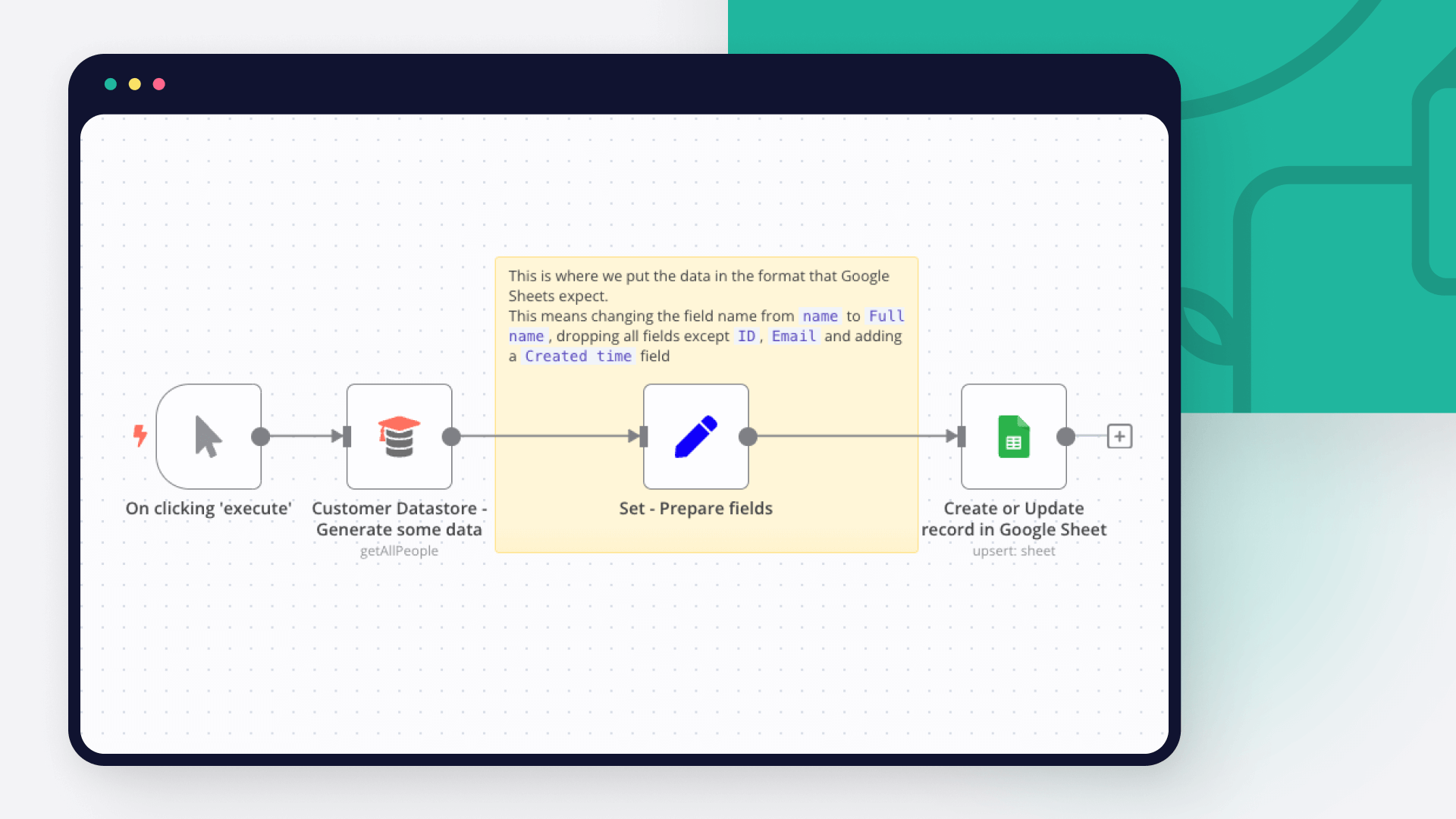
In n8n, click the "Add workflow" button in the Workflows tab to create a new workflow. Add the starting point – a trigger on when your workflow should run: an app event, a schedule, a webhook call, another workflow, an AI chat, or a manual trigger. Sometimes, the HTTP Request node might already serve as your starting point.
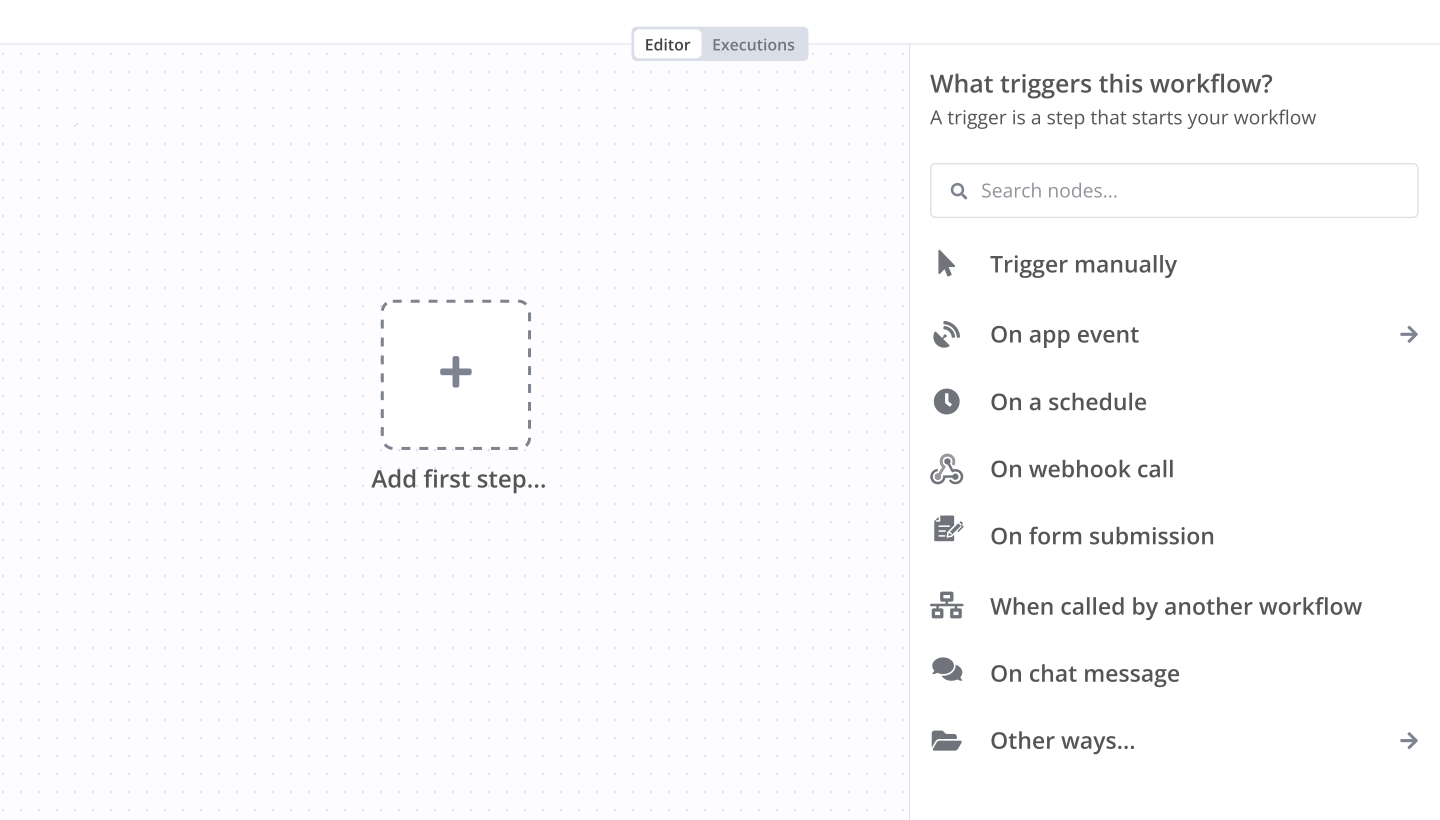
Google Chat and Google Sheets integration: Create a new workflow and add the first step

Step 2: Add and configure Google Chat and Google Sheets nodes

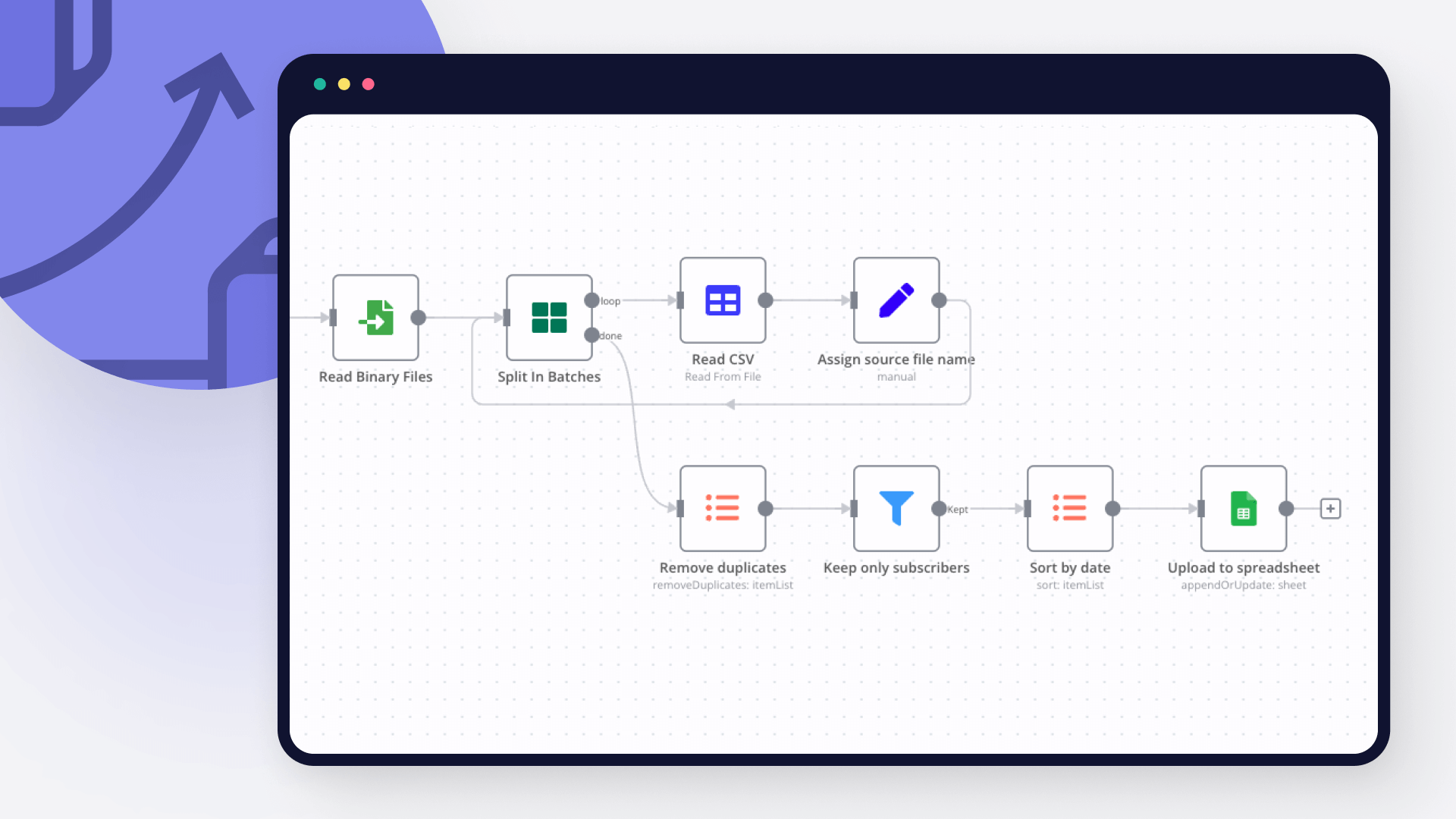
You can find Google Chat and Google Sheets in the nodes panel. Drag them onto your workflow canvas, selecting their actions. Click each node, choose a credential, and authenticate to grant n8n access. Configure Google Chat and Google Sheets nodes one by one: input data on the left, parameters in the middle, and output data on the right.

Google Chat and Google Sheets integration: Add and configure Google Chat and Google Sheets nodes

Step 3: Connect Google Chat and Google Sheets

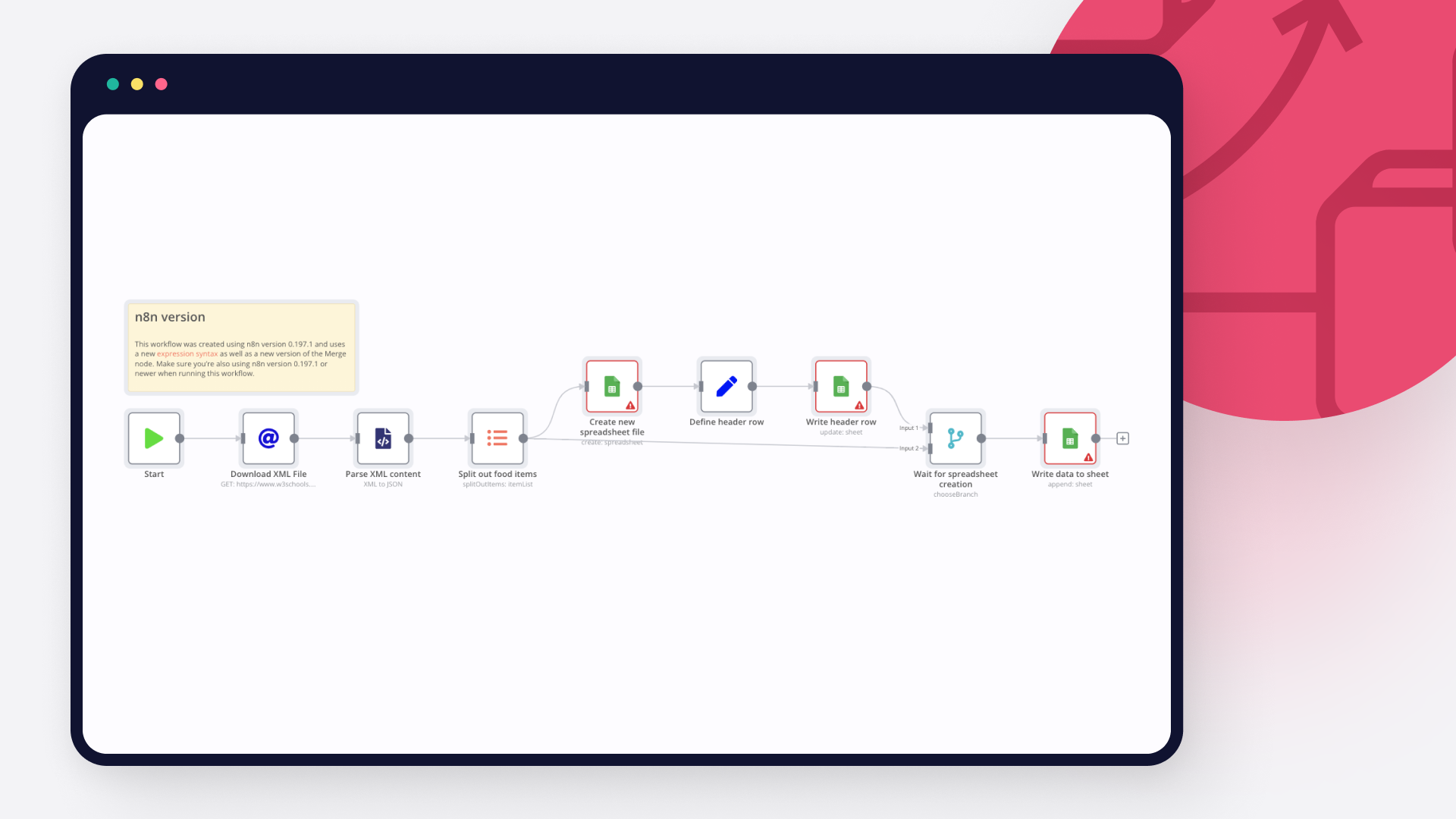
A connection establishes a link between Google Chat and Google Sheets (or vice versa) to route data through the workflow. Data flows from the output of one node to the input of another. You can have single or multiple connections for each node.

Google Chat and Google Sheets integration: Connect Google Chat and Google Sheets

Step 4: Customize and extend your Google Chat and Google Sheets integration

Use n8n's core nodes such as If, Split Out, Merge, and others to transform and manipulate data. Write custom JavaScript or Python in the Code node and run it as a step in your workflow. Connect Google Chat and Google Sheets with any of n8n’s 1000+ integrations, and incorporate advanced AI logic into your workflows.

Google Chat and Google Sheets integration: Customize and extend your Google Chat and Google Sheets integration

Step 5: Test and activate your Google Chat and Google Sheets workflow

Save and run the workflow to see if everything works as expected. Based on your configuration, data should flow from Google Chat to Google Sheets or vice versa. Easily debug your workflow: you can check past executions to isolate and fix the mistake. Once you've tested everything, make sure to save your workflow and activate it.

Google Chat and Google Sheets integration: Test and activate your Google Chat and Google Sheets workflow

Automate HVAC service scheduling with AI agent, Google Calendar and Gmail

Instant, automated scheduling. This AI Scheduling Agent manages real-time appointments, availability checks, and rescheduling across Google Calendar and Sheets, eliminating human hold times.

🎯 Problem Statement

Traditional call center or online booking systems often lack the flexibility to handle complex, multi-step customer requests like rescheduling, checking dynamic availability across multiple time slots, or handling context-aware conversational booking. This leads to friction, missed bookings, and high administrative overhead for service companies like HVAC providers.

✨ Solution

This workflow deploys a sophisticated AI Scheduling Agent that acts as a virtual receptionist. It uses the Language Model's (LLM) "tool-use" capability to intelligently execute complex, sequential business logic (e.g., check availability before booking, find existing events before rescheduling) and manages the entire lifecycle of a service appointment, from initial inquiry to final confirmation.

⚙️ How It Works (Multi-Step Execution)

Trigger: A customer request (e.g., from an external voice or text platform) hits the Webhook Trigger with intent details (e.g., tool_request: 'reschedule_appointment').

Agent Logic: The Receptionist Agent uses a strict system prompt and its internal tools to formulate an execution plan. It maintains conversational state via the simple-memory node.

Tool Execution (Example: Reschedule): The Agent executes a predefined sequence of private tools:

find\_old\_event: Locates the existing booking ID using the customer's email.
    
check\_calendar: Verifies the proposed new time is available (2-hour window).
    
reschedule\_appointment: Updates the calendar event.
    
log\_lead: Updates the central Google Sheet.

Synchronous Response: The Agent sends a confirmation or follow-up question via the respond_to_webhook node.

Asynchronous Confirmation: The log_lead action triggers a secondary workflow that composes a professional email via a second LLM (Anthropic) and sends it to the customer via Gmail, followed by an internal alert via Google Chat.
🛠️ Setup Steps

Credentials:

AI/LLM: Configure credentials for the Language Model used (OpenAI or Gemini) for the core Agent.
    
Google Services: Set up OAuth2 credentials for Google Calendar (for booking/checking), Google Sheets (for logging), and Gmail (for customer confirmation).

Google Calendar: Specify the technician's calendar ID ([email protected] in the template) in all Calendar nodes.

Google Sheets: Create a new Google Sheet to serve as the Lead Log and update the Document ID and Sheet Name in the log_lead and log_lead_trigger nodes.

Tool Configuration: Review and customize the Agent's system prompt in the Receptionist node to align time zone rules (currently Asia/Kolkata - IST) and business hours (9:00 AM to 6:00 PM) with your operations.
✅ Benefits

Increased Efficiency: Fully automates complex scheduling and rescheduling, freeing up human staff.

Contextual Service: AI handles multi-turn conversations and adheres to strict business rules (e.g., 2-hour slots, maximum tool usage).

Data Integrity: Ensures all bookings are immediately logged to Google Sheets, maintaining a centralized record (CRM).

Professional Flow: Provides immediate confirmation to the customer via email and instant notification to the internal team via chat.
🚀 Other Use Cases

The underlying multi-step, tool-execution pattern is highly versatile and can be adapted for any service industry requiring complex, rules-based scheduling:

Real Estate:** Scheduling property viewings (Check agent availability → Book viewing → Send directions).

HVAC Services:** Managing maintenance and repair visits (Diagnose issue type → Match with qualified technician → Check part availability → Schedule visit → Send service confirmation).

Medical/Dental:** Booking patient appointments (Check insurance eligibility → Check doctor availability → Book → Send pre-visit forms).

Legal Services:** Intake for consultations (Collect client issue → Check specialist availability → Book → Send retainer agreement).

Automotive Repair:** Scheduling service bays (Check bay and mechanic availability → Book → Update internal service board).

Nodes used in this workflow

Popular Google Chat and Google Sheets workflows

+2

Automate HVAC Service Scheduling with AI Agent, Google Calendar and Gmail

Instant, automated scheduling. This AI Scheduling Agent manages real-time appointments, availability checks, and rescheduling across Google Calendar and Sheets, eliminating human hold times. 🎯 Problem Statement Traditional call center or online booking systems often lack the flexibility to handle complex, multi-step customer requests like rescheduling, checking dynamic availability across multiple time slots, or handling context-aware conversational booking. This leads to friction, missed bookings, and high administrative overhead for service companies like HVAC providers. ✨ Solution This workflow deploys a sophisticated AI Scheduling Agent that acts as a virtual receptionist. It uses the Language Model's (LLM) "tool-use" capability to intelligently execute complex, sequential business logic (e.g., check availability before booking, find existing events before rescheduling) and manages the entire lifecycle of a service appointment, from initial inquiry to final confirmation. ⚙️ How It Works (Multi-Step Execution) Trigger: A customer request (e.g., from an external voice or text platform) hits the Webhook Trigger with intent details (e.g., tool\_request: 'reschedule\_appointment'). Agent Logic: The Receptionist Agent uses a strict system prompt and its internal tools to formulate an execution plan. It maintains conversational state via the simple-memory node. Tool Execution (Example: Reschedule): The Agent executes a predefined sequence of private tools: find\_old\_event: Locates the existing booking ID using the customer's email. check\_calendar: Verifies the proposed new time is available (2-hour window). reschedule\_appointment: Updates the calendar event. log\_lead: Updates the central Google Sheet. Synchronous Response: The Agent sends a confirmation or follow-up question via the respond\_to\_webhook node. Asynchronous Confirmation: The log\_lead action triggers a secondary workflow that composes a professional email via a second LLM (Anthropic) and sends it to the customer via Gmail, followed by an internal alert via Google Chat. 🛠️ Setup Steps Credentials: AI/LLM: Configure credentials for the Language Model used (OpenAI or Gemini) for the core Agent. Google Services: Set up OAuth2 credentials for Google Calendar (for booking/checking), Google Sheets (for logging), and Gmail (for customer confirmation). Google Calendar: Specify the technician's calendar ID ([email protected] in the template) in all Calendar nodes. Google Sheets: Create a new Google Sheet to serve as the Lead Log and update the Document ID and Sheet Name in the log\_lead and log\_lead\_trigger nodes. Tool Configuration: Review and customize the Agent's system prompt in the Receptionist node to align time zone rules (currently Asia/Kolkata - IST) and business hours (9:00 AM to 6:00 PM) with your operations. ✅ Benefits Increased Efficiency: Fully automates complex scheduling and rescheduling, freeing up human staff. Contextual Service: AI handles multi-turn conversations and adheres to strict business rules (e.g., 2-hour slots, maximum tool usage). Data Integrity: Ensures all bookings are immediately logged to Google Sheets, maintaining a centralized record (CRM). Professional Flow: Provides immediate confirmation to the customer via email and instant notification to the internal team via chat. 🚀 Other Use Cases The underlying multi-step, tool-execution pattern is highly versatile and can be adapted for any service industry requiring complex, rules-based scheduling: Real Estate:** Scheduling property viewings (Check agent availability → Book viewing → Send directions). HVAC Services:** Managing maintenance and repair visits (Diagnose issue type → Match with qualified technician → Check part availability → Schedule visit → Send service confirmation). Medical/Dental:** Booking patient appointments (Check insurance eligibility → Check doctor availability → Book → Send pre-visit forms). Legal Services:** Intake for consultations (Collect client issue → Check specialist availability → Book → Send retainer agreement). Automotive Repair:** Scheduling service bays (Check bay and mechanic availability → Book → Update internal service board).

Build your own Google Chat and Google Sheets integration

Create custom Google Chat and Google Sheets workflows by choosing triggers and actions. Nodes come with global operations and settings, as well as app-specific parameters that can be configured. You can also use the HTTP Request node to query data from any app or service with a REST API.

Google Chat supported actions

Get
Get a membership
Get Many
Get many memberships in a space
Create
Create a message
Delete
Delete a message
Get
Get a message
Send and Wait for Response
Send a message and wait for response
Update
Update a message
Get
Get a space
Get Many
Get many spaces the caller is a member of

Google Sheets supported actions

Create
Create a spreadsheet
Delete
Delete a spreadsheet
Append or Update Row
Append a new row or update an existing one (upsert)
Append Row
Create a new row in a sheet
Clear
Delete all the contents or a part of a sheet
Create
Create a new sheet
Delete
Permanently delete a sheet
Delete Rows or Columns
Delete columns or rows from a sheet
Get Row(s)
Retrieve one or more rows from a sheet
Update Row
Update an existing row in a sheet

FAQs

  • Can Google Chat connect with Google Sheets?

  • Can I use Google Chat’s API with n8n?

  • Can I use Google Sheets’s API with n8n?

  • Is n8n secure for integrating Google Chat and Google Sheets?

  • How to get started with Google Chat and Google Sheets integration in n8n.io?

Need help setting up your Google Chat and Google Sheets integration?

Discover our latest community's recommendations and join the discussions about Google Chat and Google Sheets integration.
Sergey Komardenkov
sérgio eduardo floresta filho
Julian
therealJMT
Guilherme

Looking to integrate Google Chat and Google Sheets in your company?

Over 3000 companies switch to n8n every single week

Why use n8n to integrate Google Chat with Google Sheets

Build complex workflows, really fast
Build complex workflows, really fast

Handle branching, merging and iteration easily.
Pause your workflow to wait for external events.

Code when you need it, UI when you don't

Simple debugging

Your data is displayed alongside your settings, making edge cases easy to track down.

Use templates to get started fast

Use 1000+ workflow templates available from our core team and our community.

Reuse your work

Copy and paste, easily import and export workflows.

Implement complex processes faster with n8n

red iconyellow iconred iconyellow icon