Back to Integrations
integrationGoogle Cloud Natural Language node
integrationMongoDB node

Google Cloud Natural Language and MongoDB integration

Save yourself the work of writing custom integrations for Google Cloud Natural Language and MongoDB and use n8n instead. Build adaptable and scalable Analytics, Development, and Data & Storage workflows that work with your technology stack. All within a building experience you will love.

How to connect Google Cloud Natural Language and MongoDB

  • Step 1: Create a new workflow
  • Step 2: Add and configure nodes
  • Step 3: Connect
  • Step 4: Customize and extend your integration
  • Step 5: Test and activate your workflow

Step 1: Create a new workflow and add the first step

In n8n, click the "Add workflow" button in the Workflows tab to create a new workflow. Add the starting point – a trigger on when your workflow should run: an app event, a schedule, a webhook call, another workflow, an AI chat, or a manual trigger. Sometimes, the HTTP Request node might already serve as your starting point.
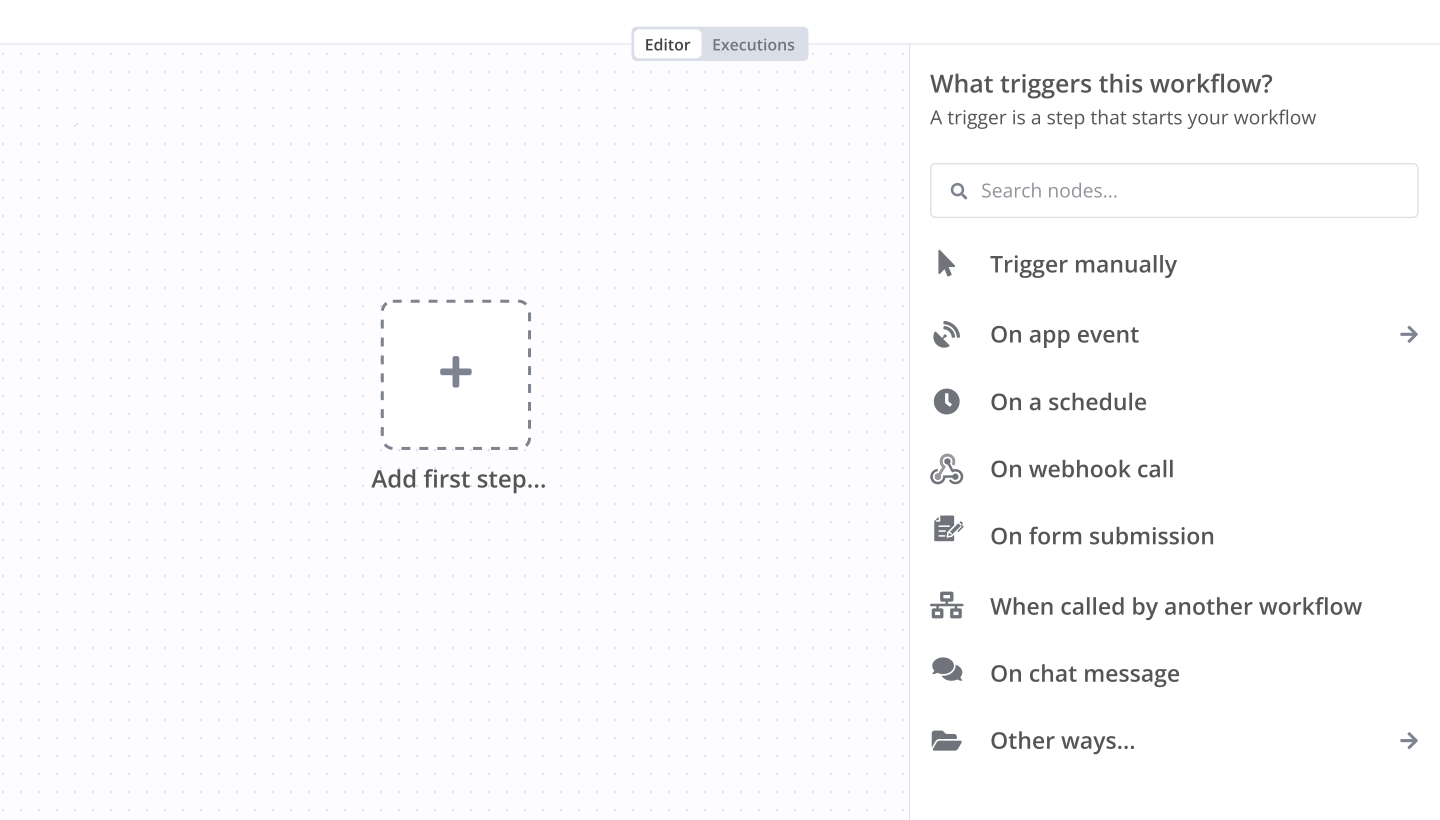
Google Cloud Natural Language and MongoDB integration: Create a new workflow and add the first step

Step 2: Add and configure Google Cloud Natural Language and MongoDB nodes

You can find Google Cloud Natural Language and MongoDB in the nodes panel. Drag them onto your workflow canvas, selecting their actions. Click each node, choose a credential, and authenticate to grant n8n access. Configure Google Cloud Natural Language and MongoDB nodes one by one: input data on the left, parameters in the middle, and output data on the right.

Google Cloud Natural Language and MongoDB integration: Add and configure Google Cloud Natural Language and MongoDB nodes

Step 3: Connect Google Cloud Natural Language and MongoDB

A connection establishes a link between Google Cloud Natural Language and MongoDB (or vice versa) to route data through the workflow. Data flows from the output of one node to the input of another. You can have single or multiple connections for each node.

Google Cloud Natural Language and MongoDB integration: Connect Google Cloud Natural Language and MongoDB

Step 4: Customize and extend your Google Cloud Natural Language and MongoDB integration

Use n8n's core nodes such as If, Split Out, Merge, and others to transform and manipulate data. Write custom JavaScript or Python in the Code node and run it as a step in your workflow. Connect Google Cloud Natural Language and MongoDB with any of n8n’s 1000+ integrations, and incorporate advanced AI logic into your workflows.

Google Cloud Natural Language and MongoDB integration: Customize and extend your Google Cloud Natural Language and MongoDB integration

Step 5: Test and activate your Google Cloud Natural Language and MongoDB workflow

Save and run the workflow to see if everything works as expected. Based on your configuration, data should flow from Google Cloud Natural Language to MongoDB or vice versa. Easily debug your workflow: you can check past executions to isolate and fix the mistake. Once you've tested everything, make sure to save your workflow and activate it.

Google Cloud Natural Language and MongoDB integration: Test and activate your Google Cloud Natural Language and MongoDB workflow

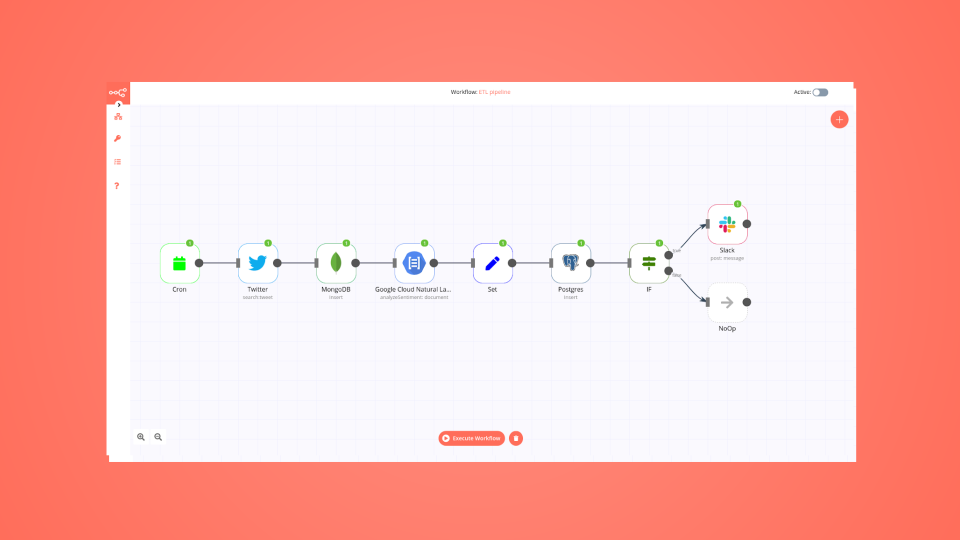
ETL pipeline for text processing

This workflow allows you to collect tweets, store them in MongoDB, analyse their sentiment, insert them into a Postgres database, and post positive tweets in a Slack channel.

Cron node: Schedule the workflow to run every day

Twitter node: Collect tweets

MongoDB node: Insert the collected tweets in MongoDB

Google Cloud Natural Language node: Analyse the sentiment of the collected tweets

Set node: Extract the sentiment score and magnitude

Postgres node: Insert the tweets and their sentiment score and magnitude in a Posgres database

IF node: Filter tweets with positive and negative sentiment scores

Slack node: Post tweets with a positive sentiment score in a Slack channel

NoOp node: Ignore tweets with a negative sentiment score

Nodes used in this workflow

Popular Google Cloud Natural Language and MongoDB workflows

+7

Build a Multi-Modal Telegram AI Assistant with Gemini, Voice & Image Generation

How it works This workflow creates a multi-talented AI assistant named Simran that interacts with users via Telegram. It can handle text and voice messages, understand the user's intent, and perform various tasks. Step 1: Receive & Transcribe Input The workflow triggers on any new Telegram message. If it's a voice message, it uses AssemblyAI to transcribe it into text; otherwise, it processes the incoming text directly. Step 2: Understand User Intent Using a Large Language Model (LLM), the workflow analyzes the user's message to determine their goal, categorizing it as a general chat, a request to generate an image, a command to set a reminder, or a request to remember a specific piece of information. Step 3: Fetch Context & Route The assistant retrieves past conversation summaries from a MongoDB database to maintain context. Based on the user's intent, the workflow routes the task to the appropriate path. Step 4: Execute the Task Chat: Generates a response using an AI agent whose personality can be toggled between a standard assistant and a "Girlfriend Mode." It also analyzes the user's mood to tailor the response. Generate Image: Creates a detailed prompt and uses an image generation API to create and send a picture. Set Reminder: Parses the natural language request, creates an event in Google Calendar and a task in Google Tasks, and sends a confirmation. Remember Info: Saves specific user-provided information to a dedicated memory collection in MongoDB. Step 5: Respond and Save Memory The final output (text, voice message, or image) is sent back to the user on Telegram. The workflow then summarizes the interaction and saves it to the database to ensure continuity in future conversations. Set up steps Estimated Set up time: 20 - 30 minutes. Configure Credentials: You will need to add credentials for several services in your n8n instance: Telegram (Bot API Token) AssemblyAI (API Key) MongoDB Google (for Calendar, Tasks, Sheets, and Natural Language API) A Large Language Model (the workflow uses Google Gemini but can be adapted) An image generation service (the workflow uses the Together.xyz API) Set up External Services: Ensure your MongoDB instance has two collections: user_memory and memory_auto. Create a Google Sheet to manage the "Girlfriend Mode" status for different users. Ensure edge-tts is installed on the machine running your n8n instance for the text-to-speech functionality. Customize Nodes: Review the nodes with hardcoded IDs, such as Google Tasks and Google Sheets, and update them with your specific Task List ID and Sheet ID. The sticky notes inside the workflow provide more detailed instructions for specific nodes and segments.

ETL pipeline for text processing

This workflow allows you to collect tweets, store them in MongoDB, analyse their sentiment, insert them into a Postgres database, and post positive tweets in a Slack channel. Cron node: Schedule the workflow to run every day Twitter node: Collect tweets MongoDB node: Insert the collected tweets in MongoDB Google Cloud Natural Language node: Analyse the sentiment of the collected tweets Set node: Extract the sentiment score and magnitude Postgres node: Insert the tweets and their sentiment score and magnitude in a Posgres database IF node: Filter tweets with positive and negative sentiment scores Slack node: Post tweets with a positive sentiment score in a Slack channel NoOp node: Ignore tweets with a negative sentiment score

Build your own Google Cloud Natural Language and MongoDB integration

Create custom Google Cloud Natural Language and MongoDB workflows by choosing triggers and actions. Nodes come with global operations and settings, as well as app-specific parameters that can be configured. You can also use the HTTP Request node to query data from any app or service with a REST API.

Google Cloud Natural Language supported actions

Analyze Sentiment

MongoDB supported actions

Create
Drop
List
Update
Aggregate
Aggregate documents
Delete
Delete documents
Find
Find documents
Find And Replace
Find and replace documents
Find And Update
Find and update documents
Insert
Insert documents
Update
Update documents

FAQs

  • Can Google Cloud Natural Language connect with MongoDB?

  • Can I use Google Cloud Natural Language’s API with n8n?

  • Can I use MongoDB’s API with n8n?

  • Is n8n secure for integrating Google Cloud Natural Language and MongoDB?

  • How to get started with Google Cloud Natural Language and MongoDB integration in n8n.io?

Need help setting up your Google Cloud Natural Language and MongoDB integration?

Discover our latest community's recommendations and join the discussions about Google Cloud Natural Language and MongoDB integration.
João Textor

Looking to integrate Google Cloud Natural Language and MongoDB in your company?

Over 3000 companies switch to n8n every single week

Why use n8n to integrate Google Cloud Natural Language with MongoDB

Build complex workflows, really fast
Build complex workflows, really fast

Handle branching, merging and iteration easily.
Pause your workflow to wait for external events.

Code when you need it, UI when you don't

Simple debugging

Your data is displayed alongside your settings, making edge cases easy to track down.

Use templates to get started fast

Use 1000+ workflow templates available from our core team and our community.

Reuse your work

Copy and paste, easily import and export workflows.

Implement complex processes faster with n8n

red iconyellow iconred iconyellow icon