Back to Integrations
integrationGoogle Docs node
integrationJira Software node

Google Docs and Jira Software integration

Save yourself the work of writing custom integrations for Google Docs and Jira Software and use n8n instead. Build adaptable and scalable Miscellaneous, Development, and Productivity workflows that work with your technology stack. All within a building experience you will love.

How to connect Google Docs and Jira Software

  • Step 1: Create a new workflow
  • Step 2: Add and configure nodes
  • Step 3: Connect
  • Step 4: Customize and extend your integration
  • Step 5: Test and activate your workflow

Step 1: Create a new workflow and add the first step

In n8n, click the "Add workflow" button in the Workflows tab to create a new workflow. Add the starting point – a trigger on when your workflow should run: an app event, a schedule, a webhook call, another workflow, an AI chat, or a manual trigger. Sometimes, the HTTP Request node might already serve as your starting point.
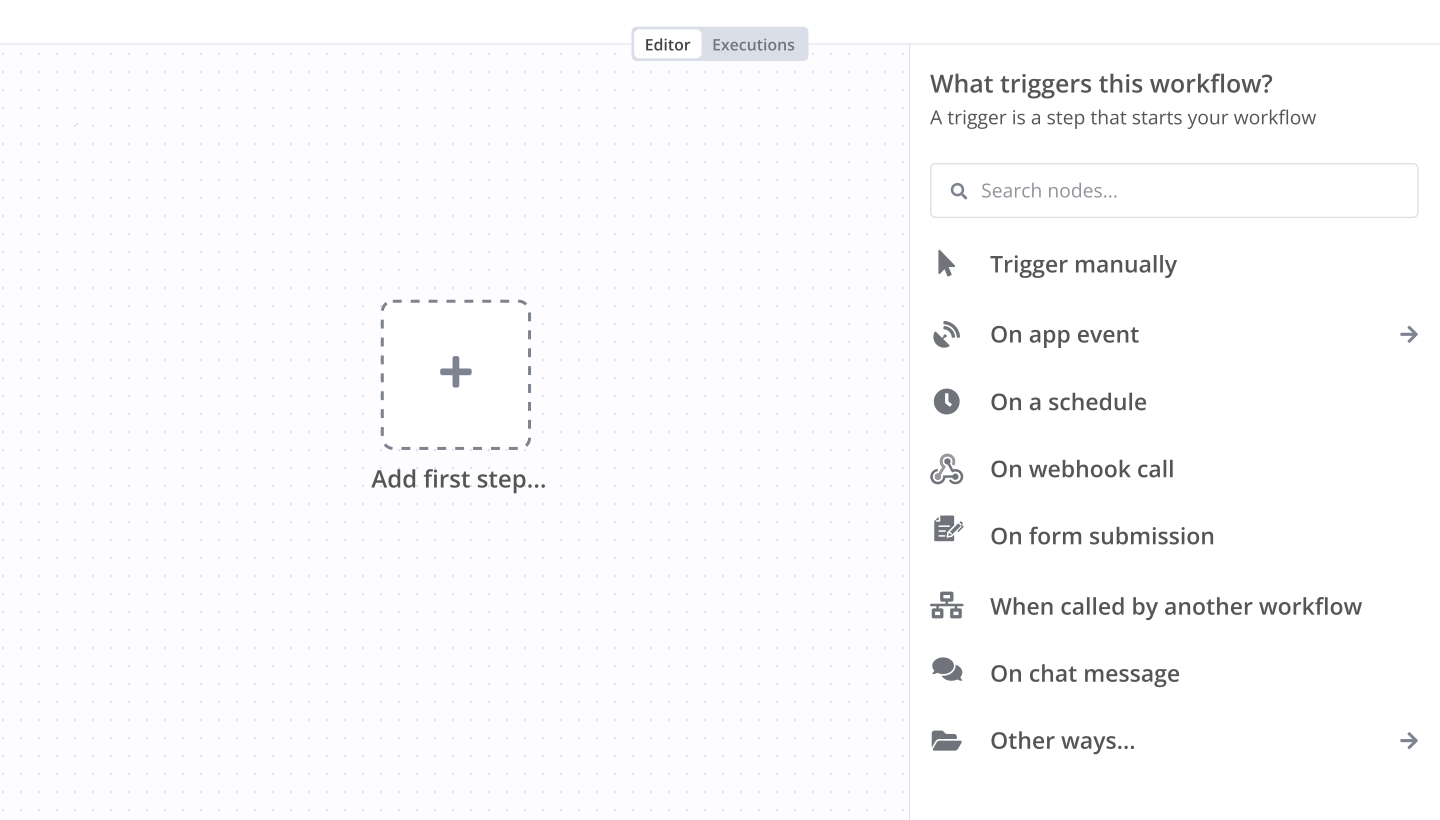
Google Docs and Jira Software integration: Create a new workflow and add the first step

Step 2: Add and configure Google Docs and Jira Software nodes

You can find Google Docs and Jira Software in the nodes panel. Drag them onto your workflow canvas, selecting their actions. Click each node, choose a credential, and authenticate to grant n8n access. Configure Google Docs and Jira Software nodes one by one: input data on the left, parameters in the middle, and output data on the right.

Google Docs and Jira Software integration: Add and configure Google Docs and Jira Software nodes

Step 3: Connect Google Docs and Jira Software

A connection establishes a link between Google Docs and Jira Software (or vice versa) to route data through the workflow. Data flows from the output of one node to the input of another. You can have single or multiple connections for each node.

Google Docs and Jira Software integration: Connect Google Docs and Jira Software

Step 4: Customize and extend your Google Docs and Jira Software integration

Use n8n's core nodes such as If, Split Out, Merge, and others to transform and manipulate data. Write custom JavaScript or Python in the Code node and run it as a step in your workflow. Connect Google Docs and Jira Software with any of n8n’s 1000+ integrations, and incorporate advanced AI logic into your workflows.

Google Docs and Jira Software integration: Customize and extend your Google Docs and Jira Software integration

Step 5: Test and activate your Google Docs and Jira Software workflow

Save and run the workflow to see if everything works as expected. Based on your configuration, data should flow from Google Docs to Jira Software or vice versa. Easily debug your workflow: you can check past executions to isolate and fix the mistake. Once you've tested everything, make sure to save your workflow and activate it.

Google Docs and Jira Software integration: Test and activate your Google Docs and Jira Software workflow

Generate lessons learned reports from Jira epics with AI and Google Docs

Who is this for?
Jira users who want to automate the generation of a Lessons Learned or Retrospective report after an Epic is Done.

What problem is this workflow solving? / use case
Lessons Learned / Retrospective reports are often omitted in Agile teams because they take time to write. With the use of n8n and AI this process can be automated.

What is this workflow doing
Triggers automatically upon an Epic reaching the "Done" status in Jira.
Collects all related tasks and comments associated with the completed Epic.
Intelligently filters the gathered data to provide the LLM with the most relevant information.
Utilizes an LLM with a structured System Message to generate insightful reports.
Delivers the finalized report directly to your specified Google Docs document.

Setup
Create a Jira API key and follow the Credentials Setup in the Jira trigger node.
Create credentials for Google Docs and paste your document ID into the Node.

How to customize this workflow to your needs
Change the System Message in the AI Agent to fit your needs.

Nodes used in this workflow

Popular Google Docs and Jira Software workflows

+4

Generate continuous PRD updates in Google Docs from Slack, Zoom, Jira, Zendesk, Figma and analytics using OpenAI

This workflow creates an automated Product Intelligence Engine that continuously collects signals from multiple product sources and generates structured PRD updates using AI. It ingests conversations, feedback, support tickets, analytics, and design comments, standardizes them, analyzes them with an AI PRD Agent, and automatically updates a Google Doc with structured PRD recommendations. Instead of manually reviewing Slack threads, Zoom calls, Jira comments, support tickets, and customer forms, this workflow centralizes everything into one intelligent PRD analysis system. High-Level Architecture - The workflow runs in 4 layers: Signal Ingestion Layer Captures product signals from: • Slack (channel messages + app mentions) • Customer Form submissions • Zoom recordings (scheduled) • Jira comments (scheduled) • Zendesk tickets (scheduled) • Figma comments (file updates) • Platform analytics via webhook • (Extendable to Salesforce / HubSpot) Standardization Layer Each source passes through a Format Node that: • Extracts relevant text • Normalizes metadata • Adds timestamps • Labels source type All inputs are converted into a unified "product signal" object. Intelligence Layer (AI PRD Agent) All signals are merged into a single stream using a Merge node. The PRD Analysis Agent then: • Extracts feature requests • Detects scope changes • Identifies risks and constraints • Evaluates priority signals • Detects target user shifts • Generates structured PRD updates PRD Governance Layer - output in a Google Doc The structured AI output is appended to a Google Doc, which is fully traceable. This creates a living PRD that continuously evolves based on real product signals. Required Credentials (And How To Add Them): You will need to configure the following credentials in n8n: Slack Used for Slack Trigger. Steps: Create a Slack App at api.slack.com Enable: app_mentions:read channels:history chat:write (optional if you want replies) Install app to workspace Copy Bot OAuth Token In n8n → Create Slack API credential Paste token Reference - https://www.youtube.com/watch?v=qk5JH6ImK0I Zoom (OAuth2) Used to fetch recordings. Steps: Create an OAuth App in Zoom Marketplace Add the Redirect URL from n8n Copy Client ID + Secret Add Zoom OAuth2 credential in n8n Connect account Reference - https://www.youtube.com/watch?v=BC6O_3LYgac Google Docs (OAuth2) Used to update PRD document. Steps: Create Google Cloud Project Add Doc URl to n8n Replace the example Google Doc URL with your own PRD document. Reference - https://www.youtube.com/watch?v=iieEHvu93dc Jira (Cloud) Steps: Generate API token from Atlassian Create Jira Software Cloud credential Enter: Email API token Domain Reference - https://www.youtube.com/watch?v=T4z7lzqSZDY Zendesk Steps: Generate API token Add Zendesk credential Enter: Subdomain Email API token Figma Steps: Generate a personal access token in Figma Add Figma credentials with the team ID Paste token Platform Analytics Webhook Replace: <PLACEHOLDER_VALUE__your_analytics_api_endpoint> With your real analytics endpoint. You can: • Send Mixpanel exports • Send Amplitude exports • Or POST custom JSON What Makes This Powerful • Eliminates product signal silos • Creates AI-driven PRD governance • Ensures traceability of decisions • Enables continuous PRD evolution • Scales across teams

Generate Lessons Learned Reports from Jira Epics with AI and Google Docs

Who is this for? Jira users who want to automate the generation of a Lessons Learned or Retrospective report after an Epic is Done. What problem is this workflow solving? / use case Lessons Learned / Retrospective reports are often omitted in Agile teams because they take time to write. With the use of n8n and AI this process can be automated. What is this workflow doing Triggers automatically upon an Epic reaching the "Done" status in Jira. Collects all related tasks and comments associated with the completed Epic. Intelligently filters the gathered data to provide the LLM with the most relevant information. Utilizes an LLM with a structured System Message to generate insightful reports. Delivers the finalized report directly to your specified Google Docs document. Setup Create a Jira API key and follow the Credentials Setup in the Jira trigger node. Create credentials for Google Docs and paste your document ID into the Node. How to customize this workflow to your needs Change the System Message in the AI Agent to fit your needs.

Build your own Google Docs and Jira Software integration

Create custom Google Docs and Jira Software workflows by choosing triggers and actions. Nodes come with global operations and settings, as well as app-specific parameters that can be configured. You can also use the HTTP Request node to query data from any app or service with a REST API.

Google Docs supported actions

Create
Get
Update

Jira Software supported actions

Changelog
Get issue changelog
Create
Create a new issue
Delete
Delete an issue
Get
Get an issue
Get Many
Get many issues
Notify
Create an email notification for an issue and add it to the mail queue
Status
Return either all transitions or a transition that can be performed by the user on an issue, based on the issue's status
Update
Update an issue
Add
Add attachment to issue
Get
Get an attachment
Get Many
Get many attachments
Remove
Remove an attachment
Add
Add comment to issue
Get
Get a comment
Get Many
Get many comments
Remove
Remove a comment
Update
Update a comment
Create
Create a new user
Delete
Delete a user
Get
Retrieve a user

FAQs

  • Can Google Docs connect with Jira Software?

  • Can I use Google Docs’s API with n8n?

  • Can I use Jira Software’s API with n8n?

  • Is n8n secure for integrating Google Docs and Jira Software?

  • How to get started with Google Docs and Jira Software integration in n8n.io?

Looking to integrate Google Docs and Jira Software in your company?

Over 3000 companies switch to n8n every single week

Why use n8n to integrate Google Docs with Jira Software

Build complex workflows, really fast
Build complex workflows, really fast

Handle branching, merging and iteration easily.
Pause your workflow to wait for external events.

Code when you need it, UI when you don't

Simple debugging

Your data is displayed alongside your settings, making edge cases easy to track down.

Use templates to get started fast

Use 1000+ workflow templates available from our core team and our community.

Reuse your work

Copy and paste, easily import and export workflows.

Implement complex processes faster with n8n

red iconyellow iconred iconyellow icon