Back to Integrations
integrationGoogle Docs node
integrationTelegram node

Google Docs and Telegram integration

Save yourself the work of writing custom integrations for Google Docs and Telegram and use n8n instead. Build adaptable and scalable Miscellaneous, Communication, and HITL workflows that work with your technology stack. All within a building experience you will love.

How to connect Google Docs and Telegram

  • Step 1: Create a new workflow
  • Step 2: Add and configure nodes
  • Step 3: Connect
  • Step 4: Customize and extend your integration
  • Step 5: Test and activate your workflow

Step 1: Create a new workflow and add the first step

In n8n, click the "Add workflow" button in the Workflows tab to create a new workflow. Add the starting point – a trigger on when your workflow should run: an app event, a schedule, a webhook call, another workflow, an AI chat, or a manual trigger. Sometimes, the HTTP Request node might already serve as your starting point.
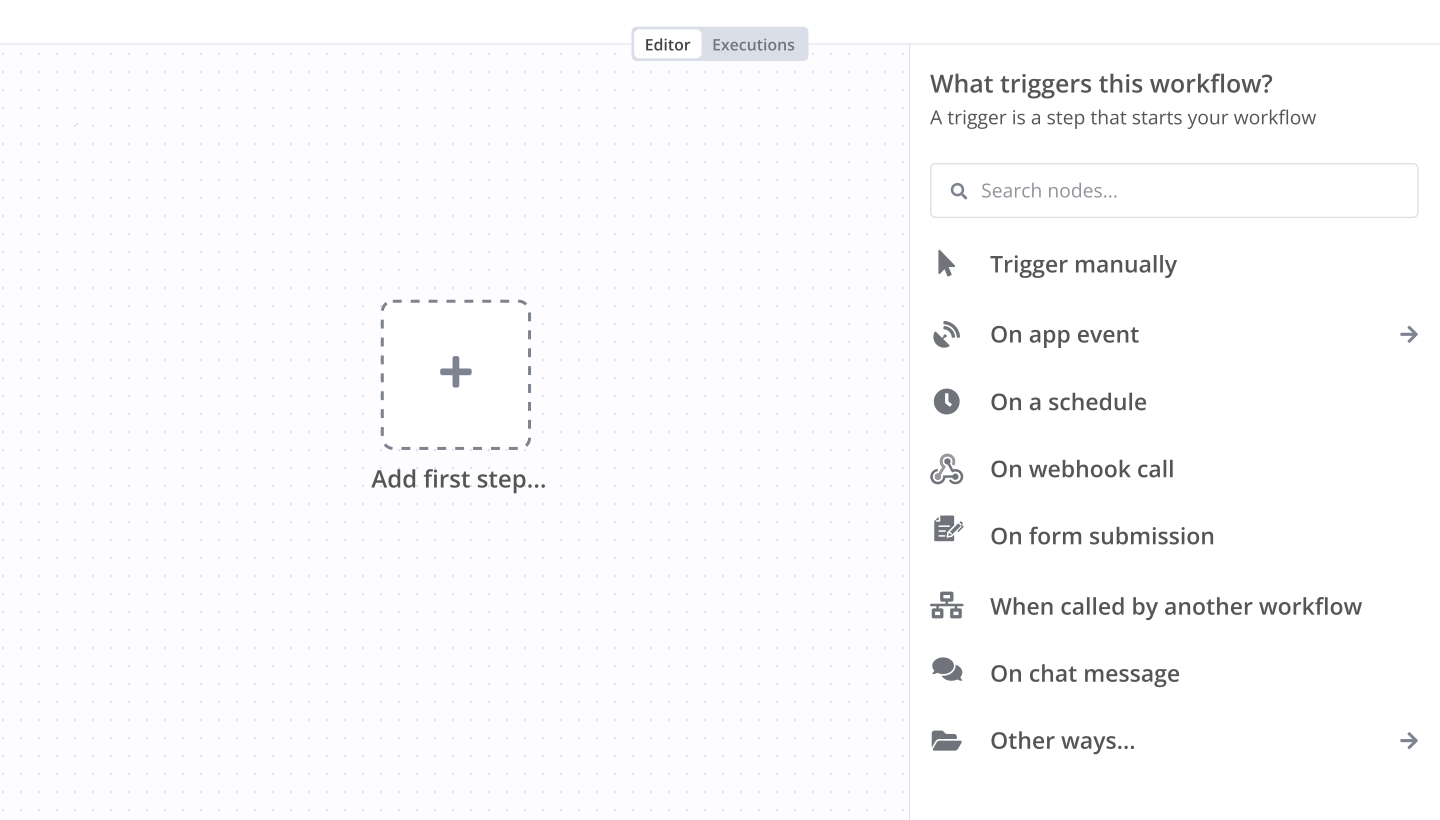
Google Docs and Telegram integration: Create a new workflow and add the first step

Step 2: Add and configure Google Docs and Telegram nodes

You can find Google Docs and Telegram in the nodes panel. Drag them onto your workflow canvas, selecting their actions. Click each node, choose a credential, and authenticate to grant n8n access. Configure Google Docs and Telegram nodes one by one: input data on the left, parameters in the middle, and output data on the right.

Google Docs and Telegram integration: Add and configure Google Docs and Telegram nodes

Step 3: Connect Google Docs and Telegram

A connection establishes a link between Google Docs and Telegram (or vice versa) to route data through the workflow. Data flows from the output of one node to the input of another. You can have single or multiple connections for each node.

Google Docs and Telegram integration: Connect Google Docs and Telegram

Step 4: Customize and extend your Google Docs and Telegram integration

Use n8n's core nodes such as If, Split Out, Merge, and others to transform and manipulate data. Write custom JavaScript or Python in the Code node and run it as a step in your workflow. Connect Google Docs and Telegram with any of n8n’s 1000+ integrations, and incorporate advanced AI logic into your workflows.

Google Docs and Telegram integration: Customize and extend your Google Docs and Telegram integration

Step 5: Test and activate your Google Docs and Telegram workflow

Save and run the workflow to see if everything works as expected. Based on your configuration, data should flow from Google Docs to Telegram or vice versa. Easily debug your workflow: you can check past executions to isolate and fix the mistake. Once you've tested everything, make sure to save your workflow and activate it.

Google Docs and Telegram integration: Test and activate your Google Docs and Telegram workflow

🤖 AI powered RAG chatbot for your docs + Google Drive + Gemini + Qdrant

🤖 AI-Powered RAG Chatbot with Google Drive Integration

This workflow creates a powerful RAG (Retrieval-Augmented Generation) chatbot that can process, store, and interact with documents from Google Drive using Qdrant vector storage and Google's Gemini AI.

How It Works

Document Processing & Storage 📚
Retrieves documents from a specified Google Drive folder
Processes and splits documents into manageable chunks
Extracts metadata using AI for enhanced search capabilities
Stores document vectors in Qdrant for efficient retrieval

Intelligent Chat Interface 💬
Provides a conversational interface powered by Google Gemini
Uses RAG to retrieve relevant context from stored documents
Maintains chat history in Google Docs for reference
Delivers accurate, context-aware responses

Vector Store Management 🗄️
Features secure delete operations with human verification
Includes Telegram notifications for important operations
Maintains data integrity with proper version control
Supports batch processing of documents

Setup Steps

Configure API Credentials:
Set up Google Drive & Docs access
Configure Gemini AI API
Set up Qdrant vector store connection
Add Telegram bot for notifications
Add OpenAI Api Key to the 'Delete Qdrant Points by File ID' node

Configure Document Sources:
Set Google Drive folder ID
Define Qdrant collection name
Set up document processing parameters

Test and Deploy:
Verify document processing
Test chat functionality
Confirm vector store operations
Check notification system

This workflow is ideal for organizations needing to create intelligent chatbots that can access and understand large document repositories while maintaining context and providing accurate responses through RAG technology.

Nodes used in this workflow

Popular Google Docs and Telegram workflows

Generate 5-level AI explanations for different audiences from Telegram to Google Docs with GPT-4.1-mini

Description Ask any question and get five different answers instantly. Each answer is written for a different audience—from kids to business executives. Your Telegram bot delivers all five explanations in under 10 seconds and saves them to Google Docs automatically. Perfect for teachers, writers, and anyone who needs to explain things to different people. Who's It For • Educators creating multi-grade curriculum content • Content creators generating material for diverse audiences • Technical writers producing documentation at different expertise levels • Parents explaining complex topics to children • Anyone who needs to explain things to different people. How It Works • Transforms any question into five distinct explanations: kid-friendly stories (5-year-olds), relatable content (teenagers), professional explanations (graduates), academic analysis (PhD researchers), and strategic insights (business executives) • Five AI agents process simultaneously for 3-8 second response times • Delivers six formatted Telegram messages (header + five explanations) • Automatically archives complete conversations to Google Docs • Uses binary tree merge architecture for reliable data handling How to Set Up • Create Telegram bot via @BotFather and add token to n8n credentials • Obtain OpenAI API key and add to n8n credentials • Connect Google account to grant Docs access • Create blank Google Doc and paste URL in workflow's Google Docs node • Activate workflow and test with any question Requirements • Telegram Bot API token (free) • OpenAI API key (pay-per-use • Google account with Docs access (free) • n8n instance (cloud or self-hosted) How to Customize • Modify AI prompts in 'Create 5 Items' node for different tones and styles • Adjust character limits in formatting nodes to control message length • Change output destinations from Telegram to Slack, email, or other platforms • Switch AI providers from OpenAI to alternatives • Add additional comprehension levels by duplicating AI agent nodes Need Help? For detailed notes and implementation, please leverage the README document at: https://drive.google.com/file/d/19Fx-FoihL70qpOi4CnEwQ6Sud2dbUnE_/view?usp=sharing Join the Discord (https://discord.com/invite/XPKeKXeB7d) or Join the n8n community forum (https://community.n8n.io/) for support

RAG Chatbot with Supabase + TogetherAI + Openrouter

⚠️ RUN the FIRST WORKFLOW ONLY ONCE (as it will convert your content in Embedding format and save it in DB and is ready for the RAG Chat) 📌 Telegram Trigger Type:** telegramTrigger Purpose:** Waits for new Telegram messages to trigger the workflow. Note:** Currently disabled. 📄 Content for the Training Type:** googleDocs Purpose:** Fetches document content from Google Docs using its URL. Details:** Uses Service Account authentication. ✂️ Splitting into Chunks Type:** code Purpose:** Splits the fetched document text into smaller chunks (1000 chars each) for processing. Logic:** Loops over text and slices it. 🧠 Embedding Uploaded Document Type:** httpRequest Purpose:** Calls Together AI embedding API to get vector embeddings for each text chunk. Details:** Sends JSON with model name and chunk as input. 🛢 Save the embedding in DB Type:** supabase Purpose:** Saves each text chunk and its embedding vector into the Supabase embed table. SECOND WORKFLOW EXPLAINATION: 💬 When chat message received Type:** chatTrigger Purpose:** Starts the workflow when a user sends a chat message. Details:** Sends an initial greeting message to the user. 🧩 Embend User Message Type:** httpRequest Purpose:** Generates embedding for the user’s input message. Details:** Calls Together AI embeddings API. 🔍 Search Embeddings Type:** httpRequest Purpose:** Searches Supabase DB for the top 5 most similar text chunks based on the generated embedding. Details:** Calls Supabase RPC function matchembeddings1. 📦 Aggregate Type:** aggregate Purpose:** Combines all retrieved text chunks into a single aggregated context for the LLM. 🧠 Basic LLM Chain Type:** chainLlm Purpose:** Passes the user's question + aggregated context to the LLM to generate a detailed answer. Details:** Contains prompt instructing the LLM to answer only based on context. 🤖 OpenRouter Chat Model Type:** lmChatOpenRouter Purpose:** Provides the actual AI language model that processes the prompt. Details:** Uses qwen/qwen3-8b:free model via OpenRouter and you can use any of your choice.
+9

✨🩷Automated Social Media Content Publishing Factory + System Prompt Composition

Social Media Content Publishing Factory for Streamlined Content Creation Across Platforms Who is this for? This workflow is designed for content creators, social media managers, and marketing teams who need to efficiently create and publish content across multiple social media platforms. It's perfect for businesses looking to maintain a consistent presence across X (Twitter), Instagram, Facebook, LinkedIn, Threads, and YouTube Shorts without spending hours crafting platform-specific content manually. What problem is this workflow solving? Creating tailored content for different social media platforms is time-consuming and requires understanding each platform's unique requirements and audience expectations. This workflow solves the challenge of: Maintaining consistent messaging across platforms while respecting platform-specific formats Generating optimized content that follows best practices for each platform Creating accompanying visuals without graphic design skills Streamlining the approval process before publishing Reducing the time spent on repetitive content creation tasks What this workflow does This automated content factory takes your content idea and transforms it into platform-optimized posts for all major social media channels. The workflow: Accepts your content idea or topic through a chat interface Leverages AI to generate tailored content for each platform (X/Twitter, Instagram, Facebook, LinkedIn, Threads, YouTube Shorts) Creates appropriate images using AI image generation Sends content for approval via email before publishing Publishes approved content to selected platforms Maintains chat memory to improve future content generation Setup Connect your social media platform credentials (X/Twitter, Instagram, Facebook, LinkedIn) Set up your email account for the approval process Configure your OpenAI API key for AI content generation Update the image generation service credentials (Pollinations.ai is used by default) Customize the system prompts and schemas in the Google Docs nodes with your brand voice and content requirements How to customize this workflow to your needs Modify the system prompts in the Google Docs nodes to match your brand voice and content strategy Adjust the social media schemas to include specific fields relevant to your content Update the approval process to include additional stakeholders if needed Add or remove social media platforms based on your marketing strategy Customize the image generation prompts to better match your visual branding Integrate with your existing content calendar or CRM systems This workflow eliminates the need to manually craft different versions of the same content for each platform, saving hours of work while ensuring your social media presence remains consistent and optimized for maximum engagement.
+8

🤖 AI Powered RAG Chatbot for Your Docs + Google Drive + Gemini + Qdrant

🤖 AI-Powered RAG Chatbot with Google Drive Integration This workflow creates a powerful RAG (Retrieval-Augmented Generation) chatbot that can process, store, and interact with documents from Google Drive using Qdrant vector storage and Google's Gemini AI. How It Works Document Processing & Storage 📚 Retrieves documents from a specified Google Drive folder Processes and splits documents into manageable chunks Extracts metadata using AI for enhanced search capabilities Stores document vectors in Qdrant for efficient retrieval Intelligent Chat Interface 💬 Provides a conversational interface powered by Google Gemini Uses RAG to retrieve relevant context from stored documents Maintains chat history in Google Docs for reference Delivers accurate, context-aware responses Vector Store Management 🗄️ Features secure delete operations with human verification Includes Telegram notifications for important operations Maintains data integrity with proper version control Supports batch processing of documents Setup Steps Configure API Credentials: Set up Google Drive & Docs access Configure Gemini AI API Set up Qdrant vector store connection Add Telegram bot for notifications Add OpenAI Api Key to the 'Delete Qdrant Points by File ID' node Configure Document Sources: Set Google Drive folder ID Define Qdrant collection name Set up document processing parameters Test and Deploy: Verify document processing Test chat functionality Confirm vector store operations Check notification system This workflow is ideal for organizations needing to create intelligent chatbots that can access and understand large document repositories while maintaining context and providing accurate responses through RAG technology.
+5

Build a Chatbot with Reinforced Learning Human Feedback (RLHF) and RAG

Who is this for? This template is designed for internal support teams, product specialists, and knowledge managers who want to build an AI-powered knowledge assistant with retrieval-augmented generation (RAG) and reinforcement learning from human feedback (RLHF) via Telegram. What problem is this workflow solving? Manual knowledge management and answering support queries can be time-consuming and error-prone. This solution automates importing and indexing official documentation into MongoDB vector search and enhances AI responses with Telegram-based user feedback to continuously improve answer quality. What these workflows do Workflow 1: Document ingestion & indexing Manually triggered workflow imports product documentation from Google Docs. Documents are split into manageable chunks and embedded using OpenAI embeddings. Embedded document chunks are stored in MongoDB Atlas vector store to enable semantic search. Workflow 2: Telegram chat with RLHF feedback loop Listens for user messages via Telegram bot integration. Uses vector similarity search on MongoDB to retrieve relevant documentation chunks. Generates answers with OpenAI GPT-4o-mini model using retrieval-augmented generation. Sends answers back via Telegram and waits for user feedback (approval or disapproval). Captures feedback, maps it as positive or negative, and stores it with the conversation data for future model improvement. Setup Setting up vector embeddings Authenticate Google Docs and connect your Google Docs URL containing the product documentation you want to index. Authenticate MongoDB Atlas and connect the collection where you want to store the vector embeddings. Create a search index on this collection to support vector similarity queries. Ensure the index name matches the one configured in n8n (data_index). See the example MongoDB search index template below for reference. Setting up chat with Telegram RLHF Create a bot in Telegram with @botFather using the /newbot command. Connect the MongoDB database and search index used for vector search in the previous workflow. Also create two new collections in MongoDB Atlas: one for feedback and one for chat history. Create a search index for feedback, copying the provided template. Configure the AI system prompt in the “Knowledge Base Agent” node, making sure it references all three tools connected (productDocs, feedbackPositive, feedbackNegative) as provided in the template prompt. Make sure Product documentation and feedback collections must connect to the same MongoDB database. There are three distinct MongoDB collections: one for product documentation, one for feedback, and one for chat history (chat history collection can be separate). Telegram API credentials are valid and webhook URLs are correctly set up. MongoDB Search Index Templates Documentation Collection Index { "mappings": { "dynamic": false, "fields": { "_id": { "type": "string" }, "text": { "type": "string" }, "embedding": { "type": "knnVector", "dimensions": 1536, "similarity": "cosine" }, "source": { "type": "string" }, "doc_id": { "type": "string" } } } } Feedback Collection Index { "mappings": { "dynamic": false, "fields": { "prompt": { "type": "string" }, "response": { "type": "string" }, "text": { "type": "string" }, "embedding": { "type": "knnVector", "dimensions": 1536, "similarity": "cosine" }, "feedback": { "type": "token" } } } }

🤖🧠 AI Agent Chatbot + LONG TERM Memory + Note Storage + Telegram

This workflow template creates an AI agent chatbot with long-term memory and note storage using Google Docs and Telegram integration. Google Docs Integration 📄 n8n Google Docs Node Setup Google Credentials Telegram Integration 💬 Telegram Setup Core Features 🌟 AI Agent Integration 🤖 Implements a sophisticated AI agent with memory management capabilities Uses GPT-4o-mini and DeepSeek models for intelligent conversation handling Maintains context awareness through session management Memory System 🧠 Long-term memory storage using Google Docs Separate note storage system for specific information Window buffer memory for maintaining conversation context Intelligent memory retrieval and storage mechanisms Communication Interface 💬 Telegram integration for message handling Real-time message processing and response generation Technical Components 🔧 Memory Architecture 📚 Dual storage system separating memories from notes Automated memory retrieval before each interaction Structured memory saving with timestamps AI Models 🤖 Primary GPT-4o-mini mini model for general interactions DeepSeek-V3 Chat for specialized processing Custom agent system with tool integration Storage Integration 💾 Google Docs integration for persistent storage Separate document management for memories and notes Automated document updates and retrievals

Build your own Google Docs and Telegram integration

Create custom Google Docs and Telegram workflows by choosing triggers and actions. Nodes come with global operations and settings, as well as app-specific parameters that can be configured. You can also use the HTTP Request node to query data from any app or service with a REST API.

Google Docs supported actions

Create
Get
Update

Telegram supported actions

Get
Get up to date information about a chat
Get Administrators
Get the Administrators of a chat
Get Member
Get the member of a chat
Leave
Leave a group, supergroup or channel
Set Description
Set the description of a chat
Set Title
Set the title of a chat
Answer Query
Send answer to callback query sent from inline keyboard
Answer Inline Query
Send answer to callback query sent from inline bot
Get
Get a file
Delete Chat Message
Delete a chat message
Edit Message Text
Edit a text message
Pin Chat Message
Pin a chat message
Send Animation
Send an animated file
Send Audio
Send a audio file
Send Chat Action
Send a chat action
Send Document
Send a document
Send Location
Send a location
Send Media Group
Send group of photos or videos to album
Send Message
Send a text message
Send and Wait for Response
Send a message and wait for response
Send Photo
Send a photo
Send Sticker
Send a sticker
Send Video
Send a video
Unpin Chat Message
Unpin a chat message

FAQs

  • Can Google Docs connect with Telegram?

  • Can I use Google Docs’s API with n8n?

  • Can I use Telegram’s API with n8n?

  • Is n8n secure for integrating Google Docs and Telegram?

  • How to get started with Google Docs and Telegram integration in n8n.io?

Need help setting up your Google Docs and Telegram integration?

Discover our latest community's recommendations and join the discussions about Google Docs and Telegram integration.
Trigi Digital

Looking to integrate Google Docs and Telegram in your company?

Over 3000 companies switch to n8n every single week

Why use n8n to integrate Google Docs with Telegram

Build complex workflows, really fast
Build complex workflows, really fast

Handle branching, merging and iteration easily.
Pause your workflow to wait for external events.

Code when you need it, UI when you don't

Simple debugging

Your data is displayed alongside your settings, making edge cases easy to track down.

Use templates to get started fast

Use 1000+ workflow templates available from our core team and our community.

Reuse your work

Copy and paste, easily import and export workflows.

Implement complex processes faster with n8n

red iconyellow iconred iconyellow icon