Back to Integrations
integrationGoogle Docs node
integrationWhatsApp Business Cloud node

Google Docs and WhatsApp Business Cloud integration

Save yourself the work of writing custom integrations for Google Docs and WhatsApp Business Cloud and use n8n instead. Build adaptable and scalable Miscellaneous, Communication, and HITL workflows that work with your technology stack. All within a building experience you will love.

How to connect Google Docs and WhatsApp Business Cloud

  • Step 1: Create a new workflow
  • Step 2: Add and configure nodes
  • Step 3: Connect
  • Step 4: Customize and extend your integration
  • Step 5: Test and activate your workflow

Step 1: Create a new workflow and add the first step

In n8n, click the "Add workflow" button in the Workflows tab to create a new workflow. Add the starting point – a trigger on when your workflow should run: an app event, a schedule, a webhook call, another workflow, an AI chat, or a manual trigger. Sometimes, the HTTP Request node might already serve as your starting point.
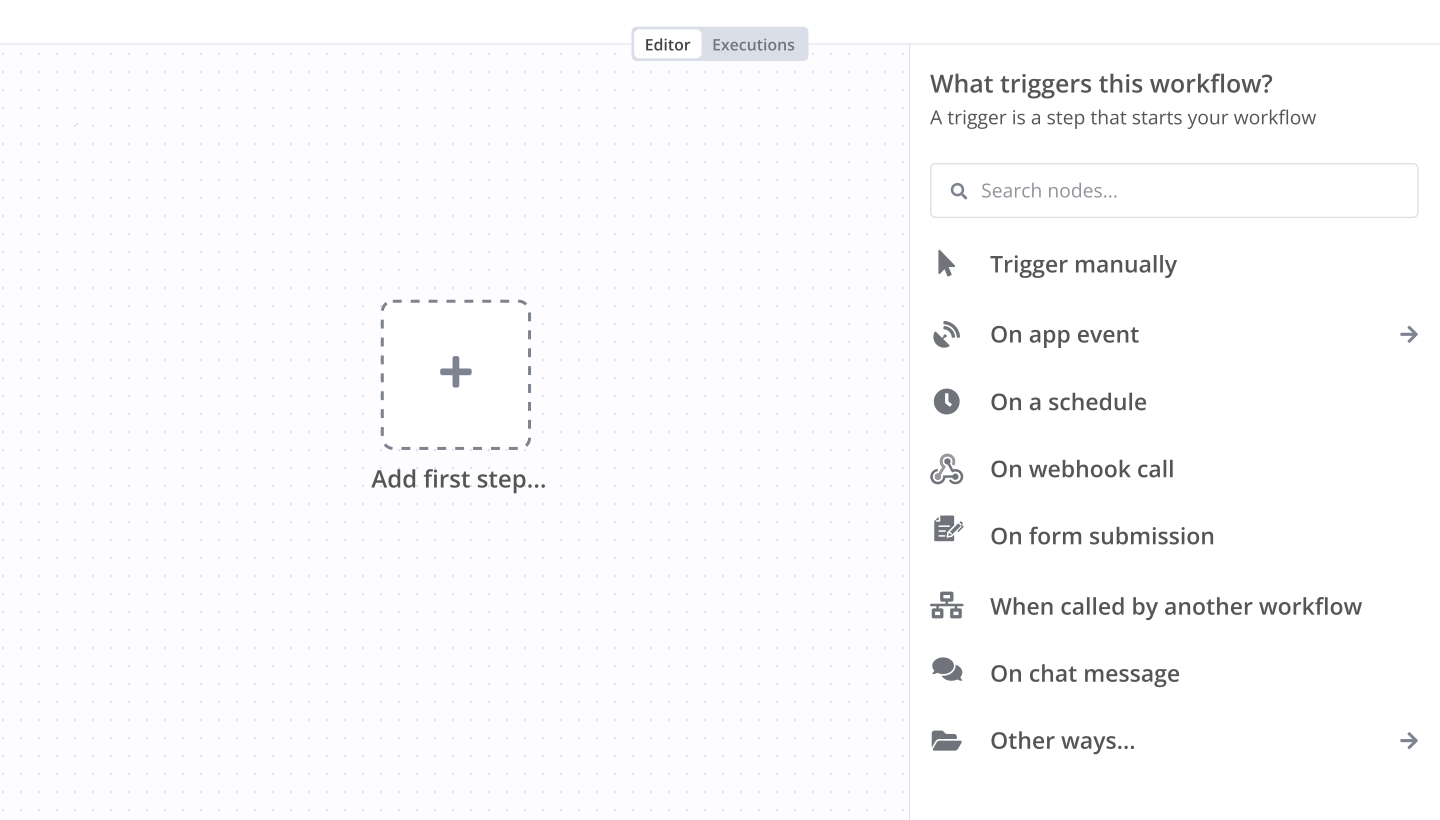
Google Docs and WhatsApp Business Cloud integration: Create a new workflow and add the first step

Step 2: Add and configure Google Docs and WhatsApp Business Cloud nodes

You can find Google Docs and WhatsApp Business Cloud in the nodes panel. Drag them onto your workflow canvas, selecting their actions. Click each node, choose a credential, and authenticate to grant n8n access. Configure Google Docs and WhatsApp Business Cloud nodes one by one: input data on the left, parameters in the middle, and output data on the right.

Google Docs and WhatsApp Business Cloud integration: Add and configure Google Docs and WhatsApp Business Cloud nodes

Step 3: Connect Google Docs and WhatsApp Business Cloud

A connection establishes a link between Google Docs and WhatsApp Business Cloud (or vice versa) to route data through the workflow. Data flows from the output of one node to the input of another. You can have single or multiple connections for each node.

Google Docs and WhatsApp Business Cloud integration: Connect Google Docs and WhatsApp Business Cloud

Step 4: Customize and extend your Google Docs and WhatsApp Business Cloud integration

Use n8n's core nodes such as If, Split Out, Merge, and others to transform and manipulate data. Write custom JavaScript or Python in the Code node and run it as a step in your workflow. Connect Google Docs and WhatsApp Business Cloud with any of n8n’s 1000+ integrations, and incorporate advanced AI logic into your workflows.

Google Docs and WhatsApp Business Cloud integration: Customize and extend your Google Docs and WhatsApp Business Cloud integration

Step 5: Test and activate your Google Docs and WhatsApp Business Cloud workflow

Save and run the workflow to see if everything works as expected. Based on your configuration, data should flow from Google Docs to WhatsApp Business Cloud or vice versa. Easily debug your workflow: you can check past executions to isolate and fix the mistake. Once you've tested everything, make sure to save your workflow and activate it.

Google Docs and WhatsApp Business Cloud integration: Test and activate your Google Docs and WhatsApp Business Cloud workflow

AI-powered WhatsApp chatbot for text, voice, images, and PDF with RAG

Who is this for?
This template is designed for internal support teams, product specialists, and knowledge managers in technology companies who want to automate ingestion of product documentation and enable AI-driven, retrieval-augmented question answering via WhatsApp.

What problem is this workflow solving?
Support agents often spend too much time manually searching through lengthy documentation, leading to inconsistent or delayed answers. This solution automates importing, chunking, and indexing product manuals, then uses retrieval-augmented generation (RAG) to answer user queries accurately and quickly with AI via WhatsApp messaging.

What these workflows do

Workflow 1: Document Ingestion & Indexing

Manually triggered to import product documentation from Google Docs.
Automatically splits large documents into chunks for efficient searching.
Generates vector embeddings for each chunk using OpenAI embeddings.
Inserts the embedded chunks and metadata into a MongoDB Atlas vector store, enabling fast semantic search.

Workflow 2: AI-Powered Query & Response via WhatsApp

Listens for incoming WhatsApp user messages, supporting various types:
Text messages: Plain text queries from users.
Audio messages: Voice notes transcribed into text for processing.
Image messages: Photos or screenshots analyzed to provide contextual answers.
Document messages: PDFs, spreadsheets, or other files parsed for relevant content.
Converts incoming queries to vector embeddings and performs similarity search on the MongoDB vector store.
Uses OpenAI’s GPT-4o-mini model with retrieval-augmented generation to produce concise, context-aware answers.
Maintains conversation context across multiple turns using a memory buffer node.
Routes different message types to appropriate processing nodes to maximize answer quality.

Setup

Setting up vector embeddings

Authenticate Google Docs and connect your Google Docs URL containing the product documentation you want to index.
Authenticate MongoDB Atlas and connect the collection where you want to store the vector embeddings. Create a search index on this collection to support vector similarity queries.
Ensure the index name matches the one configured in n8n (data_index).
See the example MongoDB search index template below for reference.

Setting up chat

Authenticate the WhatsApp node with your Meta account credentials to enable message receiving and sending.
Connect the MongoDB collection containing embedded product documentation to the MongoDB Vector Search node used for similarity queries.
Set up the system prompt in the Knowledge Base Agent node to reflect your company’s tone, answering style, and any business rules, ensuring it references the connected MongoDB collection for context retrieval.

Make sure

Both MongoDB nodes (in ingestion and chat workflows) are connected to the same collection with:

An embedding field storing vector data,

Relevant metadata fields (e.g., document ID, source), and

The same vector index name configured (e.g., data_index).

Search Index Example:

{
"mappings": {
"dynamic": false,
"fields": {
"_id": { "type": "string" },
"text": { "type": "string" },
"embedding": {
"type": "knnVector",
"dimensions": 1536,
"similarity": "cosine"
},
"source": { "type": "string" },
"doc_id": { "type": "string" }
}
}
}

Nodes used in this workflow

Popular Google Docs and WhatsApp Business Cloud workflows

+7

AI-Powered WhatsApp Chatbot for Text, Voice, Images, and PDF with RAG

Who is this for? This template is designed for internal support teams, product specialists, and knowledge managers in technology companies who want to automate ingestion of product documentation and enable AI-driven, retrieval-augmented question answering via WhatsApp. What problem is this workflow solving? Support agents often spend too much time manually searching through lengthy documentation, leading to inconsistent or delayed answers. This solution automates importing, chunking, and indexing product manuals, then uses retrieval-augmented generation (RAG) to answer user queries accurately and quickly with AI via WhatsApp messaging. What these workflows do Workflow 1: Document Ingestion & Indexing Manually triggered to import product documentation from Google Docs. Automatically splits large documents into chunks for efficient searching. Generates vector embeddings for each chunk using OpenAI embeddings. Inserts the embedded chunks and metadata into a MongoDB Atlas vector store, enabling fast semantic search. Workflow 2: AI-Powered Query & Response via WhatsApp Listens for incoming WhatsApp user messages, supporting various types: Text messages: Plain text queries from users. Audio messages: Voice notes transcribed into text for processing. Image messages: Photos or screenshots analyzed to provide contextual answers. Document messages: PDFs, spreadsheets, or other files parsed for relevant content. Converts incoming queries to vector embeddings and performs similarity search on the MongoDB vector store. Uses OpenAI’s GPT-4o-mini model with retrieval-augmented generation to produce concise, context-aware answers. Maintains conversation context across multiple turns using a memory buffer node. Routes different message types to appropriate processing nodes to maximize answer quality. Setup Setting up vector embeddings Authenticate Google Docs and connect your Google Docs URL containing the product documentation you want to index. Authenticate MongoDB Atlas and connect the collection where you want to store the vector embeddings. Create a search index on this collection to support vector similarity queries. Ensure the index name matches the one configured in n8n (data_index). See the example MongoDB search index template below for reference. Setting up chat Authenticate the WhatsApp node with your Meta account credentials to enable message receiving and sending. Connect the MongoDB collection containing embedded product documentation to the MongoDB Vector Search node used for similarity queries. Set up the system prompt in the Knowledge Base Agent node to reflect your company’s tone, answering style, and any business rules, ensuring it references the connected MongoDB collection for context retrieval. Make sure Both MongoDB nodes (in ingestion and chat workflows) are connected to the same collection with: An embedding field storing vector data, Relevant metadata fields (e.g., document ID, source), and The same vector index name configured (e.g., data_index). Search Index Example: { "mappings": { "dynamic": false, "fields": { "_id": { "type": "string" }, "text": { "type": "string" }, "embedding": { "type": "knnVector", "dimensions": 1536, "similarity": "cosine" }, "source": { "type": "string" }, "doc_id": { "type": "string" } } } }
+2

Customer Support WhatsApp Bot with Google Docs Knowledge Base and Gemini AI

Document-Aware WhatsApp AI Bot for Customer Support Google Docs-Powered WhatsApp Support Agent 24/7 WhatsApp AI Assistant with Live Knowledge from Google Docs 📝Description Template Smart WhatsApp AI Assistant Using Google Docs Help customers instantly on WhatsApp using a smart AI assistant that reads your company’s internal knowledge from a Google Doc in real time. Built for clubs, restaurants, agencies, or any business where clients ask questions based on a policy, FAQ, or services document. ⚙️ How it works Users send free-form questions to your WhatsApp Business number (e.g. “What are the gym rules?” or “Are you open today?”) The bot automatically reads your company’s internal Google Doc (policy, schedule, etc.) It merges the document content with today’s date and the user’s question to craft a custom AI prompt The AI (Gemini or ChatGPT) then replies back on WhatsApp using natural, helpful language All conversations are logged to Google Sheets for reporting or audit > 💡Bonus: The AI even understands dates inside the document and compares them to today’s date — e.g. if your document says “Closed May 25 for 30 days,” it will say “We're currently closed until June 24. 🧰 Set up steps Connect your WhatsApp Cloud API account (Meta) Add your Google account and grant access to the Doc containing your company info Choose your AI model (ChatGPT/OpenAI or Gemini) Paste your document ID into the Google Docs node Connect your WhatsApp webhook to Meta (only takes 5 minutes) Done — start receiving and answering customer questions! > 📄 Works best with free-tier OpenAI/Gemini, Google Docs, and Meta's Cloud API (no phone required). Everything is modular, extensible, and low-code. 🔄 Customization Tips Change the Google Doc anytime to update answers — no retraining needed Add your logo and business name in the AI agent’s “System Prompt” Add fallback routes like “Escalate to human” if the bot can't help Clone for multiple brands by duplicating the workflow and swapping in new docs 🤝 Need Help Setting It Up? If you'd like help connecting your WhatsApp Business API, setting up Google Docs access, or customizing this AI assistant for your business or clients… 📩 I offer setup, branding, and customization services: WhatsApp Cloud API setup & verification Google OAuth & Doc structure guidance AI model configuration (OpenAI / Gemini) Branding & prompt tone customization Logging, reporting, and escalation logic Just send a message via: Email: [email protected] WhatsApp: +20 106 180 3236

Create an auto-journal from WhatsApp with AI transcription

How it works Transform your WhatsApp messages into an organized journal with AI-powered transcription and media management. • Receive text, audio, or image messages via WhatsApp • Automatically transcribe audio messages using Google Gemini AI • Store media files in organized Google Drive folders • Update a central Google Doc with timestamped entries • Get instant confirmation messages Set up steps WhatsApp Business API: Set up credentials and configure the WhatsApp Trigger node Google Doc: Create a new Google Doc and paste its URL in all three "Actualizar documento" nodes (replace YOUR_GOOGLE_DOC_URL) Google Drive folders: • Create an "Audio" folder and paste its ID in the "Subir Audio" node (replace YOUR_AUDIO_FOLDER_ID) • Create an "Imagenes" folder and paste its ID in the "Subir Imagenes" node (replace YOUR_IMAGE_FOLDER_ID) Authorized numbers: Add your authorized WhatsApp phone numbers in the "If" node (replace YOURNUMBERPHONE(1), YOURNUMBERPHONE(2), YOURNUMBERPHONE(3) with numbers in international format without + sign, e.g., 5491112345678) WhatsApp Phone Number ID: Replace YOUR_WHATSAPP_PHONE_NUMBER_ID in all three confirmation nodes with your WhatsApp Business Phone Number ID Google Gemini: Configure your Google Gemini API credentials in the "Transcribir audio" node Requirements Credentials needed: • WhatsApp Business API account and credentials • Google Workspace account (Google Docs + Google Drive) • Google Gemini API key for audio transcription Nodes used: • WhatsApp Trigger • WhatsApp (for sending messages and downloading media) • Google Docs (for journal updates) • Google Drive (for media storage) • Google Gemini (for audio transcription) • If, Switch, HTTP Request nodes Perfect for content creators, researchers, writers, or anyone who wants to capture thoughts on-the-go via WhatsApp and have them automatically organized in a searchable, timestamped journal with AI-powered transcriptions!
+2

Build a Knowledge-Based WhatsApp Assistant with RAG, Gemini, Supabase & Google Docs

Workflow Execution Link: Watch Execution Video Workflow Pre-requisites Step 1: Supabase Setup First, replace the keys in the "Save the embedding in DB" & "Search Embeddings" nodes with your new Supabase keys. After that, run the following code snippets in your Supabase SQL editor: Create the table to store chunks and embeddings: CREATE TABLE public."RAG" ( id bigserial PRIMARY KEY, chunk text NULL, embeddings vector(1024) NULL ) TABLESPACE pg_default; Create a function to match embeddings: DROP FUNCTION IF EXISTS public.matchembeddings1(integer, vector); CREATE OR REPLACE FUNCTION public.matchembeddings1( match_count integer, query_embedding vector ) RETURNS TABLE ( chunk text, similarity float ) LANGUAGE plpgsql AS $$ BEGIN RETURN QUERY SELECT R.chunk, 1 - (R.embeddings <=> query_embedding) AS similarity FROM public."RAG" AS R ORDER BY R.embeddings <=> query_embedding LIMIT match_count; END; $$; Step 2: Create Knowledge Base Create a new Google Doc with the complete knowledge base about your business and replace the document ID in the "Content for the Training" node. Step 3: Get Together AI API Key Get a Together AI API key and paste it into the "Embedding Uploaded document" node and the "Embed User Message" node. Step 4: Setup Meta App for WhatsApp Business Cloud Go to https://business.facebook.com/latest/settings/apps, create an app, and select the use case "Connect with customer through WhatsApp". Copy the Client ID and Client Secret and add them to the first node. Go to that newly created META app in the app dashboard, click on the use case, and then click on "customise...". Go to the API setup, add your number, and also generate an access token on that page. Now paste the access token and the WhatsApp Business Account ID into the send message node. Part A: Document Preparation (One-Time Setup) When clicking ‘Execute workflow’ Type:** manualTrigger Purpose:** Manually starts the workflow for preparing training content. Content for the Training Type:** googleDocs Purpose:** Fetches the document content that will be used for training. Splitting into Chunks Type:** code Purpose:** Breaks the document text into smaller pieces for processing. Embedding Uploaded document Type:** httpRequest Purpose:** Converts each chunk into embeddings via an external API. Save the embedding in DB Type:** supabase Purpose:** Stores both the chunks and embeddings in the database for future use. Part B: Chat Interaction (Realtime Flow) WhatsApp Trigger Type:** whatsAppTrigger Purpose:** Starts the workflow whenever a user sends a WhatsApp message. If Type:** if Purpose:** Checks whether the incoming WhatsApp message contains text. Embend User Message Type:** httpRequest Purpose:** Converts the user’s message into an embedding. Search Embeddings Type:** httpRequest Purpose:** Finds the top matching document chunks from the database using embeddings. Aggregate Type:** aggregate Purpose:** Merges retrieved chunks into one context block. AI Agent Type:** langchain agent Purpose:** Builds the prompt combining user’s message and context. Google Gemini Chat Model Type:** lmChatGoogleGemini Purpose:** Generates the AI response based on the prepared prompt. Send message Type:** whatsApp Purpose:** Sends the AI’s reply back to the user on WhatsApp.
+7

Build RAG-Powered WhatsApp Chatbots for Docs with GPT-4o-mini and MongoDB

Who is this for? This template is designed for internal support teams, product specialists, and knowledge managers in technology companies who want to automate ingestion of product documentation and enable AI-driven, retrieval-augmented question answering via WhatsApp. What problem is this workflow solving? Support agents often spend too much time manually searching through lengthy documentation, leading to inconsistent or delayed answers. This solution automates importing, chunking, and indexing product manuals, then uses retrieval-augmented generation (RAG) to answer user queries accurately and quickly with AI via WhatsApp messaging. What these workflows do Workflow 1: Document Ingestion & Indexing Manually triggered to import product documentation from Google Docs. Automatically splits large documents into chunks for efficient searching. Generates vector embeddings for each chunk using OpenAI embeddings. Inserts the embedded chunks and metadata into a MongoDB Atlas vector store, enabling fast semantic search. Workflow 2: AI-Powered Query & Response via WhatsApp Listens for incoming WhatsApp user messages, supporting various types: Text messages: Plain text queries from users. Audio messages: Voice notes transcribed into text for processing. Image messages: Photos or screenshots analyzed to provide contextual answers. Document messages: PDFs, spreadsheets, or other files parsed for relevant content. Converts incoming queries to vector embeddings and performs similarity search on the MongoDB vector store. Uses OpenAI’s GPT-4o-mini model with retrieval-augmented generation to produce concise, context-aware answers. Maintains conversation context across multiple turns using a memory buffer node. Routes different message types to appropriate processing nodes to maximize answer quality. **Setup Setting up vector embeddings** 1- Authenticate Google Docs and connect your Google Docs URL containing the product documentation you want to index. 2- Authenticate MongoDB Atlas and connect the collection where you want to store the vector embeddings. Create a search index on this collection to support vector similarity queries. 3- Ensure the index name matches the one configured in n8n (data_index). See the example MongoDB search index template below for reference. Setting up chat 1- Authenticate the WhatsApp node with your Meta account credentials to enable message receiving and sending. 2- Connect the MongoDB collection containing embedded product documentation to the MongoDB Vector Search node used for similarity queries. 3- Set up the system prompt in the Knowledge Base Agent node to reflect your company’s tone, answering style, and any business rules, ensuring it references the connected MongoDB collection for context retrieval. Make sure Both MongoDB nodes (in ingestion and chat workflows) are connected to the same collection with: An embedding field storing vector data, Relevant metadata fields (e.g., document ID, source), and The same vector index name configured (e.g., data_index).

Build your own Google Docs and WhatsApp Business Cloud integration

Create custom Google Docs and WhatsApp Business Cloud workflows by choosing triggers and actions. Nodes come with global operations and settings, as well as app-specific parameters that can be configured. You can also use the HTTP Request node to query data from any app or service with a REST API.

Google Docs supported actions

Create
Get
Update

WhatsApp Business Cloud supported actions

Send
Send and Wait for Response
Send Template
Upload
Download
Delete

FAQs

  • Can Google Docs connect with WhatsApp Business Cloud?

  • Can I use Google Docs’s API with n8n?

  • Can I use WhatsApp Business Cloud’s API with n8n?

  • Is n8n secure for integrating Google Docs and WhatsApp Business Cloud?

  • How to get started with Google Docs and WhatsApp Business Cloud integration in n8n.io?

Looking to integrate Google Docs and WhatsApp Business Cloud in your company?

Over 3000 companies switch to n8n every single week

Why use n8n to integrate Google Docs with WhatsApp Business Cloud

Build complex workflows, really fast
Build complex workflows, really fast

Handle branching, merging and iteration easily.
Pause your workflow to wait for external events.

Code when you need it, UI when you don't

Simple debugging

Your data is displayed alongside your settings, making edge cases easy to track down.

Use templates to get started fast

Use 1000+ workflow templates available from our core team and our community.

Reuse your work

Copy and paste, easily import and export workflows.

Implement complex processes faster with n8n

red iconyellow iconred iconyellow icon