Back to Integrations
integrationGoogle Drive node
integrationHubSpot node

Google Drive and HubSpot integration

Save yourself the work of writing custom integrations for Google Drive and HubSpot and use n8n instead. Build adaptable and scalable Data & Storage, and Sales workflows that work with your technology stack. All within a building experience you will love.

How to connect Google Drive and HubSpot

  • Step 1: Create a new workflow
  • Step 2: Add and configure nodes
  • Step 3: Connect
  • Step 4: Customize and extend your integration
  • Step 5: Test and activate your workflow

Step 1: Create a new workflow and add the first step

In n8n, click the "Add workflow" button in the Workflows tab to create a new workflow. Add the starting point – a trigger on when your workflow should run: an app event, a schedule, a webhook call, another workflow, an AI chat, or a manual trigger. Sometimes, the HTTP Request node might already serve as your starting point.
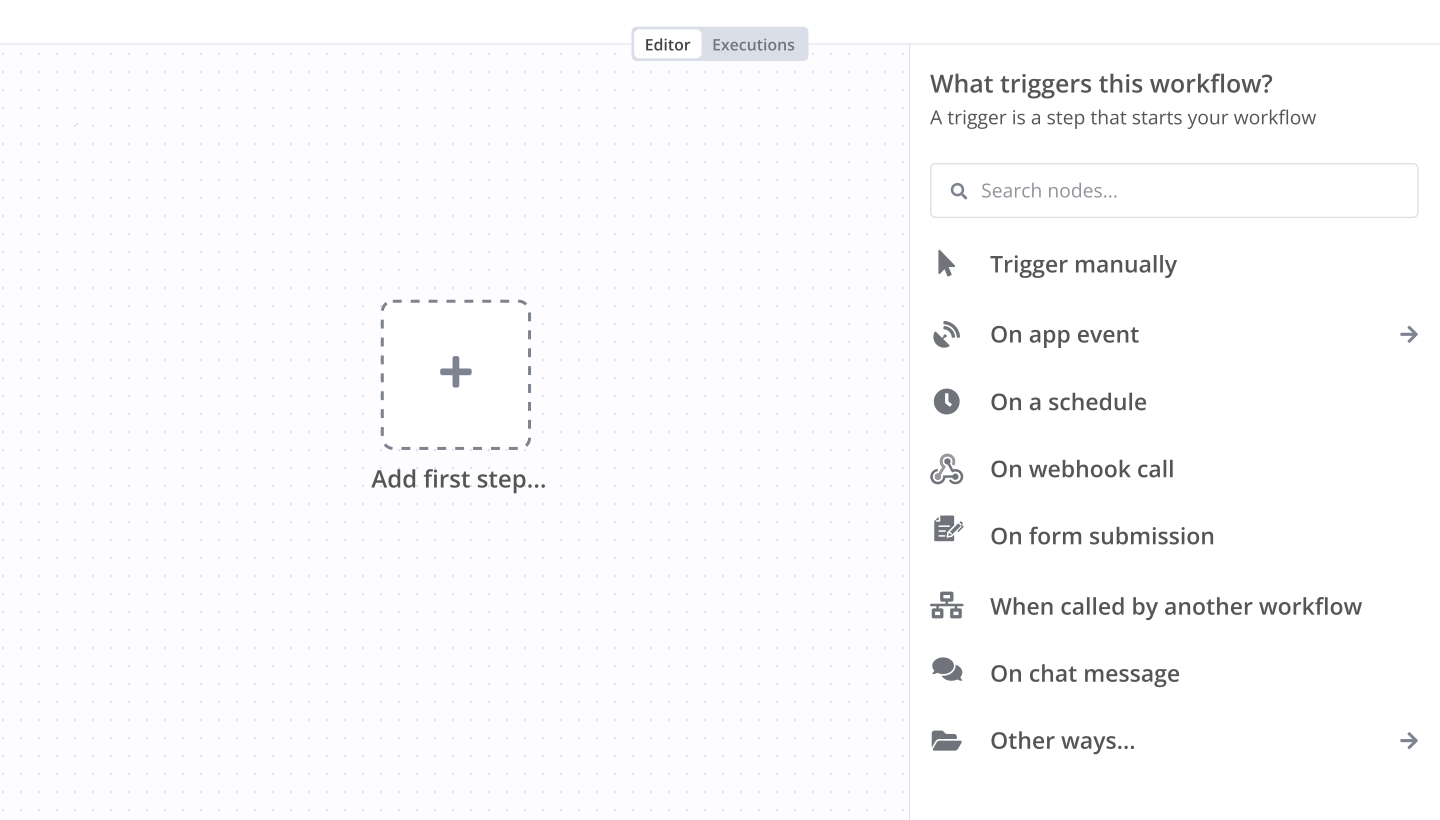
Google Drive and HubSpot integration: Create a new workflow and add the first step

Step 2: Add and configure Google Drive and HubSpot nodes

You can find Google Drive and HubSpot in the nodes panel. Drag them onto your workflow canvas, selecting their actions. Click each node, choose a credential, and authenticate to grant n8n access. Configure Google Drive and HubSpot nodes one by one: input data on the left, parameters in the middle, and output data on the right.

Google Drive and HubSpot integration: Add and configure Google Drive and HubSpot nodes

Step 3: Connect Google Drive and HubSpot

A connection establishes a link between Google Drive and HubSpot (or vice versa) to route data through the workflow. Data flows from the output of one node to the input of another. You can have single or multiple connections for each node.

Google Drive and HubSpot integration: Connect Google Drive and HubSpot

Step 4: Customize and extend your Google Drive and HubSpot integration

Use n8n's core nodes such as If, Split Out, Merge, and others to transform and manipulate data. Write custom JavaScript or Python in the Code node and run it as a step in your workflow. Connect Google Drive and HubSpot with any of n8n’s 1000+ integrations, and incorporate advanced AI logic into your workflows.

Google Drive and HubSpot integration: Customize and extend your Google Drive and HubSpot integration

Step 5: Test and activate your Google Drive and HubSpot workflow

Save and run the workflow to see if everything works as expected. Based on your configuration, data should flow from Google Drive to HubSpot or vice versa. Easily debug your workflow: you can check past executions to isolate and fix the mistake. Once you've tested everything, make sure to save your workflow and activate it.

Google Drive and HubSpot integration: Test and activate your Google Drive and HubSpot workflow

Automate employee onboarding with Slack, Jira, and Google Workspace integration

Who is this for?

This template is ideal for HR teams, startup founders, operations leads, remote-first companies, and freelancers managing onboarding manually or across multiple tools.

Whether you’re hiring your first intern or streamlining onboarding for dozens of new team members, this workflow automates the entire trigger → task creation → onboarding delivery process using no-code tools connected via n8n.

What problem does this solve?

Employee onboarding is often fragmented and error-prone — involving Jira tasks, Slack DMs, file sharing, and email templates spread across different apps.

This workflow connects it all, letting you create tasks, notify people, share folders, and message hires instantly — right when they’re marked as “Hired” in a Google Sheet or added to Slack.

No more bouncing between 5 tabs. This is onboarding as a system.

What this workflow does

✅ Watches a Google Sheet (or Slack trigger) for new hires
📋 Creates a Jira onboarding Epic with role-based subtasks
📂 Generates a Google Drive folder and shares it with the new hire
📬 Sends a personalized, HTML-formatted welcome email via Gmail
💬 Posts a Slack message in the #onboarding channel + DM to the hire
📊 Logs onboarding activity back to the Sheet (status, links, etc.)
🔁 Modular subtasks based on role/team (e.g. Dev vs Marketing vs Student)
🧠 Expressions, fallback logic, and Slack→Jira user ID mapping built-in

Setup

Create API credentials for:
Slack
Google Sheets
Google Drive
Jira Cloud
Gmail (API or SMTP)

Import the .json workflow into your n8n instance (Cloud or self-hosted)
Replace placeholder values (e.g. Project ID, Issue Type ID, folder path)
Customize onboarding messages, email HTML, and task logic
Test with included mock data (sample hire, Slack user, Jira user)
Activate your flow and start onboarding with one click

🗒 Color-coded workflow notes

This workflow uses Innovatio’s sticky note system to guide you visually:

🟩 Green Notes → Main automation steps
🟦 Blue Notes → What to customize (IDs, prompts, expressions)
🟨 Yellow Notes → Optional logic and future upgrades
🟫 Gray Notes → Welcome + final “next steps” CTA

Every group includes pre-filled nodes, dynamic expressions, and mock outputs so you can test quickly and scale confidently.

How to customize this workflow?

📂 Swap Google Sheets for Airtable (better for teams or approvals)
📅 Add 30/60/90-day check-ins via Google Calendar
🤖 Plug in OpenAI to generate onboarding subtasks by role
📬 Auto-assign mentors or SlackBot reminders after 7 days
📊 Push Sheet logs into Notion or your HR dashboard

Need custom logic? Email me at [email protected]

Final notes

This template was created by Velebit from Innovatio with modularity, scalability, and team experience in mind.

All links included are official. No affiliate tracking, no sponsored content.

📜 A separate commercial license applies to the purchase via Gumroad, which includes extended rights, usage for client work, and scaling strategies.

Nodes used in this workflow

Popular Google Drive and HubSpot workflows

+6

Automate Lead Intelligence & Outreach with GPT-4o, LinkedIn, HubSpot & Outlook

AI Lead Intelligence & Outreach: Verified Emails, HubSpot Sync & Outlook Drafts Who is this for? This workflow is designed for sales/RevOps teams, B2B founders, SDR/AE teams, and agencies who live in HubSpot and need consistent, compliant first-touch outreach at scale. If you regularly build reusable, multi-client n8n automations, this template will save you hours of manual work. What problem is this workflow solving? / Use case Manual lead handling is slow and inconsistent: Leads arrive messy across forms, lists, and imports; ownership and priority are unclear. Finding the right decision-maker and a deliverable email takes too long. Outreach copy drifts from brand guidelines, and CRM updates get missed. This workflow solves the problem by creating a reliable pipeline from capture → enrichment → verification → CRM sync → Outlook draft, cutting handoffs and preserving auditability. What this workflow does Capture and batching - Triggers on new/updated leads in HubSpot or pulls "ready" rows from Google Sheets; processes items sequentially to stay rate-safe. Normalize and score (ICP) - Cleans names, company, and domains; applies configurable ICP rules and writes score plus reasoning back to HubSpot/Sheets. Enrich contacts - Confirms official company details and identifies likely decision-makers via focused people searches; dedupes and role-normalizes. Verify emails - Finds work emails, checks deliverability, and logs confidence and timestamps to a tracking sheet immediately after each result. Compose outreach - Calls the approved template in Email content; personalizes only the first name; validates structure via Structured Output Parser. Draft in Outlook - Uses Microsoft Graph to create an HTML draft; embeds an inline signature image fetched from Google Drive. CRM sync and tasks - Creates/updates HubSpot contacts and associations, stores the composed email in properties, and opens a next-day follow-up task for the owner. Safety and observability - Deterministic prompts, strict parsing, idempotent writes, and clear flags prevent duplicates; optional Slack/Teams alerts for failures. Setup Connect your accounts: HubSpot (app token) Microsoft Graph (OAuth2) Google Sheets Google Drive Your LLM provider (for Level 2 Orchestrator and Email content) Set your credentials in the respective nodes. Adjust the Google Sheet IDs to match your own sheet structure. Map HubSpot properties (owner, contact/company IDs, custom fields for score, reasoning, and email content). Paste your approved HTML in Email content and upload your signature image to Drive. Configure schedule, batch size, and any Slack/Teams webhooks for notifications. How to customize this workflow to your needs ICP logic**: Edit scoring weights and required qualifiers (industry, region, size, tech stack). Personas**: Change role detection and caps (e.g., Ops, Finance, Procurement). Copy control**: Swap the template in Email content or add A/B variants while keeping structure validation. Triggers**: Use webhook capture from forms, list-based pulls, or time-based recrawls. Delivery**: Switch the mail node to Gmail API if preferred; keep the same compose/verify/track sequence. Governance**: Add holdouts, opt-out checks, and rate limits per domain or owner; expand logs for export to a data warehouse. ✨ With this workflow, you go from messy inbound leads → verified contacts → synchronized HubSpot records → ready-to-send Outlook drafts in just minutes, with almost no manual work. Need help customizing? Contact me for consulting and support: click here
+3

Automate Employee Onboarding with Slack, Jira, and Google Workspace Integration

Who is this for? This template is ideal for HR teams, startup founders, operations leads, remote-first companies, and freelancers managing onboarding manually or across multiple tools. Whether you’re hiring your first intern or streamlining onboarding for dozens of new team members, this workflow automates the entire trigger → task creation → onboarding delivery process using no-code tools connected via n8n. What problem does this solve? Employee onboarding is often fragmented and error-prone — involving Jira tasks, Slack DMs, file sharing, and email templates spread across different apps. This workflow connects it all, letting you create tasks, notify people, share folders, and message hires instantly — right when they’re marked as “Hired” in a Google Sheet or added to Slack. No more bouncing between 5 tabs. This is onboarding as a system. What this workflow does ✅ Watches a Google Sheet (or Slack trigger) for new hires 📋 Creates a Jira onboarding Epic with role-based subtasks 📂 Generates a Google Drive folder and shares it with the new hire 📬 Sends a personalized, HTML-formatted welcome email via Gmail 💬 Posts a Slack message in the #onboarding channel + DM to the hire 📊 Logs onboarding activity back to the Sheet (status, links, etc.) 🔁 Modular subtasks based on role/team (e.g. Dev vs Marketing vs Student) 🧠 Expressions, fallback logic, and Slack→Jira user ID mapping built-in Setup Create API credentials for: Slack Google Sheets Google Drive Jira Cloud Gmail (API or SMTP) Import the .json workflow into your n8n instance (Cloud or self-hosted) Replace placeholder values (e.g. Project ID, Issue Type ID, folder path) Customize onboarding messages, email HTML, and task logic Test with included mock data (sample hire, Slack user, Jira user) Activate your flow and start onboarding with one click 🗒 Color-coded workflow notes This workflow uses Innovatio’s sticky note system to guide you visually: 🟩 Green Notes → Main automation steps 🟦 Blue Notes → What to customize (IDs, prompts, expressions) 🟨 Yellow Notes → Optional logic and future upgrades 🟫 Gray Notes → Welcome + final “next steps” CTA Every group includes pre-filled nodes, dynamic expressions, and mock outputs so you can test quickly and scale confidently. How to customize this workflow? 📂 Swap Google Sheets for Airtable (better for teams or approvals) 📅 Add 30/60/90-day check-ins via Google Calendar 🤖 Plug in OpenAI to generate onboarding subtasks by role 📬 Auto-assign mentors or SlackBot reminders after 7 days 📊 Push Sheet logs into Notion or your HR dashboard Need custom logic? Email me at [email protected] Final notes This template was created by Velebit from Innovatio with modularity, scalability, and team experience in mind. All links included are official. No affiliate tracking, no sponsored content. 📜 A separate commercial license applies to the purchase via Gumroad, which includes extended rights, usage for client work, and scaling strategies.

Automate Contact Enrichment with Surfe, Google Sheets & HubSpot

This template enables fully automated lead enrichment using Surfe’s bulk API. Simply drop a Google Spreadsheet into your Google Drive, and n8n will handle everything — from reading the leads, enriching them in batches, filtering valid data, and pushing results to HubSpot. ❓ What Problem Does This Solve? Manually enriching contact lists is tedious, error-prone, and doesn’t scale. Whether you’re importing leads from events, marketing forms, or partners, this workflow ensures each record is enriched and synced to your CRM — hands-free. 🧰 Prerequisites To use this template, you’ll need: A self-hosted or cloud instance of n8n A Surfe API Key A Google Drive and Sheets account (with OAuth or service account) A HubSpot account with access to create/update contacts (via OAuth or Private App Token) The workflow JSON file (included with this tutorial) 📌 Input File Format To run the automation, you must upload a Google Spreadsheet to a specific folder in your Drive. The spreadsheet must contain the following columns: first name (required) last name (required) Either company name or company domain (at least one is required) linkedin url (optional) 🛑 Important: Any row missing first name, last name, and both company name and company domain will be ignored automatically by the workflow. Each row represents a person to enrich. We recommend including the linkedin url if available, but it's not mandatory. ⚙️ Setup Instructions 4.1 🔐 Create Your Credentials in n8n 4.1.1 📁 Google Drive To connect Google Drive and Google Sheets in your workflow, you need to authorize n8n via Google OAuth 2.0 using a Client ID and Client Secret from the Google Cloud Console. 📋 Step 1: Create a Google Cloud Project Visit Google Cloud Console Create a new project or select an existing one Navigate to APIs & Services → OAuth consent screen ⚙️ Step 2: Configure the OAuth Consent Screen Enter the following: App name (e.g. n8n Integration) User support email Choose Audience Type: Internal if you’re using a Google Workspace account External if using a personal Gmail account Under Contact information email address Click Save and Continue 🔑 Step 3: Create OAuth Client Credentials Go to APIs & Services → Credentials Click + Create Credentials → OAuth Client ID Select Web application as the application type Name it (e.g. n8n Google Drive Access) In Authorized redirect URIs, paste this: https://oauth.n8n.cloud/oauth2/callback (Or your self-hosted n8n redirect URI) Click Create Copy the Client ID and Client Secret ✅ Step 4: Finish Setup in n8n In n8n, go to Credentials → Create New → Google Drive / Google Sheets Choose OAuth2 Paste your: Client ID Client Secret Redirect URL (should match Google Console) Click Sign in with Google Authorize access and save the credential ✅ Your Google Drive is now ready to use in workflows. 4.1.2 📊 Google Sheets OAuth2 API Go to n8n → Credentials Create new credentials: Type: Google Sheets OAuth2 API Here a pop-up will open where you can login to your Google account from where you will read the Google Sheets When it’s done you should see this on n8n 4.1.3 📧 Gmail OAuth2 API Go to n8n → Credentials Create new credentials: Type: Gmail OAuth2 API A pop-up window will appear where you can log in with your Google account that is linked to Gmail Make sure you grant email send permissions when prompted 4.1.4 🚀 Surfe API In your Surfe dashboard → Use Surfe Api → copy your API key Go to n8n → Credentials → Create Credential Choose Credential Type: Bearer Auth Name it something like SURFE API Key Paste your API key into the Bearer Token Save 4.1.5 🎯 HubSpot 🔓 Private App Token Go to HubSpot → Settings → Integrations → Private Apps Create an app with scopes: crm.objects.contacts.read crm.objects.contacts.write crm.schemas.contacts.read Save the App token Go to n8n → Credentials → Create Credential → HubSpot App Token Paste your App Token ✅ You are now all set for the credentials 4.2 📥 Import and Configure the N8N Workflow Import the provided JSON workflow into N8N Create a New Blank Workflow click the … on the top left Import from File 4.2.1 🔗 Link Nodes to Your Credentials In the workflow, link your newly created credentials to each node of this list : Google Drive Node -> Credentials to connect with → Google Drive Account Google Sheets -> Credentials to connect with → Google Sheets Account Gmail Node Credentials to connect with → Gmail account Hubspot Node →Credentials to connect with → Gmail account Surfe HTTP nodes: Authentication → Generic Credential Type Generic Auth Type → Bearer Auth Bearer Auth → Select the credentials you created before Surfe HTTP nodes Surfe HTTP nodes HubSpot node → Credentials to connect with → select your HubSpot credentials in the list 4.2.2 🔧 Additional Setup for the Google Drive Trigger Node 🔄 How This N8N Workflow Works A new Google Sheet containing a linkedin_url column is added to a specific folder in Google Drive n8n detects the new file automatically via the Google Drive Trigger All rows are read and batched in groups of 500 to comply with Surfe’s API limits Each batch is sent to Surfe’s Bulk Enrichment API n8n polls Surfe until the enrichment job is complete It extracts the enriched contact data from Surfe’s response Only contacts with both email and phone number are kept These validated leads are pushed to HubSpot Finally, a Gmail notification is sent to confirm the job is complete 🧩 Use Cases Post-event contact enrichment** – After a trade show, upload a list of LinkedIn profile URLs from badge scans or lead capture forms Outbound LinkedIn campaign follow-ups** – Gather LinkedIn URLs from manual outreach and enrich them into usable CRM leads CRM data enhancement** – Use LinkedIn URLs to fill in missing contact info for existing or imported contacts List building from LinkedIn exports** – Upload a list of LinkedIn profiles (e.g. from Sales Navigator) and turn them into fully enriched contacts in HubSpot 🛠 Customization Ideas 🔁 Add retry logic for failed Surfe enrichment jobs 📤 Log enriched contacts into a Google Sheet or Airtable 🔍 Add pre-check logic to avoid creating duplicates in HubSpot 📊 Extend the flow to generate a basic summary report of enriched vs rejected contacts ✅ Summary This workflow turns a basic Google Sheet of LinkedIn URLs into fully enriched, CRM-ready contacts — automatically synced with HubSpot. Just upload your file. Let Surfe do the rest.

Create and send AI sales proposals using Gemini, Google Docs & Gmail

How it works This workflow automatically generates and sends personalized sales proposals when a new row is added to Google Sheets. It uses AI to create proposal content, updates contact details in HubSpot, and generates a formatted document. The document is converted into a PDF and emailed to the client. This eliminates manual proposal writing and ensures fast, consistent delivery. Step-by-step Capture lead and generate AI content** Google Sheets Trigger – Detects new form submissions in your sheet. Loop Over Items – Processes each new entry individually. Message a model – Uses Gemini AI to generate the proposal content. Code in JavaScript – Cleans and splits AI output into structured fields. Create contact and generate document** Create or update a contact – Stores or updates client data in HubSpot. Copy file – Duplicates a proposal template from Google Drive. Update a document – Replaces placeholders with real client and AI data. Download file – Converts the final document into a PDF file. Send proposal to client** Send a message – Emails the generated PDF proposal to the client. Why use this? Automatically generates professional proposals without manual writing Ensures consistent formatting using templates and placeholders Saves time by combining CRM, AI, and document creation Improves response speed for leads and increases conversion chances Scales easily for handling multiple client requests simultaneously

Screen and score resumes from Gmail with PDF parsing, HubSpot, Slack and PostgreSQL

Talent Sovereign: AI-Powered Resume Screener & Recruitment Hub 🎯 Description This is an elite enterprise-grade solution for Talent Acquisition and HR Ops teams. It automates the high-volume task of resume screening by transforming unstructured PDF applications into structured candidate profiles. Leveraging an advanced PDF-to-JSON parsing engine and a multi-factor scoring algorithm, it ensures only the highest-quality candidates reach your CRM while maintaining a professional feedback loop for all applicants. ✨ The Sovereign Lifecycle Intelligent Intake & Validation - Monitors Gmail for new submissions. A pre-validation layer ensures only healthy PDF binaries under 10MB enter the stream, filtering out noise and irrelevant attachments. Atomic Data Extraction - Utilizes the HTML to PDF (Parse PDF to JSON) node to decompose resumes into structured text data. Advanced AI Resume Parser - A sophisticated Code Node acts as a virtual Recruiter. It extracts contact info, LinkedIn URLs, and maps 45+ specific skills across 7 categories (Programming, Cloud, Data, etc.). It even calculates "Total Years of Experience" by analyzing date ranges within the text. Multi-Factor Scoring & Tiering - Candidates are automatically ranked on a 100-point scale: A+ Tier (90+): Exceptional talent; priority alerts. Qualified (70+): Standard qualified candidates. Below Threshold: Automatically prepared for the rejection track. Smart Routing Matrix - Green Track: Qualified leads are created in HubSpot CRM, archived in a "Qualified" Google Drive folder, and announced via Slack. Red Track: Unqualified candidates receive a personalized Gmail rejection including constructive feedback on skills they could improve. Closed-Loop Analytics - Logs every data point to PostgreSQL, calculating funnel metrics such as skill-match percentages and processing latency for continuous hiring strategy optimization. 💡 Key Technical Features Heuristic Skill Detection:** Uses NLP pattern matching to identify technical competencies even if they are phrased differently. Personalized Rejection Engine:** Automatically suggests specific skill areas (e.g., Cloud or Certifications) for candidates to work on based on what was missing from their resume. Forensic Archival:** Maintains a clean, searchable archive of all applicants in a hierarchical cloud structure. 🚀 Benefits ✅ 90% Faster Screening - Moves from manual reading to high-level candidate oversight instantly. ✅ Professional Employer Brand - Ensures every applicant receives a timely, personalized response. ✅ Data-Driven Hiring - Track exactly which sources and skill sets are performing best in your funnel. Tags: #recruitment #hr-tech #resume-parser #ai #hubspot #automation #pdf-to-json Category: Human Resources | Difficulty: Advanced

Secure and classify legal documents with OpenAI, Airtable and HTML to PDF

Enterprise Legal Vault: AI Classification & Multi-Jurisdictional Security 🎯 Description This enterprise-grade legal document management system provides end-to-end automation for securing, classifying, and managing the lifecycle of sensitive documents. It is designed to handle high-stakes data across multiple jurisdictions (GDPR, CCPA, HIPAA) with AI-powered intelligence. ✨ What This Workflow Does Intelligent Intake & Deduplication - Monitors Google Drive, Email, and Webhooks. It uses SHA-256 fingerprinting to ensure every document is unique and to prevent redundant processing. AI-Powered Analysis Engine - Utilizes OpenAI/Claude to classify documents (NDA, MSA, Employment Agreements), detect jurisdiction, and assign a composite Risk Score (1-100). Dynamic Security Enforcement - Translates business rules from Airtable into technical enforcement using the HTML to PDF (Lock) node: Ultra-High Risk (90+): AES-256 encryption with disabled Print, Copy, and Modify permissions. High Risk (50-89): AES-128 encryption with dynamic recipient-specific watermarking. Public Filings: Timestamped watermarking with no encryption. Lifecycle & Retention Automation - Automatically calculates retention expiry dates based on legal requirements. It sets Google Calendar renewal reminders at 90, 60, and 30-day intervals. Intelligent Distribution Matrix - Verified: Attached to HubSpot Deals and synced to Dropbox client folders. Review: Flagged items are sent to a manual review queue with a Slack preview. Failed: Isolated in a Quarantine folder with incident logging in Airtable. 💡 Key Features Jurisdictional Logic:** Automatically adapts security and retention rules based on regional laws fetched from Airtable. Forensic Watermarking:** Embeds tracking data (User ID, Timestamp) to deter and identify data leaks. Fail-Safe Quarantine:** Prevents unverified or risky documents from ever entering the primary company storage. 📦 Requirements HTML to PDF Node* - Essential for tiered Lock* operations. Airtable** - Acts as the central "Business Rules Engine." Google Drive & HubSpot** - For storage and CRM synchronization. OpenAI/Claude API** - For document classification and risk assessment. 🚀 Benefits ✅ Zero Manual Security Setup - Documents are locked according to corporate policy the moment they are uploaded. ✅ Regulatory Compliance - Meets strict GDPR "Right to be Forgotten" and data localization standards automatically. ✅ Proactive Risk Management - High-liability clauses and auto-renewals are flagged instantly to the legal team. Tags: #legal #compliance #pdf-lock #encryption #gdpr #sec-ops #hubspot #airtable Category: Legal & Compliance Difficulty: Advanced

Build your own Google Drive and HubSpot integration

Create custom Google Drive and HubSpot workflows by choosing triggers and actions. Nodes come with global operations and settings, as well as app-specific parameters that can be configured. You can also use the HTTP Request node to query data from any app or service with a REST API.

Google Drive supported actions

Copy
Create a copy of an existing file
Create From Text
Create a file from a provided text
Delete
Permanently delete a file
Download
Download a file
Move
Move a file to another folder
Share
Add sharing permissions to a file
Update
Update a file
Upload
Upload an existing file to Google Drive
Search
Search or list files and folders
Create
Create a folder
Delete
Permanently delete a folder
Share
Add sharing permissions to a folder
Create
Create a shared drive
Delete
Permanently delete a shared drive
Get
Get a shared drive
Get Many
Get the list of shared drives
Update
Update a shared drive

HubSpot supported actions

Create
Create a company
Delete
Delete a company
Get
Get a company
Get Many
Get many companies
Get Recently Created/Updated
Get recently created/updated companies
Search
Search companies by their website domain
Update
Update a company
Create or Update
Create a new contact, or update the current one if it already exists (upsert)
Delete
Delete a contact
Get
Get a contact
Get Many
Get many contacts
Get Recently Created/Updated
Get recently created/updated contacts
Search
Search contacts
Add
Add contact to a list
Remove
Remove a contact from a list
Create
Create a deal
Delete
Delete a deal
Get
Get a deal
Get Many
Get many deals
Get Recently Created/Updated
Get recently created/updated deals
Search
Search deals
Update
Update a deal
Create
Create an engagement
Delete
Delete an engagement
Get
Get an engagement
Get Many
Get many engagements
Create
Create a ticket
Delete
Delete a ticket
Get
Get a ticket
Get Many
Get many tickets
Update
Update a ticket

FAQs

  • Can Google Drive connect with HubSpot?

  • Can I use Google Drive’s API with n8n?

  • Can I use HubSpot’s API with n8n?

  • Is n8n secure for integrating Google Drive and HubSpot?

  • How to get started with Google Drive and HubSpot integration in n8n.io?

Need help setting up your Google Drive and HubSpot integration?

Discover our latest community's recommendations and join the discussions about Google Drive and HubSpot integration.
hubschrauber
Jon
David O'Neil

Looking to integrate Google Drive and HubSpot in your company?

Over 3000 companies switch to n8n every single week

Why use n8n to integrate Google Drive with HubSpot

Build complex workflows, really fast

Build complex workflows, really fast

Handle branching, merging and iteration easily.
Pause your workflow to wait for external events.

Code when you need it, UI when you don't

Simple debugging

Your data is displayed alongside your settings, making edge cases easy to track down.

Use templates to get started fast

Use 1000+ workflow templates available from our core team and our community.

Reuse your work

Copy and paste, easily import and export workflows.

Implement complex processes faster with n8n

red iconyellow iconred iconyellow icon