Back to Integrations
integrationGoogle Drive node
integrationS3 node

Google Drive and S3 integration

Save yourself the work of writing custom integrations for Google Drive and S3 and use n8n instead. Build adaptable and scalable Data & Storage, and Development workflows that work with your technology stack. All within a building experience you will love.

How to connect Google Drive and S3

  • Step 1: Create a new workflow
  • Step 2: Add and configure nodes
  • Step 3: Connect
  • Step 4: Customize and extend your integration
  • Step 5: Test and activate your workflow

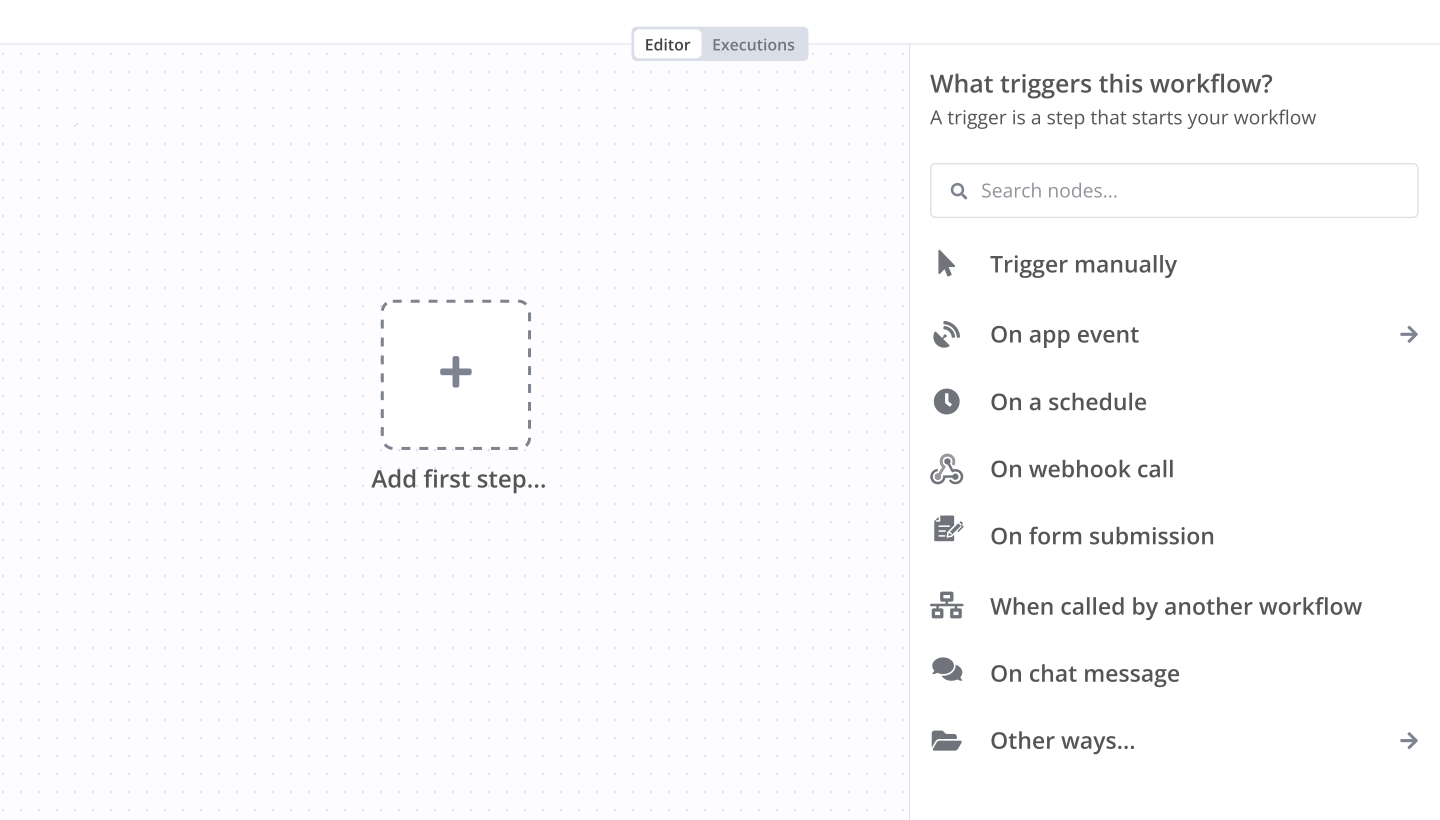
Step 1: Create a new workflow and add the first step

In n8n, click the "Add workflow" button in the Workflows tab to create a new workflow. Add the starting point – a trigger on when your workflow should run: an app event, a schedule, a webhook call, another workflow, an AI chat, or a manual trigger. Sometimes, the HTTP Request node might already serve as your starting point.

Google Drive and S3 integration: Create a new workflow and add the first step

Step 2: Add and configure Google Drive and S3 nodes

You can find Google Drive and S3 in the nodes panel. Drag them onto your workflow canvas, selecting their actions. Click each node, choose a credential, and authenticate to grant n8n access. Configure Google Drive and S3 nodes one by one: input data on the left, parameters in the middle, and output data on the right.

Google Drive and S3 integration: Add and configure Google Drive and S3 nodes

Step 3: Connect Google Drive and S3

A connection establishes a link between Google Drive and S3 (or vice versa) to route data through the workflow. Data flows from the output of one node to the input of another. You can have single or multiple connections for each node.

Google Drive and S3 integration: Connect Google Drive and S3

Step 4: Customize and extend your Google Drive and S3 integration

Use n8n's core nodes such as If, Split Out, Merge, and others to transform and manipulate data. Write custom JavaScript or Python in the Code node and run it as a step in your workflow. Connect Google Drive and S3 with any of n8n’s 1000+ integrations, and incorporate advanced AI logic into your workflows.

Google Drive and S3 integration: Customize and extend your Google Drive and S3 integration

Step 5: Test and activate your Google Drive and S3 workflow

Save and run the workflow to see if everything works as expected. Based on your configuration, data should flow from Google Drive to S3 or vice versa. Easily debug your workflow: you can check past executions to isolate and fix the mistake. Once you've tested everything, make sure to save your workflow and activate it.

Google Drive and S3 integration: Test and activate your Google Drive and S3 workflow

Hacker News to video content

Hacker News to Video Content

Overview
This workflow converts trending articles from Hacker News into engaging video content. It integrates AI-based tools to analyze, summarize, and generate multimedia content, making it ideal for content creators, educators, and marketers.

Features
Article Retrieval:
Pulls trending articles from Hacker News.
Limits the number of articles to process (configurable).

Content Analysis:
Uses OpenAI's GPT model to:
Summarize articles.
Assess their relevance to specific topics like automation or AI.
Extract key image URLs.

Image and Video Generation:
Leonardo.ai: Creates stunning AI-generated images based on extracted prompts.
RunwayML: Converts images into high-quality videos.

Structured Content Creation:
Parses content into structured formats for easy reuse.
Generates newsletter-friendly blurbs and social media-ready captions.

Cloud Integration:
Uploads generated assets to:
Dropbox
Google Drive
Microsoft OneDrive
MinIO

Social Media Posting (Optional):
Supports posting to YouTube, X (Twitter), LinkedIn, and Instagram.

Workflow Steps

  1. Trigger
    Initiated manually via the "Test Workflow" button.

  2. Fetch Articles
    Retrieves articles from Hacker News.
    Limits the results to avoid processing overload.

  3. Content Filtering
    Evaluates if articles are related to AI/Automation using OpenAI's language model.

  4. Image and Video Generation
    Generates:
    AI-driven image prompts via Leonardo.ai.
    Videos using RunwayML.

  5. Asset Management
    Saves the output to cloud storage services or uploads directly to social media platforms.

Prerequisites

API Keys**:
Hacker News
OpenAI
Leonardo.ai
RunwayML
Creatomate

n8n Installation**:
Ensure n8n is installed and configured locally or on a server.

Credentials**:
Set up credentials in n8n for all external services used in the workflow.

Customization
Replace Hacker News with any other data source node if needed.
Configure the "Article Analysis" node for different topics.
Adjust the cloud storage services or add custom storage options.

Usage
Import this workflow into your n8n instance.
Configure your API credentials.
Trigger the workflow manually or schedule it as needed.
Check the outputs in your preferred cloud storage or social media platform.

Notes
Extend this workflow further by automating social media posting or newsletter integration.
For any questions, refer to the official documentation or reach out to the creator.

About the Creator
This workflow was built by AlexK1919, an AI-native workflow automation architect. Check out the overview video for a quick demo.

Tools Used
Leonardo.ai**
RunwayML**
Creatomate**
Hacker News API**
OpenAI GPT**

Feel free to adapt and extend this workflow to meet your specific needs! 🎉

Nodes used in this workflow

Popular Google Drive and S3 workflows

+2

Expense Organizer with Google Drive Routing and Gemini AI Entity Detection

Who's it for This workflow is perfect for individuals, small businesses, or households who need to: Automatically process and categorize expense receipts Extract structured data from invoices and receipts using AI Store receipts in multiple locations (Google Drive and S3) Send automated email notifications with expense details Send documents to accounting systems via email hooks How it works This comprehensive expense processing workflow combines AI-powered document analysis with automated file management and notifications. Here's the complete flow: Form Submission: Users submit expenses through a web form with receipt upload and category selection (Personal, Business, or Shared/Home) AI Document Processing: The workflow extracts text from PDF receipts using OCR, then uses Google Gemini AI to parse and structure the data into a standardized JSON format including vendor details, amounts, dates, and categorization Smart Routing: Based on the expense category, receipts are automatically routed to different processing paths with category-specific folder organization Multi-Destination Storage: Receipts are uploaded to: Google Drive (organized by year/month folders) S3 cloud storage buckets Different destinations based on expense type Email Notifications: Sends formatted HTML email notifications with complete expense details and links to stored receipts Accounting System Integration: Automatically forwards business expenses to accounting systems via email hooks (customizable per user requirements) Requirements Credentials needed: Google Gemini API**: For AI-powered document analysis Google Drive OAuth2**: For personal and business drive access Gmail OAuth2**: For sending email notifications S3 Storage**: For cloud backup (AWS S3, Wasabi, etc.) Services used: Google Drive (multiple accounts supported) Google Gemini AI Gmail S3-compatible storage Form trigger webhook How to set up Step 1: Configure Credentials Set up Google Gemini API credentials in n8n Configure Google Drive OAuth2 for both personal and business accounts Add Gmail OAuth2 credentials Set up S3 storage credentials Step 2: Update Configuration Replace all placeholder values: YOUR_GEMINI_CREDENTIAL_ID with your Gemini credential ID YOUR_PERSONAL_GDRIVE_CREDENTIAL_ID with personal Drive credential YOUR_BUSINESS_GDRIVE_CREDENTIAL_ID with business Drive credential YOUR_GMAIL_CREDENTIAL_ID with Gmail credential YOUR_S3_CREDENTIAL_ID with S3 credential Update Google Drive folder structure: Replace YOUR_BUSINESS_DRIVE_ID and YOUR_SHARED_DRIVE_ID with actual drive IDs Update the JavaScript code in the three Code nodes with your actual folder mapping Configure email addresses: Replace [email protected] with your notification email Replace [email protected] with your accounting system's email hook (this is a mail hook for uploading documents to small business accounting systems - can be modified per user requirements) Update S3 bucket names: Replace business-expenses, personal-expenses, and shared-expenses with your bucket names Step 3: Set Up Folder Structure Create organized folder structures in your Google Drives: Drive Root/ ├── 2024/ │ ├── January/ │ ├── February/ │ └── ... (all months) ├── 2025/ │ ├── January/ │ └── ... (all months) └── 2026/ └── ... (all months) Step 4: Test the Workflow Activate the workflow Submit a test expense through the form Verify files are uploaded to correct locations Check email notifications are received How to customize the workflow Expense Categories Modify the form dropdown options and conditional logic to add/remove expense categories: Edit the "On form submission" node form fields Update the IF condition nodes for routing Add new processing paths as needed AI Processing Schema Customize the structured output parser schema to extract different fields: Modify the JSON schema in the "Structured Output Parser" node Update the AI system prompt for different extraction requirements Add new fields for specific business needs Storage Destinations Add or modify storage locations: Duplicate upload nodes for additional cloud services Modify folder organization logic in Code nodes Add new conditional routing for different storage rules Email Templates Customize the HTML email template: Edit the email message content in the Gmail node Add/remove expense fields in the table Modify styling and branding Folder Organization Update the JavaScript code in Code nodes to match your folder structure: Modify the CSV data with your actual folder IDs Change the date-based organization logic Add custom folder naming conventions Integration Extensions Extend the workflow with additional integrations: Add Slack notifications Connect to accounting software (QuickBooks, Xero) Integrate with expense management platforms Add approval workflows for business expenses

Generate LinkedIn Carousel Images from Text with Mistral AI & S3 Storage

AI Carousel Caption & Template Editor Workflow Overview This workflow is a caption-only carousel text generator built in n8n. It turns any raw LinkedIn post or text input into 3 short, slide-ready title + subtext captions and renders those captions onto image templates. Output is a single aggregated response with markdown image embeds and download links. Workflow Structure Input:** Chat UI trigger accepts text and optional template selection. Core AI:** Agent cleans input and returns structured JSON with 3 caption pairs. Template Rendering:** Edit Image nodes render title and subtext on chosen templates. Storage:** Rendered images uploaded to S3. Aggregate Output:** Aggregate node builds final markdown response with embeds and download links. Chat Trigger (Frontend) Trigger:** When chat message received UI accepts plain text post. allowFileUploads optional for template images. SessionId preserved for context. AI Agent (Core) Node name:** AI Agent Model:** Mistral Cloud Chat Model (mistral-small-latest) Behavior:** Clean input (remove stray formatting like \n and ** but keep emojis). Produce exactly one JSON object with fields: postclean, title1, subtext1, title2, subtext2, title3, subtext3. Titles must be short (max 5 words). Subtext 1 or 2 short sentences, max 7 words per line if possible. Agent must return valid JSON to be parsed by the Structured Output Parser. Structured Output Parser Node name:** Structured Output Parser Validates agent JSON and prevents downstream errors. If parsing fails, stop and surface error. Normalize Title Nodes Nodes:** normalize title,name 1, normalize title,name 2, normalize title,name 3 (and optional 4) Map parsed output into node fields: title, subtext, safeName (safe filename for exports). Template Images Source:** Google Drive template PNGs (download via Google Drive nodes) or provided upload. Keep templates high resolution and consistent aspect ratio. Edit Image Nodes (Render Captions) Nodes:** Edit Image 1, Edit Image2, Edit Image3, Edit Image3 (or Edit Image3/Edit Image4 as available) MultiStep operations render: Title text (font, size, position) Subtext (font, size, position) This is where caption text is added to the template. Upload to S3 Nodes:** S3 Upload rendered images to bucketname using safeName filenames. Confirm public access or use signed URLs. Get S3 URLs and Aggregate Nodes:** get s3 url image 1, get s3 url image 2, get s3 url image 3, get s3 url image 4 Merge + Aggregate:** Merge1 and Aggregate collect image items. Output Format:** output format builds a single markdown message: Inline image embeds `` Download links per image. Integrations Used | Service | Purpose | Credential | |---------|---------|-----------| | Mistral Cloud | AI agent model | Mistral account | | Google Drive | Template image storage | Google Drive account | | S3 | Store rendered images and serve links | Supabase account | | n8n Core | Flow control, parsing, image editing | Native | Agent System Prompt Summary > You are a data formatter and banner caption creator. Clean the user input (remove stray newlines and markup but keep emojis). Return a single JSON object with postclean, title1/subtext1, title2/subtext2, title3/subtext3. Titles must be short (max 5 words). Subtext should be 1 to 2 short sentences, useful and value adding. Respond only with JSON. Key Features Caption only output: 3 short slide-ready caption pairs. Structured JSON output enforced by a parser for reliability. Renders captions onto image templates using Edit Image nodes. Uploads images to S3 and returns markdown embeds plus download links. Template editable: swap Google Drive background templates or upload your own. Zero guess formatting: agent must produce parseable JSON to avoid downstream failures. Summary A compact n8n workflow that converts raw LinkedIn text into a caption-only carousel with rendered images. It enforces tight caption rules, validates AI JSON, places captions on templates, uploads images, and returns a single ready-to-post markdown payload. Need Help or More Workflows? We can wire this into your account, replace templates, or customize fonts, positions, and export options. We can help you set it up for free — from connecting credentials to deploying it live. Contact: [email protected] Website: https://www.digitalbiz.tech LinkedIn: https://www.linkedin.com/company/digital-biz-tech/ You can also DM us on LinkedIn for any help.
+9

Hacker News to Video Content

Hacker News to Video Content Overview This workflow converts trending articles from Hacker News into engaging video content. It integrates AI-based tools to analyze, summarize, and generate multimedia content, making it ideal for content creators, educators, and marketers. Features Article Retrieval: Pulls trending articles from Hacker News. Limits the number of articles to process (configurable). Content Analysis: Uses OpenAI's GPT model to: Summarize articles. Assess their relevance to specific topics like automation or AI. Extract key image URLs. Image and Video Generation: Leonardo.ai: Creates stunning AI-generated images based on extracted prompts. RunwayML: Converts images into high-quality videos. Structured Content Creation: Parses content into structured formats for easy reuse. Generates newsletter-friendly blurbs and social media-ready captions. Cloud Integration: Uploads generated assets to: Dropbox Google Drive Microsoft OneDrive MinIO Social Media Posting (Optional): Supports posting to YouTube, X (Twitter), LinkedIn, and Instagram. Workflow Steps Trigger Initiated manually via the "Test Workflow" button. Fetch Articles Retrieves articles from Hacker News. Limits the results to avoid processing overload. Content Filtering Evaluates if articles are related to AI/Automation using OpenAI's language model. Image and Video Generation Generates: AI-driven image prompts via Leonardo.ai. Videos using RunwayML. Asset Management Saves the output to cloud storage services or uploads directly to social media platforms. Prerequisites API Keys**: Hacker News OpenAI Leonardo.ai RunwayML Creatomate n8n Installation**: Ensure n8n is installed and configured locally or on a server. Credentials**: Set up credentials in n8n for all external services used in the workflow. Customization Replace Hacker News with any other data source node if needed. Configure the "Article Analysis" node for different topics. Adjust the cloud storage services or add custom storage options. Usage Import this workflow into your n8n instance. Configure your API credentials. Trigger the workflow manually or schedule it as needed. Check the outputs in your preferred cloud storage or social media platform. Notes Extend this workflow further by automating social media posting or newsletter integration. For any questions, refer to the official documentation or reach out to the creator. About the Creator This workflow was built by AlexK1919, an AI-native workflow automation architect. Check out the overview video for a quick demo. Tools Used Leonardo.ai** RunwayML** Creatomate** Hacker News API** OpenAI GPT** Feel free to adapt and extend this workflow to meet your specific needs! 🎉

Compress and archive old Google Drive PDFs to AWS S3 cold storage with Slack reports

Consolidate and compress project archives for cost-optimized cloud storage 🎯 Description Optimize your cloud storage costs by using this automation to intelligently compress and migrate aging project documentation. This workflow allows you to achieve a professional data lifecycle policy by identifying "stale" files in active storage, applying high-ratio PDF compression, and migrating them to cold storage while maintaining a searchable audit trail. A critical technical feature of this template is the Luxon-based lifecycle logic. By utilizing {{ $now.minus({ months: 6 }).toISODate() }}, the workflow dynamically filters for files that haven't been modified in over half a year. It then generates a unique archive path using {{ $now.toFormat('yyyy/MM_MMM') }}, ensuring your cold storage bucket remains perfectly indexed by year and month without any manual folder creation or renaming. ✨ How to achieve automated storage optimization You can achieve an enterprise-grade archiving system by using the available tools to: Monitor and age-gate — Use the Google Drive node to list project files and a Code node to compare file metadata against a 6-month "hot storage" threshold. Compress and verify — Pass identified files through the HTML to PDF compression engine to reduce file size by up to 80% while maintaining document readability. Migrate to cold storage — Stream the compressed binary directly to AWS S3 (or a dedicated archive folder), using dynamic naming conventions for organized retrieval. Log and notify — Automatically alert the IT team via Slack upon batch completion, providing a report on the specific files migrated and the storage path used. 💡 Key features Intelligent cost reduction** — Automatically targets large, old files for compression, significantly reducing long-term "Cold Storage" billing. Dynamic indexing* — Uses Luxon* to build a chronological folder structure in the cloud, making multi-year archives easy to navigate. Integrity assurance** — The workflow ensures files meet specific age and type criteria before moving them, preventing accidental archival of active documents. 📦 What you will need Google Drive — Your "Hot" storage where active project files are kept. HTML to PDF Node — Used here for the PDF compression and optimization engine. AWS S3 — Your destination "Cold" storage for long-term archiving. Slack — For automated reporting on storage optimization status. Ready to optimize your cloud storage? Import this template, connect your credentials, and start saving on long-term data costs today.

Build your own Google Drive and S3 integration

Create custom Google Drive and S3 workflows by choosing triggers and actions. Nodes come with global operations and settings, as well as app-specific parameters that can be configured. You can also use the HTTP Request node to query data from any app or service with a REST API.

Google Drive supported actions

Copy
Create a copy of an existing file
Create From Text
Create a file from a provided text
Delete
Permanently delete a file
Download
Download a file
Move
Move a file to another folder
Share
Add sharing permissions to a file
Update
Update a file
Upload
Upload an existing file to Google Drive
Search
Search or list files and folders
Create
Create a folder
Delete
Permanently delete a folder
Share
Add sharing permissions to a folder
Create
Create a shared drive
Delete
Permanently delete a shared drive
Get
Get a shared drive
Get Many
Get the list of shared drives
Update
Update a shared drive

S3 supported actions

Create
Create a bucket
Delete
Delete a bucket
Get Many
Get many buckets
Search
Search within a bucket
Copy
Copy a file
Delete
Delete a file
Download
Download a file
Get Many
Get many files
Upload
Upload a file
Create
Create a folder
Delete
Delete a folder
Get Many
Get many folders

FAQs

  • Can Google Drive connect with S3?

  • Can I use Google Drive’s API with n8n?

  • Can I use S3’s API with n8n?

  • Is n8n secure for integrating Google Drive and S3?

  • How to get started with Google Drive and S3 integration in n8n.io?

Need help setting up your Google Drive and S3 integration?

Discover our latest community's recommendations and join the discussions about Google Drive and S3 integration.
hubschrauber
Jon
David O'Neil

Looking to integrate Google Drive and S3 in your company?

Over 3000 companies switch to n8n every single week

Why use n8n to integrate Google Drive with S3

Build complex workflows, really fast

Build complex workflows, really fast

Handle branching, merging and iteration easily.
Pause your workflow to wait for external events.

Code when you need it, UI when you don't

Simple debugging

Your data is displayed alongside your settings, making edge cases easy to track down.

Use templates to get started fast

Use 1000+ workflow templates available from our core team and our community.

Reuse your work

Copy and paste, easily import and export workflows.

Implement complex processes faster with n8n

red iconyellow iconred iconyellow icon