Back to Integrations
integrationGoogle Drive node
integrationWhatsApp Business Cloud node

Google Drive and WhatsApp Business Cloud integration

Save yourself the work of writing custom integrations for Google Drive and WhatsApp Business Cloud and use n8n instead. Build adaptable and scalable Data & Storage, Communication, and HITL workflows that work with your technology stack. All within a building experience you will love.

How to connect Google Drive and WhatsApp Business Cloud

  • Step 1: Create a new workflow
  • Step 2: Add and configure nodes
  • Step 3: Connect
  • Step 4: Customize and extend your integration
  • Step 5: Test and activate your workflow

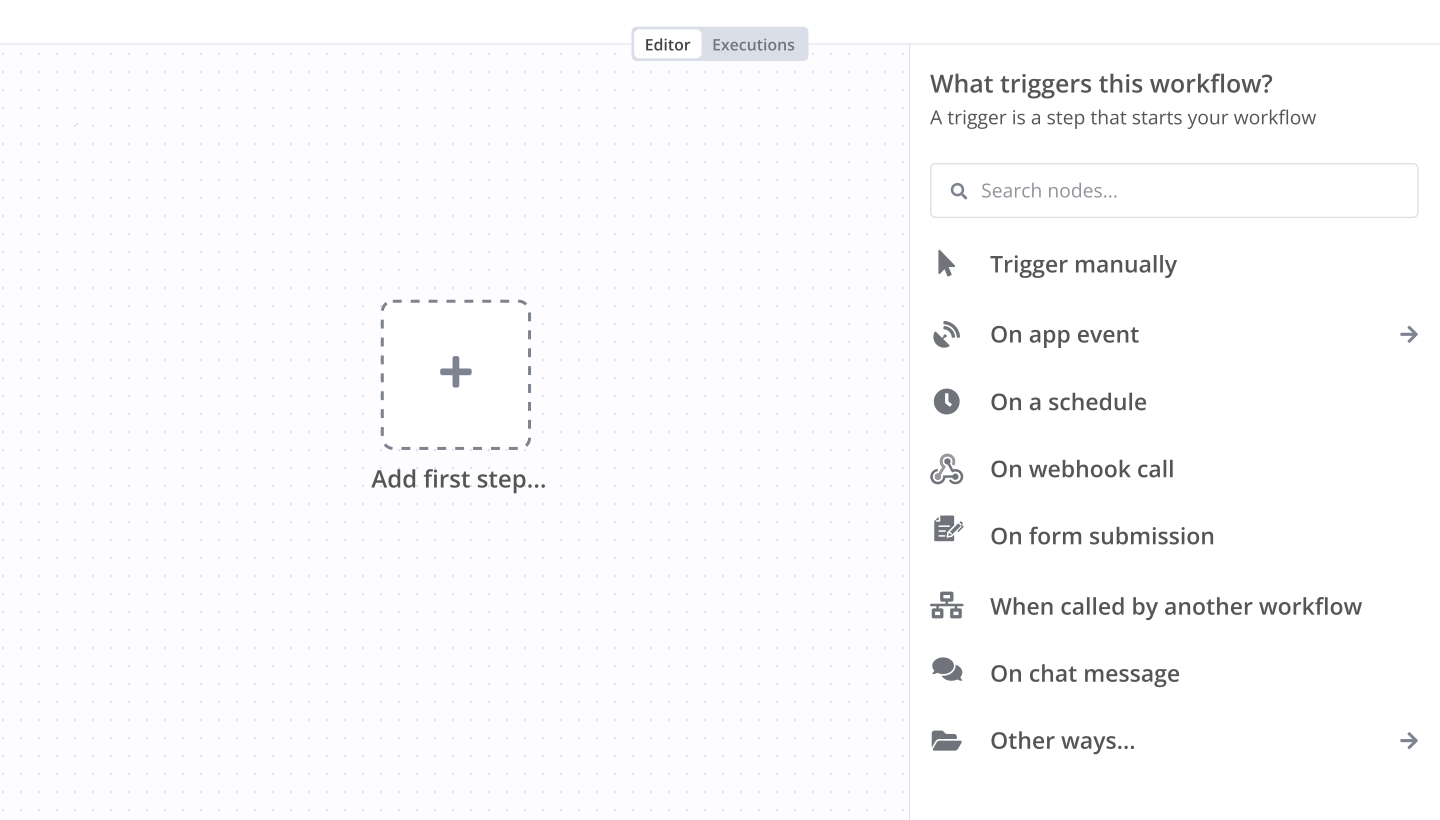
Step 1: Create a new workflow and add the first step

In n8n, click the "Add workflow" button in the Workflows tab to create a new workflow. Add the starting point – a trigger on when your workflow should run: an app event, a schedule, a webhook call, another workflow, an AI chat, or a manual trigger. Sometimes, the HTTP Request node might already serve as your starting point.

Google Drive and WhatsApp Business Cloud integration: Create a new workflow and add the first step

Step 2: Add and configure Google Drive and WhatsApp Business Cloud nodes

You can find Google Drive and WhatsApp Business Cloud in the nodes panel. Drag them onto your workflow canvas, selecting their actions. Click each node, choose a credential, and authenticate to grant n8n access. Configure Google Drive and WhatsApp Business Cloud nodes one by one: input data on the left, parameters in the middle, and output data on the right.

Google Drive and WhatsApp Business Cloud integration: Add and configure Google Drive and WhatsApp Business Cloud nodes

Step 3: Connect Google Drive and WhatsApp Business Cloud

A connection establishes a link between Google Drive and WhatsApp Business Cloud (or vice versa) to route data through the workflow. Data flows from the output of one node to the input of another. You can have single or multiple connections for each node.

Google Drive and WhatsApp Business Cloud integration: Connect Google Drive and WhatsApp Business Cloud

Step 4: Customize and extend your Google Drive and WhatsApp Business Cloud integration

Use n8n's core nodes such as If, Split Out, Merge, and others to transform and manipulate data. Write custom JavaScript or Python in the Code node and run it as a step in your workflow. Connect Google Drive and WhatsApp Business Cloud with any of n8n’s 1000+ integrations, and incorporate advanced AI logic into your workflows.

Google Drive and WhatsApp Business Cloud integration: Customize and extend your Google Drive and WhatsApp Business Cloud integration

Step 5: Test and activate your Google Drive and WhatsApp Business Cloud workflow

Save and run the workflow to see if everything works as expected. Based on your configuration, data should flow from Google Drive to WhatsApp Business Cloud or vice versa. Easily debug your workflow: you can check past executions to isolate and fix the mistake. Once you've tested everything, make sure to save your workflow and activate it.

Google Drive and WhatsApp Business Cloud integration: Test and activate your Google Drive and WhatsApp Business Cloud workflow

Complete business WhatsApp AI-powered RAG chatbot using OpenAI

The provided workflow in n8n is designed to create a Business WhatsApp AI RAG (Retrieval-Augmented Generation) Chatbot.

How it works:
Webhook Setup: The workflow begins by setting up webhooks for verification and response. The Verify webhook receives GET requests and sends back a verification code, while the Respond webhook handles incoming POST requests from Meta regarding WhatsApp messages.
Message Handling: Once a message is received, the workflow checks if the incoming JSON contains a user message. If it does, the message is processed further; otherwise, a generic response is sent.
AI Agent Interaction: The user's message is passed to the AI Agent node, which uses a conversational agent with a predefined system message tailored for an electronics store. This ensures that the AI provides accurate and professional responses based on the knowledge base.
Knowledge Base Utilization: The AI Agent references a knowledge base stored in Qdrant, a vector database. Documents from Google Drive are downloaded, vectorized using OpenAI embeddings, and stored in Qdrant for retrieval during conversations.
Response Generation: The AI Agent generates a response using the OpenAI chat model (gpt-4o-mini) and sends it back to the user via WhatsApp.

Set up steps:
Create Qdrant Collection:
Update the QDRANTURL and COLLECTION variables in the workflow.
Use the Create collection HTTP request node to initialize the collection in Qdrant.

Vectorize Documents:
Configure the Get folder and Download Files nodes to fetch documents from a specified Google Drive folder.

Use the Embeddings OpenAI node to generate embeddings for the downloaded files.
Store the vectorized documents in Qdrant using the Qdrant Vector Store node.

Configure Webhooks:
Ensure both Verify and Respond webhooks have the same URL.
Set the Verify webhook to use the GET HTTP method and the Respond webhook to use the POST HTTP method.

Set Up AI Agent:
Define the system prompt for the AI Agent, specifying guidelines for product information, technical support, customer service, and knowledge base usage.
Link the AI Agent to the OpenAI chat model and configure any additional tools as needed.

Test Workflow:
Trigger the workflow manually using the When clicking ‘Test workflow’ node to ensure all components are functioning correctly.
Monitor the flow of data through the nodes and verify that responses are being generated and sent accurately.

By following these steps, the workflow will be fully operational, enabling a robust AI-powered chatbot capable of handling customer inquiries via WhatsApp.

Need help customizing?
Contact me for consulting and support or add me on Linkedin.

Nodes used in this workflow

Popular Google Drive and WhatsApp Business Cloud workflows

+6

Complete business WhatsApp AI-Powered RAG Chatbot using OpenAI

The provided workflow in n8n is designed to create a Business WhatsApp AI RAG (Retrieval-Augmented Generation) Chatbot. How it works: Webhook Setup: The workflow begins by setting up webhooks for verification and response. The Verify webhook receives GET requests and sends back a verification code, while the Respond webhook handles incoming POST requests from Meta regarding WhatsApp messages. Message Handling: Once a message is received, the workflow checks if the incoming JSON contains a user message. If it does, the message is processed further; otherwise, a generic response is sent. AI Agent Interaction: The user's message is passed to the AI Agent node, which uses a conversational agent with a predefined system message tailored for an electronics store. This ensures that the AI provides accurate and professional responses based on the knowledge base. Knowledge Base Utilization: The AI Agent references a knowledge base stored in Qdrant, a vector database. Documents from Google Drive are downloaded, vectorized using OpenAI embeddings, and stored in Qdrant for retrieval during conversations. Response Generation: The AI Agent generates a response using the OpenAI chat model (gpt-4o-mini) and sends it back to the user via WhatsApp. Set up steps: Create Qdrant Collection: Update the QDRANTURL and COLLECTION variables in the workflow. Use the Create collection HTTP request node to initialize the collection in Qdrant. Vectorize Documents: Configure the Get folder and Download Files nodes to fetch documents from a specified Google Drive folder. Use the Embeddings OpenAI node to generate embeddings for the downloaded files. Store the vectorized documents in Qdrant using the Qdrant Vector Store node. Configure Webhooks: Ensure both Verify and Respond webhooks have the same URL. Set the Verify webhook to use the GET HTTP method and the Respond webhook to use the POST HTTP method. Set Up AI Agent: Define the system prompt for the AI Agent, specifying guidelines for product information, technical support, customer service, and knowledge base usage. Link the AI Agent to the OpenAI chat model and configure any additional tools as needed. Test Workflow: Trigger the workflow manually using the When clicking ‘Test workflow’ node to ensure all components are functioning correctly. Monitor the flow of data through the nodes and verify that responses are being generated and sent accurately. By following these steps, the workflow will be fully operational, enabling a robust AI-powered chatbot capable of handling customer inquiries via WhatsApp. Need help customizing? Contact me for consulting and support or add me on Linkedin.
+4

Answer WhatsApp Questions from PDF Documents using RAG, Google Drive and Pinecone

Good to know: This workflow creates a WhatsApp chatbot that answers questions using your own PDFs through RAG (Retrieval-Augmented Generation). Every time you upload a document to Google Drive, it is processed into embeddings and stored in Pinecone—allowing the bot to respond with accurate, context-aware answers directly on WhatsApp. Who is this for? Anyone building a custom WhatsApp chatbot. Businesses wanting a private knowledge based assistant Teams that want their documents to be searchable via chat Creators/coaches who want automated Q&A from their PDFs Developers who want a no-code RAG pipeline using n8n What problem is this workflow solving? What this workflow does: ✅ Monitors a Google Drive folder for new PDFs ✅ Extracts and splits text into chunks ✅ Generates embeddings using OpenAI/Gemini ✅ Stores embeddings in a Pinecone vector index ✅ Receives user questions via WhatsApp ✅ Retrieves the most relevant info using vector search ✅ Generates a natural response using an AI Agent ✅ Sends the answer back to the user on WhatsApp How it works: 1️⃣ Google Drive Trigger detects a new or updated PDF 2️⃣ File is downloaded and its text is split into chunks 3️⃣ Embeddings are generated and stored in Pinecone 4️⃣ WhatsApp Trigger receives a user’s question 5️⃣ The question is embedded and matched with Pinecone 6️⃣ AI Agent uses retrieved context to generate a response 7️⃣ The message is delivered back to the user on WhatsApp How to use: Connect your Google Drive account Add your Pinecone API key and index name Add your OpenAI/Gemini API key Connect your WhatsApp trigger + sender nodes Upload a sample PDF to your Drive folder Send a test WhatsApp message to see the bot reply Requirements: ✅ n8n cloud or self-hosted ✅ Google Drive account ✅ Pinecone vector database ✅ OpenAI or Gemini API key ✅ WhatsApp integration (Cloud API or provider) Customizing this workflow: 🟢 Change the Drive folder or add file-type filters 🟢 Adjust chunk size or embedding model 🟢 Modify the AI prompt for tone, style, or restrictions 🟢 Add memory, logging, or analytics 🟢 Add multiple documents or delete old vector entries 🟢 Swap the AI model (OpenAI ↔ Gemini ↔ Groq, etc.)
+12

Multi-Platform AI Sales Agent with RAG, CRM Logging & Appointment Booking

Multi-Platform AI Sales Agent with RAG, CRM Logging & Appointment Booking This workflow acts as a 24/7 sales agent, engaging leads across WhatsApp, Instagram, Facebook, Telegram, and your website. It intelligently transcribes audio messages, answers questions using a knowledge base, and uses modular sub-workflows to manage your CRM in Airtable and book appointments in Google Calendar. Who Is It For? This solution is designed for service-based businesses that require a sophisticated, multi-channel lead management and appointment booking system. Agencies, consultants, and clinics** looking to automate lead qualification and booking across text and voice messages. Sales teams** needing a robust system that separates CRM and calendar logic for easier management and scalability. Advanced n8n users** who want a powerful, agent-based framework that can be easily customized and extended. Key Features & Workflow This system is composed of a parent workflow that orchestrates the conversation and calls specialized sub-workflows (agents) to perform specific tasks. Omni-Channel Engagement:* Greets and converses with leads naturally on Website Chat, WhatsApp, Instagram, Facebook, and Telegram*. Voice Message Transcription:* Automatically transcribes incoming audio/voice notes from WhatsApp and Telegram* into text, allowing the AI to understand and respond without manual intervention. RAG-Powered Intelligence:* The AI agent draws answers from your dedicated PostgreSQL Knowledge Base (RAG)*, providing accurate information about your services, pricing, and process. A built-in tool allows you to load new knowledge documents from Google Drive. Modular CRM Agent (Sub-Workflow):* When the conversation requires CRM actions (like creating a contact or updating an opportunity), the main agent calls a dedicated Airtable CRM sub-workflow* to handle the task. Modular Calendar Agent (Sub-Workflow):* To book appointments, the main agent calls a separate Google Calendar sub-workflow*, which manages event creation, updates, and deletions. What You'll Need This workflow framework requires credentials for the following services: An AI provider (OpenAI is used for the main agent, transcription, and embeddings). PostgreSQL** database with the pgvector extension (for RAG and chat memory). Airtable** account (for the CRM sub-workflow). Google Calendar** account (for the Calendar sub-workflow). Telegram Bot** credentials. A Meta Developer Account (for WhatsApp, Instagram & Facebook). (Optional) Google Drive for loading knowledge documents. (Optional) Google Gemini for embeddings. How to Set It Up This is a modular system. You must set up the sub-workflows first. Deploy Sub-Workflows: Create two new, separate workflows using the provided templates for the CRM Agent and the Calendar Agent. Configure the credentials (Airtable, Google Calendar) within those workflows, then save and activate them. Link Sub-Workflows in Main Workflow: Return to this main workflow. In the "CRM Agent" and "Consultation Agent" tool nodes, select the new workflows you just created from the dropdown list. Configure Main Credentials: Securely add the remaining credentials (OpenAI, PostgreSQL, Telegram, and your Meta App) in this main workflow. Personalize the AI Agent: In the "Update Agent Details" node, fill in your business name, the agent's persona name, and your key services to customize the AI's personality. Load Your Knowledge (Optional): To populate the RAG database, use the manual trigger path starting with "When clicking ‘Execute workflow’" to download a document from Google Drive and insert it into your PostgreSQL vector store. Activate: Configure your channel-specific details (e.g., Phone Number ID in WhatsApp nodes), save the workflow, and activate it. Demo CRM Table: View on Airtable

+8

Build a WhatsApp AI shopping bot with virtual try-on using Gemini and GPT

Build a WhatsApp AI shopping bot with virtual try-on using Gemini 📌 Overview This workflow fully automates your T-shirt store's WhatsApp shopping experience using GPT for intent detection, MongoDB Atlas for vector-based product search, Redis for session management, and Google Gemini for AI-powered virtual try-on. It automatically handles customer messages, finds relevant products, processes orders, and generates realistic try-on images — all inside WhatsApp, with no app or website required. Customers can search for T-shirts, place orders, and virtually try on items in a single conversation. Redis ensures fast product caching and session tracking. MongoDB Atlas stores the product catalog and orders. Google Sheets logs every order automatically. Gemini generates realistic try-on images from customer selfies. This workflow eliminates manual order handling, improves customer experience, and gives store owners full visibility into orders and product searches. ⚙️ How it works This workflow runs automatically when a customer sends a WhatsApp message. 🔍 Product search 💬 Receives the customer message via WhatsApp Business API 🧠 GPT classifies the intent as product search, recommendation, or general query ⚡ Checks Redis cache for existing results (TTL: 1 hour) 🔎 On a cache miss, runs MongoDB Atlas vector search using OpenAI embeddings 🛍️ Sends matching products as interactive WhatsApp cards with Order Now and Virtual Try-On buttons 🛒 Order flow 👆 Triggered when the customer taps the Order Now button 📦 AI agent fetches product details from MongoDB 🗃️ Creates a new order document in MongoDB 📊 Logs the order to Google Sheets automatically ✅ Sends an order confirmation message to the customer via WhatsApp 👗 Virtual try-on flow 👆 Triggered when the customer taps the Virtual Try-On button 💾 Stores the product ID in Redis (TTL: 10 minutes) 📸 Prompts the customer to send a clear front-facing selfie 🔍 Gemini validates that exactly one real person is in the photo 🖼️ Merges the product image and selfie and generates a realistic try-on image 📩 Sends the try-on result back to the customer via WhatsApp 🗑️ Clears the Redis context after delivery 🛠 Setup steps Import this workflow into n8n Connect your WhatsApp Business Cloud API credentials Connect your OpenAI API credentials (for embeddings and GPT model) Connect your Google Gemini API credentials Connect your MongoDB Atlas credentials and create a vector index named ShopingBot on the product collection Connect your Redis credentials Connect your Google Drive service account credentials Connect your Google Sheets service account credentials Import your product catalog with embeddings into the MongoDB product collection Activate the workflow The workflow will run automatically when customers send WhatsApp messages. 🚀 Features 🧠 AI-powered shopping 🤖 Automatically classifies customer intent using GPT 🔎 Semantic product search using OpenAI embeddings and MongoDB Atlas vector search ⚡ Redis caching for ultra-fast repeated search results (TTL: 1 hour) 💬 Interactive WhatsApp product cards with Order Now and Virtual Try-On buttons 🔄 Sliding window session memory (last 20 messages per user) 🛒 Order management 📦 Fully automated order creation saved to MongoDB 📊 Automatic order logging to Google Sheets 🤖 AI agent handles the complete order flow without manual input ✅ Instant order confirmation sent to the customer via WhatsApp 👗 Virtual try-on ✨ AI-powered try-on image generation using Google Gemini 📷 Selfie validation ensures exactly one real person is in the photo 🖼️ Product and selfie images resized and merged before generation 📩 Try-on result delivered directly in the WhatsApp conversation 🗑️ Redis TTL automatically clears try-on context after delivery 🔐 Security and reliability 🛡️ Advanced message validation with spam and XSS protection ❌ Unsupported message types rejected with friendly error messages 🔁 Retry logic on critical HTTP request nodes 📦 Modular workflow architecture for easy customisation and scaling 📋 Requirements You need the following accounts and credentials: 🔧 n8n 📱 WhatsApp Business Cloud API 🤖 OpenAI API (embeddings and GPT model) ✨ Google Gemini API 🍃 MongoDB Atlas (with vector index named ShoppingBot on the product collection) ⚡ Redis server 📁 Google Drive (service account) 📊 Google Sheets (service account) 🎯 Benefits 🚀 Fully automated WhatsApp shopping experience 🙌 No manual order handling required 👗 Customers can try on products before buying ⚡ Fast product search with Redis caching 📊 All orders automatically tracked in Google Sheets 💼 Reduces support workload for store owners 🕐 Works 24/7 without human intervention 👨‍💻 Author BytezTech Pvt Ltd

Create an auto-journal from WhatsApp with AI transcription

How it works Transform your WhatsApp messages into an organized journal with AI-powered transcription and media management. • Receive text, audio, or image messages via WhatsApp • Automatically transcribe audio messages using Google Gemini AI • Store media files in organized Google Drive folders • Update a central Google Doc with timestamped entries • Get instant confirmation messages Set up steps WhatsApp Business API: Set up credentials and configure the WhatsApp Trigger node Google Doc: Create a new Google Doc and paste its URL in all three "Actualizar documento" nodes (replace YOUR_GOOGLE_DOC_URL) Google Drive folders: • Create an "Audio" folder and paste its ID in the "Subir Audio" node (replace YOUR_AUDIO_FOLDER_ID) • Create an "Imagenes" folder and paste its ID in the "Subir Imagenes" node (replace YOUR_IMAGE_FOLDER_ID) Authorized numbers: Add your authorized WhatsApp phone numbers in the "If" node (replace YOURNUMBERPHONE(1), YOURNUMBERPHONE(2), YOURNUMBERPHONE(3) with numbers in international format without + sign, e.g., 5491112345678) WhatsApp Phone Number ID: Replace YOUR_WHATSAPP_PHONE_NUMBER_ID in all three confirmation nodes with your WhatsApp Business Phone Number ID Google Gemini: Configure your Google Gemini API credentials in the "Transcribir audio" node Requirements Credentials needed: • WhatsApp Business API account and credentials • Google Workspace account (Google Docs + Google Drive) • Google Gemini API key for audio transcription Nodes used: • WhatsApp Trigger • WhatsApp (for sending messages and downloading media) • Google Docs (for journal updates) • Google Drive (for media storage) • Google Gemini (for audio transcription) • If, Switch, HTTP Request nodes Perfect for content creators, researchers, writers, or anyone who wants to capture thoughts on-the-go via WhatsApp and have them automatically organized in a searchable, timestamped journal with AI-powered transcriptions!
+7

Qualify CSV leads, enrich emails, and deliver results with Google Sheets, Drive, WhatsApp, and GPT-5-NANO

This automated n8n workflow transforms raw CSV data into qualified, enriched lead databases with verified emails and AI-generated personalization. It processes uploaded CSV files through multiple validation, enrichment, and sorting stages before delivering organized results via Google Drive, WhatsApp, or Google Sheets. How It Works Stage 1: Data Intake & Normalization Form Submission: User uploads a CSV/XLSX file and selects: Delivery method (Google Drive, WhatsApp, or Google Sheets with processing) Two personalization prompts for AI-generated messages Column Mapping: The workflow automatically recognizes and standardizes 100+ column name variations into consistent fields Deduplication: Removes duplicate entries by website URL and contact name Initial Filtering: Identifies and flags invalid websites (social media profiles, link shorteners) Stage 2: Data Quality Routing The workflow analyzes each record and routes it based on available data: Route A: Invalid Website → Sends directly to "x Website" sheet Route B: No Website → Verifies existing email and categorizes by validity Route C: Valid Website + Email → Proceeds to email verification and enrichment Route D: Valid Website - Email → Scrapes website to find email addresses. Stage 3: Email Discovery & Verification For records needing enrichment: Website Scraping: Fetches HTML content from company websites Email Extraction: Uses regex patterns to identify email addresses AI Selection: GPT-5-NANO chooses the most relevant email from multiple options Dual Verification: Primary check via Reoon API (deliverability, SMTP, safety) Backup verification if primary fails Personal Email Processing: Separately validates personal emails when present Stage 4: Website Intelligence Gathering Parallel to email processing: Extracts HTML title tags for company context Captures meta descriptions for business understanding Pulls H1 headings for content insight Handles scraping failures gracefully with empty placeholders Stage 5: Email Categorization Logic Records are sorted into buckets: +1 Email**: Has exactly one verified email (business OR personal OR newly found) +2 Email**: Has two or more verified emails Single Source Records**: Only business email OR only personal email Stage 6: AI Personalization For records with verified emails: Context Assembly: Combines name, company, job title, website metadata, industry, keywords AI Processing: Sends to GPT-5-NANO or Gemini with user's custom prompts Structured Output: Generates: Cleaned contact name Shortened company name Personalization message 1 (per user prompt) Personalization message 2 (per user prompt) Stage 7: Final Delivery Based on user's initial selection: Google Drive**: Uploads timestamped CSV, sends email with link WhatsApp**: Converts to XLSX and sends document Google Sheets**: Populates separate sheets by category with completion email How To Use Active n8n instance with required credentials: Google Drive API access Google Sheets API access Gmail API access (for notifications) WhatsApp Business API credentials Reoon Email Verifier API keys OpenAI API key (GPT-5-NANO) Optional: Google Gemini API key Setup Steps Configure Google Sheets Destinations Create or use existing Google Sheets for data categorization: +1 Email Sheet**: Update document ID in "+1 Email" node +2 Email Sheet**: Update document ID in "+2 Email" node x Website Sheet**: Update document ID in "x Website Data" node No Website Sheet**: Update document ID in "- Website +- Email +- Phone Number" node Ensure all sheets have matching column headers as defined in the workflow. Set Up Google Drive Folder Create a destination folder in Google Drive Update the folder ID in the "Upload file" node Ensure the service account has write permissions Configure WhatsApp Add your WhatsApp Business Phone Number ID in the "Send CSV" node Update the recipient phone number (format: +country code) Customize Email Notifications Update sender and recipient emails in "Send a message" and "Send a Success Message" nodes Modify email templates as needed Verify API Keys Check that all API credentials are active: Reoon Email Verifier keys (two instances for redundancy) OpenAI API key for GPT-5-NANO All Google API credentials

Build your own Google Drive and WhatsApp Business Cloud integration

Create custom Google Drive and WhatsApp Business Cloud workflows by choosing triggers and actions. Nodes come with global operations and settings, as well as app-specific parameters that can be configured. You can also use the HTTP Request node to query data from any app or service with a REST API.

Google Drive supported actions

Copy
Create a copy of an existing file
Create From Text
Create a file from a provided text
Delete
Permanently delete a file
Download
Download a file
Move
Move a file to another folder
Share
Add sharing permissions to a file
Update
Update a file
Upload
Upload an existing file to Google Drive
Search
Search or list files and folders
Create
Create a folder
Delete
Permanently delete a folder
Share
Add sharing permissions to a folder
Create
Create a shared drive
Delete
Permanently delete a shared drive
Get
Get a shared drive
Get Many
Get the list of shared drives
Update
Update a shared drive

WhatsApp Business Cloud supported actions

Send
Send and Wait for Response
Send Template
Upload
Download
Delete

FAQs

  • Can Google Drive connect with WhatsApp Business Cloud?

  • Can I use Google Drive’s API with n8n?

  • Can I use WhatsApp Business Cloud’s API with n8n?

  • Is n8n secure for integrating Google Drive and WhatsApp Business Cloud?

  • How to get started with Google Drive and WhatsApp Business Cloud integration in n8n.io?

Need help setting up your Google Drive and WhatsApp Business Cloud integration?

Discover our latest community's recommendations and join the discussions about Google Drive and WhatsApp Business Cloud integration.
hubschrauber
Jon
David O'Neil

Looking to integrate Google Drive and WhatsApp Business Cloud in your company?

Over 3000 companies switch to n8n every single week

Why use n8n to integrate Google Drive with WhatsApp Business Cloud

Build complex workflows, really fast

Build complex workflows, really fast

Handle branching, merging and iteration easily.
Pause your workflow to wait for external events.

Code when you need it, UI when you don't

Simple debugging

Your data is displayed alongside your settings, making edge cases easy to track down.

Use templates to get started fast

Use 1000+ workflow templates available from our core team and our community.

Reuse your work

Copy and paste, easily import and export workflows.

Implement complex processes faster with n8n

red iconyellow iconred iconyellow icon