Back to Integrations
integrationGoogle Drive node
integrationWordpress node

Google Drive and Wordpress integration

Save yourself the work of writing custom integrations for Google Drive and Wordpress and use n8n instead. Build adaptable and scalable Data & Storage, and Marketing workflows that work with your technology stack. All within a building experience you will love.

How to connect Google Drive and Wordpress

  • Step 1: Create a new workflow
  • Step 2: Add and configure nodes
  • Step 3: Connect
  • Step 4: Customize and extend your integration
  • Step 5: Test and activate your workflow

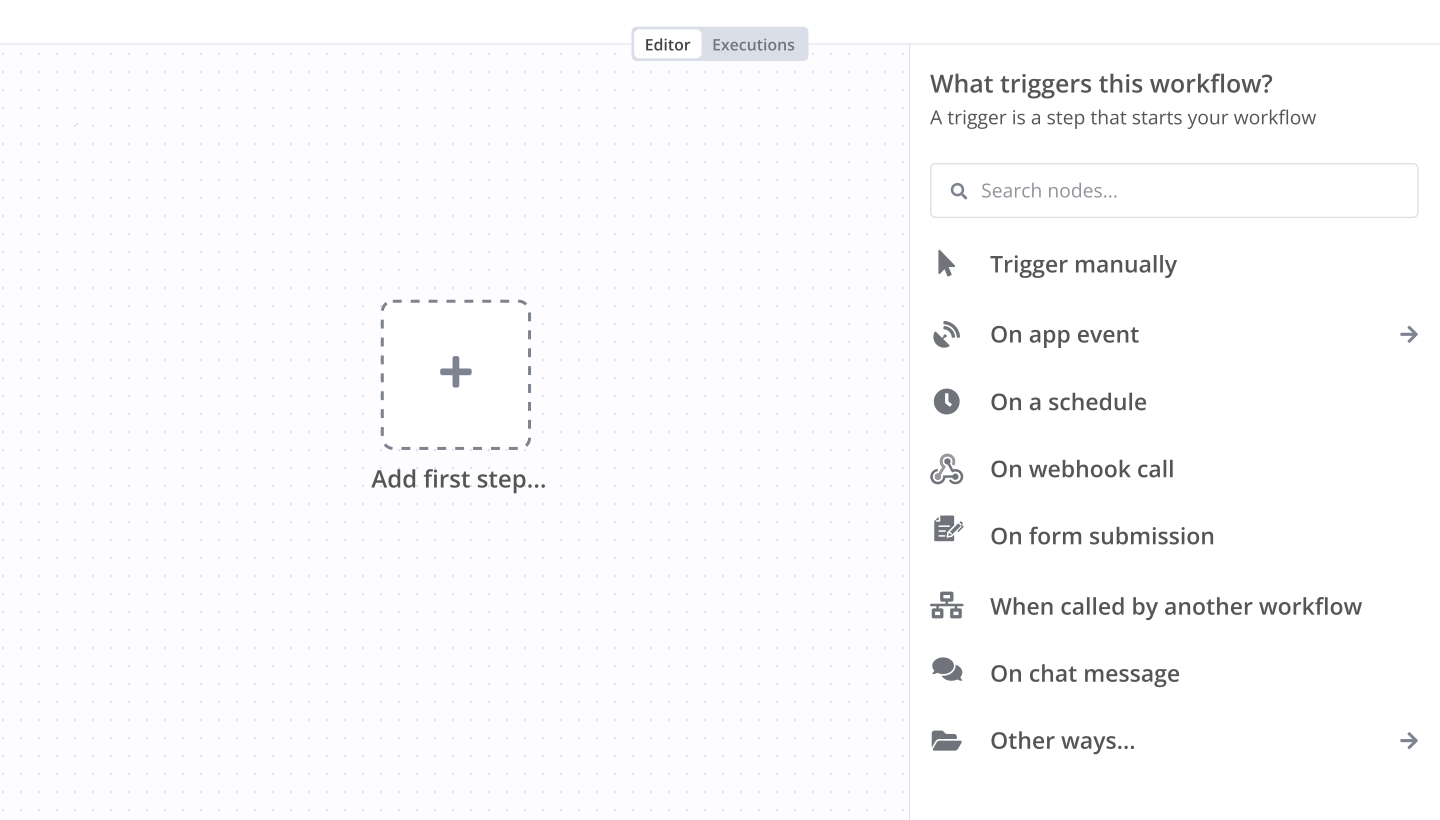
Step 1: Create a new workflow and add the first step

In n8n, click the "Add workflow" button in the Workflows tab to create a new workflow. Add the starting point – a trigger on when your workflow should run: an app event, a schedule, a webhook call, another workflow, an AI chat, or a manual trigger. Sometimes, the HTTP Request node might already serve as your starting point.

Google Drive and Wordpress integration: Create a new workflow and add the first step

Step 2: Add and configure Google Drive and Wordpress nodes

You can find Google Drive and Wordpress in the nodes panel. Drag them onto your workflow canvas, selecting their actions. Click each node, choose a credential, and authenticate to grant n8n access. Configure Google Drive and Wordpress nodes one by one: input data on the left, parameters in the middle, and output data on the right.

Google Drive and Wordpress integration: Add and configure Google Drive and Wordpress nodes

Step 3: Connect Google Drive and Wordpress

A connection establishes a link between Google Drive and Wordpress (or vice versa) to route data through the workflow. Data flows from the output of one node to the input of another. You can have single or multiple connections for each node.

Google Drive and Wordpress integration: Connect Google Drive and Wordpress

Step 4: Customize and extend your Google Drive and Wordpress integration

Use n8n's core nodes such as If, Split Out, Merge, and others to transform and manipulate data. Write custom JavaScript or Python in the Code node and run it as a step in your workflow. Connect Google Drive and Wordpress with any of n8n’s 1000+ integrations, and incorporate advanced AI logic into your workflows.

Google Drive and Wordpress integration: Customize and extend your Google Drive and Wordpress integration

Step 5: Test and activate your Google Drive and Wordpress workflow

Save and run the workflow to see if everything works as expected. Based on your configuration, data should flow from Google Drive to Wordpress or vice versa. Easily debug your workflow: you can check past executions to isolate and fix the mistake. Once you've tested everything, make sure to save your workflow and activate it.

Google Drive and Wordpress integration: Test and activate your Google Drive and Wordpress workflow

✍️🌄 Your first Wordpress + AI content creator - quick start

✍️🌄 WordPress + AI Content Creator

This workflow automates the creation and publishing of multi-reading-level content for WordPress blogs. It leverages AI to generate optimized articles, automatically creates featured images, and provides versions of the content at different reading levels (Grade 2, 5, and 9).

How It Works

Content Generation & Processing 🎯
Starts with a manual trigger and a user-defined blog topic
Uses AI to create a structured blog post with proper HTML formatting
Separates and validates the title and content components
Saves a draft version to Google Drive for backup

Multi-Reading Level Versions 📚
Automatically rewrites the content for different reading levels:
Grade 9: Sophisticated language with appropriate metaphors
Grade 5: Simplified with light humor and age-appropriate examples
Grade 2: Basic language with simple metaphors and child-friendly explanations

WordPress Integration 🌐
Creates a draft post in WordPress with the Grade 9 version
Generates a relevant featured image using Pollinations.ai
Automatically uploads and sets the featured image
Sends success/error notifications via Telegram

Setup Steps

Configure API Credentials 🔑
Set up WordPress API connection
Configure OpenAI API access
Set up Google Drive integration
Add Telegram bot credentials for notifications

Customize Content Parameters ⚙️
Adjust reading level prompts as needed
Modify image generation settings
Set WordPress post parameters

Test and Deploy 🚀
Run a test with a sample topic
Verify all reading level versions
Check WordPress draft creation
Confirm notification system

This workflow is perfect for content creators who need to maintain a consistent blog presence while catering to different audience reading levels. It's especially useful for educational content, news sites, or any platform that needs to communicate complex topics to diverse audiences.

Nodes used in this workflow

Popular Google Drive and Wordpress workflows

+9

Extract text from PDFs and images in Google Drive and post to WordPress and social media with OpenAI GPT-4.1 and DALL·E

Who is this for? This workflow is designed for content creators, social media managers, digital marketers, and business owners who want to automate their content creation and distribution process across multiple platforms. It's perfect for those who regularly create content from PDFs or images and want to streamline their social media posting workflow. Key Features Monitors a specific Google Drive folder for new PDFs or images Extracts text from PDFs or images using AI Optionally generates new images from text using OpenAI's DALL-E Automatically posts content with images to multiple platforms Sends notifications about successful posts Handles different file types with specialized extraction methods Workflow Does This workflow automates monitoring a Google Drive folder for new PDFs and images, extracting content using AI, and distributing it across social media platforms like WordPress, Facebook, Telegram, LinkedIn, and Discord. It can also generate new images from text and sends notifications about successful posts. The process ensures efficient handling of different file types and streamlines content sharing across multiple channels. Requirements Google Drive account with a dedicated folder for content OpenAI API credentials for image generation WordPress API credentials for website posting Social media API credentials: Facebook Graph API Telegram Bot API LinkedIn OAuth2 API Discord Bot API X/Twitter OAuth2 API Gmail credentials for email notifications Rapiwa account for WhatsApp notifications Important Notes Make sure all API credentials are properly configured before running the workflow The workflow handles both PDF and image files differently based on their MIME type Image generation is optional and can be disabled if not needed All social media posting nodes can be individually enabled or disabled based on your needs The workflow includes rate limiting to avoid API restrictions Support & Help WhatsApp**: Chat on WhatsApp Discord**: SpaGreen Community Facebook Group**: SpaGreen Support Website**: https://spagreen.net Developer Portfolio**: Codecanyon SpaGreen
+3

✍️🌄 Your First Wordpress + AI Content Creator - Quick Start

✍️🌄 WordPress + AI Content Creator This workflow automates the creation and publishing of multi-reading-level content for WordPress blogs. It leverages AI to generate optimized articles, automatically creates featured images, and provides versions of the content at different reading levels (Grade 2, 5, and 9). How It Works Content Generation & Processing 🎯 Starts with a manual trigger and a user-defined blog topic Uses AI to create a structured blog post with proper HTML formatting Separates and validates the title and content components Saves a draft version to Google Drive for backup Multi-Reading Level Versions 📚 Automatically rewrites the content for different reading levels: Grade 9: Sophisticated language with appropriate metaphors Grade 5: Simplified with light humor and age-appropriate examples Grade 2: Basic language with simple metaphors and child-friendly explanations WordPress Integration 🌐 Creates a draft post in WordPress with the Grade 9 version Generates a relevant featured image using Pollinations.ai Automatically uploads and sets the featured image Sends success/error notifications via Telegram Setup Steps Configure API Credentials 🔑 Set up WordPress API connection Configure OpenAI API access Set up Google Drive integration Add Telegram bot credentials for notifications Customize Content Parameters ⚙️ Adjust reading level prompts as needed Modify image generation settings Set WordPress post parameters Test and Deploy 🚀 Run a test with a sample topic Verify all reading level versions Check WordPress draft creation Confirm notification system This workflow is perfect for content creators who need to maintain a consistent blog presence while catering to different audience reading levels. It's especially useful for educational content, news sites, or any platform that needs to communicate complex topics to diverse audiences.
+18

💅 AI Agents Generate Content & Automate Posting for Beauty Salon Social Media 📲

💅 AI Agents Generate Content & Automate Posting for Beauty Salon Social Media 📲 Who Is This For? This workflow is for beauty salons who want consistent, high‑quality social media content without writing every post manually. It also suits agencies and automation builders who manage multiple beauty brands and want a reusable, AI‑driven posting system they can adapt per client. What Problem Is This Workflow Solving? Many beauty businesses struggle to post regularly because research, copywriting, and design all take time and marketing skills. This workflow automates research, writing, image creation, and posting, so your channels stay active and relevant while you focus on clients and services. What This Workflow Does Generates short, engaging posts tailored to a beauty‑salon audience (hair, nails, skincare, make‑up, self‑care) using an AI agent. Uses Tavily Internet Search to pull up‑to‑date information and trends based on a reference link or topic. Turns each post into a detailed, photorealistic image prompt and creates a matching visual with an AI image model (for example, gpt‑image‑1 or other connected providers). Automatically sends the final text and image to Telegram, and can be extended to other social platforms from the Split Out node. How It Works Trigger the workflow Scheduled automatic generation:** Run the parent workflow on a schedule (for example, once per day at 9 AM) to publish new content regularly. Google Sheets trigger:** Generate content when a new row with a reference link or topic is added to your sheet. Use it when you manage ideas or briefs in Google Sheets and want the workflow to react as soon as a new idea appears. RSS Feed trigger:** Start the workflow when new items appear in a selected RSS feed. Ideal for turning fresh blog posts, news, or industry updates into social media content or automated summaries. Meta (Facebook/Instagram) webhook:** Use the Meta Reference trigger to fire the workflow on incoming webhooks from Meta (for example, new comments, messages, or events). Helpful when you want to auto‑respond, log activity, or generate follow‑up content from Meta activity. Airtable trigger:** Start the workflow when records in a selected Airtable base/table change (for example, a new idea, brief, or status update), so your posts react instantly to updates in your Airtable content board. Postgres trigger:** Fire the workflow when new rows are inserted or existing rows are updated in a connected PostgreSQL table, letting you drive content generation from events in your app database or Supabase‑style back end. Manual start:* Hit Execute workflow* whenever you want to spin up a batch of posts on demand, test new prompt settings, or debug the flow step by step. Research and generate copy The GENERATE TEXT agent calls Tavily to gather fresh information on the topic. It writes a post under 1024 characters with a hook, practical tips, relevant hashtags, and a closing line with your salon address and contact. Create the visual The GENERATE PROMPT agent converts the post into a single, clear description of the scene (client, service, salon interior, lighting, mood) with a strict “no text on image” rule. An image model such as gpt‑image‑1 or one of the HTTP image APIs renders a matching beauty visual. Distribute the content The Split Out node fans out the result so Telegram receives a photo post with the generated caption. Additional social or content nodes (for example Facebook, LinkedIn, X, template tools) can be wired after this step for multi‑channel posting. How to Customize This Workflow to Your Needs Brand voice** Edit the system message in the GENERATE TEXT node to adjust tone (luxury, friendly, clinical, playful), language, services, and city. Update the final address and phone line to match your salon details. Topics and triggers** Point the Google Sheets Trigger to your own document ID, sheet, and columns for ideas, links, or campaign themes. Use the Schedule Trigger for fully automatic posting or rely on the Manual Trigger for controlled, batch generation sessions. Models and providers** Swap GPT‑5 llm and the default image model for alternatives such as Mistral, Gemini, Anthropic, DeepSeek, or custom HTTP image APIs by enabling the corresponding nodes and adding credentials. Channels and outputs** Connect or remove social nodes after Split Out depending on which platforms you actively use. Add extra processing steps (for example resizing images or adding UTM parameters) before each channel if needed. Visual style** Tweak the GENERATE PROMPT instructions to control composition (close‑up vs. full‑body), color palette, lighting, and overall salon aesthetic, while keeping the constraint of no text or logos in the image.
+19

💾 Generate Blog Posts on Autopilot with GPT‑5, Tavily and WordPress

Who Is This For? This workflow is designed for marketers, content creators, agencies, and solo founders who want to publish long‑form posts with visuals on autopilot using n8n and AI agents. ​ Whether you run a blog, SaaS, personal brand, newsletter, or client accounts, this tool helps you keep a consistent content pipeline without manually writing every article, creating images, and posting to each platform one by one. ​ ​ 💪🏼 While the template is wired around classic blog + social media distribution, the underlying logic is universal. You can easily adapt it to any niche by editing prompts, swapping models, and re‑wiring nodes. You can plug in any LLM you like, from ChatGPT to Claude, Gemini, Mistral, DeepSeek, OpenRouter, or even local models through Ollama. ​ What Problem Is This Workflow Solving? 🤯 Most teams waste hours on the same repetitive loop: research a topic, gather links, write a blog post, craft social captions, generate visuals, upload everything to multiple platforms, and archive assets. ​ ​ 💎 This workflow solves that by automating the full content chain—from research and blog‑post generation to image creation, publishing across channels, and logging everything in your content database—so your feeds stay active while you focus on strategy, not busywork. ​ What This Workflow Does ✨ Generates in‑depth blog posts tailored to your topic and target audience, enriched with fresh references from the web via Tavily/SerpAPI search tools. ​ ✨ Creates an image prompt and title from the article, generates the visual with OpenAI Images (gpt-image-1), and converts it into a ready‑to‑use image file. ​ ✨ Automatically publishes content to your connected platforms (WordPress for blog posts, Telegram, X/Twitter, Facebook, LinkedIn) while saving images to Google Drive and logging each publication in Google Sheets for tracking. ​ How It Works? Surprisingly simple ☺️ The workflow is triggered by another n8n workflow or by one of several triggers (Facebook, RSS, Google Sheets, Airtable, Postgres) that pass in the blogTopic, targetAudience, and Telegram chatID. ​ ​ The Blog Post Agent (LLM with access to Tavily/SerpAPI) researches the topic, writes a structured article for the specified audience, and sends its output to the Image Prompt Agent, which turns the content into a visual prompt and title. ​ 🎯 The end result: you provide a topic, run the workflow, and receive a complete blog post, matching image, and ready‑made social posts shipped directly to your channels and archives—no manual copy‑paste. ​ How to Customize This Workflow to Your Needs 🎨 Switch AI models and fine‑tune prompts so the agent can handle your exact formats: tutorials, case studies, listicles, product updates, thought‑leadership pieces, or campaign landing posts. 🔍 Refine research sources inside Tavily/SerpAPI to prioritize the domains, blogs, and docs your audience trusts, keeping posts accurate and up to date. ⏰ Adjust posting cadence and schedules to align with peak engagement for your audience, mixing automated slots with manual “launch” runs for special announcements. 📱 Expand or trim channels as needed: keep just WordPress + LinkedIn, add Telegram as a content feed, or plug the workflow into additional automations like email campaigns or RSS feeds. 📊 Use Google Sheets as your content hub to store ideas, angles, CTAs, references, and performance notes so you can double‑down on topics and formats that perform best. 🎬 Swap images for video by replacing the image generation node with video tools (for example, Runway‑style APIs) if your strategy is video‑first while keeping the same prompt pipeline. 💾 Build a reusable prompt library in Sheets, Notion, or Airtable so you can rotate proven prompt patterns each month and keep quality high without reinventing the wheel. 🤖 The system will continuously generate blog posts, visuals, and social updates and publish them across your selected platforms while archiving everything in Drive and Sheets—keeping your brand visible, consistent, and professional with minimal ongoing effort.
+7

Multi-Level WordPress Blog Generator with PerplexityAI Research & OpenAI Content

WordPress Auto-Blogging Pro v2 \- with DEEPER RESEARCH \- Advanced Content Automation (This version is an upgrade from v1: WordPress Auto-Blogging Pro \- with DEEP RESEARCH \- Content Automation Machine v1) Take your content automation to unprecedented depths\! This v2 template enhances the acclaimed "WordPress Auto-Blogging Pro \- with DEEP RESEARCH" by introducing Deeper Research, a multi-level research capability designed to generate exceptionally comprehensive, long-form content like detailed articles, reports, and even e-books. If you need more than just standard blog posts and crave truly authoritative, data-driven content generated automatically, this workflow is built for you. It optionally goes beyond simple topic research by breaking down subjects into sub-topics, and then further into sub-sub-topics, conducting real-time online research (powered by the Research Tool Sub-Flow using PerplexityAI) at each stage. This ensures unparalleled depth and coverage, perfect for tackling complex subjects. Combined with enhanced automation features for batch processing, categorization, tagging, linking, and image generation (using OpenAI's latest image model gpt-image-1 accessed via API), this is the ultimate engine for serious content automation on WordPress. It operates using a three-flow system: a Trigger Flow acts as a scheduler and dispatcher, a powerful Main Flow executes the complex content generation process, and a dedicated Research Tool Sub-Flow handles interactions with PerplexityAI. Visit AI Automation Pro’s website for more powerful n8n templates. What problem is this workflow solving? / Use cases Standard content automation often struggles with producing truly in-depth, comprehensive content on complex or rapidly evolving topics. This workflow addresses that challenge by: Automating Multi-Level Research:** Optionally eliminates the manual effort required to deeply research topics, sub-topics, and sub-sub-topics, ensuring content is thorough and well-supported when needed. Generating Long-Form Content:** Enables the creation of detailed articles, comprehensive reports, or even initial e-book drafts automatically. Scaling Content Production:** Efficiently handles lists of topics from Google Sheets, processing them sequentially for reliable, automated content creation over time. Enhancing SEO Automatically:** Integrates best practices like sitemap-based internal linking, external source linking, automatic categorization, tag generation/management, and Table of Contents generation (with “Deeper Research” articles). Streamlining Complex Tasks:** Combines research (basic or deep), writing, image generation, SEO optimization, publishing, and comprehensive backup (Google Docs, Drive, Sheets) into a single, automated system. Ideal use cases include creating cornerstone content, detailed guides, industry reports, niche site authority building, and automating the production of deeply researched articles where maximum depth is required. Who is this for? This advanced workflow is designed for demanding users who require robust, comprehensive content automation: Content Marketers & Strategists:** Needing to produce authoritative, long-form content at scale, with options for varying research depth. SEO Professionals:** Aiming to build topical authority with well-researched, structured, and highly optimized content featuring strong internal/external linking. Niche Site Builders & Affiliates:** Seeking to dominate specific topics with comprehensive guides and articles. Agencies:** Managing large-scale content production for clients requiring in-depth material. Researchers & Analysts:** Looking to automate the drafting of reports or summaries based on online data. Power Users of v1:** Ready to upgrade to the next level of research depth, flexibility, and automation features. Unique Features This v2 workflow introduces significant upgrades and retains the best features of v1: Conditional Deeper Research:** Choose per-topic whether to activate multi-level research (topic \-\> sub-topic \-\> sub-sub-topic) for maximum depth or use standard chapter-level research. Modular Three-Flow Architecture:** Robust system with a Trigger Flow for scheduling, a Main Flow for generation, and a dedicated Research Tool Sub-Flow. Table of Contents Generation:** Automatically creates a ToC for improved readability and SEO on long articles. Latest AI Image Models:** Optimized for high-quality images using OpenAI's latest model (gpt-image-1 via API), with easy node setup to switch to alternatives. Automatic Categorization & Tag Management:** AI assigns posts to the most relevant existing WordPress category and creates/assigns relevant tags. Dual Trigger Options:** Use Google Sheets for batch processing lists of topics or n8n's Native Form for single, ad-hoc topic submission. Batch Topic Processing:** Handles multiple topic inputs efficiently via the Trigger Flow loop, processing them sequentially with status tracking. Advanced External & Internal Linking:** Automatically inserts relevant internal links (from sitemap) and external source links (from research). Comprehensive Backup System:** Saves final content in multiple formats and locations: Markdown to Google Docs, Images to Google Drive, Final URLs and details to Google Sheets. Centralized Control Interface:** Google Sheets acts as the primary interface for bulk input, parameter setting (like Have Deeper Research), and status monitoring. Direct WordPress Integration:** Seamlessly publishes content, metadata, tags, categories, and images. Rate-Limit Aware:** Includes configurable Wait nodes to prevent API errors during intensive processing. Robust Error Catching:** Uses 'If' nodes to validate AI outputs and ensure smooth data flow. How this workflow works This template utilizes three interconnected n8n flows: a Trigger Flow, a Main Flow, and a Research Tool Sub-Flow, orchestrated primarily via Google Sheets. 1\. Trigger Flow (Scheduler & Dispatcher): Trigger:** Activates via a Schedule (e.g., every 10 minutes) to check for new tasks OR via a direct n8n Form submission. Select Topics:** Reads rows from a specific Google Sheet (e.g., Deeper Research - Create Topics \-\> Create Topic sheet) where the Status column is 'To Do'. Loop & Dispatch:* Processes each 'To Do' topic one by one. For each topic, it executes the Main Flow*, passing the topic details and parameters. Wait:** Pauses for a configurable duration (default: 1 hour) after each topic's processing is initiated by the Sub-Workflow, helping manage API limits and pacing. 2\. Main Flow (Content Generation Engine): Trigger:** Starts when called by the Trigger Flow. Setup:** Receives topic parameters (Topic, Audience, Style, Word Count, Have Deeper Research flag, etc.) from the Trigger Flow. Updates the topic's Status to 'In Progress' in the Google Sheet. Internal Link Gathering:** Fetches your website's sitemap XML, parses it, and extracts a set number (e.g., up to 50\) of internal URLs for later use. Initial Research & Planning:* Executes the Research Tool Sub-Flow* to perform initial online research on the main topic. An AI Agent ("Blog Planner") then uses this research to outline the entire article: Title, Subtitle, Introduction, Slug, Meta Description, Tags, Chapter outlines, and prompts for chapter/featured images. Conditional Content Creation (Based on Have Deeper Research flag):** If YES: Executes the Deeper Research path: Loops through planned chapters \-\> Executes Research Tool Sub-Flow for Chapter Research \-\> AI splits chapter into subchapters \-\> Loops through subchapters \-\> Executes Research Tool Sub-Flow for Subchapter Research \-\> AI ("Subchapter Copywriter") writes detailed content for each subchapter \-\> Aggregates subchapters back into the main chapter content. If NO: Executes the Standard Research path: Loops through planned chapters \-\> Executes Research Tool Sub-Flow for Main Chapter Research \-\> AI ("Chapter Copywriter") writes content for each chapter. Image Generation & Upload:** Generates images (using OpenAI's gpt-image-1 or equivalent via HTTP Request) for each main chapter and a featured image. Resizes images and uploads them to both your WordPress Media Library and a specified Google Drive folder. Tag Management:** Checks if the AI-generated tags exist in WordPress. Creates new tags if necessary and retrieves the IDs for all relevant tags. Article Assembly:** Combines Introduction, finalized chapter content (from either research path), Conclusion, CTA, etc., into a complete article structured in Markdown format (using a Code node). HTML Conversion:** Converts the final Markdown content to HTML suitable for WordPress. Backup \- Google Docs:* Saves the final Markdown version of the article as a new document in a specified Google Drive folder. Note:* saving to Google Docs only works on "My Drive" and will NOT work on a Shared Drive due to Google Drive API restrictions. Publish to WordPress:** Creates a new post on your WordPress site with the Title, HTML content, Slug, assigned Category (auto-detected or default), Tag IDs, and sets the generated Featured Image. Also sets the Meta Description and Post Excerpt. Backup \- Google Sheets:** Saves the final details (Published URL, Markdown, HTML, Tags, Meta info, Slug, Excerpt, etc.) to a dedicated sheet (e.g., Final Blogs) within your main Google Sheet workbook. Final Status Update:** Updates the topic's Status to 'Done' in the original Create Topic sheet. 3\. Research Tool Sub-Flow (PerplexityAI Interaction): Trigger:** Starts when called by the Main Flow. Setup:** Receives parameters like the research query, model (sonar or sonar-deep-research), system message, and max tokens. API Call:** Makes a POST request to the PerplexityAI API with the provided parameters and authentication. Response Handling:** Extracts the content from the API response. Output:** Returns the research content back to the calling Main Flow. Requirements n8n Instance**. OpenAI API Key:** Or equivalent credentials for a powerful text generation model (default to GPT-4o) and an image generation model (like gpt-image-1, compatible with OpenAI node or direct HTTP Request). Perplexity API Key:** Or equivalent for an online research tool API (used via HTTP Request node in the Research Tool Sub-Flow). WordPress Website:** REST API enabled, with an Application Password granting permissions to create/edit posts, upload media, manage categories, and manage tags. Needs an accessible post-sitemap.xml. Google Account:** For Google Sheets (trigger, control parameters, status tracking, backup), Google Drive (image/text backup), and Google Docs (Markdown backup). Setup Step-by-Step Import Workflows: Download the three .json files (Trigger Flow, Main Flow, Research Tool Sub-Flow) and import them into your n8n instance. Name them clearly (e.g., "WP Deeper Research \- Trigger Flow", "WP Deeper Research \- Main Flow", "WP Deeper Research \- Research Tool Sub-Flow"). Configure Google Sheet: Clone or create a Google Sheet workbook (e.g., Deeper Research - Create Topics). Ensure two sheets within it: Create Topic and Final Blogs. Set up required columns in Create Topic (e.g., Topic, Status, Have Deeper Research, Audience, Style, etc. \- match these exactly to the names used in the workflow nodes). Set up columns in Final Blogs for backup (e.g., Topic Name, Final URL, Markdown, HTML, etc. \- match workflow nodes). Update all Google Sheets nodes in the Trigger Flow and Main Flow to point to the correct Workbook Name, Sheet Name, and ensure column names match. Link Flows: In the Trigger Flow, locate the "Execute Workflow" node (e.g., "Execute Workflow \- Create A Topic"). Edit this node and select the imported Main Flow from the dropdown. In the Main Flow, locate all "Execute Workflow" nodes that perform research. Edit these nodes and select the imported Research Tool Sub-Flow from the dropdown. Configure Credentials: In n8n, add credentials for: OpenAI, PerplexityAI, WordPress (using Application Password), Google (ensure Sheets, Drive, Docs permissions). Connect Workflow Nodes: Open all three workflows. Go through each node requiring authentication (OpenAI, Perplexity HTTP Request, WordPress, Google Sheets, Google Drive, Google Docs) and assign the correct credential. Pay close attention to HTTP Request nodes, ensuring API keys are correctly placed. Configure Triggers: In the Trigger Flow, configure the Schedule Trigger interval (default 10 mins) or the n8n Form Trigger fields as needed. Ensure only one trigger is active unless you intend both. Customize Inputs & Parameters: Review key nodes: Trigger Flow: Adjust Wait time if needed. Main Flow: Verify Website URL (for sitemap), AI prompts (Planner, Copywriters), default Category ID, internal link limit, image sizes. Research Tool Sub-Flow: Review default model (sonar), system message, max tokens if needed. Test Connections: Perform test runs on individual nodes within each workflow (e.g., read Google Sheet, call Perplexity via Research Tool Sub-Flow, connect to WordPress) to verify credentials and configurations. Initial Test Run: Add one test topic to your Create Topic sheet (set Status to 'To Do', specify 'Yes' or 'No' for Have Deeper Research). Manually trigger the Trigger Flow once (or wait for the schedule). Verify the process completes and check outputs (WordPress post, Google Drive folder, Google Doc, Final Blogs sheet, Create Topic status update). Activate Workflows: Toggle the "Active" switch ON for the Trigger Flow in your n8n instance. The Sub-Workflows should remain inactive as they are triggered by other flows. Start Automating: Add content topics to the Create Topic sheet (set Status='To Do'), and the scheduled Trigger Flow will pick them up. Tips for Pros Control Research Depth:** Use the Have Deeper Research column ('Yes'/'No') in your Google Sheet to control the level of research per topic, optimizing for cost and complexity where needed. AI Model Selection:** Experiment with different models in the AI/Image nodes. An alternative to OpenAI’s image model is Flux.1, which can yield superior images. For research, test Perplexity's sonar-deep-research model (by passing it as a parameter to the Research Tool Sub-Flow if needed) if the standard sonar isn't deep enough. Wait Times:** Adjust the Trigger Flow's "Wait" node duration based on your API plan limits, the typical runtime of the Main Flow, and desired posting frequency. Prompt Engineering:** Refine the prompts within the Main Flow's AI nodes (Blog Planner, Chapter/Subchapter Copywriters, Image Prompts) and the Research Tool Sub-Flow's system message to fine-tune the output style, tone, structure, and image relevance. Sitemap Accessibility:** Ensure your post-sitemap.xml is publicly accessible and correctly formatted for the parsing node to work reliably for internal linking. Important Considerations API Costs:** Deep research (especially the sub-sub-topic level) and generating multiple high-quality images per post can consume significant API credits. Monitor your costs closely. Use the Have Deeper Research flag wisely. API Rate Limits:** Even with Wait nodes, high volume can hit API rate limits. Be aware of your plan limits (OpenAI, Perplexity) and adjust workflow timing (schedule interval, wait time) accordingly. Sub-Workflow Runtime:** The Main Flow can take a considerable amount of time to run, especially with Deeper Research enabled. Factor this into scheduling and expectations. Tool Dependencies:** The workflow relies heavily on the specific functionalities and APIs of OpenAI, Perplexity, Google Workspace, and WordPress. Changes in these platforms might require workflow adjustments. Initial Setup Complexity:** Due to the advanced features, three-flow structure, and multiple integrations, the initial setup requires careful configuration of credentials, node settings (especially Google Sheets names/columns), and workflow linking. Test thoroughly. For inquiries about this template, please contact AI Automation Pro.

+7

WordPress Content Automation Machine with HUMAN-IN-THE-LOOP & DEEP RESEARCH

HUMAN-IN-THE-LOOP Content Automation Pro with Deep Research & Airtable for Power Users \- Collaborative AI for WordPress Blog Automation The BEST n8n Content Automation workflow in the market is getting even better, now enabling you to have full control over the entire process. It’s time to unlock the power of true collaborative creation with GenAI\! Want to leverage AI automation but don't want to give up full control over the whole content creation process? Get the best of both worlds \- get “Human-in-the-Loop” with this supreme n8n workflow template\! This template blends the power of AI with the crucial oversight of human expertise and intervention, all managed through a central, streamlined Airtable interface. Say goodbye to generic content and hello to high-quality, deeply researched articles published directly to your WordPress site with full control. Check out my Youtube channel for a full walkthrough. What problem is this workflow solving? / Use cases Fully automated content generation tools often lack the nuance, accuracy, and strategic control necessary for truly impactful content. This workflow solves that critical gap by integrating powerful AI capabilities into a structured, human-supervised content creation process managed via a simple interface. It automates the most repetitive and time-consuming tasks – like research gathering, chapter ideations, domain copywriting – while strategically embedding essential human review points at critical junctures. Instead of simply providing a topic and receiving a finished article of uncertain quality, you actively guide the process step-by-step within an interface. You review, refine, and approve AI suggestions for chapters and content before finalizing and publishing. This approach makes it perfect for creating high-quality, deeply researched, and brand-aligned blog posts for WordPress more efficiently, without ever sacrificing essential editorial control. Who is this for? This workflow template is meticulously designed for individuals and teams deeply involved in content creation who seek a powerful blend of AI-driven efficiency and essential human-controlled quality assurance: Content Creators & Bloggers:** Who want to leverage AI for drafting and research but maintain full editorial control. Marketing Teams:** Looking to scale content production efficiently while ensuring brand voice and quality consistency. SEO Specialists:** Needing to produce well-researched, structured, and SEO-optimized content regularly. Agencies:** Managing content creation for multiple clients with a structured, repeatable process. Anyone who prefers a "human-in-the-loop" approach** over fully automated "black box" content generators. How this workflow works This template automates significant portions of the WordPress content creation process, utilizing Airtable as the central hub for management and user interaction, while leveraging AI for research and copywriting. The system is composed of four interconnected n8n flows, each handling a distinct stage of the content lifecycle. In addition, there is a sub-workflow dedicated to the research tool (Perplexity). Content Creation Process in Airtable The entire journey from idea to published post is managed within your Airtable base, offering transparency and control. Progress through each tab sequentially to complete the content creation process and produce a high-quality article that fulfills your requirements. Configure Settings (“Settings” Table): Define global parameters (website details, target audience, writing style, category IDs, about us, CTA etc.) in the “Settings” table. These serve as default inputs for the AI. Create Topics (“Create Topics“ Table): Add a record to the “Create Topics” table for each new blog post idea. Mark the topic as ready by setting its 'Status' field to “To Do” and ticking the 'Execute Flow' checkbox to initiate the first flow. Generate Chapters (“Generate Chapters“ Table): The first flow calls to the sub-workflow to do online research and generates potential chapter outlines based on your topic and settings, saving them to the “Generate Chapters” table. Select Chapters to Write (“Select Chapters“ Table): Review the suggested chapters in the “Select Chapters“ Table. Select the chapters you want to proceed with by setting their 'Status' to “To Do” and ticking the 'Execute Flow' checkbox. Generate Content for selected Chapters (“Generate Content“ Table): The second flow calls to the sub-workflow to research each selected chapter and generates draft content, saving it to the “Generate Content” table, where you have the opportunity to review and modify if necessary. Select Chapter Content (“Select Content“ Table): Review and edit the AI-generated text directly in Airtable. Approve the content for each chapter. Once all necessary content is approved, trigger the third flow for the final assembly by setting the status to “To Do” and ticking the 'Execute Flow' checkbox. Finalize Post (“Finalize Post“ Table): The third flow aggregates the approved content, generates the title, SEO metadata, tags, chapter images and featured image, placing all compiled information in the “Finalize Post” table for your final review. When the final article is ready to be published on your website, mark the status as "To Do" and check the "Ready to Publish" box to activate the fourth and final flow. Publish & Backup Post (“Backup Post“ Table): the fourth flow publishes the post to the website and creates a backup record in the “Backup Post” table, archiving key details including the live URL of the published article. n8n Workflow Functions (JSON Files) The automation is handled by four separate n8n flows, each triggered by specific changes in Airtable: Flow 1 (Topic Initiation & Chapter Generation): Trigger: Monitors the “Create Topics” table; activates when a record's 'Status' is "To Do" AND 'Execute Flow' checkbox is ticked. Action: Fetches settings from Settings. Performs initial research (e.g., via Perplexity). Uses AI to generate chapter outlines. Saves suggestions as new records in the “Generate Chapters” table. Flow 2 (Content Generation & Internal Linking): Trigger: Monitors the “Select Chapters” table; activates when a record's 'Status' is "To Do" AND 'Execute Flow' checkbox is ticked. Action: Fetches chapter details and settings. Gathers internal links (e.g., by parsing sitemap). Performs online/ deep research per chapter. Uses AI to write draft content, incorporating research and links. Saves drafts into corresponding records in the “Generate Content” table. Flow 3 (Post Assembly & Image Generation): Trigger: Monitors the “Select Content” table; activates when all content for a topic is approved and final assembly is triggered when a record's 'Status' is "To Do" AND 'Execute Flow' checkbox is ticked. Action: Fetches all content from the “Generate Content” table. Aggregates text. Uses AI for title, SEO metadata, tags, and image prompts. Generates chapter images and a featured cover image (e.g., via AI image model DALL-E). Converts content to HTML. Saves compiled data and image info into the “Finalize Post” table. Flow 4 (WordPress Publishing & Backup): Trigger: Monitors the “Finalize Post” table; activates when a record is marked Status' is "To Do" AND ‘Post to Website’ checkbox is ticked. Action: Fetches finalized data. Uploads images to WordPress. Creates WordPress post (status set to “published” by default) with content, metadata, tags, and image. Creates a record in the “Backup Post” table, with a link to the post on the website. This modular approach ensures each stage is handled distinctly, orchestrated via updates on Airtable interface. Unique Features Human-in-the-Loop Design:** Guarantees quality and relevance through mandatory user review and approval stages within Airtable for chapters, content, and the final post. Collaborative AI Partnership:** Leverages AI as a powerful assistant for research, structuring, and drafting, significantly boosting productivity while relying on human expertise for refinement and final judgment. Airtable as Interface & Control Center:** Utilizes Airtable as an intuitive interface and central database to manage the entire content lifecycle, offering clear progress tracking and facilitating team collaboration. Deep Research Integration:** Incorporates external research tools (like Perplexity) to ensure content is based on fresh, up-to-date information, crucial for accuracy and authority. Modular n8n Structure:** Simplifies complexity by dividing the process into four manageable, interconnected flows plus one sub-flows, making the system easier to understand, troubleshoot, and customize. Rate-limit Aware:** Includes built-in Wait nodes and logic designed to mitigate API rate limit issues from AI and research tools, enhancing workflow reliability during intensive use. Multiple-Image Generation:** Generates and adds images for each chapter, as well as a featured image for the article. Direct WordPress Integration:** Streamlines publication by automatically sending finalized, formatted content, metadata, tags, and the featured image directly to your WordPress site. Internal Linking:** Embeds internal website links strategically within each chapter and throughout the article, boosting SEO and enhancing user navigation. Integrated Backup:** Provides data security by automatically archiving key post details in Airtable and optionally saving text and image files to Google Drive. Future Features “Deeper Research”:** Plans for multi-level research capabilities to enable the creation of even more comprehensive reports or e-book length content. Content Sample:** Provide content samples for the AI to learn from and mimic in terms of writing style and guidelines. Category-Specific Styling:** Aiming to allow users to define styles per category for the AI to learn and imitate, ensuring greater brand consistency. Advanced Link Insertion:** Developing more sophisticated strategies for inserting relevant internal and external links, including automatic source citation and dynamic internal link density adjustments. Requirements Airtable Account: create a Airtable account for free. WordPress Website: Requires an Application Password with permissions to create posts and upload media. Must have the REST API enabled. OpenAI API Key: Or a key from another compatible AI provider for text and image generation (DALL-E is the default for images). Perplexity API Key: Or an API key for your chosen online research tool. Google Drive: for the optional backup feature to Google Drive. Setup Step-by-Step Import n8n Workflows: Download the .json workflow files and import them into your n8n instance. There is one main/ “month” workflow and one sub/ “child” workflow. Name the workflows to your needs. Get Airtable Base: Duplicate the companion Airtable Base template. Configure Credentials: Add new credentials in n8n for Airtable, WordPress (use Application Password), OpenAI API, PerplexityAI API, and Google (for Drive backup). Connect Workflow Nodes: Open each workflow in n8n and assign the correct credential to every node that requires authentication (Airtable, WordPress, AI, HTTP Request, Google nodes). Link the main workflow to the sub-workflow: Access the Research Tool nodes and establish a connection between the main workflow to sub-workflow. Configure Airtable Nodes: Update all Airtable nodes across all workflows. Verify that all 'Table' and 'Field' names in the nodes exactly match your duplicated base. Populate Airtable Settings: Fill in your specific details in the Settings table of your Airtable base (Website URL, Audience, Style, Category IDs, CTA, etc.). Test Connections: Run manual executions on key nodes within each flow to ensure connections and basic configurations are correct before activating. Activate Workflow: Toggle the "Active" switch ON for the main/ “mother” workflow in your n8n list. No need to activate the sub/ “child” workflow. Start Creating: Go to the Create Topics table in Airtable, add a new topic, go through the process and get amazed by AI magic\! Airtable Database Explanation Airtable is the central hub, acting as the database, user interface, and trigger mechanism for this workflow. Structure:** The base uses linked tables to manage the process: Settings: Global configurations. Create Topics: Initiates new content pieces. Generate Chapters: Stores AI-generated chapter outlines for review. Select Chapters: Facilitates user selection of chapters to write. Generate Content: Stores AI-generated draft content for selected chapters. Select Content: Manages user approval of drafted content before final assembly. Finalize Post: Holds the compiled post (text, metadata, image info) for final review and publish trigger. Backup Post: Archives data (including live URL) of successfully published posts. Workflow Interaction:** User updates trigger fields in Airtable (e.g., sets Status='To Do' & Execute Flow=true). n8n Airtable Trigger nodes detect these specific changes. The corresponding n8n flow runs, fetching data from Airtable. AI and other tools process data and generate outputs. Results are written back to the appropriate Airtable tables/fields. User reviews results in Airtable and triggers the next stage via status AND checkbox updates. Setup:* Using the exact* duplicated Airtable base template is mandatory, as n8n workflows expect specific table and field names. Tips for Pros AI Prompts:** Modify prompts in the AI nodes to refine tone, style, format, or incorporate specific instructions. AI Models:** the workflow is optimized for OpenAI's GPT-4o model due to its consistent performance. While you can replace the AI models in the nodes with alternatives (if you have the credentials for them), keep in mind that the workflow may not function. AI Research Model:** PerplexityAI is the tool of choice for research. The "sonar" model is the default for research in this workflow due to its speed and cost-effectiveness. However, you are welcome to explore Perplexity's other models, such as the "sonar-deep-research" model, which is specifically designed for in-depth research. AI Image Model:** The default AI model for image generation is OpenAI’s Dall-E. However, the outputs of this model are not impressive. While OpenAI's 4o multimodal is expected to be available via API soon, better/ superior image quality can be achieved in the meantime by using alternative AI image models (such as FLUX.1). Airtable Base:** Add or modify fields/tables to match your specific tracking needs, but remember to update corresponding n8n nodes accordingly. 3rd-party Integrations:** Replace research tools, image generators, or modify the final step to publish to a different CMS or add post-publication steps like social sharing. Error Handling:** For production reliability, incorporate an “Error Handling” workflow in n8n for this automation to catch failures and send notifications Important Considerations API Rate Limits:* AI and research tools have usage limits. High volume processing might cause errors. The included Wait* nodes help, but may need adjustment based on your API plans. Testing Costs:** API calls to AI models aren't free. To ensure the workflow runs correctly, start testing with OpenAI's GPT-4o. Once you've confirmed functionality, explore using other AI models which may be cheaper to keep costs down. Be aware that the workflow may not be as reliable with models other than GPT-4o. Keep an eye on your API provider's billing dashboard to monitor usage and costs. Sequential Processing:* The workflow processes one topic fully at a time to ensure stability and manage API limits. For fully automated, parallel processing from a list, consider the alternative template: [“\[n8n\] Content Automation Pro – with DEEP RESEARCH – WordPress Blog Automation”*](https://n8n.io/workflows/3041-wordpress-auto-blogging-pro-with-deep-research-content-automation-machine/).

Build your own Google Drive and Wordpress integration

Create custom Google Drive and Wordpress workflows by choosing triggers and actions. Nodes come with global operations and settings, as well as app-specific parameters that can be configured. You can also use the HTTP Request node to query data from any app or service with a REST API.

Google Drive supported actions

Copy
Create a copy of an existing file
Create From Text
Create a file from a provided text
Delete
Permanently delete a file
Download
Download a file
Move
Move a file to another folder
Share
Add sharing permissions to a file
Update
Update a file
Upload
Upload an existing file to Google Drive
Search
Search or list files and folders
Create
Create a folder
Delete
Permanently delete a folder
Share
Add sharing permissions to a folder
Create
Create a shared drive
Delete
Permanently delete a shared drive
Get
Get a shared drive
Get Many
Get the list of shared drives
Update
Update a shared drive

Wordpress supported actions

Create
Create a post
Get
Get a post
Get Many
Get many posts
Update
Update a post
Create
Create a page
Get
Get a page
Get Many
Get many pages
Update
Update a page
Create
Create a user
Get
Get a user
Get Many
Get many users
Update
Update a user

FAQs

  • Can Google Drive connect with Wordpress?

  • Can I use Google Drive’s API with n8n?

  • Can I use Wordpress’s API with n8n?

  • Is n8n secure for integrating Google Drive and Wordpress?

  • How to get started with Google Drive and Wordpress integration in n8n.io?

Need help setting up your Google Drive and Wordpress integration?

Discover our latest community's recommendations and join the discussions about Google Drive and Wordpress integration.
hubschrauber
Jon
David O'Neil

Looking to integrate Google Drive and Wordpress in your company?

Over 3000 companies switch to n8n every single week

Why use n8n to integrate Google Drive with Wordpress

Build complex workflows, really fast

Build complex workflows, really fast

Handle branching, merging and iteration easily.
Pause your workflow to wait for external events.

Code when you need it, UI when you don't

Simple debugging

Your data is displayed alongside your settings, making edge cases easy to track down.

Use templates to get started fast

Use 1000+ workflow templates available from our core team and our community.

Reuse your work

Copy and paste, easily import and export workflows.

Implement complex processes faster with n8n

red iconyellow iconred iconyellow icon