Back to Integrations
integrationGoogle Gemini Chat Model node
integrationGoogle Sheets node

Google Gemini Chat Model and Google Sheets integration

Save yourself the work of writing custom integrations for Google Gemini Chat Model and Google Sheets and use n8n instead. Build adaptable and scalable AI, Langchain, Data & Storage, and Productivity workflows that work with your technology stack. All within a building experience you will love.

How to connect Google Gemini Chat Model and Google Sheets

  • Step 1: Create a new workflow
  • Step 2: Add and configure nodes
  • Step 3: Connect
  • Step 4: Customize and extend your integration
  • Step 5: Test and activate your workflow

Step 1: Create a new workflow and add the first step

In n8n, click the "Add workflow" button in the Workflows tab to create a new workflow. Add the starting point – a trigger on when your workflow should run: an app event, a schedule, a webhook call, another workflow, an AI chat, or a manual trigger. Sometimes, the HTTP Request node might already serve as your starting point.
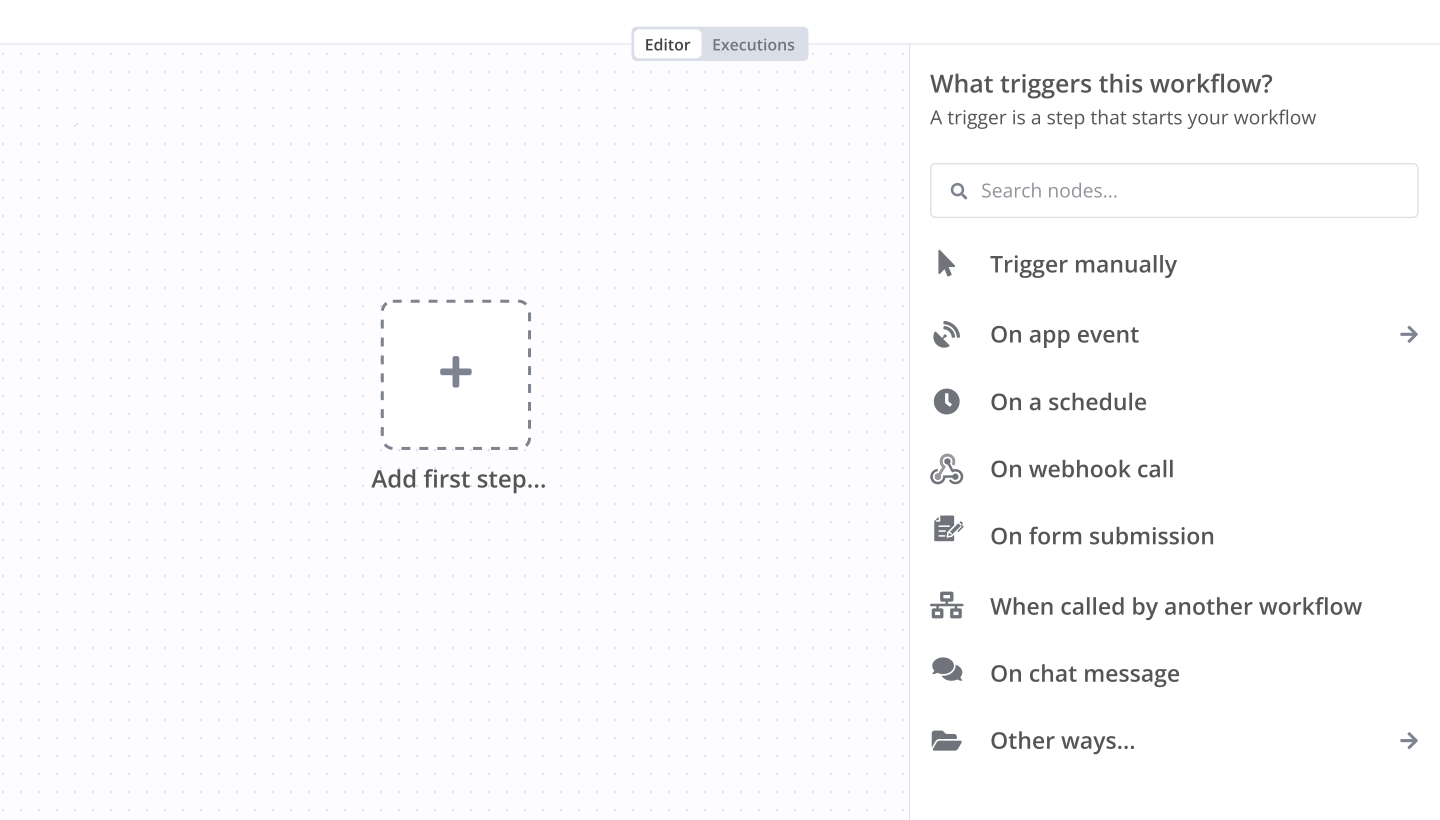
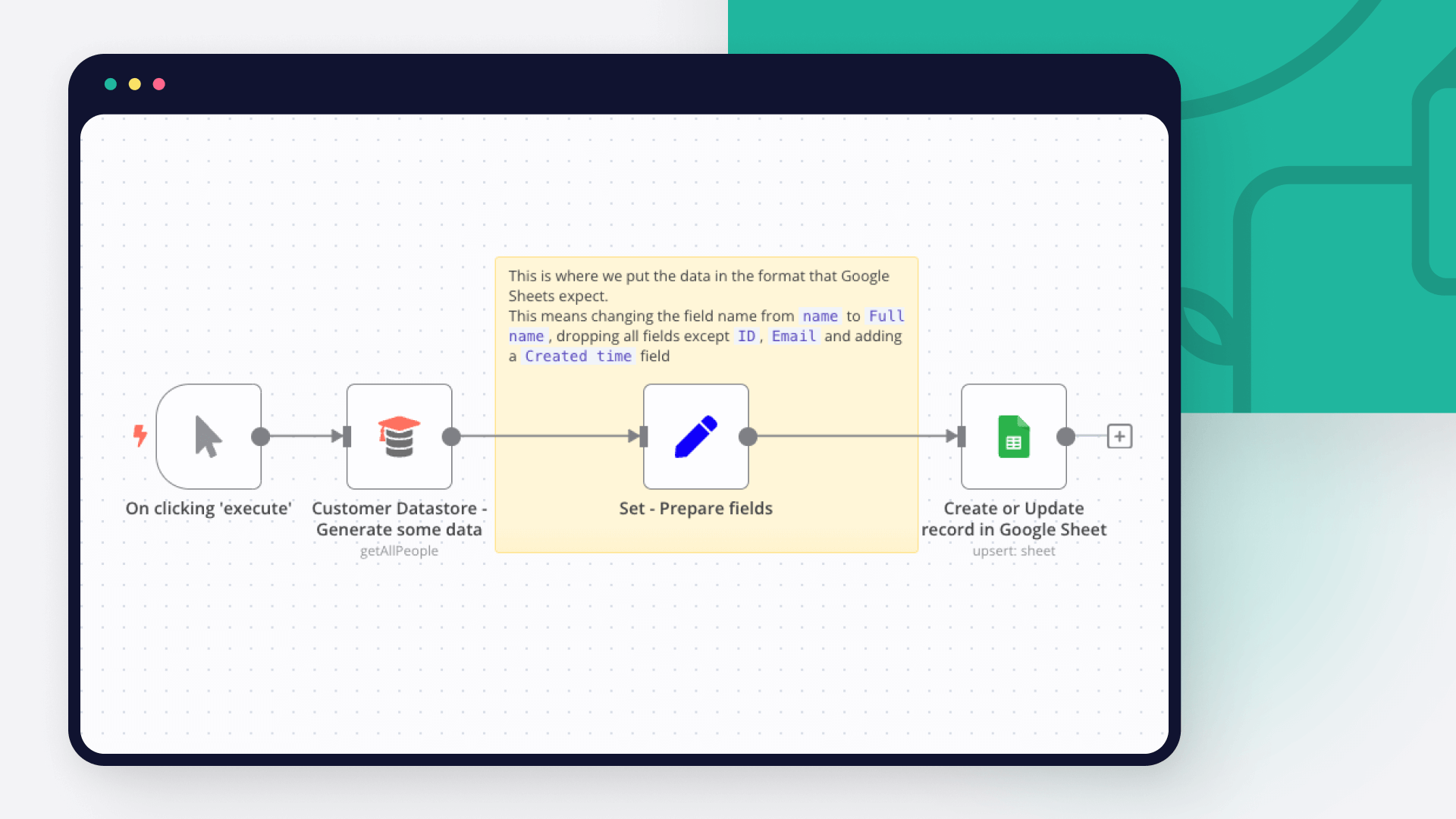
Google Gemini Chat Model and Google Sheets integration: Create a new workflow and add the first step

Step 2: Add and configure Google Gemini Chat Model and Google Sheets nodes

You can find Google Gemini Chat Model and Google Sheets in the nodes panel. Drag them onto your workflow canvas, selecting their actions. Click each node, choose a credential, and authenticate to grant n8n access. Configure Google Gemini Chat Model and Google Sheets nodes one by one: input data on the left, parameters in the middle, and output data on the right.

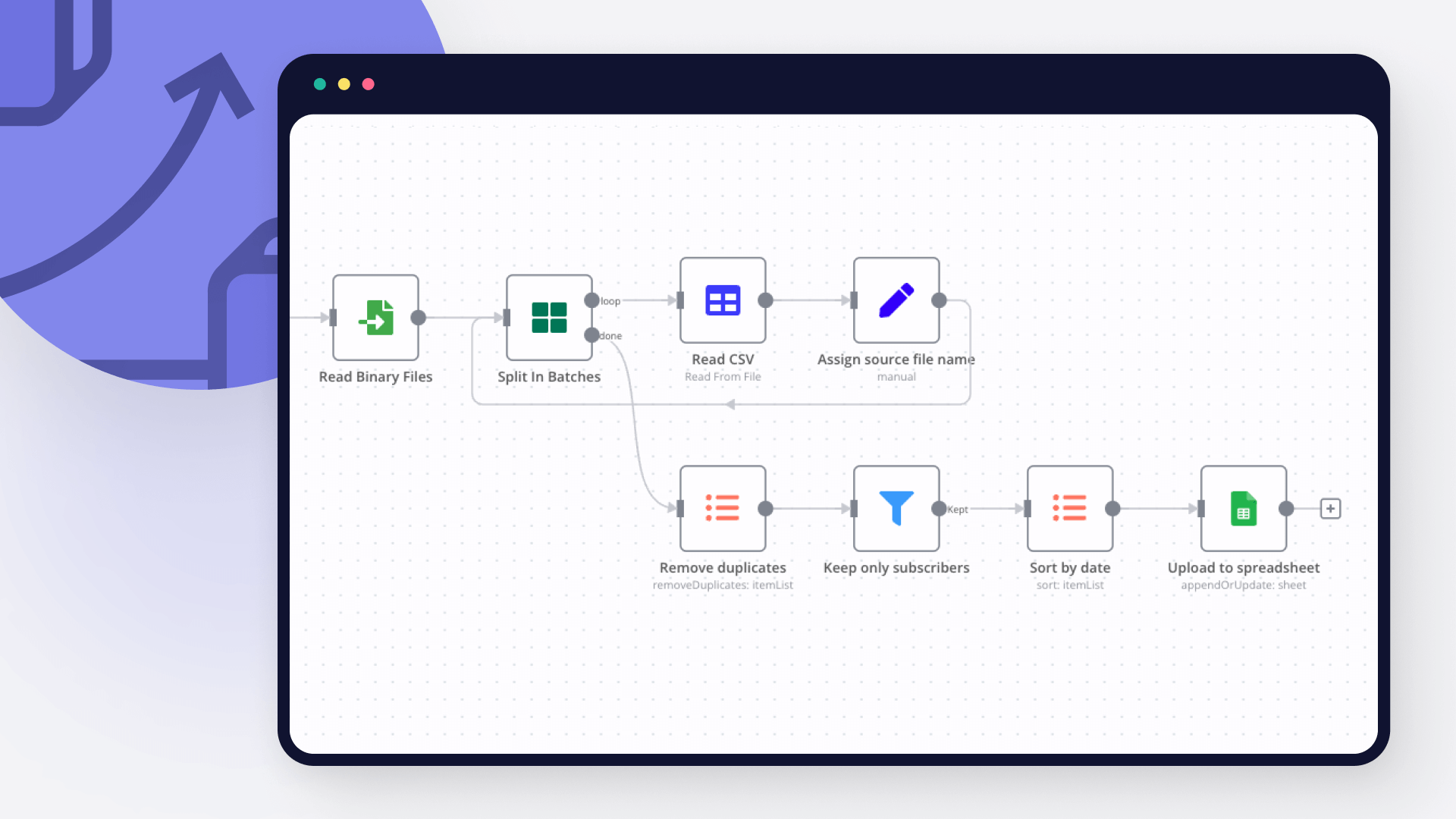
Google Gemini Chat Model and Google Sheets integration: Add and configure Google Gemini Chat Model and Google Sheets nodes

Step 3: Connect Google Gemini Chat Model and Google Sheets

A connection establishes a link between Google Gemini Chat Model and Google Sheets (or vice versa) to route data through the workflow. Data flows from the output of one node to the input of another. You can have single or multiple connections for each node.

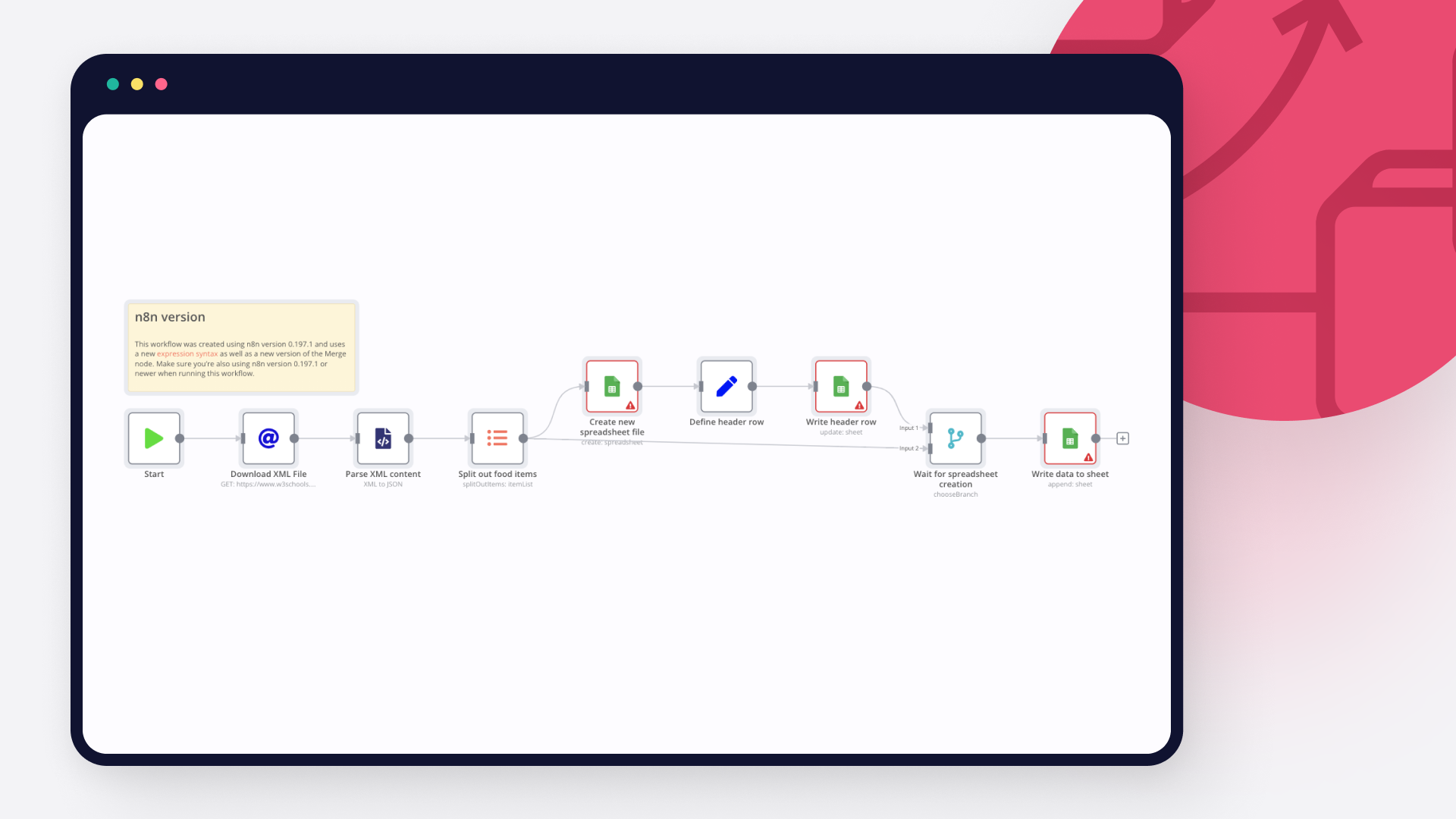
Google Gemini Chat Model and Google Sheets integration: Connect Google Gemini Chat Model and Google Sheets

Step 4: Customize and extend your Google Gemini Chat Model and Google Sheets integration

Use n8n's core nodes such as If, Split Out, Merge, and others to transform and manipulate data. Write custom JavaScript or Python in the Code node and run it as a step in your workflow. Connect Google Gemini Chat Model and Google Sheets with any of n8n’s 1000+ integrations, and incorporate advanced AI logic into your workflows.

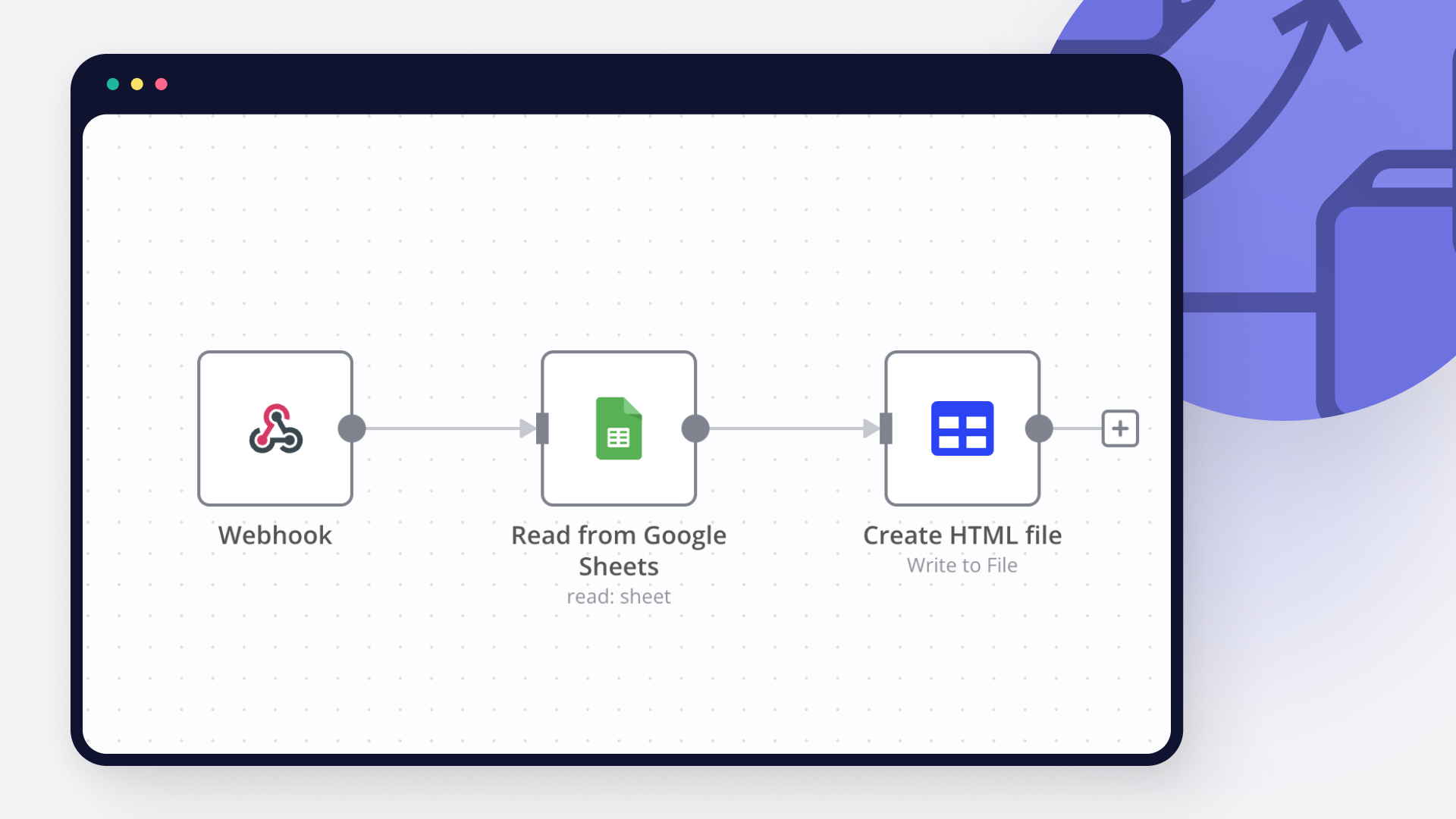
Google Gemini Chat Model and Google Sheets integration: Customize and extend your Google Gemini Chat Model and Google Sheets integration

Step 5: Test and activate your Google Gemini Chat Model and Google Sheets workflow

Save and run the workflow to see if everything works as expected. Based on your configuration, data should flow from Google Gemini Chat Model to Google Sheets or vice versa. Easily debug your workflow: you can check past executions to isolate and fix the mistake. Once you've tested everything, make sure to save your workflow and activate it.

Google Gemini Chat Model and Google Sheets integration: Test and activate your Google Gemini Chat Model and Google Sheets workflow

Automated AI content creation & Instagram publishing from Google Sheets

Automated AI Content Creation & Instagram Publishing from Google Sheets

This n8n workflow automates the creation and publishing of social media content directly to Instagram, using ideas stored in a Google Sheet. It leverages AI (Google Gemini and Replicate Flux) to generate concepts, image prompts, captions, and the final image, turning your content plan into reality with minimal manual intervention.

Think of this as the execution engine for your content strategy. It assumes you have a separate process (whether manual entry, another workflow, or a different tool) for populating the Google Sheet with initial post ideas (including Topic, Audience, Voice, and Platform). This workflow takes those ideas and handles the rest, from AI generation to final publication.

What does this workflow do?

This workflow streamlines the content execution process by:

Automatically fetching** unprocessed content ideas from a designated Google Sheet based on a schedule.
Using Google Gemini to generate a platform-specific content concept (specifically for a 'Single Image' format).
Generating two distinct AI image prompt options based on the concept using Gemini.
Writing an engaging, platform-tailored caption (including hashtags) using Gemini, based on the first prompt option.
Generating a visual image using the first prompt option via the Replicate API (using the Flux model).
Publishing* the generated image and caption directly to a connected Instagram Business account*.
Updating the status** in the Google Sheet to mark the idea as completed, preventing reprocessing.

Who is this for?

Social Media Managers & Agencies:** Automate the execution of your content calendar stored in Google Sheets.
Marketing Teams:** Streamline content production from planned ideas and ensure consistent posting schedules.
Content Creators & Solopreneurs:** Save significant time by automating the generation and publishing process based on your pre-defined ideas.
Anyone** using Google Sheets to plan social media content and wanting to automate the creative generation and posting steps with AI.

Benefits

Full Automation:** From fetching planned ideas to Instagram publishing, automate the entire content execution pipeline.
AI-Powered Generation:** Leverage Google Gemini for creative concepts, prompts, and captions, and Replicate for image generation based on your initial topic.
Content Calendar Execution:** Directly turn your Google Sheet plan into published posts.
Time Savings:** Drastically reduce the manual effort involved in creating visuals and text for each planned post.
Consistency:** Maintain a regular posting schedule by automatically processing your queue of ideas.
Platform-Specific Content:** AI prompts are designed to tailor concepts, prompts, and captions for the platform specified in your sheet (e.g., Instagram or LinkedIn).

How it Works

Scheduled Trigger: The workflow starts automatically based on the schedule you set (e.g., every hour, daily).
Fetch Idea: Reads the next row from your Google Sheet where the 'Status' column indicates it's pending (e.g., '0'). It only fetches one idea per run.
Prepare Inputs: Extracts Topic, Audience, Voice, and Platform from the sheet data.
AI Concept Generation (Gemini): Creates a single content concept suitable for a 'Single Image' post on the target platform.
AI Prompt Generation (Gemini): Develops two detailed, distinct image prompt options based on the concept.
AI Caption Generation (Gemini): Writes a caption tailored to the platform, using the first image prompt and other context.
Image Generation (Replicate): Sends the first prompt to the Replicate API (Flux model) to generate the image.
Prepare for Instagram: Formats the generated image URL and caption.
Publish to Instagram: Uses the Facebook Graph API in three steps:
Creates a media container by uploading the image URL and caption.
Waits for Instagram to process the container.
Publishes the processed container to your feed.
Update Sheet: Changes the 'Status' in the Google Sheet for the processed row (e.g., to '1') to mark it as complete.

n8n Nodes Used

Schedule Trigger
Google Sheets (Read & Update operations)
Set (Multiple instances for data preparation)
Langchain Chain - LLM (Multiple instances for Gemini calls)
Langchain Chat Model - Google Gemini (Multiple instances)
Langchain Output Parser - Structured (Multiple instances)
HTTP Request (for Replicate API call)
Wait
Facebook Graph API (Multiple instances for Instagram publishing steps)

Prerequisites

Active n8n instance (Cloud or Self-Hosted).
Google Account** with access to Google Sheets.
Google Sheets API Credentials (OAuth2):** Configured in n8n.
A Google Sheet** structured with columns like Topic, Audience, Voice, Platform, Status (or similar). Ensure your 'pending' and 'completed' statuses are defined (e.g., '0' and '1').
Google Cloud Project** with the Vertex AI API enabled.
Google Gemini API Credentials:** Configured in n8n (usually via Google Vertex AI credentials).
Replicate Account** and API Token.
Replicate API Credentials (Header Auth):** Configured in n8n.
Facebook Developer Account**.
Instagram Business Account** connected to a Facebook Page.
Facebook App** with necessary permissions: instagram_basic, instagram_content_publish, pages_read_engagement, pages_show_list.
Facebook Graph API Credentials (OAuth2):** Configured in n8n with the required permissions.

Setup

Import the workflow JSON into your n8n instance.
Configure Schedule Trigger: Set the desired frequency (e.g., every 30 minutes, every 4 hours) for checking new ideas in the sheet.
Configure Google Sheets Nodes:
Select your Google Sheets OAuth2 credentials for both Google Sheets nodes.
In 1. Get Next Post Idea..., enter your Spreadsheet ID and Sheet Name. Verify the Status filter matches your 'pending' value (e.g., 0).
In 7. Update Post Status..., enter the same Spreadsheet ID and Sheet Name. Ensure the Matching Columns (e.g., Topic) and the Status value to update match your 'completed' value (e.g., 1).
Configure Google Gemini Nodes: Select your configured Google Vertex AI / Gemini credentials in all Google Gemini Chat Model nodes.
Configure Replicate Node (4. Generate Image...): Select your Replicate Header Auth credentials. The workflow uses black-forest-labs/flux-1.1-pro-ultra by default; you can change this if needed.
Configure Facebook Graph API Nodes (6a, 6c):
Select your Facebook Graph API OAuth2 credentials.
Crucially, update the Instagram Account ID in the Node parameter of both Facebook Graph API nodes (6a and 6c). The template uses a placeholder (17841473009917118); replace this with your actual Instagram Business Account ID.
Adjust Wait Node (6b): The default wait time might be sufficient, but if you encounter errors during publishing (especially with larger images/videos in the future), you might need to increase the wait duration.
Activate the workflow.
Populate your Google Sheet: Ensure you have rows with your content ideas and the correct 'pending' status (e.g., '0'). The workflow will pick them up on its next scheduled run.

This workflow transforms your Google Sheet content plan into a fully automated AI-powered Instagram publishing engine. Start automating your social media presence today!

Nodes used in this workflow

Popular Google Gemini Chat Model and Google Sheets workflows

+3

Nutrition Tracker & Meal Logger with Telegram, Gemini AI and Google Sheets

🤖🥗 Telegram Nutrition AI Assistant (Alternative to Cal AI App) > AI-powered nutrition assistant for Telegram — log meals, set goals, and get personalized daily reports with Google Sheets integration. 📋 Description This n8n template creates a Telegram-based Nutrition AI Assistant 🥑🔥 designed as an open-source alternative to the Cal AI mobile app. It allows users to interact with an AI agent via text, voice, or images to track meals, calculate macros, and monitor nutrition goals directly from Telegram. The system integrates Google Sheets as the database, handling both user profiles and meal logs, while leveraging Gemini AI for natural conversation, food recognition, and daily progress reports. ✨ Key Features 💬 Multi-input support: Text, voice messages (transcribed), and food images (AI analysis). 📊 Macro calculation: Automatic estimation of calories, proteins, carbs, and fats. 📝 User-friendly registration: Simple onboarding without storing personal health data (no weight/height required). 🎯 Goal tracking: Users can set and update calorie and protein targets. 📈 Daily reports: Personalized progress messages with visual progress bars. 🗂 Google Sheets integration: Profile table for user targets. Meals table for food logs. 🔄 Advanced n8n nodes: Includes use of Merge, Subworkflow, and Code nodes for data processing and report generation. 💡 Acknowledgment Inspired by the Cal AI concept 💡 — this template demonstrates how to reproduce its main functionality with n8n, Telegram, and AI agents as a flexible, open-source automation workflow. 🏷 Tags telegram ai-assistant nutrition meal-tracking google-sheets food-logging voice-transcription image-analysis daily-reports n8n-template merge-node subworkflow-node code-node telegram-trigger google-gemini 💼 Use Case Use this template if you want to: 🥗 Log meals using text, images, or voice messages. 📊 Track nutrition goals (calories, proteins) with daily progress updates. 🤖 Provide a chat-based nutrition assistant without building a full app. 🗂 Store structured nutrition data in Google Sheets for easy access and analysis. 💬 Example User Interactions 📸 User sends a photo of a meal → AI analyzes the food and logs calories/macros. 🎤 User sends a voice message → AI transcribes and logs the meal. ⌨️ User types “report” → AI returns a daily nutrition summary with progress bars. 🥅 User says “update my protein goal” → AI updates profile in Google Sheets. 🔑 Required Credentials Telegram Bot API (Bot Token) Google Sheets API credentials AI Provider API (Google Gemini or compatible LLM) ⚙️ Setup Instructions 🗂 Create two Google Sheets tables: Profile: User_ID, Name, Calories_target, Protein_target Meals: User_ID, Date, Meal_description, Calories, Proteins, Carbs, Fats 🔌 Configure the Telegram Trigger with your bot token. 🤖 Connect your AI provider credentials (Gemini recommended). 📑 Connect Google Sheets with your credentials. ▶️ Deploy the workflow in n8n. 🎯 Start interacting with your nutrition assistant via Telegram. 📌 Extra Notes 🟩 Green section: Handles Telegram trigger and user check. 🟥 Red section: Registers new users and sets goals. 🟦 Blue section: Processes text, voice, and images. 🟨 Yellow section: Generates nutrition reports. 🟪 Purple section: Main AI agent controlling tools and logic. 💡 Need Assistance? If you’d like help customizing or extending this workflow, feel free to reach out: 📧 Email: [email protected] 🔗 LinkedIn: John Alejandro Silva Rodríguez

Automated Law Firm Lead Management & Scheduling with AI, Jotform & Calendar

Youtube Explanation: [https://youtu.be/KgmNiV7SwkU](https://youtu.be/KgmNiV7SwkU ) This n8n workflow is designed to automate the initial intake and scheduling for a law firm. It's split into two main parts: New Inquiry Handling: Kicks off when a potential client fills out a JotForm, saves their data, and sends them an initial welcome message on WhatsApp. Appointment Scheduling: Activates when the client replies on WhatsApp, allowing an AI agent to chat with them to schedule a consultation. Here’s a detailed breakdown of the prerequisites and each node. Prerequisites Before building this workflow, you'll need accounts and some setup for each of the following services: JotForm JotForm Account**: You need an active JotForm account. A Published Form**: Create a form with the exact fields used in the workflow: Full Name, Email Address, Phone Number, I am a..., Legal Service of Interest, Brief Message, and How Did You Hear About Us?. API Credentials**: Generate API keys from your JotForm account settings to connect it with n8n. Google Google Account**: To use Google Sheets and Google Calendar. Google Sheet**: Create a new sheet named "Law Client Enquiries". The first row must have these exact headers: Full Name, Email Address, Phone Number, client type, Legal Service of Interest, Brief Message, How Did You Hear About Us?. Google Calendar**: An active calendar to manage appointments. Google Cloud Project**: Service Account Credentials (for Sheets): In the Google Cloud Console, create a service account, generate JSON key credentials, and enable the Google Sheets API. You must then share your Google Sheet with the service account's email address (e.g., [email protected]). OAuth Credentials (for Calendar): Create OAuth 2.0 Client ID credentials to allow n8n to access your calendar on your behalf. You'll need to enable the Google Calendar API. Gemini API Key: Enable the Vertex AI API in your Google Cloud project and generate an API key to use the Google Gemini models. WhatsApp Meta Business Account**: Required to use the WhatsApp Business Platform. WhatsApp Business Platform Account: You need to set up a business account and connect a phone number to it. This is **different from the regular WhatsApp or WhatsApp Business app. API Credentials**: Get the necessary access tokens and IDs from your Meta for Developers dashboard to connect your business number to n8n. PostgreSQL Database A running PostgreSQL instance**: This can be hosted anywhere (e.g., AWS, DigitalOcean, Supabase). The AI agent needs it to store and retrieve conversation history. Database Credentials**: You'll need the host, port, user, password, and database name to connect n8n to it. Node-by-Node Explanation The workflow is divided into two distinct logical flows. Flow 1: New Client Intake from JotForm This part triggers when a new client submits your form. JotForm Trigger What it does: This is the starting point. It automatically runs the workflow whenever a new submission is received for the specified JotForm (Form ID: 252801824783057). Prerequisites: A JotForm account and a created form. Append or update row in sheet (Google Sheets) What it does: It takes the data from the JotForm submission and adds it to your "Law Client Enquiries" Google Sheet. How it works: It uses the appendOrUpdate operation. It tries to find a row where the "Email Address" column matches the email from the form. If it finds a match, it updates that row; otherwise, it appends a new row at the bottom. Prerequisites: A Google Sheet with the correct headers, shared with your service account. AI Agent What it does: This node crafts the initial welcome message to be sent to the client. How it works: It uses a detailed prompt that defines a persona ("Alex," a legal intake assistant) and instructs the AI to generate a professional WhatsApp message. It dynamically inserts the client's name and service of interest from the Google Sheet data into the prompt. Connected Node: It's powered by the Google Gemini Chat Model. Send message (WhatsApp) What it does: It sends the message generated by the AI Agent to the client. How it works: It takes the client's phone number from the data (Phone Number column) and the AI-generated text (output from the AI Agent node) to send the message via the WhatsApp Business API. Prerequisites: A configured WhatsApp Business Platform account. Flow 2: AI-Powered Scheduling via WhatsApp This part triggers when the client replies to the initial message. WhatsApp Trigger What it does: This node listens for incoming messages on your business's WhatsApp number. When a client replies, it starts this part of the workflow. Prerequisites: A configured WhatsApp Business Platform account. If node What it does: It acts as a simple filter. It checks if the incoming message text is empty. If it is (e.g., a status update), the workflow stops. If it contains text, it proceeds to the AI agent. AI Agent1 What it does: This is the main conversational brain for scheduling. It handles the back-and-forth chat with the client. How it works: Its prompt is highly detailed, instructing it to act as "Alex" and follow a strict procedure for scheduling. It has access to several "tools" to perform actions. Connected Nodes: Google Gemini Chat Model1: The language model that does the thinking. Postgres Chat Memory: Remembers the conversation history with a specific user (keyed by their WhatsApp ID), so the user doesn't have to repeat themselves. Tools: Know about the user enquiry, GET MANY EVENTS..., and Create an event. AI Agent Tools (What the AI can do) Know about the user enquiry (Google Sheets Tool): When the AI needs to know who it's talking to, it uses this tool. It takes the user's phone number and looks up their original enquiry details in the "Law Client Enquiries" sheet. GET MANY EVENTS... (Google Calendar Tool): When a client suggests a date, the AI uses this tool to check your Google Calendar for any existing events on that day to see if you're free. Create an event (Google Calendar Tool): Once a time is agreed upon, the AI uses this tool to create the event in your Google Calendar, adding the client as an attendee. Send message1 (WhatsApp) What it does: Sends the AI's response back to the client. This could be a confirmation that the meeting is booked, a question asking for their email, or a suggestion for a different time if the requested slot is busy. How it works: It sends the output text from AI Agent1 to the client's WhatsApp ID, continuing the conversation.
+2

Customer Support WhatsApp Bot with Google Docs Knowledge Base and Gemini AI

Document-Aware WhatsApp AI Bot for Customer Support Google Docs-Powered WhatsApp Support Agent 24/7 WhatsApp AI Assistant with Live Knowledge from Google Docs 📝Description Template Smart WhatsApp AI Assistant Using Google Docs Help customers instantly on WhatsApp using a smart AI assistant that reads your company’s internal knowledge from a Google Doc in real time. Built for clubs, restaurants, agencies, or any business where clients ask questions based on a policy, FAQ, or services document. ⚙️ How it works Users send free-form questions to your WhatsApp Business number (e.g. “What are the gym rules?” or “Are you open today?”) The bot automatically reads your company’s internal Google Doc (policy, schedule, etc.) It merges the document content with today’s date and the user’s question to craft a custom AI prompt The AI (Gemini or ChatGPT) then replies back on WhatsApp using natural, helpful language All conversations are logged to Google Sheets for reporting or audit > 💡Bonus: The AI even understands dates inside the document and compares them to today’s date — e.g. if your document says “Closed May 25 for 30 days,” it will say “We're currently closed until June 24. 🧰 Set up steps Connect your WhatsApp Cloud API account (Meta) Add your Google account and grant access to the Doc containing your company info Choose your AI model (ChatGPT/OpenAI or Gemini) Paste your document ID into the Google Docs node Connect your WhatsApp webhook to Meta (only takes 5 minutes) Done — start receiving and answering customer questions! > 📄 Works best with free-tier OpenAI/Gemini, Google Docs, and Meta's Cloud API (no phone required). Everything is modular, extensible, and low-code. 🔄 Customization Tips Change the Google Doc anytime to update answers — no retraining needed Add your logo and business name in the AI agent’s “System Prompt” Add fallback routes like “Escalate to human” if the bot can't help Clone for multiple brands by duplicating the workflow and swapping in new docs 🤝 Need Help Setting It Up? If you'd like help connecting your WhatsApp Business API, setting up Google Docs access, or customizing this AI assistant for your business or clients… 📩 I offer setup, branding, and customization services: WhatsApp Cloud API setup & verification Google OAuth & Doc structure guidance AI model configuration (OpenAI / Gemini) Branding & prompt tone customization Logging, reporting, and escalation logic Just send a message via: Email: [email protected] WhatsApp: +20 106 180 3236

Lead Generation Agent

Who this is for This workflow is for digital marketing agencies or sales teams who want to automatically find business leads based on industry & location, gather their contact details, and send personalized cold emails — all from one form submission. What this workflow does This workflow starts every time someone submits the Lead Machine Form. It then: Scrapes business data* (company name, website, phone, address, category) using Apify* based on business type & location. Extracts the best email address* from each business website using Google Gemini AI*. Stores valid leads* in Google Sheets*. Generates cold email content** (subject + body) with AI based on your preferred tone (Friendly, Professional, Simple). Sends the cold email** via Gmail. Updates the sheet** with send status & timestamp. Setup To set this workflow up: Form Trigger – Customize the “Lead Machine” form fields if needed (Business Type, Location, Lead Number, Email Style). Apify API – Add your Apify Actor Endpoint URL in the HTTP Request node. Google Gemini – Add credentials for extracting email addresses. Google Sheets – Connect your sheet for storing leads & email status. OpenAI – Add your credentials for cold email generation. Gmail – Connect your Gmail account for sending cold emails. How to customize this workflow to your needs Change the AI email prompt to reflect your brand’s voice and offer. Add filters to only target leads that meet specific criteria (e.g., website must exist, email must be verified). Modify the Google Sheets structure to track extra info like “Follow-up Date” or “Lead Source”. Switch Gmail to another email provider if preferred.
+2

Analyze Facebook Ads & Send Insights to Google Sheets with Gemini AI

Stop manually digging through Meta Ads data and spending hours trying to connect the dots. This workflow turns n8n into an AI-powered media buyer that automatically analyzes your ad performance, categorizes your creatives, and delivers insights directly into a Google Sheet. ➡️ Watch the full 4-part setup and tutorial on YouTube: https://youtu.be/hxQshcD3e1Y About This 4-Part Automation Series As a media buyer, I built this system to automate the heavy lifting of analyzing ad data and brainstorming new creative ideas. This template is the first foundational part of that larger system. ✅ Part 1 (This Template): Pulling Ad Data & Getting Quick Insights Automatically pulls data into a Google Sheet and uses an LLM to categorize ad performance. ✅ Part 2: Finding the Source Files for the Best Ads Fetches the image or video files for top-performing ads. ✅ Part 3: Using AI to Understand Why an Ad Works Sends your best ads to Google Gemini for structured notes on hooks, transcripts, and visuals. ✅ Part 4: Getting the AI to Suggest New Creative Ideas Uses all the insights to generate fresh ad concepts, scripts, and creative briefs. What This Template (Part 1) Does Secure Token Management Automatically retrieves and refreshes your Facebook long-term access token. Fetch Ad Data Pulls the last 28 days of ad-level performance data from your Facebook Ads account. Process & Clean Parses raw data, standardizes key e-commerce metrics (like ROAS), and filters for sales-focused campaigns. Benchmark Calculation Aggregates all data to create an overall performance benchmark (e.g., average Cost Per Purchase). AI Analysis A “Senior Media Buyer” AI persona evaluates each ad against the benchmark and categorizes it as “HELL YES,” “YES,” or “MAYBE,” with justifications. Output to Google Sheets Updates your Google Sheet with both raw performance data and AI-generated insights. Who Is It For? E-commerce store owners Digital marketing agencies Facebook Ads media buyers How to Set It Up Credentials Connect your Google Gemini and Google Sheets accounts in the respective nodes. The template uses NocoDB for token management. Configure the “Getting Long-Term Token” and “Updating Token” nodes — or replace them with your preferred credential storage method. Update Your IDs In the “Getting Data For the Past 28 Days…” HTTP Request node, replace act_XXXXXX in the URL with your Facebook Ad Account ID. In both Google Sheets nodes (“Sending Raw Data…” and “Updating Ad Insights…”), update the Document ID with your target Google Sheet’s ID. Run the Workflow Click “Test workflow” to run your first AI-powered analysis! Tools Used n8n Facebook for Developers Google AI Studio (Gemini) NocoDB (or any credential database of your choice)
+13

🤖 AI content generation for Auto Service 🚘 Automate your social media📲!

Who Is This For? 🚘This workflow is designed for auto service / car repair businesses looking to streamline their social media marketing with Ai tools and automation via n8n. Whether you’re a small garage owner, a car repair shop, an automotive specialist or automechanic - this tool helps you maintain an active online presence without spending hours creating content. 💪🏼 Though this template is set up for Auto Service daily content uploads, but the underlying logic is universal. You can easily adapt it for any niche by editing prompts, adding nodes, and creating or uploading a variety of content to any platform. You can use any LLM and generative AI of your choice. Personally, I prefer the smooth and effective results from ChatGPT 4.1 combined with GPT Image 1. But you can generate videos instead of images for your posts as well 😉 What Problem Is This Workflow Solving? 🤦‍♂️ Many auto service businesses struggle with consistently posting engaging content due to time constraints or lack of marketing expertise. 💎This workflow solves that by automating the content creation and posting process, ensuring your social media channels stay fresh and active, ultimately attracting more customers. What This Workflow Does: Generates daily social media posts tailored specifically to the auto service niche using AI. Allows easy customization of post and image prompts. Integrates research links through the Tavily Internet Search tool for relevant content. Supports starting posts based on reference article links via Google Sheets. Automatically publishes posts to your connected social media platforms. Enables scheduled or trigger-based posting for maximum flexibility. How It Works? Easy, actually ☺️ AI creates daily social media content made just for Auto Service. You can simply edit prompts for both posts and images, set up news or articles research links via the Tavily Internet Search tool. You can also start the workflow with a reference article link through Google Sheets. 🎯 Consistently posting relevant and actual niche content helps attract new customers, all while leveraging AI and n8n tools to keep the process seamless and cost-effective. Set Up Steps: I kept it quick and simple for you ✨ If you’re happy with the current LLM and image model configurations, just connect your OpenAI API credentials to enable AI content generation. Link your social media accounts (Facebook, Telegram, X, etc.) for autoposting. Optionally connect Google Sheets if you want to trigger posts based on sheet updates with reference links. Customize prompts as needed to match your brand voice, style and marketing tasks. Choose between: 1) Scheduled automatic generation and posting at the same time as socials algorythms like it. 2) Google Sheets trigger with reference. 3) Manual start. How to Customize This Workflow to Your Needs? Switch AI models and edit prompts to better reflect your specific services or promotions. Add or modify research links in Tavily to keep your posts timely and relevant. Adjust posting schedules to match peak engagement times for your audience. Expand or reduce the number of social platforms integrated depending on your marketing strategy. Use Google Sheets to batch upload ideas or curate specific content topics. After adjusting a few settings, activate the workflow and let it run. 🤖 The system will then automatically publish your content across your selected social platforms — saving you time and effort. 📌 You’ll find more detailed tips and additional ai models for customizing ai generation process inside the workflow via sticky notes. 💬 Need help? For additional guidance, feel free to message me — here’s my profile in the n8n community for direct contact 👈 click!

Build your own Google Gemini Chat Model and Google Sheets integration

Create custom Google Gemini Chat Model and Google Sheets workflows by choosing triggers and actions. Nodes come with global operations and settings, as well as app-specific parameters that can be configured. You can also use the HTTP Request node to query data from any app or service with a REST API.

Google Sheets supported actions

Create
Create a spreadsheet
Delete
Delete a spreadsheet
Append or Update Row
Append a new row or update an existing one (upsert)
Append Row
Create a new row in a sheet
Clear
Delete all the contents or a part of a sheet
Create
Create a new sheet
Delete
Permanently delete a sheet
Delete Rows or Columns
Delete columns or rows from a sheet
Get Row(s)
Retrieve one or more rows from a sheet
Update Row
Update an existing row in a sheet

FAQs

  • Can Google Gemini Chat Model connect with Google Sheets?

  • Can I use Google Gemini Chat Model’s API with n8n?

  • Can I use Google Sheets’s API with n8n?

  • Is n8n secure for integrating Google Gemini Chat Model and Google Sheets?

  • How to get started with Google Gemini Chat Model and Google Sheets integration in n8n.io?

Need help setting up your Google Gemini Chat Model and Google Sheets integration?

Discover our latest community's recommendations and join the discussions about Google Gemini Chat Model and Google Sheets integration.
Sergey Komardenkov
sérgio eduardo floresta filho
Julian
therealJMT
Guilherme

Looking to integrate Google Gemini Chat Model and Google Sheets in your company?

Over 3000 companies switch to n8n every single week

Why use n8n to integrate Google Gemini Chat Model with Google Sheets

Build complex workflows, really fast
Build complex workflows, really fast

Handle branching, merging and iteration easily.
Pause your workflow to wait for external events.

Code when you need it, UI when you don't

Simple debugging

Your data is displayed alongside your settings, making edge cases easy to track down.

Use templates to get started fast

Use 1000+ workflow templates available from our core team and our community.

Reuse your work

Copy and paste, easily import and export workflows.

Implement complex processes faster with n8n

red iconyellow iconred iconyellow icon