Back to Integrations
integrationGoogle Gemini Chat Model node
integrationHubSpot node

Google Gemini Chat Model and HubSpot integration

Save yourself the work of writing custom integrations for Google Gemini Chat Model and HubSpot and use n8n instead. Build adaptable and scalable AI, Langchain, and Sales workflows that work with your technology stack. All within a building experience you will love.

How to connect Google Gemini Chat Model and HubSpot

  • Step 1: Create a new workflow
  • Step 2: Add and configure nodes
  • Step 3: Connect
  • Step 4: Customize and extend your integration
  • Step 5: Test and activate your workflow

Step 1: Create a new workflow and add the first step

In n8n, click the "Add workflow" button in the Workflows tab to create a new workflow. Add the starting point – a trigger on when your workflow should run: an app event, a schedule, a webhook call, another workflow, an AI chat, or a manual trigger. Sometimes, the HTTP Request node might already serve as your starting point.
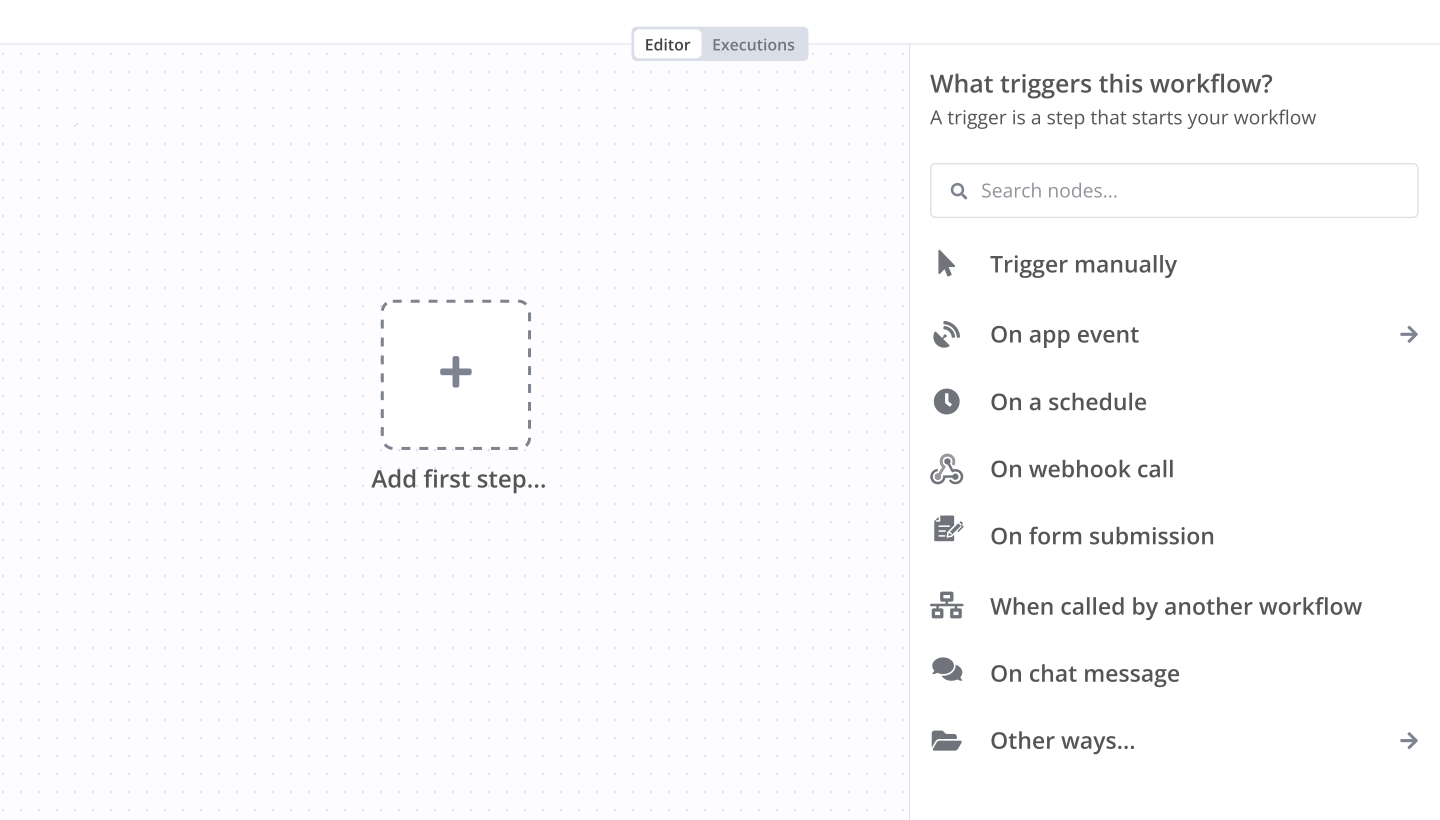
Google Gemini Chat Model and HubSpot integration: Create a new workflow and add the first step

Step 2: Add and configure Google Gemini Chat Model and HubSpot nodes

You can find Google Gemini Chat Model and HubSpot in the nodes panel. Drag them onto your workflow canvas, selecting their actions. Click each node, choose a credential, and authenticate to grant n8n access. Configure Google Gemini Chat Model and HubSpot nodes one by one: input data on the left, parameters in the middle, and output data on the right.

Google Gemini Chat Model and HubSpot integration: Add and configure Google Gemini Chat Model and HubSpot nodes

Step 3: Connect Google Gemini Chat Model and HubSpot

A connection establishes a link between Google Gemini Chat Model and HubSpot (or vice versa) to route data through the workflow. Data flows from the output of one node to the input of another. You can have single or multiple connections for each node.

Google Gemini Chat Model and HubSpot integration: Connect Google Gemini Chat Model and HubSpot

Step 4: Customize and extend your Google Gemini Chat Model and HubSpot integration

Use n8n's core nodes such as If, Split Out, Merge, and others to transform and manipulate data. Write custom JavaScript or Python in the Code node and run it as a step in your workflow. Connect Google Gemini Chat Model and HubSpot with any of n8n’s 1000+ integrations, and incorporate advanced AI logic into your workflows.

Google Gemini Chat Model and HubSpot integration: Customize and extend your Google Gemini Chat Model and HubSpot integration

Step 5: Test and activate your Google Gemini Chat Model and HubSpot workflow

Save and run the workflow to see if everything works as expected. Based on your configuration, data should flow from Google Gemini Chat Model to HubSpot or vice versa. Easily debug your workflow: you can check past executions to isolate and fix the mistake. Once you've tested everything, make sure to save your workflow and activate it.

Google Gemini Chat Model and HubSpot integration: Test and activate your Google Gemini Chat Model and HubSpot workflow

Personalise outreach emails using customer data and AI

This n8n template uses existing emails from customers as context to customise and "finetune" outreach emails to them using AI.

By now, it should be common knowledge that we can leverage AI to generate unique emails but in a way, they can remain generic as the AI lacks the customer context to be truly personalised. One way to solve this is by pulling in a source of customer data - and what better way then by using existing email correspondence.

How it works
Customers to target are pulled from Hubspot and each customer is then run in a loop. We're using a loop as the retrieved emails for each customer become separate items and a loop helps with item reference.
We connect to our Gmail account to pull all emails recieved from the customer.
The contents of the email will be suitable to build a short persona of the customer. We use the Information Extractor to get our AI model to pull out the key attributes of this persona such as decision making style and communication preferences.
With this persona, we can now pass this to our AI model to generate a personalised outreach email specifically for our customer.
Finally, a draft email is created for human review before sending. If you would rather send the email straight away, this is also possible.

How to use
Define the topic of the outreach email in the "variables" node. This directs the AI on what outreach email to generate.
Ensure the emails are pulled from the right account. If emails may contain sensitive data, adjust the filters and text parsing to ensure these are not leaked to the AI (which might then leak into the generated email).

Requirements
Hubspot for Contacts List
OpenAI for LLM
Gmail for Existing Emails and Sending Emails

Customising this workflow
Not using Hubspot? Any CRM would work just as well or even a simple text csv!
If you have customer past deals or engagements in your CRM, consider using this as additional context for the AI to use.

Nodes used in this workflow

Popular Google Gemini Chat Model and HubSpot workflows

+3

Score and nurture HubSpot leads with Clearbit and Gemini AI

Who is this for SMB sales teams and SaaS companies who want to automatically prioritize and nurture new leads without manual qualification. Perfect for businesses getting 50+ leads per month who need to identify high-value prospects quickly. How it works When a new contact is created in HubSpot, the workflow automatically enriches their data using Clearbit's company database. A scoring algorithm evaluates company size, industry fit, and job title relevance, then Gemini AI analyzes the enriched data to provide additional insights and generate personalized outreach content. Hot leads (score 80+) receive immediate personalized emails and trigger Slack notifications to the sales team. Warm leads (50-79) are added to nurturing sequences. Cold leads are simply scored for future reference. All scoring data and reasoning are logged to Google Sheets for analysis and optimization. How to set up Configure credentials for HubSpot, Clearbit API, Gemini AI, Gmail, Slack, and Google Sheets. Create a Google Sheet for scoring history with the column headers shown in the workflow. Update the Slack channel name in the notification node and customize the Gmail sender settings. Requirements HubSpot with contact creation access Clearbit Enrichment API account Google Gemini AI API key Gmail account for sending emails Slack workspace for notifications Google Sheets for tracking How to customize Adjust scoring criteria in the Set node including target industries, company size weights, and role priorities. Modify hot/warm score thresholds (default 80/50). Customize email templates and Slack message format within the Gemini AI prompt. Add additional scoring factors in the Code node calculation.
+2

AI Email Reply Based on HubSpot Data + Slack Approval

This n8n template drafts customer-ready email replies using Google Gemini, enriched with HubSpot context (contact, deals, companies, tickets). Each draft is routed to Slack for one-click approval before it’s sent from Gmail—so you move fast without losing control. Ideal for support and sales teams that want speedy, personalized responses while keeping humans in the loop. How it works Gmail Trigger** watches for new inbound emails. Sender filter** excludes internal domains (e.g., n8n.io) to avoid auto-replying to teammates. HubSpot contact lookup* finds the sender and fetches associated deals/companies/tickets* via association + batch read. CRM context is normalized** into clean, LLM-friendly fields (no IDs or sensitive noise). Gemini (Google AI Studio)** generates a concise, friendly reply using: Sender name, subject, and message snippet Safe, relevant HubSpot context (e.g., top 1–2 deals or an open ticket) Style constraints (≤ \~150 words, single CTA, optional clarifying question) Slack approval* posts the draft to a channel; if approved, n8n *replies via Gmail in the original thread. How to use Gmail: Connect the same account for the trigger and reply nodes. HubSpot: Connect OAuth on the search + HTTP request nodes. Gemini: Add your Google AI Studio API key to the Google Gemini Chat Model node. Slack: Connect and select the channel for draft approvals. (Optional) Filter: Adjust the Allowed Sender filter before going live. (Optional) Prompt: Edit “Draft Reply (AI Agent)” tone/length or how much CRM detail to include. Activate the workflow. New emails will produce Slack-approved replies automatically. Requirements Gmail** (trigger + send) HubSpot** (OAuth2) for contact + associations Slack** for approval step Google Gemini** (Google AI Studio API key) Notes & customization Safety rails:** The prompt avoids exposing IDs/raw JSON and caps CRM details to what’s useful. Auto-send mode:** Skip Slack if you want fully automated replies for specific senders/labels. Richer context:** Extend the batch read to pull more properties (e.g., next step, renewal date). Triage:** Branch on subject/labels to route billing vs. technical requests to different prompts. QA queue:* If the model asks a clarifying question, keep it to one*—the node enforces that.

Email Outreach Drafter Based on HubSpot Data

This n8n template turns a small, targeted HubSpot list into tailored outreach. It scans each contact’s recent Gmail conversations, builds a lightweight persona with AI (tone, goals, pain points, decision style), then drafts a concise sales email aligned to your offer—saved to Gmail as a reviewable draft. Perfect for SDRs and founders who want personalization at scale without writing from scratch. This template was originally created by Jim Le. How it works Manual trigger** starts a controlled run. HubSpot search** pulls a focused list of contacts (e.g., hs_buying_role = DECISION_MAKER). Batch loop** processes contacts one by one. Gmail fetch** grabs up to 20 recent threads from each contact. AI persona extraction** (Information Extractor + Gemini) analyzes messages to capture: decision-making style, communication preferences, goals/motivations pain points, work style, personality traits, buying behavior, values, market awareness Variables node* sets core fields (first name, last name, email) and the offer* you want to pitch. AI email generation* (Gemini) mirrors the contact’s tone and priorities; outputs subject + HTML body*. Gmail draft** is created for the contact so a rep can skim, tweak, and send. How to use Connect HubSpot on the “Get Contacts” node and refine the filter to your segment. Connect Gmail on both read and draft nodes (same account recommended). Add Gemini key to both Gemini nodes. In Variables, update product_to_sell with your offer and confirm the contact field mappings. (Optional) Tweak the persona attributes or the email prompt for tone/length/CTA. Click Test workflow. Review drafts in Gmail, edit if needed, then send. Requirements HubSpot** (OAuth2) for contact targeting Gmail** (read + draft) Google Gemini** (API key) for persona + copy generation Notes & customization Tighter targeting:** Change the HubSpot filter (e.g., industry, territory, lifecycle stage) to keep the list small and measurable. Richer inputs:** Increase Gmail limit or include received/sent filters to capture more context (mind rate limits). Brand voice:** Add a short style guide to the email generator’s system prompt (e.g., sentence length, jargon rules, sign-off). Offer variants:** Replace product_to_sell per segment, or branch by industry to load different value props. Compliance & privacy:** Limit stored outputs to essentials; avoid copying sensitive content from threads verbatim. Auto-send option:** Swap the draft step for “send email” if you want hands-off delivery for known segments.

Personalise Outreach Emails using Customer data and AI

This n8n template uses existing emails from customers as context to customise and "finetune" outreach emails to them using AI. By now, it should be common knowledge that we can leverage AI to generate unique emails but in a way, they can remain generic as the AI lacks the customer context to be truly personalised. One way to solve this is by pulling in a source of customer data - and what better way then by using existing email correspondence. How it works Customers to target are pulled from Hubspot and each customer is then run in a loop. We're using a loop as the retrieved emails for each customer become separate items and a loop helps with item reference. We connect to our Gmail account to pull all emails recieved from the customer. The contents of the email will be suitable to build a short persona of the customer. We use the Information Extractor to get our AI model to pull out the key attributes of this persona such as decision making style and communication preferences. With this persona, we can now pass this to our AI model to generate a personalised outreach email specifically for our customer. Finally, a draft email is created for human review before sending. If you would rather send the email straight away, this is also possible. How to use Define the topic of the outreach email in the "variables" node. This directs the AI on what outreach email to generate. Ensure the emails are pulled from the right account. If emails may contain sensitive data, adjust the filters and text parsing to ensure these are not leaked to the AI (which might then leak into the generated email). Requirements Hubspot for Contacts List OpenAI for LLM Gmail for Existing Emails and Sending Emails Customising this workflow Not using Hubspot? Any CRM would work just as well or even a simple text csv! If you have customer past deals or engagements in your CRM, consider using this as additional context for the AI to use.

Build a Slack-based CRM assistant with HubSpot and Google Gemini

How it works This workflow creates a Slack-based CRM assistant that allows users to query HubSpot data using natural language. When a user mentions the bot in Slack, the message is cleaned and processed to remove Slack-specific formatting. The workflow then retrieves and filters relevant data from HubSpot (deals, companies, and contacts). Finally, an AI agent formats the response and sends a structured reply back to Slack. Step-by-step Trigger on Slack mention** Slack Trigger – Listens for app mentions in Slack channels. Code in JavaScript – Cleans the message by removing Slack IDs and formatting. Fetch and filter CRM data** Get Deals – Retrieves deals from HubSpot. Filter Deals – Filters deals based on the user query. Get many companies – Fetches company records from HubSpot. Filter Companies – Matches companies against the query. Get Contacts – Retrieves contact data from HubSpot. Filter Contacts – Filters contacts using name-based matching. Merge – Combines filtered deals, companies, and contacts into one dataset. Generate and send AI response** AI Agent – Uses AI to format and structure the CRM data into a readable response. Google Gemini Chat Model – Provides the language model for the AI agent. Send a message – Sends the final response back to the Slack channel. Why use this? Enables instant CRM access directly from Slack without logging into HubSpot Simplifies data lookup using natural language queries Combines multiple CRM objects into a single intelligent response Improves team productivity with faster decision-making Easily customizable for additional fields, filters, or AI formatting
+2

Enrich event registrations with HubSpot, Clearbit, LinkedIn and Gemini AI

Event Registration + Auto-Enrichment Intelligence Who is this for? Event organizers, conference planners, and marketing teams fighting registration drop-off who want 4-field forms with LinkedIn-level attendee intelligence. What problem is this workflow solving? Multi-page forms kill conversions: 80-90% drop-off on page 2 No attendee insights post-reg Manual enrichment wastes hours Abandoned carts = lost revenue This captures 4 fields but enriches 15+ data points automatically. What this workflow does 3 Webhook Intelligence Suite: POST /event-registration**: 4-field form → enrichment → HubSpot POST /reg-beacon**: Abandoned cart tracking pixel POST /validate-promo**: AJAX promo code validation Requires 2 sub-workflows: 1) Abandoned Cart Recovery 2) Participant Re-engager Enrichment Waterfall: Clearbit → LinkedIn (Proxycurl) → Google+AI → Full profile Outputs: HubSpot contacts with company/role/title Data Tables: enriched_profiles / reg_analytics Slack alerts + email confirmations Setup (12 minutes) Data Tables**: enriched_profiles, reg_analytics, promo_codes HubSpot**: API key + custom properties APIs**: Clearbit, Proxycurl, SerpAPI, Gemini Host**: reg-page/index.html (update webhook URLs) SMTP/Slack**: Notifications Fully configurable, no code changes needed. How to customize to your needs Forms**: Swap HTML for Typeform/Webflow Enrichment**: Add Apollo/Hunter for emails CRM**: HubSpot → Salesforce → Airtable Promos**: Tiered discounts / early-bird Companion**: Abandoned Cart + Re-engager templates ROI: 3x registration completion** (4 fields vs 12+) 65% enriched profiles** (company/role/title) 20% revenue recovery** (abandoned carts) Need help customizing?: Contact me for consulting and support: LinkedIn / Message Keywords: event registration, attendee enrichment, abandoned cart recovery, conference automation, HubSpot

Build your own Google Gemini Chat Model and HubSpot integration

Create custom Google Gemini Chat Model and HubSpot workflows by choosing triggers and actions. Nodes come with global operations and settings, as well as app-specific parameters that can be configured. You can also use the HTTP Request node to query data from any app or service with a REST API.

HubSpot supported actions

Create
Create a company
Delete
Delete a company
Get
Get a company
Get Many
Get many companies
Get Recently Created/Updated
Get recently created/updated companies
Search
Search companies by their website domain
Update
Update a company
Create or Update
Create a new contact, or update the current one if it already exists (upsert)
Delete
Delete a contact
Get
Get a contact
Get Many
Get many contacts
Get Recently Created/Updated
Get recently created/updated contacts
Search
Search contacts
Add
Add contact to a list
Remove
Remove a contact from a list
Create
Create a deal
Delete
Delete a deal
Get
Get a deal
Get Many
Get many deals
Get Recently Created/Updated
Get recently created/updated deals
Search
Search deals
Update
Update a deal
Create
Create an engagement
Delete
Delete an engagement
Get
Get an engagement
Get Many
Get many engagements
Create
Create a ticket
Delete
Delete a ticket
Get
Get a ticket
Get Many
Get many tickets
Update
Update a ticket
Use case

Supercharge your CRM

Need a more powerful integration with your CRM? n8n lets you go beyond standard integrations offered by popular CRMs!

Learn more

FAQs

  • Can Google Gemini Chat Model connect with HubSpot?

  • Can I use Google Gemini Chat Model’s API with n8n?

  • Can I use HubSpot’s API with n8n?

  • Is n8n secure for integrating Google Gemini Chat Model and HubSpot?

  • How to get started with Google Gemini Chat Model and HubSpot integration in n8n.io?

Looking to integrate Google Gemini Chat Model and HubSpot in your company?

Over 3000 companies switch to n8n every single week

Why use n8n to integrate Google Gemini Chat Model with HubSpot

Build complex workflows, really fast
Build complex workflows, really fast

Handle branching, merging and iteration easily.
Pause your workflow to wait for external events.

Code when you need it, UI when you don't

Simple debugging

Your data is displayed alongside your settings, making edge cases easy to track down.

Use templates to get started fast

Use 1000+ workflow templates available from our core team and our community.

Reuse your work

Copy and paste, easily import and export workflows.

Implement complex processes faster with n8n

red iconyellow iconred iconyellow icon