Back to Integrations
integrationGoogle Gemini Chat Model node
integrationHunter node

Google Gemini Chat Model and Hunter integration

Save yourself the work of writing custom integrations for Google Gemini Chat Model and Hunter and use n8n instead. Build adaptable and scalable AI, Langchain, and Sales workflows that work with your technology stack. All within a building experience you will love.

How to connect Google Gemini Chat Model and Hunter

  • Step 1: Create a new workflow
  • Step 2: Add and configure nodes
  • Step 3: Connect
  • Step 4: Customize and extend your integration
  • Step 5: Test and activate your workflow

Step 1: Create a new workflow and add the first step

In n8n, click the "Add workflow" button in the Workflows tab to create a new workflow. Add the starting point – a trigger on when your workflow should run: an app event, a schedule, a webhook call, another workflow, an AI chat, or a manual trigger. Sometimes, the HTTP Request node might already serve as your starting point.
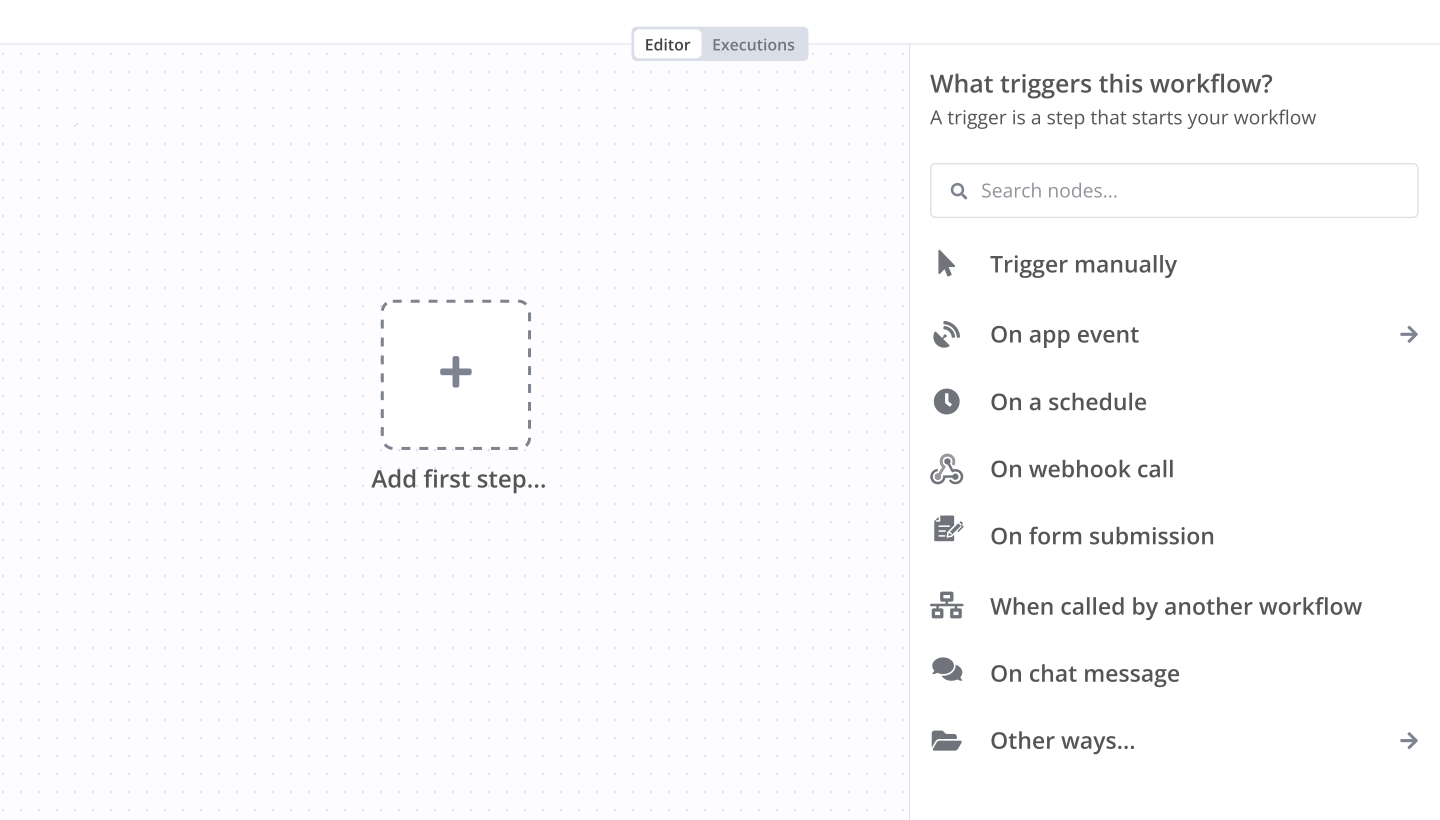
Google Gemini Chat Model and Hunter integration: Create a new workflow and add the first step

Step 2: Add and configure Google Gemini Chat Model and Hunter nodes

You can find Google Gemini Chat Model and Hunter in the nodes panel. Drag them onto your workflow canvas, selecting their actions. Click each node, choose a credential, and authenticate to grant n8n access. Configure Google Gemini Chat Model and Hunter nodes one by one: input data on the left, parameters in the middle, and output data on the right.

Google Gemini Chat Model and Hunter integration: Add and configure Google Gemini Chat Model and Hunter nodes

Step 3: Connect Google Gemini Chat Model and Hunter

A connection establishes a link between Google Gemini Chat Model and Hunter (or vice versa) to route data through the workflow. Data flows from the output of one node to the input of another. You can have single or multiple connections for each node.

Google Gemini Chat Model and Hunter integration: Connect Google Gemini Chat Model and Hunter

Step 4: Customize and extend your Google Gemini Chat Model and Hunter integration

Use n8n's core nodes such as If, Split Out, Merge, and others to transform and manipulate data. Write custom JavaScript or Python in the Code node and run it as a step in your workflow. Connect Google Gemini Chat Model and Hunter with any of n8n’s 1000+ integrations, and incorporate advanced AI logic into your workflows.

Google Gemini Chat Model and Hunter integration: Customize and extend your Google Gemini Chat Model and Hunter integration

Step 5: Test and activate your Google Gemini Chat Model and Hunter workflow

Save and run the workflow to see if everything works as expected. Based on your configuration, data should flow from Google Gemini Chat Model to Hunter or vice versa. Easily debug your workflow: you can check past executions to isolate and fix the mistake. Once you've tested everything, make sure to save your workflow and activate it.

Google Gemini Chat Model and Hunter integration: Test and activate your Google Gemini Chat Model and Hunter workflow

Generate product-aware B2B leads and outreach emails with Gemini, Pinecone and Gmail

How can you find your target market if you don't know what your product is.

This simple philosophy changes the way we think about automated sales agents. Context changes everything. In this 4-part workflow, we start by creating a knowledge base that will act as context across the workflow. This context will guide and provide our AI Agents across the workflow to locate better leads and perform market research based on what the product actually offers.

Use Case: Lead generation for Product-based Sales

Tech Required

Neon DB**: For storing Research and Lead Data. You can use Google sheets but it has a rate limiting problem.
Google Serper**: As a web search tool for our AI.
Google Drive**: For storing our knowledge base documents.
Pinecone**: Vector DB for converting our knowledge base into context for AI.
Hunter.io**: For finding emails for outreach.
Email Client**: An email client, maybe gmail or anything that can send an email on your behalf.
Gemini**: Our trusty AI LLM.

Good to know

All of the tools that I use in this workflow are either free or have an extremely generous free-tier.

How it works

We start by converting our knowledge base into context for AI. Take in the documents from Google drive and convert it into embeddings and store them in a vector store like Pinecone. This needs to be only run once, or whenever you have a new document in your knowledge base.
Then we pass this context to an AI agent and tell it to generate search queries for locating companies that actually need my services.
Then for each company that we've located, we determine the company staff that we need to reach out to for selling our product. This will be done by a combination of Google Serper and Hunter.io
Once we have the list of employees and their emails, we start creating personalized emails based on the data we've collected for each of the employee and send them outreach emails.

Nodes used in this workflow

Popular Google Gemini Chat Model and Hunter workflows

+10

Generate product-aware B2B leads and outreach emails with Gemini, Pinecone and Gmail

How can you find your target market if you don't know what your product is. This simple philosophy changes the way we think about automated sales agents. Context changes everything. In this 4-part workflow, we start by creating a knowledge base that will act as context across the workflow. This context will guide and provide our AI Agents across the workflow to locate better leads and perform market research based on what the product actually offers. Use Case: Lead generation for Product-based Sales Tech Required Neon DB**: For storing Research and Lead Data. You can use Google sheets but it has a rate limiting problem. Google Serper**: As a web search tool for our AI. Google Drive**: For storing our knowledge base documents. Pinecone**: Vector DB for converting our knowledge base into context for AI. Hunter.io**: For finding emails for outreach. Email Client**: An email client, maybe gmail or anything that can send an email on your behalf. Gemini**: Our trusty AI LLM. Good to know All of the tools that I use in this workflow are either free or have an extremely generous free-tier. How it works We start by converting our knowledge base into context for AI. Take in the documents from Google drive and convert it into embeddings and store them in a vector store like Pinecone. This needs to be only run once, or whenever you have a new document in your knowledge base. Then we pass this context to an AI agent and tell it to generate search queries for locating companies that actually need my services. Then for each company that we've located, we determine the company staff that we need to reach out to for selling our product. This will be done by a combination of Google Serper and Hunter.io Once we have the list of employees and their emails, we start creating personalized emails based on the data we've collected for each of the employee and send them outreach emails.

Generate PDF business proposals with Google Gemini and PDF Generator API

AI-Powered Automated Proposal & Lead Management System This advanced n8n workflow automates the transition from "Raw Lead" to "Sent Proposal." By integrating Email Verification, Large Language Models (LLMs), and Document Automation, it eliminates manual data entry and ensures that every proposal sent is personalized, professional, and delivered to a verified address. 🛠️ How It Works Data Intake & Validation The workflow is triggered via a Webhook. Before any processing occurs, the data passes through the Hunter node, which performs a real-time email verification check. Smart Error Handling: An If Node evaluates the verification result. If the email is invalid or "risky," the workflow redirects to a Respond to Webhook node, providing immediate feedback to the source and preventing wasted API credits on downstream nodes. The AI Agent Layer Once validated, the data reaches the Set Fields node to be mapped for the AI. Custom Prompt Logic: The AI Agent node, powered by Google Gemini, contains a sophisticated custom prompt. This prompt acts as a "template engine," instructing the AI to take specific input variables (like client name, project scope, and budget) and output a clean, professional HTML structure. This allows for dynamic content generation that adapts to the unique context of every lead. Professional PDF Generation Instead of sending a plain text email, the workflow passes the AI-generated HTML to the PDF Generator API. This tool renders the code into a high-quality, brand-consistent PDF document ready for client viewing. Automated Delivery & CRM Logging Gmail Integration: The final PDF is automatically attached and sent to the verified email address with a personalized message. Google Sheets Logging: To ensure full visibility, the workflow appends a row to a Google Sheet, tracking the date, client details, and the status of the sent proposal. 📋 Requirements To run this workflow, you will need active accounts and API credentials for the following services: n8n Instance: (Self-hosted or Cloud). Hunter.io API: For the email verification node. Google Gemini API: To power the AI Agent and custom prompt. PDF Generator API: To convert the AI's HTML output into documents. Google Workspace Account: Required for the Gmail (Sending) and Google Sheets (Logging) nodes. ⚙️ How to Set Up Follow these steps to get the workflow operational: Import the Workflow: Download the JSON file and paste it into your n8n canvas. Configure Credentials: Connect your Hunter API key. Set up your Google Gemini credentials (via Google Cloud Console). Add your PDF Generator API key. Authenticate your Google Account (OAuth2) for Gmail and Google Sheets. Customize the AI Prompt: Open the AI Agent node. Under the "System Message" or "Prompt" section, adjust the HTML template to match your brand's style and the specific fields you want to include in your proposal. Map your Google Sheet: Open the Append row in sheet node and select the specific spreadsheet and worksheet where you want to log your leads. Test the Flow: Use the Webhook simulator (Example DATA) to send a test payload and verify that the PDF is generated and the email is sent correctly.

Build your own Google Gemini Chat Model and Hunter integration

Create custom Google Gemini Chat Model and Hunter workflows by choosing triggers and actions. Nodes come with global operations and settings, as well as app-specific parameters that can be configured. You can also use the HTTP Request node to query data from any app or service with a REST API.

Hunter supported actions

Domain Search
Get every email address found on the internet using a given domain name, with sources
Email Finder
Generate or retrieve the most likely email address from a domain name, a first name and a last name
Email Verifier
Verify the deliverability of an email address
Use case

Supercharge your CRM

Need a more powerful integration with your CRM? n8n lets you go beyond standard integrations offered by popular CRMs!

Learn more

FAQs

  • Can Google Gemini Chat Model connect with Hunter?

  • Can I use Google Gemini Chat Model’s API with n8n?

  • Can I use Hunter’s API with n8n?

  • Is n8n secure for integrating Google Gemini Chat Model and Hunter?

  • How to get started with Google Gemini Chat Model and Hunter integration in n8n.io?

Looking to integrate Google Gemini Chat Model and Hunter in your company?

Over 3000 companies switch to n8n every single week

Why use n8n to integrate Google Gemini Chat Model with Hunter

Build complex workflows, really fast
Build complex workflows, really fast

Handle branching, merging and iteration easily.
Pause your workflow to wait for external events.

Code when you need it, UI when you don't

Simple debugging

Your data is displayed alongside your settings, making edge cases easy to track down.

Use templates to get started fast

Use 1000+ workflow templates available from our core team and our community.

Reuse your work

Copy and paste, easily import and export workflows.

Implement complex processes faster with n8n

red iconyellow iconred iconyellow icon