Back to Integrations
integrationGoogle Gemini Chat Model node
integrationJira Software node

Google Gemini Chat Model and Jira Software integration

Save yourself the work of writing custom integrations for Google Gemini Chat Model and Jira Software and use n8n instead. Build adaptable and scalable AI, Langchain, Development, and Productivity workflows that work with your technology stack. All within a building experience you will love.

How to connect Google Gemini Chat Model and Jira Software

  • Step 1: Create a new workflow
  • Step 2: Add and configure nodes
  • Step 3: Connect
  • Step 4: Customize and extend your integration
  • Step 5: Test and activate your workflow

Step 1: Create a new workflow and add the first step

In n8n, click the "Add workflow" button in the Workflows tab to create a new workflow. Add the starting point – a trigger on when your workflow should run: an app event, a schedule, a webhook call, another workflow, an AI chat, or a manual trigger. Sometimes, the HTTP Request node might already serve as your starting point.
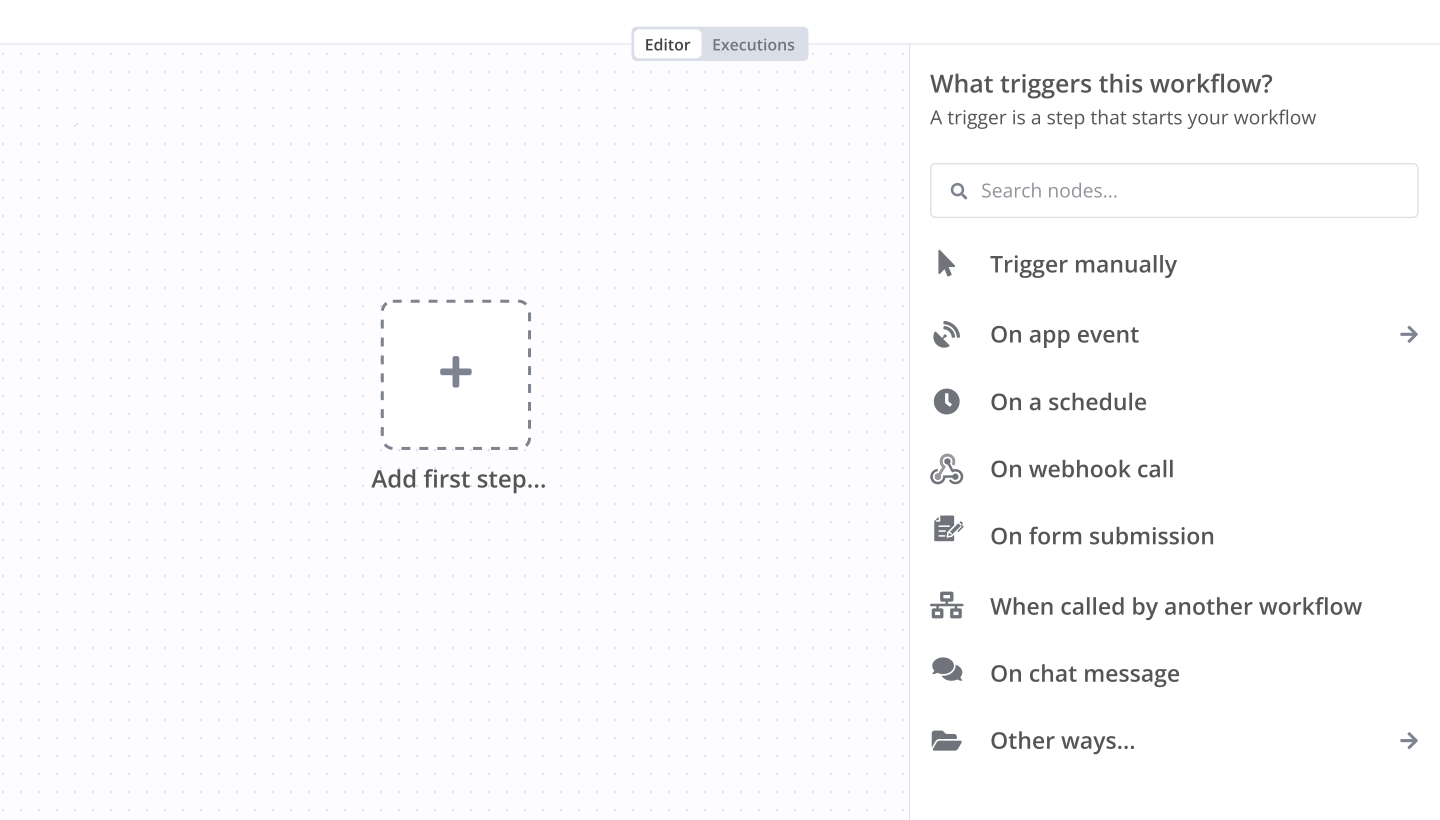
Google Gemini Chat Model and Jira Software integration: Create a new workflow and add the first step

Step 2: Add and configure Google Gemini Chat Model and Jira Software nodes

You can find Google Gemini Chat Model and Jira Software in the nodes panel. Drag them onto your workflow canvas, selecting their actions. Click each node, choose a credential, and authenticate to grant n8n access. Configure Google Gemini Chat Model and Jira Software nodes one by one: input data on the left, parameters in the middle, and output data on the right.

Google Gemini Chat Model and Jira Software integration: Add and configure Google Gemini Chat Model and Jira Software nodes

Step 3: Connect Google Gemini Chat Model and Jira Software

A connection establishes a link between Google Gemini Chat Model and Jira Software (or vice versa) to route data through the workflow. Data flows from the output of one node to the input of another. You can have single or multiple connections for each node.

Google Gemini Chat Model and Jira Software integration: Connect Google Gemini Chat Model and Jira Software

Step 4: Customize and extend your Google Gemini Chat Model and Jira Software integration

Use n8n's core nodes such as If, Split Out, Merge, and others to transform and manipulate data. Write custom JavaScript or Python in the Code node and run it as a step in your workflow. Connect Google Gemini Chat Model and Jira Software with any of n8n’s 1000+ integrations, and incorporate advanced AI logic into your workflows.

Google Gemini Chat Model and Jira Software integration: Customize and extend your Google Gemini Chat Model and Jira Software integration

Step 5: Test and activate your Google Gemini Chat Model and Jira Software workflow

Save and run the workflow to see if everything works as expected. Based on your configuration, data should flow from Google Gemini Chat Model to Jira Software or vice versa. Easily debug your workflow: you can check past executions to isolate and fix the mistake. Once you've tested everything, make sure to save your workflow and activate it.

Google Gemini Chat Model and Jira Software integration: Test and activate your Google Gemini Chat Model and Jira Software workflow

Automate GitHub, JIRA release notes with Google Gemini & notification over email

This n8n template from Intuz provides a complete and automated solution for creating and distributing sophisticated release notes.

It connects to GitHub and JIRA to gather data from recent commits and completed tickets, using specific keywords or labels to identify key features for inclusion.

This information is then processed by Google Gemini to automatically generate well-written, human-like release notes, which are then distributed via email to stakeholders, creating a complete, end-to-end communication pipeline for every new software release.

This template is perfect for development teams looking to streamline their release process, ensure consistent communication, and eliminate the manual effort of writing release notes.

How to use

  1. Set up Credentials:

GitHub
JIRA (Software Cloud API)
Google Gemini (or another PaLM/LLM provider)
Your SMTP email server.

  1. Configure the GitHub Trigger:

Select the Github Trigger node.
In the Repository Owner field, enter your GitHub username or organization name.
In the Repository Name field, select the repository you want to monitor.

  1. Verify the JIRA Integration:

Important:** This workflow assumes your commit messages contain a JIRA key (e.g., "PROJ-123: Fix login bug").
Select the first Code node. It uses a regular expression ([A-Z]+-\d+)/i to find JIRA keys. Adjust this expression if your team uses a different format.
Select the Get an issue node and ensure your JIRA credentials are correctly configured.

  1. Customize the AI Prompt:

Select the Basic LLM Chain node. You can edit the prompt to change the tone, style, or structure of the generated HTML release note to match your company's standards.

  1. Configure Email Notifications:

Select the Send email node.
Update the To Email field with the recipient's email address (e.g., a team distribution list or a stakeholder's email).
Customize the From Email and Subject line as needed.

  1. Activate Workflow:

Save your changes and activate the workflow. Now, every push to your configured repository will trigger the automated generation and sending of release notes.

Required Tools

GitHub: To trigger the workflow on code pushes.
JIRA: To fetch details about the tasks and bugs included in the release.
Google Gemini: To intelligently generate the release note content. (You can swap this for another LLM supported by n8n).
SMTP Provider: To send the final release note via email.

Connect with us

Website: https://www.intuz.com/n8n-workflow-automation-templates
Email: [email protected]
LinkedIn: https://www.linkedin.com/company/intuz
Get Started: https://n8n.partnerlinks.io/intuz

For Custom Worflow Automation
Click here- Get Started

Nodes used in this workflow

Popular Google Gemini Chat Model and Jira Software workflows

Automate Code Reviews for GitLab MRs with Gemini AI and JIRA Context

What it does Automates code review by listening for a comment trigger on GitLab merge requests, summarising the diff, and using an LLM to post constructive, line‑specific feedback. If a JIRA ticket ID is found in the MR description, the ticket’s summary is used to inform the AI review. Use cases Quickly obtain high‑quality feedback on MRs without waiting for peers. Highlight logic, security or performance issues that might slip through cursory reviews. Incorporate project context by pulling in related JIRA ticket summaries. Good to know Triggered by commenting ai-review on a merge request. The LLM returns only high‑value findings; if nothing critical is detected, the workflow posts an “all clear” message. You can swap out the LLM (Gemini, OpenAI, etc.) or adjust the prompt to fit your team’s guidelines. AI usage may incur costs or be geo‑restricted depending on your provider n8n.io. How it works Webhook listener:** A Webhook node captures GitLab note events and filters for the trigger phrase. Fetch & parse:** The workflow retrieves MR details and diffs, splitting each change into “original” and “new” code blocks. Optional JIRA context:** If your MR description includes a JIRA key (e.g., PROJ-123), the workflow fetches the ticket (and parent ticket for subtasks) and composes a brief context summary. LLM review:** The parsed diff and optional context are sent to an LLM with instructions to identify logic, security or performance issues and suggest improvements. Post results:** Inline comments are posted back to the MR at the appropriate file/line positions; if no issues are found, a single “all clear” note is posted. How to use Import the template JSON and open the Webhook node. Replace the REPLACE_WITH_UNIQUE_PATH placeholder with your desired path and configure a GitLab project webhook to send MR comments to that URL. Select your LLM credentials in the Gemini (or other LLM) node, and optionally add JIRA credentials in the JIRA nodes. Activate the workflow and comment ai-review on any merge request to test it. For each review, the workflow posts status updates (“AI review initiated…”) and final comments. Requirements A GitLab project with a generate Personal Access Token (PAT) stored as an environment variable (GITLAB_TOKEN). LLM credentials (e.g., Google Gemini) and optional JIRA credentials. Customising this workflow Change the trigger phrase in the Trigger Phrase Filter node. Modify the LLM prompt to focus on different aspects (e.g., style, documentation). Filter out certain file types or directories before sending diffs to the LLM. Integrate other services (Slack, email) to notify teams when reviews are complete.

Automate GitHub, JIRA release notes with Google Gemini & notification over email

This n8n template from Intuz provides a complete and automated solution for creating and distributing sophisticated release notes. It connects to GitHub and JIRA to gather data from recent commits and completed tickets, using specific keywords or labels to identify key features for inclusion. This information is then processed by Google Gemini to automatically generate well-written, human-like release notes, which are then distributed via email to stakeholders, creating a complete, end-to-end communication pipeline for every new software release. This template is perfect for development teams looking to streamline their release process, ensure consistent communication, and eliminate the manual effort of writing release notes. How to use Set up Credentials: GitHub JIRA (Software Cloud API) Google Gemini (or another PaLM/LLM provider) Your SMTP email server. Configure the GitHub Trigger: Select the Github Trigger node. In the Repository Owner field, enter your GitHub username or organization name. In the Repository Name field, select the repository you want to monitor. Verify the JIRA Integration: Important:** This workflow assumes your commit messages contain a JIRA key (e.g., "PROJ-123: Fix login bug"). Select the first Code node. It uses a regular expression ([A-Z]+-\\d+)/i to find JIRA keys. Adjust this expression if your team uses a different format. Select the Get an issue node and ensure your JIRA credentials are correctly configured. Customize the AI Prompt: Select the Basic LLM Chain node. You can edit the prompt to change the tone, style, or structure of the generated HTML release note to match your company's standards. Configure Email Notifications: Select the Send email node. Update the To Email field with the recipient's email address (e.g., a team distribution list or a stakeholder's email). Customize the From Email and Subject line as needed. Activate Workflow: Save your changes and activate the workflow. Now, every push to your configured repository will trigger the automated generation and sending of release notes. Required Tools GitHub: To trigger the workflow on code pushes. JIRA: To fetch details about the tasks and bugs included in the release. Google Gemini: To intelligently generate the release note content. (You can swap this for another LLM supported by n8n). SMTP Provider: To send the final release note via email. Connect with us Website: https://www.intuz.com/n8n-workflow-automation-templates Email: [email protected] LinkedIn: https://www.linkedin.com/company/intuz Get Started: https://n8n.partnerlinks.io/intuz For Custom Worflow Automation Click here- Get Started

Build your own Google Gemini Chat Model and Jira Software integration

Create custom Google Gemini Chat Model and Jira Software workflows by choosing triggers and actions. Nodes come with global operations and settings, as well as app-specific parameters that can be configured. You can also use the HTTP Request node to query data from any app or service with a REST API.

Jira Software supported actions

Changelog
Get issue changelog
Create
Create a new issue
Delete
Delete an issue
Get
Get an issue
Get Many
Get many issues
Notify
Create an email notification for an issue and add it to the mail queue
Status
Return either all transitions or a transition that can be performed by the user on an issue, based on the issue's status
Update
Update an issue
Add
Add attachment to issue
Get
Get an attachment
Get Many
Get many attachments
Remove
Remove an attachment
Add
Add comment to issue
Get
Get a comment
Get Many
Get many comments
Remove
Remove a comment
Update
Update a comment
Create
Create a new user
Delete
Delete a user
Get
Retrieve a user
Use case

Save engineering resources

Reduce time spent on customer integrations, engineer faster POCs, keep your customer-specific functionality separate from product all without having to code.

Learn more

FAQs

  • Can Google Gemini Chat Model connect with Jira Software?

  • Can I use Google Gemini Chat Model’s API with n8n?

  • Can I use Jira Software’s API with n8n?

  • Is n8n secure for integrating Google Gemini Chat Model and Jira Software?

  • How to get started with Google Gemini Chat Model and Jira Software integration in n8n.io?

Looking to integrate Google Gemini Chat Model and Jira Software in your company?

Over 3000 companies switch to n8n every single week

Why use n8n to integrate Google Gemini Chat Model with Jira Software

Build complex workflows, really fast
Build complex workflows, really fast

Handle branching, merging and iteration easily.
Pause your workflow to wait for external events.

Code when you need it, UI when you don't

Simple debugging

Your data is displayed alongside your settings, making edge cases easy to track down.

Use templates to get started fast

Use 1000+ workflow templates available from our core team and our community.

Reuse your work

Copy and paste, easily import and export workflows.

Implement complex processes faster with n8n

red iconyellow iconred iconyellow icon