Back to Integrations
integrationGoogle Sheets node
integrationGoogle Tasks node

Google Sheets and Google Tasks integration

Save yourself the work of writing custom integrations for Google Sheets and Google Tasks and use n8n instead. Build adaptable and scalable Data & Storage, and Productivity workflows that work with your technology stack. All within a building experience you will love.

How to connect Google Sheets and Google Tasks

  • Step 1: Create a new workflow
  • Step 2: Add and configure nodes
  • Step 3: Connect
  • Step 4: Customize and extend your integration
  • Step 5: Test and activate your workflow

Step 1: Create a new workflow and add the first step

In n8n, click the "Add workflow" button in the Workflows tab to create a new workflow. Add the starting point – a trigger on when your workflow should run: an app event, a schedule, a webhook call, another workflow, an AI chat, or a manual trigger. Sometimes, the HTTP Request node might already serve as your starting point.
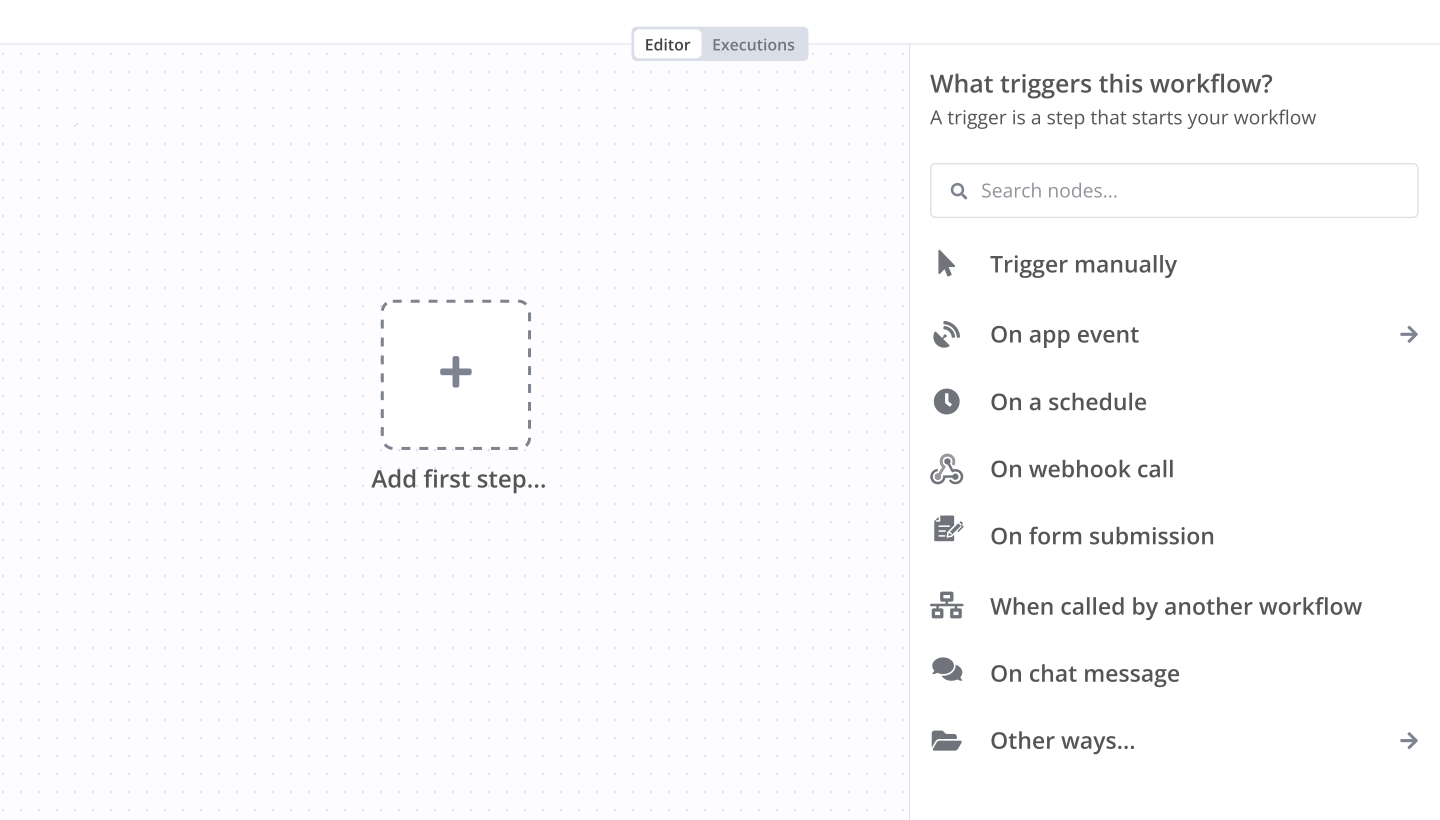
Google Sheets and Google Tasks integration: Create a new workflow and add the first step

Step 2: Add and configure Google Sheets and Google Tasks nodes

You can find Google Sheets and Google Tasks in the nodes panel. Drag them onto your workflow canvas, selecting their actions. Click each node, choose a credential, and authenticate to grant n8n access. Configure Google Sheets and Google Tasks nodes one by one: input data on the left, parameters in the middle, and output data on the right.

Google Sheets and Google Tasks integration: Add and configure Google Sheets and Google Tasks nodes

Step 3: Connect Google Sheets and Google Tasks

A connection establishes a link between Google Sheets and Google Tasks (or vice versa) to route data through the workflow. Data flows from the output of one node to the input of another. You can have single or multiple connections for each node.

Google Sheets and Google Tasks integration: Connect Google Sheets and Google Tasks

Step 4: Customize and extend your Google Sheets and Google Tasks integration

Use n8n's core nodes such as If, Split Out, Merge, and others to transform and manipulate data. Write custom JavaScript or Python in the Code node and run it as a step in your workflow. Connect Google Sheets and Google Tasks with any of n8n’s 1000+ integrations, and incorporate advanced AI logic into your workflows.

Google Sheets and Google Tasks integration: Customize and extend your Google Sheets and Google Tasks integration

Step 5: Test and activate your Google Sheets and Google Tasks workflow

Save and run the workflow to see if everything works as expected. Based on your configuration, data should flow from Google Sheets to Google Tasks or vice versa. Easily debug your workflow: you can check past executions to isolate and fix the mistake. Once you've tested everything, make sure to save your workflow and activate it.

Google Sheets and Google Tasks integration: Test and activate your Google Sheets and Google Tasks workflow

🌳 EU green legislation tracker with GPT-4o, Google Sheets and Tasks

Tags: EU Legislation, Sustainability, Automation, Web Scraping, OpenAI, Google Sheets, Policy Monitoring, Climate

Context

Hey! I’m Samir, a Supply Chain Engineer and Data Scientist from Paris, and the founder of LogiGreen Consulting.

We use AI, automation, and data to support sustainable business practices for small, medium and large companies.

This workflow is part of our broader initiative to monitor and act on sustainability legislation in Europe.

> How do you know if new EU laws will impact your business's sustainability goals?

This n8n workflow automatically scrapes the EU Parliament’s legislative portal to find and flag procedures related to environmental sustainability.

📬 For business inquiries, feel free to connect with me on LinkedIn

Who is this template for?

This workflow is useful for:
Sustainability consultants** monitoring legal frameworks
NGOs and researchers** tracking environmental regulations
Companies* aligning with CSRD or EU Green Deal* objectives
Policy analysts** looking for automation tools

What does it do?

This n8n workflow:
🌐 Scrapes the EU Parliament legislative portal for yesterday’s entries
🧠 Uses OpenAI to classify if each procedure is related to sustainability
🗂️ Filters out irrelevant items
📊 Saves the results in a Google Sheet
✅ Creates a Google Task for each relevant file to review the legislation

How it works

Trigger manually or on schedule
Scrape HTML blocks for scheduled debates
Parse each procedure to extract Title, Committee, Rapporteur, PDF link
Call GPT-4-turbo to check if the topic matches sustainability criteria
Filter responses based on “yes” or “no”
Store valid items into Google Sheets
Generate tasks in Google Tasks

The AI only flags procedures that directly impact the environment, circular economy, or pollution control.

What do I need to get started?

You’ll need:
A Google Sheet connected to your n8n instance
An OpenAI account with GPT-4 access
A Google Task List

Follow the Guide!
Follow the sticky notes in the workflow or check my tutorial to configure each node and start using AI to monitor sustainability regulations in Europe.

🎥 Watch My Tutorial

Notes

AI filters are strict — you can customise the system prompt to match your needs
This is ideal for tracking legislative risk for climate regulations

This workflow was built using n8n version 1.85.4
Submitted: April 21, 2025

Nodes used in this workflow

Popular Google Sheets and Google Tasks workflows

Convert Task Ideas to Implementation Plans with GPT-4o, Slack & Google Sheets

🚀 Turn your random ideas into concrete automation specs This workflow acts as your interactive "n8n Consultant." Simply write down a rough automation idea in Google Tasks (e.g., "Send weather updates to Telegram"), and the AI will research, design, and send a detailed n8n implementation plan to your Slack. ✨ Why is this workflow special? Unlike simple notification workflows, this features a Human-in-the-Loop review process. You don't just get a message; you get control. Regenerate:** Not satisfied with the AI's plan? Click a button in Slack to have the AI rewrite it instantly. Archive:* Happy with the plan? Click "Approve" to automatically save the detailed specs to Google Sheets* and mark the task as complete. How it works Fetch: The workflow periodically checks a specific Google Tasks list for new ideas. AI Design: The AI (OpenAI) analyzes your idea and generates a structured plan, including node configuration and potential pitfalls. Human Review: It sends the plan to Slack with interactive "Approve" and "Regenerate" buttons. The workflow waits for your input. If Regenerate: The AI re-analyzes the idea and creates a new variation. If Approve: The workflow proceeds to the next step. Archive: The approved plan (Title, Nodes, Challenges) is saved to a Google Sheet for future development. Close: The original Google Task is updated with a "Processed" flag. How to set up Google Tasks: Create a new list named "n8n Ideas". Google Sheets: Create a new sheet with the following headers in the first row (A to H): Date Added Idea Title Status Recommended Nodes Key Challenges Improvement Ideas Alternatives Source Task ID Credentials: Configure credentials for Google Tasks, Google Sheets, OpenAI, and Slack. Configure Nodes: [Step 1] Fetch New Ideas: Select your Task list. [Step 4] Slack — Review & Approve: Select your target channel. [Action] Archive to Sheets: Select your Spreadsheet and Sheet. [Close] Mark Task Done: Select your Task list again. Requirements Google Tasks account Google Sheets account OpenAI API Key Slack account
+7

Build a Multi-Modal Telegram AI Assistant with Gemini, Voice & Image Generation

How it works This workflow creates a multi-talented AI assistant named Simran that interacts with users via Telegram. It can handle text and voice messages, understand the user's intent, and perform various tasks. Step 1: Receive & Transcribe Input The workflow triggers on any new Telegram message. If it's a voice message, it uses AssemblyAI to transcribe it into text; otherwise, it processes the incoming text directly. Step 2: Understand User Intent Using a Large Language Model (LLM), the workflow analyzes the user's message to determine their goal, categorizing it as a general chat, a request to generate an image, a command to set a reminder, or a request to remember a specific piece of information. Step 3: Fetch Context & Route The assistant retrieves past conversation summaries from a MongoDB database to maintain context. Based on the user's intent, the workflow routes the task to the appropriate path. Step 4: Execute the Task Chat: Generates a response using an AI agent whose personality can be toggled between a standard assistant and a "Girlfriend Mode." It also analyzes the user's mood to tailor the response. Generate Image: Creates a detailed prompt and uses an image generation API to create and send a picture. Set Reminder: Parses the natural language request, creates an event in Google Calendar and a task in Google Tasks, and sends a confirmation. Remember Info: Saves specific user-provided information to a dedicated memory collection in MongoDB. Step 5: Respond and Save Memory The final output (text, voice message, or image) is sent back to the user on Telegram. The workflow then summarizes the interaction and saves it to the database to ensure continuity in future conversations. Set up steps Estimated Set up time: 20 - 30 minutes. Configure Credentials: You will need to add credentials for several services in your n8n instance: Telegram (Bot API Token) AssemblyAI (API Key) MongoDB Google (for Calendar, Tasks, Sheets, and Natural Language API) A Large Language Model (the workflow uses Google Gemini but can be adapted) An image generation service (the workflow uses the Together.xyz API) Set up External Services: Ensure your MongoDB instance has two collections: user_memory and memory_auto. Create a Google Sheet to manage the "Girlfriend Mode" status for different users. Ensure edge-tts is installed on the machine running your n8n instance for the text-to-speech functionality. Customize Nodes: Review the nodes with hardcoded IDs, such as Google Tasks and Google Sheets, and update them with your specific Task List ID and Sheet ID. The sticky notes inside the workflow provide more detailed instructions for specific nodes and segments.

🌳 EU green legislation tracker with GPT-4o, Google Sheets and Tasks

Tags: EU Legislation, Sustainability, Automation, Web Scraping, OpenAI, Google Sheets, Policy Monitoring, Climate Context Hey! I’m Samir, a Supply Chain Engineer and Data Scientist from Paris, and the founder of LogiGreen Consulting. We use AI, automation, and data to support sustainable business practices for small, medium and large companies. This workflow is part of our broader initiative to monitor and act on sustainability legislation in Europe. > How do you know if new EU laws will impact your business's sustainability goals? This n8n workflow automatically scrapes the EU Parliament’s legislative portal to find and flag procedures related to environmental sustainability. 📬 For business inquiries, feel free to connect with me on LinkedIn Who is this template for? This workflow is useful for: Sustainability consultants** monitoring legal frameworks NGOs and researchers** tracking environmental regulations Companies* aligning with CSRD or EU Green Deal* objectives Policy analysts** looking for automation tools What does it do? This n8n workflow: 🌐 Scrapes the EU Parliament legislative portal for yesterday’s entries 🧠 Uses OpenAI to classify if each procedure is related to sustainability 🗂️ Filters out irrelevant items 📊 Saves the results in a Google Sheet ✅ Creates a Google Task for each relevant file to review the legislation How it works Trigger manually or on schedule Scrape HTML blocks for scheduled debates Parse each procedure to extract Title, Committee, Rapporteur, PDF link Call GPT-4-turbo to check if the topic matches sustainability criteria Filter responses based on “yes” or “no” Store valid items into Google Sheets Generate tasks in Google Tasks The AI only flags procedures that directly impact the environment, circular economy, or pollution control. What do I need to get started? You’ll need: A Google Sheet connected to your n8n instance An OpenAI account with GPT-4 access A Google Task List Follow the Guide! Follow the sticky notes in the workflow or check my tutorial to configure each node and start using AI to monitor sustainability regulations in Europe. 🎥 Watch My Tutorial Notes AI filters are strict — you can customise the system prompt to match your needs This is ideal for tracking legislative risk for climate regulations This workflow was built using n8n version 1.85.4 Submitted: April 21, 2025

Build your own Google Sheets and Google Tasks integration

Create custom Google Sheets and Google Tasks workflows by choosing triggers and actions. Nodes come with global operations and settings, as well as app-specific parameters that can be configured. You can also use the HTTP Request node to query data from any app or service with a REST API.

Google Sheets supported actions

Create
Create a spreadsheet
Delete
Delete a spreadsheet
Append or Update Row
Append a new row or update an existing one (upsert)
Append Row
Create a new row in a sheet
Clear
Delete all the contents or a part of a sheet
Create
Create a new sheet
Delete
Permanently delete a sheet
Delete Rows or Columns
Delete columns or rows from a sheet
Get Row(s)
Retrieve one or more rows from a sheet
Update Row
Update an existing row in a sheet

Google Tasks supported actions

Create
Add a task to tasklist
Delete
Delete a task
Get
Retrieve a task
Get Many
Retrieve many tasks from a tasklist
Update
Update a task

Google Sheets and Google Tasks integration details

FAQs

  • Can Google Sheets connect with Google Tasks?

  • Can I use Google Sheets’s API with n8n?

  • Can I use Google Tasks’s API with n8n?

  • Is n8n secure for integrating Google Sheets and Google Tasks?

  • How to get started with Google Sheets and Google Tasks integration in n8n.io?

Need help setting up your Google Sheets and Google Tasks integration?

Discover our latest community's recommendations and join the discussions about Google Sheets and Google Tasks integration.
Sergey Komardenkov
sérgio eduardo floresta filho
Julian
therealJMT
Guilherme

Looking to integrate Google Sheets and Google Tasks in your company?

Over 3000 companies switch to n8n every single week

Why use n8n to integrate Google Sheets with Google Tasks

Build complex workflows, really fast
Build complex workflows, really fast

Handle branching, merging and iteration easily.
Pause your workflow to wait for external events.

Code when you need it, UI when you don't

Simple debugging

Your data is displayed alongside your settings, making edge cases easy to track down.

Use templates to get started fast

Use 1000+ workflow templates available from our core team and our community.

Reuse your work

Copy and paste, easily import and export workflows.

Implement complex processes faster with n8n

red iconyellow iconred iconyellow icon