Back to Integrations
integrationGoogle Sheets node
integrationGraphQL node

Google Sheets and GraphQL integration

Save yourself the work of writing custom integrations for Google Sheets and GraphQL and use n8n instead. Build adaptable and scalable Data & Storage, Productivity, and Development workflows that work with your technology stack. All within a building experience you will love.

How to connect Google Sheets and GraphQL

  • Step 1: Create a new workflow
  • Step 2: Add and configure nodes
  • Step 3: Connect
  • Step 4: Customize and extend your integration
  • Step 5: Test and activate your workflow

Step 1: Create a new workflow and add the first step

In n8n, click the "Add workflow" button in the Workflows tab to create a new workflow. Add the starting point – a trigger on when your workflow should run: an app event, a schedule, a webhook call, another workflow, an AI chat, or a manual trigger. Sometimes, the HTTP Request node might already serve as your starting point.

Google Sheets and GraphQL integration: Create a new workflow and add the first step

Step 2: Add and configure Google Sheets and GraphQL nodes

You can find Google Sheets and GraphQL in the nodes panel. Drag them onto your workflow canvas, selecting their actions. Click each node, choose a credential, and authenticate to grant n8n access. Configure Google Sheets and GraphQL nodes one by one: input data on the left, parameters in the middle, and output data on the right.

Google Sheets and GraphQL integration: Add and configure Google Sheets and GraphQL nodes

Step 3: Connect Google Sheets and GraphQL

A connection establishes a link between Google Sheets and GraphQL (or vice versa) to route data through the workflow. Data flows from the output of one node to the input of another. You can have single or multiple connections for each node.

Google Sheets and GraphQL integration: Connect Google Sheets and GraphQL

Step 4: Customize and extend your Google Sheets and GraphQL integration

Use n8n's core nodes such as If, Split Out, Merge, and others to transform and manipulate data. Write custom JavaScript or Python in the Code node and run it as a step in your workflow. Connect Google Sheets and GraphQL with any of n8n’s 1000+ integrations, and incorporate advanced AI logic into your workflows.

Google Sheets and GraphQL integration: Customize and extend your Google Sheets and GraphQL integration

Step 5: Test and activate your Google Sheets and GraphQL workflow

Save and run the workflow to see if everything works as expected. Based on your configuration, data should flow from Google Sheets to GraphQL or vice versa. Easily debug your workflow: you can check past executions to isolate and fix the mistake. Once you've tested everything, make sure to save your workflow and activate it.

Google Sheets and GraphQL integration: Test and activate your Google Sheets and GraphQL workflow

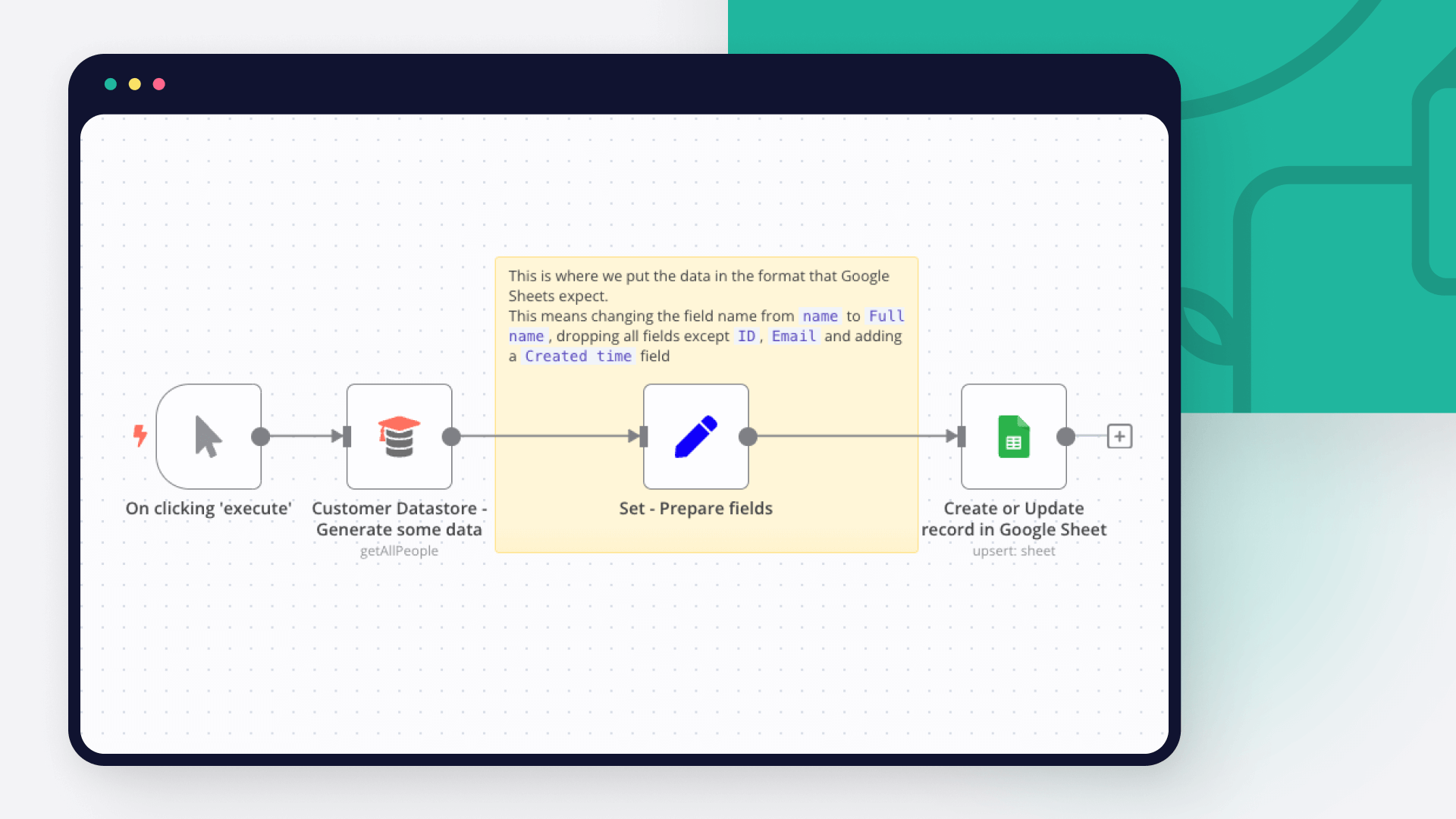
Bulk create Shopify products with inventory management from Google Sheets

Create Products in Shopify from a Google Sheet

This workflow creates products in your Shopify store from a google sheet. It also enables inventory tracking and sets the quantity of an inventory item at your store's default location.

This is a great way to get test data into test or staging stores to try out apps, update templates or try out new designs.

This Automation will only import new products. It will skip existing products if the slug matches an existing product's handle (Shopify's term for a slug).
Setup Notes

The Google Sheet has the following columns :
title - free text
description - free text
company - free text
category - free text
status - ACTIVE, DRAFT or ARCHIVE
slug - used in the product url, text with no spaces, can also use hyphen.
price - sale price of the products
compare_at_price - compare at price for products
sku - unique code for each product
stock_on_hand - quantity of this item available for purchase.

Use those labels in the first row of your sheet and N8N will create one object per row with the column names as object fields.

Update GraphQL nodes with your Shopify store URL

  1. Replace the URL in all GraphQL nodes with the URL for your Shopify store.
  2. These GraphQL requests all use the Shopify 2025-04 GraphQL Admin API.

This flow is updated to use Airtable at Sync Products between Airtable and Shopify with Inventory Management

Nodes used in this workflow

Popular Google Sheets and GraphQL workflows

Import Products from Google Sheets to Shopify with Multi-Variant Support

Short Description (for listing) Import products from Google Sheets to Shopify with automatic handling of single products and multi-variant products (sizes, colors, etc.). Includes SKU management, inventory tracking, and image uploads via GraphQL API. Category E-commerce Productivity Data Import/Export Full Description Overview This workflow automates the process of importing products from a Google Sheet into your Shopify store. It intelligently detects and handles both simple products and products with multiple variants (like different sizes or colors), creating them with proper SKU management, pricing, inventory levels, and images. Key Features ✅ Dual Product Support: Handles single products and multi-variant products automatically ✅ Smart SKU Parsing: Automatically groups variants by parsing SKU format (e.g., 12345-SM, 12345-MD) ✅ Inventory Management: Sets stock levels for each variant at your default location ✅ Image Upload: Attaches product images from URLs ✅ GraphQL API: Uses Shopify's modern GraphQL API for reliable product creation ✅ Batch Processing: Process multiple products in one workflow run Use Cases Initial store setup with bulk product import Regular inventory updates from spreadsheet Migrating products from another platform Managing seasonal product catalogs Synchronizing products with external systems Requirements Shopify store with Admin API access Google Sheets API credentials n8n version 1.0+ Basic understanding of GraphQL (helpful but not required) What You'll Need to Configure Shopify Admin API token Your Shopify store URL (in 'set store url' node) Google Sheets connection (Optional) Vendor name and product type defaults Input Format Your Google Sheet should contain columns: Product Name SKU (format: BASESKU-VARIANT for variants) Size (or other variant option) Price On hand Inventory Product Image (URL) Products with the same name are automatically grouped as variants. How It Works Reads product data from your Google Sheet Groups products by name and detects if they have variants Switches to appropriate creation path (single or variant) Creates product in Shopify with options and variants Updates each variant with SKU and pricing Sets inventory levels at your location Uploads product images Technical Details Uses Shopify GraphQL Admin API (2025-04) Handles up to 100 variants per product Processes variants individually for accurate data mapping Includes error handling for missing data Supports one inventory location per run Common Modifications Change vendor name and product type Add more variant options (color, material, etc.) Customize product status (draft vs active) Modify inventory location selection Add product descriptions Perfect For Shopify store owners managing large catalogs E-commerce managers doing bulk imports Agencies setting up client stores Developers building automated product workflows Difficulty: Intermediate Estimated Setup Time: 15-30 minutes Nodes Used: 16 External Services: Shopify, Google Sheets

Bulk Create Shopify Products with Inventory Management from Google Sheets

Create Products in Shopify from a Google Sheet This workflow creates products in your Shopify store from a google sheet. It also enables inventory tracking and sets the quantity of an inventory item at your store's default location. This is a great way to get test data into test or staging stores to try out apps, update templates or try out new designs. This Automation will only import new products. It will skip existing products if the slug matches an existing product's handle (Shopify's term for a slug). Setup Notes The Google Sheet has the following columns : title - free text description - free text company - free text category - free text status - ACTIVE, DRAFT or ARCHIVE slug - used in the product url, text with no spaces, can also use hyphen. price - sale price of the products compare_at_price - compare at price for products sku - unique code for each product stock_on_hand - quantity of this item available for purchase. Use those labels in the first row of your sheet and N8N will create one object per row with the column names as object fields. Update GraphQL nodes with your Shopify store URL 1) Replace the URL in all GraphQL nodes with the URL for your Shopify store. 2) These GraphQL requests all use the Shopify 2025-04 GraphQL Admin API. This flow is updated to use Airtable at Sync Products between Airtable and Shopify with Inventory Management

Fetch All Shopify Orders (Handles 250-Limit Loop)

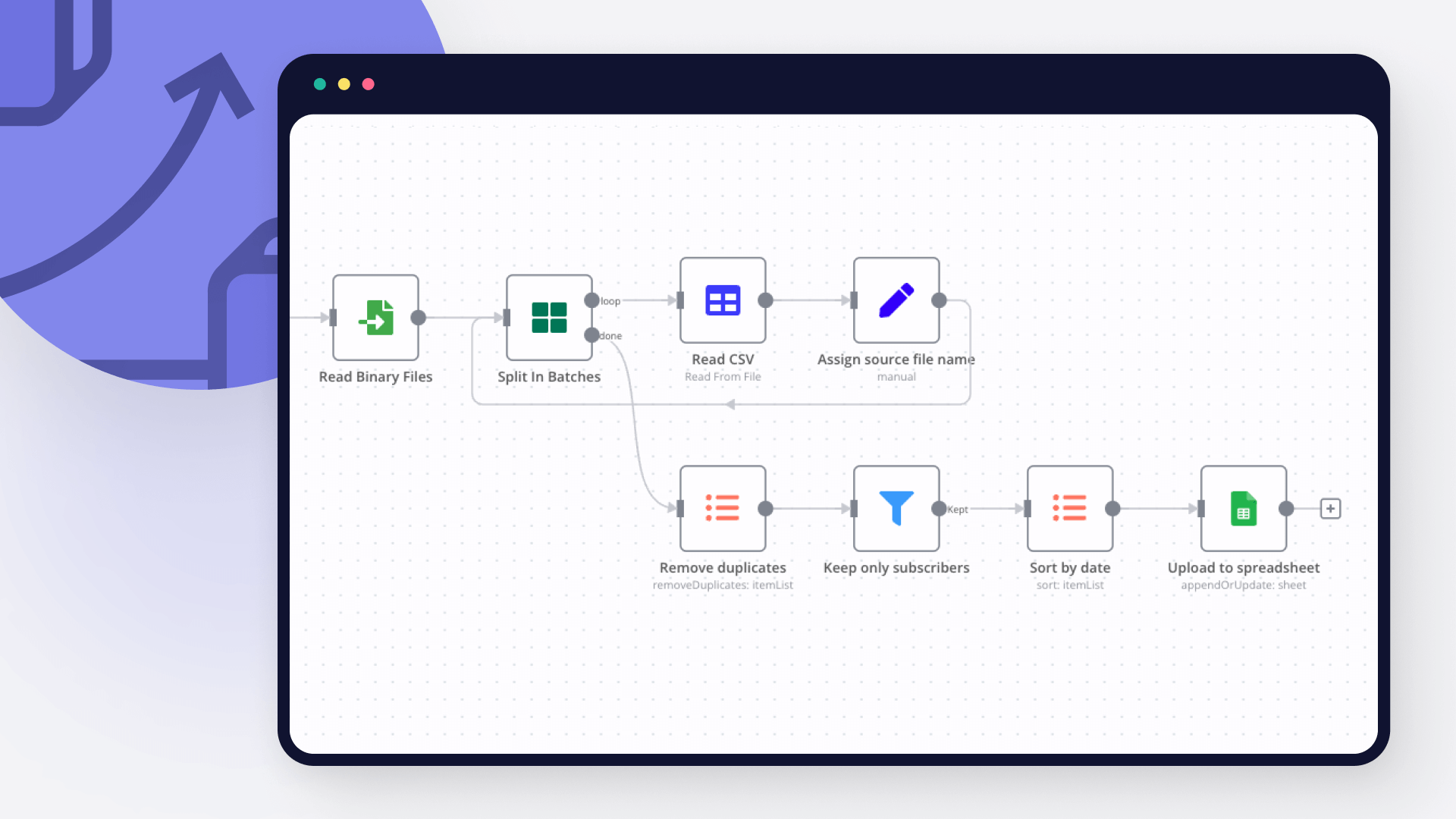
Who Is This For? E-commerce managers, data analysts, and n8n beginners who need a hands-off way to pull all Shopify orders—even stores with thousands of orders—into Google Sheets for reporting or BI. What Problem Does It Solve? Shopify’s GraphQL API only returns up to 250 orders per call, forcing you to manually manage cursors and loops. This template handles the “get next 250” logic for you, so you never miss an order. What This Workflow Does Schedule Trigger – Runs at your chosen cadence (daily, hourly, or manual). Set Date Range – Defines startDay and endDay based on $now. GraphQL Loop – Fetches orders 250 at a time, using pageInfo.hasNextPage and endCursor until complete. Code Node – Flattens orders into line-item rows and summarizes by SKU/vendor. Google Sheets – Appends results to your sheet for easy analysis.

Create Shopify customers from a Google Sheet

Task Read a list of customers from a GoogleSheet and create them in Shopify using Shopify's Admin API (GraphQL). Why ? Generate test users for development stores. Migrate customers from other platforms. Easy intro to Shopify's GraphQL API. Setup Setting up Google Sheets access Follow the instructions in the N8N Docs for granting Oauth2 access to Google services. You'll need to grant API access to Google Sheets and Google Drive (to list available sheets). Setting up Shopify access Shopify's Admin API uses 'Header Auth' with a key of X-Shopify-Access-Token and a value of your shopify access token which starts with shpat_ . How to generate a Shopify Access Token To generate a Shopify Access Token create an app, grant the app the necessary scopes, then generate a token. From inside a store do the following : click Settings (nav link) click Apps and sales channels (nav link) click Develop Apps (button) click Create App (button) give the app a name click configure Admin API Scopes (button) at a minimum grant read_customers and write_customers scope. Grant additional scopes if you plan on accessing other parts of the API. click save To generate the token click install app (button) click install on the dialog that pops up (button) click 'reveal token once' (button) copy the token into a password vault or somewhere secure. Template Updates To test this out you'll need to make the following changes : 1) Create a header credential where the key is X-Shopify-Access-Token and the value is your Shopify Access Token (it starts with shpat_ 2) In the GraphQL node change the endpoint URL to your store. Something like https://{your store goes here}.myshopify.com/admin/api/2025-04/graphql.json Google Sheet Structure Columns can be in any order, because the rows will be mapped to fields in a json object. N8N will treat the first row in the sheet as a column name, so at a minimum use the column names below in row 1 of your sheet. first_name : Any string last_name : Any string email : Valid email mobile_phone : International mobile phone format with no spaces eg. +61414708406 (Shopify will reject anything else). Example CSV "first_name","last_name","email","mobile_phone" "Bob","Smith","[email protected]","+61414999999"

Write all Linear tickets to Google Sheets

Use Case Track all Linear tickets in Google sheets. Useful if you want to do some custom analysis but don't want to pay for Linear's Plus features (Linear Insights) or that it does not cover. Setup Add Linear API header key Add Google sheets creds Update which teams to get tickets from in Graphql Nodes Update which Google Sheets page to write all the tickets to You only need to add one column, id, in the sheet. Google Sheets node in automatic mapping mode will handle adding the rest of the columns. Set any custom data on each ticket Activate workflow 🚀 How to adjust this template Set any custom fields you want to get out of this, that you can quickly do in n8n.

Shopify to Google Sheets Product Sync Automation

Workflow Description: This workflow automates the synchronization of product data from a Shopify store to a Google Sheets document, ensuring seamless management and tracking. It retrieves product details such as title, tags, description, and price from Shopify via GraphQL queries. The outcome is a comprehensive list of products neatly organized in Google Sheets for easy access and analysis. Key Features: Automated: Runs on a schedule you define (e.g., daily, hourly) to keep your product data fresh. Complete Product Details: Retrieves titles, descriptions, variants, images, inventory, and more. Cursor-Based Pagination: Efficiently handles large product sets by navigating pages without starting from scratch. Google Sheets Integration: Writes product data directly to your designated sheets. Set up Instructions: Set up GraphQL node with Header Authentication for Shopify: Create Google Sheet Credentials: Follow this guide to set up your Google Sheet credentials for n8n: https://docs.n8n.io/integrations/builtin/credentials/google/ Choose your Google Sheet: Select the sheet where you want product information written. For the setup, we need a document with two sheets: 1. for storing Shopify data 2. for storing cursor details. Google sheet template : https://docs.google.com/spreadsheets/d/1I6JnP8ugqmMD5ktJlNB84J1MlSkoCHhAEuCofSa3OSM Schedule and run: Decide how often you want the data refreshed (daily, hourly, etc.) and let n8n do its magic!

Build your own Google Sheets and GraphQL integration

Create custom Google Sheets and GraphQL workflows by choosing triggers and actions. Nodes come with global operations and settings, as well as app-specific parameters that can be configured. You can also use the HTTP Request node to query data from any app or service with a REST API.

Google Sheets supported actions

Create
Create a spreadsheet
Delete
Delete a spreadsheet
Append or Update Row
Append a new row or update an existing one (upsert)
Append Row
Create a new row in a sheet
Clear
Delete all the contents or a part of a sheet
Create
Create a new sheet
Delete
Permanently delete a sheet
Delete Rows or Columns
Delete columns or rows from a sheet
Get Row(s)
Retrieve one or more rows from a sheet
Update Row
Update an existing row in a sheet

FAQs

  • Can Google Sheets connect with GraphQL?

  • Can I use Google Sheets’s API with n8n?

  • Can I use GraphQL’s API with n8n?

  • Is n8n secure for integrating Google Sheets and GraphQL?

  • How to get started with Google Sheets and GraphQL integration in n8n.io?

Need help setting up your Google Sheets and GraphQL integration?

Discover our latest community's recommendations and join the discussions about Google Sheets and GraphQL integration.
Sergey Komardenkov
sérgio eduardo floresta filho
Julian
therealJMT
Guilherme

Looking to integrate Google Sheets and GraphQL in your company?

Over 3000 companies switch to n8n every single week

Why use n8n to integrate Google Sheets with GraphQL

Build complex workflows, really fast

Build complex workflows, really fast

Handle branching, merging and iteration easily.
Pause your workflow to wait for external events.

Code when you need it, UI when you don't

Simple debugging

Your data is displayed alongside your settings, making edge cases easy to track down.

Use templates to get started fast

Use 1000+ workflow templates available from our core team and our community.

Reuse your work

Copy and paste, easily import and export workflows.

Implement complex processes faster with n8n

red iconyellow iconred iconyellow icon