Back to Integrations
integrationGoogle Sheets node
integrationNASA node

Google Sheets and NASA integration

Save yourself the work of writing custom integrations for Google Sheets and NASA and use n8n instead. Build adaptable and scalable Data & Storage, Productivity, and Miscellaneous workflows that work with your technology stack. All within a building experience you will love.

How to connect Google Sheets and NASA

  • Step 1: Create a new workflow
  • Step 2: Add and configure nodes
  • Step 3: Connect
  • Step 4: Customize and extend your integration
  • Step 5: Test and activate your workflow

Step 1: Create a new workflow and add the first step

In n8n, click the "Add workflow" button in the Workflows tab to create a new workflow. Add the starting point – a trigger on when your workflow should run: an app event, a schedule, a webhook call, another workflow, an AI chat, or a manual trigger. Sometimes, the HTTP Request node might already serve as your starting point.
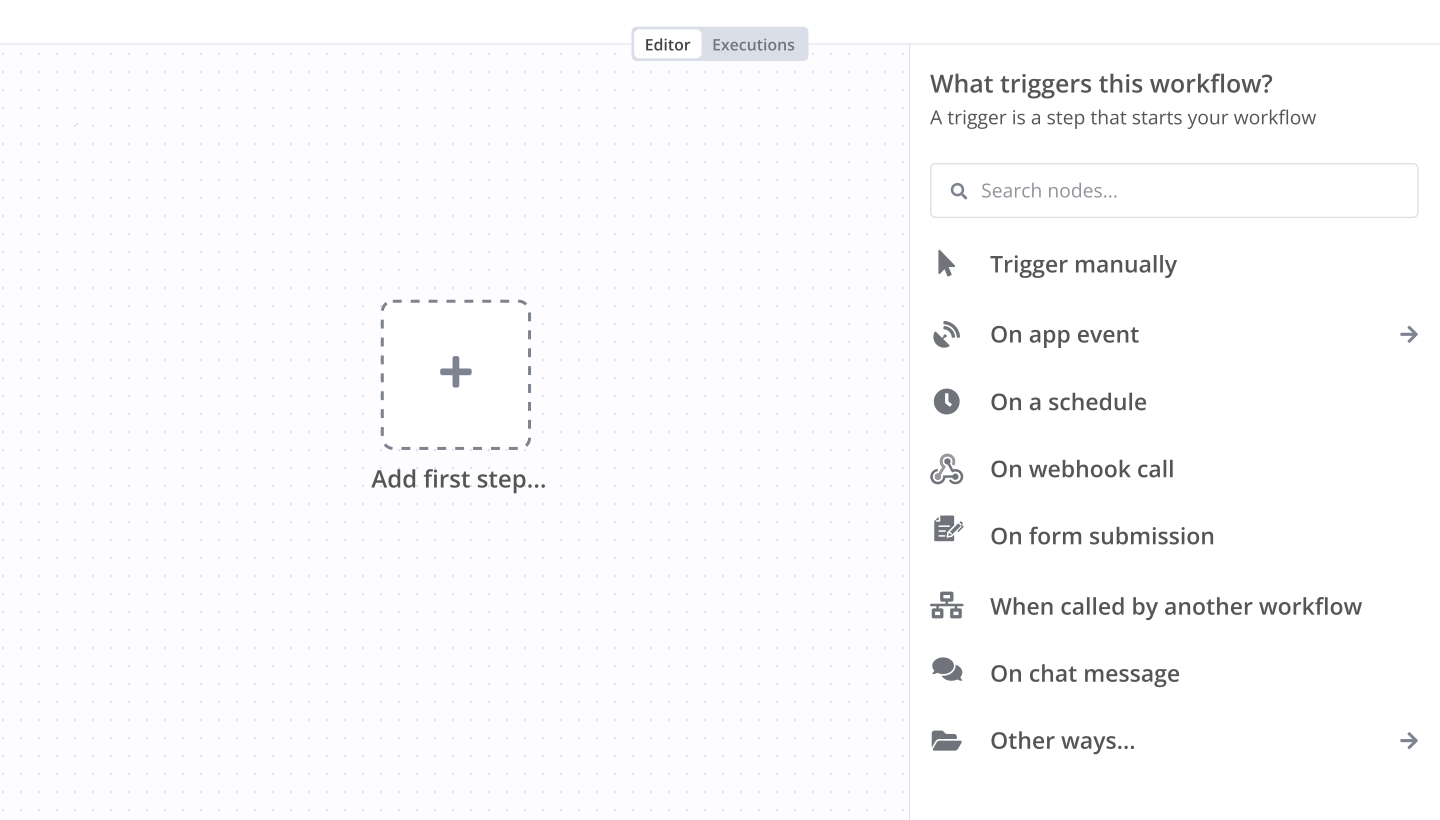
Google Sheets and NASA integration: Create a new workflow and add the first step

Step 2: Add and configure Google Sheets and NASA nodes

You can find Google Sheets and NASA in the nodes panel. Drag them onto your workflow canvas, selecting their actions. Click each node, choose a credential, and authenticate to grant n8n access. Configure Google Sheets and NASA nodes one by one: input data on the left, parameters in the middle, and output data on the right.

Google Sheets and NASA integration: Add and configure Google Sheets and NASA nodes

Step 3: Connect Google Sheets and NASA

A connection establishes a link between Google Sheets and NASA (or vice versa) to route data through the workflow. Data flows from the output of one node to the input of another. You can have single or multiple connections for each node.

Google Sheets and NASA integration: Connect Google Sheets and NASA

Step 4: Customize and extend your Google Sheets and NASA integration

Use n8n's core nodes such as If, Split Out, Merge, and others to transform and manipulate data. Write custom JavaScript or Python in the Code node and run it as a step in your workflow. Connect Google Sheets and NASA with any of n8n’s 1000+ integrations, and incorporate advanced AI logic into your workflows.

Google Sheets and NASA integration: Customize and extend your Google Sheets and NASA integration

Step 5: Test and activate your Google Sheets and NASA workflow

Save and run the workflow to see if everything works as expected. Based on your configuration, data should flow from Google Sheets to NASA or vice versa. Easily debug your workflow: you can check past executions to isolate and fix the mistake. Once you've tested everything, make sure to save your workflow and activate it.

Google Sheets and NASA integration: Test and activate your Google Sheets and NASA workflow

Transform NASA patents into business ideas with OpenAI and send to Google Sheets & Slack

Who is this for
Entrepreneurs looking for verified technology to license.
R&D Teams tracking aerospace innovation.
Content Creators covering tech trends.
How it works
Fetch: Gets the latest patents from NASA's Tech Transfer API.
Filter & Loop: Removes empty entries and processes each patent individually.
Analyze: Translates the abstract (DeepL) and uses OpenAI to brainstorm practical business applications.
Archive: Saves the details to Google Sheets.
Notify: Compiles a summary and sends it to Slack.
How to set up
Prepare Google Sheet: Create a new sheet with these exact headers in Row 1:
Date
Title
Abstract_Translated
Business_Idea
Link
Edit Settings: Double-click the Edit Settings node to add your Google Sheet ID, Sheet Name, and Slack Channel ID.
Credentials: Configure credentials for OpenAI, DeepL, Google Sheets, and Slack.
Activate: Run a test execution, then switch the workflow to Active.
Requirements
OpenAI: API Key (gpt-4o or gpt-3.5-turbo)
DeepL: API Key (Free or Pro)
Google Sheets: OAuth2 credentials with Drive/Sheets scopes.
Slack: Bot User OAuth Token with chat:write scope.
How to customize
Change the Prompt: Edit the Generate Business Ideas node to tailor ideas for a specific niche (e.g., "Applications for medical devices").
Adjust Schedule: Change the trigger in the Weekly Schedule node to run daily or monthly.
Different Output: Swap Slack for Microsoft Teams or Email nodes if preferred.

Nodes used in this workflow

Popular Google Sheets and NASA workflows

Transform NASA Patents into Business Ideas with OpenAI and Send to Google Sheets & Slack

Who is this for Entrepreneurs looking for verified technology to license. R&D Teams tracking aerospace innovation. Content Creators covering tech trends. How it works Fetch: Gets the latest patents from NASA's Tech Transfer API. Filter & Loop: Removes empty entries and processes each patent individually. Analyze: Translates the abstract (DeepL) and uses OpenAI to brainstorm practical business applications. Archive: Saves the details to Google Sheets. Notify: Compiles a summary and sends it to Slack. How to set up Prepare Google Sheet: Create a new sheet with these exact headers in Row 1: Date Title Abstract_Translated Business_Idea Link Edit Settings: Double-click the Edit Settings node to add your Google Sheet ID, Sheet Name, and Slack Channel ID. Credentials: Configure credentials for OpenAI, DeepL, Google Sheets, and Slack. Activate: Run a test execution, then switch the workflow to Active. Requirements OpenAI: API Key (gpt-4o or gpt-3.5-turbo) DeepL: API Key (Free or Pro) Google Sheets: OAuth2 credentials with Drive/Sheets scopes. Slack: Bot User OAuth Token with chat:write scope. How to customize Change the Prompt: Edit the Generate Business Ideas node to tailor ideas for a specific niche (e.g., "Applications for medical devices"). Adjust Schedule: Change the trigger in the Weekly Schedule node to run daily or monthly. Different Output: Swap Slack for Microsoft Teams or Email nodes if preferred.
+2

Monitor NASA asteroid threats with AI fact-check and multi-channel alerts

Who Is This For? This workflow is designed for space enthusiasts, science educators, journalists, fact-checkers, and researchers who want to stay informed about near-Earth asteroid threats while filtering out media sensationalism. It's also valuable for anyone studying how different regions cover space-related news. What It Does This workflow creates an automated planetary defense monitoring system that: Scans NASA's Near Earth Object database for potentially hazardous asteroids over a 7-day window Searches news coverage across three regions (US, Japan, EU) to compare media reporting Uses AI (GPT-4o-mini) to fact-check news claims against official NASA data Detects misinformation and measures media sensationalism levels Generates visual charts comparing actual threat levels vs media panic Sends alerts through multiple channels (Slack, Discord, Email) Logs all alerts to Google Sheets for historical analysis How It Works Trigger: Runs daily at 9 AM or on-demand via webhook NASA Data Fetch: Retrieves 7-day asteroid forecast from NASA NeoWs API Threat Analysis: Identifies potentially hazardous asteroids and assigns alert levels (LOW/MEDIUM/HIGH) News Search: Searches news in US, Japan, and EU using Apify's Google Search Scraper AI Fact-Check: GPT-4o-mini compares news claims against NASA data, detecting misinformation Visualization: Generates gauge charts for threat level and media panic, plus regional comparison bar chart Multi-Channel Alerts: Sends formatted reports to Slack, Discord, Email, and logs to Google Sheets Set Up Steps Estimated time: 15-20 minutes NASA API (Required): Get your free API key at api.nasa.gov Apify (Required): Create account and connect via OAuth OpenAI (Required): Add your API key from platform.openai.com Notification Channels (Choose at least one): Slack: Create OAuth app and connect Discord: Create webhook URL Email: Configure SMTP settings Google Sheets (Optional): Create a sheet for logging with columns: Date, Alert Level, Hazardous Count, Threat Score, Media Panic Score, Misinformation Detected, Top Asteroid, Most Accurate Region Requirements NASA API key (free) Apify account (free tier available) OpenAI API key (paid) At least one notification channel configured n8n version 1.0+ How to Customize Change scan frequency**: Modify the Schedule Trigger node Add more regions**: Edit the "Configure Regional Search" code node Adjust alert thresholds**: Modify lunar distance threshold (currently 10) in "Analyze Asteroid Threats" Disable channels**: Simply remove connections to notification nodes you don't need Customize messages**: Edit the "Format Multi-Channel Messages" node

Transform NASA DONKI Space Alerts to Japanese with GPT-4 for Slack and Sheets

Who’s it for Teams that care about space-weather impact—SRE/infra, satellite ops, aviation, power utilities, researchers—or anyone who wants timely, readable alerts when NASA publishes significant solar events. How it works / What it does Every 30 minutes a Cron trigger runs, the NASA DONKI node fetches the past 24 hours of space-weather notifications, and a code step de-duplicates, labels event types, and assigns a severity (CRITICAL / HIGH / OTHER). A Switch routes items: CRITICAL/HIGH** → an LLM (“AI Agent”) produces a concise Japanese alert → Slack posts with local time and source link. OTHER** → an LLM creates a short summary for record-keeping → a small merge step prepares fields → Google Sheets appends a new row. Sticky notes in the canvas explain the schedule, data source, and overall flow. How to set up Add credentials for Slack, Google Sheets, and OpenAI (or compatible LLM). Open the Slack nodes and select your workspace + target channel. Select your Google Sheet and worksheet for logging. (Optional) Adjust the Cron interval and the NASA lookback window. Test with a manual execution, then activate. Requirements Slack Bot with permission to post to the chosen channel Google account with access to the target Sheet OpenAI (or API-compatible) credentials for the LLM nodes Internet access to NASA DONKI (no API key required) How to customize the workflow Tweak severity rules inside the Analyze & Prioritize code node. Edit prompt tone/length in each AI Agent node. Change Slack formatting or mention style (@channel vs none). Add filters (e.g., alert only on CME/FLR) or extend logging fields in the merge step.

Build your own Google Sheets and NASA integration

Create custom Google Sheets and NASA workflows by choosing triggers and actions. Nodes come with global operations and settings, as well as app-specific parameters that can be configured. You can also use the HTTP Request node to query data from any app or service with a REST API.

Google Sheets supported actions

Create
Create a spreadsheet
Delete
Delete a spreadsheet
Append or Update Row
Append a new row or update an existing one (upsert)
Append Row
Create a new row in a sheet
Clear
Delete all the contents or a part of a sheet
Create
Create a new sheet
Delete
Permanently delete a sheet
Delete Rows or Columns
Delete columns or rows from a sheet
Get Row(s)
Retrieve one or more rows from a sheet
Update Row
Update an existing row in a sheet

NASA supported actions

Get Many
Browse the overall asteroid dataset
Get
Retrieve a list of asteroids based on their closest approach date to Earth
Get
Look up an asteroid based on its NASA SPK-ID
Get
Get the Astronomy Picture of the Day
Get
Retrieve DONKI coronal mass ejection data
Get
Retrieve DONKI high speed stream data
Get
Retrieve DONKI interplanetary shock data
Get
Retrieve data on DONKI magnetopause crossings
Get
Retrieve DONKI notifications data
Get
Retrieve DONKI radiation belt enhancement data
Get
Retrieve DONKI solar energetic particle data
Get
Retrieve DONKI solar flare data
Get
Retrieve DONKI WSA+EnlilSimulation data
Get
Retrieve Earth assets
Get
Retrieve Earth imagery

FAQs

  • Can Google Sheets connect with NASA?

  • Can I use Google Sheets’s API with n8n?

  • Can I use NASA’s API with n8n?

  • Is n8n secure for integrating Google Sheets and NASA?

  • How to get started with Google Sheets and NASA integration in n8n.io?

Need help setting up your Google Sheets and NASA integration?

Discover our latest community's recommendations and join the discussions about Google Sheets and NASA integration.
Sergey Komardenkov
sérgio eduardo floresta filho
Julian
therealJMT
Guilherme

Looking to integrate Google Sheets and NASA in your company?

Over 3000 companies switch to n8n every single week

Why use n8n to integrate Google Sheets with NASA

Build complex workflows, really fast

Build complex workflows, really fast

Handle branching, merging and iteration easily.
Pause your workflow to wait for external events.

Code when you need it, UI when you don't

Simple debugging

Your data is displayed alongside your settings, making edge cases easy to track down.

Use templates to get started fast

Use 1000+ workflow templates available from our core team and our community.

Reuse your work

Copy and paste, easily import and export workflows.

Implement complex processes faster with n8n

red iconyellow iconred iconyellow icon