Back to Integrations
integrationGoogle Tasks node
integrationHTTP Request node

Google Tasks and HTTP Request integration

Save yourself the work of writing custom integrations for Google Tasks and HTTP Request and use n8n instead. Build adaptable and scalable Productivity, Development, and Core Nodes workflows that work with your technology stack. All within a building experience you will love.

How to connect Google Tasks and HTTP Request

  • Step 1: Create a new workflow
  • Step 2: Add and configure nodes
  • Step 3: Connect
  • Step 4: Customize and extend your integration
  • Step 5: Test and activate your workflow

Step 1: Create a new workflow and add the first step

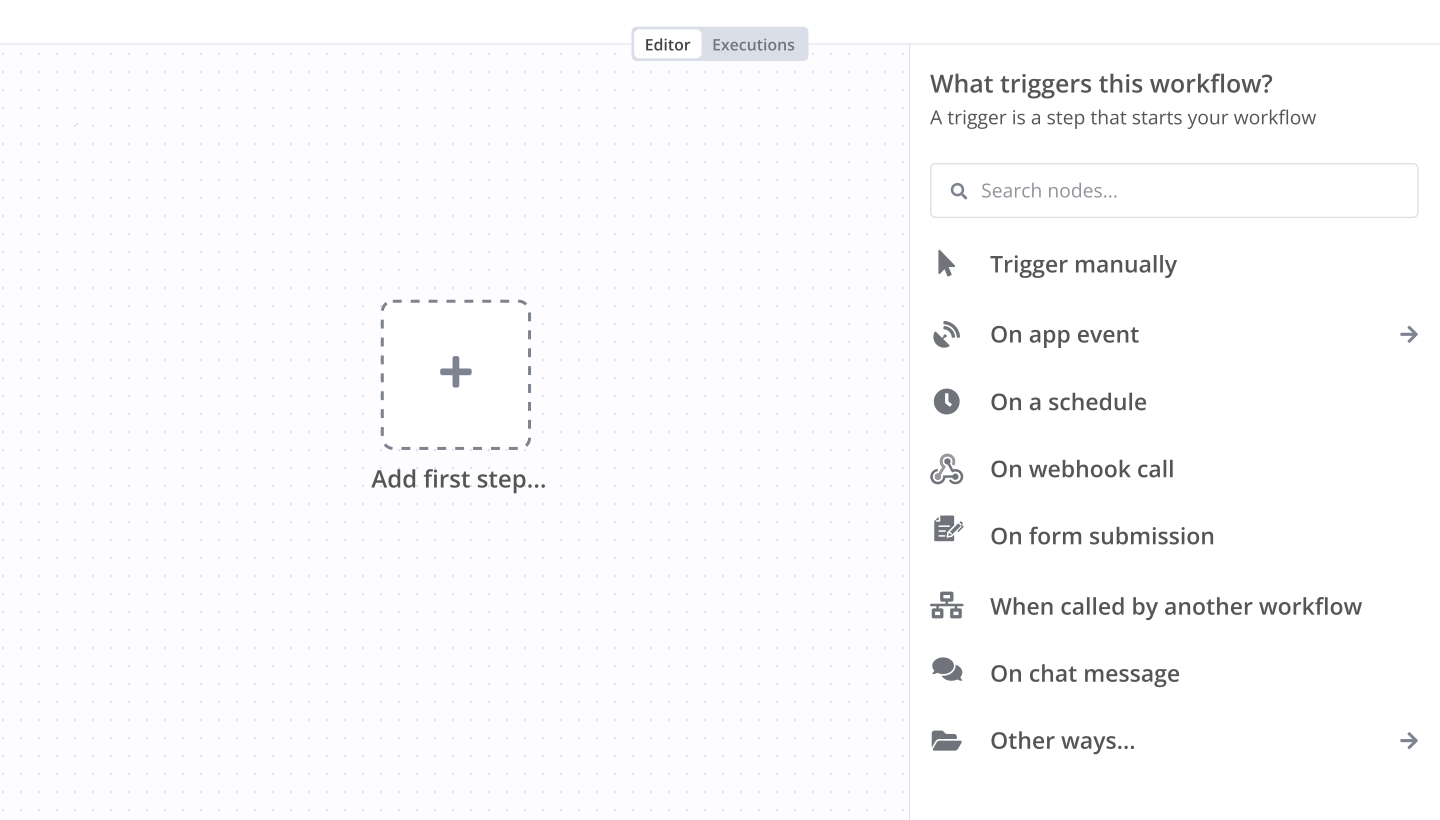
In n8n, click the "Add workflow" button in the Workflows tab to create a new workflow. Add the starting point – a trigger on when your workflow should run: an app event, a schedule, a webhook call, another workflow, an AI chat, or a manual trigger. Sometimes, the HTTP Request node might already serve as your starting point.

Google Tasks and HTTP Request integration: Create a new workflow and add the first step

Step 2: Add and configure Google Tasks and HTTP Request nodes

You can find Google Tasks and HTTP Request in the nodes panel. Drag them onto your workflow canvas, selecting their actions. Click each node, choose a credential, and authenticate to grant n8n access. Configure Google Tasks and HTTP Request nodes one by one: input data on the left, parameters in the middle, and output data on the right.

Google Tasks and HTTP Request integration: Add and configure Google Tasks and HTTP Request nodes

Step 3: Connect Google Tasks and HTTP Request

A connection establishes a link between Google Tasks and HTTP Request (or vice versa) to route data through the workflow. Data flows from the output of one node to the input of another. You can have single or multiple connections for each node.

Google Tasks and HTTP Request integration: Connect Google Tasks and HTTP Request

Step 4: Customize and extend your Google Tasks and HTTP Request integration

Use n8n's core nodes such as If, Split Out, Merge, and others to transform and manipulate data. Write custom JavaScript or Python in the Code node and run it as a step in your workflow. Connect Google Tasks and HTTP Request with any of n8n’s 1000+ integrations, and incorporate advanced AI logic into your workflows.

Google Tasks and HTTP Request integration: Customize and extend your Google Tasks and HTTP Request integration

Step 5: Test and activate your Google Tasks and HTTP Request workflow

Save and run the workflow to see if everything works as expected. Based on your configuration, data should flow from Google Tasks to HTTP Request or vice versa. Easily debug your workflow: you can check past executions to isolate and fix the mistake. Once you've tested everything, make sure to save your workflow and activate it.

Google Tasks and HTTP Request integration: Test and activate your Google Tasks and HTTP Request workflow

🌳 EU green legislation tracker with GPT-4o, Google Sheets and Tasks

Tags: EU Legislation, Sustainability, Automation, Web Scraping, OpenAI, Google Sheets, Policy Monitoring, Climate

Context

Hey! I’m Samir, a Supply Chain Engineer and Data Scientist from Paris, and the founder of LogiGreen Consulting.

We use AI, automation, and data to support sustainable business practices for small, medium and large companies.

This workflow is part of our broader initiative to monitor and act on sustainability legislation in Europe.

> How do you know if new EU laws will impact your business's sustainability goals?

This n8n workflow automatically scrapes the EU Parliament’s legislative portal to find and flag procedures related to environmental sustainability.

📬 For business inquiries, feel free to connect with me on LinkedIn

Who is this template for?

This workflow is useful for:
Sustainability consultants** monitoring legal frameworks
NGOs and researchers** tracking environmental regulations
Companies* aligning with CSRD or EU Green Deal* objectives
Policy analysts** looking for automation tools

What does it do?

This n8n workflow:
🌐 Scrapes the EU Parliament legislative portal for yesterday’s entries
🧠 Uses OpenAI to classify if each procedure is related to sustainability
🗂️ Filters out irrelevant items
📊 Saves the results in a Google Sheet
✅ Creates a Google Task for each relevant file to review the legislation

How it works

Trigger manually or on schedule
Scrape HTML blocks for scheduled debates
Parse each procedure to extract Title, Committee, Rapporteur, PDF link
Call GPT-4-turbo to check if the topic matches sustainability criteria
Filter responses based on “yes” or “no”
Store valid items into Google Sheets
Generate tasks in Google Tasks

The AI only flags procedures that directly impact the environment, circular economy, or pollution control.

What do I need to get started?

You’ll need:
A Google Sheet connected to your n8n instance
An OpenAI account with GPT-4 access
A Google Task List

Follow the Guide!
Follow the sticky notes in the workflow or check my tutorial to configure each node and start using AI to monitor sustainability regulations in Europe.

🎥 Watch My Tutorial

Notes

AI filters are strict — you can customise the system prompt to match your needs
This is ideal for tracking legislative risk for climate regulations

This workflow was built using n8n version 1.85.4
Submitted: April 21, 2025

Nodes used in this workflow

Popular Google Tasks and HTTP Request workflows

Send a personalized WhatsApp morning brief with GPT-4o, Google and WATI

Transform your morning routine with an automated personal assistant that delivers everything you need to know directly to WhatsApp. This workflow aggregates live data from multiple sources and uses OpenAI to greet you with a context-aware, motivational message based on your specific day. 🎯 What This Workflow Does This template creates a highly personalized "Daily Digest" that saves you from checking multiple apps every morning: ⚡ Dual Entry Points The briefing can be automated to fire every morning at 7 AM via a Schedule Trigger, or it can be requested on-demand by texting the word brief to your WATI number. 🌤️ Real-time Environment Data Fetches current weather conditions (temperature, humidity, and wind speed) for your specific city using the OpenWeatherMap API. 📰 Custom News Feed Pulls the top 3 headlines based on your personal interests (e.g., technology, business) via NewsAPI. 📅 Agenda Integration Syncs with Google Calendar and Google Tasks to list your upcoming meetings and high-priority to-do items for the day. 🤖 AI-Powered Greetings OpenAI (GPT-4o) analyzes your weather and schedule to write a unique, 15-word opener that sets the tone for your day. ✨ Key Features Self-Service Subscription:** Users can join or leave the service themselves by texting subscribe or stop. Subscriber-Specific Config:** Supports multiple users, each with their own city and news interest preferences. Intelligent Assembly:** A central Code Node formats all data into a clean, emoji-rich WhatsApp card for easy reading. Reliability Fallbacks:** Designed with error-handling to ensure the briefing still sends even if one data source (like weather) is temporarily unavailable. 💼 Perfect For Busy Professionals:** Getting a snapshot of your day before your first coffee. Remote Workers:** Staying connected to global news and local weather. Productivity Enthusiasts:** Consolidating multiple task and calendar apps into one interface. Community Groups:** Providing a daily value-add service to WhatsApp group members. 🔧 What You'll Need Required Integrations WATI:** For WhatsApp messaging and command triggers. Google OAuth2:** For Calendar and Tasks access. OpenAI API:** For generating the daily personalized opener. Configuration Steps API Keys: Obtain free keys for OpenWeatherMap and NewsAPI. Subscriber List: Update the Load User Config node with your phone number and city. Credentials: Connect your Google and OpenAI accounts in n8n. Ready to wake up to a better morning? Import this template and connect your accounts to start receiving your daily briefings!
+2

AI-Powered Meeting Minutes with GPT-4, Task Assignment & Multichannel Distribution

Meeting Minutes & Action Item Tracker Fully automated meeting documentation workflow that uses AI to transform raw transcripts into professional PDFs and actionable tasks. Features AI-powered summary generation (GPT-4) Automatic action item extraction with assignees, deadlines, and priorities Professional PDF generation with custom styling Multi-channel distribution (Email, Slack, Google Drive) Task creation in Google Tasks Personalized notifications to each assignee Deadline tracking and urgency detection Setup Instructions REQUIRED CREDENTIALS: OpenAI API - Get from Gmail OAuth2 - Connect your Google account Google Drive OAuth2 - Same Google account Google Tasks OAuth2 - Same Google account Slack OAuth2 - Connect your workspace htmlcsstopdf API - Get from CONFIGURATION STEPS: WEBHOOK: Note your webhook URL after activation EMAIL NODES: "Email All Participants": Uses participants array from input "Send Individual Task Emails": Change @yourcompany.com to your domain GOOGLE DRIVE: Select folder where PDFs should be stored Recommended: Create "Meeting Minutes" folder SLACK: Select channel for team notifications Recommended: Create #meeting-notes channel GOOGLE TASKS: Select task list where tasks should be created Default list works fine TESTING: Use the webhook URL with sample meeting data Check execution log for any errors Verify PDF in Google Drive Check emails were sent Confirm tasks created in Google Tasks Example Input Format POST : Headers: Content-Type: application/json Body: { "title": "Weekly Team Standup", "date": "2025-09-29", "participants": [ "[email protected]", "[email protected]", "[email protected]" ], "duration": "30 minutes", "transcript": "John started the meeting by discussing the progress on the API development. Sarah mentioned that she's working on the dashboard and needs to prepare mockups by Thursday. The team agreed that Sarah will review the API documentation before the client demo on Friday. Akshita confirmed she finished the database schema redesign and needs to schedule a meeting with DevOps team by next Monday to discuss production deployment." } This will generate: Professional PDF with summary and action items Emails to all participants Individual task emails to John, Sarah, and Joe Tasks in Google Tasks Slack notification Output After execution, you'll get: Professional PDF stored in Google Drive Email sent to all participants with meeting overview Individual emails to each assignee with their tasks Slack notification with summary and download link Tasks created in Google Tasks with deadlines CUSTOMIZATION: Modify PDF styling in "Generate PDF Document" node Adjust email templates in Gmail nodes Change AI prompts in OpenAI nodes for different output Modify priority/deadline logic in "Parse and Enrich Data" Troubleshooting Workflow stops at validation: Ensure transcript has >50 words Check that webhook payload is correctly formatted No PDF generated: Verify htmlcsstopdf API credentials Check API usage limits Tasks not created: Verify deadline format is YYYY-MM-DD Check Google Tasks API connection Emails not sending: Confirm Gmail OAuth2 is connected Check that email addresses are valid Support For issues or questions, visit the n8n community forum. License MIT License - Feel free to modify and share!
+3

Automated B2B Prospecting with RapidAPI, Hunter.io, GPT & Gmail

Automate your B2B prospecting by finding local businesses and sending AI-personalized outreach emails to qualified contacts. What This Workflow Does This workflow acts as a powerful AI Sales Assistant, automating your entire B2B lead generation process for local businesses. It saves you countless hours of manual research and outreach by intelligently finding prospects, enriching their data, and drafting personalized emails tailored to their specific business. Stop prospecting manually and start scaling your outreach efforts effectively. How It Works The process is designed to be both smart and efficient: Find Businesses: It starts by searching for local businesses based on your criteria (e.g., "engineering in London"). Qualify & Enrich: It filters out businesses without a website. For the valid ones, it scrapes the website's title and description to understand what they do. Identify Contacts: Using Hunter.io, it finds professional email contacts associated with the company and verifies their validity to ensure high-quality leads. Generate AI-Personalized Emails: For each valid contact, it uses OpenAI to write a unique, short, and professional outreach email. The AI uses the scraped website information to create a personalized hook, showing you've done your research. Send & Organize: The final email is sent automatically via your Gmail account. If a business has no website, a follow-up task is created in your Google Tasks for manual review. Key Benefits Save Time: Automate a time-consuming prospecting process from start to finish. Increase Reply Rates: Engage prospects with personalized emails, not generic templates. Scale Your Outreach: Generate and contact dozens of qualified leads effortlessly. Stay Organized: Never lose a lead, thanks to the integrated task management for manual follow-ups.
+7

Build a Multi-Modal Telegram AI Assistant with Gemini, Voice & Image Generation

How it works This workflow creates a multi-talented AI assistant named Simran that interacts with users via Telegram. It can handle text and voice messages, understand the user's intent, and perform various tasks. Step 1: Receive & Transcribe Input The workflow triggers on any new Telegram message. If it's a voice message, it uses AssemblyAI to transcribe it into text; otherwise, it processes the incoming text directly. Step 2: Understand User Intent Using a Large Language Model (LLM), the workflow analyzes the user's message to determine their goal, categorizing it as a general chat, a request to generate an image, a command to set a reminder, or a request to remember a specific piece of information. Step 3: Fetch Context & Route The assistant retrieves past conversation summaries from a MongoDB database to maintain context. Based on the user's intent, the workflow routes the task to the appropriate path. Step 4: Execute the Task Chat: Generates a response using an AI agent whose personality can be toggled between a standard assistant and a "Girlfriend Mode." It also analyzes the user's mood to tailor the response. Generate Image: Creates a detailed prompt and uses an image generation API to create and send a picture. Set Reminder: Parses the natural language request, creates an event in Google Calendar and a task in Google Tasks, and sends a confirmation. Remember Info: Saves specific user-provided information to a dedicated memory collection in MongoDB. Step 5: Respond and Save Memory The final output (text, voice message, or image) is sent back to the user on Telegram. The workflow then summarizes the interaction and saves it to the database to ensure continuity in future conversations. Set up steps Estimated Set up time: 20 - 30 minutes. Configure Credentials: You will need to add credentials for several services in your n8n instance: Telegram (Bot API Token) AssemblyAI (API Key) MongoDB Google (for Calendar, Tasks, Sheets, and Natural Language API) A Large Language Model (the workflow uses Google Gemini but can be adapted) An image generation service (the workflow uses the Together.xyz API) Set up External Services: Ensure your MongoDB instance has two collections: user_memory and memory_auto. Create a Google Sheet to manage the "Girlfriend Mode" status for different users. Ensure edge-tts is installed on the machine running your n8n instance for the text-to-speech functionality. Customize Nodes: Review the nodes with hardcoded IDs, such as Google Tasks and Google Sheets, and update them with your specific Task List ID and Sheet ID. The sticky notes inside the workflow provide more detailed instructions for specific nodes and segments.

🌳 EU green legislation tracker with GPT-4o, Google Sheets and Tasks

Tags: EU Legislation, Sustainability, Automation, Web Scraping, OpenAI, Google Sheets, Policy Monitoring, Climate Context Hey! I’m Samir, a Supply Chain Engineer and Data Scientist from Paris, and the founder of LogiGreen Consulting. We use AI, automation, and data to support sustainable business practices for small, medium and large companies. This workflow is part of our broader initiative to monitor and act on sustainability legislation in Europe. > How do you know if new EU laws will impact your business's sustainability goals? This n8n workflow automatically scrapes the EU Parliament’s legislative portal to find and flag procedures related to environmental sustainability. 📬 For business inquiries, feel free to connect with me on LinkedIn Who is this template for? This workflow is useful for: Sustainability consultants** monitoring legal frameworks NGOs and researchers** tracking environmental regulations Companies* aligning with CSRD or EU Green Deal* objectives Policy analysts** looking for automation tools What does it do? This n8n workflow: 🌐 Scrapes the EU Parliament legislative portal for yesterday’s entries 🧠 Uses OpenAI to classify if each procedure is related to sustainability 🗂️ Filters out irrelevant items 📊 Saves the results in a Google Sheet ✅ Creates a Google Task for each relevant file to review the legislation How it works Trigger manually or on schedule Scrape HTML blocks for scheduled debates Parse each procedure to extract Title, Committee, Rapporteur, PDF link Call GPT-4-turbo to check if the topic matches sustainability criteria Filter responses based on “yes” or “no” Store valid items into Google Sheets Generate tasks in Google Tasks The AI only flags procedures that directly impact the environment, circular economy, or pollution control. What do I need to get started? You’ll need: A Google Sheet connected to your n8n instance An OpenAI account with GPT-4 access A Google Task List Follow the Guide! Follow the sticky notes in the workflow or check my tutorial to configure each node and start using AI to monitor sustainability regulations in Europe. 🎥 Watch My Tutorial Notes AI filters are strict — you can customise the system prompt to match your needs This is ideal for tracking legislative risk for climate regulations This workflow was built using n8n version 1.85.4 Submitted: April 21, 2025

Build your own Google Tasks and HTTP Request integration

Create custom Google Tasks and HTTP Request workflows by choosing triggers and actions. Nodes come with global operations and settings, as well as app-specific parameters that can be configured. You can also use the HTTP Request node to query data from any app or service with a REST API.

Google Tasks supported actions

Create
Add a task to tasklist
Delete
Delete a task
Get
Retrieve a task
Get Many
Retrieve many tasks from a tasklist
Update
Update a task

Google Tasks and HTTP Request integration details

integrationGoogle Tasks node
Google Tasks

Google Tasks is a free tool for creating and managing to-do lists. It is easy to access and helps you manage, edit and share your tasks from Mac, Windows, phone or tablet.

Use case

Save engineering resources

Reduce time spent on customer integrations, engineer faster POCs, keep your customer-specific functionality separate from product all without having to code.

Learn more

FAQs

  • Can Google Tasks connect with HTTP Request?

  • Can I use Google Tasks’s API with n8n?

  • Can I use HTTP Request’s API with n8n?

  • Is n8n secure for integrating Google Tasks and HTTP Request?

  • How to get started with Google Tasks and HTTP Request integration in n8n.io?

Need help setting up your Google Tasks and HTTP Request integration?

Discover our latest community's recommendations and join the discussions about Google Tasks and HTTP Request integration.
Moiz Contractor
theo
Jon
Dan Burykin
Tony

Looking to integrate Google Tasks and HTTP Request in your company?

Over 3000 companies switch to n8n every single week

Why use n8n to integrate Google Tasks with HTTP Request

Build complex workflows, really fast

Build complex workflows, really fast

Handle branching, merging and iteration easily.
Pause your workflow to wait for external events.

Code when you need it, UI when you don't

Simple debugging

Your data is displayed alongside your settings, making edge cases easy to track down.

Use templates to get started fast

Use 1000+ workflow templates available from our core team and our community.

Reuse your work

Copy and paste, easily import and export workflows.

Implement complex processes faster with n8n

red iconyellow iconred iconyellow icon