Back to Integrations
integrationHTTP Request node
integrationHubSpot node

HTTP Request and HubSpot integration

Save yourself the work of writing custom integrations for HTTP Request and HubSpot and use n8n instead. Build adaptable and scalable Development, Core Nodes, and Sales workflows that work with your technology stack. All within a building experience you will love.

How to connect HTTP Request and HubSpot

  • Step 1: Create a new workflow
  • Step 2: Add and configure nodes
  • Step 3: Connect
  • Step 4: Customize and extend your integration
  • Step 5: Test and activate your workflow

Step 1: Create a new workflow and add the first step

In n8n, click the "Add workflow" button in the Workflows tab to create a new workflow. Add the starting point – a trigger on when your workflow should run: an app event, a schedule, a webhook call, another workflow, an AI chat, or a manual trigger. Sometimes, the HTTP Request node might already serve as your starting point.
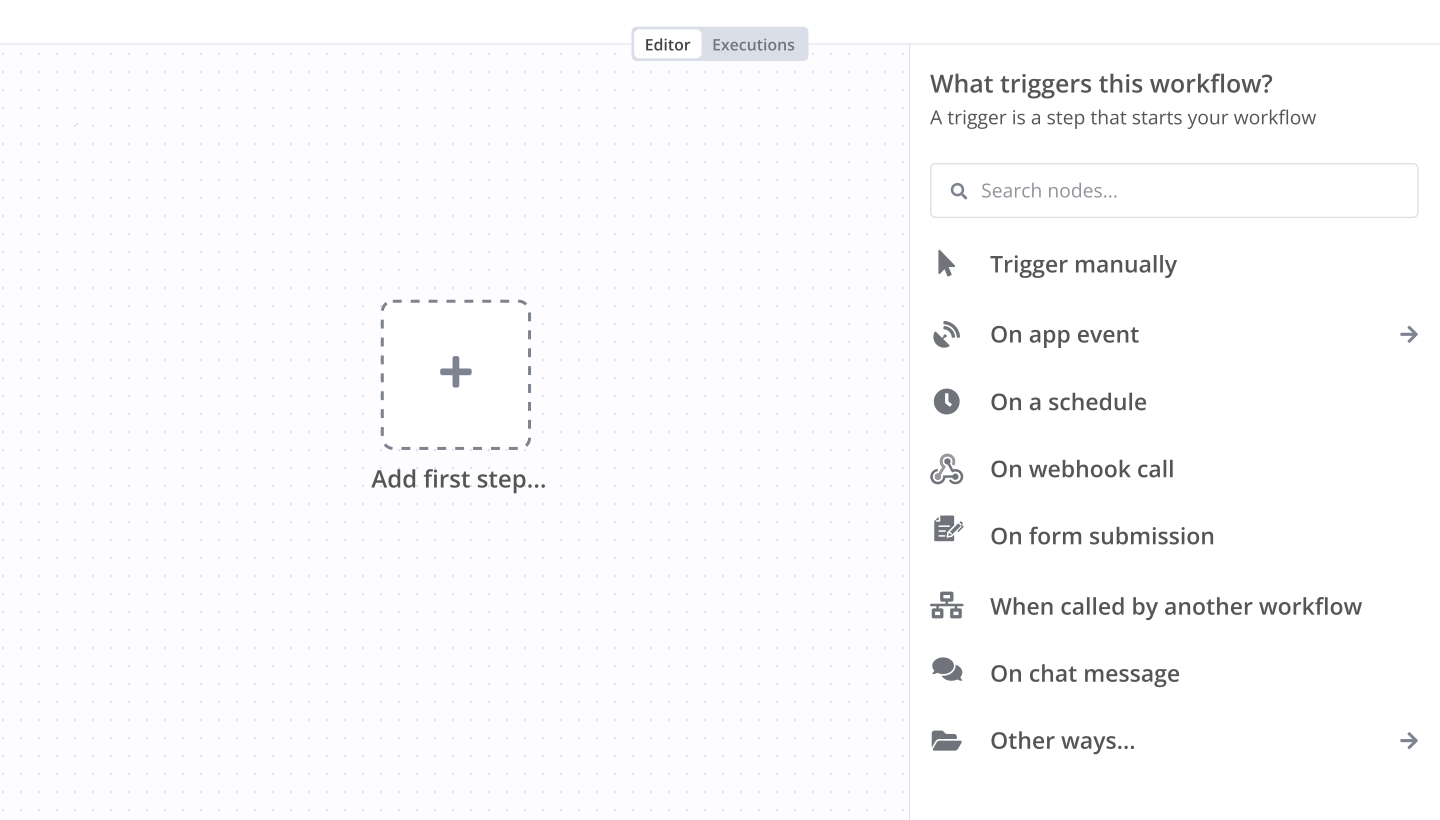
HTTP Request and HubSpot integration: Create a new workflow and add the first step

Step 2: Add and configure HTTP Request and HubSpot nodes

You can find HTTP Request and HubSpot in the nodes panel. Drag them onto your workflow canvas, selecting their actions. Click each node, choose a credential, and authenticate to grant n8n access. Configure HTTP Request and HubSpot nodes one by one: input data on the left, parameters in the middle, and output data on the right.

HTTP Request and HubSpot integration: Add and configure HTTP Request and HubSpot nodes

Step 3: Connect HTTP Request and HubSpot

A connection establishes a link between HTTP Request and HubSpot (or vice versa) to route data through the workflow. Data flows from the output of one node to the input of another. You can have single or multiple connections for each node.

HTTP Request and HubSpot integration: Connect HTTP Request and HubSpot

Step 4: Customize and extend your HTTP Request and HubSpot integration

Use n8n's core nodes such as If, Split Out, Merge, and others to transform and manipulate data. Write custom JavaScript or Python in the Code node and run it as a step in your workflow. Connect HTTP Request and HubSpot with any of n8n’s 1000+ integrations, and incorporate advanced AI logic into your workflows.

HTTP Request and HubSpot integration: Customize and extend your HTTP Request and HubSpot integration

Step 5: Test and activate your HTTP Request and HubSpot workflow

Save and run the workflow to see if everything works as expected. Based on your configuration, data should flow from HTTP Request to HubSpot or vice versa. Easily debug your workflow: you can check past executions to isolate and fix the mistake. Once you've tested everything, make sure to save your workflow and activate it.

HTTP Request and HubSpot integration: Test and activate your HTTP Request and HubSpot workflow

Real estate lead generation with BatchData skip tracing & CRM integration

How It Works
This workflow automates the entire property lead generation process in a few simple steps:

Property Search: Connects to BatchData's Property Search API with customizable parameters (location, property type, value range, equity percentage, etc.)
Lead Filtering & Scoring: Processes results to identify the most promising leads based on criteria like absentee ownership, years owned, equity percentage, and tax status. Each property receives a lead score to prioritize follow-up.
Skip Tracing: Automatically retrieves owner contact information (phone, email, mailing address) for each qualified property.
Data Formatting: Structures all property and owner data into a clean, organized format ready for your systems.
Multi-Channel Output:
Generates an Excel spreadsheet with all lead details
Pushes leads directly to your CRM (configurable for HubSpot, Salesforce, etc.)
Sends a summary email with the spreadsheet attached

The workflow can run on a daily schedule or be triggered manually as needed. All parameters are easily configurable through dedicated nodes, requiring no coding knowledge.

Who's It For
This workflow is perfect for:

Real Estate Investors looking to find off-market properties with motivated sellers
Real Estate Agents who want to generate listing leads from distressed or high-equity properties
Investment Companies that need regular lead flow for acquisitions
Real Estate Marketers who run targeted campaigns to property owners
Wholesalers seeking to build a pipeline of potential deals
Property Service Providers (roof repair, renovation contractors, etc.) who target specific property types

Anyone who needs reliable, consistent lead generation for real estate without the manual work of searching, filtering, and organizing property data will benefit from this automation.

About BatchData
BatchData is a comprehensive property data provider that offers access to nationwide property information, owner details, and skip tracing services. Key features include:

Extensive Database: Covers 150+ million properties across all 50 states
Rich Property Data: Includes ownership information, tax records, sales history, valuation estimates, equity positions, and more
Skip Tracing Services: Provides owner contact information including phone numbers, email addresses, and mailing addresses
Distressed Property Indicators: Flags for pre-foreclosure, tax delinquency, vacancy, and other motivation factors
RESTful API: Professional API for programmatic access to all property data services
Regular Updates: Continuously refreshed data for accurate information

BatchData's services are designed for real estate professionals who need reliable property and owner information to power their marketing and acquisition strategies. Their API-first approach makes it ideal for workflow automation tools like N8N.

Nodes used in this workflow

Popular HTTP Request and HubSpot workflows

Design scalable sync workflows with Data Tables, ProspectPro and HubSpot

This template is a pattern library (one importable workflow) that shows a repeatable way to structure n8n automations so they remain easy to extend, cheaper to run, and safer to scale. It’s intentionally opinionated and dry: the goal is not “plug & play”, but a set of proven building blocks you can copy into your own workflows. Problems this framework solves Spaghetti workflows that are hard to change** A consistent split into Trigger → Manager → Function → Utility so changes don’t ripple through everything. Duplicate processing when runs overlap** Uses “in progress / success / error” indicators so the trigger can skip items that are already being processed. Unnecessary re-runs that keep failing** Items that fail can be marked/parked, so you don’t burn executions repeating the same error. Execution costs exploding over time** Offers polling + batching alternatives when “one event = one execution” becomes too expensive. Rate limits and API throttling under load** Includes rate-limited processing patterns (delays/throttling) to smooth spikes. Missed items during downtime, deploys, or restarts** Stores sync state (e.g., lastSync) in n8n Data Tables instead of relying on in-memory state. Long-running pagination that becomes fragile** Demonstrates manual “page-wise” pagination (fetch N → process N → checkpoint → repeat) to avoid huge in-memory batches. Debugging incidents without visibility** Includes an error workflow pattern (Error Trigger + notification) and structured error logging. What you get in this template Trigger patterns (simple and rate-limited) Polling / batching patterns (basic → more robust → fully configurable with pagination) A “manager” pattern for stateful processing and overlap protection Function + utility workflow examples for reusability Error logging to a Data Table and an example Telegram alert Requirements / setup n8n version that includes the Data Table node Create/replace Data Tables used in the template (e.g. Timestamps, Errors) Example nodes use ProspectPro, HubSpot, and Telegram (optional). Replace these with your own tools if you’re not using them. Important notes This is not a finished automation. Import it, then choose the pattern(s) you need and swap the example “get items / process item” steps for your own logic. Some patterns include looping/recursion options—configure stop conditions carefully to avoid unintended infinite runs. This framework is one effective route to scalable n8n systems, not the only one. Note: this is a living document that will be updated periodically.

Build Targeted Prospect Lists: Find & Enrich Leads with Surfe to HubSpot

🚀 Build Hyper-Targeted Prospecting Lists with Surfe & HubSpot This template automatically discovers companies that match your Ideal Customer Profile (ICP), finds the right people inside those companies and enriches them — ready to drop straight into HubSpot. Launch the workflow, sit back, and get a clean list of validated prospects in minutes. ❓ What Problem Does This Solve? Sourcing prospects that truly fit your ICP is slow and repetitive. You jump between databases, copy domains, hunt down decision-makers, and then still have to enrich emails and phone numbers one by one. This workflow replaces all that manual effort: It queries Surfe’s database for companies that match your exact industry, size, revenue and geography filters. It pulls the best-fit people inside each company and enriches them in bulk. It keeps only records with both a direct email and mobile phone, then syncs them to HubSpot automatically. No spreadsheets, no copy-paste — just a fresh, qualified prospect list ready for outreach. 🧰 Prerequisites You’ll need: A self-hosted or cloud instance of n8n A Surfe API Key A HubSpot Private App Token with contact read/write scopes A Gmail account (OAuth2) for the completion notification The workflow JSON file linked above N8N_FLOW_2__Building_Prospecting_Lists.json 📌 Search ICP Companies Configuration — Fine-Tune Your Targeting 3.1 Editing the JSON Every targeting rule lives inside the “🔍 Search ICP Companies” HTTP node. Open the node Search ICP Companies → Parameters tab → JSON Body to edit the filters. | Filter | JSON path | What it does | Example | | --- | --- | --- | --- | | industries | filters.industries | Narrow to specific verticals (case-sensitive strings) | ["Software","Apps","SaaS"] | | employeeCount.from / to | filters.employeeCount | from / to | 1 / 35 | | countries | filters.countries | 2-letter ISO codes | ["FR","DE"] | | revenues | filters.revenues | Annual revenue brackets | ["1-10M"] | | limit | limit | Companies per run | 20 | 3.2 Where to find allowed values Surfe exposes an “🗂 Get Filters” endpoint that returns every accepted value for: industries employeeCounts revenues countries (always ISO-2 codes) You can hit it with a simple GET /v1/people/search/filters request or browse the interactive docs here: https://developers.surfe.com/public-008-people-filters developers.surfe.com For company-level searches, the same enumerations apply. ⚙️ Setup Instructions 4.1 🔐 Create Your Credentials in n8n 4.1.1 🚀 Surfe API In your Surfe dashboard → Use Surfe Api → copy your API key Go to n8n → Credentials → Create Credential Choose Credential Type: Bearer Auth Name it something like SURFE API Key Paste your API key into the Bearer Token Save 4.1.2 📧 Gmail OAuth2 API Go to n8n → Credentials Create new credentials: Type: Gmail OAuth2 API A pop-up window will appear where you can log in with your Google account that is linked to Gmail Make sure you grant email send permissions when prompted 4.1.3 🎯 HubSpot 🔓 Private App Token Go to HubSpot → Settings → Integrations → Private Apps Create an app with scopes: crm.objects.contacts.read crm.objects.contacts.write crm.schemas.contacts.read Save the App token Go to n8n → Credentials → Create Credential → HubSpot App Token Paste your App Token ✅ You are now all set for the credentials 4.2 📥 Import and Configure the N8N Workflow Import the provided JSON workflow into N8N Create a New Blank Workflow click the … on the top left Import from File 4.2.1 🔗 Link Nodes to Your Credentials In the workflow, link your newly created credentials to each node of this list : Surfe HTTP nodes: Authentication → Generic Credential Type Generic Auth Type → Bearer Auth Bearer Auth → Select the credentials you created before Gmail Node Credentials to connect with → Gmail account Hubspot Node →Credentials to connect with → Gmail account Surfe HTTP nodes Surfe HTTP nodes HubSpot node → Credentials to connect with → select your HubSpot credentials in the list 🔄 How This N8N Workflow Works Manual Trigger – Click Execute Workflow (or schedule it) to start. Search ICP Companies – Surfe returns company domains that match your filter set. Prepare JSON Payload with Company Domains – Formats the domain list for the next call. Search People in Companies – Finds people inside each company. Prepare JSON Payload Enrichment Request – Builds the bulk-enrichment request. Surfe Bulk Enrichments API – Launches one enrichment job for the whole batch. Wait + Polling loop – Checks job status every 3 seconds until it’s COMPLETED. Extract List of People – Pulls the enriched contacts from Surfe’s response. Filter: phone AND email – Keeps only fully reachable prospects (email and mobile). HubSpot: Create or Update – Inserts/updates each contact in HubSpot. Gmail – Sends you a “Your ICP prospecting enrichment is done” email. 🧩 Use Cases Weekly prospect list refresh** – Generate 50 perfectly-matched prospects every Monday morning. Territory expansion** – Spin up a list of SMB software CEOs in a new country in minutes. ABM prep** – Build multi-stakeholder buying-group lists for target accounts. Campaign-specific lists** – Quickly assemble contacts for a limited-time product launch. 🛠 Customization Ideas prepare 🎯 Refine filters for people – Add seniorities or other filters in the node JSON PAYLOAD WITH Company Domains use the surfe search people api doc https://developers.surfe.com/public-009-search-people-v2 ♻️ Deduplicate – Check HubSpot first to skip existing contacts. 🟢 Slack alert – Replace Gmail with a Slack notification. 📊 Reporting – Append enriched contacts to a Google Sheet for analytics. ✅ Summary Fire off the workflow, and n8n will find ICP-fit companies, pull key people, enrich direct contact data and drop everything into HubSpot — all on autopilot. Prospecting lists, done for you.

Create HubSpot Companies & Tasks from Jotform Submissions with Google Sheets

🛠️ Workflow: Jotform → HubSpot Company + Task Automation Automatically create or update HubSpot companies and generate follow-up tasks whenever a Jotform is submitted. All logs are stored to Google Sheets for traceability, transparency, and debugging. ✅ Use Cases Capture marketing queries from your website’s Jotform form and immediately create tasks for your sales or SDR team. Enrich HubSpot companies with submitted domains, company names, and contact data. Automatically assign tasks to owners and keep all form submissions logged and auditable. Avoid manual handoffs — full automation from form submission → CRM. 🔍 How It Works (Step-by-Step) Jotform Trigger The workflow starts when a new submission is received via the Jotform webhook. Captured fields include: name, email, LinkedIn profile, company name, marketing budget, domain, and any specific query. Create or Update Company in HubSpot + Format Data The “Create Company” node ensures the submitted company is either created in HubSpot or updated if it already exists. A Formatter (Function) node standardizes the data — names, email, LinkedIn URL, domain, marketing budget, and query text. It composes a task title, generates a follow-up timestamp, and dynamically assigns an owner. Loop & HTTP Request – Create HubSpot Task The workflow loops through each formatted item. A Wait node prevents rate limit issues. It then sends an HTTP POST request to HubSpot’s Tasks API, creating a task with: Subject and body including the submission details Task status, priority, and type Assigned owner and associated company Loop & HTTP Request – Set Company Domain After tasks are created, another loop updates each HubSpot company record with the submitted domain. This ensures all HubSpot companies have proper website data for future enrichment. Storing Logs (Google Sheets) All processed submissions, responses, errors, and metadata are appended or updated in a Google Sheets document. This provides a complete audit trail — ideal for debugging, reporting, and performance monitoring. 🧩 Node Structure Overview | Step | Node | Description | |------|------|--------------| | 1️⃣ | Jotform Trigger | Receives form submission data | | 2️⃣ | HubSpot Create Company | Ensures company record exists | | 3️⃣ | Formatter / Function Node | Cleans & structures data, assigns owner, generates task fields | | 4️⃣ | Wait / Delay Node | Controls API call frequency | | 5️⃣ | HTTP Request (Create Task) | Pushes task to HubSpot | | 6️⃣ | HTTP Request (Update Domain) | Updates company domain in HubSpot | | 7️⃣ | Google Sheets Node | Logs inputs, outputs, and status | 📋 Requirements & Setup 🔑 HubSpot Private App Token with permissions to create companies, tasks, and update records 🌐 Jotform Webhook URL pointing to this workflow 📗 Google Sheets Credentials (OAuth or service account) with write access ✅ HubSpot app must have crm.objects.companies.write and crm.objects.tasks.write scopes ⚠️ Add retry or error-handling branches for failed API calls ⚙️ Customization Tips & Variations Add contact association:** Modify the payload to also link the task with a HubSpot Contact (via email) so it appears in both company and contact timelines. Use fallback values:** In the Formatter node, provide defaults like “Unknown Company” or “No query provided.” Dynamic owner assignment:** Replace hash-based assignment with round-robin or territory logic. Conditional task creation:** Add logic to only create tasks when certain conditions are met (e.g., budget > 0). Error branches:** Capture failed HTTP responses and send Slack/Email alerts. Extended logs:** Add response codes, errors, and retry counts to your Google Sheet for more transparency. 🎯 Benefits & Why You’d Use This ⚡ Speed & Automation — eliminate manual data entry into HubSpot 📊 Data Consistency — submissions are clean, enriched, and traceable 👀 Transparency — every action logged for full visibility 🌍 Scalability — handle hundreds of submissions effortlessly 🔄 Flexibility — adaptable for other use cases (support tickets, surveys, partnerships, etc.) ✨ Example Use Case A marketing form on your website captures partnership or franchise inquiries. This workflow instantly creates a HubSpot company, logs the inquiry as a task, assigns it to a regional manager, and saves a record in Google Sheets — all within seconds. Tags: HubSpot Jotform CRM GoogleSheets Automation LeadManagement
+2

Automate Event Follow-Ups with GPT-4, LinkedIn & HubSpot Multi-Channel Outreach

Automate your post-event networking with this intelligent n8n workflow. Triggered instantly after an event, it collects attendee and interaction data, enriches profiles with LinkedIn insights, and uses GPT-4 to analyze engagement and generate tailored follow-up messages. High-value leads are prioritized, messages are sent via email, LinkedIn, or Slack, and all activity is logged in your CRM and database. Save hours of manual follow-up while boosting relationship-building and ROI. 🤝✨ Advanced Features Webhook automation** – Starts instantly on event completion Multi-Source Enrichment** – Combines event data, interactions, and LinkedIn profiles AI-Powered Insights** – GPT-4 analyzes behavior and suggests personalized talking points Smart Priority Filtering** – Routes leads into High, Medium, and Low priority paths Personalized Content Generation** – AI crafts custom emails and LinkedIn messages Multi-Channel Outreach** – Sends via Email, LinkedIn DM, and Slack CRM Integration** – Automatically updates HubSpot with contact notes and engagement PostgreSQL Logging** – Stores full interaction history and analytics ROI Dashboard** – Tracks response rates, meetings booked, and pipeline impact What It Does Collects attendee data from your event platform Enriches with LinkedIn profiles & real-time interaction logs Scores networking potential using engagement algorithms Uses AI to analyze conversations, roles, and mutual interests Generates hyper-personalized follow-up emails and LinkedIn messages Sends messages through preferred channels (email, LinkedIn, Slack) Updates HubSpot CRM with follow-up status and next steps Logs all actions and tracks analytics for performance reporting Workflow Process The Webhook Trigger initiates the workflow via POST request with event and attendee data. Get Attendees** fetches participant list from the event platform. Get Interactions** pulls Q&A, chat, poll, and networking activity logs. Enrich LinkedIn Data** retrieves professional profiles, job titles, and company details via LinkedIn API. Merge & Enrich Data** combines all sources into a unified lead profile. AI Analyze Profile** uses GPT-4 to evaluate interaction depth, role relevance, and conversation context. Filter High Priority** routes top-tier leads (e.g., decision-makers with strong engagement). Filter Medium Priority** handles warm prospects for lighter follow-up. AI Agent1** generates personalized email content using chat model and memory. Generate Email** creates a professional, context-aware follow-up email. Send Email** delivers the message to the lead’s inbox. AI Agent2** crafts a concise, friendly LinkedIn connection message. Generate LinkedIn Msg** produces a tailored outreach note. Send LinkedIn** posts the message via LinkedIn API. Slack Notification** alerts your team in real-time about high-priority outreach. Update CRM (HubSpot)** adds contact, tags, and follow-up tasks automatically. Save to Database (Insert)** logs full lead journey and message content in PostgreSQL. Generate Analytics** compiles engagement metrics and success rates. Send Response** confirms completion back to the event system. Setup Instructions Import the workflow JSON into n8n Configure credentials: Event Platform API (for attendees & interactions) LinkedIn API (OAuth2) OpenAI (GPT-4) SMTP (for email) or Email Service (SendGrid, etc.) HubSpot API Key PostgreSQL Database Slack Webhook URL Trigger with a webhook POST containing event ID and settings Watch personalized outreach happen automatically! Prerequisites Event platform with webhook + attendee/interaction API LinkedIn Developer App with API access OpenAI API key with GPT-4 access HubSpot account with API enabled PostgreSQL database (table for leads & logs) Slack workspace (optional, for team alerts) Example Webhook Payload { "eventId": "evt_spring2025", "eventName": "Annual Growth Summit", "triggerFollowUp": true, "priorityThreshold": { "high": 75, "medium": 50 } } Modification Options Adjust scoring logic in AI Analyze Profile (e.g., weight Q&A participation higher) Add custom email templates in Generate Email with your brand voice Include meeting booking links (Calendly) in high-priority messages Route VIP leads to Send SMS via Twilio Export analytics to Google Sheets or BI tools (Looker, Tableau) Add approval step before sending LinkedIn messages Ready to 10x your event ROI? Get in touch with us for custom n8n automation!

Monitor CRM hiring spikes and send Slack alerts with HubSpot and PredictLeads

Monitor CRM accounts for hiring spikes by enriching HubSpot companies with PredictLeads job data and alerting your team via Slack. This workflow pulls all companies from your HubSpot CRM, checks each one against the PredictLeads Job Openings API for target roles (sales, engineering, marketing, product, data), compares the current count to historical data stored in Google Sheets, and flags any company where hiring jumped more than 50%. Flagged companies get updated in HubSpot with a hiring signal and trigger a Slack alert so your sales team can act fast. How it works: Schedule trigger runs the workflow daily at 9 AM. Retrieves all companies from HubSpot CRM (domain, name, ID). Loops through each company and fetches job openings from PredictLeads. Filters jobs to target roles (sales, engineering, marketing, product, data). Reads the previous job count for that company from Google Sheets. Calculates percentage change between current and historical counts. If hiring increased more than 50%, flags it as a spike. Updates the HubSpot company record with a hiring signal property. Sends a Slack alert with the company name, role count, and percentage change. Updates Google Sheets with the latest count regardless of spike status. Setup: Connect your HubSpot CRM (OAuth2) with company read/write access. Create a Google Sheet with a "HistoricalCounts" tab containing columns: domain, company_name, job_count, previous_count, percent_change, check_date. Connect a Slack bot to the channel where you want hiring alerts. Add your PredictLeads API credentials (X-Api-Key and X-Api-Token headers). Requirements: HubSpot CRM account with OAuth2 credentials. Google Sheets OAuth2 credentials. Slack OAuth2 credentials (bot with chat:write permission). PredictLeads API account (https://docs.predictleads.com). Notes: The 50% spike threshold can be adjusted in the IF node. Target roles are configured in the Filter Target Roles code node -- add or remove roles as needed. The workflow updates historical data on every run, so spike detection improves over time. PredictLeads Job Openings API docs: https://docs.predictleads.com
+6

Automate Lead Intelligence & Outreach with GPT-4o, LinkedIn, HubSpot & Outlook

AI Lead Intelligence & Outreach: Verified Emails, HubSpot Sync & Outlook Drafts Who is this for? This workflow is designed for sales/RevOps teams, B2B founders, SDR/AE teams, and agencies who live in HubSpot and need consistent, compliant first-touch outreach at scale. If you regularly build reusable, multi-client n8n automations, this template will save you hours of manual work. What problem is this workflow solving? / Use case Manual lead handling is slow and inconsistent: Leads arrive messy across forms, lists, and imports; ownership and priority are unclear. Finding the right decision-maker and a deliverable email takes too long. Outreach copy drifts from brand guidelines, and CRM updates get missed. This workflow solves the problem by creating a reliable pipeline from capture → enrichment → verification → CRM sync → Outlook draft, cutting handoffs and preserving auditability. What this workflow does Capture and batching - Triggers on new/updated leads in HubSpot or pulls "ready" rows from Google Sheets; processes items sequentially to stay rate-safe. Normalize and score (ICP) - Cleans names, company, and domains; applies configurable ICP rules and writes score plus reasoning back to HubSpot/Sheets. Enrich contacts - Confirms official company details and identifies likely decision-makers via focused people searches; dedupes and role-normalizes. Verify emails - Finds work emails, checks deliverability, and logs confidence and timestamps to a tracking sheet immediately after each result. Compose outreach - Calls the approved template in Email content; personalizes only the first name; validates structure via Structured Output Parser. Draft in Outlook - Uses Microsoft Graph to create an HTML draft; embeds an inline signature image fetched from Google Drive. CRM sync and tasks - Creates/updates HubSpot contacts and associations, stores the composed email in properties, and opens a next-day follow-up task for the owner. Safety and observability - Deterministic prompts, strict parsing, idempotent writes, and clear flags prevent duplicates; optional Slack/Teams alerts for failures. Setup Connect your accounts: HubSpot (app token) Microsoft Graph (OAuth2) Google Sheets Google Drive Your LLM provider (for Level 2 Orchestrator and Email content) Set your credentials in the respective nodes. Adjust the Google Sheet IDs to match your own sheet structure. Map HubSpot properties (owner, contact/company IDs, custom fields for score, reasoning, and email content). Paste your approved HTML in Email content and upload your signature image to Drive. Configure schedule, batch size, and any Slack/Teams webhooks for notifications. How to customize this workflow to your needs ICP logic**: Edit scoring weights and required qualifiers (industry, region, size, tech stack). Personas**: Change role detection and caps (e.g., Ops, Finance, Procurement). Copy control**: Swap the template in Email content or add A/B variants while keeping structure validation. Triggers**: Use webhook capture from forms, list-based pulls, or time-based recrawls. Delivery**: Switch the mail node to Gmail API if preferred; keep the same compose/verify/track sequence. Governance**: Add holdouts, opt-out checks, and rate limits per domain or owner; expand logs for export to a data warehouse. ✨ With this workflow, you go from messy inbound leads → verified contacts → synchronized HubSpot records → ready-to-send Outlook drafts in just minutes, with almost no manual work. Need help customizing? Contact me for consulting and support: click here

Build your own HTTP Request and HubSpot integration

Create custom HTTP Request and HubSpot workflows by choosing triggers and actions. Nodes come with global operations and settings, as well as app-specific parameters that can be configured. You can also use the HTTP Request node to query data from any app or service with a REST API.

HubSpot supported actions

Create
Create a company
Delete
Delete a company
Get
Get a company
Get Many
Get many companies
Get Recently Created/Updated
Get recently created/updated companies
Search
Search companies by their website domain
Update
Update a company
Create or Update
Create a new contact, or update the current one if it already exists (upsert)
Delete
Delete a contact
Get
Get a contact
Get Many
Get many contacts
Get Recently Created/Updated
Get recently created/updated contacts
Search
Search contacts
Add
Add contact to a list
Remove
Remove a contact from a list
Create
Create a deal
Delete
Delete a deal
Get
Get a deal
Get Many
Get many deals
Get Recently Created/Updated
Get recently created/updated deals
Search
Search deals
Update
Update a deal
Create
Create an engagement
Delete
Delete an engagement
Get
Get an engagement
Get Many
Get many engagements
Create
Create a ticket
Delete
Delete a ticket
Get
Get a ticket
Get Many
Get many tickets
Update
Update a ticket
Use case

Save engineering resources

Reduce time spent on customer integrations, engineer faster POCs, keep your customer-specific functionality separate from product all without having to code.

Learn more
Use case

Supercharge your CRM

Need a more powerful integration with your CRM? n8n lets you go beyond standard integrations offered by popular CRMs!

Learn more

FAQs

  • Can HTTP Request connect with HubSpot?

  • Can I use HTTP Request’s API with n8n?

  • Can I use HubSpot’s API with n8n?

  • Is n8n secure for integrating HTTP Request and HubSpot?

  • How to get started with HTTP Request and HubSpot integration in n8n.io?

Need help setting up your HTTP Request and HubSpot integration?

Discover our latest community's recommendations and join the discussions about HTTP Request and HubSpot integration.
Moiz Contractor
theo
Jon
Dan Burykin
Tony

Looking to integrate HTTP Request and HubSpot in your company?

Over 3000 companies switch to n8n every single week

Why use n8n to integrate HTTP Request with HubSpot

Build complex workflows, really fast

Build complex workflows, really fast

Handle branching, merging and iteration easily.
Pause your workflow to wait for external events.

Code when you need it, UI when you don't

Simple debugging

Your data is displayed alongside your settings, making edge cases easy to track down.

Use templates to get started fast

Use 1000+ workflow templates available from our core team and our community.

Reuse your work

Copy and paste, easily import and export workflows.

Implement complex processes faster with n8n

red iconyellow iconred iconyellow icon