Back to Integrations
integrationHTTP Request node
integrationJWT node

HTTP Request and JWT integration

Save yourself the work of writing custom integrations for HTTP Request and JWT and use n8n instead. Build adaptable and scalable Development, and Core Nodes workflows that work with your technology stack. All within a building experience you will love.

How to connect HTTP Request and JWT

  • Step 1: Create a new workflow
  • Step 2: Add and configure nodes
  • Step 3: Connect
  • Step 4: Customize and extend your integration
  • Step 5: Test and activate your workflow

Step 1: Create a new workflow and add the first step

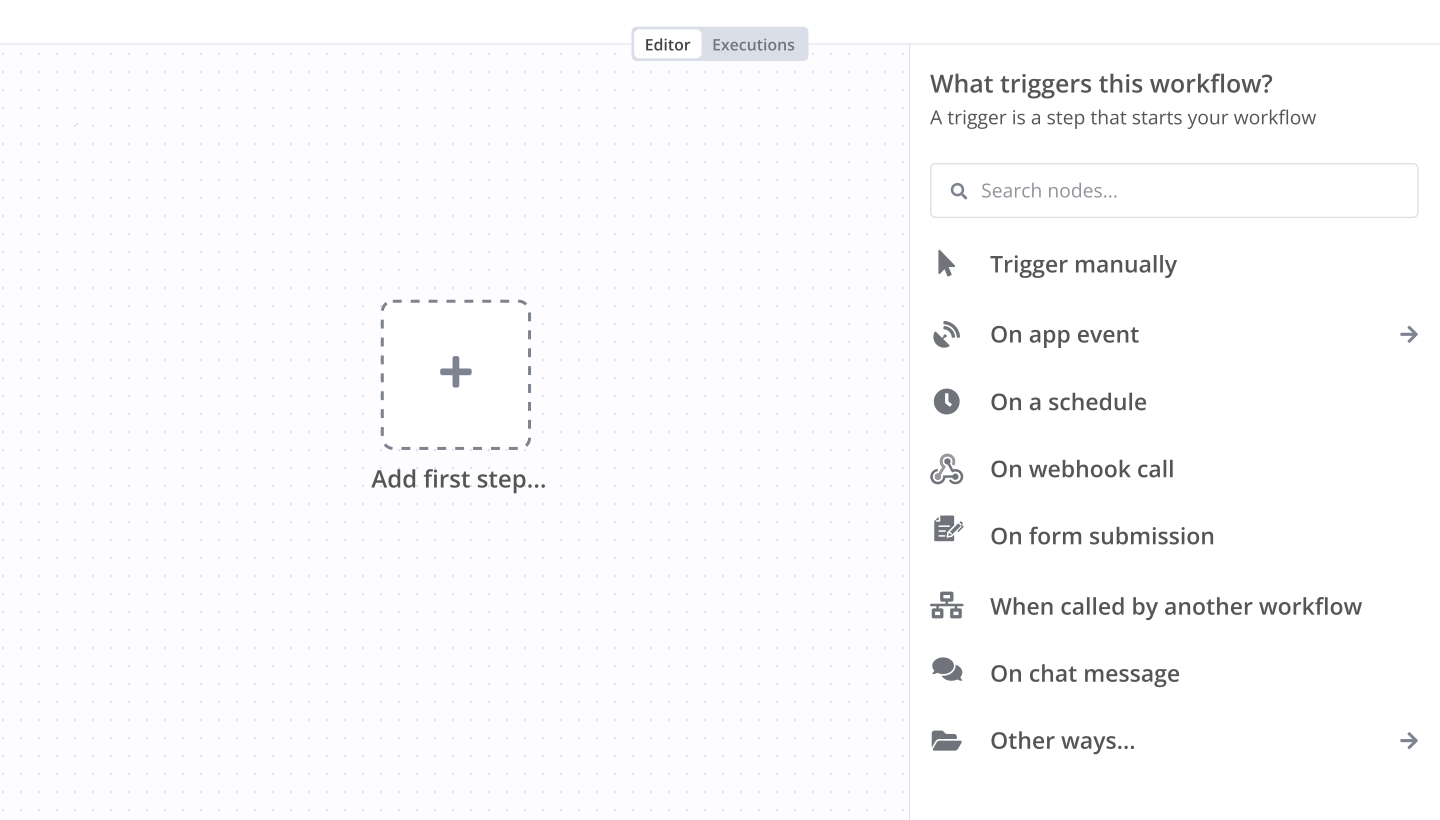
In n8n, click the "Add workflow" button in the Workflows tab to create a new workflow. Add the starting point – a trigger on when your workflow should run: an app event, a schedule, a webhook call, another workflow, an AI chat, or a manual trigger. Sometimes, the HTTP Request node might already serve as your starting point.

HTTP Request and JWT integration: Create a new workflow and add the first step

Step 2: Add and configure HTTP Request and JWT nodes

You can find HTTP Request and JWT in the nodes panel. Drag them onto your workflow canvas, selecting their actions. Click each node, choose a credential, and authenticate to grant n8n access. Configure HTTP Request and JWT nodes one by one: input data on the left, parameters in the middle, and output data on the right.

HTTP Request and JWT integration: Add and configure HTTP Request and JWT nodes

Step 3: Connect HTTP Request and JWT

A connection establishes a link between HTTP Request and JWT (or vice versa) to route data through the workflow. Data flows from the output of one node to the input of another. You can have single or multiple connections for each node.

HTTP Request and JWT integration: Connect HTTP Request and JWT

Step 4: Customize and extend your HTTP Request and JWT integration

Use n8n's core nodes such as If, Split Out, Merge, and others to transform and manipulate data. Write custom JavaScript or Python in the Code node and run it as a step in your workflow. Connect HTTP Request and JWT with any of n8n’s 1000+ integrations, and incorporate advanced AI logic into your workflows.

HTTP Request and JWT integration: Customize and extend your HTTP Request and JWT integration

Step 5: Test and activate your HTTP Request and JWT workflow

Save and run the workflow to see if everything works as expected. Based on your configuration, data should flow from HTTP Request to JWT or vice versa. Easily debug your workflow: you can check past executions to isolate and fix the mistake. Once you've tested everything, make sure to save your workflow and activate it.

HTTP Request and JWT integration: Test and activate your HTTP Request and JWT workflow

Summarize Apple App Store reviews with Pinecone, GPT-4 Mini & Slack

This n8n workflow automates the process of collecting, storing, and summarizing customer reviews from the Apple App Store for multiple apps. It fetches daily reviews, stores them in a Pinecone vector database, and generates a weekly summary using OpenAI, which is then posted to a Slack channel.

Key Features

Fetches daily customer reviews for a list of Apple App Store apps using the App Store Connect API.
Stores reviews in Pinecone, with separate namespaces for each app and automatic weekly cleanup.
Uses OpenAI to generate a summary of reviews, including positive/negative highlights and average star rating.
Posts the summary to a specified Slack channel every week.

How to use

Set your Apple App Store app IDs and names in the provided Set nodes.
Configure your Apple API, Pinecone, OpenAI, and Slack credentials.
Adjust the schedule triggers as needed for daily fetching and weekly summarization.
Deploy the workflow to automate review monitoring and reporting for your apps.

Nodes used in this workflow

Popular HTTP Request and JWT workflows

+3

Summarize Apple App Store Reviews with Pinecone, GPT-4 Mini & Slack

This n8n workflow automates the process of collecting, storing, and summarizing customer reviews from the Apple App Store for multiple apps. It fetches daily reviews, stores them in a Pinecone vector database, and generates a weekly summary using OpenAI, which is then posted to a Slack channel. Key Features Fetches daily customer reviews for a list of Apple App Store apps using the App Store Connect API. Stores reviews in Pinecone, with separate namespaces for each app and automatic weekly cleanup. Uses OpenAI to generate a summary of reviews, including positive/negative highlights and average star rating. Posts the summary to a specified Slack channel every week. How to use Set your Apple App Store app IDs and names in the provided Set nodes. Configure your Apple API, Pinecone, OpenAI, and Slack credentials. Adjust the schedule triggers as needed for daily fetching and weekly summarization. Deploy the workflow to automate review monitoring and reporting for your apps.
+2

Automate ASMR Glass Fruit Video Creation & Publishing with Veo, Shotstack & Postiz

🎥 Veo Machine Reels Factory — Full User Guide 🧭 Introduction The Veo Machine Reels Factory is an automated content creation system built in n8n that turns creative ideas into fully rendered ASMR-style glass fruit reels, ready to post on TikTok, YouTube Shorts, and Instagram Reels. This template connects multiple AI and automation services into a single, repeatable pipeline. It eliminates manual steps — from concept brainstorming to posting — allowing creators or marketing teams to produce viral short-form videos hands-free. ⚙️ How It Works (In Short) The workflow starts automatically every 8 hours (or manually when triggered). It checks a Google Sheet to see which fruits have already been used. An AI “Idea Agent” selects a new, unique glass fruit concept. Another AI “Prompt Agent” writes a cinematic Google Veo 3 prompt describing the video. The system sends that prompt to Google Veo, which generates the actual video file. The video is automatically: Converted to 9:16 vertical format via Shotstack Uploaded to Google Cloud Storage Posted to TikTok, YouTube, and Instagram through Postiz API 🧱 Requirements Before running this workflow, make sure you have the following ready: Category Requirement Google Cloud: Project ID, Service Account Email, and Storage Bucket (e.g., veo_courses) Veo Access: Access to Google Veo 3.0 API (through Vertex AI or similar endpoint) Google Sheets: A sheet with previous fruit ideas (used for avoiding duplicates) OpenAI Account: API key configured in n8n credentials Shotstack Account: API key (for cropping to 9:16) Postiz Account: Active integrations for TikTok, YouTube, and Instagram 🧩 Workflow Structure Overview The workflow can be divided into five main parts: 🕒 Automation & Data Input 🧠 AI Generation (Idea + Prompt Creation) 🎬 Video Generation with Google Veo 📱 Video Conversion & Upload 🚀 Auto-Publishing to Social Media

Automatic Google Cloud Run Auth with JWT Token Management (sub-workflow)

Who it’s for? Anyone calling a Google Cloud Run service from n8n who wants a small, reusable auth layer instead of wiring tokens in every workflow. What it does / How it works This sub-workflow checks whether an incoming id_token exists and is still valid (with a 5-minute buffer). If it’s good, it reuses it. If not, it signs a short-lived JWT with your service account, exchanges it at Google’s token endpoint, and returns a fresh id_token. It also passes through service_url and an optional service_path so the caller can hit the endpoint right away. (Designed to be called via Execute Workflow from your main flow.) How to set up Add your JWT (PEM) credential using the service account private_key. In Vars, set client_email (from your key) and confirm token_uri is https://oauth2.googleapis.com/token. Call this sub-workflow with service_url (and optional service_path). Optionally include a prior id_token to enable reuse. Inputs / Outputs Inputs: id_token (optional), service_url, service_path Outputs: id_token, service_url, service_path Notes Built for loops: pair with a Merge/Split strategy to attach id_token to each item. Keep credentials in n8n Credentials (no keys in nodes). Full write-up and context: Build a Secure Google Cloud Run API, Then Call It from n8n (Free Tier) — by Marco Cassar

Securely Call Private Google Cloud Run APIs with JWT Authentication (Simplified)

Who it’s for? Anyone who wants a dead-simple, free-tier friendly way to run custom API logic on Google Cloud Run and call it securely from n8n—no public exposure, no local hosting. What it does Minimal flow: Set → JWT (sign) → HTTP (token exchange) → HTTP (call Cloud Run with Authorization: Bearer <id_token> ). No caching, no extras—just enough to authenticate and hit your endpoint. How to set up General instructions below—see my detailed guide for more info: Build a Secure Google Cloud Run API, Then Call It from n8n (Free Tier) Setup: Create a Cloud Run service and enable Require authentication (Cloud IAM). Create a Google Service Account with Cloud Run Invoker on that service. In n8n, set service_url, client_email, token_uri (https://oauth2.googleapis.com/token) in Set. Create a JWT (PEM) credential from your service account key (paste the full BEGIN/END block). Run the workflow; the second HTTP node calls your Cloud Run URL with the ID token. Requirements Cloud Run service URL (auth required) Google Service Account with Cloud Run Invoker Private key JSON fields downloaded from Service Account | needed to generate JWT credentials More details Full write-up (minimal + modular versions): Build a Secure Google Cloud Run API, Then Call It from n8n (Free Tier)
+2

Generate and post Apple App Store review replies with Anthropic Claude

Generate and post Apple App Store review replies with Anthropic Claude, Google Drive and App Store Connect API This workflow empowers app developers and community management teams by automating the generation and posting of responses to user reviews on the Apple App Store. Designed to streamline the engagement process, it drastically reduces the manual workload on community managers by integrating AI-driven responses with necessary human oversight. By leveraging n8n's workflow automation capabilities, this solution eliminates the need for costly third-party platforms like AppFollow or Appbot, making it a cost-effective and efficient alternative. Pre-requisites Google Drive & Google Sheets access: To store and manage review spreadsheets. App Store Connect API credentials: To fetch and respond to app reviews. LLM credentials (e.g., Anthropic): Required for generating responses. Slack account Workflow steps Initialise and trigger workflow: The process begins daily at 10 AM through a scheduled trigger. Fetch application data: Utilizes a data table (Apple App Store apps) to retrieve a list of applications with their app id and name, essential for identifying review sources. Collect App Store Reviews: Retrieves previous day's reviews from the App Store Connect API based on app data. Stores the reviews in Google Sheets for further processing. Generate AI Responses: AI model generates initial responses based on review content. Responses are structured and stored along with reviews within a Google Spreadsheet located in a Google Drive folder called ToReview. A Slack message is sent with the URL of the file Human Review & Modification: Community managers review and refine AI-generated responses. Reviewed spreadsheets are moved to the ToSubmit Google Drive folder by the editor. Post Verified Responses: Workflow triggers again at 5 PM to access reviewed spreadsheets in ToSubmit folder. It posts the human-verified responses back to the respective reviews on Apple App Store using App Store Connect API. Logs are maintained, recording each response's success or failure. Archive processed spreadsheets: After posting the responses, workflow moves the processed files from ToSubmit to a different folder called Archived

Track and Report App Store Featuring Nominations with MySQL, Slack and Google Drive

Apple App Store Connect: Featuring Nominations Report This workflow automates the process of tracking and reporting app nominations submitted to Apple for App Store featuring consideration. It connects to the App Store Connect API to fetch your list of apps and submitted nominations, stores the data in a MySQL database, and generates a report of all nominations. The report is then exported as a CSV file and can be automatically shared via Google Drive and Slack. Key features Authenticates with App Store Connect using JWT. Fetches all apps and submitted nominations, including details and related in-app events (API documentation: https://developer.apple.com/documentation/appstoreconnectapi/featuring-nominations) Stores and updates app and nomination data in MySQL tables. Generates a comprehensive nominations report with app and nomination details. Exports the report as a CSV file. Shares the report automatically to Google Drive and Slack. Runs on a weekly schedule, but can be triggered manually as well. Setup Instructions Obtain your App Store Connect API credentials (Issuer ID, Key ID, and private key) from your Apple Developer account. Set up a MySQL database and configure the connection details in the workflow’s MySQL node(s). (Optional) Connect your Google Drive and Slack accounts using the respective n8n nodes if you want to share the report automatically. Update any credentials in the workflow to match your setup. Activate the workflow and set the schedule as needed. This template is ideal for teams who regularly submit apps or updates for featuring on the App Store and want to keep track of their nomination history and status in a structured, automated way.

Build your own HTTP Request and JWT integration

Create custom HTTP Request and JWT workflows by choosing triggers and actions. Nodes come with global operations and settings, as well as app-specific parameters that can be configured. You can also use the HTTP Request node to query data from any app or service with a REST API.

JWT supported actions

Decode
Sign
Verify

HTTP Request and JWT integration details

Use case

Save engineering resources

Reduce time spent on customer integrations, engineer faster POCs, keep your customer-specific functionality separate from product all without having to code.

Learn more

FAQs

  • Can HTTP Request connect with JWT?

  • Can I use HTTP Request’s API with n8n?

  • Can I use JWT’s API with n8n?

  • Is n8n secure for integrating HTTP Request and JWT?

  • How to get started with HTTP Request and JWT integration in n8n.io?

Need help setting up your HTTP Request and JWT integration?

Discover our latest community's recommendations and join the discussions about HTTP Request and JWT integration.
Moiz Contractor
theo
Jon
Dan Burykin
Tony

Looking to integrate HTTP Request and JWT in your company?

Over 3000 companies switch to n8n every single week

Why use n8n to integrate HTTP Request with JWT

Build complex workflows, really fast

Build complex workflows, really fast

Handle branching, merging and iteration easily.
Pause your workflow to wait for external events.

Code when you need it, UI when you don't

Simple debugging

Your data is displayed alongside your settings, making edge cases easy to track down.

Use templates to get started fast

Use 1000+ workflow templates available from our core team and our community.

Reuse your work

Copy and paste, easily import and export workflows.

Implement complex processes faster with n8n

red iconyellow iconred iconyellow icon