Back to Integrations
integrationHTTP Request node
integrationMailerLite node

HTTP Request and MailerLite integration

Save yourself the work of writing custom integrations for HTTP Request and MailerLite and use n8n instead. Build adaptable and scalable Development, Core Nodes, Communication, and Marketing workflows that work with your technology stack. All within a building experience you will love.

How to connect HTTP Request and MailerLite

  • Step 1: Create a new workflow
  • Step 2: Add and configure nodes
  • Step 3: Connect
  • Step 4: Customize and extend your integration
  • Step 5: Test and activate your workflow

Step 1: Create a new workflow and add the first step

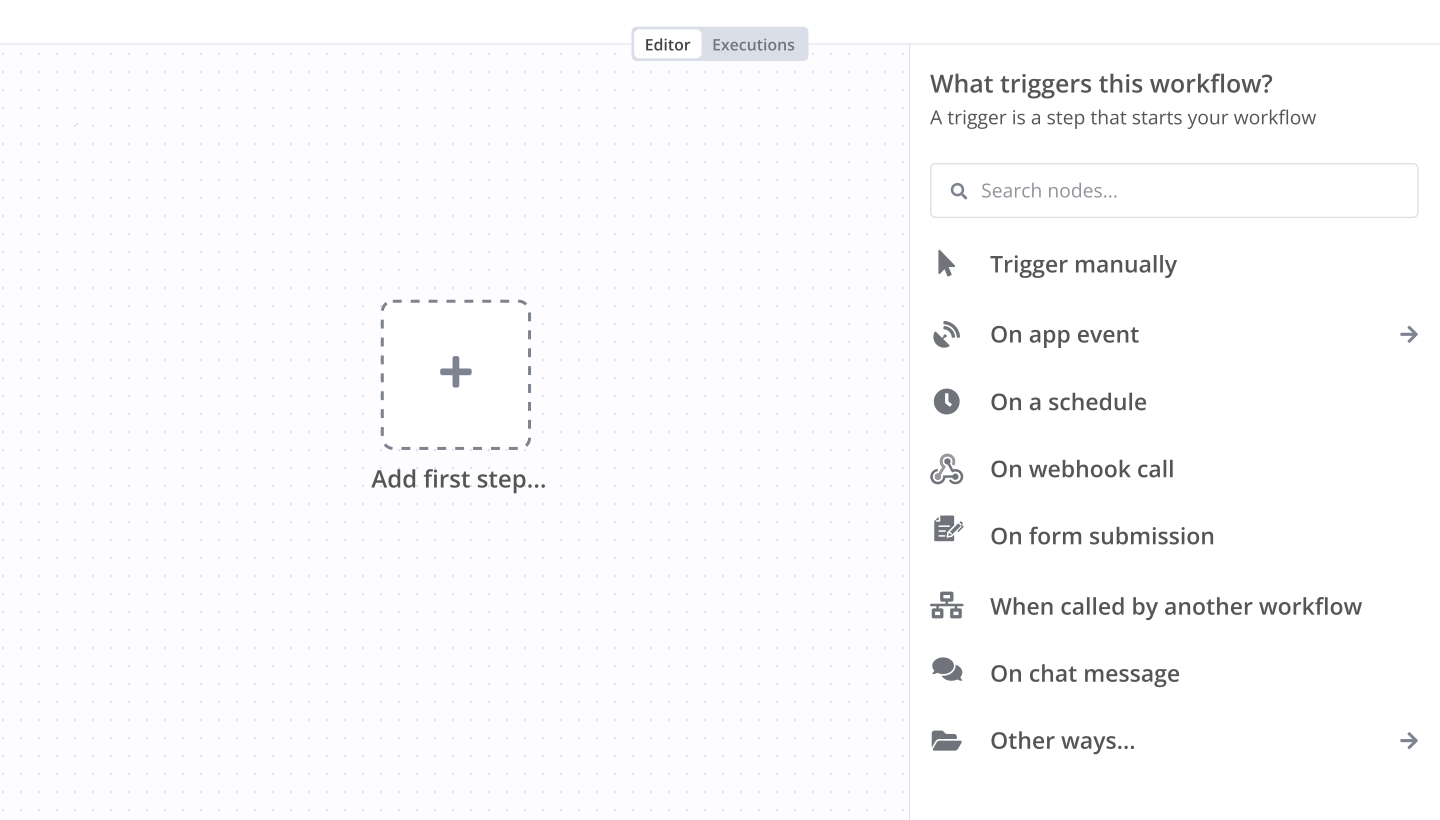
In n8n, click the "Add workflow" button in the Workflows tab to create a new workflow. Add the starting point – a trigger on when your workflow should run: an app event, a schedule, a webhook call, another workflow, an AI chat, or a manual trigger. Sometimes, the HTTP Request node might already serve as your starting point.

HTTP Request and MailerLite integration: Create a new workflow and add the first step

Step 2: Add and configure HTTP Request and MailerLite nodes

You can find HTTP Request and MailerLite in the nodes panel. Drag them onto your workflow canvas, selecting their actions. Click each node, choose a credential, and authenticate to grant n8n access. Configure HTTP Request and MailerLite nodes one by one: input data on the left, parameters in the middle, and output data on the right.

HTTP Request and MailerLite integration: Add and configure HTTP Request and MailerLite nodes

Step 3: Connect HTTP Request and MailerLite

A connection establishes a link between HTTP Request and MailerLite (or vice versa) to route data through the workflow. Data flows from the output of one node to the input of another. You can have single or multiple connections for each node.

HTTP Request and MailerLite integration: Connect HTTP Request and MailerLite

Step 4: Customize and extend your HTTP Request and MailerLite integration

Use n8n's core nodes such as If, Split Out, Merge, and others to transform and manipulate data. Write custom JavaScript or Python in the Code node and run it as a step in your workflow. Connect HTTP Request and MailerLite with any of n8n’s 1000+ integrations, and incorporate advanced AI logic into your workflows.

HTTP Request and MailerLite integration: Customize and extend your HTTP Request and MailerLite integration

Step 5: Test and activate your HTTP Request and MailerLite workflow

Save and run the workflow to see if everything works as expected. Based on your configuration, data should flow from HTTP Request to MailerLite or vice versa. Easily debug your workflow: you can check past executions to isolate and fix the mistake. Once you've tested everything, make sure to save your workflow and activate it.

HTTP Request and MailerLite integration: Test and activate your HTTP Request and MailerLite workflow

Capture Gumroad sales, add buyer to MailerLite group, log to Google Sheets CRM

Turn Gumroad buyers into loyal email subscribers and keep your CRM up‑to‑date.

When someone makes a purchase on your Gumroad store, this n8n workflow instantly adds that customer to the right MailerLite group (so your nurture sequence starts on time) and writes the sale details into your Google Sheets CRM. You’ll never copy‑and‑paste orders again, and every buyer begins receiving your follow‑up emails the moment they purchase.

Requirements
A Gumroad account with a product listed
A MailerLite account.
A MailerLite group of subscribers created
Enabled APIs and credentials for Google Sheets, MailerLite and Gumroad

How it works
Listen for a new sale on Gumroad**
The Gumroad trigger watches your account 24/7 and fires as soon as a sale is completed.

Create (or update) the subscriber in MailerLite**
Their name and email are added to MailerLite. If they already exist, the workflow simply updates their profile.

Assign the subscriber to your Gumroad group**
Grouping lets your MailerLite automation send the right onboarding or upsell sequence without manual tagging.

Log the purchase in Google Sheets**
The buyer’s contact details, product, price, and date are appended as a new row in your CRM sheet.

Set‑up steps
Create an application in Gumroad. Copy the access token, you’ll paste it into the Gumroad trigger node.

Grab your MailerLite API key
MailerLite dashboard → Integrations → API. Paste it into the two MailerLite nodes.

Prepare a Google Sheets spreadsheet
Add column headers like Name, Email, Product, Price, Date.

Open the template in n8n Cloud or Desktop

In the Gumroad node, paste your token.

In the MailerLite nodes, paste your API keys and replace the group id.

In the Google Sheets node, replace the credentials, pick your spreadsheet and worksheet.

Get in touch with us
Feel free to contact us at 1 Node.
Get instant access to a library of free resources we created.

Nodes used in this workflow

Popular HTTP Request and MailerLite workflows

Sync Ghost members with MailerLite subscribers in real time

Sync Ghost Members with MailerLite Subscribers in Real-Time This n8n workflow automatically syncs your Ghost CMS members with MailerLite subscribers in real-time using webhooks. When members join or leave your Ghost site, they're automatically added or unsubscribed from MailerLite with no manual exports, imports, or CSV files required. A simple configuration form lets you enable or disable sync settings for member additions and deletions independently. Who is this for? Ghost site owners, content creators, and membership site operators who use MailerLite for email marketing and want to keep the two platforms in sync with no manual effort. What problem is this workflow solving? MailerLite and Ghost offer email capabilities that solve different issues: one is for delivering content, while the other is for marketing and promotions. Keeping the two lists in sync can lead to tedious manual effort and errors. This workflow automates that process saving time and ensures that all Ghost members are added or removed from MailerLite seemlessly and in real-time. What this workflow does Configuration Form**: Provides an easy-to-use form trigger where you set your Ghost API URL, webhook URL, and enable/disable sync for member additions and deletions. Webhook Management**: Automatically creates and manages webhooks in Ghost for member.added and member.deleted events based on your settings. Real-Time Sync**: Listens for Ghost webhook events and immediately syncs changes to MailerLite: Member Added: Creates a new subscriber in MailerLite with the member's email. Member Deleted: Unsubscribes the member from MailerLite. Remembers Settings and Sync Status**: Stores Ghost webhook IDs in an n8n data table and updates the workflow's own configuration to remember your settings between runs. Smart Initialization**: Automatically creates the required data table if it doesn't exist on first run. Setup Get Credentials: Ghost Admin API: Create an integration in your Ghost Admin panel (Settings → Integrations → Add custom integration) to get API credentials. Make note your Ghost API URL for later. MailerLite API: Generate an API key from your MailerLite account settings. n8n API: Create n8n API credentials to allow the workflow to update itself (Settings → API). Configure Credentials in Workflow: Add your Ghost Admin API, MailerLite API, and n8n API credentials to the appropriate nodes. Sync Settings Form: Open the workflow and copy the Webhook node URL (from the "Webhook" node in the workflow). Trigger the "Sync Settings Form" to access the configuration form. Fill in the following fields: Ghost API URL: Your Ghost API URL (e.g., https://yourblog.ghost.io) You will have used this setting up your credentials as well. Webhook URL: The URL from the Webhook node Ghost Member Added > Added to Mailerlite: Enable or Disable Ghost Member Removed > Removed from Mailerlite: Enable or Disable Submit the form to activate the sync. Requirements Ghost CMS**: Self-hosted or Ghost(Pro) with Admin API access. MailerLite Account**: Active account with API access. How to further customize the workflow Add Custom Fields**: Extend the MailerLite nodes to map additional Ghost member fields (name, labels, notes) to MailerLite custom fields. Group Management**: Modify the "Create a subscriber" node to automatically add new subscribers to specific MailerLite groups based on Ghost member properties. Notifications**: Add Slack or Email nodes to receive notifications when members are synced. Filtering**: Add conditional logic to sync only specific types of members (e.g., paid members only) based on Ghost member fields. Made by: Epilocal - We help local businesses thrive online Tags: ghost, mailerlite, email-marketing, webhook, cms

Sync new subscribers from Google Sheets to MailerLite without duplicates

This n8n template from Intuz provides a complete solution to automate the syncing of new subscribers from Google Sheets to MailerLite. It intelligently identifies and adds only new contacts, preventing duplicates and ensuring your email lists are clean and accurate. Who's this workflow for? Marketing Teams Email Marketers Small Business Owners Community Managers How it works Read from Google Sheets: The workflow begins by reading all contact rows from your designated Google Sheet. Check for Existing Subscribers: For each contact, it performs a search in MailerLite to check if a subscriber with that email address already exists. Handle Duplicates: If the subscriber is found in MailerLite, the workflow stops processing that specific contact, preventing any duplicates from being created. Create New Subscribers: If the contact is not found, the workflow proceeds to create a new subscriber in MailerLite, using all the details from the Google Sheet (like name, company, and country) and assigns them to the specified group. Setup Instructions Google Sheets Setup: Connect your Google Sheets account to n8n. Create a sheet with the required columns: Email, first_name, last_name, Company, Country, and group_id. In the Get row(s) in sheet node, select your credentials and specify the Document ID and Sheet Name. MailerLite Setup: Connect your MailerLite account to n8n using your API key. In both the Get a subscriber and Create subscriber... nodes, select your MailerLite credentials. Make sure the group_id values in your Google Sheet correspond to valid Group IDs in your MailerLite account. Activate Workflow: Save the workflow and click "Execute workflow" to run the sync whenever you need to update your subscriber list. Connect with us Website: https://www.intuz.com/n8n-workflow-automation-templates Email: [email protected] LinkedIn: https://www.linkedin.com/company/intuz Get Started: https://n8n.partnerlinks.io/intuz For Custom Worflow Automation Click here- Get Started

Capture Gumroad sales, add buyer to MailerLite group, log to Google Sheets CRM

Turn Gumroad buyers into loyal email subscribers and keep your CRM up‑to‑date. When someone makes a purchase on your Gumroad store, this n8n workflow instantly adds that customer to the right MailerLite group (so your nurture sequence starts on time) and writes the sale details into your Google Sheets CRM. You’ll never copy‑and‑paste orders again, and every buyer begins receiving your follow‑up emails the moment they purchase. Requirements A Gumroad account with a product listed A MailerLite account. A MailerLite group of subscribers created Enabled APIs and credentials for Google Sheets, MailerLite and Gumroad How it works Listen for a new sale on Gumroad** The Gumroad trigger watches your account 24/7 and fires as soon as a sale is completed. Create (or update) the subscriber in MailerLite** Their name and email are added to MailerLite. If they already exist, the workflow simply updates their profile. Assign the subscriber to your Gumroad group** Grouping lets your MailerLite automation send the right onboarding or upsell sequence without manual tagging. Log the purchase in Google Sheets** The buyer’s contact details, product, price, and date are appended as a new row in your CRM sheet. Set‑up steps Create an application in Gumroad. Copy the access token, you’ll paste it into the Gumroad trigger node. Grab your MailerLite API key MailerLite dashboard → Integrations → API. Paste it into the two MailerLite nodes. Prepare a Google Sheets spreadsheet Add column headers like Name, Email, Product, Price, Date. Open the template in n8n Cloud or Desktop In the Gumroad node, paste your token. In the MailerLite nodes, paste your API keys and replace the group id. In the Google Sheets node, replace the credentials, pick your spreadsheet and worksheet. Get in touch with us Feel free to contact us at 1 Node. Get instant access to a library of free resources we created.

Build your own HTTP Request and MailerLite integration

Create custom HTTP Request and MailerLite workflows by choosing triggers and actions. Nodes come with global operations and settings, as well as app-specific parameters that can be configured. You can also use the HTTP Request node to query data from any app or service with a REST API.

MailerLite supported actions

Create
Create a new subscriber
Get
Get an subscriber
Get Many
Get many subscribers
Update
Update an subscriber
Use case

Save engineering resources

Reduce time spent on customer integrations, engineer faster POCs, keep your customer-specific functionality separate from product all without having to code.

Learn more
Use case

Automate lead management

Using too many marketing tools? n8n lets you orchestrate all your apps into one cohesive, automated workflow.

Learn more

FAQs

  • Can HTTP Request connect with MailerLite?

  • Can I use HTTP Request’s API with n8n?

  • Can I use MailerLite’s API with n8n?

  • Is n8n secure for integrating HTTP Request and MailerLite?

  • How to get started with HTTP Request and MailerLite integration in n8n.io?

Need help setting up your HTTP Request and MailerLite integration?

Discover our latest community's recommendations and join the discussions about HTTP Request and MailerLite integration.
Moiz Contractor
theo
Jon
Dan Burykin
Tony

Looking to integrate HTTP Request and MailerLite in your company?

Over 3000 companies switch to n8n every single week

Why use n8n to integrate HTTP Request with MailerLite

Build complex workflows, really fast

Build complex workflows, really fast

Handle branching, merging and iteration easily.
Pause your workflow to wait for external events.

Code when you need it, UI when you don't

Simple debugging

Your data is displayed alongside your settings, making edge cases easy to track down.

Use templates to get started fast

Use 1000+ workflow templates available from our core team and our community.

Reuse your work

Copy and paste, easily import and export workflows.

Implement complex processes faster with n8n

red iconyellow iconred iconyellow icon