Back to Integrations
integrationHTTP Request node
integrationMicrosoft Excel 365 node

HTTP Request and Microsoft Excel 365 integration

Save yourself the work of writing custom integrations for HTTP Request and Microsoft Excel 365 and use n8n instead. Build adaptable and scalable Development, Core Nodes, Data & Storage, and Productivity workflows that work with your technology stack. All within a building experience you will love.

How to connect HTTP Request and Microsoft Excel 365

  • Step 1: Create a new workflow
  • Step 2: Add and configure nodes
  • Step 3: Connect
  • Step 4: Customize and extend your integration
  • Step 5: Test and activate your workflow

Step 1: Create a new workflow and add the first step

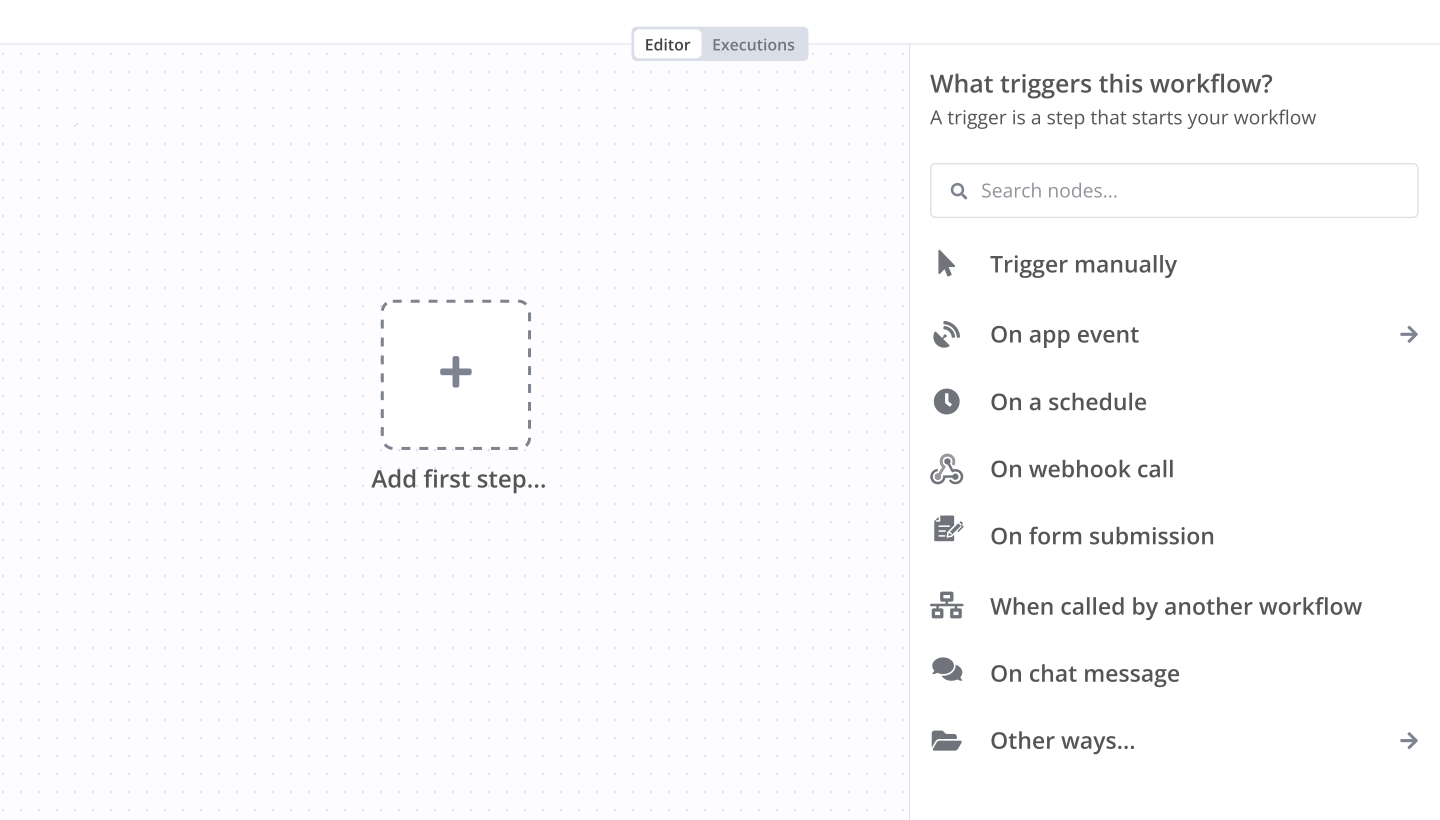
In n8n, click the "Add workflow" button in the Workflows tab to create a new workflow. Add the starting point – a trigger on when your workflow should run: an app event, a schedule, a webhook call, another workflow, an AI chat, or a manual trigger. Sometimes, the HTTP Request node might already serve as your starting point.

HTTP Request and Microsoft Excel 365 integration: Create a new workflow and add the first step

Step 2: Add and configure HTTP Request and Microsoft Excel 365 nodes

You can find HTTP Request and Microsoft Excel 365 in the nodes panel. Drag them onto your workflow canvas, selecting their actions. Click each node, choose a credential, and authenticate to grant n8n access. Configure HTTP Request and Microsoft Excel 365 nodes one by one: input data on the left, parameters in the middle, and output data on the right.

HTTP Request and Microsoft Excel 365 integration: Add and configure HTTP Request and Microsoft Excel 365 nodes

Step 3: Connect HTTP Request and Microsoft Excel 365

A connection establishes a link between HTTP Request and Microsoft Excel 365 (or vice versa) to route data through the workflow. Data flows from the output of one node to the input of another. You can have single or multiple connections for each node.

HTTP Request and Microsoft Excel 365 integration: Connect HTTP Request and Microsoft Excel 365

Step 4: Customize and extend your HTTP Request and Microsoft Excel 365 integration

Use n8n's core nodes such as If, Split Out, Merge, and others to transform and manipulate data. Write custom JavaScript or Python in the Code node and run it as a step in your workflow. Connect HTTP Request and Microsoft Excel 365 with any of n8n’s 1000+ integrations, and incorporate advanced AI logic into your workflows.

HTTP Request and Microsoft Excel 365 integration: Customize and extend your HTTP Request and Microsoft Excel 365 integration

Step 5: Test and activate your HTTP Request and Microsoft Excel 365 workflow

Save and run the workflow to see if everything works as expected. Based on your configuration, data should flow from HTTP Request to Microsoft Excel 365 or vice versa. Easily debug your workflow: you can check past executions to isolate and fix the mistake. Once you've tested everything, make sure to save your workflow and activate it.

HTTP Request and Microsoft Excel 365 integration: Test and activate your HTTP Request and Microsoft Excel 365 workflow

Automated web scraping: email a CSV, save to Google Sheets & Microsoft Excel

How it works:
The workflow starts by sending a request to a website to retrieve its HTML content.
It then parses the HTML extracting the relevant information
The extracted data is storted and converted into a CSV file.
The CSV file is attached to an email and sent to your specified address.
The data is simultaneously saved to both Google Sheets and Microsoft Excel for further analysis or use.

Set-up steps:
Change the website to scrape in the "Fetch website content" node
Configure Microsoft Azure credentials with Microsoft Graph permissions (required for the Save to Microsoft Excel 365 node)
Configure Google Cloud credentials with access to Google Drive, Google Sheets and Gmail APIs (the latter is required for the Send CSV via e-mail node).

Nodes used in this workflow

Popular HTTP Request and Microsoft Excel 365 workflows

Fetch Live ETF Metrics from JustETF to Excel with One-Click Updates

Automate Your ETF Comparison: Real-Time Data & Analysis Automate ETF research in Excel with one click. This n8n workflow pulls live data from justetf.com using ISIN codes from your Excel table, extracts key metrics (dividends, fees, 5-year performance), and updates your “Div study” sheet instantly — all triggered by a button in Excel. Perfect for dividend investors, ETF screeners, or portfolio trackers who want fresh, accurate data without manual copy-paste. How it works Trigger: Click “Update Table” in Excel → calls n8n via webhook Excel: Logs current time (GMT-2) and reads all rows from “DivComp” table HTTP Request: Fetches ETF profile page from justetf.com using ISIN HTML Extraction: Parses page with CSS selectors to grab dividends, fees, 5Y performance Code Node: Cleans & structures data (e.g., last 5 years of dividends, yield, growth) Update Excel: Writes clean values back to your table (fees, yield, performance, name) Setup steps In Excel: Add a button → assign macro that calls your n8n webhook URL (path: /ETF) Ensure table “DivComp” has: ISIN, Dernière mise à jour, Frais, Performance depuis 5 ans, etc. In n8n: Connect Microsoft Excel (OneDrive) credential Update workbook/worksheet/table references if needed Test with 1–2 ISINs first Click “Update Table” → watch data refresh in real time! Tags: ETF, Excel, Web Scraping, Investing, Finance, Automation, justetf, Dividend Tracking

Parse Incoming Invoices From Outlook using AI Document Understanding

This n8n template monitors an Outlook mailbox for invoices, automatically parses/extracts data from them and then uploads the output to an Excel Workbook. One of my top workflow requests, this template can save many hours of manual labour for you or your finance/accounts team. How it works A scheduled trigger is set to fetch recent Outlook messages to the Accounts receivable mailbox. Each message is analysed to determine whether or not it from a supplier and is issuing/contains an invoice. For each valid message, the attachments are downloaded and non-invoice documents are filtered out via AI Vision classification. Invoices are then processed through a AI vision model again to extract the details. The extracted data can then be used for reconciliation or otherwise. For this demonstration, we'll just append the row to an Excel sheet for now. How to use Ensure your Microsoft365 credential points to the correct mailbox. If a shared folder is used, toggle "shared folder" option to "on" and for the principal ID, use the email address. If you receive lots of other types of messages such as replies and forwards, you may want to implement additional checks to prevent processing invoices twice. The "remove duplicates" node can help with this. Requirements Outlook for Mailbox Google Gemini for Document Understanding and Invoice Extraction Excel for Data Storage Customising this workflow Note the assumption for this template is that all invoices will come as a PDF attachment. In real life, this is rarely the case! Adding in document conversion to cover all invoice formats. Human feedback is also an important factor in AI workflows. Try tagging emails as a way to notify team members that the invoice was processed.

Daily Newsletter Service using Excel, Outlook and AI

This n8n template builds a newsletter ("daily digest") delivery service which pulls and summarises the latest n8n.io template in select categories defined by subscribers. It's scheduled to run once a day and sends the newsletter directly to subscriber via a nicely formatted email. If you've had trouble keeping up with the latest and greatest templates beign published daily, this workflow can save you a lot of time! How it works A scheduled trigger pulls a list of subscribers (email and category preferences) from an Excel workbook. We work out unique categories amongst all subscribers and only fetch the latest n8n website templates from these categories to save on resources and optimise the number of API calls we make. The fetched templates are summarised via AI to produce a short description which is more suitable for our email format. For each subscriber, we filter and collect only the templates relevant to their category preferences (as defined in the Excel) and ensure that duplicate templates or those which have been "seen before" are omitted. A HTML node is then used to generate the email newsletter. HTML emails are the perfect format since we can add links back to the template. Finally, we use the Outlook node to send the email digest to the subscriber. How to use Populate your Excel sheet with 3 columns: name, email and categories. Categories is a comma-delimited list of categories which match the n8n template website. The available categories are AI, SecOps, Sales, IT Ops, Marketing, Engineering, DevOps, Building Blocks, Design, Finance, HR, Other, Product and Support. To subscribe a new user, simply add their email to the Excel sheet with at least one category. To unsubscribe a user, remove them from the sheet. If you're not interested in paid templates, you may want to filter them out after fetching. Requirements Microsoft Excel for subscriber list Microsoft Outlook for delivering emails OpenAI for AI-generated descriptions Customising the workflow Use AI to summarise the week's trend of templates types and use-cases This template can be the basis for other similar newsletters - just pull in a list of things from anywhere!

Automated Web Scraping: email a CSV, save to Google Sheets & Microsoft Excel

How it works: The workflow starts by sending a request to a website to retrieve its HTML content. It then parses the HTML extracting the relevant information The extracted data is storted and converted into a CSV file. The CSV file is attached to an email and sent to your specified address. The data is simultaneously saved to both Google Sheets and Microsoft Excel for further analysis or use. Set-up steps: Change the website to scrape in the "Fetch website content" node Configure Microsoft Azure credentials with Microsoft Graph permissions (required for the Save to Microsoft Excel 365 node) Configure Google Cloud credentials with access to Google Drive, Google Sheets and Gmail APIs (the latter is required for the Send CSV via e-mail node).


Transform Excel Data into AI-Ready Vectors with OpenAI and Supabase

Description This workflow is a practical, “dirty” solution for real-world scenarios where frontline workers keep using Excel in their daily processes. Instead of forcing change, we take their spreadsheets as-is, clean and normalize the data, generate embeddings, and store everything in Supabase. The benefit: frontline staff continue with their familiar tools, while data analysts gain clean, structured, and vectorized data ready for analysis or RAG-style AI applications. How it works Frontline workers continue with Excel** – no disruption to their daily routines. Upload & trigger** – The workflow runs when a new Excel sheet is ready. Read Excel rows** – Data is pulled from the specified workbook and worksheet. Clean & normalize** – HTML is stripped, Excel dates are fixed, and text fields are standardized. Batch & switch** – Rows are split and routed into Question/Answer processing paths. Generate embeddings** – Cleaned Questions and Answers are converted into vectors via OpenAI. Merge enriched records** – Original business data is combined with embeddings. Write into Supabase** – Data lands in a structured table (excel_records) with vector and FTS indexes. Why it’s “dirty but useful” No disruption** – frontline workers don’t need to change how they work. Analyst-ready data** – Supabase holds clean, queryable data for dashboards, reporting, or AI pipelines. Bridge between old and new** – Excel remains the input, but the backend becomes modern and scalable. Incremental modernization** – paves the way for future workflow upgrades without blocking current work. Outcome Frontline workers keep their Excel-based workflows, while data can immediately be structured, searchable, and vectorized in Supabase — enabling AI-powered search, reporting, and retrieval-augmented generation. Required setup Supabase account Create a project and enable the pgvector extension. OpenAI API Key Required for generating embeddings (text-embedding-3-small). Microsoft Excel credentials Needed to connect to your workbook and worksheet. Need Help 🔗 LinkedIn – Wessel Bulte

Student Absence Alerts via Email & WhatsApp with Attendance Tracking

📘 Student Absence Alerts & Attendance Tracking Automation Automatically alerts parents about student absences and tracks 30-day attendance patterns to identify risks and trends. 🔧 Main Components Daily Attendance Check – 10:30 AM** Triggers the workflow every day at 10:30 AM. Read Today’s Attendance** Retrieves current-day attendance records from the source Excel or database. Read Student Contacts** Reads contact details (email, phone) of students for alert delivery. Process Absent Students** Identifies students who are absent and unexcused for the day. Prepare Absence Email** Generates customized email content for absent students. Send Absence Email** Sends an absence alert email to the student’s parent/guardian. Prepare Absence SMS** Formats WhatsApp-friendly message for alerts. Send Absence WhatsApp** Sends the WhatsApp message using API (e.g., Facebook Graph). Generate Attendance Report** Prepares a daily attendance summary with absence level classifications. Save Attendance Report** Appends the generated report to a historical attendance sheet. ⚠️ Alert Logic Based on the past 30-day absence pattern, the system classifies students into: | Level | Absences in 30 Days | Status | | --------- | ------------------- | -------------- | | 🔴 High | 5+ | Critical Alert | | 🟡 Medium | 3–4 | Warning | | 🟢 Low | 1–2 | Low Risk | 📊 Tracking Features 🔢 Attendance Rate Calculation – Tracks each student's attendance percentage 🔍 Pattern Analysis – Detects recurring absenteeism trends 🚨 Risk Identification – Flags high-risk students for early intervention 📈 Historical Reporting – Maintains daily logs for future reference ✅ Essential Prerequisites Excel sheet or database with daily attendance logs Excel sheet or database with student contact details SMTP credentials for sending emails WhatsApp API integration (e.g., Facebook Graph or Twilio) Storage access for saving attendance reports 📁 Required Excel File Structures Attendance Sheet (daily_attendance.xlsx) | Student ID | Date | Status | | ---------- | ---------- | ------ | | ST101 | 2025-08-06 | Absent | Contacts Sheet (student_contacts.xlsx) | Student ID | Name | Email | Phone | | ---------- | ---------- | --------------------------------------------- | ------------- | | ST101 | Aryan Shah | [email protected] | +919123456789 | 🧾 Expected Input Format Example { "studentId": "ST101", "name": "Aryan Shah", "email": "[email protected]", "phone": "+919123456789", "status": "Absent", "date": "2025-08-06" } 🚀 Key Features ⏰ Scheduled Daily Execution – Automated tracking at 10:30 AM ✉️ Multi-Channel Notifications – Email + WhatsApp alerts to parents 📊 Absence Pattern Monitoring – 30-day trend analysis 🧠 Risk-Based Alerts – Smart classification into alert levels 🗂️ Daily Reports – Easy to audit attendance summary logs ⚙️ Quick Setup Guide Import Workflow JSON into n8n. Configure schedule trigger at 10:30 AM. Set Excel file paths in "Read Today’s Attendance" and "Read Student Contacts". Customize absence thresholds in the “Process Absent Students” node. Add SMTP details for the “Send Absence Email” node. Integrate WhatsApp API in the “Send Absence WhatsApp” node. Test with mock data and review reports. Activate the workflow. 🔧 Parameters to Configure | Parameter | Description | | ---------------------- | -------------------------------------- | | attendance_file_path | Path to today's attendance records | | contacts_file_path | Path to student contacts sheet | | smtp_user | Email username for SMTP server | | smtp_password | Password for SMTP server | | whatsapp_api_url | Endpoint for sending WhatsApp messages | | alert_thresholds | Absence count thresholds for alerts |

Build your own HTTP Request and Microsoft Excel 365 integration

Create custom HTTP Request and Microsoft Excel 365 workflows by choosing triggers and actions. Nodes come with global operations and settings, as well as app-specific parameters that can be configured. You can also use the HTTP Request node to query data from any app or service with a REST API.

Microsoft Excel 365 supported actions

Append
Add rows to the end of the table
Convert to Range
Convert a table to a range
Create
Add a table based on range
Delete
Delete a table
Get Columns
Retrieve a list of table columns
Get Rows
Retrieve a list of table rows
Lookup
Look for rows that match a given value in a column
Add Sheet
Add a new sheet to the workbook
Delete
Delete workbook
Get Many
Get workbooks
Append
Append data to sheet
Append or Update
Append a new row or update the current one if it already exists (upsert)
Clear
Clear sheet
Delete
Delete sheet
Get Many
Get a list of sheets
Get Rows
Retrieve a list of sheet rows
Update
Update rows of a sheet or sheet range
Use case

Save engineering resources

Reduce time spent on customer integrations, engineer faster POCs, keep your customer-specific functionality separate from product all without having to code.

Learn more

FAQs

  • Can HTTP Request connect with Microsoft Excel 365?

  • Can I use HTTP Request’s API with n8n?

  • Can I use Microsoft Excel 365’s API with n8n?

  • Is n8n secure for integrating HTTP Request and Microsoft Excel 365?

  • How to get started with HTTP Request and Microsoft Excel 365 integration in n8n.io?

Need help setting up your HTTP Request and Microsoft Excel 365 integration?

Discover our latest community's recommendations and join the discussions about HTTP Request and Microsoft Excel 365 integration.
Moiz Contractor
theo
Jon
Dan Burykin
Tony

Looking to integrate HTTP Request and Microsoft Excel 365 in your company?

Over 3000 companies switch to n8n every single week

Why use n8n to integrate HTTP Request with Microsoft Excel 365

Build complex workflows, really fast

Build complex workflows, really fast

Handle branching, merging and iteration easily.
Pause your workflow to wait for external events.

Code when you need it, UI when you don't

Simple debugging

Your data is displayed alongside your settings, making edge cases easy to track down.

Use templates to get started fast

Use 1000+ workflow templates available from our core team and our community.

Reuse your work

Copy and paste, easily import and export workflows.

Implement complex processes faster with n8n

red iconyellow iconred iconyellow icon