Back to Integrations
integrationHTTP Request node
integrationMicrosoft OneDrive node

HTTP Request and Microsoft OneDrive integration

Save yourself the work of writing custom integrations for HTTP Request and Microsoft OneDrive and use n8n instead. Build adaptable and scalable Development, Core Nodes, and Data & Storage workflows that work with your technology stack. All within a building experience you will love.

How to connect HTTP Request and Microsoft OneDrive

  • Step 1: Create a new workflow
  • Step 2: Add and configure nodes
  • Step 3: Connect
  • Step 4: Customize and extend your integration
  • Step 5: Test and activate your workflow

Step 1: Create a new workflow and add the first step

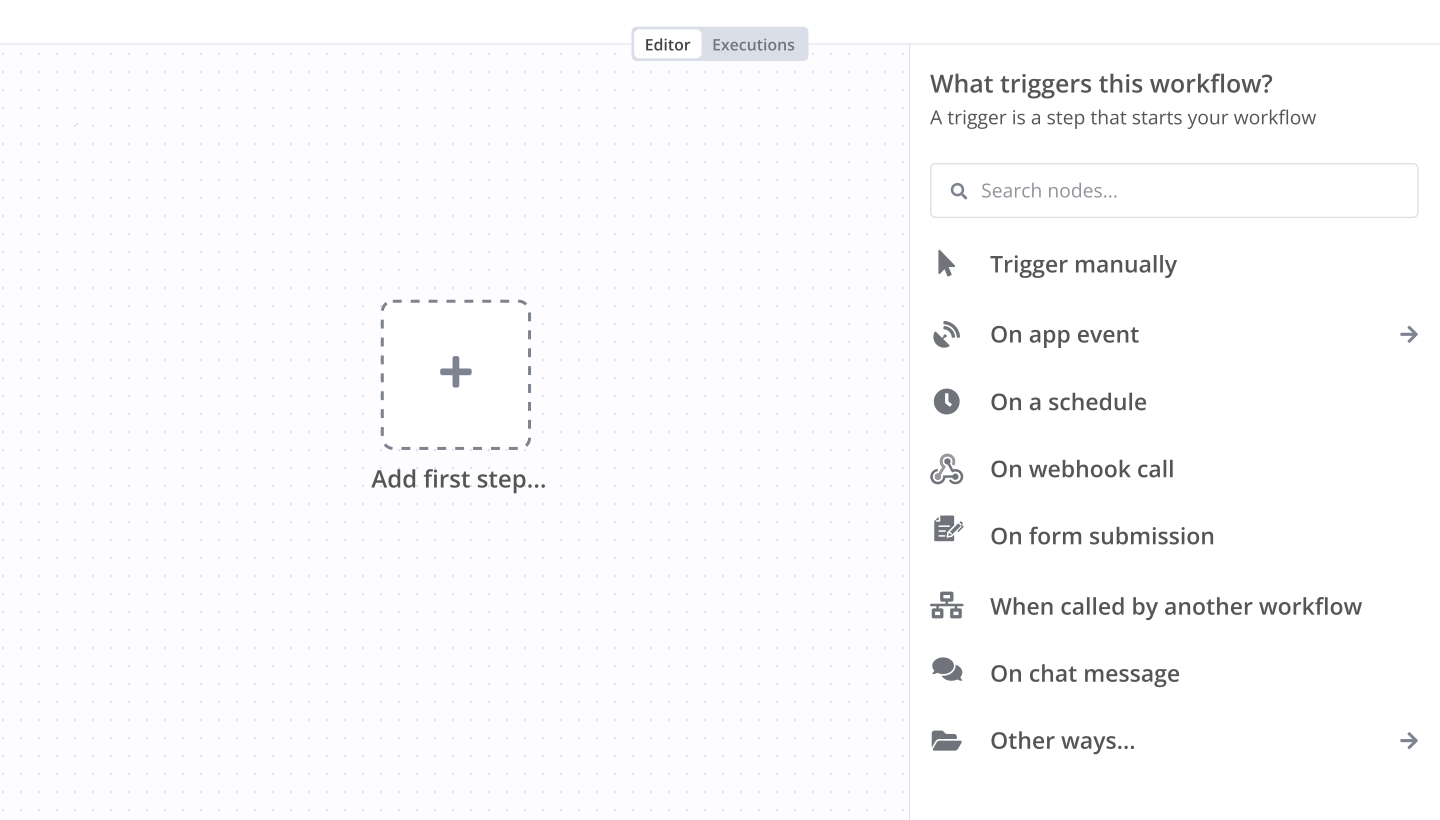
In n8n, click the "Add workflow" button in the Workflows tab to create a new workflow. Add the starting point – a trigger on when your workflow should run: an app event, a schedule, a webhook call, another workflow, an AI chat, or a manual trigger. Sometimes, the HTTP Request node might already serve as your starting point.

HTTP Request and Microsoft OneDrive integration: Create a new workflow and add the first step

Step 2: Add and configure HTTP Request and Microsoft OneDrive nodes

You can find HTTP Request and Microsoft OneDrive in the nodes panel. Drag them onto your workflow canvas, selecting their actions. Click each node, choose a credential, and authenticate to grant n8n access. Configure HTTP Request and Microsoft OneDrive nodes one by one: input data on the left, parameters in the middle, and output data on the right.

HTTP Request and Microsoft OneDrive integration: Add and configure HTTP Request and Microsoft OneDrive nodes

Step 3: Connect HTTP Request and Microsoft OneDrive

A connection establishes a link between HTTP Request and Microsoft OneDrive (or vice versa) to route data through the workflow. Data flows from the output of one node to the input of another. You can have single or multiple connections for each node.

HTTP Request and Microsoft OneDrive integration: Connect HTTP Request and Microsoft OneDrive

Step 4: Customize and extend your HTTP Request and Microsoft OneDrive integration

Use n8n's core nodes such as If, Split Out, Merge, and others to transform and manipulate data. Write custom JavaScript or Python in the Code node and run it as a step in your workflow. Connect HTTP Request and Microsoft OneDrive with any of n8n’s 1000+ integrations, and incorporate advanced AI logic into your workflows.

HTTP Request and Microsoft OneDrive integration: Customize and extend your HTTP Request and Microsoft OneDrive integration

Step 5: Test and activate your HTTP Request and Microsoft OneDrive workflow

Save and run the workflow to see if everything works as expected. Based on your configuration, data should flow from HTTP Request to Microsoft OneDrive or vice versa. Easily debug your workflow: you can check past executions to isolate and fix the mistake. Once you've tested everything, make sure to save your workflow and activate it.

HTTP Request and Microsoft OneDrive integration: Test and activate your HTTP Request and Microsoft OneDrive workflow

Hacker News to video content

Hacker News to Video Content

Overview
This workflow converts trending articles from Hacker News into engaging video content. It integrates AI-based tools to analyze, summarize, and generate multimedia content, making it ideal for content creators, educators, and marketers.

Features
Article Retrieval:
Pulls trending articles from Hacker News.
Limits the number of articles to process (configurable).

Content Analysis:
Uses OpenAI's GPT model to:
Summarize articles.
Assess their relevance to specific topics like automation or AI.
Extract key image URLs.

Image and Video Generation:
Leonardo.ai: Creates stunning AI-generated images based on extracted prompts.
RunwayML: Converts images into high-quality videos.

Structured Content Creation:
Parses content into structured formats for easy reuse.
Generates newsletter-friendly blurbs and social media-ready captions.

Cloud Integration:
Uploads generated assets to:
Dropbox
Google Drive
Microsoft OneDrive
MinIO

Social Media Posting (Optional):
Supports posting to YouTube, X (Twitter), LinkedIn, and Instagram.

Workflow Steps

  1. Trigger
    Initiated manually via the "Test Workflow" button.

  2. Fetch Articles
    Retrieves articles from Hacker News.
    Limits the results to avoid processing overload.

  3. Content Filtering
    Evaluates if articles are related to AI/Automation using OpenAI's language model.

  4. Image and Video Generation
    Generates:
    AI-driven image prompts via Leonardo.ai.
    Videos using RunwayML.

  5. Asset Management
    Saves the output to cloud storage services or uploads directly to social media platforms.

Prerequisites

API Keys**:
Hacker News
OpenAI
Leonardo.ai
RunwayML
Creatomate

n8n Installation**:
Ensure n8n is installed and configured locally or on a server.

Credentials**:
Set up credentials in n8n for all external services used in the workflow.

Customization
Replace Hacker News with any other data source node if needed.
Configure the "Article Analysis" node for different topics.
Adjust the cloud storage services or add custom storage options.

Usage
Import this workflow into your n8n instance.
Configure your API credentials.
Trigger the workflow manually or schedule it as needed.
Check the outputs in your preferred cloud storage or social media platform.

Notes
Extend this workflow further by automating social media posting or newsletter integration.
For any questions, refer to the official documentation or reach out to the creator.

About the Creator
This workflow was built by AlexK1919, an AI-native workflow automation architect. Check out the overview video for a quick demo.

Tools Used
Leonardo.ai**
RunwayML**
Creatomate**
Hacker News API**
OpenAI GPT**

Feel free to adapt and extend this workflow to meet your specific needs! 🎉

Nodes used in this workflow

Popular HTTP Request and Microsoft OneDrive workflows

Automate Invoice Processing with OCR, GPT-4 & Salesforce Opportunity Creation

PDF Invoice Extractor (AI) End-to-end pipeline: Watch Drive ➜ Download PDF ➜ OCR text ➜ AI normalize to JSON ➜ Upsert Buyer (Account) ➜ Create Opportunity ➜ Map Products ➜ Create OLI via Composite API ➜ Archive to OneDrive. Node by node (what it does & key setup) 1) Google Drive Trigger Purpose**: Fire when a new file appears in a specific Google Drive folder. Key settings**: Event: fileCreated Folder ID: google drive folder id Polling: everyMinute Creds: googleDriveOAuth2Api Output**: Metadata { id, name, ... } for the new file. 2) Download File From Google Purpose**: Get the file binary for processing and archiving. Key settings**: Operation: download File ID: ={{ $json.id }} Creds: googleDriveOAuth2Api Output**: Binary (default key: data) and original metadata. 3) Extract from File Purpose**: Extract text from PDF (OCR as needed) for AI parsing. Key settings**: Operation: pdf OCR: enable for scanned PDFs (in options) Output**: JSON with OCR text at {{ $json.text }}. 4) Message a model (AI JSON Extractor) Purpose: Convert OCR text into **strict normalized JSON array (invoice schema). Key settings**: Node: @n8n/n8n-nodes-langchain.openAi Model: gpt-4.1 (or gpt-4.1-mini) Message role: system (the strict prompt; references {{ $json.text }}) jsonOutput: true Creds: openAiApi Output (per item): $.message.content → the parsed **JSON (ensure it’s an array). 5) Create or update an account (Salesforce) Purpose: Upsert **Buyer as Account using an external ID. Key settings**: Resource: account Operation: upsert External Id Field: tax_id__c External Id Value: ={{ $json.message.content.buyer.tax_id }} Name: ={{ $json.message.content.buyer.name }} Creds: salesforceOAuth2Api Output: Account record (captures Id) for downstream **Opportunity. 6) Create an opportunity (Salesforce) Purpose**: Create Opportunity linked to the Buyer (Account). Key settings**: Resource: opportunity Name: ={{ $('Message a model').item.json.message.content.invoice.code }} Close Date: ={{ $('Message a model').item.json.message.content.invoice.issue_date }} Stage: Closed Won Amount: ={{ $('Message a model').item.json.message.content.summary.grand_total }} AccountId: ={{ $json.id }} (from Upsert Account output) Creds: salesforceOAuth2Api Output**: Opportunity Id for OLI creation. 7) Build SOQL (Code / JS) Purpose: Collect unique product **codes from AI JSON and build a SOQL query for PricebookEntry by Pricebook2Id. Key settings**: pricebook2Id (hardcoded in script): e.g., 01sxxxxxxxxxxxxxxx Source lines: $('Message a model').first().json.message.content.products Output**: { soql, codes } 8) Query PricebookEntries (Salesforce) Purpose**: Fetch PricebookEntry.Id for each Product2.ProductCode. Key settings**: Resource: search Query: ={{ $json.soql }} Creds: salesforceOAuth2Api Output**: Items with Id, Product2.ProductCode (used for mapping). 9) Code in JavaScript (Build OLI payloads) Purpose: Join lines with PBE results and Opportunity Id ➜ build **OpportunityLineItem payloads. Inputs**: OpportunityId: ={{ $('Create an opportunity').first().json.id }} Lines: ={{ $('Message a model').first().json.message.content.products }} PBE rows: from previous node items Output**: { body: { allOrNone:false, records:[{ OpportunityLineItem... }] } } Notes**: Converts discount_total ➜ per-unit if needed (currently commented for standard pricing). Throws on missing PBE mapping or empty lines. 10) Create Opportunity Line Items (HTTP Request) Purpose**: Bulk create OLIs via Salesforce Composite API. Key settings**: Method: POST URL: https://<your-instance>.my.salesforce.com/services/data/v65.0/composite/sobjects Auth: salesforceOAuth2Api (predefined credential) Body (JSON): ={{ $json.body }} Output**: Composite API results (per-record statuses). 11) Update File to One Drive Purpose: Archive the **original PDF in OneDrive. Key settings**: Operation: upload File Name: ={{ $json.name }} Parent Folder ID: onedrive folder id Binary Data: true (from the Download node) Creds: microsoftOneDriveOAuth2Api Output**: Uploaded file metadata. Data flow (wiring) Google Drive Trigger → Download File From Google Download File From Google → Extract from File → Update File to One Drive Extract from File → Message a model Message a model → Create or update an account Create or update an account → Create an opportunity Create an opportunity → Build SOQL Build SOQL → Query PricebookEntries Query PricebookEntries → Code in JavaScript Code in JavaScript → Create Opportunity Line Items Quick setup checklist 🔐 Credentials: Connect Google Drive, OneDrive, Salesforce, OpenAI. 📂 IDs: Drive Folder ID (watch) OneDrive Parent Folder ID (archive) Salesforce Pricebook2Id (in the JS SOQL builder) 🧠 AI Prompt: Use the strict system prompt; jsonOutput = true. 🧾 Field mappings: Buyer tax id/name → Account upsert fields Invoice code/date/amount → Opportunity fields Product name must equal your Product2.ProductCode in SF. ✅ Test: Drop a sample PDF → verify: AI returns array JSON only Account/Opportunity created OLI records created PDF archived to OneDrive Notes & best practices If PDFs are scans, enable OCR in Extract from File. If AI returns non-JSON, keep “Return only a JSON array” as the last line of the prompt and keep jsonOutput enabled. Consider adding validation on parsing.warnings to gate Salesforce writes. For discounts/taxes in OLI: Standard OLI fields don’t support per-line discount amounts directly; model them in UnitPrice or custom fields. Replace the Composite API URL with your org’s domain or use the Salesforce node’s Bulk Upsert for simplicity.
+9

Hacker News to Video Content

Hacker News to Video Content Overview This workflow converts trending articles from Hacker News into engaging video content. It integrates AI-based tools to analyze, summarize, and generate multimedia content, making it ideal for content creators, educators, and marketers. Features Article Retrieval: Pulls trending articles from Hacker News. Limits the number of articles to process (configurable). Content Analysis: Uses OpenAI's GPT model to: Summarize articles. Assess their relevance to specific topics like automation or AI. Extract key image URLs. Image and Video Generation: Leonardo.ai: Creates stunning AI-generated images based on extracted prompts. RunwayML: Converts images into high-quality videos. Structured Content Creation: Parses content into structured formats for easy reuse. Generates newsletter-friendly blurbs and social media-ready captions. Cloud Integration: Uploads generated assets to: Dropbox Google Drive Microsoft OneDrive MinIO Social Media Posting (Optional): Supports posting to YouTube, X (Twitter), LinkedIn, and Instagram. Workflow Steps Trigger Initiated manually via the "Test Workflow" button. Fetch Articles Retrieves articles from Hacker News. Limits the results to avoid processing overload. Content Filtering Evaluates if articles are related to AI/Automation using OpenAI's language model. Image and Video Generation Generates: AI-driven image prompts via Leonardo.ai. Videos using RunwayML. Asset Management Saves the output to cloud storage services or uploads directly to social media platforms. Prerequisites API Keys**: Hacker News OpenAI Leonardo.ai RunwayML Creatomate n8n Installation**: Ensure n8n is installed and configured locally or on a server. Credentials**: Set up credentials in n8n for all external services used in the workflow. Customization Replace Hacker News with any other data source node if needed. Configure the "Article Analysis" node for different topics. Adjust the cloud storage services or add custom storage options. Usage Import this workflow into your n8n instance. Configure your API credentials. Trigger the workflow manually or schedule it as needed. Check the outputs in your preferred cloud storage or social media platform. Notes Extend this workflow further by automating social media posting or newsletter integration. For any questions, refer to the official documentation or reach out to the creator. About the Creator This workflow was built by AlexK1919, an AI-native workflow automation architect. Check out the overview video for a quick demo. Tools Used Leonardo.ai** RunwayML** Creatomate** Hacker News API** OpenAI GPT** Feel free to adapt and extend this workflow to meet your specific needs! 🎉
+2

LINE Messages with GPT: Save Notes, Namecard Data and Tasks

This workflow template, "Personal Assistant to Note Messages and Extract Namecard Information" is designed to streamline the processing of incoming messages on the LINE messaging platform. It integrates with powerful tools like Microsoft Teams , Microsoft To Do , OneDrive , and OpenRouter.ai to handle tasks such as saving notes, extracting namecard information, and organizing images. Whether you’re managing personal productivity or automating workflows for teams, this template offers a versatile and customizable solution. By leveraging this workflow, you can automate repetitive tasks, improve collaboration, and enhance efficiency in handling LINE messages. Who Is This Template For? This template is ideal for: Professionals: Who want to save important messages, extract data from namecards, or organize images automatically. Teams: Looking to integrate LINE messages into tools like Microsoft Teams and Microsoft To Do for better collaboration. Developers: Seeking to build intelligent workflows that process text, images, and other inputs from LINE. Business Owners: Who need to manage customer interactions, follow-ups, and task tracking efficiently. What Problem Does This Workflow Solve? Managing incoming messages on LINE can be time-consuming, especially when dealing with diverse input types like text, images, and namecards. This workflow solves that problem by: Automatically identifying and routing different message types (text, images, namecards) to appropriate actions. Extracting structured data from namecards and saving it for follow-up tasks. Uploading images to OneDrive and saving text messages to Microsoft Teams or Microsoft To Do for easy access. Sending real-time feedback to users via LINE to confirm that their messages have been processed. What This Workflow Does Receive Messages via LINE Webhook: The workflow is triggered whenever a user sends a message (text, image, or other types) to the LINE bot. Display Loading Animation: A loading animation is displayed to reassure the user that their request is being processed. Route Input Types: The workflow uses a Switch node to determine the type of input: Text Starting with "T": Adds the message as a task in Microsoft To Do. Plain Text: Saves the message in Microsoft Teams under a designated channel (e.g., "Notes"). Images: Identifies whether the image is a namecard, handwritten note, or other content, then processes accordingly. Unsupported formats trigger a polite response indicating the limitation. Process Namecards: *Images * If the image is identified as a namecard, the workflow extracts structured data (e.g., name, email, phone number) using OpenRouter.ai and saves it to Microsoft To Do for follow-up tasks. Save Images to OneDrive: Images are uploaded to OneDrive, renamed based on their unique message ID, and linked in Microsoft Teams for reference. Send Feedback via LINE: The workflow replies to the user with confirmation messages, such as "[ Task Created ]" or "[ Message Saved ]." Setup Guide Pre-Requisites Access to the LINE Developers Console to configure your webhook and bot. Accounts for Microsoft Teams , Microsoft To Do, and OneDrive with API access. An OpenRouter.ai account with credentials to access models like GPT-4o. Basic knowledge of APIs, webhooks, and JSON formatting. Step-by-Step Setup 1) Configure the LINE Webhook: Go to the LINE Developers Console and set up a webhook to receive incoming messages. Copy the Webhook URL from the Line Webhook node and paste it into the LINE Console. Remove any "test" configurations when moving to production. 2) Set Up Microsoft Integrations: Connect your Microsoft Teams, Microsoft To Do, and OneDrive accounts to the respective nodes in the workflow. 3) Set Up OpenRouter.ai: Create an account on OpenRouter.ai and obtain your API credentials. Connect your credentials to the OpenRouter nodes in the workflow. Test the Workflow: Simulate sending text, images, and namecards to the LINE bot to verify that all actions are processed correctly. How to Customize This Workflow to Your Needs Add More Actions: Extend the workflow to handle additional input types or integrate with other tools. Enhance Image Processing: Use advanced OCR tools to improve text extraction from complex images. Customize Feedback Messages: Modify the reply format to include emojis, links, or other formatting options. Expand Use Cases: Adapt the workflow for specific industries, such as sales or customer support, by tailoring the actions to relevant tasks. Why Use This Template? Versatile Automation: Handles multiple input types (text, images, namecards) with ease. Seamless Integration: Connects LINE messages to popular productivity tools like Microsoft Teams and To Do. Structured Data Extraction: Extracts and organizes data from namecards, saving time and effort. Real-Time Feedback: Keeps users informed about the status of their requests with instant notifications.

Auto-Convert OneDrive Word Documents to PDF with Foxit and Send via Gmail

This n8n template demonstrates how to add a document conversion process to incoming Word documents in a OneDrive folder. Documents are converted to PDF and emailed to a reviewer. Use cases would be environments where incoming documents are dropped into cloud storage and a human needs to review them. By converting to PDF, it becomes easier to read in a consistent format in the browser. How it works Listen for new files added in a OneDrive folder, identified by an ID Download the bits of the new document if the file was a Micrsoft Word document (the API I'm using can convert any Office document, but wanted to start simple) Upload to Foxit's API service, convert to PDF, and download when done Use GMail to mail the PDF to a human reviewer. How to use You'll need to determine a OneDrive folder ID to monitor, or select an entire account instead, just be careful when testing. When the workflow is done, it emails to myself, so please connect your own GMail and set a preferred email address for testing. Requirements A Microsoft OneDrive account Foxit developer account (https://developer-api.foxit.com) A Gmail account At least one Word document - we all have that, right? Next Steps This workflow could be modified to work with any Office style document, and could also upload the PDF version back to OneDrive.

Working with Excel spreadsheet files (xls & xlsx)

This workflow will help guide you through obtaining a spreadsheet file, reading it, making a change then saving it to local or cloud storage.

Build your own HTTP Request and Microsoft OneDrive integration

Create custom HTTP Request and Microsoft OneDrive workflows by choosing triggers and actions. Nodes come with global operations and settings, as well as app-specific parameters that can be configured. You can also use the HTTP Request node to query data from any app or service with a REST API.

Microsoft OneDrive supported actions

Copy
Copy a file
Delete
Delete a file
Download
Download a file
Get
Get a file
Rename
Rename a file
Search
Search a file
Share
Share a file
Upload
Upload a file up to 4MB in size
Create
Create a folder
Delete
Delete a folder
Get Children
Get items inside a folder
Rename
Rename a folder
Search
Search a folder
Share
Share a folder
Use case

Save engineering resources

Reduce time spent on customer integrations, engineer faster POCs, keep your customer-specific functionality separate from product all without having to code.

Learn more

FAQs

  • Can HTTP Request connect with Microsoft OneDrive?

  • Can I use HTTP Request’s API with n8n?

  • Can I use Microsoft OneDrive’s API with n8n?

  • Is n8n secure for integrating HTTP Request and Microsoft OneDrive?

  • How to get started with HTTP Request and Microsoft OneDrive integration in n8n.io?

Need help setting up your HTTP Request and Microsoft OneDrive integration?

Discover our latest community's recommendations and join the discussions about HTTP Request and Microsoft OneDrive integration.
Moiz Contractor
theo
Jon
Dan Burykin
Tony

Looking to integrate HTTP Request and Microsoft OneDrive in your company?

Over 3000 companies switch to n8n every single week

Why use n8n to integrate HTTP Request with Microsoft OneDrive

Build complex workflows, really fast

Build complex workflows, really fast

Handle branching, merging and iteration easily.
Pause your workflow to wait for external events.

Code when you need it, UI when you don't

Simple debugging

Your data is displayed alongside your settings, making edge cases easy to track down.

Use templates to get started fast

Use 1000+ workflow templates available from our core team and our community.

Reuse your work

Copy and paste, easily import and export workflows.

Implement complex processes faster with n8n

red iconyellow iconred iconyellow icon