Back to Integrations
integrationHTTP Request node
integrationOpenAI node

HTTP Request and OpenAI integration

Save yourself the work of writing custom integrations for HTTP Request and OpenAI and use n8n instead. Build adaptable and scalable Development, Core Nodes, AI, and Langchain workflows that work with your technology stack. All within a building experience you will love.

How to connect HTTP Request and OpenAI

  • Step 1: Create a new workflow
  • Step 2: Add and configure nodes
  • Step 3: Connect
  • Step 4: Customize and extend your integration
  • Step 5: Test and activate your workflow

Step 1: Create a new workflow and add the first step

In n8n, click the "Add workflow" button in the Workflows tab to create a new workflow. Add the starting point – a trigger on when your workflow should run: an app event, a schedule, a webhook call, another workflow, an AI chat, or a manual trigger. Sometimes, the HTTP Request node might already serve as your starting point.
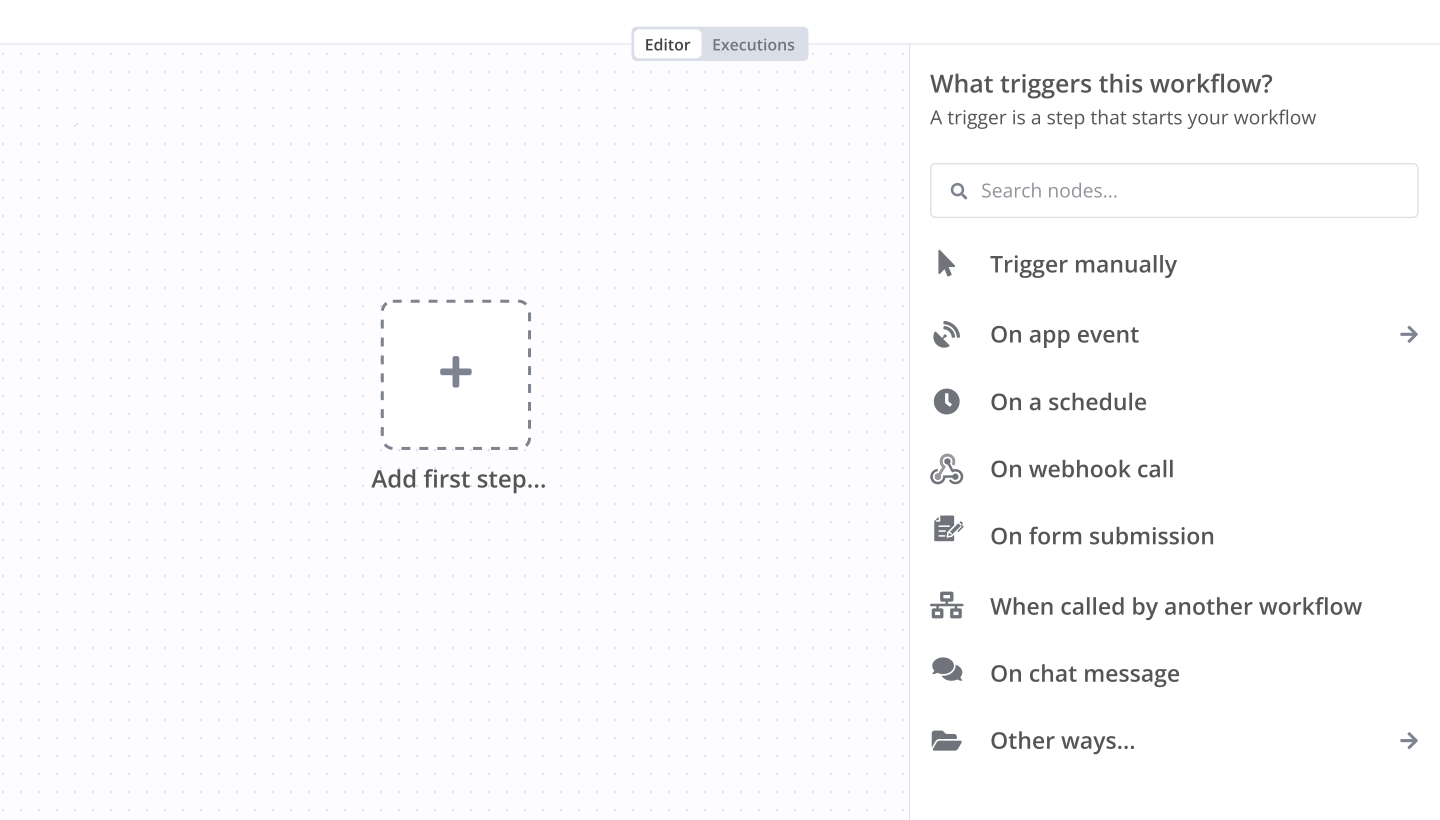
HTTP Request and OpenAI integration: Create a new workflow and add the first step

Step 2: Add and configure HTTP Request and OpenAI nodes

You can find HTTP Request and OpenAI in the nodes panel. Drag them onto your workflow canvas, selecting their actions. Click each node, choose a credential, and authenticate to grant n8n access. Configure HTTP Request and OpenAI nodes one by one: input data on the left, parameters in the middle, and output data on the right.

HTTP Request and OpenAI integration: Add and configure HTTP Request and OpenAI nodes

Step 3: Connect HTTP Request and OpenAI

A connection establishes a link between HTTP Request and OpenAI (or vice versa) to route data through the workflow. Data flows from the output of one node to the input of another. You can have single or multiple connections for each node.

HTTP Request and OpenAI integration: Connect HTTP Request and OpenAI

Step 4: Customize and extend your HTTP Request and OpenAI integration

Use n8n's core nodes such as If, Split Out, Merge, and others to transform and manipulate data. Write custom JavaScript or Python in the Code node and run it as a step in your workflow. Connect HTTP Request and OpenAI with any of n8n’s 1000+ integrations, and incorporate advanced AI logic into your workflows.

HTTP Request and OpenAI integration: Customize and extend your HTTP Request and OpenAI integration

Step 5: Test and activate your HTTP Request and OpenAI workflow

Save and run the workflow to see if everything works as expected. Based on your configuration, data should flow from HTTP Request to OpenAI or vice versa. Easily debug your workflow: you can check past executions to isolate and fix the mistake. Once you've tested everything, make sure to save your workflow and activate it.

HTTP Request and OpenAI integration: Test and activate your HTTP Request and OpenAI workflow

✨🤖Automate Multi-Platform Social Media Content Creation with AI

Automate Multi-Platform Social Media Content Creation with AI

Who is this for?
Social Media Managers and Digital Marketers seeking to streamline content production across 7+ platforms (X/Twitter, Instagram, LinkedIn, Facebook, TikTok, Threads, YouTube Shorts) using AI-powered automation.

What problem does this solve?
Creating platform-optimized content at scale while maintaining brand consistency across multiple channels, reducing manual work by 80% through AI generation and automated publishing.

What this workflow does
AI Content Generation:
Uses GPT-4/Gemini to create platform-specific posts
Automatically generates hashtags, CTAs, and emoji placement
Supports image/video suggestions and image creation using OpenAI or Pollinations.ai
Uses SERP api to search for relavent content

Approval Workflow:
Sends formatted HTML emails for human review
Implements double-approval system with Gmail integration

Cross-Platform Publishing:
One-click deployment to:
Instagram/Facebook (via Graph API)
X/Twitter (Official API)
LinkedIn (Sales Navigator integration)

Setup
Credentials:
OpenAI API key
Google Gemini API
Social media platform tokens (X, LinkedIn, Facebook)
ImgBB for image hosting
Gmail
SERP API
Telegram

Configuration:
Update all "your-unique-id" placeholders in API nodes
Set email recipients in Gmail nodes
Customize AI prompts

Customization:
Adjust character limits per platform
Modify approval thresholds
Add/remove social platforms as needed

How to customize
Content Style**: Edit prompt templates in the "Social Media Content Factory" agent node
Approval Process**: Modify email templates
Analytics**: Connect to Google Sheets for performance tracking
Image Generation**: Switch between Pollinations.ai/DALL-E/Midjourney

Nodes used in this workflow

Popular HTTP Request and OpenAI workflows

Auto-Create TikTok Videos with VEED.io AI Avatars, ElevenLabs & GPT-4

💥 Viral TikTok Video Machine: Auto-Create Videos with Your AI Avatar 🎯 Who is this for? This workflow is for content creators, marketers, and agencies who want to use Veed.io’s AI avatar technology to produce short, engaging TikTok videos automatically. It’s ideal for creators who want to appear on camera without recording themselves, and for teams managing multiple brands who need to generate videos at scale. ⚙️ What problem this workflow solves Manually creating videos for TikTok can take hours — finding trends, writing scripts, recording, and editing. By combining Veed.io, ElevenLabs, and GPT-4, this workflow transforms a simple Telegram input into a ready-to-post TikTok video featuring your AI avatar powered by Veed.io — speaking naturally with your cloned voice. 🚀 What this workflow does This automation links Veed.io’s video-generation API with multiple AI tools: Analyzes TikTok trends via Perplexity AI Writes a 10-second viral script using GPT-4 Generates your voiceover via ElevenLabs Uses Veed.io (Fabric 1.0 via FAL.ai) to animate your avatar and sync the lips to the voice Creates an engaging caption + hashtags for TikTok virality Publishes the video automatically via Blotato TikTok API Logs all results to Google Sheets for tracking 🧩 Setup Telegram Bot Create your bot via @BotFather Configure it as the trigger for sending your photo and theme Connect Veed.io Create an account on Veed.io Get your FAL.ai API key (Veed Fabric 1.0 model) Use HTTPS image/audio URLs compatible with Veed Fabric Other APIs Add Perplexity, ElevenLabs, and Blotato TikTok keys Connect your Google Sheet for logging results 🛠️ How to customize this workflow Change your Avatar:* Upload a new image through Telegram, and Veed.io* will generate a new talking version automatically. Modify the Script Style:** Adjust the GPT prompt for tone (educational, funny, storytelling). Adjust Voice Tone:* Tweak ElevenLabs* stability and similarity settings. Expand Platforms:** Add Instagram, YouTube Shorts, or X (Twitter) posting nodes. Track Performance:** Customize your Google Sheet to measure your most successful Veed.io-based videos. 🧠 Expected Outcome In just a few seconds after sending your photo and theme, this workflow — powered by Veed.io — creates a fully automated TikTok video featuring your AI avatar with natural lip-sync and voice. The result is a continuous stream of viral short videos, made without cameras, editing, or effort. ✅ Import the JSON file in n8n, add your API keys (including Veed.io via FAL.ai), and start generating viral TikTok videos starring your AI avatar today! 🎥 Watch This Tutorial 📄 Documentation: Notion Guide Need help customizing? Contact me for consulting and support : Linkedin / Youtube

Generate AI Videos with Google Veo3, Save to Google Drive and Upload to YouTube

This workflow allows users to generate AI videos using Google Veo3, save them to Google Drive, generate optimized YouTube titles with GPT-4o, and automatically upload them to YouTube with Upload-Post. The entire process is triggered from a Google Sheet that acts as the central interface for input and output. IT automates video creation, uploading, and tracking, ensuring seamless integration between Google Sheets, Google Drive, Google Veo3, and YouTube. Benefits of this Workflow 💡 No Code Interface**: Trigger and control the video production pipeline from a simple Google Sheet. ⚙️ Full Automation**: Once set up, the entire video generation and publishing process runs hands-free. 🧠 AI-Powered Creativity**: Generates engaging YouTube titles using GPT-4o. Leverages advanced generative video AI from Google Veo3. 📁 Cloud Storage & Backup**: Stores all generated videos on Google Drive for safekeeping. 📈 YouTube Ready**: Automatically uploads to YouTube with correct metadata, saving time and boosting visibility. 🧪 Scalable**: Designed to process multiple video prompts by looping through new entries in Google Sheets. 🔒 API-First**: Utilizes secure API-based communication for all services. How It Works Trigger: The workflow can be started manually ("When clicking ‘Test workflow’") or scheduled ("Schedule Trigger") to run at regular intervals (e.g., every 5 minutes). Fetch Data: The "Get new video" node retrieves unfilled video requests from a Google Sheet (rows where the "VIDEO" column is empty). Video Creation: The "Set data" node formats the prompt and duration from the Google Sheet. The "Create Video" node sends a request to the Fal.run API (Google Veo3) to generate a video based on the prompt. Status Check: The "Wait 60 sec." node pauses execution for 60 seconds. The "Get status" node checks the video generation status. If the status is "COMPLETED," the workflow proceeds; otherwise, it waits again. Video Processing: The "Get Url Video" node fetches the video URL. The "Generate title" node uses OpenAI (GPT-4.1) to create an SEO-optimized YouTube title. The "Get File Video" node downloads the video file. Upload & Update: The "Upload Video" node saves the video to Google Drive. The "HTTP Request" node uploads the video to YouTube via the Upload-Post API. The "Update Youtube URL" and "Update result" nodes update the Google Sheet with the video URL and YouTube link. Set Up Steps Google Sheet Setup: Create a Google Sheet with columns: PROMPT, DURATION, VIDEO, and YOUTUBE_URL. Share the Sheet link in the "Get new video" node. API Keys: Obtain a Fal.run API key (for Veo3) and set it in the "Create Video" node (Header: Authorization: Key YOURAPIKEY). Get an Upload-Post API key (for YouTube uploads) and configure the "HTTP Request" node (Header: Authorization: Apikey YOUR_API_KEY). YouTube Upload Configuration: Replace YOUR_USERNAME in the "HTTP Request" node with your Upload-Post profile name. Schedule Trigger: Configure the "Schedule Trigger" node to run periodically (e.g., every 5 minutes). 👉 Subscribe to my new YouTube channel. Here I’ll share videos and Shorts with practical tutorials and FREE templates for n8n. Need help customizing? Contact me for consulting and support or add me on Linkedin.
+7

AI-Powered WhatsApp Chatbot for Text, Voice, Images, and PDF with RAG

Who is this for? This template is designed for internal support teams, product specialists, and knowledge managers in technology companies who want to automate ingestion of product documentation and enable AI-driven, retrieval-augmented question answering via WhatsApp. What problem is this workflow solving? Support agents often spend too much time manually searching through lengthy documentation, leading to inconsistent or delayed answers. This solution automates importing, chunking, and indexing product manuals, then uses retrieval-augmented generation (RAG) to answer user queries accurately and quickly with AI via WhatsApp messaging. What these workflows do Workflow 1: Document Ingestion & Indexing Manually triggered to import product documentation from Google Docs. Automatically splits large documents into chunks for efficient searching. Generates vector embeddings for each chunk using OpenAI embeddings. Inserts the embedded chunks and metadata into a MongoDB Atlas vector store, enabling fast semantic search. Workflow 2: AI-Powered Query & Response via WhatsApp Listens for incoming WhatsApp user messages, supporting various types: Text messages: Plain text queries from users. Audio messages: Voice notes transcribed into text for processing. Image messages: Photos or screenshots analyzed to provide contextual answers. Document messages: PDFs, spreadsheets, or other files parsed for relevant content. Converts incoming queries to vector embeddings and performs similarity search on the MongoDB vector store. Uses OpenAI’s GPT-4o-mini model with retrieval-augmented generation to produce concise, context-aware answers. Maintains conversation context across multiple turns using a memory buffer node. Routes different message types to appropriate processing nodes to maximize answer quality. Setup Setting up vector embeddings Authenticate Google Docs and connect your Google Docs URL containing the product documentation you want to index. Authenticate MongoDB Atlas and connect the collection where you want to store the vector embeddings. Create a search index on this collection to support vector similarity queries. Ensure the index name matches the one configured in n8n (data_index). See the example MongoDB search index template below for reference. Setting up chat Authenticate the WhatsApp node with your Meta account credentials to enable message receiving and sending. Connect the MongoDB collection containing embedded product documentation to the MongoDB Vector Search node used for similarity queries. Set up the system prompt in the Knowledge Base Agent node to reflect your company’s tone, answering style, and any business rules, ensuring it references the connected MongoDB collection for context retrieval. Make sure Both MongoDB nodes (in ingestion and chat workflows) are connected to the same collection with: An embedding field storing vector data, Relevant metadata fields (e.g., document ID, source), and The same vector index name configured (e.g., data_index). Search Index Example: { "mappings": { "dynamic": false, "fields": { "_id": { "type": "string" }, "text": { "type": "string" }, "embedding": { "type": "knnVector", "dimensions": 1536, "similarity": "cosine" }, "source": { "type": "string" }, "doc_id": { "type": "string" } } } }

Automate AI Video Creation & Multi-Platform Publishing with GPT-4, Veo 3.1 & Blotato

💥 Automate AI Video Creation & Multi-Platform Publishing with Veo 3.1 & Blotato 🎯 Who is this for? This workflow is designed for content creators, marketers, and automation enthusiasts who want to produce professional AI-generated videos and publish them automatically on social media — without editing or manual uploads. Perfect for those using Veo 3.1, GPT-4, and Blotato to scale video creation. 💡 What problem is this workflow solving? Creating short-form content (TikTok, Instagram Reels, YouTube Shorts) is time-consuming — from writing scripts to video editing and posting. This workflow eliminates the manual steps by combining AI storytelling + video generation + automated publishing, letting you focus on creativity while your system handles production and distribution. ⚙️ What this workflow does Reads new ideas from Google Sheets Generates story scripts using GPT-4 Creates cinematic videos using Veo 3.1 (fal.ai/veo3.1/reference-to-video) with 3 input reference images Uploads the final video automatically to Google Drive Publishes the video across multiple platforms (TikTok, Instagram, Facebook, X, LinkedIn, YouTube) via Blotato Updates Google Sheets with video URL and status (Completed / Failed) 🧩 Setup Required accounts: OpenAI → GPT-4 API key fal.ai → Veo 3.1 API key Google Cloud Console → Sheets & Drive connection Blotato → API key for social media publishing Configuration steps: Copy the Google Sheets structure: A: id_video B: niche C: idea D: url_1 E: url_2 F: url_3 G: url_final H: status Add your API keys to the Workflow Configuration node. Insert three image URLs and a short idea into your sheet. Wait for the automation to process and generate your video. 🧠 How to customize this workflow Change duration or aspect ratio** → Edit the Veo 3.1 node JSON body (duration, aspect_ratio) Modify prompt style** → Adjust the “Optimize Prompt for Veo” node for your desired tone or cinematic look Add more platforms** → Extend Blotato integration to publish on Pinterest, Reddit, or Threads Enable Telegram Trigger** → Allow users to submit ideas and images directly via Telegram 🚀 Expected Outcome Within 2–3 minutes, your idea is transformed into a full cinematic AI video — complete with storytelling, visuals, and automatic posting to your social media channels. Save hours of editing and focus on strategy, creativity, and growth. 👋 Need help or want to customize this? 📩 Contact: LinkedIn 📺 YouTube: @DRFIRASS 🚀 Workshops: Mes Ateliers n8n 📄 Documentation: Notion Guide Need help customizing? Contact me for consulting and support : Linkedin / Youtube / 🚀 Mes Ateliers n8n
+4

Create AI product images and marketing videos with NanoBanana Pro, Veo 3.1 and Blotato

💥 Generate product images with NanoBanana Pro to Veo videos and Blotato Who is this for? This workflow is designed for: Content creators and marketers E-commerce and product-based businesses Agencies producing social media visuals and videos Automation builders looking for AI-powered creative pipelines It is ideal for anyone who wants to automate product image and video creation using AI and publish content without manual work. What problem is this workflow solving? / Use case Creating product visuals and marketing videos usually requires multiple tools, manual prompt writing, and repetitive steps. This workflow solves: Manual image and video creation Inconsistent visual quality across assets Time-consuming prompt iteration Manual video publishing to social platforms The workflow automates the entire process from image generation to video publishing using AI. What this workflow does This workflow provides an end-to-end automation pipeline: Generates high-quality product images using NanoBanana Pro Applies Contact Sheet Prompting to explore multiple visual variations Converts selected images into short marketing videos using Veo 3.1 Automatically publishes the final videos via BLOTATO The result is a fully automated creative workflow that turns AI prompts into ready-to-publish video content. Setup To use this workflow, you need the following services and credentials: OpenAI API** Used for image analysis and prompt generation NanoBanana Pro (fal.ai)** Product image generation API: https://fal.ai/models/fal-ai/nano-banana-pro/edit/api Veo 3.1 (fal.ai)** Video generation API: https://fal.ai/models/fal-ai/veo3.1/first-last-frame-to-video Blotato** Video publishing to social platforms Sign up at BLOTATO All credentials must be added in n8n before running the workflow. How to customize this workflow to your needs You can easily adapt this workflow by: Modifying AI prompts to match your brand style Adjusting image composition and realism parameters in NanoBanana Pro Changing video motion, pacing, and aspect ratio in Veo 3.1 Selecting different social platforms or publishing rules in Blotato Replacing or extending individual steps while keeping the same architecture The workflow is modular and can be reused for multiple products or campaigns. 🎥 Watch This Tutorial 👋 Need help or want to customize this? 📩 Contact: LinkedIn 📺 YouTube: @DRFIRASS 🚀 Workshops: Mes Ateliers n8n 📄 Documentation: Notion Guide Need help customizing? Contact me for consulting and support : Linkedin / Youtube / 🚀 Mes Ateliers n8n
+5

Automate & Publish Video Ad Campaigns with NanoBanana, Seedream, GPT-4o, Veo 3

💥 Automate video ads with NanoBanana, Seedream 4, ChatGPT Image and Veo 3 Who is this for? This template is designed for marketers, content creators, and e-commerce brands who want to automate the creation of professional ad videos at scale. It’s ideal for teams looking to generate consistent, high-quality video ads for social media without spending hours on manual design, editing, or publishing. What problem is this workflow solving? / Use case Creating video ads usually requires multiple tools and a lot of time: writing scripts, designing product visuals, editing videos, and publishing them across platforms. This workflow automates the entire pipeline — from idea to ready-to-publish ad video — ensuring brands can quickly test campaigns and boost engagement without production delays. What this workflow does Generates ad ideas from Telegram input (text + product image). Creates product visuals using multiple AI image engines: 🌊 Seedream 4.0 (realistic visuals) 🍌 NanoBanana (image editing & enhancement) 🤖 ChatGPT Image / GPT-4o (creative variations) Produces cinematic video ads with Veo 3 based on AI-generated scripts. Merges multiple short clips into a polished final ad. Publishes automatically to multiple platforms (TikTok, Instagram, LinkedIn, X, Threads, Facebook, Pinterest, Bluesky, YouTube) via Blotato. Stores metadata and results in Google Sheets & Google Drive for easy tracking. Notifies you via Telegram with the video link and copy. Setup Connect your accounts in n8n: Telegram API (for input and notifications) Google Drive + Google Sheets (storage & tracking) Kie AI API (Seedream + Veo 3) Fal.ai API (NanoBanana + video merging) OpenAI (for script and prompt generation) Blotato API (for social publishing) Prepare a Google Sheet with brand info and settings (product name, category, features, offer, website URL). Deploy the workflow and connect your Telegram bot to start sending ad ideas (photo + caption). Run the workflow — it will automatically generate images, create videos, and publish to your chosen channels. How to customize this workflow to your needs Brand customization**: Adjust the Google Sheet values to reflect your brand’s offers and product features. Platforms**: Enable/disable specific Blotato nodes depending on which platforms you want to publish to. Video style**: Edit the AI agent’s system prompt to control tone, format, and transitions (cinematic, playful, modern, etc.). Notifications**: Adapt Telegram nodes to send updates to different team members or channels. Storage**: Change the Google Drive folder IDs to store generated videos and images in your preferred location. This workflow lets you go from idea → images → cinematic ad video → auto-published content in minutes, fully automated. 📄 🎥 Watch This Tutorial: Step by Step 📄 Documentation: Notion Guide Need help customizing? Contact me for consulting and support : Linkedin / Youtube

Build your own HTTP Request and OpenAI integration

Create custom HTTP Request and OpenAI workflows by choosing triggers and actions. Nodes come with global operations and settings, as well as app-specific parameters that can be configured. You can also use the HTTP Request node to query data from any app or service with a REST API.

OpenAI supported actions

Message a Model
Generate a model response with GPT 3, 4, 5, etc. using Responses API
Classify Text for Violations
Check whether content complies with usage policies
Analyze Image
Take in images and answer questions about them
Generate an Image
Creates an image from a text prompt
Edit Image
Edit an image
Generate Audio
Creates audio from a text prompt
Transcribe a Recording
Transcribes audio into text
Translate a Recording
Translates audio into text in English
Delete a File
Delete a file from the server
List Files
Returns a list of files that belong to the user's organization
Upload a File
Upload a file that can be used across various endpoints
Create
Create a conversation
Get
Get a conversation
Remove
Remove a conversation
Update
Update a conversation
Generate
Creates a video from a text prompt

HTTP Request and OpenAI integration details

integrationOpenAI node
OpenAI

OpenAI, the creator of ChatGPT, offers a range of powerful models including GPT-3, DALL·E, and Whisper. Leverage these models to build AI-powered workflows.

Use case

Save engineering resources

Reduce time spent on customer integrations, engineer faster POCs, keep your customer-specific functionality separate from product all without having to code.

Learn more

FAQs

  • Can HTTP Request connect with OpenAI?

  • Can I use HTTP Request’s API with n8n?

  • Can I use OpenAI’s API with n8n?

  • Is n8n secure for integrating HTTP Request and OpenAI?

  • How to get started with HTTP Request and OpenAI integration in n8n.io?

Need help setting up your HTTP Request and OpenAI integration?

Discover our latest community's recommendations and join the discussions about HTTP Request and OpenAI integration.
Artem
Moiz Contractor
theo
Jon
Dan Burykin

Looking to integrate HTTP Request and OpenAI in your company?

Over 3000 companies switch to n8n every single week

Why use n8n to integrate HTTP Request with OpenAI

Build complex workflows, really fast
Build complex workflows, really fast

Handle branching, merging and iteration easily.
Pause your workflow to wait for external events.

Code when you need it, UI when you don't

Simple debugging

Your data is displayed alongside your settings, making edge cases easy to track down.

Use templates to get started fast

Use 1000+ workflow templates available from our core team and our community.

Reuse your work

Copy and paste, easily import and export workflows.

Implement complex processes faster with n8n

red iconyellow iconred iconyellow icon