Back to Integrations
integrationHTTP Request node
integrationOpenWeatherMap node

HTTP Request and OpenWeatherMap integration

Save yourself the work of writing custom integrations for HTTP Request and OpenWeatherMap and use n8n instead. Build adaptable and scalable Development, Core Nodes, Miscellaneous, and Utility workflows that work with your technology stack. All within a building experience you will love.

How to connect HTTP Request and OpenWeatherMap

  • Step 1: Create a new workflow
  • Step 2: Add and configure nodes
  • Step 3: Connect
  • Step 4: Customize and extend your integration
  • Step 5: Test and activate your workflow

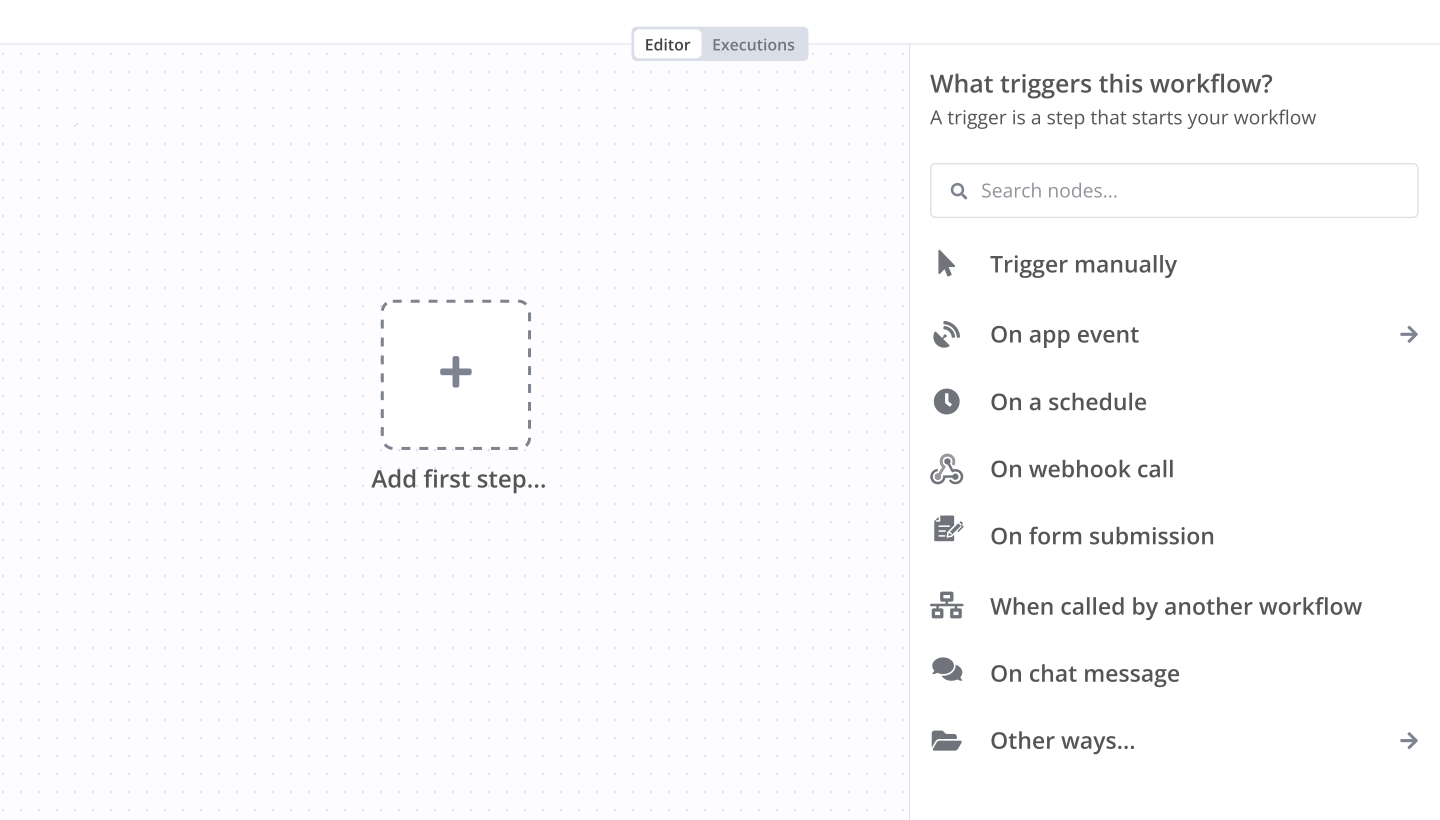
Step 1: Create a new workflow and add the first step

In n8n, click the "Add workflow" button in the Workflows tab to create a new workflow. Add the starting point – a trigger on when your workflow should run: an app event, a schedule, a webhook call, another workflow, an AI chat, or a manual trigger. Sometimes, the HTTP Request node might already serve as your starting point.

HTTP Request and OpenWeatherMap integration: Create a new workflow and add the first step

Step 2: Add and configure HTTP Request and OpenWeatherMap nodes

You can find HTTP Request and OpenWeatherMap in the nodes panel. Drag them onto your workflow canvas, selecting their actions. Click each node, choose a credential, and authenticate to grant n8n access. Configure HTTP Request and OpenWeatherMap nodes one by one: input data on the left, parameters in the middle, and output data on the right.

HTTP Request and OpenWeatherMap integration: Add and configure HTTP Request and OpenWeatherMap nodes

Step 3: Connect HTTP Request and OpenWeatherMap

A connection establishes a link between HTTP Request and OpenWeatherMap (or vice versa) to route data through the workflow. Data flows from the output of one node to the input of another. You can have single or multiple connections for each node.

HTTP Request and OpenWeatherMap integration: Connect HTTP Request and OpenWeatherMap

Step 4: Customize and extend your HTTP Request and OpenWeatherMap integration

Use n8n's core nodes such as If, Split Out, Merge, and others to transform and manipulate data. Write custom JavaScript or Python in the Code node and run it as a step in your workflow. Connect HTTP Request and OpenWeatherMap with any of n8n’s 1000+ integrations, and incorporate advanced AI logic into your workflows.

HTTP Request and OpenWeatherMap integration: Customize and extend your HTTP Request and OpenWeatherMap integration

Step 5: Test and activate your HTTP Request and OpenWeatherMap workflow

Save and run the workflow to see if everything works as expected. Based on your configuration, data should flow from HTTP Request to OpenWeatherMap or vice versa. Easily debug your workflow: you can check past executions to isolate and fix the mistake. Once you've tested everything, make sure to save your workflow and activate it.

HTTP Request and OpenWeatherMap integration: Test and activate your HTTP Request and OpenWeatherMap workflow

Send multi-city weather forecasts with AI-enhanced formatting from OpenWeatherMap to Gmail

Overview

This workflow automates weather forecast delivery by collecting city names, fetching 5-day forecasts from OpenWeatherMap, and generating professionally formatted HTML emails using GPT-4. The AI creates condition-based color-coded reports with safety precautions and sends them via Gmail.

How It Works

A form trigger collects up to three city names, which are geocoded via OpenWeatherMap API to retrieve coordinates and 5-day forecasts.

JavaScript nodes process the raw weather data into daily summaries, calculating temperature ranges, precipitation levels, wind speeds, and dominant weather conditions.

GPT-4 then generates professionally formatted HTML emails with condition-based color coding: The AI intelligently adds contextual safety warnings for heavy rain, extreme heat, high winds, and thunderstorms.

A validation node ensures proper JSON formatting before Gmail sends the final briefing.

Use Cases

• Field ops & construction crew briefings
• Travel planning and itinerary preparation
• Outdoor event planning & coordination
• Logistics and transportation route planning
• Real estate property viewing scheduling
• Sports and recreational activity planning

Setup Requirements

  1. OpenWeatherMap API credentials
  2. OpenAI API key
  3. Gmail OAuth2 authentication

Need Help?

Join the Discord or ask in the Forum!
README file available at https://tinyurl.com/MulticityWeatherForecast

Nodes used in this workflow

Popular HTTP Request and OpenWeatherMap workflows

Send Multi-City Weather Forecasts with AI-Enhanced Formatting from OpenWeatherMap to Gmail

Overview This workflow automates weather forecast delivery by collecting city names, fetching 5-day forecasts from OpenWeatherMap, and generating professionally formatted HTML emails using GPT-4. The AI creates condition-based color-coded reports with safety precautions and sends them via Gmail. How It Works A form trigger collects up to three city names, which are geocoded via OpenWeatherMap API to retrieve coordinates and 5-day forecasts. JavaScript nodes process the raw weather data into daily summaries, calculating temperature ranges, precipitation levels, wind speeds, and dominant weather conditions. GPT-4 then generates professionally formatted HTML emails with condition-based color coding: The AI intelligently adds contextual safety warnings for heavy rain, extreme heat, high winds, and thunderstorms. A validation node ensures proper JSON formatting before Gmail sends the final briefing. Use Cases • Field ops & construction crew briefings • Travel planning and itinerary preparation • Outdoor event planning & coordination • Logistics and transportation route planning • Real estate property viewing scheduling • Sports and recreational activity planning Setup Requirements 1) OpenWeatherMap API credentials 2) OpenAI API key 3) Gmail OAuth2 authentication Need Help? Join the Discord or ask in the Forum! README file available at https://tinyurl.com/MulticityWeatherForecast

Get enriched location, weather, and timezone data using free APIs

Get location insights using free APIs Transform GPS coordinates into rich location data using 100% free APIs. This webhook aggregates address, timezone, weather, and sun data into a single response. Perfect for location tracking apps, travel platforms, and IoT projects. What You'll Get A single API endpoint returning 28 enriched data fields: Detailed address with components (suburb, city, state, country, postcode) Timezone data (name, abbreviation, current local time and date) Live weather (temperature, humidity, pressure, conditions with icon) Sun times (sunrise, sunset, day length) Visual assets (weather icons and country flag URLs) How It Works Webhook receives coordinates via GET request (lat and lon parameters) Parallel API calls to 4 free services (OpenStreetMap, TimezoneDB, Sunrise-Sunset, OpenWeatherMap) Data merging combines all responses Format and structure transforms data into 28 clean fields JSON response returns enriched location data Response time: 1 to 3 seconds Set Up Steps Get Free API Keys OpenWeatherMap: Sign up at openweathermap.org (free tier: 60 calls/min) TimezoneDB: Register at timezonedb.com (free tier available) Note: OpenStreetMap and Sunrise-Sunset require no keys Configure Credentials Add OpenWeatherMap credentials to the OpenWeatherMap node Replace TimezoneDB API key in HTTP Request node with your key Activate and Test Activate workflow to generate webhook URL Test with sample: ?lat=27.1751495&lon=78.0395673 Example Usage Request: curl "https://your-n8n.com/webhook/geo-details?lat=27.1751495&lon=78.0395673" Response: JSON array with 28 fields including address, timezone, weather, and sun data. Use Cases Location tracking applications Travel and tourism platforms Weather dashboards Fleet management systems Geographic analytics tools Smart home automation Educational projects Why This Template? Zero cost (all APIs are free) Production ready with error handling Fast response via parallel processing Well documented with sticky notes Easy to customize and extend No vendor lock-in Perfect for startups, indie developers, students, and budget-conscious projects. Rate Limits (Free Tiers) OpenStreetMap: 1 req/sec TimezoneDB: 1 req/sec OpenWeatherMap: 60 calls/min, 1M calls/month Sunrise-Sunset: No documented limits Tip: Implement caching to stay within limits. Tags: location, geocoding, weather, timezone, free-api, webhook, rest-api, gps

Monitor multi-city weather with OpenWeatherMap, GPT-4o-mini, and Discord

Weather Monitoring Across Multiple Cities with OpenWeatherMap, GPT-4o-mini, and Discord This workflow provides an automated, intelligent solution for global weather monitoring. It goes beyond simple data fetching by calculating a custom "Comfort Index" and using AI to provide human-like briefings and activity recommendations. Whether you are managing remote teams or planning travel, this template centralizes complex environmental data into actionable insights. Who’s it for Remote Team Leads:** Keep an eye on environmental conditions for team members across different time zones. Frequent Travelers & Event Planners:** Monitor weather risks and comfort levels for multiple destinations simultaneously. Smart Home/Life Enthusiasts:** Receive daily morning briefings on air quality and weather alerts directly in Discord. How it works Schedule Trigger: The workflow runs every 6 hours (customizable) to ensure data is up to date. Data Collection: It loops through a list of cities, fetching current weather, 5-day forecasts, and Air Quality Index (AQI) data via the OpenWeatherMap node and HTTP Request node. Smart Processing: A Code node calculates a "Comfort Index" (based on temperature and humidity) and flags specific alerts (e.g., extreme heat, high winds, or poor AQI). AI Analysis: The OpenAI node (using GPT-4o-mini) analyzes the aggregated data to compare cities and recommend the best location for outdoor activities. Conditional Routing: An If node checks for active weather alerts. Urgent alerts are routed to a specific Discord notification, while routine briefings are sent normally. Archiving: All processed data is appended to Google Sheets for historical tracking and future analysis. How to set up Credentials: Connect your OpenWeatherMap, OpenAI, Discord (Webhook), and Google Sheets accounts. Locations: Open the 'Set Monitoring Locations' node and edit the JSON array with the cities, latitudes, and longitudes you wish to track. Google Sheets: Configure the 'Log to Google Sheets' node with your specific Spreadsheet ID and Sheet Name. Discord: Ensure your Webhook URL is correctly pasted into the Discord nodes. Requirements OpenWeatherMap API Key** (Free tier is sufficient). OpenAI API Key** (Configured for GPT-4o-mini). Discord Webhook URL**. Google Sheet** with headers ready for logging. How to customize Adjust Alert Thresholds:** Modify the logic in the 'Process and Analyze Data' Code node to change what triggers a "High Wind" or "Extreme Heat" alert. Refine AI Persona:** Edit the System Prompt in the 'AI Weather Analysis' node to change the tone or focus of the weather briefing. Change Frequency:** Adjust the Schedule Trigger to run once a day or every hour depending on your needs.


Smart Irrigation Scheduler with Weather Forecast and Soil Analysis

Smart Irrigation Scheduler with Weather Forecast and Soil Analysis Summary Automated garden and farm irrigation system that uses weather forecasts and evapotranspiration calculations to determine optimal watering schedules, preventing water waste while maintaining healthy plants. Detailed Description A comprehensive irrigation management workflow that analyzes weather conditions, forecasts, soil types, and plant requirements to make intelligent watering decisions. The system considers multiple factors including expected rainfall, temperature, humidity, wind speed, and days since last watering to determine if irrigation is needed and how much. Key Features Multi-Zone Management**: Support for multiple irrigation zones with different plant and soil types Weather-Based Decisions**: Uses OpenWeatherMap current conditions and 5-day forecast Evapotranspiration Calculation**: Simplified Penman method for accurate water loss estimation Rain Forecast Skip**: Automatically skips watering when significant rain is expected Plant-Type Specific**: Different requirements for flowers, vegetables, grass, and shrubs Soil Type Consideration**: Adjusts for clay, loam, and sandy soil characteristics Urgency Classification**: High/medium/low priority based on moisture levels Optimal Timing**: Adjusts watering time based on temperature and wind conditions IoT Integration**: Sends commands to smart irrigation controllers Historical Logging**: Tracks all decisions in Google Sheets Use Cases Home garden automation Commercial greenhouse management Agricultural operations Landscaping company scheduling Property management with large grounds Water conservation projects Required Credentials OpenWeatherMap API key Slack Bot Token Google Sheets OAuth IoT Hub API (optional) Node Count: 24 (19 functional + 5 sticky notes) Unique Aspects Uses OpenWeatherMap node (rarely used in templates) Uses Split Out node for loop-style processing of zones Uses Filter node for conditional routing Uses Aggregate node to collect results Implements evapotranspiration calculation using Code node Comprehensive multi-factor decision logic Workflow Architecture [Daily Morning Check] [Manual Override Trigger] | | +----------+-------------+ | v [Define Irrigation Zones] | v [Split Zones] (Loop) / \ v v [Get Current] [Get 5-Day Forecast] \ / +----+----+ | v [Merge Weather Data] | v [Analyze Irrigation Need] / \ v v [Filter Needing] [Aggregate All] \ / +----+----+ | v [Generate Irrigation Schedule] | v [Has Irrigation Tasks?] (If) / \ Has Tasks No Tasks / | \ | Sheets[Slack] [Log No Action] \ | / | +---+---+-----------+ | v [Respond to Webhook] Configuration Guide Irrigation Zones: Edit "Define Irrigation Zones" with your zone data (coordinates, plant/soil types) Water Thresholds: Adjust waterThreshold per zone based on plant needs OpenWeatherMap: Add API credentials in the weather nodes Slack Channel: Set to your garden/irrigation channel IoT Integration: Configure endpoint URL for your smart valve controller Google Sheets: Connect to your logging spreadsheet Decision Logic The system evaluates: Expected rainfall in next 24 hours (skip if >5mm expected) Soil moisture estimate based on days since watering + evapotranspiration Plant-specific minimum and ideal moisture levels Temperature adjustments for hot days Scheduled watering frequency by plant type Wind speed for optimal watering time
+2

Smart Break Recommendation System using Google Calendar, Weather Data, and GPT-4 to Slack

Who is this for This workflow is perfect for busy professionals, consultants, and anyone who frequently travels between meetings. If you want to make the most of your free time between appointments and discover great nearby spots without manual searching, this template is for you. What it does This workflow automatically monitors your Google Calendar and identifies gaps between appointments. When it detects sufficient free time (configurable, default 30+ minutes), it calculates travel time to your next destination, checks the weather, and uses AI to recommend the top 3 spots to visit during your break. Recommendations are weather-aware: indoor spots like cafés in malls or stations for rainy days, and outdoor terraces or open-air venues for nice weather. How it works Schedule Trigger - Runs every 30 minutes to check your calendar Fetch Data - Gets your next calendar event and user preferences from Notion Calculate Gap Time - Determines available free time by subtracting travel time (via Google Maps) from time until your next appointment Weather Check - Gets current weather at your destination using OpenWeatherMap Smart Routing - Routes to indoor or outdoor spot search based on weather conditions AI Recommendations - GPT-4.1-mini analyzes spots and generates personalized top 3 recommendations Slack Notification - Sends a friendly message with recommendations to your Slack channel Set up steps Configure API Keys - Add your Google Maps, Google Places, and OpenWeatherMap API keys in the "Set Configuration" node Connect Google Calendar - Set up OAuth connection and select your calendar Set up Notion - Create a database for user preferences and add the database ID Connect Slack - Set up OAuth and specify your notification channel Connect OpenAI - Add your OpenAI API credentials Customize - Adjust currentLocation and minGapTimeMinutes to your needs Requirements Google Cloud account with Maps and Places APIs enabled OpenWeatherMap API key (free tier available) Notion account with a preferences database Slack workspace with bot permissions OpenAI API key How to customize Change trigger frequency: Modify the Schedule Trigger interval Adjust minimum gap time: Change minGapTimeMinutes in the configuration node Modify search radius: Edit the radius parameter in the Places API calls (default: 1000m) Customize spot types: Modify the type and keyword parameters in the HTTP Request nodes Change AI model: Switch to a different OpenAI model in the AI node Localize language: Update the AI prompt to generate responses in your preferred language
+2

Generate Weather-Based Date Itineraries with Google Places, OpenRouter AI, and Slack

🧩 What this template does This workflow builds a 120-minute local date course around your starting point by querying Google Places for nearby spots, selecting the top candidates, fetching real-time weather data, letting an AI generate a matching emoji, and drafting a friendly itinerary summary with an LLM in both English and Japanese. It then posts the full bilingual plan with a walking route link and weather emoji to Slack. 👥 Who it’s for Makers and teams who want a plug-and-play bilingual local itinerary generator with weather awareness — no custom code required. ⚙️ How it works Trigger – Manual (or schedule/webhook). Discovery – Google Places nearby search within a configurable radius. Selection – Rank by rating and pick the top 3. Weather – Fetch current weather (via OpenWeatherMap). Emoji – Use an AI model to match the weather with an emoji 🌤️. Planning – An LLM writes the itinerary in Markdown (JP + EN). Route – Compose a Google Maps walking route URL. Share – Post the bilingual itinerary, route link, and weather emoji to Slack. 🧰 Requirements n8n (Cloud or self-hosted) Google Maps Platform (Places API) OpenWeatherMap API key Slack Bot (chat:write) LLM provider (e.g., OpenRouter or DeepL for translation) 🚀 Setup (quick) Open Set → Fields: Config and fill in coords/radius/time limit. Connect Credentials for Google, OpenWeatherMap, Slack, and your LLM. Test the workflow and confirm the bilingual plan + weather emoji appear in Slack. 🛠 Customize Adjust ranking filters (type, min rating). Modify translation settings (target language or tone). Change output layout (side-by-side vs separated). Tune emoji logic or travel mode. Add error handling, retries, or logging for production use.

Build your own HTTP Request and OpenWeatherMap integration

Create custom HTTP Request and OpenWeatherMap workflows by choosing triggers and actions. Nodes come with global operations and settings, as well as app-specific parameters that can be configured. You can also use the HTTP Request node to query data from any app or service with a REST API.

OpenWeatherMap supported actions

Current Weather
Returns the current weather data
5 Day Forecast
Returns the weather data for the next 5 days
Use case

Save engineering resources

Reduce time spent on customer integrations, engineer faster POCs, keep your customer-specific functionality separate from product all without having to code.

Learn more

FAQs

  • Can HTTP Request connect with OpenWeatherMap?

  • Can I use HTTP Request’s API with n8n?

  • Can I use OpenWeatherMap’s API with n8n?

  • Is n8n secure for integrating HTTP Request and OpenWeatherMap?

  • How to get started with HTTP Request and OpenWeatherMap integration in n8n.io?

Need help setting up your HTTP Request and OpenWeatherMap integration?

Discover our latest community's recommendations and join the discussions about HTTP Request and OpenWeatherMap integration.
Moiz Contractor
theo
Jon
Dan Burykin
Tony

Looking to integrate HTTP Request and OpenWeatherMap in your company?

Over 3000 companies switch to n8n every single week

Why use n8n to integrate HTTP Request with OpenWeatherMap

Build complex workflows, really fast

Build complex workflows, really fast

Handle branching, merging and iteration easily.
Pause your workflow to wait for external events.

Code when you need it, UI when you don't

Simple debugging

Your data is displayed alongside your settings, making edge cases easy to track down.

Use templates to get started fast

Use 1000+ workflow templates available from our core team and our community.

Reuse your work

Copy and paste, easily import and export workflows.

Implement complex processes faster with n8n

red iconyellow iconred iconyellow icon