Back to Integrations
integrationHTTP Request node
integrationQuickBooks Online node

HTTP Request and QuickBooks Online integration

Save yourself the work of writing custom integrations for HTTP Request and QuickBooks Online and use n8n instead. Build adaptable and scalable Development, Core Nodes, and Finance & Accounting workflows that work with your technology stack. All within a building experience you will love.

How to connect HTTP Request and QuickBooks Online

  • Step 1: Create a new workflow
  • Step 2: Add and configure nodes
  • Step 3: Connect
  • Step 4: Customize and extend your integration
  • Step 5: Test and activate your workflow

Step 1: Create a new workflow and add the first step

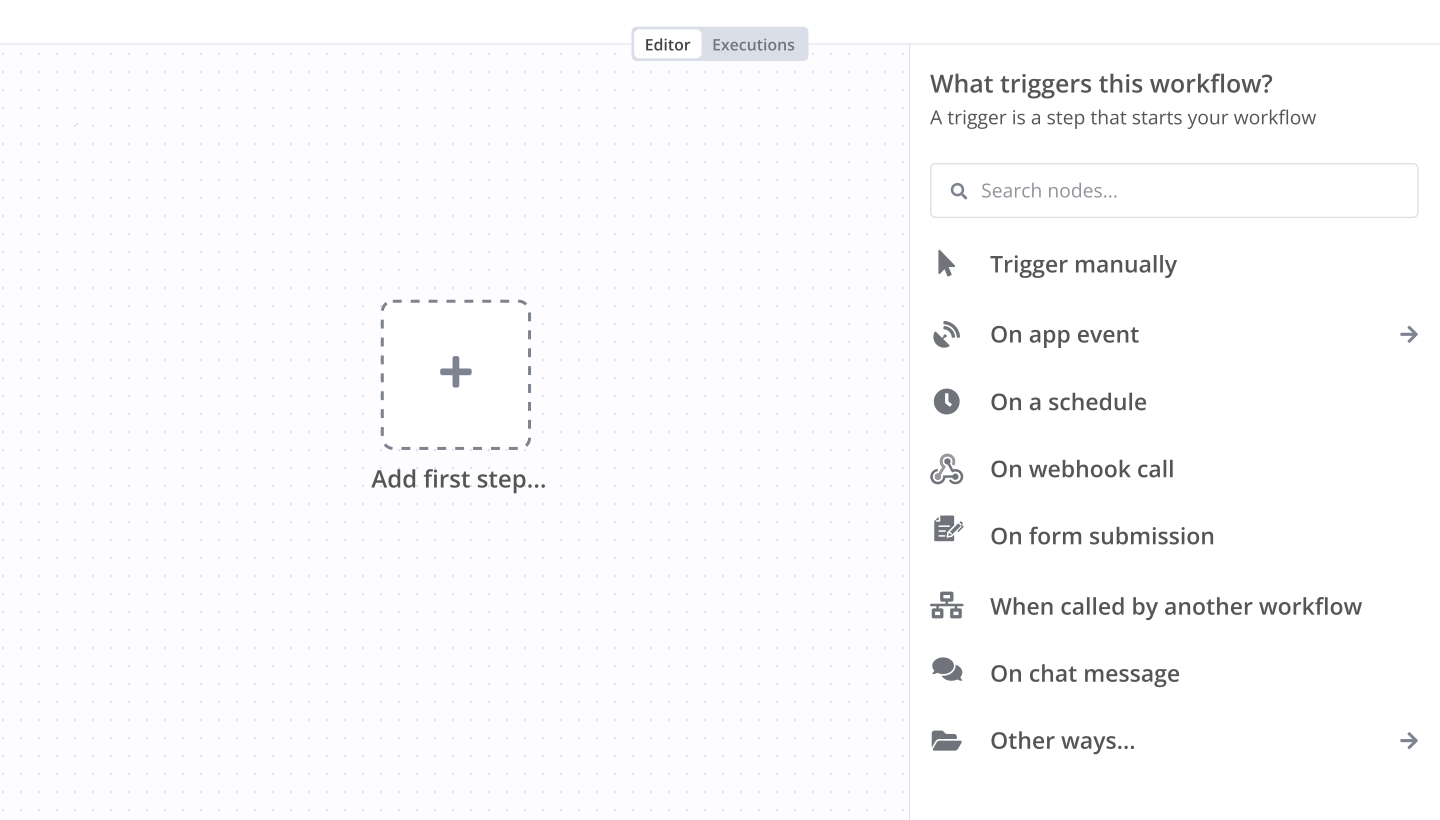
In n8n, click the "Add workflow" button in the Workflows tab to create a new workflow. Add the starting point – a trigger on when your workflow should run: an app event, a schedule, a webhook call, another workflow, an AI chat, or a manual trigger. Sometimes, the HTTP Request node might already serve as your starting point.

HTTP Request and QuickBooks Online integration: Create a new workflow and add the first step

Step 2: Add and configure HTTP Request and QuickBooks Online nodes

You can find HTTP Request and QuickBooks Online in the nodes panel. Drag them onto your workflow canvas, selecting their actions. Click each node, choose a credential, and authenticate to grant n8n access. Configure HTTP Request and QuickBooks Online nodes one by one: input data on the left, parameters in the middle, and output data on the right.

HTTP Request and QuickBooks Online integration: Add and configure HTTP Request and QuickBooks Online nodes

Step 3: Connect HTTP Request and QuickBooks Online

A connection establishes a link between HTTP Request and QuickBooks Online (or vice versa) to route data through the workflow. Data flows from the output of one node to the input of another. You can have single or multiple connections for each node.

HTTP Request and QuickBooks Online integration: Connect HTTP Request and QuickBooks Online

Step 4: Customize and extend your HTTP Request and QuickBooks Online integration

Use n8n's core nodes such as If, Split Out, Merge, and others to transform and manipulate data. Write custom JavaScript or Python in the Code node and run it as a step in your workflow. Connect HTTP Request and QuickBooks Online with any of n8n’s 1000+ integrations, and incorporate advanced AI logic into your workflows.

HTTP Request and QuickBooks Online integration: Customize and extend your HTTP Request and QuickBooks Online integration

Step 5: Test and activate your HTTP Request and QuickBooks Online workflow

Save and run the workflow to see if everything works as expected. Based on your configuration, data should flow from HTTP Request to QuickBooks Online or vice versa. Easily debug your workflow: you can check past executions to isolate and fix the mistake. Once you've tested everything, make sure to save your workflow and activate it.

HTTP Request and QuickBooks Online integration: Test and activate your HTTP Request and QuickBooks Online workflow

Create QuickBooks Online customers with sales receipts for new Stripe payments

Streamline your accounting by automatically creating QuickBooks Online customers and sales receipts whenever a successful Stripe payment is processed. Ideal for businesses looking to reduce manual data entry and improve accounting efficiency.

How it works

Trigger: The workflow is triggered when a new successful payment intent event is received from Stripe.
Retrieve Customer Data: Fetches customer details from Stripe associated with the payment.
Check QuickBooks Customer: Searches QuickBooks Online to see if the customer already exists using their email address.
Create or Use Existing Customer: If the customer doesn't exist in QuickBooks, they are created; otherwise, the existing customer is used.
Generate Sales Receipt: A sales receipt is created in QuickBooks Online with payment details, including item descriptions, amounts, and currency.

Set up steps

Connect Accounts: Authenticate both your QuickBooks Online and Stripe accounts in n8n.
Webhook Setup: Configure the Stripe webhook to send payment_intent.succeeded events to this workflow.
Test the Workflow: Trigger a test payment in Stripe to validate the integration.
Customize Details: Adjust item descriptions or other fields in the QuickBooks sales receipt JSON body as needed.

This workflow requires basic familiarity with n8n, but setup can be completed in under 15 minutes for most users.

Nodes used in this workflow

Popular HTTP Request and QuickBooks Online workflows

Process emailed PDF invoices into QuickBooks bills with OpenAI

AI Invoice Processor for QuickBooks - Email to Bill with PDF Attachment Automatically processes vendor invoices received by email, creates QuickBooks bills with full details, and attaches the original PDF. Who is this for? Small/medium businesses using QuickBooks Online Bookkeepers processing 20+ invoices/month Accounting firms managing multiple clients Anyone tired of manually entering invoice data into QuickBooks What it does Monitors Gmail for new emails with PDF attachments (every 15 minutes) Extracts text from the PDF using n8n's built-in PDF parser AI classification - determines if the PDF is actually an invoice (skips receipts, contracts, etc.) AI data extraction - pulls structured data: vendor name, invoice number, amount, currency, dates, and line items Vendor lookup - searches QuickBooks for the vendor by name Creates a Bill in QuickBooks with all extracted data (amount, description, dates) Attaches the original PDF to the bill for reference Sends confirmation email back to the sender with bill details Error handling Not an invoice?** Silently skipped - no noise AI can't extract valid data?** Email sent to AP team with error details Vendor not found in QuickBooks?** Email sent to AP team with vendor name and action steps Setup (5 minutes) Prerequisites Gmail account (OAuth2) OpenAI API key QuickBooks Online account (OAuth2) Steps Import the workflow into your n8n instance Connect credentials: Gmail OAuth2 OpenAI API QuickBooks OAuth2 Edit the Config node with your values: realmId - your QuickBooks Company ID (Settings → Account) apTeamEmail - where error notifications go defaultExpenseAccountId - your QB expense account ID (see below) Activate the workflow How to find your Expense Account ID Log in to QuickBooks Online Go to Settings (gear icon) → Chart of Accounts Find an expense account (e.g. "Office Supplies", "Professional Services") Hover → click View register (or Run report) Look at the URL for accountId=XX or account=XX That number is your defaultExpenseAccountId Sandbox vs Production If using QuickBooks Sandbox, update the Upload PDF to Bill node URL from: https://quickbooks.api.intuit.com/v3/company/... to: https://sandbox-quickbooks.api.intuit.com/v3/company/... Technical details AI extraction schema The AI extracts these fields from each invoice PDF: | Field | Type | Example | |-------|------|---------| | is_invoice | boolean | true | | vendor_name | string | "Acme Corp" | | invoice_number | string | "INV-2024-001" | | amount | number | 1500.00 | | currency | string | "USD" | | due_date | string | "2024-12-31" | | txn_date | string | "2024-12-01" | | line_items | array | [{description, amount, quantity}] | Binary data flow PDF binary data is lost after the AI extraction step (LangChain nodes don't preserve binary). The attachment pipeline solves this by referencing the binary from the Config node using $('Config').item.binary.attachment_0 - a named reference that works regardless of the connection path. Force Inline Binary (n8n v2 quirk) n8n v2 stores binary data as database streams. QuickBooks' /upload API requires Content-Length in multipart uploads, which streams can't provide. A Code node converts binary streams to inline base64 before upload. Nodes used Gmail Trigger (polling) Extract from File (PDF) Information Extractor (LangChain + OpenAI) QuickBooks Online (vendor search, bill creation) HTTP Request (PDF upload to bill) Gmail (confirmation & error emails) Code nodes (data transformation) IF nodes (routing logic) Limitations Single line item per bill** - the native QuickBooks node supports only one line item. All extracted line items are combined into the description field with invoice number.


+3

Process email invoices with OCR, GPT-4, Slack, QuickBooks and Google Sheets

Overview This workflow automates invoice processing directly from your email inbox. It captures invoice attachments, extracts structured data using OCR and AI, validates totals, and securely processes invoices. If issues are detected, it routes them for human review. Approved invoices are recorded in QuickBooks and logged for auditing. How It Works Email Trigger Monitors a Gmail label and downloads invoice attachments automatically. Configuration & Metadata Sets OCR API, thresholds, and captures invoice details like vendor, timestamp, and file hash. File Processing Routes PDFs to a text extractor and images to an OCR API. AI Data Extraction AI converts raw text into structured invoice data with confidence scores. Validation Recalculates totals and verifies subtotal, tax, and final amounts. Data Privacy Masks sensitive fields like PAN, GST, and bank account details. Review Decision Flags invoices for review if validation fails or confidence is low. Human Review (if needed) Sends Slack alert and waits for approval before proceeding. Accounting Integration Creates a bill in QuickBooks for approved invoices. Audit Logging Stores processing details in Google Sheets for traceability. Notifications Sends a success message after processing is complete. Setup Instructions Connect Gmail trigger and configure the invoice label (e.g., "AP Inbox") Add OCR API endpoint in the configuration node Connect OpenAI credentials for data extraction Connect Slack for alerts and notifications Connect QuickBooks for bill creation Add Google Sheets ID for audit logging Configure: Validation tolerance Confidence threshold Test with sample invoice emails Activate the workflow Use Cases Automating accounts payable workflows Reducing manual invoice data entry Validating invoices before accounting entry Handling invoice approvals with human-in-the-loop Maintaining audit logs for compliance Requirements Gmail account (with label setup) OpenAI API credentials OCR API (e.g., OCR.space or Google Vision) Slack workspace QuickBooks account Google Sheets (for audit logs) n8n instance with file handling enabled Notes You can adjust validation tolerance and confidence thresholds based on your needs. Extend validation logic in the Code node for stricter financial checks. Replace QuickBooks or Google Sheets with your preferred tools if needed. Ensure secure handling of sensitive financial data in production environments.

Custom Branded QuickBooks Invoices to PDF & Email

Automated QuickBooks Invoice to Custom PDF & Email Tired of the standard, boring invoices from QuickBooks Online? This workflow completely automates the process of creating beautiful, custom-branded PDF invoices and emailing them directly to your clients, saving you time and elevating your brand's professionalism. The moment you create an invoice in QuickBooks, this workflow triggers, fetches all the necessary data, and generates a lavish, multi-page-aware PDF invoice complete with your company logo and signature. Key Features Fully Automated:** Runs instantly when a new invoice is created in QuickBooks. Custom Branding:** Automatically fetches your company logo and signature from a URL to place on the invoice. Modern & Professional Design:** Uses a premium, multi-column HTML template that is clean, easy to read, and far superior to the default QBO templates. Multi-Page Ready:** If an invoice has many line items, the template will intelligently create multiple pages and add a "Page X of Y" footer automatically. Smart Layout:** The totals and summary block are designed to never break across pages, ensuring a professional look no matter the length. Automatic Emailing:** The final PDF is attached to a beautifully formatted email and sent directly to the customer's email address on file. Prerequisites Before you start, you will need a few things: A running n8n instance. A QuickBooks Online account with API access. A running Gotenberg instance. This is a powerful, open-source tool for converting HTML to PDF. This workflow is designed to connect to its API. You can learn more about it here. Publicly accessible URLs for your company logo and signature image (e.g., hosted on your website or a service like Imgur). Setup Guide Follow these steps carefully to configure the workflow for your own use. Nodes that need your attention are marked with a [!!] prefix. Step 1: Configure the QuickBooks Webhook The workflow starts with a webhook. You need to tell QuickBooks to send information to this webhook. Open the [!!] Listen for New QuickBooks Invoice node. You will see a Webhook URL. Copy the Production URL. Go to your QuickBooks Developer dashboard, select your app, and navigate to the Webhooks section. Paste the n8n URL into the Endpoint URL field and select the Invoice event to subscribe to. Step 2: Connect Your QuickBooks Account Open the [!!] Get Invoice Data from QuickBooks node. In the "Credentials" field, select your existing QuickBooks Online credentials or create a new set. Step 3: Add Your Branding Open the [!!] Fetch Company Logo Image node. In the URL field, replace the placeholder with the public URL of your company's logo. Open the [!!] Fetch Company Signature Image node. In the URL field, replace the placeholder with the public URL of your signature image. Step 4: Update the PDF Generation Service Open the [!!] Generate PDF via Gotenberg node. In the URL field, replace the placeholder http://YourGotenBergInstanceURL/... with the real URL of your running Gotenberg instance. Step 5: Configure Your Email Open the [!!] Email PDF Invoice to Customer node. In the "Credentials" field, select your SMTP or email service credentials. Customize the From Email and Subject fields. You can also edit the beautiful HTML email body to match your company's tone of voice. Step 6: Activate Your Workflow You're all set! Save the workflow and activate it using the toggle at the top-right of the screen. Now, when you create a new invoice in QuickBooks, this automation will handle the rest. A Note from the Creator Thank you for using this workflow! I believe that professional and automated invoicing is a cornerstone of a great business. This tool was designed to save you time and help you put your best foot forward with every client interaction. If you have any questions or need assistance, feel free to reach out. Website:** https://www.elegantbiztech.com/ Email:** [email protected]

Create QuickBooks Online Customers With Sales Receipts For New Stripe Payments

Streamline your accounting by automatically creating QuickBooks Online customers and sales receipts whenever a successful Stripe payment is processed. Ideal for businesses looking to reduce manual data entry and improve accounting efficiency. How it works Trigger: The workflow is triggered when a new successful payment intent event is received from Stripe. Retrieve Customer Data: Fetches customer details from Stripe associated with the payment. Check QuickBooks Customer: Searches QuickBooks Online to see if the customer already exists using their email address. Create or Use Existing Customer: If the customer doesn't exist in QuickBooks, they are created; otherwise, the existing customer is used. Generate Sales Receipt: A sales receipt is created in QuickBooks Online with payment details, including item descriptions, amounts, and currency. Set up steps Connect Accounts: Authenticate both your QuickBooks Online and Stripe accounts in n8n. Webhook Setup: Configure the Stripe webhook to send payment_intent.succeeded events to this workflow. Test the Workflow: Trigger a test payment in Stripe to validate the integration. Customize Details: Adjust item descriptions or other fields in the QuickBooks sales receipt JSON body as needed. This workflow requires basic familiarity with n8n, but setup can be completed in under 15 minutes for most users.
+3

Convert emailed timesheets into QuickBooks invoices with OCR, AI, Gmail and Sheets

AI-Powered Timesheet → Invoice Automation (Gmail + OCR + AI + Google Sheets + QuickBooks) > Note: This workflow uses sticky notes extensively to document each logical section of the automation. Sticky notes are mandatory and already included to explain OCR, AI parsing, folder logic, duplicate handling, and QuickBooks steps. This workflow automates the full lifecycle of timesheet-based invoicing — from emailed timesheets to structured Google Sheets records and finalized invoices in QuickBooks Online. It is designed for real-world billing scenarios, including split weeks across months, zero-hour months, duplicate prevention, and first-week-of-year edge cases. What This Workflow Does Listens to Gmail for timesheet emails with attachments Splits and processes each attachment independently Extracts text using OCR (no hardcoded API keys) Uses AI to parse month-wise billable hours Correctly splits weeks spanning multiple months Looks up Customer and PO details from Google Sheets Organizes files in Client → Employee → Year folders in Google Drive Reuses existing invoice sheets or creates new ones Prevents duplicate invoice rows Automatically finds or creates customers in QuickBooks Creates invoices in QuickBooks using validated data High-Level Workflow Stages Gmail Intake and Attachment Loop OCR Text Extraction AI-Based Timesheet Parsing Month Normalization and Validation Customer & PO Lookup Drive Folder Discovery and Creation Invoice Sheet Reuse or Creation Duplicate and Edge-Case Handling Append Invoice Rows to Google Sheets Create / Update Customers in QuickBooks Create Invoices in QuickBooks Each of these stages is clearly documented with sticky notes inside the workflow canvas. Quick Setup Instructions Import the workflow JSON into your n8n instance Configure credentials for: Gmail Google Drive Google Sheets OpenAI or Google Gemini QuickBooks Online Verify the OCR HTTP node: Default URL: https://universal-file-to-text-extractor.vercel.app/extract No hardcoded API keys are used Configure Get Customer Info From PO Sheet: Spreadsheet ID Sheet name and column mappings Ensure the Client Invoices root folder exists in Google Drive Send a test timesheet email Execute the workflow once manually Activate the workflow Who This Workflow Is For Agencies and consultancies billing from emailed timesheets Finance and operations teams using Google Workspace + QuickBooks Staffing firms with monthly or bi-weekly contractor billing Teams that want a fully auditable, zero-manual invoice process Requirements n8n instance Gmail account receiving timesheet emails Google Drive and Google Sheets OpenAI or Google Gemini API OCR API endpoint (configurable) QuickBooks Online account Customer PO Google Sheet containing: Email Customer Name Company Name Customer Account Number PO Number Item Folder Name Invoice range Due Date Calculation How It Works (Detailed) Email Intake and Attachment Loop Gmail Trigger polls for timesheet emails Attachments are split so each file is processed independently Sticky notes explain the intake and loop logic OCR Extraction Each attachment is sent to the OCR API PDFs and images are converted to plain text OCR logic is documented via sticky notes AI Timesheet Parsing (Month-Wise) AI extracts data only from BILLABLE HOURS sections Outputs strict JSON: Employee Name Client Name Month Year Week Start Date Week End Date Total Billable Hours Special handling included: Split weeks across months Zero-hour months still included No guessed or inferred dates Month Normalization and Validation AI output is normalized into a month array Each month is processed independently Invalid or zero-hour entries are skipped Customer and PO Lookup Sender email is matched in the PO sheet Retrieved values drive: Folder structure Invoice logic Due date calculation Google Drive Folder Structure The workflow enforces a strict hierarchy: Client Invoices └── Client └── Employee └── Year Missing folders are created automatically. Invoice Sheet Naming and Search Sheet names are generated using: Employee Name Month Year Existing sheets are reused when found Supports monthly and 15-day billing cycles Duplicate Prevention and Edge Cases Duplicate invoice rows are detected and skipped January first-week edge case is handled explicitly Safe re-runs are supported Google Sheets Invoice Rows Each appended row includes: Customer Account Number Invoice Date Due Date PO Number Item Name Quantity (Total Hours) Period description QuickBooks Integration Searches for existing customers in QuickBooks Creates customers automatically if missing Creates invoices using: Customer reference Item Quantity Invoice date Due date All QuickBooks logic is documented with sticky notes. How To Customize Swap AI model (OpenAI ↔ Gemini) Extend prompts to extract: Project Cost center Approval status Add tax codes, currency, or unit pricing Modify folder naming rules Insert approval steps before invoice creation Common Use Cases Monthly contractor invoicing Agency billing across multiple clients Finance automation with audit-ready records Eliminating manual timesheet-to-invoice work Troubleshooting | Issue | Likely Cause | |------|-------------| | No invoices created | Gmail filter mismatch or email already read | | OCR output empty | Unsupported file or OCR endpoint issue | | Wrong month split | Review AI prompt and month logic | | Duplicate rows | Duplicate detection conditions | | Invoice missing in QuickBooks | Customer or item configuration issue | Notes on Community Guidelines Sticky notes are used throughout the workflow No hardcoded API keys are present Markdown is used (no HTML tags) This workflow is original and not copied Need Help or Customization? Digital Biz Tech can help tailor this workflow to your business. We offer free setup support, including credential configuration and deployment. Contact: [email protected] Website: https://www.digitalbiz.tech LinkedIn: https://www.linkedin.com/company/digital-biz-tech/ You can also DM us on LinkedIn for any help. You can also DM us on LinkedIn.

Post bank statement transactions to QuickBooks Online using OpenRouter AI

✅ What problem does this workflow solve? Manually entering bank statements into QuickBooks is one of the most time-consuming and error-prone accounting tasks. Accountants often spend hours converting PDF bank statements into individual income and expense entries—risking missed transactions, incorrect categorization, and inconsistencies. This workflow fully automates the end-to-end process: from uploading a (even password-protected) bank statement PDF to creating accurate Sales Receipts and Expenses directly inside QuickBooks, using AI and n8n. ⚙️ What does this workflow do? Accepts bank statement PDFs via a secure web form Decrypts and extracts text from password-protected PDFs Uses AI to extract structured transactions from raw statement text Validates AI output against a strict JSON schema Processes each transaction individually for reliability Automatically routes transactions based on type: Credits → Income (Sales Receipts) Debits → Expenses Intelligently creates missing QuickBooks entities: Customers Vendors Items Expense categories Posts transactions directly into QuickBooks Eliminates manual accounting entry completely 🧠 How It Works – End-to-End Flow 1️⃣ Secure Bank Statement Upload A user uploads a bank statement PDF (normal or password-protected) using an n8n Form Trigger. 2️⃣ PDF Decryption & Text Extraction The workflow: Unlocks the PDF (if password-protected) Extracts the full statement text using the Extract PDF Text node 3️⃣ AI-Powered Transaction Extraction An AI Agent reads the raw bank statement text and extracts every transaction with high precision: Transaction type (credit / debit) Date (YYYY-MM-DD)` Amount Description Reference number Payee / counterparty 4️⃣ Strict JSON Validation AI output is validated using a Structured Output Parser to ensure: No malformed data Schema-safe transactions Reliable downstream processing 5️⃣ Transaction Processing Loop Each transaction is processed individually using batching and loop control to guarantee accuracy. 6️⃣ Smart Routing: Credit vs Debit A switch node routes transactions automatically: Credits** → Income flow Debits** → Expense flow 💰 Credit Path – Income Automation For every credit transaction: Checks if a matching QuickBooks item exists Creates missing service items automatically Finds or creates the customer Builds a Sales Receipt payload Posts the transaction into QuickBooks as income 💸 Debit Path – Expense Automation For every debit transaction: Searches for the vendor by payee name Creates the vendor if missing Loads expense categories from the Chart of Accounts Auto-maps transactions to the correct category using keyword logic Builds a Purchase (Expense) payload Posts the expense into QuickBooks 🧠 Built-In QuickBooks Intelligence This workflow intelligently handles: Duplicate prevention Missing customer/vendor creation Automatic item mapping Category resolution using transaction descriptions Consistent accounting structure across all entries 📊 Results & Benefits ✅ Zero manual bank statement entry ✅ Works with password-protected PDFs ✅ Handles both income and expenses automatically ✅ Creates clean, structured QuickBooks records ✅ Saves dozens of accounting hours every month ✅ Reduces human error and reconciliation issues 🔧 Setup Requirements Connect your QuickBooks Online account (Sandbox or Production) Add OpenRouter / AI model credentials for transaction extraction Update the PDF password (if required) in the extraction node Replace company_id in QuickBooks API endpoints Verify QuickBooks account IDs (bank, income, expense) Test with a sample bank statement PDF 👤 Who is this for? This workflow is ideal for: 📒 Accountants & bookkeeping firms 🏢 Businesses managing frequent bank statements 💼 Finance teams using QuickBooks Online 🤖 Automation-first accounting systems

Build your own HTTP Request and QuickBooks Online integration

Create custom HTTP Request and QuickBooks Online workflows by choosing triggers and actions. Nodes come with global operations and settings, as well as app-specific parameters that can be configured. You can also use the HTTP Request node to query data from any app or service with a REST API.

QuickBooks Online supported actions

Create
Delete
Get
Get Many
Update
Create
Get
Get Many
Update
Create
Get
Get Many
Update
Create
Delete
Get
Get Many
Send
Update
Create
Delete
Get
Get Many
Send
Update
Void
Get
Get Many
Create
Delete
Get
Get Many
Send
Update
Void
Get
Get Many
Get Report
Create
Get
Get Many
Update
Use case

Save engineering resources

Reduce time spent on customer integrations, engineer faster POCs, keep your customer-specific functionality separate from product all without having to code.

Learn more

FAQs

  • Can HTTP Request connect with QuickBooks Online?

  • Can I use HTTP Request’s API with n8n?

  • Can I use QuickBooks Online’s API with n8n?

  • Is n8n secure for integrating HTTP Request and QuickBooks Online?

  • How to get started with HTTP Request and QuickBooks Online integration in n8n.io?

Need help setting up your HTTP Request and QuickBooks Online integration?

Discover our latest community's recommendations and join the discussions about HTTP Request and QuickBooks Online integration.
Moiz Contractor
theo
Jon
Dan Burykin
Tony

Looking to integrate HTTP Request and QuickBooks Online in your company?

Over 3000 companies switch to n8n every single week

Why use n8n to integrate HTTP Request with QuickBooks Online

Build complex workflows, really fast

Build complex workflows, really fast

Handle branching, merging and iteration easily.
Pause your workflow to wait for external events.

Code when you need it, UI when you don't

Simple debugging

Your data is displayed alongside your settings, making edge cases easy to track down.

Use templates to get started fast

Use 1000+ workflow templates available from our core team and our community.

Reuse your work

Copy and paste, easily import and export workflows.

Implement complex processes faster with n8n

red iconyellow iconred iconyellow icon