Back to Integrations
integrationHTTP Request node
integrationS3 node

HTTP Request and S3 integration

Save yourself the work of writing custom integrations for HTTP Request and S3 and use n8n instead. Build adaptable and scalable Development, Core Nodes, and Data & Storage workflows that work with your technology stack. All within a building experience you will love.

How to connect HTTP Request and S3

  • Step 1: Create a new workflow
  • Step 2: Add and configure nodes
  • Step 3: Connect
  • Step 4: Customize and extend your integration
  • Step 5: Test and activate your workflow

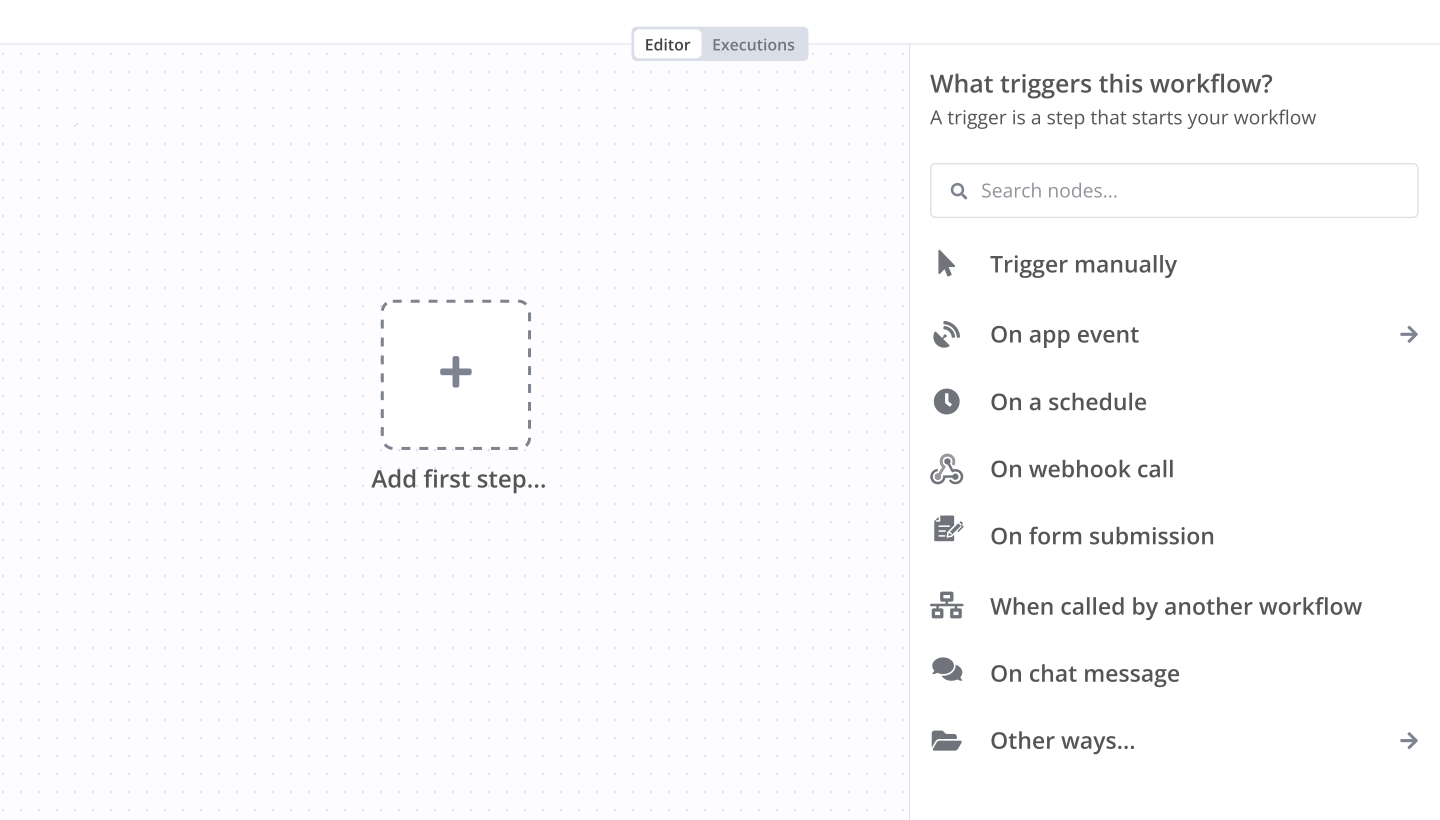
Step 1: Create a new workflow and add the first step

In n8n, click the "Add workflow" button in the Workflows tab to create a new workflow. Add the starting point – a trigger on when your workflow should run: an app event, a schedule, a webhook call, another workflow, an AI chat, or a manual trigger. Sometimes, the HTTP Request node might already serve as your starting point.

HTTP Request and S3 integration: Create a new workflow and add the first step

Step 2: Add and configure HTTP Request and S3 nodes

You can find HTTP Request and S3 in the nodes panel. Drag them onto your workflow canvas, selecting their actions. Click each node, choose a credential, and authenticate to grant n8n access. Configure HTTP Request and S3 nodes one by one: input data on the left, parameters in the middle, and output data on the right.

HTTP Request and S3 integration: Add and configure HTTP Request and S3 nodes

Step 3: Connect HTTP Request and S3

A connection establishes a link between HTTP Request and S3 (or vice versa) to route data through the workflow. Data flows from the output of one node to the input of another. You can have single or multiple connections for each node.

HTTP Request and S3 integration: Connect HTTP Request and S3

Step 4: Customize and extend your HTTP Request and S3 integration

Use n8n's core nodes such as If, Split Out, Merge, and others to transform and manipulate data. Write custom JavaScript or Python in the Code node and run it as a step in your workflow. Connect HTTP Request and S3 with any of n8n’s 1000+ integrations, and incorporate advanced AI logic into your workflows.

HTTP Request and S3 integration: Customize and extend your HTTP Request and S3 integration

Step 5: Test and activate your HTTP Request and S3 workflow

Save and run the workflow to see if everything works as expected. Based on your configuration, data should flow from HTTP Request to S3 or vice versa. Easily debug your workflow: you can check past executions to isolate and fix the mistake. Once you've tested everything, make sure to save your workflow and activate it.

HTTP Request and S3 integration: Test and activate your HTTP Request and S3 workflow

Flux AI image generator

Easily generate images with Black Forest's Flux Text-to-Image AI models using Hugging Face’s Inference API. This template serves a webform where you can enter prompts and select predefined visual styles that are customizable with no-code. The workflow integrates seamlessly with Hugging Face's free tier, and it’s easy to modify for any Text-to-Image model that supports API access.

Try it
Curious what this template does? Try a public version here: https://devrel.app.n8n.cloud/form/flux

Set Up
Watch this quick set up video 👇

Accounts required
Huggingface.co account (free)
Cloudflare.com account (free - used for storage; but can be swapped easily e.g. GDrive)

Key Features:
Text-to-Image Creation**: Generates unique visuals based on your prompt and style.
Hugging Face Integration**: Utilizes Hugging Face’s Inference API for reliable image generation.
Customizable Visual Styles**: Select from preset styles or easily add your own.
Adaptable**: Swap in any Hugging Face Text-to-Image model that supports API calls.

Ideal for:
Creators**: Rapidly create visuals for projects.
Marketers**: Prototype campaign visuals.
Developers**: Test different AI image models effortlessly.

How It Works:
You submit an image prompt via the webform and select a visual style, which appends style instructions to your prompt. The Hugging Face Inference API then generates and returns the image, which gets hosted on Cloudflare S3. The workflow can be easily adjusted to use other models and styles for complete flexibility.

Nodes used in this workflow

Popular HTTP Request and S3 workflows

+9

Hacker News to Video Content

Hacker News to Video Content Overview This workflow converts trending articles from Hacker News into engaging video content. It integrates AI-based tools to analyze, summarize, and generate multimedia content, making it ideal for content creators, educators, and marketers. Features Article Retrieval: Pulls trending articles from Hacker News. Limits the number of articles to process (configurable). Content Analysis: Uses OpenAI's GPT model to: Summarize articles. Assess their relevance to specific topics like automation or AI. Extract key image URLs. Image and Video Generation: Leonardo.ai: Creates stunning AI-generated images based on extracted prompts. RunwayML: Converts images into high-quality videos. Structured Content Creation: Parses content into structured formats for easy reuse. Generates newsletter-friendly blurbs and social media-ready captions. Cloud Integration: Uploads generated assets to: Dropbox Google Drive Microsoft OneDrive MinIO Social Media Posting (Optional): Supports posting to YouTube, X (Twitter), LinkedIn, and Instagram. Workflow Steps Trigger Initiated manually via the "Test Workflow" button. Fetch Articles Retrieves articles from Hacker News. Limits the results to avoid processing overload. Content Filtering Evaluates if articles are related to AI/Automation using OpenAI's language model. Image and Video Generation Generates: AI-driven image prompts via Leonardo.ai. Videos using RunwayML. Asset Management Saves the output to cloud storage services or uploads directly to social media platforms. Prerequisites API Keys**: Hacker News OpenAI Leonardo.ai RunwayML Creatomate n8n Installation**: Ensure n8n is installed and configured locally or on a server. Credentials**: Set up credentials in n8n for all external services used in the workflow. Customization Replace Hacker News with any other data source node if needed. Configure the "Article Analysis" node for different topics. Adjust the cloud storage services or add custom storage options. Usage Import this workflow into your n8n instance. Configure your API credentials. Trigger the workflow manually or schedule it as needed. Check the outputs in your preferred cloud storage or social media platform. Notes Extend this workflow further by automating social media posting or newsletter integration. For any questions, refer to the official documentation or reach out to the creator. About the Creator This workflow was built by AlexK1919, an AI-native workflow automation architect. Check out the overview video for a quick demo. Tools Used Leonardo.ai** RunwayML** Creatomate** Hacker News API** OpenAI GPT** Feel free to adapt and extend this workflow to meet your specific needs! 🎉

Flux AI Image Generator

Easily generate images with Black Forest's Flux Text-to-Image AI models using Hugging Face’s Inference API. This template serves a webform where you can enter prompts and select predefined visual styles that are customizable with no-code. The workflow integrates seamlessly with Hugging Face's free tier, and it’s easy to modify for any Text-to-Image model that supports API access. Try it Curious what this template does? Try a public version here: https://devrel.app.n8n.cloud/form/flux Set Up Watch this quick set up video 👇 Accounts required Huggingface.co account (free) Cloudflare.com account (free - used for storage; but can be swapped easily e.g. GDrive) Key Features: Text-to-Image Creation**: Generates unique visuals based on your prompt and style. Hugging Face Integration**: Utilizes Hugging Face’s Inference API for reliable image generation. Customizable Visual Styles**: Select from preset styles or easily add your own. Adaptable**: Swap in any Hugging Face Text-to-Image model that supports API calls. Ideal for: Creators**: Rapidly create visuals for projects. Marketers**: Prototype campaign visuals. Developers**: Test different AI image models effortlessly. How It Works: You submit an image prompt via the webform and select a visual style, which appends style instructions to your prompt. The Hugging Face Inference API then generates and returns the image, which gets hosted on Cloudflare S3. The workflow can be easily adjusted to use other models and styles for complete flexibility.

⚡ Text → Viral Shorts | AI Video Studio in Telegram /w Setup Video

🎬 AI Video Studio Bot - Telegram to YouTube Shorts, TikTok and Instagram Reels Automation Transform text into viral shorts — all from your phone 📱✨ 🎥 Watch It In Action 🔗 Full Demo: youtu.be/OI_oJ_2F1O0 🚀 What This Workflow Does Imagine having a full-stack AI video production studio in your pocket — no editing software, no dashboard hopping, no prompt engineering. Just pure creation magic through Telegram. This n8n workflow transforms Telegram into your personal AI video factory that: Your Message → AI Magic → Viral Short → Auto-Published ⏱️ 30 seconds 🎬 2-5 minutes 📤 Done! The Complete Pipeline: 📱 Message Telegram Bot - Send text, image, or voice memo 🤖 AI Prompt Generation - GPT-4 crafts perfect video prompts 🎬 Video Creation - Veo 3, Sora 2, or Seedance generates your short 📤 Auto-Upload - Instantly publishes to YouTube Shorts 🔁 Extend & Iterate - One-tap video extension (Veo only) No manual work. No technical skills. No limits. 💡 Why This Changes Everything | Traditional Way | This Workflow | |----------------|---------------| | ❌ Open 5+ platforms | ✅ One Telegram chat | | ❌ 30 min per video | ✅ 5 min per video | | ❌ Complex prompts needed | ✅ AI writes prompts for you | | ❌ Manual uploads | ✅ Auto-publishes everywhere | | ❌ Desktop only | ✅ Works from your phone | Result: Create 10+ YouTube Shorts during your lunch break 🚀 🎨 Video Styles - Choose Your Vibe Control everything with simple Telegram commands: | Command | Style | Perfect For | |---------|-------|------------| | /general | 🎭 Creative Shorts | Product demos, hooks, viral content | | /lost | 👻 Found Footage | Mystery, horror, urban exploration | | /3d | 🎮 3D Objects | Talking products, explainers, memes | | /story | 📖 Emotional Stories | Multi-scene narratives, brand stories | No command? AI intelligently picks the best style for your message. 🤖 AI Models - Pick Your Engine Choose your video generation model right from Telegram: Veo 3 / Veo 3 Fast ⚡ Best for: Quick iterations, realistic scenes Speed: 2-3 minutes Unique: Video extension support Sora 2 🎬 Best for: Cinematic quality, long sequences Speed: 4-5 minutes Unique: Best motion consistency Seedance 1.5 Pro 🌊 Best for: Artistic effects, fluid motion Speed: 3-4 minutes Unique: Stylized aesthetics Select directly in-chat with interactive buttons! ⚡ Power Features 🎯 Smart Video Generation AI analyzes your message intent Generates optimal prompts automatically Adapts to text, images, or voice input 📤 Auto-Publishing Pipeline Uploads to YouTube Shorts instantly AI-generated titles, descriptions, tags SEO-optimized for maximum reach 🔄 Extend & Refine One-tap video extension (Veo only) Keep the vibe, extend the story No re-generation needed 💳 Credit Management Real-time credit checking Prevents failed generations Session-based tracking with Redis 🔔 Status Monitoring Real-time generation updates Webhook polling for long jobs Graceful error handling & cancellation 🗂️ Session Storage Redis-powered state management Resume interrupted workflows Track generation history 🎪 Perfect For | Creator Type | Use Case | |-------------|----------| | 🎥 Faceless Channels | Generate endless Shorts without showing face | | 🏢 Agencies | Scale content production 10x for clients | | 📱 Solo Creators | Daily Shorts from your phone, no laptop needed | | 🤖 AI Farms | Automate content pipelines end-to-end | | 🧪 Experimenters | Rapid prototyping of video ideas | | 📊 Marketers | A/B test video concepts at scale | 🛠️ Tech Stack Telegram Bot API → User interface OpenAI GPT-4 → Prompt generation KIE.ai → Video generation (Veo/Sora/Seedance) YouTube Data API → Auto-publishing Redis → Session & state management S3-compatible → Video storage n8n → Orchestration layer Requirements: ✅ Telegram Bot Token ✅ OpenAI API Key ✅ KIE.ai Account (Veo/Sora/Seedance access) ✅ YouTube OAuth Credentials ✅ Redis Instance (recommended) ✅ S3-compatible Storage ✅ n8n Instance (cloud or self-hosted) 🎬 Real-World Workflow Example You: "A golden retriever puppy discovering snow for the first time" Bot: ✨ Generating your video... 📊 Credits: 50 remaining 🎬 Using: Veo 3 Fast ⏱️ ETA: 2 minutes 2 minutes later: ✅ Your video is ready! 📺 Uploaded to YouTube Shorts 🔗 Link: youtube.com/shorts/abc123 👁️ Views: 0 → 1.2K (24 hours) [Extend Video] [Generate New] Result: Viral short created from your phone while waiting for coffee ☕ 🔧 Customization Ideas 🎨 Extend the Platform Add TikTok publishing Include Instagram Reels Add Twitter video posts Support LinkedIn video 🎙️ Alternative Inputs Replace Telegram with WhatsApp Add Discord bot interface Support Slack commands Email-to-video pipeline 🎭 Creative Variations Swap OpenAI for Claude/Gemini Add custom style presets Include watermarking steps Generate captions automatically 📊 Analytics & Tracking Log all generations to Google Sheets Track video performance metrics A/B test title/thumbnail combinations Monitor credit usage trends 📊 Success Metrics After using this workflow for 30 days: | Metric | Before | After | Improvement | |--------|--------|-------|-------------| | ⏱️ Time per video | 45 min | 5 min | 9x faster | | 📹 Videos/week | 5 | 50+ | 10x volume | | 💰 Cost per video | $15 | $2 | 7.5x cheaper | | 📱 Creation location | Desktop only | Anywhere | ∞ flexibility | | 🧠 Prompt writing | Manual | Automated | No skill needed | 🚀 Quick Start Import workflow to n8n Add credentials (Telegram, OpenAI, KIE.ai, YouTube, Redis) Configure video storage (S3) Activate workflow Message your bot and watch the magic happen Setup time: ~20 minutes First video: ~5 minutes after setup 🏷️ Tags telegram ai-video youtube-shorts automation content-creation openai veo sora seedance text-to-video social-media creator-tools faceless-channel redis s3 n8n-workflow telegram-bot video-automation shorts-generator 📜 License MIT License - Use freely, modify, share, monetize! ⚡ Stop editing. Start generating. Scale your content empire. ⚡ Created by Joe Venner | Built with ❤️ and n8n
+5

Generate M&A due diligence reports with Decodo, OpenAI and Pinecone

Turn unstructured pitch decks and investment memos into polished Due Diligence PDF reports automatically. This n8n workflow handles everything from document ingestion to final delivery, combining internal document analysis with live web research to produce analyst-grade output in minutes. The Problem It Solves Reviewing a single deal manually reading the deck, cross-checking claims online, formatting the summary easily takes half a day. Multiply that by 10–20 inbound deals per week, and your team is buried in low-leverage work before any real analysis begins. This workflow compresses that cycle into a single automated pipeline. How It Works Upload: Send a PDF, DOCX, or PPTX to the webhook endpoint. Parse: LlamaParse extracts clean Markdown from complex layouts, preserving tables and financial data. Enrich: The workflow identifies the target company, then pulls supplementary data from the open web (corporate pages, risk signals) using Decodo's search and scraping APIs to verify and contextualize claims made in the source documents. Analyze: An AI Agent runs six targeted retrieval queries against the combined dataset: revenue history, key risks, business model, competitive landscape, management profile, and deal terms. Deliver: Results render into a branded HTML template, convert to PDF via Puppeteer, upload to Cloudflare R2, and return a download link. Each deal gets a unique namespace in Pinecone, so documents are isolated and repeat uploads skip redundant parsing. What You Need | Service | Role | | --- | --- | | n8n | Workflow orchestration | | LlamaIndex Cloud | Document parsing (LlamaParse) | | Pinecone | Vector storage & retrieval | | OpenAI API | Embeddings (text-embedding-3-small) & LLM analysis (GPT-5.4) | | Decodo API | Web search & page scraping | | Cloudflare R2 | Report file storage (S3-compatible) | Quick Start Import the workflow JSON into your n8n instance. Add credentials for OpenAI, Pinecone, LlamaIndex (Header Auth), Decodo, and Cloudflare R2 (S3-compatible). Update the R2 base URL in the "Build Public Report URL" node. Fire a test POST with a sample deck to the webhook. Customization Ideas Swap the HTML template to match your firm's branding and report structure. Extend the AI Agent prompt to cover additional dimensions like ESG scoring or technical debt. Route the finished PDF to Slack, email, or your CRM instead of (or alongside) R2. Troubleshooting | Symptom | Likely Fix | | --- | --- | | Parsing times out | Increase the Wait node duration; check file size against LlamaParse limits | | Thin or generic analysis | Verify the source PDF is text-based, not a scanned image, enable OCR if needed | | Broken PDF layout | Simplify CSS in the HTML render node; older Puppeteer builds handle basic layouts better | Created by: Khmuhtadin Category: Business Intelligence | Tags: AI, RAG, Due Diligence, Decodo Portfolio • Store • LinkedIn • Medium • Threads

Generate AI images via Telegram with WaveSpeed, credit system, PIX and S3

🤖 Generate images via Telegram using an AI bot with a credit system and S3 storage A complete, production-ready Telegram bot for AI-powered image generation and editing, featuring a built-in credit system, payment integration, and cloud storage. ✨ Features 🎨 AI Image Generation Text-to-Image: Generate stunning images from text prompts using the **Nano Banana Pro Ultra model via WaveSpeed API Image-to-Image Editing**: Edit existing images by sending a photo with a caption describing the desired changes Multiple Resolutions: Support for both **4K and 8K output quality Flexible Aspect Ratios**: Choose from 10 different aspect ratios (1:1, 3:2, 2:3, 3:4, 4:3, 4:5, 5:4, 9:16, 16:9, 21:9) 💳 Credit Management System Per-generation billing**: Different costs for 4K vs 8K resolution Balance tracking**: Real-time credit balance displayed to users Initial credits**: New users receive starter credits automatically Insufficient balance handling**: Graceful messages when credits run out Here's the adjusted payment section: 💰 Payment Integration (Mercado Pago PIX) > About PIX: PIX is Brazil's instant payment system, launched by the Central Bank of Brazil in 2020. It allows instant money transfers 24/7, 365 days a year, using QR codes or copy-paste codes. It has become the most popular payment method in Brazil due to its speed and zero fees for individuals. This workflow includes a fully integrated PIX payment flow as a reference implementation. You can adapt it to your local payment provider. Features: Multiple deposit options**: Pre-configured credit packages (R$ 3, R$ 6, R$ 10) QR Code generation**: Automatic PIX QR code sent directly to users via Telegram Copy-paste code**: PIX code provided for manual payment Webhook confirmation**: Real-time payment status updates via Mercado Pago webhooks Auto credit top-up**: Credits added automatically upon payment approval Payment status handling**: Supports approved, pending, and rejected states > 💡 Tip: To adapt this for other regions, replace the Mercado Pago nodes with your preferred payment gateway (Stripe, PayPal, etc.) while keeping the same credit update logic. ⚙️ User Configuration Resolution settings**: Users can set their preferred default resolution Aspect ratio preferences**: Save preferred aspect ratio for future generations Custom default prompts**: Set a default prompt that's automatically appended to all generations Persistent settings**: All preferences stored in n8n Data Tables 📦 Cloud Storage (S3/MinIO) Automatic upload**: Generated images are automatically uploaded to S3-compatible storage Persistent URLs**: Images remain accessible via permanent links Edit from storage**: Reference previously uploaded images for editing 🛠️ Tech Stack | Component | Technology | |-----------|------------| | Bot Platform | Telegram Bot API | | AI Generation | WaveSpeed API (Nano Banana Pro) | | Storage | S3-compatible (MinIO/AWS S3) | | Database | n8n Data Tables | | Payments | Mercado Pago PIX | | Automation | n8n | 📋 Prerequisites Before using this workflow, you'll need: Telegram Bot Token - Create a bot via @BotFather WaveSpeed API Key - Sign up at WaveSpeed S3-compatible Storage - MinIO, AWS S3, or any S3-compatible service Mercado Pago Account (optional) - For payment integration n8n Data Table - Create a table with the required schema 📊 Data Table Schema Create a Data Table with the following columns: | Column | Type | Description | |--------|------|-------------| | chat_id | String | Telegram chat ID (primary key) | | username | String | Telegram username | | status | String | Current user state in the flow | | credits | String | User's credit balance | | resolution | String | Preferred resolution (4k/8k) | | aspect_ratio | String | Preferred aspect ratio | | user_default_prompt | String | Custom default prompt | | number_images | Number | Total images generated | | number_videos | Number | Total videos generated | | demo_sended | Boolean | Welcome demo sent flag | ⚡ Quick Setup Import the workflow into your n8n instance Configure the Global Environment node with your settings: botName: Your bot's display name botToken: Your Telegram bot token dataTableId: Your n8n Data Table ID bucketName: Your S3 bucket name initialCredits: Credits given to new users generateImageCost4k: Cost per 4K image generateImageCost8k: Cost per 8K image Set up credentials: Telegram API credentials WaveSpeed API credentials S3 credentials Mercado Pago credentials (if using payments) Activate the workflow 🎮 Bot Commands | Command | Description | |---------|-------------| | /start | Initialize bot and receive welcome message | | menu | Return to main menu | | config | Open settings menu | | Any text | Generate image from prompt (when in generation mode) | | Photo + caption | Edit the photo based on the caption | 🔄 Workflow Flow User Message → Telegram Trigger → Route by Status ↓ ┌───────────────────┼───────────────────┐ ↓ ↓ ↓ New User Generate Image Edit Image ↓ ↓ ↓ Welcome Flow Check Credits Check Credits ↓ ↓ ↓ Create User Submit to WaveSpeed Upload to S3 ↓ ↓ ↓ Show Menu Poll for Result Submit Edit ↓ ↓ Download Image Poll for Result ↓ ↓ Send to User ←←←←←←←←←←←←←┘ 📝 Notes The workflow uses polling to check generation status - WaveSpeed processes may take up to 1 minute Credits are deducted when the task is submitted and refunded if generation fails All user states are managed through the Data Table for persistence across restarts 📄 License Free to use and modify. Attribution appreciated but not required.
+2

Publish daily multi-platform social posts from live web research with GPT-5.5

This template is built for content creators, founders, solopreneurs, content marketers, and agencies who want to publish consistent, research-backed content across 4 social platforms without writing, formatting, or posting manually. It runs reliably for a single personal brand and scales seamlessly to dozens of accounts with no structural changes. You define a topic once. The pipeline finds a fresh article every day at 8 AM, writes platform-native copy for all 4 channels, generates a cinematic AI image, stores it on Cloudflare R2, and publishes everything autonomously. Your only job is a 30-second review in Notion before it goes live. Each post costs approximately $0.90 to $1.20 in OpenAI API credits. Cloudflare R2, Notion, Buffer free tier, and Bluesky cost nothing within their free limits. The architecture is built to scale. Adding more social accounts requires only a Buffer paid plan, or the workflow can be extended with native platform APIs for X, Instagram, and more, for full control at any scale. No structural changes to the workflow. Still not convinced? See it live This exact pipeline runs the accounts below. No editing. No manual posting. Just the workflow doing its job every day. LinkedIn: linkedin.com/in/expansionledger Threads: threads.net/@expansionledger Pinterest: pinterest.com/expansionledger Bluesky: bsky.app/profile/expansionledger.com Watch the complete tutorial Click the thumbnail below to watch the full step-by-step build on YouTube. How it works The bundle contains 4 fully connected and documented workflows. WF-01 Data Ingestion runs every day at 8 AM. GPT-5.5 with live web search finds a real article published in the last 14 days on your topic. It deduplicates against Notion using a Source ID so the same article is never processed twice. Creates a Raw entry in Notion and immediately calls WF-02. WF-02 Content Generation fetches the full article text, uses gpt-5.4-mini to analyze it and generate platform-specific copy for all 4 channels with character limits enforced in code (LinkedIn 2900, Threads 495, Pinterest 500, Bluesky 295), creates a cinematic AI image with gpt-image-2, uploads it to Cloudflare R2, updates Notion to Pending Review, and sends a Pushover notification to your phone. You open Notion on your phone, read the generated content, and set Status to Approved. That single tap triggers publishing. If you skip approvals for several days, posts simply queue up in Pending Review. Nothing publishes without your tap, so you stay in full control even when life gets busy. WF-03 Content Publisher polls Notion every minute for Approved pages. Posts to LinkedIn, Threads, and Pinterest via the Buffer GraphQL API scheduled 1 minute ahead (Buffer does not allow instant publishing via API). Posts directly to Bluesky via the AT Protocol with the image blob embedded. Marks the Notion page as Live and sends a confirmation to your phone. WF-04 Error Handler is the central error receiver for the entire pipeline. If anything fails in any workflow, a High Priority Pushover alert arrives on your phone instantly with the workflow name, the failed node, the error message, and a direct link to the failed execution in n8n. Why not just use Buffer for everything? Buffer is excellent for scheduling posts you already have written. It cannot search the web, it cannot read a live article, and it cannot generate images or copy. The pipeline uses Buffer only for what it does best: queuing and publishing to LinkedIn, Threads, and Pinterest. Bluesky is posted directly via the AT Protocol because it gives full control over the post format and image embedding without depending on Buffer's Bluesky support. The Buffer free tier includes 3 social channels, which covers LinkedIn, Threads, and Pinterest perfectly. Important: Buffer's public API is currently in beta. The request structure may change in future updates without prior notice. If you encounter errors on the Buffer nodes, check the official Buffer API documentation first before debugging the workflow code. Why Cloudflare R2 for image storage? The AI-generated image needs a public URL so Buffer and Bluesky can fetch it at publishing time. Cloudflare R2 is the right tool for several reasons. 10 GB of free storage per month, permanently. At roughly 1 MB per image, that covers approximately 10,000 posts before you pay a single cent. No egress fees. Cloudflare does not charge bandwidth when images are served publicly, unlike AWS S3. Works with or without a custom domain. You can use the default R2 public URL at no cost, or point your own domain to the bucket from the Cloudflare dashboard in a few clicks. Ready for video. The same infrastructure handles video files. To extend this pipeline to TikTok, Instagram Reels, or YouTube Shorts, you upload the video to R2 and pass the public URL to a new publishing step. The architecture supports it with no structural changes. How to set up Cloudflare R2: Create a free account at dash.cloudflare.com Go to R2 Object Storage and create a new bucket In the bucket settings enable Public Access and copy the public domain Go to Manage R2 API Tokens and create a token with Object Read and Write permissions Copy the Account ID, Access Key ID, and Secret Access Key In n8n create an S3 credential, set the Endpoint URL to your R2 endpoint (format: https://ACCOUNT_ID.r2.cloudflarestorage.com), paste your keys, and set Region to auto Paste your bucket name and public base URL into the Pipeline Configuration node in WF-02 Why Pushover for notifications? Pushover is a dedicated push notification service. It is not email. It is not Slack. It lands on your phone instantly with a distinct sound. WF-04 sends error alerts at Priority 1 (High), which bypasses your phone's quiet hours. You know immediately when the pipeline breaks, even at 3am. It is not tied to any social platform or workspace tool, so you never miss a notification because you were not logged into the right app. It costs a one-time payment of $5 per platform (iOS or Android) and is free forever after with no subscription. How to set up Pushover: Create an account at pushover.net and note your User Key from the dashboard Click Create an Application, give it a name (for example: n8n Pipeline), and copy the App Token Install the Pushover app on your phone from the App Store or Google Play In n8n create a Pushover credential, paste the App Token Paste your User Key into the Pushover nodes inside WF-02, WF-03, and WF-04 Why GPT-5.5 and gpt-image-2? GPT-5.5 is used with live web search for article discovery because it finds real articles published in the last 14 days by searching the live web on every run. No hallucinated sources. No outdated content. gpt-image-2 is OpenAI's latest image model. It generates cinematic, photorealistic images from a text prompt automatically derived from the article content, so every post gets a unique and contextually relevant image at a fraction of the cost of older models. For the actual copywriting step, the pipeline uses gpt-5.4-mini deliberately. It is significantly cheaper than the flagship models while keeping high output quality, and the quality difference is negligible for short-form social copy, where character limits do most of the editing for you. How to get your OpenAI API key: Go to platform.openai.com and create an account or log in Go to API Keys and click Create new secret key Copy the key and paste it into the OpenAI credential in n8n Important: gpt-image-2 requires account verification. To use gpt-image-2 you need to verify your OpenAI account at platform.openai.com/settings/organization/general This works for both individuals and companies. The process is fast, usually approved within 30 minutes of submission. It is worth doing, trust me. The cost per full post across all 4 platforms is approximately $0.90 to $1.20, almost entirely from the OpenAI API: GPT-5.5 with web search for discovery ($0.20 to $0.30), gpt-5.4-mini for content generation ($0.10), and gpt-image-2 at high quality 1024x1024 (~$0.60 to $0.80). The Notion Template The pipeline uses a Notion database as its backbone. Every article, every piece of generated content, and every status update flows through it. The Notion template is ready to use. Duplicate it with one click and it is ready to connect. Duplicate the Notion template here: tuguidragos.notion.site/Automated-Content-Pipeline-n8n How to connect Notion to n8n: Go to notion.so/my-integrations and click New integration Give it a name, select your workspace, and set Content Capabilities to Read, Update, and Insert content Copy the Internal Integration Token In n8n create a Notion credential and paste the token In your duplicated Notion database click the three dots in the top right, go to Connections, and add your integration How to get your Notion database ID: Open the database in Notion in a browser. The database ID is the 32-character string in the URL between the last slash and the question mark. Paste it into the Pipeline Configuration node in WF-01 and WF-02. Where does this run? This pipeline runs on n8n, either on n8n Cloud at n8n.io/cloud (fully managed, no server required) or on a self-hosted n8n instance on your own VPS, NAS, or home server. Once activated, the workflows run 24 hours a day. WF-01 triggers daily at 8 AM and WF-03 polls Notion every minute. No manual intervention is needed after the initial setup. How to customize the workflow To change the topic, update the niche field in the Pipeline Configuration node in WF-01. That single change redirects the entire pipeline. Fitness, real estate, personal finance, crypto, SaaS, any niche with a consistent stream of published articles works without touching any other node. To add more social platforms, extend the Buffer step in WF-03 with additional channel IDs or add new publishing nodes after the Bluesky step. For more than 3 channels, a Buffer paid plan is needed, starting at $6 per month. Every workflow has a written description. Every node is named and has a sticky note explaining exactly what it does, what credential it needs, and what to configure. The bundle is fully ready for Claude MCP integration out of the box. Requirements n8n instance, cloud or self-hosted OpenAI account with API access at platform.openai.com Notion account with an integration at notion.so/my-integrations Buffer account, free tier covers 3 channels, at buffer.com Cloudflare account with R2 enabled at dash.cloudflare.com Bluesky account with an App Password at bsky.app/settings/app-passwords Pushover account at pushover.net How to set up Duplicate the Notion template and connect it to your Notion integration Add all credentials in n8n: Notion, OpenAI, S3 pointing to Cloudflare R2, Pushover In WF-01 and WF-02 open Pipeline Configuration and set your Notion database ID, R2 bucket name, R2 public base URL, and topic in the niche field In WF-03 open the Config node and add your Buffer API key, channel IDs for LinkedIn, Threads, and Pinterest, your Bluesky handle, and your Bluesky app password In the workflow settings of WF-01, WF-02, and WF-03 set WF-04 as the Error Workflow Activate in this order: WF-04 first, then WF-02, then WF-03, then WF-01 Note: The screenshots above are representative previews taken from a release candidate (RC) build and may not perfectly match the final shipped version. Workflow logic, node names, and output remain the same.

Build your own HTTP Request and S3 integration

Create custom HTTP Request and S3 workflows by choosing triggers and actions. Nodes come with global operations and settings, as well as app-specific parameters that can be configured. You can also use the HTTP Request node to query data from any app or service with a REST API.

S3 supported actions

Create
Create a bucket
Delete
Delete a bucket
Get Many
Get many buckets
Search
Search within a bucket
Copy
Copy a file
Delete
Delete a file
Download
Download a file
Get Many
Get many files
Upload
Upload a file
Create
Create a folder
Delete
Delete a folder
Get Many
Get many folders
Use case

Save engineering resources

Reduce time spent on customer integrations, engineer faster POCs, keep your customer-specific functionality separate from product all without having to code.

Learn more

FAQs

  • Can HTTP Request connect with S3?

  • Can I use HTTP Request’s API with n8n?

  • Can I use S3’s API with n8n?

  • Is n8n secure for integrating HTTP Request and S3?

  • How to get started with HTTP Request and S3 integration in n8n.io?

Need help setting up your HTTP Request and S3 integration?

Discover our latest community's recommendations and join the discussions about HTTP Request and S3 integration.

Moiz Contractor
theo
Jon
Dan Burykin
Tony

Looking to integrate HTTP Request and S3 in your company?

Over 3000 companies switch to n8n every single week

Why use n8n to integrate HTTP Request with S3

Build complex workflows, really fast

Build complex workflows, really fast

Handle branching, merging and iteration easily.
Pause your workflow to wait for external events.

Code when you need it, UI when you don't

Simple debugging

Your data is displayed alongside your settings, making edge cases easy to track down.

Use templates to get started fast

Use 1000+ workflow templates available from our core team and our community.

Reuse your work

Copy and paste, easily import and export workflows.

Implement complex processes faster with n8n

red iconyellow iconred iconyellow icon