Back to Integrations
integrationHTTP Request node
integrationServiceNow node

HTTP Request and ServiceNow integration

Save yourself the work of writing custom integrations for HTTP Request and ServiceNow and use n8n instead. Build adaptable and scalable Development, Core Nodes, Productivity, and Communication workflows that work with your technology stack. All within a building experience you will love.

How to connect HTTP Request and ServiceNow

  • Step 1: Create a new workflow
  • Step 2: Add and configure nodes
  • Step 3: Connect
  • Step 4: Customize and extend your integration
  • Step 5: Test and activate your workflow

Step 1: Create a new workflow and add the first step

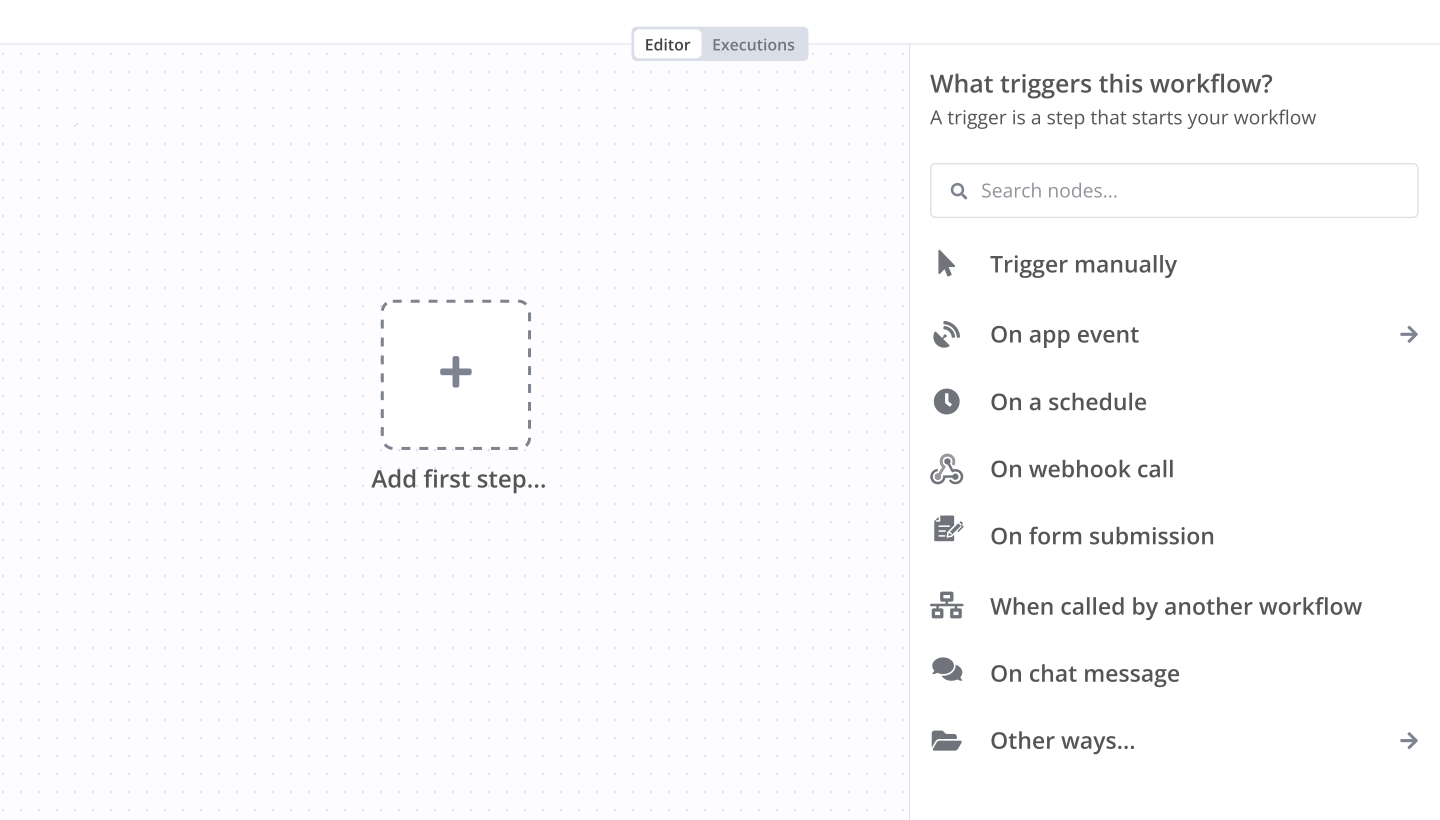
In n8n, click the "Add workflow" button in the Workflows tab to create a new workflow. Add the starting point – a trigger on when your workflow should run: an app event, a schedule, a webhook call, another workflow, an AI chat, or a manual trigger. Sometimes, the HTTP Request node might already serve as your starting point.

HTTP Request and ServiceNow integration: Create a new workflow and add the first step

Step 2: Add and configure HTTP Request and ServiceNow nodes

You can find HTTP Request and ServiceNow in the nodes panel. Drag them onto your workflow canvas, selecting their actions. Click each node, choose a credential, and authenticate to grant n8n access. Configure HTTP Request and ServiceNow nodes one by one: input data on the left, parameters in the middle, and output data on the right.

HTTP Request and ServiceNow integration: Add and configure HTTP Request and ServiceNow nodes

Step 3: Connect HTTP Request and ServiceNow

A connection establishes a link between HTTP Request and ServiceNow (or vice versa) to route data through the workflow. Data flows from the output of one node to the input of another. You can have single or multiple connections for each node.

HTTP Request and ServiceNow integration: Connect HTTP Request and ServiceNow

Step 4: Customize and extend your HTTP Request and ServiceNow integration

Use n8n's core nodes such as If, Split Out, Merge, and others to transform and manipulate data. Write custom JavaScript or Python in the Code node and run it as a step in your workflow. Connect HTTP Request and ServiceNow with any of n8n’s 1000+ integrations, and incorporate advanced AI logic into your workflows.

HTTP Request and ServiceNow integration: Customize and extend your HTTP Request and ServiceNow integration

Step 5: Test and activate your HTTP Request and ServiceNow workflow

Save and run the workflow to see if everything works as expected. Based on your configuration, data should flow from HTTP Request to ServiceNow or vice versa. Easily debug your workflow: you can check past executions to isolate and fix the mistake. Once you've tested everything, make sure to save your workflow and activate it.

HTTP Request and ServiceNow integration: Test and activate your HTTP Request and ServiceNow workflow

List recent ServiceNow incidents in Slack using pop up modal

Who is this for?
This workflow is designed for IT teams, service desk personnel, and incident management professionals who need a streamlined way to monitor and report on recent ServiceNow incidents directly within Slack.

What problem is this workflow solving? / Use Case
Manually monitoring incidents in ServiceNow can be time-consuming, and keeping teams updated about new or specific incidents often involves additional manual effort. This workflow automates the process of querying recent incidents from ServiceNow based on user-defined parameters and delivering formatted results directly to Slack. It ensures faster response times and improved incident visibility.

What this workflow does
This workflow integrates Slack and ServiceNow to provide an automated system for retrieving and presenting incident details.
Slack User Interaction: Users initiate the workflow via a Slack modal form, selecting incident parameters like priority and state.
ServiceNow Query: The workflow queries ServiceNow for incidents matching the selected criteria.
Results Delivery: Incident results are sent back to Slack as a message formatted using Block Kit. If no results are found, the workflow notifies the user with a detailed message, either in a Slack channel or via direct message.
Error Handling: If no channel is selected or any issues arise, the workflow ensures graceful fallback with appropriate notifications.

Setup Instructions
Slack Setup:
Integrate Slack with n8n using a Slack app.
Configure the modal form to accept parameters like priority and state.
Check out this video for setting up a modal slack app on YouTube.
ServiceNow Integration:
Use ServiceNow credentials to connect with n8n.
Ensure appropriate permissions for querying incidents.
n8n Workflow Configuration:
Import this workflow into n8n.
Verify all node configurations, particularly those for ServiceNow API queries and Slack outputs.
Set up webhook URLs for Slack event handling.
Testing:
Trigger the workflow from Slack to test modal inputs and incident queries.
Confirm the output is correctly formatted and delivered to the intended Slack channel or user.

How to Customize this Workflow to Your Needs
Modify the ServiceNow query logic to include additional filters or fields.
Adjust the Slack Block Kit formatting to match your organization’s preferred notification style.
Use conditional logic to add more advanced handling for specific priorities or states.
Expand the workflow to include escalation steps, such as notifying a specific team or creating follow-up tasks.

Workflow Highlights
Slack Modal Form**: Allows users to specify search criteria for incidents interactively.
Dynamic Results Delivery**: Automatically sends results to a Slack channel or direct message based on user input.
Error Handling**: Provides fallback notifications when no incidents are found or user inputs are incomplete.
Customizable Integration**: Easily adaptable to fit different organizational needs, including advanced filtering and formatting options.

Nodes used in this workflow

Popular HTTP Request and ServiceNow workflows

+5

Automate ITSM ticket classification and resolution using Gemini, Qdrant and ServiceNow

Who’s it for This template is ideal for IT support teams, internal helpdesk automation engineers, and developers building intelligent ticketing systems. It helps streamline ITSM workflows by automatically classifying user queries, retrieving relevant knowledge base entries, and triggering incident creation in ServiceNow. How it works / What it does This workflow uses Google Gemini and Qdrant to power an intelligent ITSM assistant. When a user submits a query via chat: The Text Classifier categorizes the input as an Incident, Request, or Other. Based on the category: Incidents are automatically logged in ServiceNow. Requests trigger an HTTP call (e.g., for provisioning or access). Other queries are routed to an AI Agent that searches the FAQBase in Qdrant and responds contextually. The Gemini LLM enriches responses and summaries. The Qdrant Vector Store retrieves semantically similar answers from a pre-embedded FAQ knowledge base. The Summarization Chain condenses incident details for better tracking. Sticky notes are used throughout the workflow to document each node’s purpose and improve maintainability. How to set up Connect your Google Gemini API, Qdrant, and ServiceNow credentials. Populate the FAQBase collection in Qdrant with your ITSM knowledge base. Deploy the webhook to receive chat inputs. Test the flow using the Manual Trigger node. Customize the classifier categories and Gemini prompts as needed. Requirements Google Gemini API access Qdrant vector database with embedded FAQ data ServiceNow account with API access n8n instance with LangChain nodes installed How to customize the workflow Modify the Text Classifier categories to suit your organization’s ticket types. Add more FAQ entries to Qdrant for broader coverage. Replace the HTTP Request node with integrations relevant to your ITSM tools. Adjust the Gemini prompts to reflect your tone and support style. Extend the workflow with Slack, Teams, or email notifications for ticket updates.
+4

AI-Powered ServiceNow Chat Triage with GPT-4 — Incident & Request Manager

Automated Incident and Request Management in ServiceNow Who’s it for This workflow is designed for IT teams, service desk agents, and operations managers who use ServiceNow. It reduces manual effort by automatically classifying chat messages as Incidents or Requests, creating/updating them in ServiceNow, and summarizing ticket updates. What it does Receives incoming chat messages. Classifies the message as one of: Incident (something broken, unavailable, or a complaint) Request (access, provisioning, product/order related) Follow-ups (incident or request update checks) Update action (user wants to add info to an existing ticket) Everything else (knowledge search / general query). Creates Incidents in ServiceNow via the ServiceNow node. Creates Requests in ServiceNow using the Service Catalog API. Updates existing Incidents with new work notes when the user provides an update. Pulls existing incident/request work notes for summaries. Optionally uses SerpAPI for general queries (if enabled). Returns a concise summary back to the user through the webhook. Requirements ServiceNow account** with API access (Basic Auth) OpenAI API key** (used by the classifier and summarizer) SerpAPI key* *(optional – for general web lookups) Credentials needed You will need to set up the following credentials in n8n: ServiceNow Basic Auth (username, password, instance URL). OpenAI API (API key). SerpAPI (optional – only if you want web search enabled). How to set up Import the workflow JSON into your n8n instance. Create the credentials mentioned above and assign them to the corresponding nodes: Create an incident → ServiceNow Basic Auth HTTP Request1 (for Service Catalog requests) → ServiceNow Basic Auth OpenAI Chat Model / OpenAI Chat Model1 / OpenAI Chat Model2 / OpenAI Chat Model3 → OpenAI API SerpAPI node (optional) → SerpAPI key Adjust the ServiceNow instance URL in the HTTP Request node to match your environment. Deploy the workflow. Send a test chat message to trigger the workflow. How to customize Update the classification rules in the Text Classifier node if your organization uses different definitions for incidents vs. requests. Edit the summary prompt in the Summarization Chain to include or exclude specific fields. Add additional notification nodes (Slack, Teams, or Email) if you want updates pushed to other channels. Notes & Limitations This workflow creates general requests in ServiceNow using the catalog API. For production, update the Service Catalog item ID to match your environment. “Everything else” category uses SerpAPI. If not configured, those queries will not return results. This workflow requires OpenAI GPT-4.1 mini (or another supported model) for classification and summarization.
+3

AI-Powered ServiceNow Chat Triage with GPT-4 — Incident & Request Router

Short description Automatically triage incoming chat messages into Incidents, Service Requests, or Other using an LLM-powered classifier; create Incidents in ServiceNow, submit Service Catalog requests (HTTP), and route everything else to an AI Agent with web search + memory. Includes an optional summarization step for ticket context. Full description This n8n template wires a chat trigger to an LLM-based Text Classifier and then routes messages to the appropriate downstream action: Trigger: When chat message received — incoming messages from your chat channel. Text Classifier: small LLM prompt/classifier that returns one of three labels: Incident, Request, or Everything Else. Create Incident (ServiceNow connector): when labeled Incident, the workflow creates a Servicenow Incident record (short fields: short\_description, description, priority, caller). Submit General Request (HTTP Request): when labeled Request, the workflow calls your Service Catalog API (POST) to place a catalog item / submit a request. AI Agent: when labeled Everything Else, route to an AI Agent node that: uses an OpenAI chat model for contextual replies, can consult SerpAPI (web search) as a tool, saves relevant context to Simple Memory for future conversations. Summarization Chain: optional chain to summarize long chat threads into concise ticket descriptions before creating incidents/requests. This template is ideal for support desks that want automated triage with human-quality context and searchable memory. Key highlights (what to call out) Three-way LLM triage**: ensures messages are routed automatically to the correct backend action (Incident vs Service Request vs AI handling). ServiceNow native connector**: uses the ServiceNow node to create Incidents (safer than raw HTTP for incidents). Service Catalog via HTTP**: flexible — supports organizations using RESTful catalog endpoints. Summarization before ticket creation**: produces concise, high-quality short_description and description fields. AI Agent + Memory + Web Search**: handles non-ticket queries with web-augmented answers and stores context for follow-ups. Failover & logging**: include a catch node (optional) that logs failures and notifies admins. Required credentials & inputs (must configure) ServiceNow**: Instance URL + API user (must have rights to create incidents). Service Catalog HTTP endpoint**: URL + API key / auth header (for POST). OpenAI API key** (or other LLM provider): for Text Classifier, Summarization Chain, and AI Agent. SerpAPI key** (optional): for web search tools inside the AI Agent. Memory store**: Simple Memory node (or external DB) for conversation history. Nodes included (quick map) Trigger: When chat message received Processor: Text Classifier (OpenAI/LLM) Branch A: ServiceNow (Create Incident) Branch B: HTTP Request (Service Catalog POST) Branch C: AI Agent (OpenAI + SerpAPI + Simple Memory) Shared: Summarization Chain (used before A or B where enabled) Optional: Error / Audit logging node, Slack/email notifications Recommended n8n settings & tips Use structured outputs** from classifier ({ label: "Incident", confidence: 0.92 }) so you can implement confidence thresholds. If confidence < 0.7**, route to a human review queue instead of auto-creating a ticket. Sanitize user PII** before storing in memory or sending to external APIs. Rate-limit** OpenAI/SerpAPI calls to avoid unexpected bills. Test the Service Catalog POST body** in Postman first — include sample variables JSON. Short sample variables JSON (Service Catalog POST) { "sysparm_quantity": 1, "variables": { "description": "User reports VPN timeout on Windows machine; error code 1234" } }

Automate CVE Monitoring with OpenAI Processing for ServiceNow Security Incidents

This n8n workflow automatically fetches the latest CVE data at scheduled intervals, extracts relevant security details, and creates a corresponding Security Incident in ServiceNow for each new vulnerability. Schedule Trigger – Runs at predefined intervals. Jina Fetch – Retrieves the latest CVE feed. Information Extractor (OpenAI Chat Model) – Processes and extracts key details from the CVE data. Split Out – Separates each CVE entry for individual processing. Create Incident – Generates a ServiceNow Security Incident with the extracted CVE details. Ideal for security teams to ensure timely tracking and remediation of new vulnerabilities without manual monitoring.

IP Reputation Check & SOC Alerts with Splunk, VirusTotal and AlienVault

IP Reputation Check & Threat Summary using Splunk + VirusTotal + AlienVault + n8n This workflow automates IP reputation analysis using Splunk alerts, enriches data via VirusTotal and AlienVault OTX, and generates actionable threat summaries for SOC teams — all without any coding. What It Does When a Splunk alert contains a suspicious IP: Ingests the IP** from the Splunk alert via webhook. Performs dual threat enrichment** using: VirusTotal IP reputation & tags. AlienVault OTX pulses, reputation & WHOIS. Merges & processes** threat intel data. Generates a rich HTML summary** for analyst review. Routes action based on severity**: Sends Slack alert for suspicious IPs. Creates an incident in ServiceNow. Emails a formatted HTML report to the SOC inbox. Tech Stack Used Splunk** – SIEM alert source VirusTotal API** – Reputation check & analysis stats AlienVault OTX API** – Community threat intel & pulse info n8n** – For orchestration, merging, summary generation Slack, Gmail, ServiceNow** – For SOC notifications and ticketing Ideal Use Case Perfect for security teams wanting to: Automatically validate IP reputation from SIEM logs Get quick context from multiple threat feeds Generate email-ready reports and escalate high-risk IPs Included Nodes Webhook (Splunk) Function nodes for IOC extraction and intel processing HTTP Request (VirusTotal & AlienVault) Merge + Switch nodes for conditional logic Gmail, Slack, ServiceNow integration Tips Add your VirusTotal and AlienVault credentials in n8n's credential manager. Use the Switch node to route based on your internal threat score logic. Easily extend this to include AbuseIPDB or GreyNoise for deeper enrichment.

Malicious File Detection & Response: Wazuh to VirusTotal with Slack Alerts

Malicious File Detection & Threat Summary Automation using Wazuh + VirusTotal + n8n This workflow helps SOC teams automate the detection and reporting of potentially malicious files using Wazuh alerts, VirusTotal hash validation, and integrated summary/report generation. It's ideal for analysts who want instant context and communication for file-based threats — without writing a single line of code. What It Does When Wazuh detects a suspicious file: Ingests Wazuh Alert** A webhook node captures incoming alerts containing file hashes (SHA256/MD5). Parses IOCs** Extracts relevant indicators (file hash, filename, etc.). Validates with VirusTotal** Automatically checks the file hash reputation using VirusTotal's threat intelligence API. Generates Human-Readable Summary** Outputs a structured file report. Routes Alerts Based on Threat Level** Sends a formatted email with the file summary using Gmail. If the file is deemed malicious/suspicious: Creates a file-related incident ticket. Sends an instant Slack alert to notify the team. Tech Stack Used Wazuh** – For endpoint alerting VirusTotal API** – For real-time hash validation n8n** – To orchestrate, parse, enrich, and communicate Slack, Gmail, Incident Tool** – To notify and take action Ideal Use Case This template is designed for security teams looking to automate file threat triage, IOC validation, and alert-to-ticket escalation, with zero human delay. Included Nodes Webhook** (Wazuh) Function** (IOC extraction and summary) HTTP Request** (VirusTotal) If / Switch** (threat level check) Gmail, **Slack, Incident Creation Tips Make sure to add your VirusTotal API key in the HTTP node. Customize the incident creation node to fit your ticketing platform (Jira, ServiceNow, etc.). Add logic to enrich the file alert further using WHOIS or sandbox reports if needed.

Build your own HTTP Request and ServiceNow integration

Create custom HTTP Request and ServiceNow workflows by choosing triggers and actions. Nodes come with global operations and settings, as well as app-specific parameters that can be configured. You can also use the HTTP Request node to query data from any app or service with a REST API.

ServiceNow supported actions

Upload
Upload an attachment to a specific table record
Delete
Delete an attachment
Get
Get an attachment
Get Many
Get many attachments on a table
Get Many
Get Many
Get Many
Get Many
Create
Delete
Get
Get Many
Update
Create
Delete
Get
Get Many
Update
Create
Delete
Get
Get Many
Update
Get Many
Get Many
Use case

Save engineering resources

Reduce time spent on customer integrations, engineer faster POCs, keep your customer-specific functionality separate from product all without having to code.

Learn more

FAQs

  • Can HTTP Request connect with ServiceNow?

  • Can I use HTTP Request’s API with n8n?

  • Can I use ServiceNow’s API with n8n?

  • Is n8n secure for integrating HTTP Request and ServiceNow?

  • How to get started with HTTP Request and ServiceNow integration in n8n.io?

Need help setting up your HTTP Request and ServiceNow integration?

Discover our latest community's recommendations and join the discussions about HTTP Request and ServiceNow integration.
Moiz Contractor
theo
Jon
Dan Burykin
Tony

Looking to integrate HTTP Request and ServiceNow in your company?

Over 3000 companies switch to n8n every single week

Why use n8n to integrate HTTP Request with ServiceNow

Build complex workflows, really fast

Build complex workflows, really fast

Handle branching, merging and iteration easily.
Pause your workflow to wait for external events.

Code when you need it, UI when you don't

Simple debugging

Your data is displayed alongside your settings, making edge cases easy to track down.

Use templates to get started fast

Use 1000+ workflow templates available from our core team and our community.

Reuse your work

Copy and paste, easily import and export workflows.

Implement complex processes faster with n8n

red iconyellow iconred iconyellow icon