Back to Integrations
integrationHTTP Request node
integrationMicrosoft SharePoint node

HTTP Request and Microsoft SharePoint integration

Save yourself the work of writing custom integrations for HTTP Request and Microsoft SharePoint and use n8n instead. Build adaptable and scalable Development, and Core Nodes workflows that work with your technology stack. All within a building experience you will love.

How to connect HTTP Request and Microsoft SharePoint

  • Step 1: Create a new workflow
  • Step 2: Add and configure nodes
  • Step 3: Connect
  • Step 4: Customize and extend your integration
  • Step 5: Test and activate your workflow

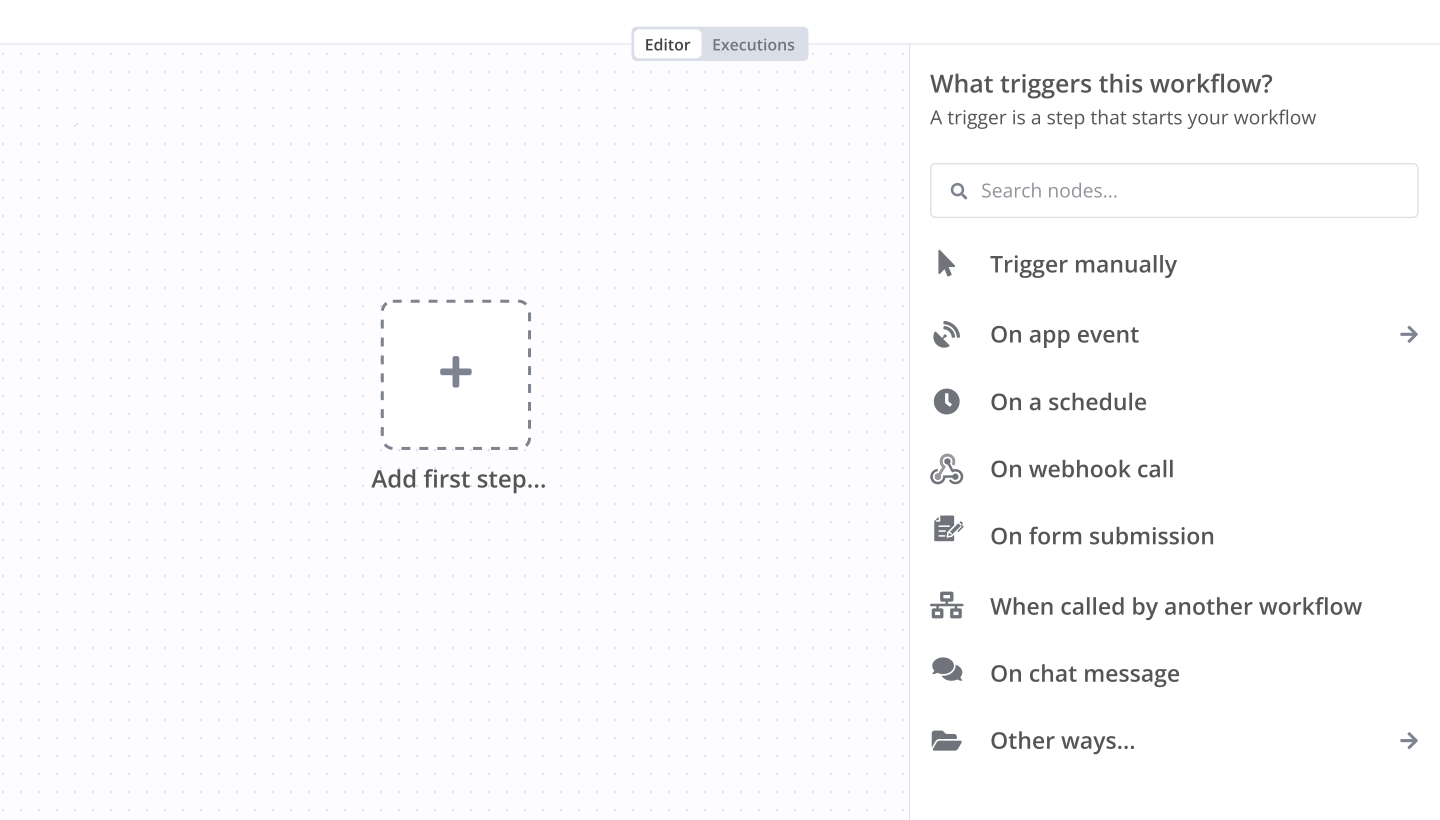
Step 1: Create a new workflow and add the first step

In n8n, click the "Add workflow" button in the Workflows tab to create a new workflow. Add the starting point – a trigger on when your workflow should run: an app event, a schedule, a webhook call, another workflow, an AI chat, or a manual trigger. Sometimes, the HTTP Request node might already serve as your starting point.

HTTP Request and Microsoft SharePoint integration: Create a new workflow and add the first step

Step 2: Add and configure HTTP Request and Microsoft SharePoint nodes

You can find HTTP Request and Microsoft SharePoint in the nodes panel. Drag them onto your workflow canvas, selecting their actions. Click each node, choose a credential, and authenticate to grant n8n access. Configure HTTP Request and Microsoft SharePoint nodes one by one: input data on the left, parameters in the middle, and output data on the right.

HTTP Request and Microsoft SharePoint integration: Add and configure HTTP Request and Microsoft SharePoint nodes

Step 3: Connect HTTP Request and Microsoft SharePoint

A connection establishes a link between HTTP Request and Microsoft SharePoint (or vice versa) to route data through the workflow. Data flows from the output of one node to the input of another. You can have single or multiple connections for each node.

HTTP Request and Microsoft SharePoint integration: Connect HTTP Request and Microsoft SharePoint

Step 4: Customize and extend your HTTP Request and Microsoft SharePoint integration

Use n8n's core nodes such as If, Split Out, Merge, and others to transform and manipulate data. Write custom JavaScript or Python in the Code node and run it as a step in your workflow. Connect HTTP Request and Microsoft SharePoint with any of n8n’s 1000+ integrations, and incorporate advanced AI logic into your workflows.

HTTP Request and Microsoft SharePoint integration: Customize and extend your HTTP Request and Microsoft SharePoint integration

Step 5: Test and activate your HTTP Request and Microsoft SharePoint workflow

Save and run the workflow to see if everything works as expected. Based on your configuration, data should flow from HTTP Request to Microsoft SharePoint or vice versa. Easily debug your workflow: you can check past executions to isolate and fix the mistake. Once you've tested everything, make sure to save your workflow and activate it.

HTTP Request and Microsoft SharePoint integration: Test and activate your HTTP Request and Microsoft SharePoint workflow

Track top social media trends with Reddit, Twitter, and GPT-4o to SP/Drive

Who’s it for
Content creators, marketers, journalists, and product teams who need a quick, automated snapshot of what the internet is talking about—served as a ready-to-use spreadsheet every morning.

How it works / What it does
Manual Trigger / Cron starts the flow.
Set Config picks today’s date and a topic keyword (default “Artificial Intelligence”).
API calls gather trend data:
• Reddit API → /r/artificial “hot” posts.
• Twitter (X) Trends via our own plemeo endpoint or any other social API.
(Add additional sources before the Merge Data node—Instagram, YouTube, TikTok, etc.)
Aggregate Content concatenates raw titles; AI Agent (GPT-4o) analyses them and returns the top 5 trends in JSON.
Prepare Excel formats each trend into rows; Create Excel turns them into an .xlsx file.
Upload the file to SharePoint (swap for Google Drive, Dropbox, S3—just replace the node).

How to set up
Import the template into n8n (cloud or self-hosted).
Create credentials: Reddit OAuth2, OpenAI, and your preferred storage (SharePoint, Drive, etc.).
In Set Config choose your default topic; adjust the cron schedule if required.
If you’re using Google Drive/Dropbox: delete the SharePoint node and add the corresponding upload node instead.
(Optional) Add more APIs—duplicate Merge Data inputs and map their results in Aggregate Content.
Save & activate. A spreadsheet called social-media-trends.xls appears in your target folder each run.

Requirements
n8n 1.33 +
Reddit app (OAuth2)
OpenAI account
One storage credential: SharePoint, Google Drive, Dropbox, or any other supported provider

How to customize
Change the number of trends: edit the limit in Aggregate Content and the prompt in AI Agent.
Want CSV instead of Excel? Swap Create Excel for Spreadsheet File → to File (CSV).
Push trends to Slack/Teams: branch after Prepare Excel and add a chat node.
Fully serverless? Trigger via webhook instead of manual/cron.

Nodes used in this workflow

Popular HTTP Request and Microsoft SharePoint workflows

Track Top Social Media Trends with Reddit, Twitter, and GPT-4o to SP/Drive

Who’s it for Content creators, marketers, journalists, and product teams who need a quick, automated snapshot of what the internet is talking about—served as a ready-to-use spreadsheet every morning. How it works / What it does Manual Trigger / Cron starts the flow. Set Config picks today’s date and a topic keyword (default “Artificial Intelligence”). API calls gather trend data: • Reddit API → /r/artificial “hot” posts. • Twitter (X) Trends via our own plemeo endpoint or any other social API. (Add additional sources before the Merge Data node—Instagram, YouTube, TikTok, etc.) Aggregate Content concatenates raw titles; AI Agent (GPT-4o) analyses them and returns the top 5 trends in JSON. Prepare Excel formats each trend into rows; Create Excel turns them into an .xlsx file. Upload the file to SharePoint (swap for Google Drive, Dropbox, S3—just replace the node). How to set up Import the template into n8n (cloud or self-hosted). Create credentials: Reddit OAuth2, OpenAI, and your preferred storage (SharePoint, Drive, etc.). In Set Config choose your default topic; adjust the cron schedule if required. If you’re using Google Drive/Dropbox: delete the SharePoint node and add the corresponding upload node instead. (Optional) Add more APIs—duplicate Merge Data inputs and map their results in Aggregate Content. Save & activate. A spreadsheet called social-media-trends.xls appears in your target folder each run. Requirements n8n 1.33 + Reddit app (OAuth2) OpenAI account One storage credential: SharePoint, Google Drive, Dropbox, or any other supported provider How to customize Change the number of trends: edit the limit in Aggregate Content and the prompt in AI Agent. Want CSV instead of Excel? Swap Create Excel for Spreadsheet File → to File (CSV). Push trends to Slack/Teams: branch after Prepare Excel and add a chat node. Fully serverless? Trigger via webhook instead of manual/cron.

Auto-Generate SEO Content from Trends with GPT-4o, FAL AI & Multi-Storage

Who's it for Content creators, SEO specialists, and marketing teams who want to automatically generate SEO-optimized content based on trending topics—complete with AI-generated images, optional videos, and ready-to-publish HTML. How it works / What it does Webhook receives a request with use case and video preferences. Get Trends XLSX downloads a spreadsheet (created by the Social Media Trends workflow) from SharePoint. Select Topic from Trends randomly picks one trending topic from the spreadsheet. AI Agent (GPT-4o) generates bilingual newsletter content about the selected trend. Get Newsletter Template fetches your HTML template; Build Newsletter injects the AI content. Optional creative assets: • Pollinations AI → generates a 1080 × 1350 image. • FAL AI → creates video from the image + Lyria2 audio → merged via FFmpeg. Gmail Approval sends the draft for review; continues only on approval. Upload all files (HTML + JPG + video URL) to your chosen storage provider. How to set up Import the template into n8n (cloud or self-hosted). Create credentials: OpenAI, Microsoft 365 (SharePoint), Gmail, and FAL AI. Upload your HTML newsletter template to SharePoint (see yellow sticky note for required placeholders). Ensure you have a trends spreadsheet (from the Social Media Trends workflow) in your SharePoint folder. Update Configuration Settings with your ENV_* variables. Activate the workflow and POST to the webhook: { "text": "usecase: blog post, include_video: true" }. Requirements n8n 1.33 + OpenAI account Microsoft 365 tenant (SharePoint) Gmail account FAL AI API Key (for video generation) A trends spreadsheet (from the Social Media Trends workflow) How to customize Change storage provider: replace SharePoint upload nodes with Google Drive, Dropbox, or S3. Modify topic selection: edit Select Topic from Trends for different selection logic. Adjust content tone: tweak the prompt in Prepare Newsletter Data. Skip video generation: set include_video: false in the webhook request.
+3

Bilingual Newsletters with GPT-4o, AI Images & Videos for HubSpot & SP

Who’s it for Marketing, growth, and automation teams that need to ship polished bilingual newsletters—complete with images, optional video, and multi-channel distribution—without writing a line of code. How it works / What it does A Webhook receives a plain-language request (e.g. “Create a newsletter about XYZ and store it in SharePoint”). The Webhook can be changed to another trigger, fr example Manual Trigger. An AI Agent (OpenAI GPT-4o) drafts German & English newsletter copy following a strict JSON schema. SharePoint fetches an HTML template; a Code node injects AI copy into the placeholders. Optional creative assets: Pollinations AI → image (resolution check & frame overlay) FAL AI → short video + Lyria2 audio → merged via FFmpeg API A Gmail Approval step sends the draft to an approver; the flow continues only on “Approve”. Depending on user intent the workflow: Emails the newsletter to HubSpot contacts, and/or Saves HTML (+ JPG/Video URL) to a SharePoint library. How to set up Import the template Open the yellow sticky note and follow the checklist Create credentials for OpenAI, HubSpot (App Token), Microsoft 365, Gmail, and FAL AI. Enter them in n8n Credential Manager (never in the HTTP node). Edit the Configuration Settings Set node with your ENV_* variables. Activate the workflow, copy the production Webhook URL, and trigger it with JSON body { "text": "…" } or with a desired trigger. Requirements OpenAI account Microsoft 365 tenant (SharePoint & Outlook) HubSpot App Token FAL AI API Key (video & audio generation) How to customize Want a different language? Tweak the AI prompt inside AI Agent. Want a different storage provider? Change the SharePoint nodes to Google Drive or Dropbox. Skip video generation: set include_video to false in the incoming prompt. Change the distribution logic by adjusting the WF Result Switch node. Add more channels (e.g. Slack) by inserting additional branches after the Switch and modifying the intent determination at the beginning of the workflow.
+5

Create weekly AI WordPress posts with images from SharePoint topics

AI Article Publisher — Scheduled WordPress Post from Topic List This workflow automatically generates and publishes a full-length, SEO-optimized WordPress article on a weekly schedule. Topics are sourced from a SharePoint list. The AI agent writes the article body with embedded inline images, generates a separate featured (hero) image, creates a WordPress draft, and sends a notification email when complete. How it works Schedule Trigger fires on a configurable schedule (default: every Monday at 10 AM) Get Topics pulls unposted items from a SharePoint list where PostID is null Fetch WP Categories retrieves all WordPress categories from your site Format Categories + Match Categories AI selects the best-fit category IDs for the topic Write Article (AI Agent + web search) writes a 1,500–2,500-word HTML article with 3–4 embedded inline images via the image tool Strip Code Fences + Generate Title clean the output and produce an SEO-optimized title Add Draft to WP creates the post as a draft in WordPress Generate Feature Image + Upload Image → Attach Featured Media sets the hero image on the post Update SharePoint PostID stamps the list item with the new WP Post ID to prevent re-processing Build Notification Email + Send Notification delivers a formatted HTML email summary to your team Setup WordPress credential**: Create an Application Password in WP Admin → Users → Profile. Set the WordPress API credential in all WordPress nodes. WordPress site URL**: Replace YOUR_WP_SITE_URL placeholder in HTTP Request nodes with your domain (e.g., https://yoursite.com). SharePoint credential: Add a Microsoft SharePoint OAuth2 credential and select your SharePoint site and list in the **Get Topics and Update SharePoint PostID nodes. OpenAI credential**: Add your OpenAI API key. GPT-4.1 (or GPT-4o) is recommended for the article agent; GPT-4.1-mini for category matching and title generation. Google Gemini credential: Required for the **Generate Feature Image node. Add a Google PaLM/Gemini API key. Image sub-workflow: The **Generate and Upload Image tool calls a separate image-generation sub-workflow. Deploy that workflow first and update the workflow ID in the tool node. Notification email: Replace YOUR_NOTIFICATION_EMAIL in the **Send Notification node with your email address. Customization Change status: 'draft' to 'publish' in Add Draft to WP to auto-publish articles. Adjust the article tone and CTA in the Write Article system prompt to match your brand voice. Swap the SharePoint list for a Google Sheet or Airtable by replacing the Get Topics and Update Record nodes. Visit automatedintelligentsolutions.com for more information and workflows.

Auto-like Tweets from Selected Profiles with Phantombuster & SharePoint AI Rotation

Who’s it for Growth hackers, community builders, and marketers who want to keep their Twitter (X) accounts active by liking posts from selected profiles automatically. How it works / What it does Schedule Trigger fires hourly. Profile Post Extractor fetches up to 20 tweets for each profile in your CSV. Select Cookie rotates Twitter session-cookies. Get Random Post checks against twitter_posts_already_liked.csv. Builds twitter_posts_to_like.csv, uploads to SharePoint. Phantombuster Autolike Agent likes the tweet. Logs the liked URL to avoid duplicates. How to set up Add Phantombuster + SharePoint credentials. In SharePoint “Phantombuster” folder: • twitter_session_cookies.txt • twitter_posts_already_liked.csv (header postUrl) • profiles_twitter.csv (list of profiles). Profile CSV format Your profiles_twitter.csv must contain a header profileUrl and direct links to the Twitter profiles. Example: profileUrl https://twitter.com/elonmusk https://twitter.com/openai

Automated Instagram Commenting on Selected Profiles with GPT-4o and Phantombuster

Who’s it for Influencers and social-media teams who want to comment automatically on posts from selected Instagram profiles—scaling engagement while staying within platform limits. How it works / What it does Schedule Trigger runs every 2 h. Profile Post Extractor fetches up to 20 posts per profile from your CSV. Select Cookie rotates Instagram session-cookies. Get Random Post selects one. Create Comment (GPT-4o) writes ≤150-character reply in your chosen language. Builds instagram_post_to_comment.csv, uploads to SharePoint. Phantombuster Autocomment Agent posts it. Logged in instagram_posts_already_commented.csv to prevent repeats. How to set up Same as the auto-liker, but also add instagram_posts_already_commented.csv (header postUrl). Define tracked profiles in profiles_instagram.csv. Configure comment prompt & language in Set ENV Variables. Profile CSV format Your profiles_instagram.csv must contain a header profileUrl and valid Instagram profile URLs. Example: profileUrl https://www.instagram.com/brand_account/ https://www.instagram.com/influencer123/

Build your own HTTP Request and Microsoft SharePoint integration

Create custom HTTP Request and Microsoft SharePoint workflows by choosing triggers and actions. Nodes come with global operations and settings, as well as app-specific parameters that can be configured. You can also use the HTTP Request node to query data from any app or service with a REST API.

Microsoft SharePoint supported actions

Download
Download a file
Update
Update a file
Upload
Upload an existing file
Create
Create an item in an existing list
Create or Update
Create a new item, or update the current one if it already exists (upsert)
Delete
Delete an item from a list
Get
Retrieve an item from a list
Get Many
Get specific items in a list or list many items
Update
Update an item in an existing list
Get
Retrieve details of a single list
Get Many
Retrieve a list of lists
Use case

Save engineering resources

Reduce time spent on customer integrations, engineer faster POCs, keep your customer-specific functionality separate from product all without having to code.

Learn more

FAQs

  • Can HTTP Request connect with Microsoft SharePoint?

  • Can I use HTTP Request’s API with n8n?

  • Can I use Microsoft SharePoint’s API with n8n?

  • Is n8n secure for integrating HTTP Request and Microsoft SharePoint?

  • How to get started with HTTP Request and Microsoft SharePoint integration in n8n.io?

Need help setting up your HTTP Request and Microsoft SharePoint integration?

Discover our latest community's recommendations and join the discussions about HTTP Request and Microsoft SharePoint integration.
Moiz Contractor
theo
Jon
Dan Burykin
Tony

Looking to integrate HTTP Request and Microsoft SharePoint in your company?

Over 3000 companies switch to n8n every single week

Why use n8n to integrate HTTP Request with Microsoft SharePoint

Build complex workflows, really fast

Build complex workflows, really fast

Handle branching, merging and iteration easily.
Pause your workflow to wait for external events.

Code when you need it, UI when you don't

Simple debugging

Your data is displayed alongside your settings, making edge cases easy to track down.

Use templates to get started fast

Use 1000+ workflow templates available from our core team and our community.

Reuse your work

Copy and paste, easily import and export workflows.

Implement complex processes faster with n8n

red iconyellow iconred iconyellow icon