Back to Integrations
integrationHTTP Request node
integrationWebflow node

HTTP Request and Webflow integration

Save yourself the work of writing custom integrations for HTTP Request and Webflow and use n8n instead. Build adaptable and scalable Development, Core Nodes, and Marketing workflows that work with your technology stack. All within a building experience you will love.

How to connect HTTP Request and Webflow

  • Step 1: Create a new workflow
  • Step 2: Add and configure nodes
  • Step 3: Connect
  • Step 4: Customize and extend your integration
  • Step 5: Test and activate your workflow

Step 1: Create a new workflow and add the first step

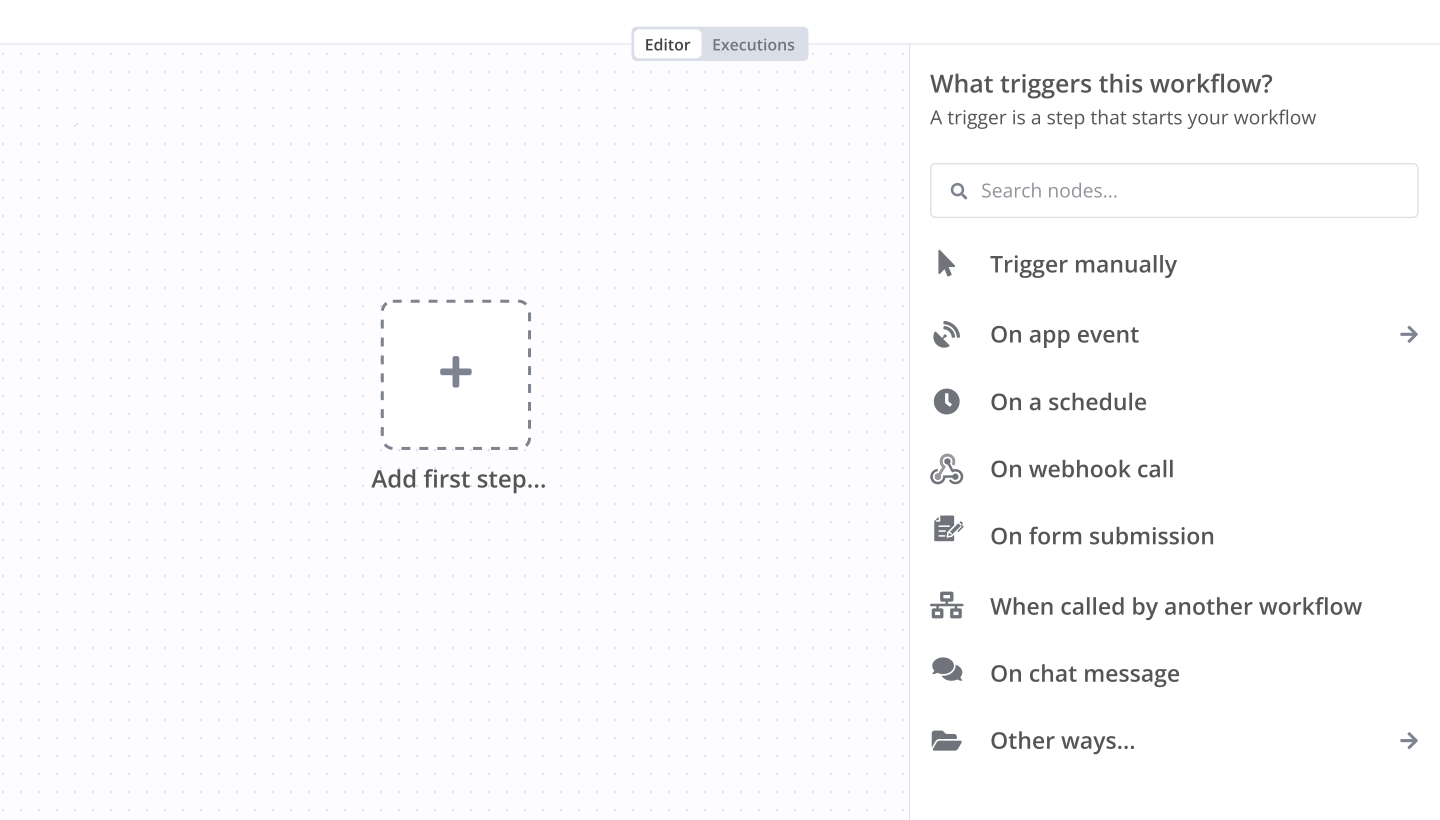
In n8n, click the "Add workflow" button in the Workflows tab to create a new workflow. Add the starting point – a trigger on when your workflow should run: an app event, a schedule, a webhook call, another workflow, an AI chat, or a manual trigger. Sometimes, the HTTP Request node might already serve as your starting point.

HTTP Request and Webflow integration: Create a new workflow and add the first step

Step 2: Add and configure HTTP Request and Webflow nodes

You can find HTTP Request and Webflow in the nodes panel. Drag them onto your workflow canvas, selecting their actions. Click each node, choose a credential, and authenticate to grant n8n access. Configure HTTP Request and Webflow nodes one by one: input data on the left, parameters in the middle, and output data on the right.

HTTP Request and Webflow integration: Add and configure HTTP Request and Webflow nodes

Step 3: Connect HTTP Request and Webflow

A connection establishes a link between HTTP Request and Webflow (or vice versa) to route data through the workflow. Data flows from the output of one node to the input of another. You can have single or multiple connections for each node.

HTTP Request and Webflow integration: Connect HTTP Request and Webflow

Step 4: Customize and extend your HTTP Request and Webflow integration

Use n8n's core nodes such as If, Split Out, Merge, and others to transform and manipulate data. Write custom JavaScript or Python in the Code node and run it as a step in your workflow. Connect HTTP Request and Webflow with any of n8n’s 1000+ integrations, and incorporate advanced AI logic into your workflows.

HTTP Request and Webflow integration: Customize and extend your HTTP Request and Webflow integration

Step 5: Test and activate your HTTP Request and Webflow workflow

Save and run the workflow to see if everything works as expected. Based on your configuration, data should flow from HTTP Request to Webflow or vice versa. Easily debug your workflow: you can check past executions to isolate and fix the mistake. Once you've tested everything, make sure to save your workflow and activate it.

HTTP Request and Webflow integration: Test and activate your HTTP Request and Webflow workflow

Enrich FAQ sections on your website pages at scale with AI

This n8n workflow template lets you easily generate comprehensive FAQ (Frequently Asked Questions) content for multiple services (or any items or pages you need to add the FAQs to). Simply provide the Google Sheets document containing the items to scrape, and the workflow automatically creates detailed, AI-enhanced FAQ documents.

How it works
The workflow reads data from a Google Sheets document containing information about different services and categories (again, in your case - whatever objects you need).
For each service and category, it generates a set of standard questions and answers covering setup, permissions, integrations, use cases, and pricing benefits.
An AI model (OpenAI's GPT) is used to enhance or complete some of the answers, making the content more comprehensive and natural-sounding.
The workflow formats the Q&A pairs, combining AI-generated content with predefined answers where applicable.
It creates a text file (JSON) for each service or category, containing the formatted Q&A pairs.
The generated files are saved to specific folders in Google Drive, organized by the type of integration (native, credential-only, non-native) or category.
After processing each service or category, it updates the status in the original Google Sheets document to mark it as completed.

Ideal for:
Marketing teams: Rapidly create comprehensive FAQ documents for multiple products or services.
Customer support: Generate consistent and detailed answers for common customer queries.
Product managers: Easily maintain up-to-date documentation as products evolve.
Content creators: Streamline the process of creating informative content about various offerings.

Accounts required
Google account (for Google Sheets and Google Drive)
OpenAI API account (for AI-enhanced content generation)
n8n.io account (for workflow execution)

Set up instructions
Set up the required credentials for Google Sheets, Google Drive, and OpenAI when you first open the workflow.
Prepare your Google Sheets document with the service/category information. Here's an example of Google Sheet.
Fill the "Define Sheets" node with your sheets
Adjust the folder IDs in the "Prepare Job" node to match your Google Drive structure.
Configure the OpenAI model settings in the "OpenAI Chat Model" node if needed.
Test the workflow with a small subset of data before running it on your entire dataset.
Adjust the questions asked in the "Create your Q&A templates" section
After testing, activate your workflow for automated FAQ generation.

🙏 Big, big kudos to Jim Le for his ideas, input and support when building this workflow. Your approach to AI workflows is always super helpful!

Nodes used in this workflow

Popular HTTP Request and Webflow workflows

+5

Generate & Publish SEO Articles with Claude AI, Webflow & Image Generation

**Content engine that ships fresh, SEO-ready articles every single day. ** Workflow: ⸻ Layout Blueprint • Purpose: Define content structure before writing begins. • What’s Included: • Search intent mapping • Internal link planning • Call-to-action (CTA) placement • Benefit: Ensures consistency, SEO alignment, and content goals are baked in early. ⸻ AI-Assisted Drafting • Tool: GPT generates the first draft. • Editor’s Role: • Focus on depth and accuracy • Align tone and style with existing site content • Context-Aware: Pulls insights from top-ranking articles already live on the site. ⸻ SEO Validation • Automated Checks for: • Keyword coverage • Readability scoring • Schema markup • Internal/external link quality • Outcome: Each piece is validated before hitting publish. ⸻ Media Production • Process: AI auto-generates relevant images. • Delivery: Visual assets are automatically added to the CMS library. ⸻ Optional Human Review: Team feedback via Slack or Teams if needed. ⸻ Automated Publishing • Action: Instantly publishes content to Webflow once approved. • Result: A fully streamlined pipeline from draft to live with minimal manual steps.
+5

Generate SEO blog posts from a keyword list and publish to Webflow

Who's it for Content marketers and SEO specialists who need to generate multiple SEO-optimized articles targeting keyword variations. Ideal for affiliate sites, niche blogs, or service-based businesses creating location/product-specific landing pages. How it works This workflow automates bulk content creation from keyword list to Webflow draft: Loads keywords from Google Sheets with structured format (main keyword + slug) AI generates articles - Creates 600+ word content following SEO best practices Creates custom images - Calls a sub-workflow using Gemini 2.5 Flash to generate relevant featured images Quality validation - Ensures minimum word count; expands content if needed HTML conversion - Transforms markdown to Webflow-ready HTML Result tracking - Logs success/errors to separate Google Sheets The workflow includes automatic content expansion, error handling, and uses a separate sub-workflow as a tool for AI image generation. Important: The subworkflow should be created as an individual one. Then, in the Agent Tool node, you need to select it as the tool. DON'T try to run it inside the same workflow. Requirements OpenAI API key (for content generation) OpenRouter API key or similar (for Gemini image generation via sub-workflow) Google Sheets with three tabs: keywords, content_created, webflow_error_logs Webflow site with CMS collection configured Google Drive folder for image storage Companion workflow**: "AI image generation for automatic content creation" (imported separately and called as a tool) How to set up Import both workflows separately: Main workflow: "Bulk SEO content generation and Webflow draft creation with AI images" Sub-workflow: "AI image generation for automatic content creation" Configure your Google Sheet with the recommended structure Required sheets: keywords: id, main keyword, head terms, modifiers, slug, status content_created: id, slug, meta description, content, generatedAt, updated on webflow_error_logs: keyword, error, timestamp, status Add API credentials: OpenAI API OpenRouter API with Gemini access or similar (for image generation) Webflow OAuth2 API (see Webflow setup instructions in sticky note) Google Sheets Google Drive Update workflow configuration: Google Sheets: Update document IDs in all Google Sheets nodes Webflow: Set your Site ID and Collection ID in Create/Update Post nodes Google Drive: Set folder ID in the image generation sub-workflow AI Image Tool: Verify the "AI Image Generation Tool1" node points to your imported sub-workflow Test with a single keyword: Schedule for production: Enable the Schedule Trigger (currently set to monthly) How to customize Content customization: Adjust article length in AI Agent prompt (currently 600-800 words) Modify article structure/sections in the system prompt Change content tone by editing the AI Agent system message Add/remove content sections in the prompt template Image customization: Change AI model in sub-workflow (currently Gemini 2.5 Flash) Modify image style/prompt in the AI Image Generation Tool parameters Update Google Drive destination folder Webflow customization: Add custom CMS fields by updating Create/Update Post nodes Modify field mappings to match your Webflow collection structure Change draft behavior or add auto-publish logic Workflow behavior: Adjust batch size in Loop Over Items node Modify quality threshold (currently 600 words minimum) Change error handling/retry logic Update scheduling frequency in Schedule Trigger
+3

Enrich FAQ sections on your website pages at scale with AI

This n8n workflow template lets you easily generate comprehensive FAQ (Frequently Asked Questions) content for multiple services (or any items or pages you need to add the FAQs to). Simply provide the Google Sheets document containing the items to scrape, and the workflow automatically creates detailed, AI-enhanced FAQ documents. How it works The workflow reads data from a Google Sheets document containing information about different services and categories (again, in your case - whatever objects you need). For each service and category, it generates a set of standard questions and answers covering setup, permissions, integrations, use cases, and pricing benefits. An AI model (OpenAI's GPT) is used to enhance or complete some of the answers, making the content more comprehensive and natural-sounding. The workflow formats the Q&A pairs, combining AI-generated content with predefined answers where applicable. It creates a text file (JSON) for each service or category, containing the formatted Q&A pairs. The generated files are saved to specific folders in Google Drive, organized by the type of integration (native, credential-only, non-native) or category. After processing each service or category, it updates the status in the original Google Sheets document to mark it as completed. Ideal for: Marketing teams: Rapidly create comprehensive FAQ documents for multiple products or services. Customer support: Generate consistent and detailed answers for common customer queries. Product managers: Easily maintain up-to-date documentation as products evolve. Content creators: Streamline the process of creating informative content about various offerings. Accounts required Google account (for Google Sheets and Google Drive) OpenAI API account (for AI-enhanced content generation) n8n.io account (for workflow execution) Set up instructions Set up the required credentials for Google Sheets, Google Drive, and OpenAI when you first open the workflow. Prepare your Google Sheets document with the service/category information. Here's an example of Google Sheet. Fill the "Define Sheets" node with your sheets Adjust the folder IDs in the "Prepare Job" node to match your Google Drive structure. Configure the OpenAI model settings in the "OpenAI Chat Model" node if needed. Test the workflow with a small subset of data before running it on your entire dataset. Adjust the questions asked in the "Create your Q&A templates" section After testing, activate your workflow for automated FAQ generation. 🙏 Big, big kudos to Jim Le for his ideas, input and support when building this workflow. Your approach to AI workflows is always super helpful!

Manage Webflow form submissions in Airtable

What this does This automation will create tables in your Airtable base and send Webflow form submissions as records in those tables. It keeps track of your Webflow forms with a Form Index table to ensure that form content does not get sent to the wrong table if you have Webflow forms with identical names. This is useful for Enhancing your Webflow form submission management. By sending structured data to your Airtable base you can do more with your Webflow forms. Usage guide Full written and video guide This automation is made to be as low effort as possible to start enhancing your Webflow forms. Simply create credentials for Webflow and a Personal Access Token for your Airtable base and connect them to the relevant nodes. The guide demonstrates a realworld example using a Webflow template and breaksdown the flow and logic for all the nodes.

Build your own HTTP Request and Webflow integration

Create custom HTTP Request and Webflow workflows by choosing triggers and actions. Nodes come with global operations and settings, as well as app-specific parameters that can be configured. You can also use the HTTP Request node to query data from any app or service with a REST API.

Webflow supported actions

Create
Delete
Get
Get Many
Update
Use case

Save engineering resources

Reduce time spent on customer integrations, engineer faster POCs, keep your customer-specific functionality separate from product all without having to code.

Learn more
Use case

Automate lead management

Using too many marketing tools? n8n lets you orchestrate all your apps into one cohesive, automated workflow.

Learn more

FAQs

  • Can HTTP Request connect with Webflow?

  • Can I use HTTP Request’s API with n8n?

  • Can I use Webflow’s API with n8n?

  • Is n8n secure for integrating HTTP Request and Webflow?

  • How to get started with HTTP Request and Webflow integration in n8n.io?

Need help setting up your HTTP Request and Webflow integration?

Discover our latest community's recommendations and join the discussions about HTTP Request and Webflow integration.
Georgy Alaverdyan
Moiz Contractor
theo
Jon
Dan Burykin

Looking to integrate HTTP Request and Webflow in your company?

Over 3000 companies switch to n8n every single week

Why use n8n to integrate HTTP Request with Webflow

Build complex workflows, really fast

Build complex workflows, really fast

Handle branching, merging and iteration easily.
Pause your workflow to wait for external events.

Code when you need it, UI when you don't

Simple debugging

Your data is displayed alongside your settings, making edge cases easy to track down.

Use templates to get started fast

Use 1000+ workflow templates available from our core team and our community.

Reuse your work

Copy and paste, easily import and export workflows.

Implement complex processes faster with n8n

red iconyellow iconred iconyellow icon