Back to Integrations
integrationHTTP Request node
integrationWooCommerce node

HTTP Request and WooCommerce integration

Save yourself the work of writing custom integrations for HTTP Request and WooCommerce and use n8n instead. Build adaptable and scalable Development, Core Nodes, and Sales workflows that work with your technology stack. All within a building experience you will love.

How to connect HTTP Request and WooCommerce

  • Step 1: Create a new workflow
  • Step 2: Add and configure nodes
  • Step 3: Connect
  • Step 4: Customize and extend your integration
  • Step 5: Test and activate your workflow

Step 1: Create a new workflow and add the first step

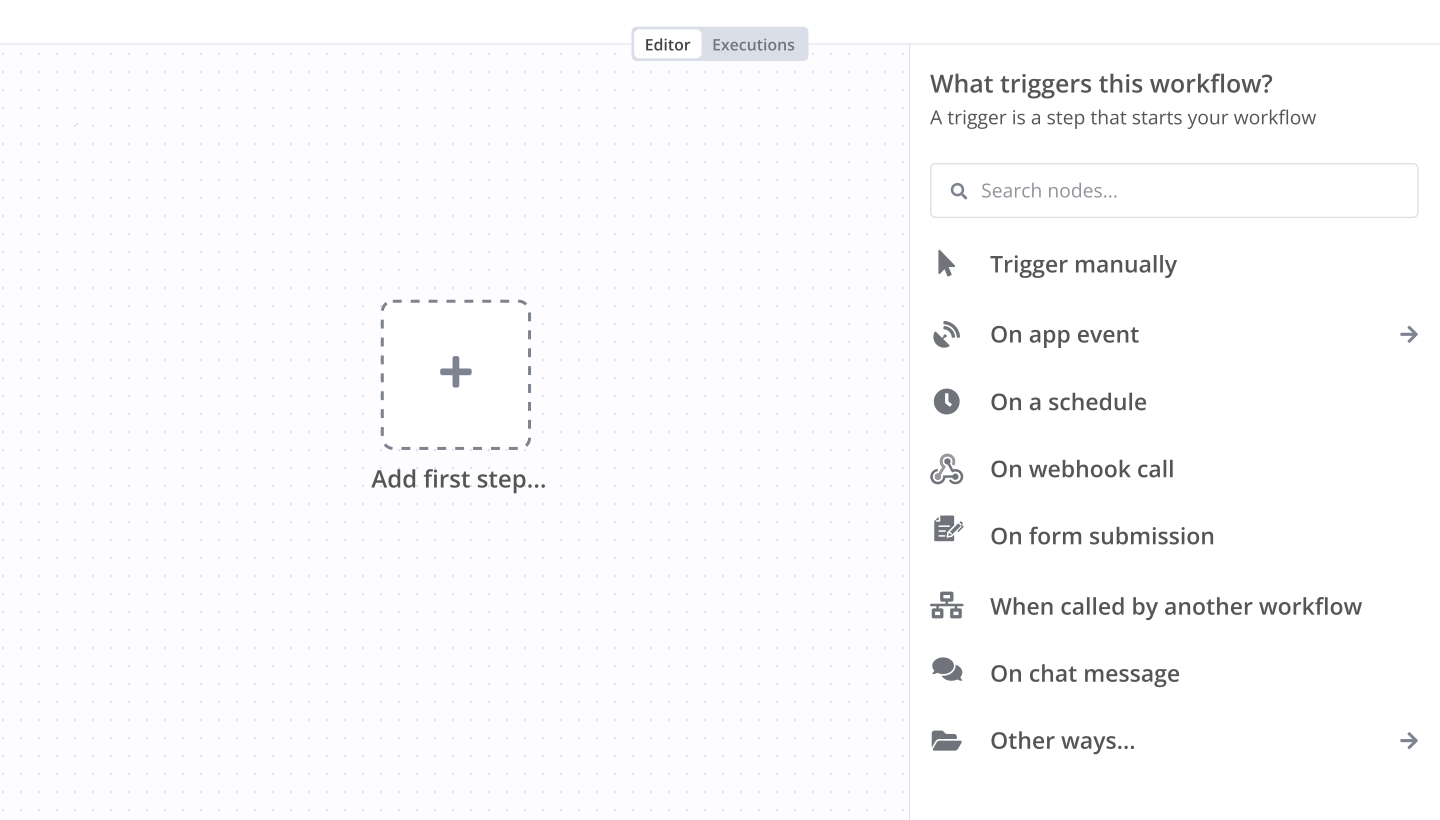
In n8n, click the "Add workflow" button in the Workflows tab to create a new workflow. Add the starting point – a trigger on when your workflow should run: an app event, a schedule, a webhook call, another workflow, an AI chat, or a manual trigger. Sometimes, the HTTP Request node might already serve as your starting point.

HTTP Request and WooCommerce integration: Create a new workflow and add the first step

Step 2: Add and configure HTTP Request and WooCommerce nodes

You can find HTTP Request and WooCommerce in the nodes panel. Drag them onto your workflow canvas, selecting their actions. Click each node, choose a credential, and authenticate to grant n8n access. Configure HTTP Request and WooCommerce nodes one by one: input data on the left, parameters in the middle, and output data on the right.

HTTP Request and WooCommerce integration: Add and configure HTTP Request and WooCommerce nodes

Step 3: Connect HTTP Request and WooCommerce

A connection establishes a link between HTTP Request and WooCommerce (or vice versa) to route data through the workflow. Data flows from the output of one node to the input of another. You can have single or multiple connections for each node.

HTTP Request and WooCommerce integration: Connect HTTP Request and WooCommerce

Step 4: Customize and extend your HTTP Request and WooCommerce integration

Use n8n's core nodes such as If, Split Out, Merge, and others to transform and manipulate data. Write custom JavaScript or Python in the Code node and run it as a step in your workflow. Connect HTTP Request and WooCommerce with any of n8n’s 1000+ integrations, and incorporate advanced AI logic into your workflows.

HTTP Request and WooCommerce integration: Customize and extend your HTTP Request and WooCommerce integration

Step 5: Test and activate your HTTP Request and WooCommerce workflow

Save and run the workflow to see if everything works as expected. Based on your configuration, data should flow from HTTP Request to WooCommerce or vice versa. Easily debug your workflow: you can check past executions to isolate and fix the mistake. Once you've tested everything, make sure to save your workflow and activate it.

HTTP Request and WooCommerce integration: Test and activate your HTTP Request and WooCommerce workflow

AI-powered WooCommerce Support-Agent

With this workflow you get a fully automated AI powered Support-Agent for your WooCommerce webshop. It allows customers to request information about things like:
the status of their order
the ordered products
shipping and billing address
current DHL shipping status

How it works

The workflow receives chat messages from an in a website integrated chat. For security and data-privacy reasons, does the website transmit the email address of the user encrypted with the requests. That ensures that user can just request the information about their own orders.

An AI agent with a custom tool supplies the needed information. The tool calls a sub-workflow (in this case, in the same workflow for convenience) to retrieve the required information. This includes the full information of past orders plus the shipping information from DHL.
If otherr shipping providers are used it should be simple to adjust the workflow to query information from other APIs like UPS, Fedex or others.

Nodes used in this workflow

Popular HTTP Request and WooCommerce workflows

Auto-Generate Virtual AI Try-On Images for WooCommerce with Gemini Nano Banana

This workflow automates the creation of AI-generated virtual try-on images for fashion eCommerce stores. Instead of relying on expensive and time-consuming photoshoots, the system uses AI to generate realistic images of models wearing selected clothing items. This n8n workflow automates the process of generating AI-powered virtual try-on images for a WooCommerce store. It fetches product data from a Google Sheet, uses the Fal.ai Nano Banana model to create an image of a model wearing the clothing item, and then updates both the Google Sheet and the WooCommerce product with the final generated image. Advantages ✅ Cost Reduction: Eliminates the need for professional photo shoots, saving on models, photographers, and studio expenses. ✅ Time Efficiency: Automates the entire workflow—from data input to product update—minimizing manual work. ✅ Scalability: Works seamlessly across large product catalogs, making it easy to update hundreds of products quickly. ✅ Enhanced eCommerce Experience: Provides shoppers with realistic previews of clothing on models, boosting trust and conversion rates. ✅ Marketing Flexibility: The generated images can also be repurposed for ads, social media, and promotional campaigns. ✅ Centralized Management: Google Sheets acts as the control center, making it easy to manage inputs and track results. How It Works The workflow operates in a sequential, loop-based manner to process multiple products from a spreadsheet. Here is the logical flow: Manual Trigger & Data Fetch: The workflow starts manually (e.g., by clicking "Test workflow"). It first reads data from a specified Google Sheet, looking for rows where the "IMAGE RESULT" column is empty. Loop Processing: It loops over each row of data fetched from the sheet. Each row should contain URLs for a model image and a product image, along with a WooCommerce product ID. API Request to Generate Image: For each item in the loop, the workflow sends a POST request to the Fal.ai Nano Banana API. The request includes the two image URLs and a prompt instructing the AI to create a photo of the model wearing the submitted clothing item. Polling for Completion: The AI processing is asynchronous. The workflow enters a polling loop: it waits for 60 seconds and then checks the status of the processing request. If the status is not COMPLETED, it waits and checks again. This loop continues until the image is ready. Fetching and Storing the Result: Once the status is COMPLETED, the workflow retrieves the URL of the generated image, downloads the image file, and uploads it to a designated folder in Google Drive. Updating Systems: The workflow then performs two crucial update steps: It updates the original Google Sheet row, writing the URL of the final generated image into the "IMAGE RESULT" column. It updates the corresponding product in WooCommerce, adding the generated image to the product's gallery. Loop Continuation: After processing one item, the workflow loops back to process the next row in the Google Sheet until all items are complete. Set Up Steps* To make this workflow functional, you need to configure three main connections: Step 1: Prepare the Google Sheet Create a Google Sheet with the following columns: IMAGE MODEL, IMAGE PRODUCT, PRODUCT ID, and IMAGE RESULT. Populate the first three columns for each product. The IMAGE RESULT column must be left blank; the workflow will fill it automatically. In the n8n workflow, configure the "Google Sheets" node to point to your specific Google Sheet and worksheet. Step 2: Configure the Fal.ai API Key Create an account at fal.ai and obtain your API key. In the n8n workflow, locate the three "HTTP Request" nodes named "Get Url image", "Get status", and "Create Image". Edit the credentials for these nodes (named "Fal.run API") and update the Value field in the Header Auth to be Key YOURAPIKEY (replacing YOURAPIKEY with your actual key). Step 3: Set Up WooCommerce API Ensure you have the API keys (Consumer Key and Consumer Secret) for your WooCommerce store's REST API. In the n8n workflow, locate the "WooCommerce" node. Edit its credentials and provide the required information: your store's URL and the API keys. This allows the workflow to authenticate and update your products. Need help customizing? Contact me for consulting and support or add me on Linkedin.

Automate WooCommerce Image Product Background Removal using API and Google Sheet

This workflow automates the process of removing backgrounds from WooCommerce product images using the BackgroundCut API, and then updates the product images in both WooCommerce and a Google Sheet. Once set up, the workflow processes product images in bulk, removing backgrounds and updating WooCommerce seamlessly. This workflow is perfect for online stores that sell: Clothing and fashion items Jewelry and accessories General consumer products Any product that benefits from clean, background-free images for a professional storefront presentation will see improved visual appeal and potentially higher conversions. Benefits ⏱ Time-saving:** Automates what would otherwise be a manual and repetitive task of editing images and updating product listings. 🔄 Fully Integrated:** Connects Google Sheets, BackgroundCut API, FTP server, and WooCommerce in a seamless loop. 📦 Scalable:** Supports batch processing, making it suitable for stores with hundreds of products. 📁 Organized Tracking:** Updates the Google Sheet with the new image and a “DONE” flag for easy monitoring. 🔧 Customizable:** You can change the image processing API, storage server, or eCommerce platform if needed. How It Works Data Retrieval: The workflow starts by fetching product data (ID and IMAGE URL) from a Google Sheets document. Only rows without a "DONE" marker are processed to avoid duplicates. Background Removal: Each product image URL is sent to the BackgroundCut API, which removes the background and returns the edited image. File Handling: The processed image is uploaded to an FTP server with the original filename preserved. A new URL for the edited image is generated and assigned to the product. WooCommerce Update: The product in WooCommerce is updated with the new image URL. Sheet Update: The Google Sheet is marked as "DONE" for the processed row, and the new image URL is recorded. Batch Processing: The workflow loops through all rows in the sheet until all products are processed. Set Up Steps Prepare the Google Sheet: Clone the provided Google Sheet template. Fill in the ID (product ID) and IMAGE (original image URL) columns. API & Credentials Setup: Get an API key from BackgroundCut.co. Configure the HTTP Request node ("Remove from Image URL") with: Header Auth: Authorization = API_KEY. Set up WooCommerce API credentials in the "Update product" node. FTP Configuration: Replace YOUR_FTP_URL in the "New Image Url" node with your FTP/CDN base URL. Ensure FTP credentials are correctly set in the FTP node. Execution: Run the workflow manually via "When clicking ‘Execute workflow’". The process automatically handles background removal, file upload, and WooCommerce updates. Need help customizing? Contact me for consulting and support or add me on Linkedin.

Send WooCommerce Cross-Sell Offers to Customers via WhatsApp Using Rapiwa API

Who Is This For? This n8n workflow enables automated cross-selling by identifying each WooCommerce customer's most frequently purchased product, finding a related product to recommend, and sending a personalized WhatsApp message using the Rapiwa API. It also verifies whether the user's number is WhatsApp-enabled before sending, and logs both successful and unsuccessful attempts to Google Sheets for tracking. What This Workflow Does Retrieves all paying customers from your WooCommerce store Identifies each customer's most purchased product Finds the latest product in the same category as their most purchased item Cleans and verifies customer phone numbers for WhatsApp compatibility Sends personalized WhatsApp messages with product recommendations Logs all activities to Google Sheets for tracking and analysis Handles both verified and unverified numbers appropriately Key Features Customer Segmentation:** Automatically identifies paying customers from your WooCommerce store Product Analysis:** Determines each customer's most purchased product Smart Recommendations:** Finds the latest products in the same category as customer favorites WhatsApp Integration:** Uses Rapiwa API for message delivery Phone Number Validation:** Verifies WhatsApp numbers before sending messages Dual Logging System:** Tracks both successful and failed message attempts in Google Sheets Rate Limiting:** Uses batching and wait nodes to prevent API overload Personalized Messaging:** Includes customer name and product details in messages Requirements WooCommerce store with API access Rapiwa account with API access for WhatsApp verification and messaging Google account with Sheets access Customer phone numbers in WooCommerce (stored in billing.phone field) How to Use — Step-by-Step Setup Credentials Setup WooCommerce API: Configure WooCommerce API credentials in n8n (e.g., "WooCommerce (get customer)" and "WooCommerce (get customer data)") Rapiwa Bearer Auth: Create an HTTP Bearer credential with your Rapiwa API token Google Sheets OAuth2: Set up OAuth2 credentials for Google Sheets access Configure Google Sheets Ensure your sheet has the required columns as specified in the Google Sheet Column Structure section Verify Code Nodes Code (get paying_customer): Filters customers to include only those who have made purchases Get most buy product id & Clear Number: Identifies the most purchased product and cleans phone numbers Configure HTTP Request Nodes Get customer data: Verify the WooCommerce API endpoint for retrieving customer orders Get specific product data: Verify the WooCommerce API endpoint for product details Get specific product recommend latest product: Verify the WooCommerce API endpoint for finding latest products by category Check valid WhatsApp number Using Rapiwa: Verify the Rapiwa endpoint for WhatsApp number validation Rapiwa Sender: Verify the Rapiwa endpoint for sending messages Google Sheet Required Columns You’ll need two Google Sheets (or two tabs in one spreadsheet): A Google Sheet formatted like this ➤ sample The workflow uses a Google Sheet with the following columns to track coupon distribution: Both must have the following headers (match exactly): | name | number | email | address1 | price | suk | title | product link | validity | staus | | ---------- | ------------- | ----------------------------------------------- | ----------- | ----- | --- | ---------------------------------- | ------------------------------------------------------------------------------------------------------------------------------------------------------ | ---------- | -------- | | Abdul Mannan | 8801322827799 | [email protected] | mirpur dohs | 850 | | Sharp Most Demanding Hoodie x Nike | https://your_shop_domain/p-img-nike | verified | sent | | Abdul Mannan | 8801322827799 | [email protected] | mirpur dohs | 850 | | Sharp Most Demanding Hoodie x Nike | https://your_shop_domain/p-img-nike | unverified | not sent | | Abdul Mannan | 8801322827799 | [email protected] | mirpur dohs | 850 | | Sharp Most Demanding Hoodie x Nike | https://your_shop_domain/p-img-nike | verified | sent | Important Notes Phone Number Format:** The workflow cleans phone numbers by removing all non-digit characters. Ensure your WooCommerce phone numbers are in a compatible format. API Rate Limits:** Rapiwa and WooCommerce APIs have rate limits. Adjust batch sizes and wait times accordingly. Data Privacy:** Ensure compliance with data protection regulations when sending marketing messages. Error Handling:** The workflow logs unverified numbers but doesn't have extensive error handling. Consider adding error notifications for failed API calls. Product Availability:** The workflow recommends the latest product in a category, but doesn't check if it's in stock. Consider adding stock status verification. Testing:** Always test with a small batch before running the workflow on your entire customer list. Useful Links Dashboard:** https://app.rapiwa.com Official Website:** https://rapiwa.com Documentation:** https://docs.rapiwa.com Support & Help WhatsApp**: Chat on WhatsApp Discord**: SpaGreen Community Facebook Group**: SpaGreen Support Website**: https://spagreen.net Developer Portfolio**: Codecanyon SpaGreen

Send WooCommerce New Category Alert via WhatsApp Using Rapiwa API

Send WooCommerce New Category Alert via WhatsApp Using Rapiwa API This n8n automation listens for the creation of a new WooCommerce product category, fetches all WooCommerce customers, cleans and formats their phone numbers, verifies them using the Rapiwa WhatsApp validation API, sends a WhatsApp message to verified numbers with the new category info, and logs each interaction into a Google Sheet (separately for verified and unverified customers). Who this is for You have a WooCommerce store and want to: Send a promotional message when a new product category is added, Verify customer WhatsApp numbers in bulk, Keep a clear log in Google Sheets of which numbers are verified or not. What it does (high level) Webhook is triggered when a new WooCommerce category is created. Fetches all WooCommerce customers via API. Limits processing to the first 10 customers (for performance/testing). Cleans phone numbers (removes +, spaces, and non-digits). Verifies each number via Rapiwa WhatsApp Verify API. If verified: sends WhatsApp message with new category info, logs as Verification = verified, Status = sent. If not verified: logs as Verification = unverified, Status = not sent. Processes users in batches with delays to avoid rate limiting. How it works (step-by-step) Trigger**: Webhook node is triggered by WooCommerce category creation. Format Data**: Category details (name, slug, description) are parsed. Get Customers**: Fetch all WooCommerce customers using the WooCommerce API. Limit**: Only the first 10 are processed. Loop & Clean**: Loop over each customer, clean phone numbers and extract info. Verify Number**: Send HTTP POST to https://app.rapiwa.com/api/verify-whatsapp. Decision Node**: Use If node to check if exists == true. Send Message**: If verified, send WhatsApp message with category details. Append to Sheet**: Log verified and unverified customers separately in Google Sheets. Wait + Batch Control**: Use Wait and SplitInBatches nodes to control flow and prevent throttling. Example verify body (HTTP Request node): { ""number"": ""{{ $json['WhatsApp No'] }}"" } Google Sheet Column Reference | name | number | email | address | catagoris | description | status | |-------------|---------------|------------------------------|------------------------------------------------------|-------------|-------------------------------------------------------------------------------------------------|------------| | Abdul Mannan | 8801322827799 | [email protected] | mirpur dohs | Electronics | SShop top-braxxxxrable tech. | unverified | | Abdul Mannan | 8801322827799 | [email protected] | mirpur dohs | Electronics | Shop top-braxxxxrable tech. | verified | | Abdul Mannan | 8801322827799 | [email protected] | mirpur doh | Electronics | Shop top-braxxxxrable tech. | verified | Customization ideas Send images, videos, or template messages if supported by Rapiwa. Personalize messages using name or category data. Increase delay or reduce batch size to minimize risk of rate limits. Add a second sheet to log full API responses for debugging and auditing. Best practices Test on small batches before scaling. Only send messages to users who opted in. Store API credentials securely using n8n’s credentials manager. Ensure your Google Sheet column headers match exactly with what's expected. Key Improvements Made Clarified the trigger source as a Webhook from WooCommerce category creation. Fixed inconsistency in the ""What it does"" section (originally referenced reading from Google Sheets, but your workflow starts from WooCommerce, not Sheets). Standardized terminology to match n8n nodes: Webhook, Loop, HTTP Request, etc. Aligned the flow exactly with your nodes: Webhook → Format → Get Customers → Limit → Loop → Clean → Verify → If → Send/Log → Wait → Repeat Useful Links Dashboard:** https://app.rapiwa.com Official Website:** https://rapiwa.com Documentation:** https://docs.rapiwa.com Support WhatsApp Support: Chat Now Discord: Join SpaGreen Community Facebook Group: SpaGreen Support Website: https://spagreen.net Developer Portfolio: Codecanyon SpaGreen "

AI Virtual TryOn automated generation 🤖🧠 for WooCommerce clothing catalog 👔

This AI Agent is designed to streamline the process of creating realistic images of clothing products worn by models, eliminating the need for expensive photoshoots. The primary goal is to automate the generation of virtual try-on images for an eCommerce store selling clothing, using advanced image processing technologies. Example of results How It Works Triggering the Workflow: The workflow can be triggered manually using the When clicking ‘Test workflow’ node or automatically via the Schedule Trigger node, which runs the workflow at regular intervals (e.g., every 5 minutes). Data Retrieval: The Get new product node retrieves data from a Google Sheets document containing the URLs of the model image, the clothing product image, and the WooCommerce product ID. The document also includes a column for the resulting virtual try-on image URL, which is initially empty. Setting Up the Request: The Set data node prepares the data for the AI request by assigning the model image URL and the product image URL to variables. AI Image Generation: The Create Image node sends a request to API to generate a virtual try-on image. The request includes the URLs of the model and the clothing product. When you register for the API service you will get 1$ for free. For continuous work add API credits to your account. Image Retrieval: The Get Url image node retrieves the URL of the generated virtual try-on image. The Get File image node downloads the generated image from the provided URL. Image Storage: The Upload Image node uploads the generated image to a specified Google Drive folder for storage. Updating Google Sheets: The Update result node updates the Google Sheets document with the URL of the generated virtual try-on image. Updating WooCommerce: The Update product node updates the corresponding product in WooCommerce by adding the generated virtual try-on image to the product's image gallery. Functionality This AI Agent is designed to streamline the process of creating realistic images of clothing products worn by models, eliminating the need for expensive photoshoots. The primary goal is to automate the generation of virtual try-on images for an eCommerce store selling clothing, using advanced image processing technologies. By offering realistic images of clothing items worn by models, this automation process saves time and resources, making product catalog management more efficient. This approach not only enhances the competitiveness of the eCommerce store but also provides greater flexibility in creating high-quality visual content adaptable to various digital marketing campaigns. Key Features Automated Virtual Try-On**: Generates realistic images of models wearing clothing items using AI. Google Sheets Integration**: Retrieves and updates data in Google Sheets for seamless data management. Image Storage**: Uploads generated images to Google Drive for easy access and archiving. WooCommerce Integration**: Updates product pages with virtual try-on images, enhancing the shopping experience. Scheduled Automation**: Can be triggered manually or run at regular intervals for continuous processing. This workflow is ideal for eCommerce businesses looking to enhance their product catalogs with high-quality, realistic images without the need for costly photoshoots. It leverages AI to provide a cost-effective and efficient solution for virtual try-on image generation.
+3

AI-powered WooCommerce Support-Agent

With this workflow you get a fully automated AI powered Support-Agent for your WooCommerce webshop. It allows customers to request information about things like: the status of their order the ordered products shipping and billing address current DHL shipping status How it works The workflow receives chat messages from an in a website integrated chat. For security and data-privacy reasons, does the website transmit the email address of the user encrypted with the requests. That ensures that user can just request the information about their own orders. An AI agent with a custom tool supplies the needed information. The tool calls a sub-workflow (in this case, in the same workflow for convenience) to retrieve the required information. This includes the full information of past orders plus the shipping information from DHL. If otherr shipping providers are used it should be simple to adjust the workflow to query information from other APIs like UPS, Fedex or others.

Build your own HTTP Request and WooCommerce integration

Create custom HTTP Request and WooCommerce workflows by choosing triggers and actions. Nodes come with global operations and settings, as well as app-specific parameters that can be configured. You can also use the HTTP Request node to query data from any app or service with a REST API.

WooCommerce supported actions

Create
Create a customer
Delete
Delete a customer
Get
Retrieve a customer
Get Many
Retrieve many customers
Update
Update a customer
Create
Create a order
Delete
Delete a order
Get
Get a order
Get Many
Get many orders
Update
Update a order
Create
Create a product
Delete
Delete a product
Get
Get a product
Get Many
Get many products
Update
Update a product
Use case

Save engineering resources

Reduce time spent on customer integrations, engineer faster POCs, keep your customer-specific functionality separate from product all without having to code.

Learn more
Use case

Supercharge your CRM

Need a more powerful integration with your CRM? n8n lets you go beyond standard integrations offered by popular CRMs!

Learn more

FAQs

  • Can HTTP Request connect with WooCommerce?

  • Can I use HTTP Request’s API with n8n?

  • Can I use WooCommerce’s API with n8n?

  • Is n8n secure for integrating HTTP Request and WooCommerce?

  • How to get started with HTTP Request and WooCommerce integration in n8n.io?

Need help setting up your HTTP Request and WooCommerce integration?

Discover our latest community's recommendations and join the discussions about HTTP Request and WooCommerce integration.
Moiz Contractor
theo
Jon
Dan Burykin
Tony

Looking to integrate HTTP Request and WooCommerce in your company?

Over 3000 companies switch to n8n every single week

Why use n8n to integrate HTTP Request with WooCommerce

Build complex workflows, really fast

Build complex workflows, really fast

Handle branching, merging and iteration easily.
Pause your workflow to wait for external events.

Code when you need it, UI when you don't

Simple debugging

Your data is displayed alongside your settings, making edge cases easy to track down.

Use templates to get started fast

Use 1000+ workflow templates available from our core team and our community.

Reuse your work

Copy and paste, easily import and export workflows.

Implement complex processes faster with n8n

red iconyellow iconred iconyellow icon