

Back to Integrations
integrationHTTP Request node
integrationXero node

HTTP Request and Xero integration

Save yourself the work of writing custom integrations for HTTP Request and Xero and use n8n instead. Build adaptable and scalable Development, Core Nodes, and Finance & Accounting workflows that work with your technology stack. All within a building experience you will love.

How to connect HTTP Request and Xero

  • Step 1: Create a new workflow
  • Step 2: Add and configure nodes
  • Step 3: Connect
  • Step 4: Customize and extend your integration
  • Step 5: Test and activate your workflow

Step 1: Create a new workflow and add the first step

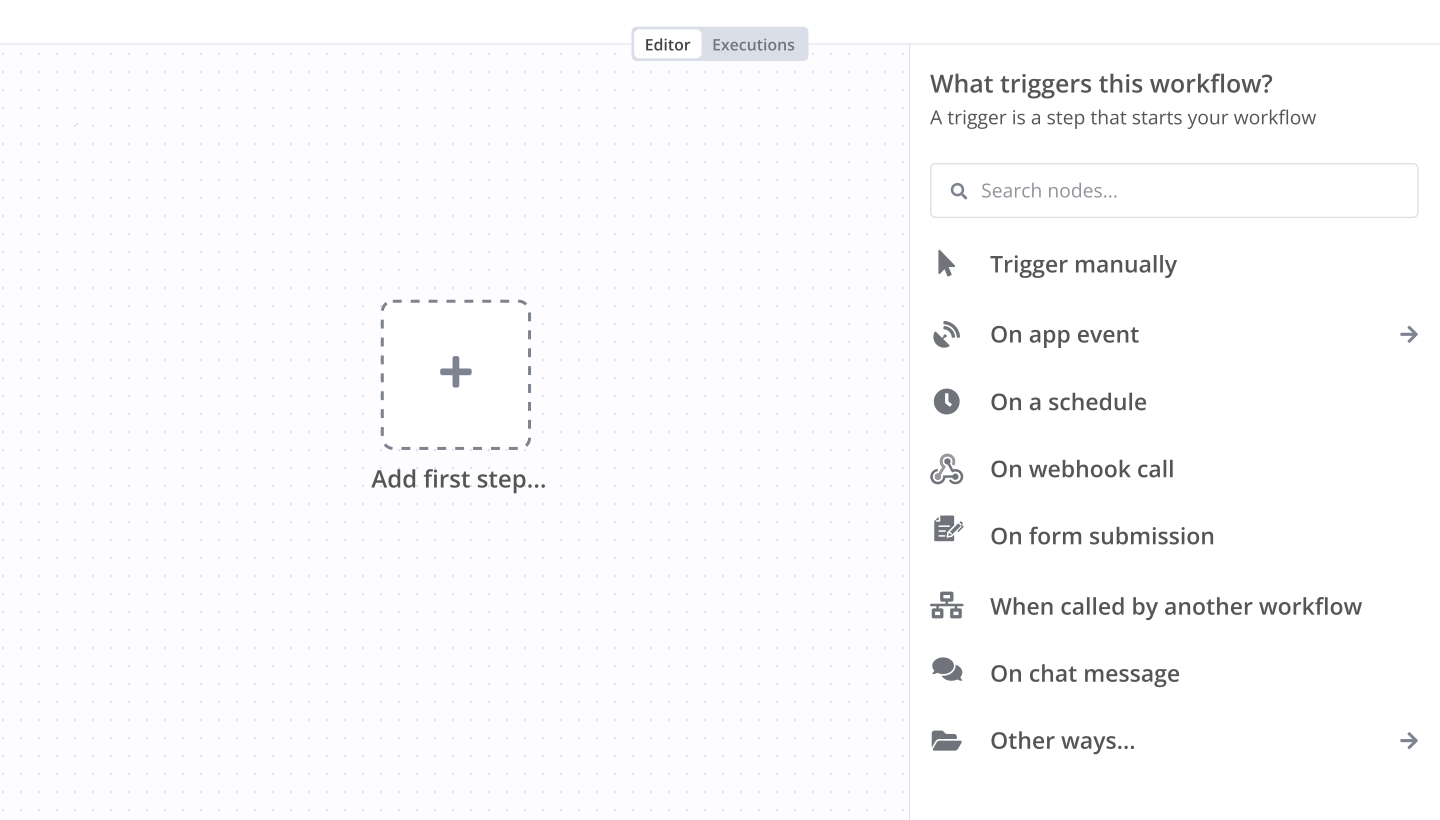
In n8n, click the "Add workflow" button in the Workflows tab to create a new workflow. Add the starting point – a trigger on when your workflow should run: an app event, a schedule, a webhook call, another workflow, an AI chat, or a manual trigger. Sometimes, the HTTP Request node might already serve as your starting point.

HTTP Request and Xero integration: Create a new workflow and add the first step

Step 2: Add and configure HTTP Request and Xero nodes

You can find HTTP Request and Xero in the nodes panel. Drag them onto your workflow canvas, selecting their actions. Click each node, choose a credential, and authenticate to grant n8n access. Configure HTTP Request and Xero nodes one by one: input data on the left, parameters in the middle, and output data on the right.

HTTP Request and Xero integration: Add and configure HTTP Request and Xero nodes

Step 3: Connect HTTP Request and Xero

A connection establishes a link between HTTP Request and Xero (or vice versa) to route data through the workflow. Data flows from the output of one node to the input of another. You can have single or multiple connections for each node.

HTTP Request and Xero integration: Connect HTTP Request and Xero

Step 4: Customize and extend your HTTP Request and Xero integration

Use n8n's core nodes such as If, Split Out, Merge, and others to transform and manipulate data. Write custom JavaScript or Python in the Code node and run it as a step in your workflow. Connect HTTP Request and Xero with any of n8n’s 1000+ integrations, and incorporate advanced AI logic into your workflows.

HTTP Request and Xero integration: Customize and extend your HTTP Request and Xero integration

Step 5: Test and activate your HTTP Request and Xero workflow

Save and run the workflow to see if everything works as expected. Based on your configuration, data should flow from HTTP Request to Xero or vice versa. Easily debug your workflow: you can check past executions to isolate and fix the mistake. Once you've tested everything, make sure to save your workflow and activate it.

HTTP Request and Xero integration: Test and activate your HTTP Request and Xero workflow

Automate invoice processing with Gmail, OCR.space, Slack & Xero

How It Works

Trigger: Watches for new emails in Gmail with PDF/image attachments.
OCR: Sends the attachment to OCR.space API (https://ocr.space/OCRAPI) to extract invoice text.
Parsing: Extracts key fields:
Vendor
Invoice number
Amount
Currency
Invoice date
Due date
Description
Validation Logic:
Checks if amount is valid
Ensures vendor and invoice number are present
Flags high-value invoices (e.g., over $10,000)
Routing:
If invalid:
Sends a Slack message highlighting issues
Labels email as Rejected
If valid:
Logs the invoice into Google Sheets
Sends a Slack message to the finance team for approval
After approval, creates a draft invoice in Xero
Labels the email as Processed in Gmail
Set up steps

• Estimated setup time: 45-60 mins
• You’ll need connected credentials for Gmail, Slack, Google Sheets, and Xero
• Replace the default API key for OCR.space with your own (in the HTTP Request node)
• Update Slack channel IDs and label IDs to match your workspace
• Adjust invoice validation rules as needed (e.g. currency, red flag conditions)

All detailed explanations and field mappings are provided in sticky notes within the workflow.

Nodes used in this workflow

Popular HTTP Request and Xero workflows

Automate Invoice Processing with Gmail, OCR.space, Slack & Xero

How It Works Trigger: Watches for new emails in Gmail with PDF/image attachments. OCR: Sends the attachment to OCR.space API (https://ocr.space/OCRAPI) to extract invoice text. Parsing: Extracts key fields: Vendor Invoice number Amount Currency Invoice date Due date Description Validation Logic: Checks if amount is valid Ensures vendor and invoice number are present Flags high-value invoices (e.g., over $10,000) Routing: If invalid: Sends a Slack message highlighting issues Labels email as Rejected If valid: Logs the invoice into Google Sheets Sends a Slack message to the finance team for approval After approval, creates a draft invoice in Xero Labels the email as Processed in Gmail Set up steps • Estimated setup time: 45-60 mins • You’ll need connected credentials for Gmail, Slack, Google Sheets, and Xero • Replace the default API key for OCR.space with your own (in the HTTP Request node) • Update Slack channel IDs and label IDs to match your workspace • Adjust invoice validation rules as needed (e.g. currency, red flag conditions) All detailed explanations and field mappings are provided in sticky notes within the workflow.
+2

Automate 3-way invoice matching from Gmail to Xero with Slack and Teams alerts

Intelligent Financial Invoice Hub: AI Parsing, 3-Way Matching & Multi-Channel Alerting 🎯 Description This is an enterprise-grade solution designed for complex finance departments. It automates the entire accounts payable lifecycle by combining secure document handling, intelligent vendor mapping, 3-way reconciliation, and a sophisticated multi-channel notification engine. ✨ What This Workflow Does Multi-Channel Ingestion - Consolidates invoices arriving via Gmail, legacy IMAP servers, and direct vendor portal webhooks into a single processing stream. Advanced Security Layer - Automatically retrieves rotating encryption keys from a secure database and uses the HTML to PDF (Unlock) node to decrypt protected vendor statements. Fuzzy Vendor Identification - Uses intelligent string analysis to identify vendors despite name variations (e.g., "Amazon" vs. "AWS"), ensuring data consistency. Automated 3-Way Matching - Fetches the associated Purchase Order (PO) and Delivery Receipt, then uses the HTML to PDF (Merge) engine to create a verified "Audit Bundle" for compliance. AI-Driven Data Extraction - Parses line-item details, converts international currencies using live exchange rates, and detects early payment discounts to optimize cash flow. Enterprise Notification Engine - Slack: Instant escalation for high-value outliers (e.g., >$10k) or urgent invoices. Microsoft Teams: Direct alerts to Department Heads when items impact their specific budgets. Gmail: Delivers a daily processing success digest to the Finance Lead. 💡 Key Features 3-Way Reconciliation:** Prevents fraud and overpayment by validating quantities and prices across three distinct documents before ERP synchronization. Encrypted Document Handling:** Seamlessly manages password-protected PDFs without manual intervention. Currency Intelligence:** Automatically handles international vendor payments with real-time conversion and tax mapping. Budget Allocation:** Smartly assigns costs to specific department codes and project tags in your accounting software. 🔧 Technical Highlights Binary Buffer Management:** High-performance handling of multiple large PDF streams during the merge process. Fuzzy Matching Logic:** Robust vendor recognition that handles typos and naming variations. Hybrid Trigger Support:** Reliable execution via polling (Email) and real-time events (Webhooks). Modular Architecture:** Easy to adapt for Xero, QuickBooks, or custom SQL databases. 📦 What You'll Need HTML to PDF Node - Essential for the Unlock and Merge operations. Google Sheets - To serve as the Vendor Vault (decryption keys) and Master Audit Log. ERP Credentials - Access to Xero, QuickBooks, or Sage for bill creation. Communication Tools - Slack, Microsoft Teams, and a Gmail account. 🚀 Benefits ✅ Zero Manual Data Entry - Complete "Email-to-ERP" automation saves hours of administrative work. ✅ Eliminate Overpayments - 3-way matching ensures you only pay for exactly what was ordered and received. ✅ Real-Time Financial Visibility - Department heads are notified the moment their budget is impacted. ✅ Audit Readiness - Automatically maintains a complete digital paper trail for every single invoice. 🎨 Customization Options Thresholds:** Adjust the "High Value" IF-node to match your internal approval policies. Channels:** Easily swap Slack for Discord or Teams for SMS alerts (via Twilio). Currency:** Add or remove currency pairs in the Intelligence Engine code node. Tags: #finance #accounting #xero #3-way-match #pdf-automation #slack #enterprise #security Category: Finance & Accounting Difficulty: Advanced

Send automated payment reminders for Xero invoices via Outlook email

Who's this for Small business owners, finance teams, accountants, and bookkeepers who use Xero for invoicing and want to improve cash flow by automating payment reminders. If you're spending time manually following up on unpaid invoices or struggling with late payments, this workflow eliminates the manual effort and ensures consistent, timely communication with customers while maintaining a complete audit trail. What it does This workflow automatically monitors all invoices in your Xero account and sends friendly payment reminders to customers when invoices are approaching their due date. It runs daily at noon, checks every invoice, calculates how many days until payment is due, sends personalized email reminders for invoices due within 7 days, and logs each reminder activity back into Xero's invoice history. The automation ensures no invoice slips through the cracks, reduces the administrative burden of accounts receivable management, and maintains professional customer relationships through polite, timely reminders—all while keeping your Xero records up to date with reminder tracking. How it works The workflow executes automatically every day at 12 PM and follows this process: Triggers the daily check using the Schedule Trigger node Fetches all invoices from your Xero account using the Xero API integration Filters out invoices that are already marked as "PAID" to avoid sending unnecessary reminders Calculates the number of days remaining until each unpaid invoice is due using a JavaScript code node Identifies invoices that are due within the next 7 days (customizable threshold) Sends personalized email reminders to customers via Microsoft Outlook, including invoice number, due date, and amount Logs the reminder activity back into Xero's invoice history with the date sent and days until due Creates a complete audit trail in Xero showing when reminders were sent for each invoice The workflow only sends reminders for invoices meeting the criteria, so customers aren't bombarded with unnecessary emails. The Xero history logging ensures your team can see at a glance which customers have been reminded and when, preventing duplicate reminders and providing accountability. Requirements Xero account with API access enabled (available to all Xero users at no additional cost) Microsoft Outlook or Office 365 account for sending email reminders Valid email addresses configured for all customers in your Xero contact records n8n instance (self-hosted or cloud) with credentials configured for: Xero OAuth2 connection (used twice: once for fetching invoices, once for logging history) Microsoft Outlook OAuth2 connection Setup instructions Enable Xero API access Ensure your Xero account has API access enabled. This is available by default for all Xero accounts. You'll need administrator access to create the API connection. Configure n8n credentials In your n8n instance, set up OAuth2 credentials for: Xero:** Follow n8n's Xero credential documentation to authorize access to your Xero organization. Make sure the credentials have permission to both read invoices and write to invoice history. Microsoft Outlook:** Set up OAuth2 connection to allow n8n to send emails on your behalf Assign credentials to nodes Open the workflow and assign your configured credentials to these nodes: "Fetch All Xero Invoices" → Select your Xero credential "Send Email Reminder to Customer" → Select your Microsoft Outlook credential "Log Reminder in Xero History" → Select your Xero credential (same as above) Customize the email template Edit the "Send Email Reminder to Customer" node to personalize the message: Update the sender name and signature Add your company branding or logo Include payment instructions or online payment links Adjust the tone to match your customer communication style Add any legal disclaimers or terms if required Customize the subject line if needed Adjust the reminder threshold (optional) By default, reminders are sent for invoices due within 7 days. To change this: Open the "Calculate Days Until Due" code node Find the line: isDueSoon: diffDays <= 7 && diffDays >= 0 Change 7 to your preferred number of days (e.g., 14 for two weeks notice) Test the workflow Before enabling the daily schedule: Use the manual trigger to test with your actual Xero data Verify that invoices are fetched correctly Check that the date calculations are accurate Send a test email to yourself to review the message format Confirm the reminder is logged in Xero's invoice history Verify only qualifying invoices trigger reminders Activate the workflow Once testing is complete, activate the workflow. It will run automatically every day at noon (or your customized schedule time).

Build your own HTTP Request and Xero integration

Create custom HTTP Request and Xero workflows by choosing triggers and actions. Nodes come with global operations and settings, as well as app-specific parameters that can be configured. You can also use the HTTP Request node to query data from any app or service with a REST API.

Xero supported actions

Create
Create a contact
Get
Get a contact
Get Many
Get many contacts
Update
Update a contact
Create
Create a invoice
Get
Get a invoice
Get Many
Get many invoices
Update
Update a invoice
Use case

Save engineering resources

Reduce time spent on customer integrations, engineer faster POCs, keep your customer-specific functionality separate from product all without having to code.

Learn more

FAQs

  • Can HTTP Request connect with Xero?

  • Can I use HTTP Request’s API with n8n?

  • Can I use Xero’s API with n8n?

  • Is n8n secure for integrating HTTP Request and Xero?

  • How to get started with HTTP Request and Xero integration in n8n.io?

Need help setting up your HTTP Request and Xero integration?

Discover our latest community's recommendations and join the discussions about HTTP Request and Xero integration.
Moiz Contractor
theo
Jon
Dan Burykin
Tony

Looking to integrate HTTP Request and Xero in your company?

Over 3000 companies switch to n8n every single week

Why use n8n to integrate HTTP Request with Xero

Build complex workflows, really fast

Build complex workflows, really fast

Handle branching, merging and iteration easily.
Pause your workflow to wait for external events.

Code when you need it, UI when you don't

Simple debugging

Your data is displayed alongside your settings, making edge cases easy to track down.

Use templates to get started fast

Use 1000+ workflow templates available from our core team and our community.

Reuse your work

Copy and paste, easily import and export workflows.

Implement complex processes faster with n8n

red iconyellow iconred iconyellow icon