Back to Integrations
integrationHubSpot node
integrationOpenAI node

HubSpot and OpenAI integration

Save yourself the work of writing custom integrations for HubSpot and OpenAI and use n8n instead. Build adaptable and scalable Sales, AI, and Langchain workflows that work with your technology stack. All within a building experience you will love.

How to connect HubSpot and OpenAI

  • Step 1: Create a new workflow
  • Step 2: Add and configure nodes
  • Step 3: Connect
  • Step 4: Customize and extend your integration
  • Step 5: Test and activate your workflow

Step 1: Create a new workflow and add the first step

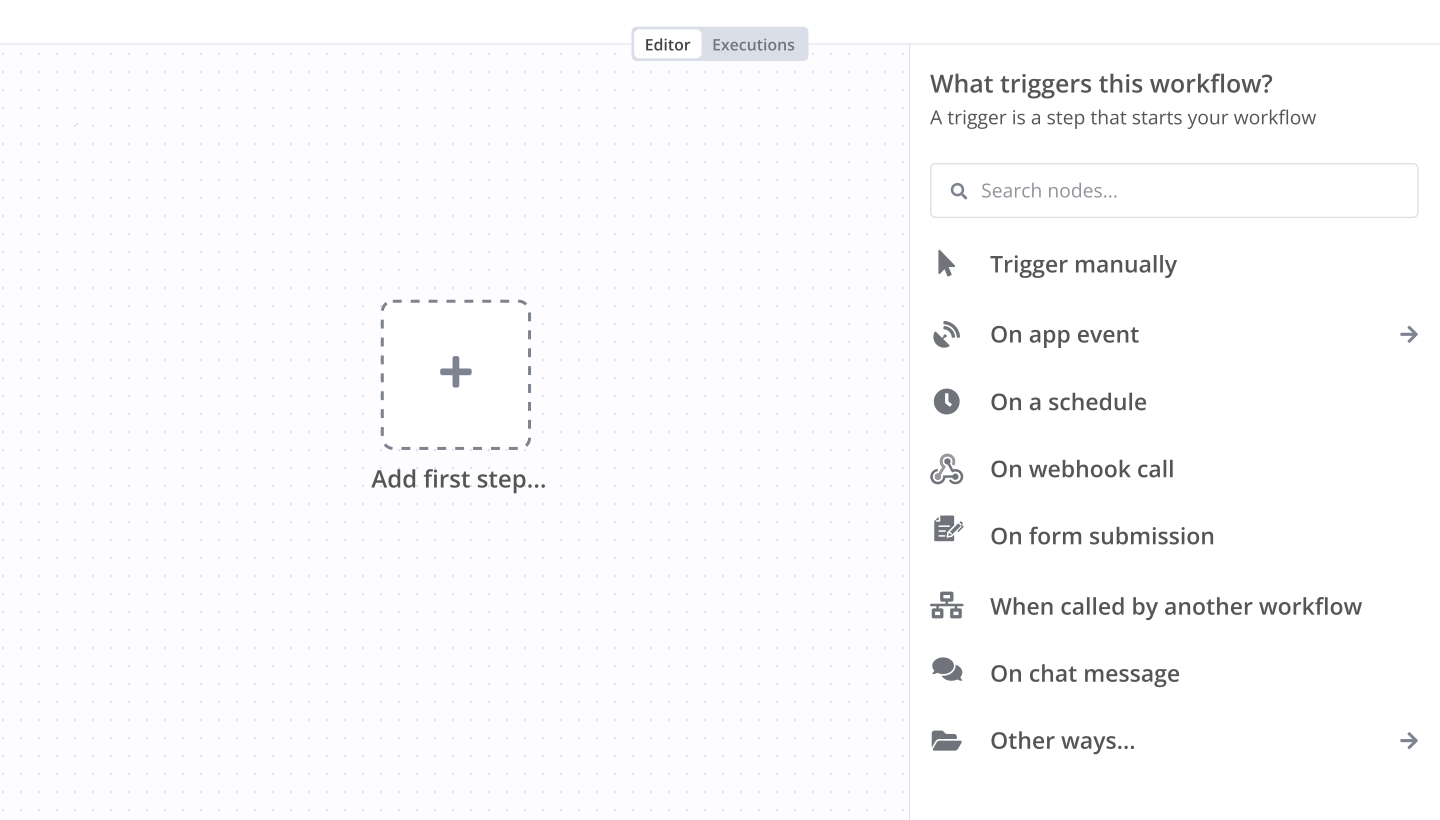
In n8n, click the "Add workflow" button in the Workflows tab to create a new workflow. Add the starting point – a trigger on when your workflow should run: an app event, a schedule, a webhook call, another workflow, an AI chat, or a manual trigger. Sometimes, the HTTP Request node might already serve as your starting point.

HubSpot and OpenAI integration: Create a new workflow and add the first step

Step 2: Add and configure HubSpot and OpenAI nodes

You can find HubSpot and OpenAI in the nodes panel. Drag them onto your workflow canvas, selecting their actions. Click each node, choose a credential, and authenticate to grant n8n access. Configure HubSpot and OpenAI nodes one by one: input data on the left, parameters in the middle, and output data on the right.

HubSpot and OpenAI integration: Add and configure HubSpot and OpenAI nodes

Step 3: Connect HubSpot and OpenAI

A connection establishes a link between HubSpot and OpenAI (or vice versa) to route data through the workflow. Data flows from the output of one node to the input of another. You can have single or multiple connections for each node.

HubSpot and OpenAI integration: Connect HubSpot and OpenAI

Step 4: Customize and extend your HubSpot and OpenAI integration

Use n8n's core nodes such as If, Split Out, Merge, and others to transform and manipulate data. Write custom JavaScript or Python in the Code node and run it as a step in your workflow. Connect HubSpot and OpenAI with any of n8n’s 1000+ integrations, and incorporate advanced AI logic into your workflows.

HubSpot and OpenAI integration: Customize and extend your HubSpot and OpenAI integration

Step 5: Test and activate your HubSpot and OpenAI workflow

Save and run the workflow to see if everything works as expected. Based on your configuration, data should flow from HubSpot to OpenAI or vice versa. Easily debug your workflow: you can check past executions to isolate and fix the mistake. Once you've tested everything, make sure to save your workflow and activate it.

HubSpot and OpenAI integration: Test and activate your HubSpot and OpenAI workflow

AI-powered lead enrichment with Bright Data MCP and Google Sheets

📌 HubSpot Lead Enrichment with Bright Data MCP

This template enables natural-language-driven automation using Bright Data's MCP tools, triggered directly by new leads in HubSpot. It dynamically extracts and executes the right tool based on lead context—powered by AI and configurable in N8N.

❓ What Problem Does This Solve?

Manual lead enrichment is slow, inconsistent, and drains valuable time. This solution automates the process using a no-code workflow that connects HubSpot, Bright Data MCP, and an AI agent—without requiring scripts or technical skills. Perfect for marketing, sales, and RevOps teams.

🧰 Prerequisites

To use this template, you’ll need:

A self-hosted or cloud instance of N8N
A Bright Data MCP API token
A valid OpenAI API key (or compatible AI model)
A HubSpot account
Either a Private App token or OAuth credentials for HubSpot
Basic familiarity with N8N workflows

⚙️ Setup Instructions

  1. Set Up Authentication in HubSpot

🔐 Option 1: Use a Private App Token (Simple Setup)
Log in to your HubSpot account.
Navigate to Settings → Integrations → Private Apps.
Create a new Private App with the following scopes:
crm.objects.contacts.read
crm.objects.contacts.write
crm.schemas.contacts.read
crm.objects.companies.read (optional)
Copy the Access Token.
In N8N, create a credential for HubSpot App Token and paste the app token in the field.
Go back to Hubspot Private App settings to setup a webhook.
Copy the url in your workflow's Webhook node and paste it here.

🔁 Option 2: Use OAuth (Advanced + Secure)
In HubSpot, go to Settings → Integrations → Apps → Create App.
Set your Redirect URL to match your N8N OAuth2 redirect path.
Choose scopes like:
crm.objects.companies.read
crm.objects.contacts.read
crm.objects.deals.read
crm.schemas.companies.read
crm.schemas.contacts.read
crm.schemas.deals.read
crm.objects.contacts.write (conditionally required)
Note the Client ID and Client Secret.
Copy the App ID and the developer API key
In N8N, create a credential for HubSpot Developer API and paste those info from previous step.
Attach these credentials to the HubSpot node in N8N.

  1. Setup and obtain API token and other necessary information from Bright Data

    In your Bright Data account, obtain the following information:
    API token
    Web Unlocker zone name (optional)
    Browser API username and password string separated by colon (optional)

  2. Host SSE server from STDIO command
    The methods below will allow you to receive SSE (Server-Sent Events) from Bright Data MCP via a local Supergateway or Smithery

    **

    Method 1: Run Supergateway in a separate web service (Recommended)

    This method will work for both cloud version and self-hosted N8N.

    Signup to any cloud services of your choice (DigitalOcean, Heroku, Hetzner, Render, etc.).

For NPM based installation:

Create a new web service.
Choose Node.js as runtime environment and setup a custom server without repository.
In your server’s settings to define environment variables or .env file, add:
API_TOKEN=your_brightdata_api_token WEB_UNLOCKER_ZONE=optional_zone_name BROWSER_AUTH=optional_browser_auth
Paste the following text as a start command: npx -y supergateway --stdio "npx -y @brightdata/mcp" --port 8000 --baseUrl http://localhost:8000 --ssePath /sse --messagePath /message
Deploy it and copy the web server URL, then append /sse into it.
Your SSE server should now be accessible at: https://your_server_url/sse

For Docker based installation:
Create a new web service.
Choose Docker as the runtime environment.
Set up your Docker environment by pulling the necessary images or creating a custom Dockerfile.
In your server’s settings to define environment variables or .env file, add:
API_TOKEN=your_brightdata_api_token WEB_UNLOCKER_ZONE=optional_zone_name BROWSER_ZONE=optional_browser_zone_name
Use the following Docker command to run Supergateway: docker run -it --rm -p 8000:8000 supercorp/supergateway \ --stdio "npx -y @brightdata/mcp /" \ --port 8000
Deploy it and copy the web server URL, then append /sse into it.
Your SSE server should now be accessible at: https://your_server_url/sse

For more installation guides, please refer to https://github.com/supercorp-ai/supergateway.git.
**

Method 2: Run Supergateway in the same web service as the N8N instance

This method will only work for self-hosted N8N.

a. Set Required Environment Variables

In your server's settings to define environment variables or .env file, add:

  API_TOKEN=your_brightdata_api_token

WEB_UNLOCKER_ZONE=optional_zone_name
BROWSER_ZONE=optional_browser_zone_name
b. Run Supergateway in Background

  npx -y supergateway --stdio "npx -y @brightdata/mcp" --port 8000 --baseUrl http://localhost:8000 --ssePath /sse --messagePath /message
  Use the command above to execute it through the cloud shell or set it as a pre-deploy command.

Your SSE server should now be accessible at:
http://localhost:8000/sse

For more installation guides, please refer to https://github.com/supercorp-ai/supergateway.git.

Method 3: Configure via Smithery.ai (Easiest)
If you don't want additional setup and want to test it right away, follow these instructions:

Visit https://smithery.ai/server/@luminati-io/brightdata-mcp/tools to:
Signup (if you are new to Smithery)
Create an API key
Define environment variables via a profile
Retrieve your SSE server HTTP URL

  1. Connect Google Sheets to N8N

Ensure your Google Sheet:
Contains columns like row_id, first_name, last_name, email, and status.
Is shared with your N8N service account (or connected via OAuth)

In N8N:
Add a Google Sheets Trigger node
Set it to watch for new rows in your lead sheet

  1. Import and Configure the N8N Workflow

Import the provided JSON workflow into N8N
Update nodes with your credentials:
Hubspot: Add your API key or connect it via OAuth.
Google Sheets Trigger: Link to your actual sheet
OpenAI Node: Add your API key
Bright Data Tool Execution: Add Bright Data token and SSE URL

🔄 How It Works
New contact in Hubspot or a new row is added to the Google Sheet
N8N triggers the workflow
AI agent classifies the task (e.g., “Find LinkedIn”, “Get company info”)
The relevant MCP tool is called
Results are appended back to the sheet or routed to another destination
Rerun the specific record by specifying status "needs more enrichment", or leaving it blank.

🧩 Use Cases

B2B Lead Enrichment** – Add missing fields (title, domain, social profiles)
Email Intelligence** – Validate and enrich based on email
Market Research** – Pull company or contact data on demand
CRM Auto-fill** – Push enriched leads to tools like HubSpot or Salesforce

🛠️ Customization

Prompt Tuning** – Adjust how the AI interprets input data
Column Mapping** – Customize which fields to pull from the sheet
Tool Logic** – Add retries, fallback tools, or confidence-based routing
Destination Output** – Integrate with CRMs, Slack, or webhook endpoints

✅ Summary

This template turns a Google Sheet into an AI-powered lead enrichment engine. By combining Bright Data’s tools with a natural language AI agent, your team can automate repetitive tasks and scale lead ops—without writing code.

Just add a row, and let the workflow do the rest.

Nodes used in this workflow

Popular HubSpot and OpenAI workflows

+3

AI-Powered Lead Enrichment with Bright Data MCP and Google Sheets

📌 HubSpot Lead Enrichment with Bright Data MCP This template enables natural-language-driven automation using Bright Data's MCP tools, triggered directly by new leads in HubSpot. It dynamically extracts and executes the right tool based on lead context—powered by AI and configurable in N8N. ❓ What Problem Does This Solve? Manual lead enrichment is slow, inconsistent, and drains valuable time. This solution automates the process using a no-code workflow that connects HubSpot, Bright Data MCP, and an AI agent—without requiring scripts or technical skills. Perfect for marketing, sales, and RevOps teams. 🧰 Prerequisites To use this template, you’ll need: A self-hosted or cloud instance of N8N A Bright Data MCP API token A valid OpenAI API key (or compatible AI model) A HubSpot account Either a Private App token or OAuth credentials for HubSpot Basic familiarity with N8N workflows ⚙️ Setup Instructions Set Up Authentication in HubSpot 🔐 Option 1: Use a Private App Token (Simple Setup) Log in to your HubSpot account. Navigate to Settings → Integrations → Private Apps. Create a new Private App with the following scopes: crm.objects.contacts.read crm.objects.contacts.write crm.schemas.contacts.read crm.objects.companies.read (optional) Copy the Access Token. In N8N, create a credential for HubSpot App Token and paste the app token in the field. Go back to Hubspot Private App settings to setup a webhook. Copy the url in your workflow's Webhook node and paste it here. 🔁 Option 2: Use OAuth (Advanced + Secure) In HubSpot, go to Settings → Integrations → Apps → Create App. Set your Redirect URL to match your N8N OAuth2 redirect path. Choose scopes like: crm.objects.companies.read crm.objects.contacts.read crm.objects.deals.read crm.schemas.companies.read crm.schemas.contacts.read crm.schemas.deals.read crm.objects.contacts.write (conditionally required) Note the Client ID and Client Secret. Copy the App ID and the developer API key In N8N, create a credential for HubSpot Developer API and paste those info from previous step. Attach these credentials to the HubSpot node in N8N. Setup and obtain API token and other necessary information from Bright Data In your Bright Data account, obtain the following information: API token Web Unlocker zone name (optional) Browser API username and password string separated by colon (optional) Host SSE server from STDIO command The methods below will allow you to receive SSE (Server-Sent Events) from Bright Data MCP via a local Supergateway or Smithery ** Method 1: Run Supergateway in a separate web service (Recommended) This method will work for both cloud version and self-hosted N8N. Signup to any cloud services of your choice (DigitalOcean, Heroku, Hetzner, Render, etc.). For NPM based installation: Create a new web service. Choose Node.js as runtime environment and setup a custom server without repository. In your server’s settings to define environment variables or .env file, add: `API_TOKEN=your_brightdata_api_token WEB_UNLOCKER_ZONE=optional_zone_name BROWSER_AUTH=optional_browser_auth` Paste the following text as a start command: npx -y supergateway --stdio "npx -y @brightdata/mcp" --port 8000 --baseUrl http://localhost:8000 --ssePath /sse --messagePath /message Deploy it and copy the web server URL, then append /sse into it. Your SSE server should now be accessible at: https://your_server_url/sse For Docker based installation: Create a new web service. Choose Docker as the runtime environment. Set up your Docker environment by pulling the necessary images or creating a custom Dockerfile. In your server’s settings to define environment variables or .env file, add: `API_TOKEN=your_brightdata_api_token WEB_UNLOCKER_ZONE=optional_zone_name BROWSER_ZONE=optional_browser_zone_name` Use the following Docker command to run Supergateway: `docker run -it --rm -p 8000:8000 supercorp/supergateway \ --stdio "npx -y @brightdata/mcp /" \ --port 8000` Deploy it and copy the web server URL, then append /sse into it. Your SSE server should now be accessible at: https://your_server_url/sse For more installation guides, please refer to https://github.com/supercorp-ai/supergateway.git. ** Method 2: Run Supergateway in the same web service as the N8N instance This method will only work for self-hosted N8N. a. Set Required Environment Variables In your server's settings to define environment variables or .env file, add: API_TOKEN=your_brightdata_api_token WEB_UNLOCKER_ZONE=optional_zone_name BROWSER_ZONE=optional_browser_zone_name b. Run Supergateway in Background npx -y supergateway --stdio "npx -y @brightdata/mcp" --port 8000 --baseUrl http://localhost:8000 --ssePath /sse --messagePath /message Use the command above to execute it through the cloud shell or set it as a pre-deploy command. Your SSE server should now be accessible at: http://localhost:8000/sse For more installation guides, please refer to https://github.com/supercorp-ai/supergateway.git. Method 3: Configure via Smithery.ai (Easiest) If you don't want additional setup and want to test it right away, follow these instructions: Visit https://smithery.ai/server/@luminati-io/brightdata-mcp/tools to: Signup (if you are new to Smithery) Create an API key Define environment variables via a profile Retrieve your SSE server HTTP URL Connect Google Sheets to N8N Ensure your Google Sheet: Contains columns like row_id, first_name, last_name, email, and status. Is shared with your N8N service account (or connected via OAuth) In N8N: Add a Google Sheets Trigger node Set it to watch for new rows in your lead sheet Import and Configure the N8N Workflow Import the provided JSON workflow into N8N Update nodes with your credentials: Hubspot: Add your API key or connect it via OAuth. Google Sheets Trigger: Link to your actual sheet OpenAI Node: Add your API key Bright Data Tool Execution: Add Bright Data token and SSE URL 🔄 How It Works New contact in Hubspot or a new row is added to the Google Sheet N8N triggers the workflow AI agent classifies the task (e.g., “Find LinkedIn”, “Get company info”) The relevant MCP tool is called Results are appended back to the sheet or routed to another destination Rerun the specific record by specifying status "needs more enrichment", or leaving it blank. 🧩 Use Cases B2B Lead Enrichment** – Add missing fields (title, domain, social profiles) Email Intelligence** – Validate and enrich based on email Market Research** – Pull company or contact data on demand CRM Auto-fill** – Push enriched leads to tools like HubSpot or Salesforce 🛠️ Customization Prompt Tuning** – Adjust how the AI interprets input data Column Mapping** – Customize which fields to pull from the sheet Tool Logic** – Add retries, fallback tools, or confidence-based routing Destination Output** – Integrate with CRMs, Slack, or webhook endpoints ✅ Summary This template turns a Google Sheet into an AI-powered lead enrichment engine. By combining Bright Data’s tools with a natural language AI agent, your team can automate repetitive tasks and scale lead ops—without writing code. Just add a row, and let the workflow do the rest.
+5

Multilingual WhatsApp Translator with OpenAI Whisper & GPT-4 and HubSpot Integration

🌍 AI WhatsApp Translator + Voice Transcriber with HubSpot Integration Hello! I'm Amanda ❤️, a passionate automation creator and AI enthusiast. With over 2 years of experience in n8n and Make.com, I design robust, intelligent agents that make your operations smarter and smoother. This translator + transcriber assistant is perfect for multilingual communication via WhatsApp. It automatically captures voice or text messages, identifies the customer's region and language, transcribes audio using OpenAI Whisper, and generates friendly, culturally adapted translations with GPT-4 or GPT-4o. All messages and contacts are saved in your HubSpot CRM—so no lead gets lost. ✅ What this Workflow Does: 🎧 Transcribes audio messages using OpenAI Whisper (accurate + fast). 🌐 Translates text & voice into the client’s native language or a default one. 🇧🇷 Adapts tone, slang, emojis, and cultural expressions for natural conversation. 💼 Saves contact info & history to HubSpot automatically (name, phone, and translation). 📬 Replies via WhatsApp using Evolution API (also works with chatbots). ✨ Handles over 80+ countries and phone prefixes to detect preferred languages. 🛠️ How to Use It: Clone the workflow to your n8n instance (cloud or self-hosted). Configure the Webhook URL in your Evolution API or WhatsApp provider. Set up credentials for: OpenAI (for transcription and GPT translation) HubSpot (to store leads) Optional: Adjust prompt logic and default languages inside the AI Agent node. Done! Your AI translator bot is live 💬🌎 🧠 LLMs and Tools Used: OpenAI GPT-4o / GPT-4 Mini** for translation OpenAI Whisper** for transcription HubSpot CRM** integration Evolution API** for WhatsApp messaging Dynamic language detection based on phone prefix 💡 Ideal For: Multinational businesses with global customers Customer support teams with multilingual needs Agencies serving clients in Latin America, Europe, or Asia Translating informal messages in real-time 📁 Included: 1x Complete n8n Workflow Preconfigured translation agents HubSpot contact mapper Multi-country language index Ready-to-use voice transcription logic ❤️ Support Materials and Templates: iloveflows.gumroad.com ☁️ Want to use this with n8n Cloud? Use my affiliate link to get started: 👉 https://n8n.partnerlinks.io/amanda 🔥 Buy a VPS server with a Super Discount: https://hostinger.com/vps

Analyze Retell AI call transcripts with OpenAI and sync insights to HubSpot

Who is this for Sales teams and agencies using Retell AI for voice outreach who want to automatically analyze every call and push insights into their CRM. Ideal for businesses running AI voice agents that need structured post-call intelligence without manual review. How it works When a Retell AI voice call ends, the platform sends a call_analyzed webhook to this workflow. It parses the transcript, call duration, and metadata, then sends everything to OpenAI for analysis. The AI returns structured data: sentiment, lead score (1-10), key topics, buying signals, objections, action items, and a recommended next step. The enriched data is synced to HubSpot, updating the contact record. If the lead score meets your threshold, the workflow alerts your sales team on Slack and creates a priority follow-up task in HubSpot. Every call is logged to Google Sheets for tracking. How to set up Open the Set user config variables node and enter your Slack channel, lead score threshold (default: 7), Google Sheet ID, and sheet name. Connect your OpenAI, HubSpot, Slack, and Google Sheets credentials in each respective node. Copy the production webhook URL from the trigger node and add it to your Retell AI dashboard under Webhook Settings for the call_analyzed event. Create a Google Sheet with columns: Date, Call ID, From Number, Duration, Sentiment, Lead Score, Summary, Action Items, Qualified. Activate the workflow and make a test call to verify the full pipeline. Requirements Retell AI account with an active voice agent OpenAI API key (GPT-4o-mini or GPT-4o) HubSpot CRM account Slack workspace with a bot token Google Sheets How to customize Adjust the lead score threshold in the config node to control when hot lead alerts fire. Modify the AI analysis prompt to extract industry-specific fields (e.g., appointment booked, insurance type, budget range). Add a Twilio SMS branch for instant text follow-ups to hot leads. Connect additional CRM nodes if you use Pipedrive, Salesforce, or another platform instead of HubSpot.

RSVP Lead Scoring for Events with GPT, HubSpot & Slack

RSVP Lead Scoring for Events with GPT, HubSpot & Slack Who is this for? Event organizers, RevOps teams, sales managers, and marketers running conferences, webinars, or meetups who want to automatically qualify RSVPs and turn attendees into revenue opportunities. What problem is this workflow solving? RSVP lead qualification is manual and slow: Reviewing 1000+ registrations takes hours Missing high-fit prospects (directors, founders) No instant sales handoff or nurture segmentation Leads leak between events and CRM This workflow auto-scores RSVPs 0-100 and routes high-fits to sales instantly. What this workflow does Trigger**: Google Forms/Typeform RSVP webhook AI Scoring: GPT-4o-mini analyzes job title, company, intent → **0-100 fit score High Scorers (80+)**: HubSpot CRM contact + Slack "#sales: Director @ Acme (87) → Book now [Calendly]" Low Scorers**: Nurture sequence (email lists) Dashboard**: Google Sheets with scores, conversions tracked Setup (3 minutes) Forms**: Google Forms/Typeform → n8n webhook (copy/paste URL) AI**: OpenAI API key (GPT-4o-mini - cheap & fast) CRM**: HubSpot API key (works Free tier) Slack**: #sales channel + bot token Fully configurable—no code changes needed. How to customize to your needs Scoring**: Adjust GPT thresholds (80→90 for enterprise) CRM**: Swap HubSpot for Salesforce/Pipedrive Channels**: Add Teams/Email + multiple Slack rooms Events**: Multi-event scoring by form source Follow-up**: Auto-Calendly, SMS, or email sequences ROI: 3x qualified leads** to sales team 5x faster sales response** 40% less lead leakage** (proven 500+ runs) Zero manual qualification** Need help customizing?: Contact me for consulting and support: LinkedIn / Message Keywords: event RSVP, AI lead scoring, conference lead qualification, event lead gen RevOps, lead fit scoring.

Turn Gmail meeting summaries into HubSpot CRM records with OpenAI

How it works This workflow listens for incoming meeting summary emails in Gmail and processes them automatically. The email content is cleaned and sent to an AI model that extracts CRM-ready sales data in a structured format. The parsed data is then used to create or update contacts, deals, and meeting engagements in HubSpot. This removes manual note-taking and ensures CRM data stays accurate and consistent after every call. Step-by-step Trigger on meeting summary email** Gmail Trigger – Watches the inbox for new meeting summary emails from a specific sender. Prepare and normalize meeting notes** Prepare Meeting Summary – Extracts the meeting text and stores it in a clean summary field for AI processing. Extract structured sales insights** AI Extraction – Sends the meeting summary to an AI model to identify company details, problems, budget, decision makers, timing, competitors, and next steps. Parse AI response** Parse AI JSON Output – Validates and converts the AI response into structured JSON fields usable by CRM nodes. Update HubSpot CRM** Create or Update Contact – Creates a new contact or updates an existing one based on extracted details. Update Deal – Updates the related deal with budget, description, stage, and pipeline information. Create Meeting Engagement – Logs a meeting engagement in HubSpot with key discussion points and next actions. Why use this? Eliminates manual CRM updates after sales or discovery calls. Ensures meeting insights are captured consistently and accurately. Reduces admin work for sales teams and improves data quality. Works seamlessly with meeting recap tools that send summary emails. Scales easily as meeting volume increases without extra effort.

Analyze lost HubSpot deals and generate revival strategies with OpenAI

How it works This workflow runs on a daily schedule to analyze all Closed–Lost deals from your CRM and uncover the true reason behind each loss. It uses AI to classify the primary loss category, generate a confidence-backed explanation, and then create a realistic re-engagement strategy for every deal. All insights are consolidated into leadership-ready email and Slack summaries. Every analyzed deal and revival plan is logged for long-term tracking and audits. Step-by-step Trigger and fetch lost deals** Schedule Trigger – Runs the workflow automatically at a defined time. Get many deals – Fetches all deal records from the CRM. If – Filters only deals marked as Closed–Lost. Edit Fields – Standardizes key deal attributes like amount, industry, owner, and loss reason. Analyze loss reasons and generate revival strategies** Brief Explanation Creator – Uses AI to identify the primary loss category with confidence. Code in JavaScript – Parses and normalizes AI loss analysis output. Merge – Combines deal data with loss insights. Feedback Creator – Generates a practical re-engagement strategy for each lost deal. Code in JavaScript7 – Parses and safeguards revival strategy outputs. Merge4 – Merges deal details, loss analysis, and revival strategy into one final dataset. Report, notify, and store results** Code in JavaScript11 – Builds a consolidated HTML summary email. Send a message4 – Sends the summary to stakeholders via email. Code in JavaScript12 – Creates a structured Slack summary. Send a message1 – Delivers insights to a Slack channel. Code in JavaScript10 – Reconstructs final data with delivery status. Append or update row in sheet – Logs all results into Google Sheets for audit and tracking. Why use this? Turns lost deals into actionable learning instead of static CRM records Gives sales teams clear, realistic re-engagement plans without manual analysis Provides leadership with concise, decision-ready summaries Creates a historical database of loss reasons and revival outcomes Improves pipeline recovery while enforcing consistent sales intelligence

Build your own HubSpot and OpenAI integration

Create custom HubSpot and OpenAI workflows by choosing triggers and actions. Nodes come with global operations and settings, as well as app-specific parameters that can be configured. You can also use the HTTP Request node to query data from any app or service with a REST API.

HubSpot supported actions

Create
Create a company
Delete
Delete a company
Get
Get a company
Get Many
Get many companies
Get Recently Created/Updated
Get recently created/updated companies
Search
Search companies by their website domain
Update
Update a company
Create or Update
Create a new contact, or update the current one if it already exists (upsert)
Delete
Delete a contact
Get
Get a contact
Get Many
Get many contacts
Get Recently Created/Updated
Get recently created/updated contacts
Search
Search contacts
Add
Add contact to a list
Remove
Remove a contact from a list
Create
Create a deal
Delete
Delete a deal
Get
Get a deal
Get Many
Get many deals
Get Recently Created/Updated
Get recently created/updated deals
Search
Search deals
Update
Update a deal
Create
Create an engagement
Delete
Delete an engagement
Get
Get an engagement
Get Many
Get many engagements
Create
Create a ticket
Delete
Delete a ticket
Get
Get a ticket
Get Many
Get many tickets
Update
Update a ticket

OpenAI supported actions

Message a Model
Generate a model response with GPT 3, 4, 5, etc. using Responses API
Classify Text for Violations
Check whether content complies with usage policies
Analyze Image
Take in images and answer questions about them
Generate an Image
Creates an image from a text prompt
Edit Image
Edit an image
Generate Audio
Creates audio from a text prompt
Transcribe a Recording
Transcribes audio into text
Translate a Recording
Translates audio into text in English
Delete a File
Delete a file from the server
List Files
Returns a list of files that belong to the user's organization
Upload a File
Upload a file that can be used across various endpoints
Create
Create a conversation
Get
Get a conversation
Remove
Remove a conversation
Update
Update a conversation
Generate
Creates a video from a text prompt

HubSpot and OpenAI integration details

Use case

Supercharge your CRM

Need a more powerful integration with your CRM? n8n lets you go beyond standard integrations offered by popular CRMs!

Learn more

FAQs

  • Can HubSpot connect with OpenAI?

  • Can I use HubSpot’s API with n8n?

  • Can I use OpenAI’s API with n8n?

  • Is n8n secure for integrating HubSpot and OpenAI?

  • How to get started with HubSpot and OpenAI integration in n8n.io?

Need help setting up your HubSpot and OpenAI integration?

Discover our latest community's recommendations and join the discussions about HubSpot and OpenAI integration.
Artem
sérgio eduardo floresta filho
Andrew adawdad
PinkFloyd
Steve Warburton

Looking to integrate HubSpot and OpenAI in your company?

Over 3000 companies switch to n8n every single week

Why use n8n to integrate HubSpot with OpenAI

Build complex workflows, really fast

Build complex workflows, really fast

Handle branching, merging and iteration easily.
Pause your workflow to wait for external events.

Code when you need it, UI when you don't

Simple debugging

Your data is displayed alongside your settings, making edge cases easy to track down.

Use templates to get started fast

Use 1000+ workflow templates available from our core team and our community.

Reuse your work

Copy and paste, easily import and export workflows.

Implement complex processes faster with n8n

red iconyellow iconred iconyellow icon