Back to Integrations
integrationHubSpot node
integrationShopify node

HubSpot and Shopify integration

Save yourself the work of writing custom integrations for HubSpot and Shopify and use n8n instead. Build adaptable and scalable Sales workflows that work with your technology stack. All within a building experience you will love.

How to connect HubSpot and Shopify

  • Step 1: Create a new workflow
  • Step 2: Add and configure nodes
  • Step 3: Connect
  • Step 4: Customize and extend your integration
  • Step 5: Test and activate your workflow

Step 1: Create a new workflow and add the first step

In n8n, click the "Add workflow" button in the Workflows tab to create a new workflow. Add the starting point – a trigger on when your workflow should run: an app event, a schedule, a webhook call, another workflow, an AI chat, or a manual trigger. Sometimes, the HTTP Request node might already serve as your starting point.
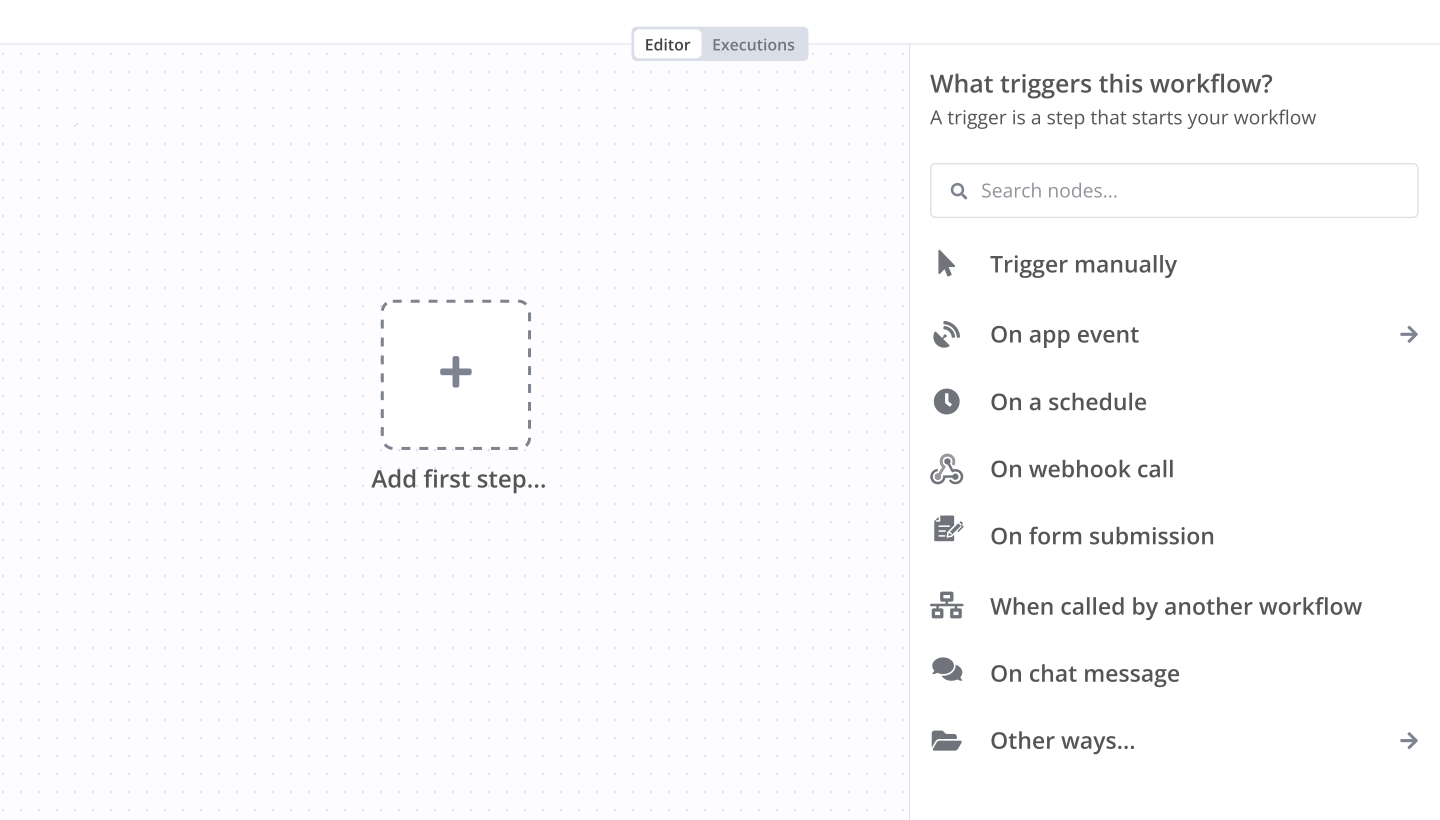
HubSpot and Shopify integration: Create a new workflow and add the first step

Step 2: Add and configure HubSpot and Shopify nodes

You can find HubSpot and Shopify in the nodes panel. Drag them onto your workflow canvas, selecting their actions. Click each node, choose a credential, and authenticate to grant n8n access. Configure HubSpot and Shopify nodes one by one: input data on the left, parameters in the middle, and output data on the right.

HubSpot and Shopify integration: Add and configure HubSpot and Shopify nodes

Step 3: Connect HubSpot and Shopify

A connection establishes a link between HubSpot and Shopify (or vice versa) to route data through the workflow. Data flows from the output of one node to the input of another. You can have single or multiple connections for each node.

HubSpot and Shopify integration: Connect HubSpot and Shopify

Step 4: Customize and extend your HubSpot and Shopify integration

Use n8n's core nodes such as If, Split Out, Merge, and others to transform and manipulate data. Write custom JavaScript or Python in the Code node and run it as a step in your workflow. Connect HubSpot and Shopify with any of n8n’s 1000+ integrations, and incorporate advanced AI logic into your workflows.

HubSpot and Shopify integration: Customize and extend your HubSpot and Shopify integration

Step 5: Test and activate your HubSpot and Shopify workflow

Save and run the workflow to see if everything works as expected. Based on your configuration, data should flow from HubSpot to Shopify or vice versa. Easily debug your workflow: you can check past executions to isolate and fix the mistake. Once you've tested everything, make sure to save your workflow and activate it.

HubSpot and Shopify integration: Test and activate your HubSpot and Shopify workflow

Sync Shopify customers to your HubSpot contacts

This workflow syncs Shopify customers to your HubSpot account as contacts. Whenever somebody makes a purchase on Shopify, it automatically adds them as a new customer to your Hubspot account if the customer doesn’t exist yet.

Also, this workflow creates or updates contacts from new paid orders on Shopify by adding the amount and order close date of the deal.

Prerequisites
Shopify account and Shopify credentials
HubSpot account and HubSpot credentials

How it works
Shopify trigger starts the workflow whenever an order is updated.
HubSpot node creates or updates the contact who made the order update.
Set node sorts and passes only the userid.
Merge node merges data of both inputs, the order and the customer.
Hubspot node looks up if the order already exists.
If node splits the workflow conditionally, based on data received.
If the order is new, the new deal is created in the Hubspot node.

Nodes used in this workflow

Popular HubSpot and Shopify workflows

+2

Discover influencers in Shopify customers with influencers.club, GPT-4o and SendGrid

How it works: Get multi social platform data for e-commerce clients with their email and send personalized comms to onboard them as organic creators, affiliates or ambassadors. Step by step workflow to enrich Shopify customers' emails with multi social (Instagram, Tiktok, Youtube, Twitter, Onlyfans, Twitch and more) profiles, analytics and metrics using the influencers.club API and send tailored outreach to activate them as creators. Set up: Shopify (can be swapped for any e-commerce CRM like Wix, WooCommerce or Hubspot, Sheets, direct DB integration) Influencers.club API Sendgrid (can be swapped for any programmatic email sender like Mailgun) Slack (optional notification for large influencers)

Vet new Shopify leads with ZeroBounce and sync qualified contacts to HubSpot

Shopify to HubSpot: Advanced ZeroBounce Lead Vetting This workflow automates the transition of new Shopify customers into HubSpot, using ZeroBounce for multi-layer validation (Validation + AI Scoring). Results are also output to Google Sheets for review. 🧩 Nodes used in this workflow ZeroBounce Shopify Hubspot Google Sheets (or alternative e.g. Data Table) 💡 Key Benefits ✨ Zero-Waste Sync:** Only "Valid" or "High-Scoring" leads reach your CRM. 🛡️ Credit Safety:** Internal checks ensure you never trigger an API call without credits. 📊 Detailed Suppressions:** Every rejected lead is categorized by reason (e.g. Email Missing, Invalid, Low Score, or Insufficient credits). 🚀 How it Works ⚡ Trigger & Verification: Activates on new Shopify customers and first checks if an email address is provided. Email present: Proceeds to credit check and validation Email missing: Customer details are added to Rejected output for review with reason 'Email missing'. 💳 Credit Management: Before each ZeroBounce call, the workflow checks your account for sufficient credits to prevent node failures. Success: Proceeds to Stage 1 (Validation). Failure: Customer details are added to Rejected output for retry with reason 'Not enough credits'. ✔️ Stage 1: Email Validation: Validates the email address with ZeroBounce. Valid: Adds the result to Accepted output and creates a contact in HubSpot. Invalid: Logs to an n8n Data Table with the validation results and a reason for rejection for review. Catch-all: Proceeds to Stage 2 (Scoring). 🎯 Stage 2: AI Email Scoring: For "Catch-all" emails, the workflow requests ZeroBounce AI Scoring. High Score (>=9): Syncs to HubSpot. Medium/Low Score: Suppressed and added to an n8n Data Table with the assigned score for review. 📤 Output Results: Accepted: Output validation and scoring results to Accepted and Hubspot Rejected Output validation and scoring results to Rejected. 📋 Setup Requirements Shopify:** Connect via OAuth2 to watch for "Customer Created" events (Topic: customers/create). ZeroBounce:* Connect via API Key. *Create one here. HubSpot:** Connect via OAuth2 to create/update contacts for high-quality leads. Google Sheets:* Connect via OAuth2 to append/update rows in a Google Sheets worksheet. Alternatively, swap these nodes out with any other data storage node e.g. n8n Data Table or Microsoft Excel*. The sheets/tables can be created with the headers: Accepted columns: ID,Email,First Name,Last Name,Accepted At,Accepted Reason,ZB Status,ZB Sub Status,ZB Free Email,ZB Did You Mean,ZB Account,ZB Domain,ZB Domain Age Days,ZB SMTP Provider,ZB MX Found,ZB MX Record,ZB Score Rejected columns ID,Email,First Name,Last Name,Rejected At,Rejected Reason,ZB Status,ZB Sub Status,ZB Free Email,ZB Did You Mean,ZB Account,ZB Domain,ZB Domain Age Days,ZB SMTP Provider,ZB MX Found,ZB MX Record,ZB Score

Recover Abandoned Shopify Carts with Email Follow-ups, HubSpot CRM & Google Sheets Tracking

How it works The workflow triggers on a new checkout event from Shopify and extracts all relevant cart data. It filters carts based on value and age to isolate qualified abandoned checkouts. For each qualified cart, it sends a follow-up email, updates or creates the corresponding HubSpot contact, and generates a CRM note linked to that contact. Finally, it logs the processed cart into Google Sheets for tracking and review. Step-by-step Trigger on new Shopify checkout** Shopify Trigger – Starts the workflow when a new checkout is created. Normalize and structure cart data** Parse Cart Data – Extracts email, customer name, items, cart totals, timestamps, and hours since creation. Filter carts that meet follow-up criteria** Filter Qualified Carts – Passes only carts older than 12 hours and valued above 50. Send follow-up message** Send a message – Delivers a reminder email to the customer about the pending checkout. Create or update CRM contact** Create or update a contact – Ensures the shopper exists as a HubSpot contact. Prepare CRM note details** Generates Note Data – Builds a structured note containing timing, cart details, and follow-up context. Create the HubSpot note** Create HubSpot Note – Submits the prepared note to HubSpot’s CRM. Associate note with the contact** Associate Note with Contact in HubSpot – Links the generated note to the correct HubSpot contact. Record activity in tracker sheet** Log to Google Sheets – Appends processed cart fields including items, totals, timestamps, and customer info. Why use this? Identifies high-value or long-abandoned carts automatically and follows up without manual effort. Keeps CRM records updated and adds contextual notes sales teams can act on. Maintains a structured audit trail of every abandoned cart interaction. Improves recovery chances by combining email outreach with CRM enrichment and logging. Enables analysis of abandoned checkout patterns directly from Google Sheets.

Sync Shopify customers to your HubSpot contacts

This workflow syncs Shopify customers to your HubSpot account as contacts. Whenever somebody makes a purchase on Shopify, it automatically adds them as a new customer to your Hubspot account if the customer doesn’t exist yet. Also, this workflow creates or updates contacts from new paid orders on Shopify by adding the amount and order close date of the deal. Prerequisites Shopify account and Shopify credentials HubSpot account and HubSpot credentials How it works Shopify trigger starts the workflow whenever an order is updated. HubSpot node creates or updates the contact who made the order update. Set node sorts and passes only the userid. Merge node merges data of both inputs, the order and the customer. Hubspot node looks up if the order already exists. If node splits the workflow conditionally, based on data received. If the order is new, the new deal is created in the Hubspot node.

Build your own HubSpot and Shopify integration

Create custom HubSpot and Shopify workflows by choosing triggers and actions. Nodes come with global operations and settings, as well as app-specific parameters that can be configured. You can also use the HTTP Request node to query data from any app or service with a REST API.

HubSpot supported actions

Create
Create a company
Delete
Delete a company
Get
Get a company
Get Many
Get many companies
Get Recently Created/Updated
Get recently created/updated companies
Search
Search companies by their website domain
Update
Update a company
Create or Update
Create a new contact, or update the current one if it already exists (upsert)
Delete
Delete a contact
Get
Get a contact
Get Many
Get many contacts
Get Recently Created/Updated
Get recently created/updated contacts
Search
Search contacts
Add
Add contact to a list
Remove
Remove a contact from a list
Create
Create a deal
Delete
Delete a deal
Get
Get a deal
Get Many
Get many deals
Get Recently Created/Updated
Get recently created/updated deals
Search
Search deals
Update
Update a deal
Create
Create an engagement
Delete
Delete an engagement
Get
Get an engagement
Get Many
Get many engagements
Create
Create a ticket
Delete
Delete a ticket
Get
Get a ticket
Get Many
Get many tickets
Update
Update a ticket

Shopify supported actions

Create
Create an order
Delete
Delete an order
Get
Get an order
Get Many
Get many orders
Update
Update an order
Create
Create a product
Delete
Delete a product
Get
Get a product
Get Many
Get many products
Update
Update a product

FAQs

  • Can HubSpot connect with Shopify?

  • Can I use HubSpot’s API with n8n?

  • Can I use Shopify’s API with n8n?

  • Is n8n secure for integrating HubSpot and Shopify?

  • How to get started with HubSpot and Shopify integration in n8n.io?

Need help setting up your HubSpot and Shopify integration?

Discover our latest community's recommendations and join the discussions about HubSpot and Shopify integration.
Driss Talainte
Adriano Cantele

Looking to integrate HubSpot and Shopify in your company?

Over 3000 companies switch to n8n every single week

Why use n8n to integrate HubSpot with Shopify

Build complex workflows, really fast

Build complex workflows, really fast

Handle branching, merging and iteration easily.
Pause your workflow to wait for external events.

Code when you need it, UI when you don't

Simple debugging

Your data is displayed alongside your settings, making edge cases easy to track down.

Use templates to get started fast

Use 1000+ workflow templates available from our core team and our community.

Reuse your work

Copy and paste, easily import and export workflows.

Implement complex processes faster with n8n

red iconyellow iconred iconyellow icon